A How-To Guide for Industrial Equipment Removal for Factories

Tackling an industrial equipment removal for factories project isn't just about hauling away old machinery. It's a complex logistical puzzle that, when solved correctly, transforms into a structured, value-driven process. This is a critical business function that has a real impact on your budget, project timeline, and legal standing.
Whether you're clearing out a single production line in Chicago or decommissioning an entire facility in California, it has to be done right.
Your Playbook for Factory Equipment Removal
Dismantling a factory floor, whether you're in a high-tech manufacturing hub like Atlanta, a major industrial center like Houston, or anywhere else nationwide, can feel like a massive undertaking. Facility managers are constantly juggling priorities, from keeping the rest of the plant running to hitting tight shutdown deadlines.
But here’s the thing: a well-run equipment removal project is a strategic move, not just a chore to get through. It protects your building from damage, keeps you compliant with safety and environmental rules, and can even unlock significant cash from your old assets. This guide is your playbook, breaking the entire process down into clear, manageable phases for projects of any scale, from local cleanouts to nationwide multi-site closures.
The Scale of Industrial Decommissioning
The demand for professional removal services is booming, and for good reason. This is a massive global industry. The market for Plant and Heavy Machinery Dismantling Services hit US$11.1 billion in 2024, a number that shows just how much industrial turnover is happening.
This growth is only expected to continue as factories upgrade, move, or close, and as the focus on sustainable practices gets stronger.
In the U.S. alone, manufacturing plants dismantled over 15,000 heavy machinery units in 2023. We see this firsthand, with our teams managing industrial equipment removal for factories from coast to coast, especially in specialized sectors like pharmaceuticals and biotech, which have complex needs similar to the labs and research centers we work with.
A Phased Approach to Removal
Thinking about a huge project in distinct phases makes it far less overwhelming. Each stage has its own goal, from the initial walkthrough and assessment to the final reports and documentation. This structured approach is the key to minimizing risk and keeping everything on schedule, whether your project is in a single city or spread across multiple states.
The table below breaks down the key phases of a typical industrial equipment removal project.
| Phase | Objective | Key Activities |
|---|---|---|
| 1. Scoping & Planning | Define project scope, goals, and constraints. | Asset inventory, site assessment, hazard identification, budget & timeline development. |
| 2. Decontamination & Prep | Ensure safety and regulatory compliance before removal. | Hazardous material abatement, data sanitation, electrical & mechanical lock-out/tag-out. |
| 3. Disconnection & Rigging | Safely dismantle and prepare equipment for transport. | Professional disconnection, heavy rigging, internal movement, staging for load-out. |
| 4. Logistics & Transport | Efficiently remove assets from the facility. | On-site packing/crating, secure transportation, coordination with carriers nationwide. |
| 5. Disposal & Reporting | Manage final disposition and document the entire process. | Asset resale, responsible recycling, chain-of-custody documentation, project closeout. |
By breaking it down this way, you ensure that every critical step is accounted for.
The diagram below simplifies this workflow even further into three core principles: Plan, Disconnect, and Dispose.
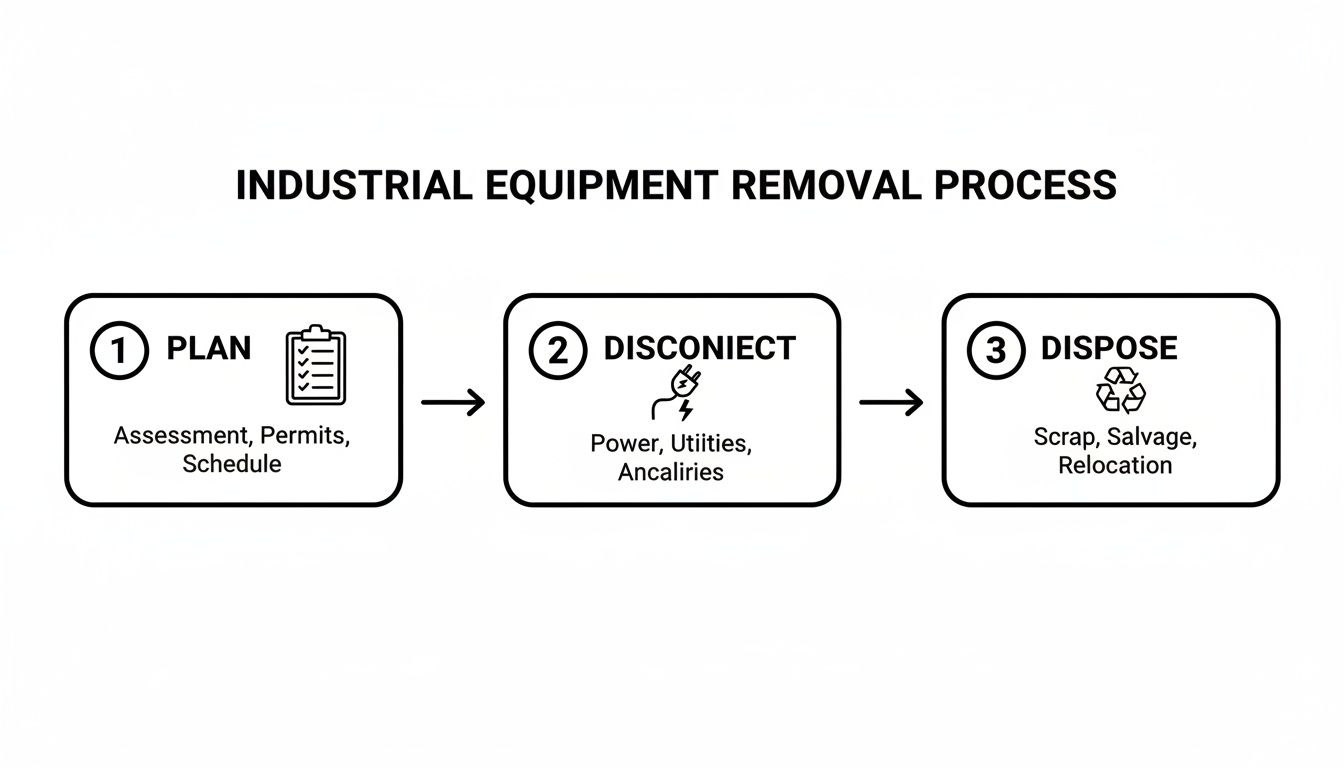
This process highlights a crucial truth: success starts long before a wrench is ever turned and continues well after the last truck has pulled away. You can explore more in-depth articles in our library of comprehensive guides and resources.
From scoping and inventory to logistics and recycling, every step is connected. A simple mistake in the planning phase can create major safety hazards during disconnection or serious compliance headaches during disposal. Following a proven playbook like this is how you turn a potential liability into a smooth, successful project.
Mastering Your Project Scope and Inventory
Any successful industrial equipment removal for factories stands on one critical foundation: a painstakingly detailed project inventory. This isn't just about making a list of the big machines. It's about building a master document—a single source of truth for the entire decommissioning project, whether it's at a local plant or part of a nationwide consolidation.
Believe me, skipping or rushing this initial audit is one of the most common and costly mistakes a facility manager can make. It’s like a builder trying to construct a skyscraper without blueprints. You end up operating blind, unable to accurately estimate costs, schedule crews, or see problems coming.
The only way to do this right is with a thorough site walk-through alongside your removal partner. You have to capture every single detail, from the largest press brake down to the smallest benchtop centrifuge. This audit is your best defense against last-minute surprises and budget overruns.
Conducting the Comprehensive Site Audit
A proper site audit is more of an investigation than a simple headcount. Your goal is to document not just what an item is, but its exact condition, location, dependencies, and any potential hazards that come with it. This is the granular detail that separates a smooth, predictable project from a chaotic mess.
Think about a large industrial oven. It's not just a big metal box. We need to know its power source, identify any connected gas lines, see which ventilation ducts have to be capped, and determine if it's bolted to the floor or welded into a larger assembly. These are the details that directly shape the disconnection and rigging plan.
A solid audit needs to capture several key data points for every single asset:
- Unique Asset ID: A tag or number used for tracking from start to finish.
- Equipment Description: Manufacturer, model, and serial number.
- Physical Location: Building, floor, room number, and its spot on the grid.
- Dimensions & Weight: Absolutely critical for rigging and transport logistics.
- Condition Assessment: Is it functional, non-functional, for parts, or just scrap?
- Utility Connections: All electrical, water, gas, air, and data lines.
- Contamination Status: Note if it was ever used with chemicals or biologicals.
This process is even more critical in specialized settings like labs. If you're dealing with that kind of environment, you can learn more about our specific approach for certified laboratory equipment removal for commercial labs.
Identifying Interdependencies and Hidden Systems
One of the biggest traps in factory removals is missing the ancillary systems. A production line isn't a row of standalone machines; it’s a deeply interconnected ecosystem. If you don't map these dependencies properly, the entire project can come to a grinding halt.
I once worked on a project at a massive food processing plant near Atlanta. The crew was tasked with taking out a huge mixing vat. What they missed during the initial scope was the centralized coolant system that fed that vat and three other active production lines. Disconnecting it prematurely shut down a huge portion of the facility, leading to thousands in unplanned downtime.
This is exactly why a professional assessment is non-negotiable. An experienced team knows to look past the obvious and trace every connected system back to its source.
Commonly Overlooked Systems to Inventory
- Centralized HVAC and Exhaust: Fume hoods and vents are often tied into building-wide networks.
- Compressed Air and Vacuum Lines: These are frequently shared across dozens of machines.
- Coolant and Fluid Distribution: A single reservoir might serve an entire wing of the factory.
- Conveyor and Material Handling Systems: These can snake through walls and across different floors.
Building Your Master Asset List
Once the site audit is done, all this information gets compiled into your master inventory list. This document is the playbook for everything that comes next. The rigging team will use it to plan their lifts, the logistics coordinator will use it to book the right trucks, and the accounting department will use it to track how every asset is handled—whether it's for resale, recycling, or disposal.
A well-organized inventory list, usually in a spreadsheet or database, lets you sort and filter by any criteria. Need a quick list of all equipment with hard drives that require data sanitation? Done. Need to see all assets tagged for scrap metal recycling? Easy. This master list ensures everyone—from the crew on the floor to the C-suite—is working from the same accurate information. That’s the real key to a successful removal project.
Tackling Safety, Decontamination, and Regulations
When you're dealing with industrial equipment removal, compliance isn't just a box to check—it's the foundation of the entire project. One misstep can lead to more than just delays; we're talking about serious fines, worker injuries, and environmental headaches that don't go away. This is exactly why that detailed inventory list we talked about is so critical. It becomes your roadmap for safety and compliance.
Every single asset you’ve tagged for removal needs to be checked against federal, state, and local rules. You’ll mainly be dealing with the big three: OSHA, the EPA, and your local authorities, whose rules can often be even tougher, whether you're in New Jersey or Texas.
Getting Worker and Facility Safety Right
Before anyone even thinks about touching a wrench, worker safety has to be the top priority. Disconnecting heavy industrial gear is a high-stakes game. You’re dealing with high-voltage power, systems under pressure, and potential chemical residues. That’s why a documented lock-out/tag-out (LOTO) procedure is non-negotiable for any piece of equipment with an energy source.
Think about a hydraulic press. It's not enough to just kill the power. The team has to bleed the hydraulic lines to release all that stored energy. If they don't, you risk a catastrophic failure when someone tries to move it. This entire de-energization process must be verified and signed off on before the rigging crew can get anywhere near the machine.
It's absolutely crucial to follow strict electrical safety standards like NFPA 70E before starting any disconnection work. Understanding these guidelines is key to keeping everyone on site safe.
Decontamination for Hazardous and Sensitive Materials
Decontamination is probably the most overlooked part of an equipment removal job. You can't just unplug a machine and haul it out if it’s ever touched hazardous materials. The cleaning process is dictated entirely by what that equipment was used for.
We see these scenarios all the time, in factories across the U.S.:
- Chemical Residue: Lab fume hoods or chemical mixing vats need a deep clean, following specific protocols for the chemicals they handled. This isn't a job for a standard cleaning crew; it often requires HAZMAT-trained specialists.
- Biological Contaminants: In a hospital or biotech setting, equipment like biosafety cabinets has to be professionally sterilized to get rid of any biohazards. This protects every single person who handles the equipment down the line.
- Oils and Coolants: Most heavy machinery uses oils, solvents, and coolants that are classified as hazardous waste. These fluids have to be completely drained and collected for compliant disposal—never just washed down a drain.
Knowing the right steps is essential. To get a better handle on this critical stage, you can dive into our guide on the proper sterilization of equipment to see what best practices look like.
Protecting Data with Certified Sanitization
In this day and age, "equipment" includes a lot of IT assets filled with sensitive data. Servers, computers, and even networked factory controllers can hold everything from company trade secrets to protected patient information. Hitting "delete" is not a solution.
For places like hospitals (bound by HIPAA) or R&D labs, certified data destruction isn't optional; it's a legal must-do. This can't be an afterthought for your IT department. It has to be a planned, documented part of the removal.
The gold standard here is the DoD 5220.22-M 3-pass method. This process overwrites a hard drive's data three separate times, making the original information nearly impossible to get back. For any drive that can't be wiped clean, physical shredding is the only way to go.
Failing to properly sanitize data-bearing devices before they leave your building is a massive liability. One lost hard drive could trigger a data breach, costing millions and destroying your reputation. Always insist on a Certificate of Data Destruction from your removal partner. That paper trail is your proof that you did your due diligence and met your compliance obligations.
The Mechanics of Disconnection, Rigging, and Removal
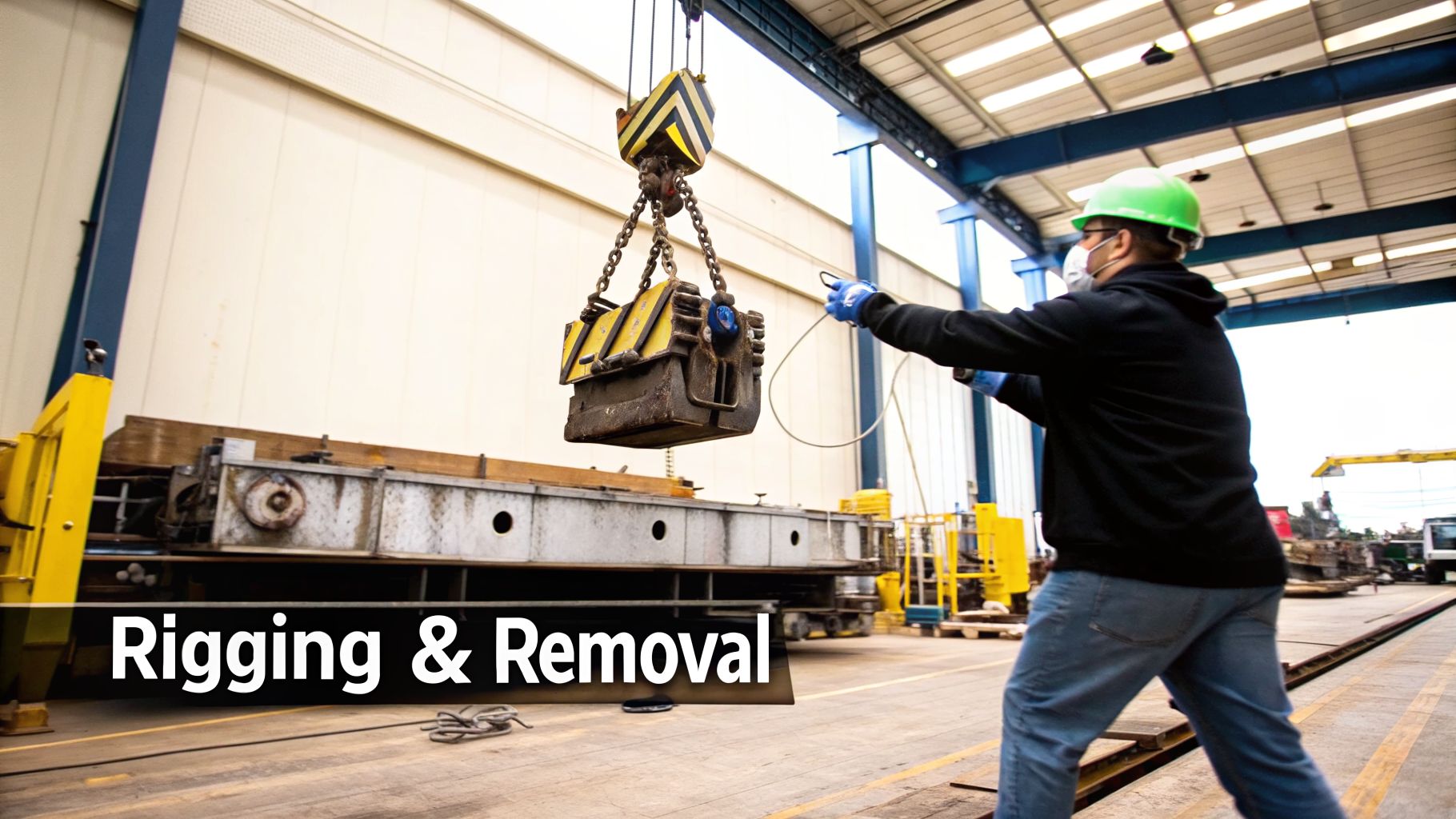
This is where the rubber meets the road. All that careful planning turns into real, physical action. The mechanical phase of industrial equipment removal for factories is where a project’s success is measured in safe, efficient movement. It’s a hands-on process that involves electrical disconnection, mechanical shutdown, and the specialized skill of heavy rigging.
Safety is always the first move. Before a single tool is picked up, every energy source feeding a piece of equipment has to be completely neutralized. We accomplish this with a strict Lock-Out/Tag-Out (LOTO) procedure. A certified technician will isolate the power right at the breaker, slap on a physical lock, and add a tag that clearly states who is working on the system. No mistakes.
This simple step prevents a machine from being accidentally powered up while crews are working—one of the biggest causes of serious accidents in our industry. But we're not just talking about electricity. Hydraulic and pneumatic systems can store a massive amount of potential energy, and they have to be properly depressurized and bled before anyone can safely start disconnecting lines.
The Art and Science of Rigging
Once an asset is confirmed to be fully de-energized and safe to approach, our rigging team steps in. Rigging isn't just about hooking a machine to a crane. It’s a true discipline that mixes physics, engineering, and years of hands-on experience to move incredibly heavy objects through complicated spaces without a hitch.
The team’s first step is to assess the machine’s weight, dimensions, and center of gravity. That data tells them exactly which tools to bring in for the job:
- Cranes and Gantries: For any vertical lifts, especially when we need to pull equipment out through the roof or upper-level access points.
- High-Capacity Forklifts: The workhorses for moving assets across the factory floor.
- Air Skates and Dollies: Our go-to solution for shifting heavy gear through tight corridors or over sensitive flooring where a forklift just won’t work.
Every single movement is mapped out ahead of time. The rigging supervisor plans the entire exit route, from the machine’s original spot all the way to the loading dock. They have to account for every narrow doorway, support column, and floor load limit along the way. One bad calculation can lead to catastrophic damage to the building or the equipment—or worse. This is exactly why you can't substitute professional experience.
Real-World Precision: A Data Center Example
Think about the challenge of removing a multi-ton server array from a live data center. You can't just knock down a wall. Our teams have to work inside cleanroom environments, navigate around raised floors, and deal with low ceilings. The server racks have to be lifted perfectly vertically, set on specialized skates, and carefully maneuvered through a maze of active infrastructure—all without disrupting a single operation.
This kind of job really shows why hiring a professional de-installation crew is an investment, not an expense. The cost of a skilled team is nothing compared to the potential bill from facility damage, lost equipment, or operational downtime caused by an inexperienced crew. You might find our article on choosing a laboratory moving company useful, as it covers many of the same principles of precision and care.
A professional rigging team doesn’t just prevent damage; they optimize the entire removal process. By strategically sequencing lifts and movements, they can dramatically reduce the time it takes to clear a facility, saving both time and labor costs.
The demand for these specialized skills is on the rise. The global Factory Equipment Dismantling Services market is growing, with major expansion expected from 2026 onward. This is partly fueled by a 12% spike in U.S. factory shutdowns in 2024 as companies upgrade technology and reshore operations, creating huge demand for secure de-installation. This expert-led approach is what guarantees a smooth transition from a working factory to a clear, ready-to-use space.
Sustainable Disposal And Asset Value Recovery
Once your equipment is disconnected, rigged, and transported off-site, the job isn’t over. This final phase of your industrial equipment removal for factories project is all about what happens next. It's where you turn potential liabilities into real assets and prove your company’s commitment to environmental responsibility.
This is the critical point where the final fate of every single machine is decided. The choices you make here will directly impact your project's financial return, environmental footprint, and compliance record. The goal is to maximize value while ensuring every item is handled responsibly, whether that means resale, refurbishment, or certified recycling.
Turning Scrap Into Revenue
The idea that old equipment is just junk is a costly mistake. Many materials inside decommissioned industrial assets hold significant commodity value. An experienced removal partner knows exactly how to identify and separate these materials to get the highest possible price on the scrap market.
This isn't about just hauling a mixed load of metal to the nearest scrapyard. It involves a strategic process of dismantling equipment into its core components—ferrous metals, non-ferrous metals like copper and aluminum, and even plastics. Each material stream gets processed and sold on its own, which brings in a much higher return than selling a pile of mixed scrap.
This process has become incredibly sophisticated. The Asia-Pacific region now holds a dominant 51.50% share of the material removal tools market, which hit USD 7.98 billion in 2024. In 2023, for example, Chinese factories managed over 30% of global dismantling projects, recovering millions of tons of scrap that went right back into supply chains. Modern tech like briquetting presses, which can shrink metal-chip volumes by 85%, helps companies earn up to USD 320 per tonne from scrap. It transforms disposal from a cost into a real revenue stream. You can see more on this growing market over at Fortune Business Insights.
Weighing Your Disposal And Recovery Options
Not everything is destined for the scrap heap. You have a whole spectrum of options, and the right one depends on the equipment's age, condition, and current market demand. A smart asset recovery strategy means evaluating each machine to find its most valuable and responsible end-of-life path.
Here’s a quick breakdown of the most common routes:
- Resale: For functional, in-demand equipment, selling it on the secondary market gives you the highest potential return. This involves assessing its market value, finding a buyer, and handling all the logistics.
- Refurbishment: Some machines might be worth a lot more after some minor repairs or upgrades. This path can seriously increase the resale value, but it does require an upfront investment.
- Cannibalization for Parts: If a machine is obsolete but has valuable working components inside, harvesting those parts can be more profitable than scrapping the whole unit.
- Certified Recycling: For equipment that’s broken or has no resale market, certified recycling is the only responsible choice. This guarantees materials are properly processed and kept out of landfills.
A key service a professional partner provides is helping you make these decisions. They have the market knowledge to identify which assets are worth selling and the infrastructure to manage the recycling of everything else, creating a blended strategy that maximizes your financial and environmental goals.
The Critical Role Of Certified Recycling And Documentation
Partnering with a certified e-waste and industrial equipment recycler is non-negotiable if you want to stay compliant. Certifications like R2 (Responsible Recycling) and e-Stewards are your proof that the vendor follows strict environmental standards and data security protocols. This is especially important for electronics and equipment containing circuit boards, which are often classified as universal waste. For a closer look at this topic, our guide on corporate e-waste solutions offers more detail.
This partnership is about more than just avoiding landfills. It's about protecting your organization with a solid, unbroken chain of custody.
When the project is finished, you should receive final documents that close the loop. This paperwork should include:
- A Certificate of Recycling/Disposal: This is your legal proof that your assets were managed in full compliance with all EPA and local regulations.
- A final reconciliation report: This report details the final outcome for every asset from your initial inventory list, showing whether it was resold, recycled, or disposed of.
- Data Destruction Certificates: For any IT assets, this confirms all data was verifiably sanitized or destroyed, protecting you from any future liability.
This final package of documents is your proof of due diligence. It shows that your industrial equipment removal for factories was handled professionally, sustainably, and legally, turning a complex operational headache into a documented corporate success.
Common Questions About Industrial Equipment Removal
Even with the best playbook, a few questions always pop up during a complex industrial equipment removal for factories. Whether you need local service in Atlanta or a coordinated nationwide effort, we find that facility managers, IT directors, and operations leads tend to run into the same concerns. We've gathered the most common questions we hear to give you clear, straight-up answers and help you move forward with confidence.
How Long Does a Typical Factory Equipment Removal Project Take?
There's no single answer here—the timeline depends entirely on the size and complexity of your project.
For example, clearing out a small, self-contained lab with a few dozen pieces of benchtop equipment might only take a couple of days. But a full-scale factory decommissioning? One that involves multiple production lines, massive machinery, and serious decontamination work could easily take several weeks, if not months.
A few key things will dictate your project's timeline:
- Facility Size and Layout: The bigger and more complicated the building, the more time it takes to get in, navigate, and pull equipment out.
- Quantity and Type of Equipment: A high volume of assets or oversized machinery will naturally add to the schedule.
- Decontamination Requirements: If equipment needs to be meticulously cleaned of chemical or biological materials, that adds significant time for safety and compliance.
- Building Access and Egress: Limited access points, tight hallways, or needing to crane assets out through the roof will definitely slow things down.
A realistic schedule only comes after a thorough on-site walk-through. A professional partner with nationwide capabilities can work with your team to build a timeline that minimizes disruption and keeps things moving efficiently across all your sites.
What Are the Biggest Hidden Costs in Equipment Removal?
Unexpected costs almost always boil down to one thing: not enough planning. These expensive surprises can blow up a budget if you're not ready for them.
The most common hidden costs we see facility managers face are:
- Regulatory Fines: Usually from improperly disposing of e-waste or equipment that contains hazardous materials.
- Facility Damage: This happens when amateur riggers damage floors, walls, doorways, or loading docks trying to move heavy gear.
- Data Breach Liabilities: A huge risk that comes from unsecured IT assets and failing to get certified data destruction.
- Hazardous Waste Disposal Fees: It's easy to overlook the costs tied to managing things like oils, coolants, and chemical residues.
The best defense against these hidden costs is working with an experienced vendor. A professional service gives you transparent, upfront pricing that covers all the logistics, labor, recycling, and compliance paperwork for both local and nationwide projects. This approach kills budget overruns and makes sure there are no nasty surprises down the line.
Can I Sell My Old Industrial Equipment Instead of Recycling It?
Absolutely. Selling off functional, well-maintained equipment is a great way to recover value from your decommissioned assets. It all comes down to the equipment's age, condition, and what the current demand looks like on the secondary market. A newer CNC machine is obviously going to have more resale potential than a 30-year-old proprietary press.
But trying to manage the resale process on your own can be a massive time sink. You have to figure out market values, find real buyers, negotiate pricing, and then deal with all the logistics and shipping.
For most companies, a hybrid approach is the smartest move.
A professional removal partner can assess your entire inventory and pinpoint the specific assets with strong resale value. They can handle the sale of those items while ensuring everything else is recycled or disposed of in full compliance. This strategy maximizes your financial return and turns a logistical headache into a financial positive.
What Documentation Should I Expect from a Removal Service?
Think of comprehensive documentation as your legal shield. This paper trail is your official proof that you followed every procedure and handled every single asset responsibly, from start to finish.
When any industrial equipment removal for factories project wraps up, you need a complete documentation package. Make sure you get the following:
- Certificate of Data Destruction: For any device with a hard drive or memory, this certificate confirms all data was securely wiped using a recognized standard (like DoD 5220.22-M) or physically destroyed.
- Certificate of Recycling or Disposal: This is your proof that all non-sellable assets were handled according to federal, state, and local environmental laws, keeping waste out of landfills.
- Detailed Asset Report: This is a final reconciliation of your original inventory. It should show the end-of-life path for every item—whether it was sold, recycled, or disposed of.
This chain-of-custody documentation is non-negotiable for internal audits and proves your company is committed to due diligence and corporate responsibility.
Planning your next equipment removal project? Let Scientific Equipment Disposal handle the complexities for you. We offer expert on-site de-installation, secure data destruction, and certified recycling services for factories, labs, and data centers locally in the Atlanta area and nationwide. Visit us online to get a quote and simplify your next decommissioning project.