How to Dispose of Factory Equipment Safely: A Nationwide & Local Guide

When the time comes to clear out old factory or lab equipment, it's easy to think of it as just another junk removal job. But as any facility manager knows, from Atlanta to Austin, it’s a whole different ballgame. We're talking about a complex process governed by a web of environmental regulations, data security laws, and strict safety standards. One misstep can lead to staggering fines, a damaging data breach, or long-term environmental liability.
The key is to approach it methodically. You need to categorize every single asset for potential resale, recycling, or specialized disposal. Then, you find a certified partner who can manage the entire process—whether locally or across the country—and provide a complete chain of custody. This isn't just about getting rid of stuff; it's about protecting your organization.
Starting Your Equipment Disposal Project
Before you can figure out how to safely get rid of your factory equipment, you have to know exactly what you have. The entire project hinges on a detailed inventory and a clear-eyed assessment. This initial legwork turns a potentially chaotic cleanout into a manageable, compliant project, no matter your location.
First Things First: Build Your Asset Inventory
Alright, time to grab a tablet or a clipboard and walk the floor. You need to create a master list of every piece of equipment on the disposal list. This isn't just a simple headcount; you're gathering critical data that will inform every decision you make later.
For each machine, be sure to document:
- Asset Type and Model: Is it a hefty CNC machine, a delicate laboratory centrifuge, or a rack of servers?
- Serial Number: This is non-negotiable for tracking and creating a paper trail.
- Physical Condition: Be honest. Is it working, could it be repaired, or is it strictly parts-only?
- Location: Note the building, floor, and room. This will be a lifesaver for the logistics team.
- Data Storage: Does it have a hard drive, a memory card, or any other device that holds information? This is a huge one.
A well-organized inventory is the absolute cornerstone of a compliant and cost-effective disposal strategy. It ensures no asset—and no hidden risk—gets overlooked.
Assess and Categorize for Disposal
With your inventory in hand, it's time for triage. This is where you evaluate each item and assign it to the right disposal pathway. It's also where you start building a strategy that's both compliant and financially smart.
The scale of mishandled equipment is shocking. A recent report from the United Nations estimates a staggering 10 billion kg of large equipment goes undocumented every year, even though it's often more recyclable than smaller electronics. The used lab equipment market alone is worth around $2 billion, yet countless valuable assets end up as scrap.
Nationwide, we see it all the time: servers, fume hoods, and industrial machinery sitting in storage, collecting dust and posing a real risk for data breaches or compliance violations.
This simple workflow is how we recommend approaching this crucial first stage.
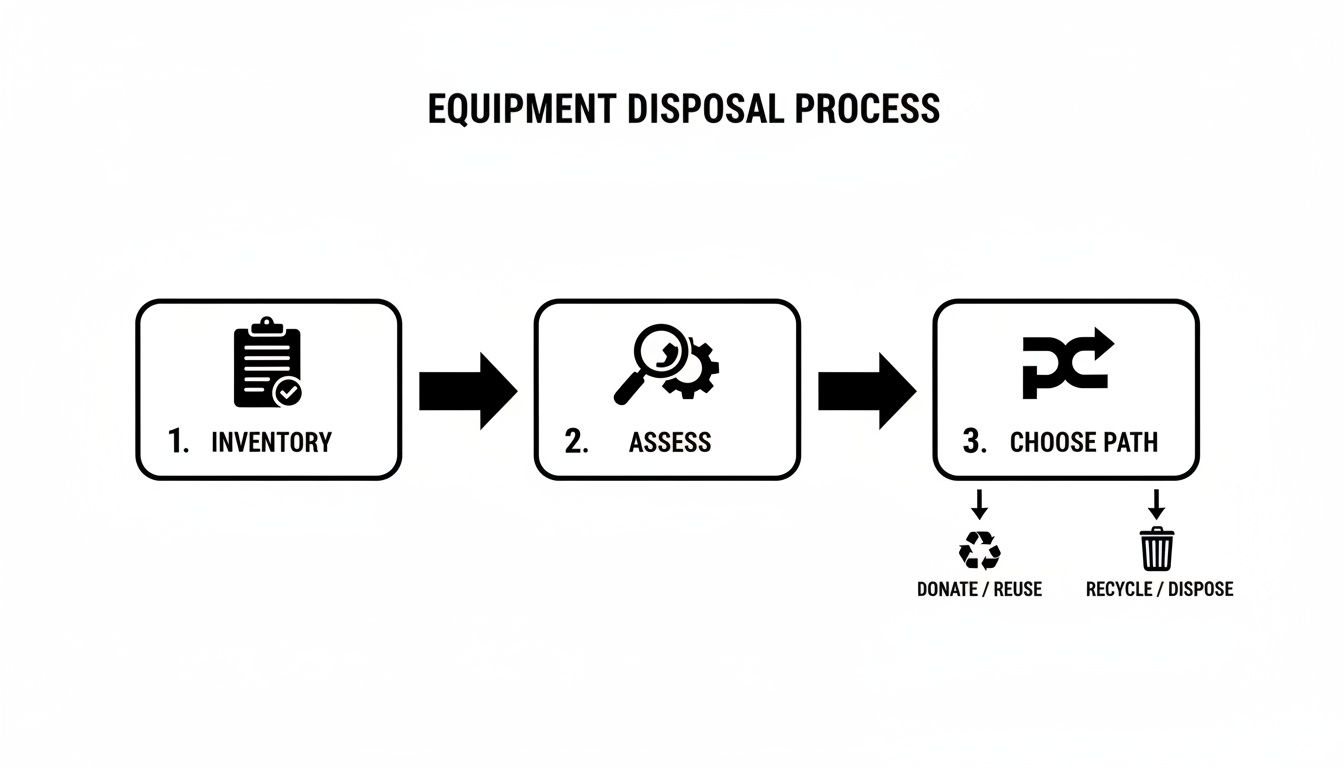
The flowchart breaks it down into a simple three-part approach: document what you have, assess its condition and value, and then choose the right path forward.
To help with that decision, here's a quick reference table.
Quick Guide to Equipment Disposal Pathways
Use this table to quickly assess your equipment and identify the most appropriate and compliant disposal strategy.
| Equipment Condition | Recommended Disposal Path | Primary Action Needed | Example Equipment |
|---|---|---|---|
| Functional & In-Demand | Resale / Remarketing | Professional appraisal, secure data destruction, and consignment. | Newer CNC machines, specialized lab analyzers, server racks. |
| Functional but Obsolete | Donation / Reuse | Identify non-profits or educational institutions; ensure data is wiped. | Older but working computers, basic test equipment, office furniture. |
| Repairable | Refurbishment | Assess repair costs vs. resale value; partner with a refurbisher. | Industrial motors with worn parts, centrifuges needing service. |
| Non-Functional / Scrap | Certified Recycling | Ensure e-waste certification (R2/e-Stewards); material segregation. | Broken monitors, irreparable machinery, obsolete electronics. |
| Hazardous Materials Present | Specialized Disposal | Decontamination, partner with a licensed hazardous waste vendor. | Equipment with mercury switches, asbestos, or chemical residue. |
This assessment phase is critical. By taking the time to properly categorize everything, you can maximize your return, stay compliant, and handle the entire project with confidence.
You can also read about our specific approach to industrial equipment removal for factories. Taking the time for this initial assessment ensures you can choose the right path for every asset, maximizing value and minimizing risk from the very beginning.
Managing On-Site Hazards Before Equipment Removal

So you've got your inventory list. Great. Now comes the part where safety becomes the absolute priority. Factory and lab machinery are rarely just metal and wires; they're often full of residual chemicals, biological matter, or even dangerous stored energy. Tackling these risks isn’t just a good idea—it’s a non-negotiable step for a safe and compliant disposal project, whether you are in California or North Carolina.
These hidden hazards are a real threat to your team, the removal crew, and the environment. Proper decommissioning means following a strict playbook to neutralize these dangers before a single piece of equipment gets moved. This is how you stay on the right side of both OSHA and the EPA.
Identifying Chemical and Biological Hazards
The first challenge is figuring out exactly what you're up against. That factory press might be holding hydraulic fluids and lubricants, while a lab centrifuge could have trace biological material. Each demands a completely different decontamination plan.
You'll need to dig into equipment logs and Safety Data Sheets (SDS) and, just as importantly, talk to the people who actually ran the machines. They know what went in them. Zero in on any equipment that handled corrosive, toxic, or flammable substances. In a lab, this means looking hard at biosafety cabinets, fume hoods, and any analytical gear that processed hazardous compounds. You can learn more by reviewing our guide on understanding the common toxic hazard signs you might encounter.
Think about a gas chromatograph. You can't just unplug it and call it a day. You have to professionally purge the gas lines and safely pull any chemical columns. Skipping that step could cause a dangerous release during transport.
Protocols for Decontamination and Neutralization
Once you know what the hazards are, you need a specific plan to deal with them. This is not a one-size-fits-all job. The decontamination method has to be tailored to both the contaminant and the machine.
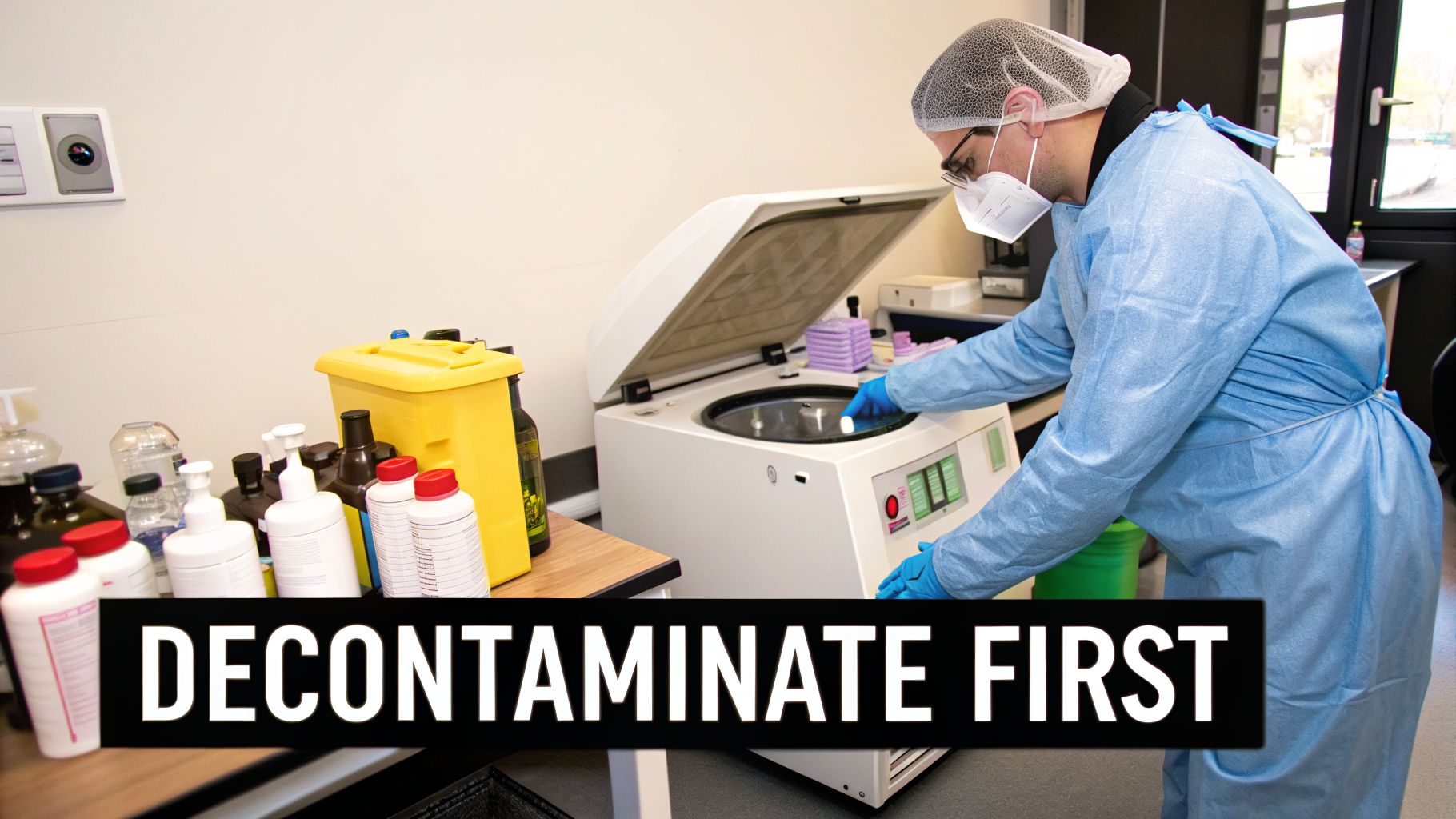
- Chemical Decontamination: This usually involves flushing lines with a neutralizing agent, triple-rinsing any containers, and meticulously wiping down every surface. For a big metal press, it means draining all the hydraulic fluid and cleaning off years of grease.
- Biological Sterilization: For lab equipment like incubators or biosafety cabinets, a full sterilization cycle is mandatory. This often means using an autoclave, ethylene oxide gas, or a validated chemical disinfectant to kill off any biological risk.
- Stored Energy Discharge: Lots of equipment holds a charge even when it's off. Large capacitors in power supplies can store a lethal amount of energy and must be safely discharged by a qualified technician before anyone lays a hand on them.
A centrifuge that only spun inert samples might just need a good wipe-down. But one from a BSL-2 lab in a research facility? That requires a documented, multi-step sterilization process to meet federal and local health codes. Getting this detail right is crucial.
Ensuring Worker Safety and Compliance
Throughout this whole process, your team's safety is everything. OSHA is very clear: everyone involved in decommissioning needs the right Personal Protective Equipment (PPE). That could be as simple as gloves and safety glasses or as serious as full-face respirators and chemical-resistant suits, all depending on the hazards you've identified.
When you're dealing with the removal of large or complex machinery, having the right heavy equipment insurance is a critical backstop. It protects you from liability in case of unforeseen accidents or damage during the de-installation and removal. It's a key piece of your risk management strategy.
Ultimately, managing these on-site hazards is foundational. If you’re asking how to dispose of factory equipment safely, this is where you start. By methodically identifying, neutralizing, and documenting every step, you create a secure environment for removal and ensure you meet all your regulatory obligations, whether you're in Atlanta, GA or anywhere else in the U.S.
Protecting Your Data and Your Reputation
Let's be blunt: a single hard drive from a lab bench or factory controller can turn into a million-dollar problem if it falls into the wrong hands. Data security isn't just an IT issue; it's a critical part of any equipment disposal project. We're not only talking about computers, either. Think about the sensitive information stored on industrial controllers, medical devices, and analytical instruments.
A lot of people think hitting "delete" or reformatting a drive is enough. It's not. All that does is remove the signpost pointing to the data, leaving the information itself behind and easily recoverable. To truly protect your organization and stay compliant with national laws like HIPAA, GLBA, and FACTA, you need professional, certified data destruction.
Your Options for Data Destruction
When you need to dispose of factory equipment safely, choosing the right technique is everything. The best method really depends on the storage media, its condition, and the level of security your organization requires.
We see it all, and here are the three go-to methods for making sure data is gone for good:
- Data Wiping (Sanitization): We use specialized software to overwrite a drive with random data, usually in several passes. This completely erases the original information. It's the perfect choice for functional hard drives you might want to reuse or resell.
- Degaussing: This is a powerful one. We use a high-powered magnetic field to instantly scramble the magnetic structure of hard drives and tapes. The process renders the drive totally useless and the data is destroyed forever.
- Physical Shredding: For the highest level of security, or for drives that are already dead, nothing beats physical destruction. We feed the drive into an industrial shredder that grinds it into tiny metal fragments. There's no coming back from that.
The DoD Standard: A Benchmark for Security
For any organization we work with that handles sensitive information—from hospitals and R&D labs nationwide—the DoD 5220.22-M 3-pass sanitization standard is our benchmark. It's the same protocol trusted by federal agencies.
The process involves overwriting the data three separate times: first with a specific character, then its opposite, and finally with random characters. It’s a bulletproof method that ensures even the most advanced recovery attempts will come up empty. When we offer DoD-compliant wiping, it means we’re using one of the most defensible data destruction protocols out there. You can get more details on how we handle this in our overview of secure data destruction services.
Choosing the right method is a risk management decision. For a hospital retiring a diagnostic machine with patient data, physical shredding is often the only way to meet HIPAA rules. For a factory decommissioning a CNC machine, a certified data wipe might be all you need.
The Paper Trail That Protects You
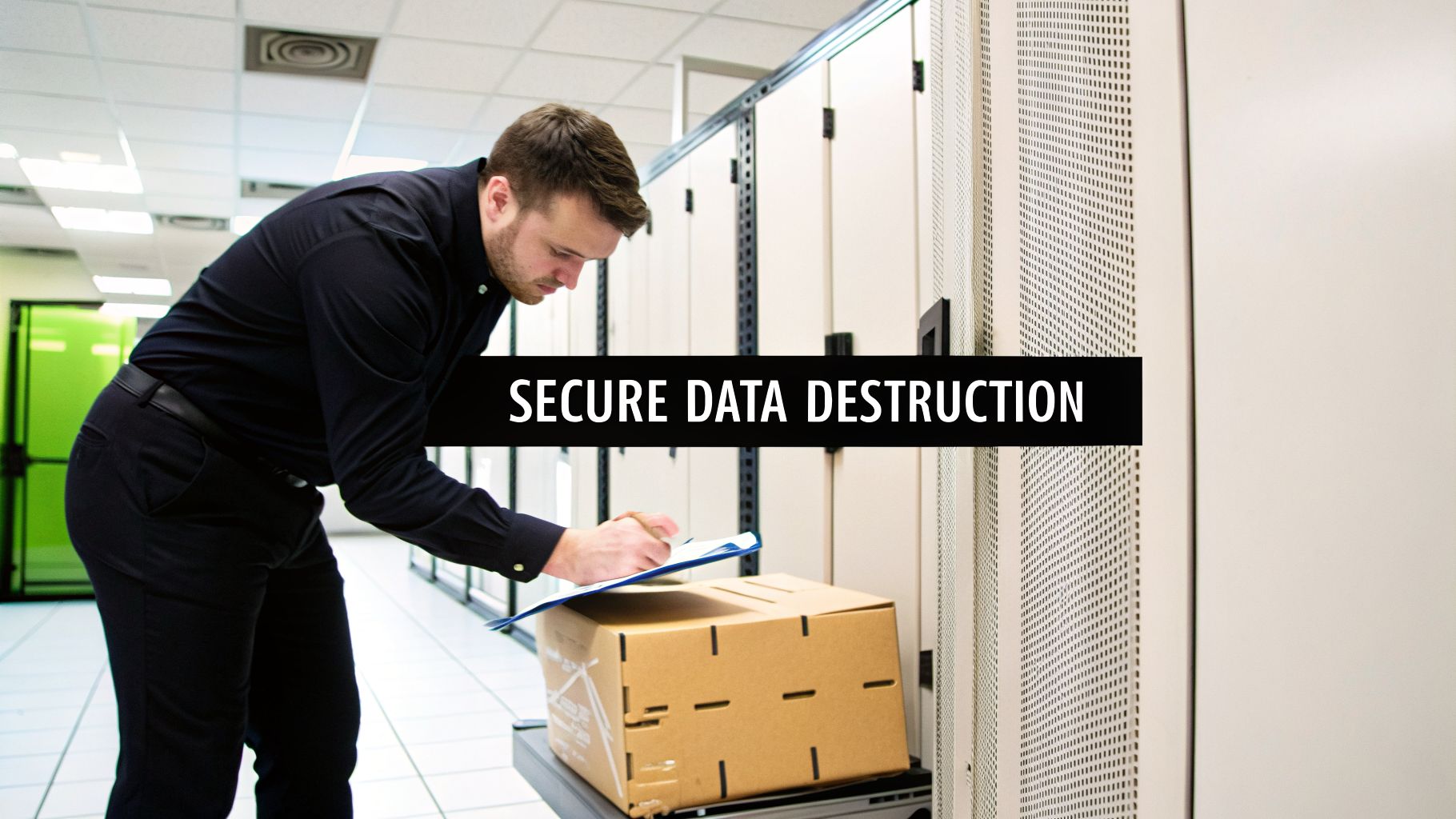
Proof is just as important as the process. That's why a Chain of Custody document is non-negotiable. This document is your formal record, tracking every single data-bearing device from the moment it leaves your facility to its certified destruction.
A rock-solid Chain of Custody must include:
- An on-site inventory of all devices, complete with serial numbers.
- Confirmation of secure transport in a locked, tracked vehicle.
- A record of when items arrived at the secure facility.
- The final Certificate of Destruction, which is a signed document confirming the date, method, and serial numbers of all destroyed media.
This audit trail is your legal proof of due diligence. It’s your best defense against any future claims of a data breach or regulatory trouble.
Finding the Right Disposal Partner Nationwide
After you've done all the internal prep work—the inventory, decontamination, and data security planning—you’re left with what is arguably the most critical choice of the entire project: picking your disposal partner. This is where the rubber meets the road.
A truly qualified, certified partner doesn't just show up and haul stuff away. They take on the liability, guarantee compliance, and make sure every single piece of equipment is managed responsibly from start to finish.
This is a huge deal for businesses everywhere, as the mix of manufacturing, biotech, and tech creates some seriously complex disposal needs. Whether you're shutting down one local facility or coordinating a cleanout across the country, your vetting process has to be rock-solid.
Specialized Partner vs. a General Scrap Hauler
It can be tempting to just call a standard scrap metal hauler for a quick pickup. I’ve seen it happen, and it’s almost always a mistake when you’re dealing with regulated factory, lab, or IT assets.
The difference in service, security, and accountability between a general hauler and a specialized B2B disposal partner is night and day.
A scrap hauler’s job is to get the most money from recyclable metals. That’s their focus. Their process rarely includes the detailed tracking, certified data destruction, or environmental compliance paperwork your organization needs to prove you did your due diligence. Once your equipment is off the dock, you often lose all visibility and control, opening yourself up to some major risks.
A specialized B2B partner, on the other hand, operates from a completely different mindset. Their entire business is built on managing your risk. They know the ins and outs of how to dispose of factory equipment safely and are set up to handle it all—from on-site de-installation and secure logistics to providing the auditable documentation that protects you down the road.
Think of it this way: a scrap hauler buys your metal, but a certified disposal partner manages your risk. For any organization worried about compliance, the choice is pretty clear.
The Essential Vetting Checklist
When you start evaluating potential partners, don't let the conversation stop at the price. You need to demand proof of their qualifications. Any real professional will have this information on hand and will welcome the chance to show you they’re legitimate.
Your checklist should include these non-negotiables:
- R2v3 or e-Stewards Certification: These are the gold standards for electronics recycling. They're your proof that a vendor meets the highest environmental and data security practices. E-Stewards, for instance, has a strict policy against exporting hazardous e-waste.
- Proof of Insurance: Ask to see their Certificate of Insurance. Look for general liability, pollution liability, and workers' comp. This protects you from any on-site accidents or environmental problems that might pop up.
- Chain of Custody Process: They have to walk you through their process for creating a complete Chain of Custody. How do they scan serial numbers on-site? What does the final Certificate of Destruction look like?
- Logistics and Fleet Capabilities: Do they run their own fleet of trucks? A dedicated logistics team is essential for handling complex projects, especially if you’re cleaning out multiple sites or have heavy machinery to move.
Nationwide Service With a Local Focus
For companies with a national footprint, consistency is everything. A corporate shutdown with facilities in multiple states demands a partner who can deliver the exact same high standard of service everywhere.
This is where a national provider with a strong local presence—like our hubs serving major metros—really shines. They offer the best of both worlds.
You get the sophisticated systems, deep expertise, and regulatory know-how of a big operator, but with the hands-on service and logistical flexibility of a local team. For facilities anywhere in the country, that means you get responsive, on-the-ground support that’s backed by a national compliance framework. A qualified e-waste recycling company can provide exactly this blend of local service and national capability.
This combination is invaluable. It streamlines a complex project and ensures you have a smooth, secure, and defensible process, no matter where your equipment is located.
When you're clearing out old equipment, it’s not just about making room. It's about making smart, sustainable choices that help your bottom line and demonstrate your commitment to the environment. The modern way to handle asset disposition is to divert every possible ounce of material from the landfill, turning what used to be junk into a real resource.
This sustainable approach is the core of how we handle factory and lab equipment disposal safely. It's a simple but powerful hierarchy: first, we look for any chance to reuse or refurbish. For everything else, we turn to certified, responsible recycling. This isn't just a trend; it's the foundation of a circular economy.
Finding a Second Life Through Reuse and Resale
Before you write off a piece of equipment as scrap, it’s worth taking a second look. You’d be surprised how much functional, even if outdated, equipment still has significant value on the secondary market. The first goal should always be to find it a new home where it can continue to be productive.
Specialized partners and platforms exist specifically to connect your surplus assets with other organizations that can put them to good use. For instance, functional lab instruments can be donated to programs like Seeding Labs, which equips researchers in under-resourced communities. Not only does this support a great cause, but it also creates a powerful story for your corporate social responsibility (CSR) reports.
Here’s a quick checklist to see if your equipment has potential for resale or donation:
- Functionality: Is the unit in good working condition, or could it be repaired without a major investment?
- Completeness: Do you have all the essential parts, power cords, accessories, and manuals?
- Market Demand: Is there an active secondary market for this model or type of equipment?
Giving your equipment a second life through reuse is the single most sustainable choice you can make. It saves all the energy and raw materials needed to manufacture a new item from scratch and directly supports a circular economy.
This strategy keeps valuable machinery out of the scrap heap and reduces the overall demand for new manufacturing. It also aligns with broader industrial trends, like those discussed in the Sustainability and Green Aspects of 3D Printing, which show a clear industry-wide shift toward more eco-friendly practices.
The Power of Certified Recycling and Urban Mining
So, what do you do with equipment that is truly at the end of its road? For assets that are obsolete, broken beyond repair, or simply non-functional, certified recycling is the only responsible path forward. This goes way beyond just scrapping for metal—it’s a meticulous process we often refer to as "urban mining."
Expert recyclers de-manufacture complex machinery and electronics down to their core materials. They carefully sort and separate everything into clean streams of commodities like steel, aluminum, copper, plastics, and glass. These recovered materials are then sold back into the global supply chain, drastically cutting down the need to mine for virgin resources. You can learn more about how we handle recycling services in the Atlanta area and in other cities nationwide.
This process is absolutely critical. In 2019 alone, the world generated a staggering 53.6 million metric tons of e-waste, but only a tiny 17.4% of that was properly collected and recycled. With these numbers climbing, improper disposal releases dangerous toxins like lead and mercury into the environment—a major compliance risk for businesses that have to answer to strict EPA regulations across the U.S.
Committing to a Zero-Landfill Policy
Working with a disposal partner who operates on a strict zero-landfill policy is one of the most impactful decisions you can make. This commitment means your partner will exhaust every available reuse and recycling option before ever even considering a landfill as a last resort. It's your guarantee that your company's sustainability values are being followed through the entire process.
Choosing a vendor with this core philosophy also strengthens your brand. It’s a clear signal to your customers, employees, and community that you are serious about your environmental duties. Ultimately, it’s a key part of hitting your CSR goals and showing a real, tangible commitment to a cleaner future.
Common Questions About Factory and Lab Equipment Disposal
Even the most buttoned-up disposal plan can hit a few snags. Questions always come up, and when you’re dealing with heavy machinery or sensitive lab instruments, you need answers you can trust.
As a team that manages these projects daily for facilities nationwide, we've heard it all. Here are the most common questions we get, with the kind of straightforward advice we give our own clients.
What Kind of Documentation Proves We Handled Disposal Correctly?
This is probably the most critical question you can ask. The answer isn't a single piece of paper, but a complete documentation package that proves you did everything by the book. Any reputable, certified vendor is obligated to provide this—it’s your shield against any future compliance headaches.
Your file should have three non-negotiable items:
- A Certificate of Disposal/Recycling: This is the official document confirming your assets were handled in an environmentally sound way, following all federal, state, and local laws.
- A Certificate of Data Destruction: If a device held data, this is mandatory. It must list the serial numbers of the sanitized media and state the exact method used, whether that was a DoD 5220.22-M wipe, degaussing, or physical shredding.
- A Full Chain of Custody Record: This logbook tracks your equipment from the second it leaves your dock to its final destination. It's an unbroken timeline proving nothing was lost or diverted along the way.
Think of this paper trail as more than just a formality. It’s a core part of your risk management. If an auditor ever comes knocking, this documentation is your definitive proof of responsible action.
How Much Does It Cost to Dispose of Industrial Equipment?
There’s no simple price list for equipment disposal—the final cost can vary dramatically. Anyone who gives you a flat rate over the phone without asking questions isn't getting the full picture. A custom, itemized quote is the only way to go.
The price tag really comes down to a few key things:
- Equipment Type and Volume: A pallet of old computers is a world away from a 10-ton industrial press. The complexity, size, and weight are huge cost drivers.
- Logistics: Where is the equipment located? Does it require specialized rigging to get it out of the building? How far does it need to be transported? These on-the-ground factors matter.
- Hazardous Materials: If equipment needs on-site decontamination or contains hazardous waste, expect the costs to be higher. That work requires specialized handling and a ton of compliance oversight.
- Data Security Needs: While some vendors might offer a "free" pickup for high-value IT gear, certified data destruction for a large batch of hard drives will always be a separate, and critical, line item.
Instead of seeing it as an expense, think of compliant disposal as an investment in avoiding risk. The cost of hiring a professional is a tiny fraction of the fines, brand damage, or legal battles that come from a data breach or an EPA violation.
Can We Donate Old Equipment to a School or Charity?
Donating functional equipment is a fantastic way to support the community, and we're all for it. But it has to be done with extreme care. A good deed doesn't release you from your legal responsibility, especially when it comes to data.
Before a single piece of equipment is handed over, you have to be 100% certain it's wiped clean of any and all sensitive data. Your organization is still on the hook for any information left on a donated server, computer, or medical device. Just hitting "delete" is nowhere near enough and puts both you and the recipient at massive risk.
The right way to donate is to perform certified data destruction first. A professional partner can wipe all drives to government standards, give you a Certificate of Data Destruction for your records, and then help you facilitate the donation. It's the only way to give back without opening yourself up to a huge liability.
What Is the Difference Between R2 and E-Stewards Certification?
Seeing either R2 (Responsible Recycling) or e-Stewards on a vendor’s website is a great sign. Both are the top-tier, third-party certifications in the electronics recycling world. Choosing a partner with either credential is a massive step up from using an uncertified recycler and shows you’re serious about doing things right.
The main difference comes down to their rules on exporting electronic waste.
- e-Stewards: This certification has a strict, all-encompassing ban on exporting hazardous e-waste from developed countries (like the U.S.) to developing ones. It's built on the principles of the Basel Convention and is generally seen as the most stringent environmental standard.
- R2 (currently R2v3): This standard allows for the export of tested, working equipment and certain non-hazardous materials. However, they can only be sent to downstream partners that have also been audited and certified to meet R2’s own rigorous standards.
For any lab or factory, partnering with a vendor that holds either certification is one of the best moves you can make to guarantee your equipment is handled safely and ethically.
Planning a lab cleanout or decommissioning a factory? Scientific Equipment Disposal provides comprehensive, compliant disposal and recycling services for businesses nationwide. We handle everything from on-site de-installation and secure transport to certified data destruction and responsible recycling, giving you a single, reliable partner for your entire project. Visit us at https://www.scientificequipmentdisposal.com to learn more and schedule your pickup.