Hospital Equipment Cleanout Services Your Complete Guide

When a hospital or medical facility needs to get rid of outdated, broken, or surplus equipment, it's not a simple disposal job. These hospital equipment cleanout services are specialized solutions built to manage the entire project from start to finish—from the moment a machine is unplugged to its final, documented recycling. Whether you need services nationwide or locally in cities like Atlanta, this guide covers what you need to know.
Your Guide To A Seamless Hospital Equipment Cleanout
Decommissioning medical equipment is a high-stakes project. It’s a world away from a standard office cleanout. Whether you’re overhauling an entire wing, upgrading diagnostic tools, or clearing a shuttered lab, this guide is your roadmap to getting it done right.
We get it. We've seen firsthand the challenges that hospital administrators and IT directors face. You're juggling strict HIPAA and EPA regulations while guaranteeing every bit of protected health information (PHI) is completely destroyed. A single hard drive mishandled can spiral into massive compliance fines and damage to your reputation.
Why A Specialized Service Is Essential
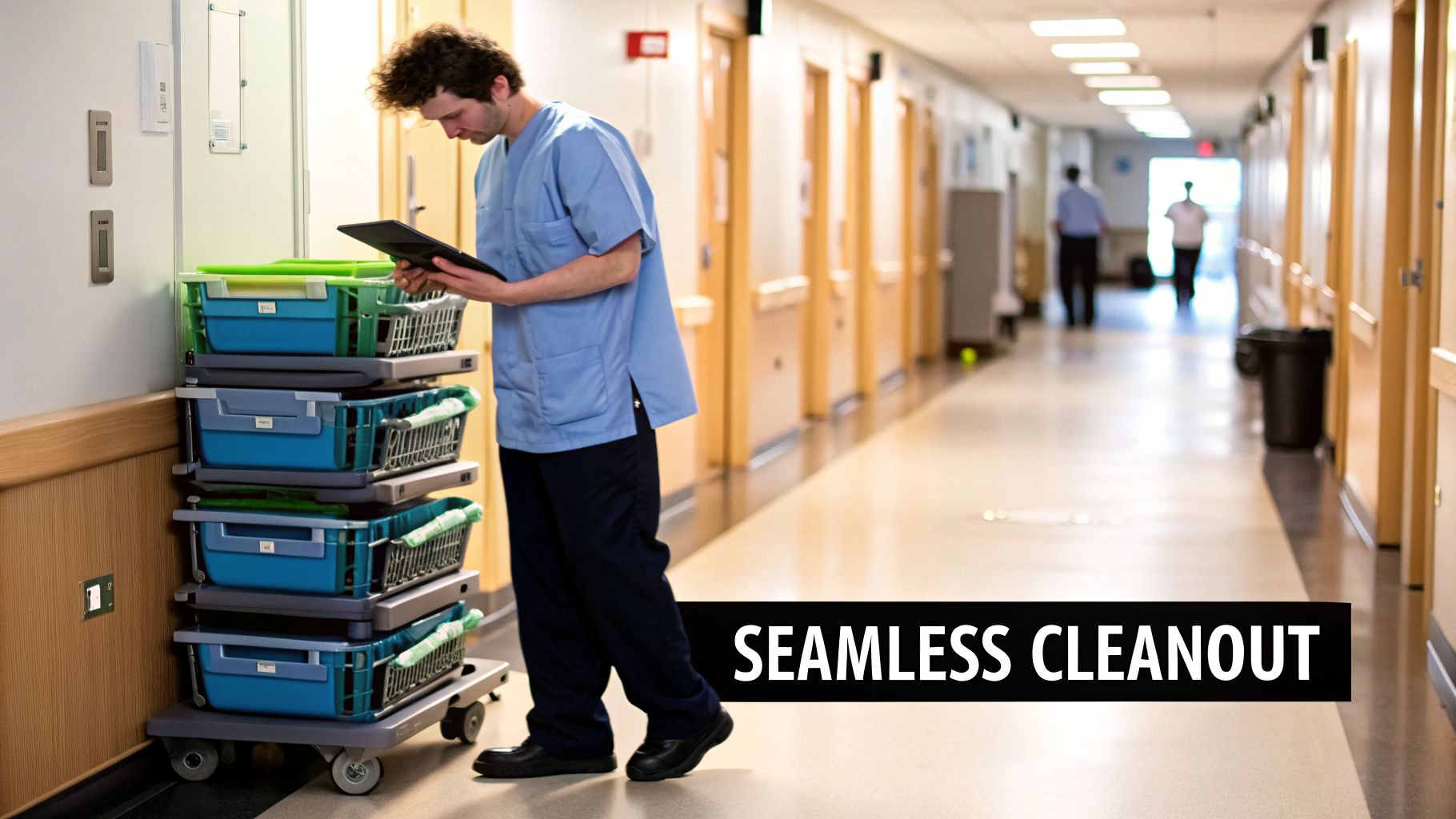
Think about the sheer logistics of moving an old MRI machine or a dozen heavy lab centrifuges through active hospital corridors without disrupting patient care. It's a massive puzzle. A professional service comes in with the experience and precision to plan and execute the removal seamlessly, whether you're in New York City or a small town in Georgia.
This guide will walk you through the whole process, from creating that first equipment inventory list to receiving the final compliance paperwork that proves the job was done correctly. Our goal is to take what feels like a daunting, complex task and turn it into a successful, buttoned-up project.
- Mitigate Compliance Risks: We ensure every step adheres to federal and state rules, including HIPAA and EPA guidelines, so you can avoid those costly penalties.
- Ensure Data Security: All patient data is irretrievably destroyed using certified methods before any equipment ever leaves your facility.
- Improve Operational Efficiency: An experienced crew that knows how to work in a medical environment minimizes disruption to your staff and, most importantly, your patients.
- Promote Sustainability: We focus on maximizing the recycling of old assets, helping your facility hit its environmental targets and keeping tons of e-waste out of landfills.
A common mistake we see is underestimating the scope. A facility manager thinks they can tackle a cleanout with their internal team, only to find themselves completely overwhelmed by the volume of equipment and the absolute necessity of compliant data destruction.
Nationwide Reach And Local Expertise
Whether you're a multi-state health system needing a partner with a nationwide logistics network or a single clinic in Atlanta decommissioning a lab, the core principles don't change. The right partner has seen it all and knows how to handle everything from delicate lab instruments to entire server rooms filled with patient data. They provide nationwide coverage with the feel of a local service.
Ultimately, choosing a specialized provider is about mitigating risk, ensuring sustainability, and getting a documented, defensible, and successful cleanout. They provide the structure, the certifications, and the peace of mind you need.
Building Your Hospital Equipment Cleanout Blueprint
A successful hospital equipment cleanout doesn’t start when the truck arrives. It starts with a solid plan. The biggest mistake we see facilities make is diving in without one, and that’s a recipe for blown budgets, operational chaos, and serious compliance headaches.
Think of this plan as your project blueprint. It's the most important thing you can do to get a predictable, secure, and smooth result. It turns a mountain of outdated assets into a manageable, step-by-step process, whether you're clearing out a single lab in a specific city or coordinating a system-wide decommissioning across the country.
Start With a Wall-to-Wall Asset Inventory
First things first: you have to know exactly what you’re dealing with. A detailed inventory is the bedrock of your entire project. Without it, you're just guessing at the scope, the cost, and whether every asset is properly accounted for.
Get started by creating a master spreadsheet of every single item you plan to remove. We're talking about everything:
- Lab Equipment: Centrifuges, incubators, fume hoods, analyzers, and microscopes.
- IT & Data Center Gear: Servers, hard drives, PCs, monitors, networking equipment, and even old backup tapes.
- General Medical Devices: Patient monitors, infusion pumps, EKG machines, and imaging peripherals.
- Furniture & Fixtures: Don't forget the desks, chairs, and filing cabinets included in the cleanout.
For each asset, grab the make, model, serial number, and its exact location (building, floor, and room number). Also, make a quick note of its condition. This isn't just busywork; it's the official start of your chain-of-custody documentation.
Sort and Categorize Your Assets for Disposal
With your inventory list complete, it’s time to sort. This step is all about assigning each asset to the right disposal pathway, which determines the logistics, security measures, and costs involved.
Group everything into a few key buckets:
- Data-Bearing Devices: This is your high-risk category. It includes anything that ever stored Protected Health Information (PHI), like servers, computers, and medical devices with internal drives. These must undergo certified data destruction.
- General E-waste: Think electronics without data—monitors, keyboards, and basic lab instruments. These have to go to a certified e-waste recycler to keep you compliant with environmental laws.
- Scrap & Bulky Equipment: Large items like server racks, stainless steel carts, or heavy machinery casings. These often have scrap value but need special handling and removal.
- Assets for Resale/Donation: Is some of the equipment newer or still functional? Identifying these items early can generate revenue to help offset the cost of the project.
A critical mistake is treating all equipment the same. An old server holding thousands of patient records requires a fundamentally different disposal process than an expired box of pipettes. Proper categorization from the start prevents major compliance headaches later.
Lock In a Realistic Timeline and Budget
Now that you have a categorized inventory, you can finally build a real-world timeline and budget. When it comes to scheduling a hospital equipment cleanout service, there is only one rule that matters: zero disruption to patient care.
Work with department managers to schedule all the work—de-installing, packing, and removal—during off-peak hours, like nights or weekends. A small clinic cleanout might just take a day, but clearing an entire hospital wing could easily become a phased, week-long project. We go into more detail on this in our full guide to medical equipment decommissioning.
Your budget should account for these key line items:
- Labor: The on-site team handling de-installation, packing, and loading.
- Data Destruction: Certified services for wiping or physically shredding hard drives and media.
- Logistics: The cost of trucks and transport to the processing facility.
- Recycling Fees: Certain items, like old CRT monitors or lab freezers, may have disposal fees.
- Value Recovery: Any revenue you get back from resold equipment or scrap metal, which can offset your total cost.
This detailed blueprint arms you with the hard data you need to get buy-in from leadership and choose the right partner for the job. It's the difference between a project that runs like clockwork and one that’s full of expensive, last-minute surprises.
Navigating The Complex World Of Compliance And Data Security
When you're dealing with a hospital equipment cleanout, this is where the stakes get incredibly high. One mistake with patient data or hazardous materials can spiral into seven-figure fines, drawn-out legal battles, and a reputation that’s hard to repair. It’s not just about moving old machines; it's about shielding your entire organization from massive liability.
Understanding the web of regulations isn't optional. Any piece of equipment that has ever stored, processed, or even displayed Protected Health Information (PHI) is governed by the strict rules of HIPAA. The fines for getting this wrong are staggering—up to $1.5 million per year for repeated violations.
This is a major concern for everyone, from nationwide healthcare systems down to local Atlanta-area hospitals. The biomedical waste sector is booming for a reason. With 6,120 hospitals in the U.S. alone, the sheer volume of medical e-waste is immense. That market is on track to hit USD 52.7 billion by 2034, a number that underscores just how critical responsible disposal has become.
Why Hitting Delete Is Not Enough
Simply deleting files or doing a quick reformat of a hard drive is one of the most dangerous mistakes you can make. It leaves behind a trail of data that can be easily recovered with basic, widely available software.
True data security requires certified, irreversible destruction methods. This process, known as data sanitization, is the only way to be absolutely certain that PHI is gone for good. Any hospital equipment cleanout service worth its salt will insist on one of two methods.
- Certified Data Wiping: This isn't your standard wipe. We use specialized software to overwrite a drive multiple times with random data. The benchmark is the DoD 5220.22-M 3-pass wipe, a method trusted by the Department of Defense to make data forensically unrecoverable.
- Physical Destruction (Shredding): For drives that are old, non-functional, or contained highly sensitive information, nothing beats physical destruction. The drives are fed into an industrial shredder that turns them into tiny, confetti-like fragments, making data retrieval impossible.
Real-World Scenario: A regional hospital system got rid of old servers through a general recycler without getting any proof of data destruction. A year later, those servers popped up on an online marketplace, still holding thousands of unencrypted patient records. The HIPAA investigation resulted in a multi-million dollar settlement and a painful, mandatory corrective action plan.
The process flow below shows how the initial steps—inventory, timeline, and budget—set the foundation for these critical security measures.
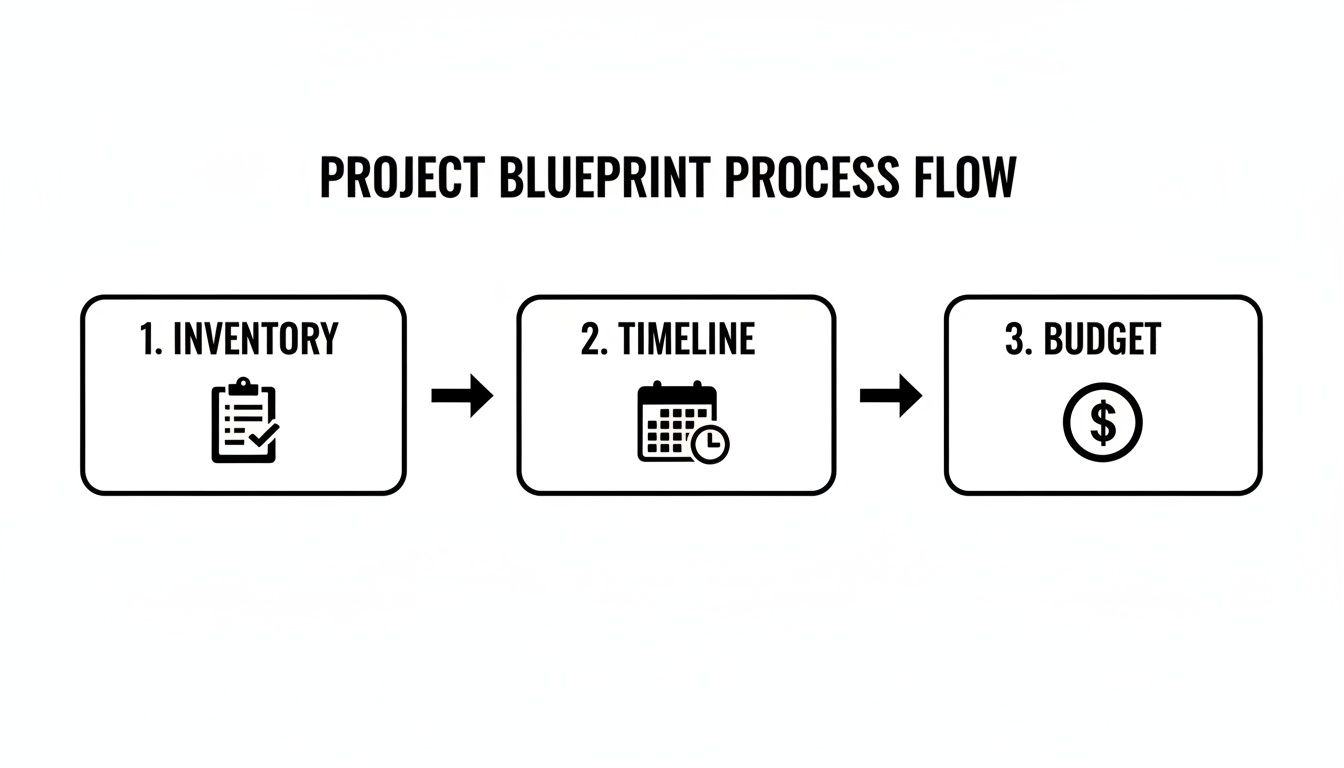
This blueprint is what allows you to identify every single data-bearing asset that requires certified destruction, leaving no room for error.
Your Best Defense Is Documentation
So, how do you prove you did everything right? The answer is a solid, unbroken chain of custody. This paper trail is your single most important line of defense if an auditor comes knocking. It provides a detailed, verifiable history for every asset from the moment it leaves your facility.
A compliant chain-of-custody process must include:
- A serialized inventory list that perfectly matches the equipment being removed.
- Signed transfer receipts every time the assets change hands.
- Secure, GPS-tracked transportation to the processing facility.
The final piece of the puzzle—and the most important—is the Certificate of Data Destruction. This is a legal document confirming that your devices were sanitized or destroyed according to federal standards. Crucially, it must list the unique serial number of every single hard drive. Without a serialized certificate, you have no real proof of compliance. Make this a dealbreaker when vetting any partner.
You can learn more by checking out our guide on HIPAA-compliant medical equipment disposal services.
Ultimately, navigating compliance and data security is about finding a partner who understands the risks as deeply as you do. It’s about demanding documented proof and ensuring your facility is protected long after the equipment is gone.
Mastering The Logistics Of On-Site Equipment Removal
With a solid plan in place, it’s time to move from paper to practice. This is the "boots on the ground" phase—where equipment is physically disconnected, packed up, and moved out of your facility. It's a complex logistical puzzle, especially inside a functioning hospital where patient care can't miss a beat.
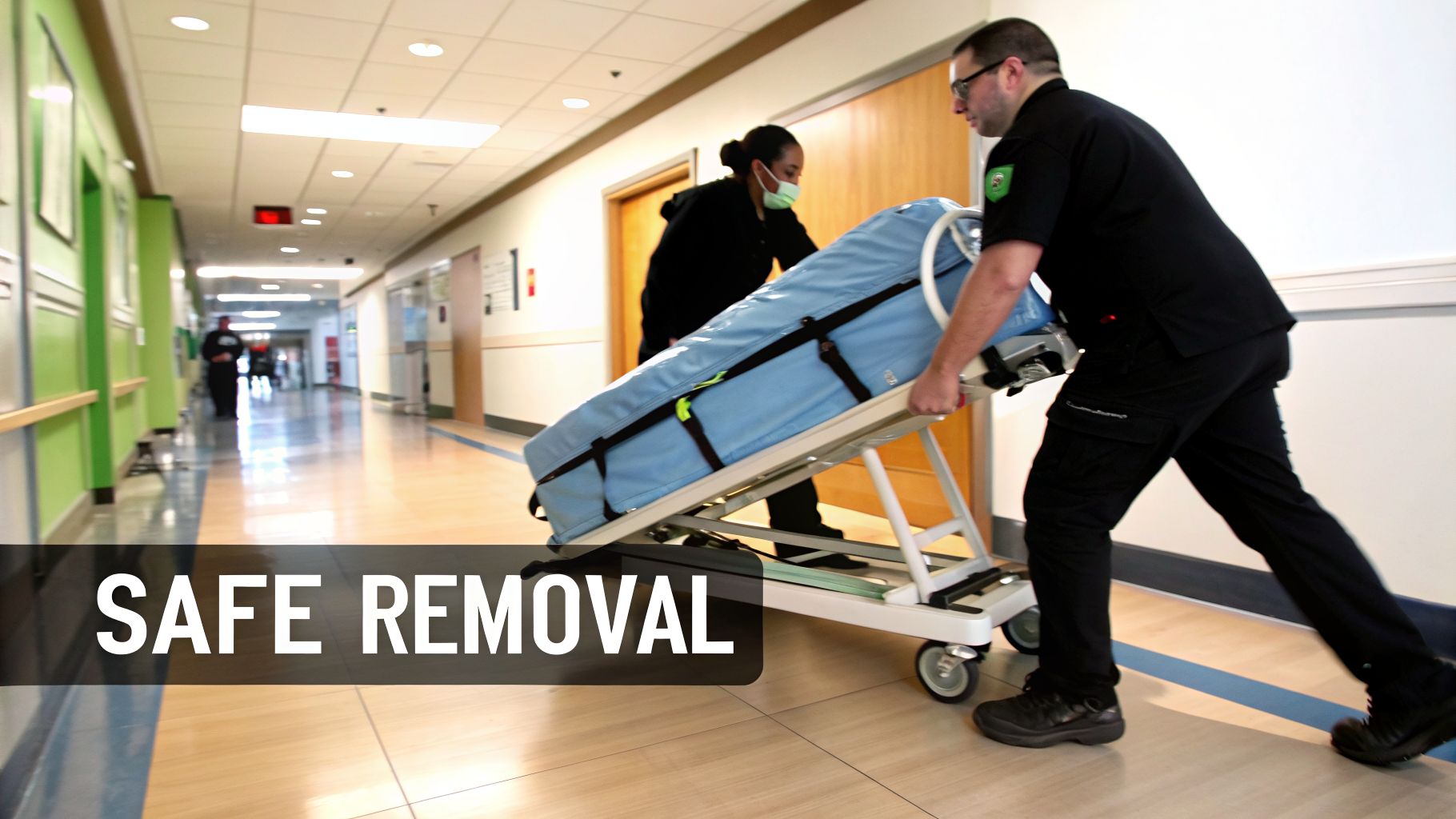
Success here comes down to flawless coordination between your staff and your chosen hospital equipment cleanout services provider. A true professional partner will work with you to build a detailed operational schedule, making sure every move is safe, efficient, and causes zero disruption.
Coordinating De-Installation And Site Prep
The first real action is the de-installation. This is a lot more than just pulling a plug. Our professional crews are trained to safely disconnect everything from intricate lab analyzers to heavy-duty server racks without leaving a scratch on your facility's infrastructure.
Before the team even arrives, a little site prep goes a long way. This means:
- Clearing Pathways: Make sure hallways, elevators, and loading docks are completely free of clutter.
- Protecting Surfaces: We recommend laying down floor coverings and corner guards in high-traffic zones to prevent scuffs and dings.
- Confirming Access: Double-check that all necessary doors are unlocked and that the crew has any required access badges or escorts lined up.
Getting this done beforehand lets the removal team work quickly and safely, showing respect for the hospital environment. For a closer look at what this involves, our guide on professional medical equipment removal services breaks it down even further.
Scheduling For Minimal Disruption
In a hospital, timing is everything. You simply can't have crews hauling bulky equipment down corridors during peak patient or visitor times. The only solution is strategic scheduling, which almost always means working after hours or on weekends.
An experienced partner will sit down with your facility managers to map out a removal plan in phases. For instance, we might clear equipment from the quieter upper floors during the evening, then shift to ground-floor labs or data centers overnight to take advantage of an empty loading dock.
Real-World Scenario: A Weekend Lab Decommission in a Major City
A major hospital in a busy metro area needed to clear out an entire research lab. We scheduled the entire job over a single weekend. The team arrived Friday evening to disconnect and pack sensitive diagnostic tools and servers. Saturday was for the heavy lifting—removing bulky items like fume hoods with specialized dollies and lifts. By Sunday morning, the space was empty, swept clean, and ready for the renovation crew, all without impacting the hospital's weekday operations.
This level of detailed planning should always incorporate comprehensive heavy equipment safety tips to keep everyone on site protected throughout the removal.
Smart Packing, Labeling, and Transport
As each piece of equipment is disconnected, it needs to be packed and labeled correctly to maintain the chain of custody you established earlier. This is no time for a generic "lab stuff" label on a box.
Our disciplined packing process is methodical:
- Secure Packing: Delicate instruments get bubble-wrapped, while heavy machinery is strapped securely to pallets.
- Serialized Labeling: Every single box, pallet, or piece gets a unique label that matches the master inventory list. No exceptions.
- Staging: All packed items are moved to a pre-planned staging area near an exit to streamline the loading process.
Once staged, the equipment is loaded onto secure, GPS-tracked trucks. This ensures every asset is accounted for, from the moment it leaves your loading dock to its arrival at our processing facility. This documented journey is the bedrock of a compliant cleanout, giving your organization the auditable proof of secure handling it needs.
How To Choose The Right Cleanout Partner
Picking the right partner for your hospital equipment cleanout is where the rubber really meets the road. This decision, more than any other, will determine whether your project is a smooth, compliant success or a logistical nightmare riddled with risk.
Get this right, and your partner acts as a shield, protecting you from HIPAA fines, data breaches, and environmental liability. Get it wrong, and you’re exposing your facility to all of it.
This is much more than hiring a moving company. When you're choosing a security outsourcing partner, you vet them intensely, right? You need to bring that same level of diligence here. These vendors will be handling equipment loaded with protected health information (PHI) and, in some cases, hazardous materials. Trust and certified expertise aren’t just nice-to-haves; they're the entire ballgame.
Your First Filter: The Non-Negotiable Credentials
Before you waste time comparing quotes, you need a shortlist. This list should only include companies that can prove they meet the absolute baseline for security and compliance. If a potential vendor can't immediately hand over proof of the following, they're out. No exceptions.
Your initial vetting checklist should include:
- Proof of Insurance: Don't just ask if they have it; ask for the Certificate of Insurance (COI). You need to see general liability, workers' compensation, and, crucially, cyber liability coverage. This is your protection if an accident or data incident occurs.
- Industry Certifications: The gold standards are R2 (Responsible Recycling) or e-Stewards certification. These aren't just logos for a website; they are rigorous, third-party audited standards that prove a vendor handles electronics and data securely and ethically.
- HIPAA Compliance: They must be willing and able to sign a Business Associate Agreement (BAA). Ask to see examples of their HIPAA-compliant work and documentation processes.
The market for these services is growing fast—the global medical waste management market was valued at USD 10.18 billion in 2024 and is on track to hit USD 16.28 billion by 2032. With North America making up a 30.86% slice of that pie, facilities in hubs like Atlanta and across the US are under immense pressure to get this right. A certified partner is your key to navigating the complexities of EPA and HIPAA compliance.
Asking The Tough Questions
Once you have a shortlist of certified and insured vendors, it's time to dig in. The way they answer the following questions will tell you everything you need to know about their process and professionalism.
A seasoned, professional partner will appreciate your detailed questions. They should have clear, confident answers. If you get vague responses or a runaround when you ask for documentation, that’s a massive red flag.
Here’s what you need to ask:
- "Can you walk me through your chain-of-custody process from start to finish?" A solid answer involves serialized inventory tracking, locked and sealed transport, and documented handoffs at every stage.
- "What data destruction methods do you use, and will I get a serialized Certificate of Data Destruction?" You want to hear DoD 5220.22-M wiping and physical shredding. A certificate that just says "drives destroyed" is not enough. Insist on one that lists the serial number of every single drive—that's your auditable proof.
- "Who are your downstream recycling partners, and are they also certified?" A truly responsible e-waste recycling company maintains a fully vetted and certified downstream. This ensures your assets don't end up illegally dumped or exported.
- "Are the people doing the work your employees or subcontractors?" Direct employees mean more control, consistent training, and greater accountability. A crew of unknown subcontractors introduces unnecessary risk.
Local Focus Versus Nationwide Logistics
The size and location of your facility will play a big part in deciding between a local specialist and a national provider. Each has its own strengths.
| Provider Type | Best For | Key Advantages |
|---|---|---|
| Local Service Provider | Single-site hospitals, clinics, and labs in a specific metro area (e.g., Atlanta, GA). | – Faster Response: Can often schedule services more quickly. – Regional Expertise: Knows local regulations and logistics inside and out. – Lower Overhead: May offer better pricing for smaller projects. |
| Nationwide Provider | Multi-state healthcare systems or large, complex cleanouts across the U.S. | – Standardized Process: Guarantees consistency across all your locations. – Robust Logistics: Has the network to manage multiple projects at once. – Centralized Reporting: Gives you a single point of contact and unified paperwork. |
For many hospitals in regions like the Southeast, a local expert like Scientific Equipment Disposal offers the best of both worlds. We bring the hands-on service and quick response of a local team but operate with the same strict, nationwide-level compliance standards that your organization demands. It’s how you get a partner who understands both your immediate needs on the ground and the critical importance of data security for hospital equipment cleanouts nationwide.
Frequently Asked Questions About Hospital Equipment Cleanouts
When you're tasked with a hospital equipment cleanout, a lot of the same questions tend to pop up. After years of handling these projects for facilities of all sizes, both locally and across the country, we've heard them all. Here are the straight answers to the things hospital administrators, IT directors, and lab managers ask us most.
What Types Of Hospital Equipment Can You Recycle?
A proper hospital equipment cleanout service needs to take almost everything. We’re talking about the full spectrum of assets, from lab mainstays like centrifuges, incubators, and fume hoods to all your IT e-waste. That means computers, servers, monitors, networking gear—you name it.
Even highly specialized medical devices can often be recycled, but there's a critical catch: they must be completely free of any biohazards. Before you start, always get a clear, detailed list of accepted items from your disposal partner. This is the only way to make sure you're keeping as much material out of the landfill as possible. If you have a unique or proprietary machine, a quick call to confirm is always a smart move.
How Do You Guarantee Patient Data Is Secure During Disposal?
Data security isn't just a feature; it's the absolute most critical part of a HIPAA-compliant cleanout. A truly secure process has multiple layers and is documented from start to finish. It all begins with certified data wiping software that meets government standards, like the DoD 5220.22-M 3-pass method. This overwrites data repeatedly, making it impossible to recover even with forensic tools.
But what about drives that have failed, are too old to be wiped, or held incredibly sensitive PHI? For those, physical destruction is the only answer. We run them through an industrial shredder that reduces hard drives and other storage media to a pile of tiny, useless metal fragments.
The single most important piece of paper you'll get is a serialized Certificate of Data Destruction. This is your legal, auditable proof that every device was properly sanitized or destroyed. If a vendor can't provide this, walk away.
If your facility wants to handle its own documentation, you can start by looking at resources like our free Certificate of Destruction template.
What Are The Average Costs For A Hospital Equipment Cleanout?
There's no single price tag; costs really depend on the size and difficulty of the job. The main things that will affect your quote are:
- The total volume and weight of all the equipment.
- The kind of data destruction you need (wiping is different from shredding).
- Logistics—getting equipment out of a 10th-floor lab is a lot more work than rolling it out of a ground-level loading dock.
Some companies might offer free pickups if you have a large batch of high-value IT gear, while others will charge a flat fee or by the pallet. Always insist on a detailed, itemized quote. And remember, the potential cost of a data breach or an environmental fine is astronomically higher than the price of a professional, compliant disposal service.
How Long Does A Typical Hospital Cleanout Project Take?
The timeline is tied directly to the scope of the project. If you're just decommissioning a small clinic or a single lab, our team can often be in and out in a single day. A full-scale hospital wing or data center cleanout, on the other hand, is a different beast. That could take a week or even longer from the first day of on-site work to the final truck pulling away.
The need for these services is exploding. The medical waste management market was valued at USD 34.06 billion in 2023 and is expected to hit USD 59.42 billion by 2030. With hospitals driving 62.95% of this market, facilities are under immense pressure to avoid steep RCRA penalties and meet sustainability goals, like diverting 90% of metals and plastics from landfills. You can dive deeper by reviewing the market research on medical waste management.
When you’re ready to ensure your facility’s equipment is handled securely and sustainably, trust the experts. Scientific Equipment Disposal provides certified, HIPAA-compliant cleanout services for hospitals and labs, offering both local service in the Atlanta metro area and nationwide logistics. Visit us at https://www.scientificequipmentdisposal.com to schedule your project.