A Guide to Nationwide and Local Factory Equipment Removal & Disposal Services

When you're looking at a facility shutdown or a major equipment upgrade, the logistics can seem endless. That's where professional factory equipment removal & disposal services come in. We handle everything from the initial on-site de-installation and secure transport to making sure every piece is recycled or disposed of in a compliant, sustainable way. It's an essential service for labs, data centers, and industrial plants, whether you need a local team here in the Atlanta area or nationwide coverage.
Your Complete Guide to Decommissioning Your Facility
Shutting down a facility—or even just one part of your operations—is about more than unplugging machines and calling a junk hauler. This is a complex project with real financial, legal, and environmental weight. A messy, disorganized approach can quickly lead to expensive delays, data security nightmares, and stiff regulatory fines, regardless of your location.
This guide is designed to break down the entire equipment removal and disposal process into clear, manageable stages. We're going beyond generic advice to give you the real-world insights we’ve gained from years of experience serving clients from coast to coast.
The whole project really boils down to three key phases: a detailed inventory, professional removal, and certified final disposal.
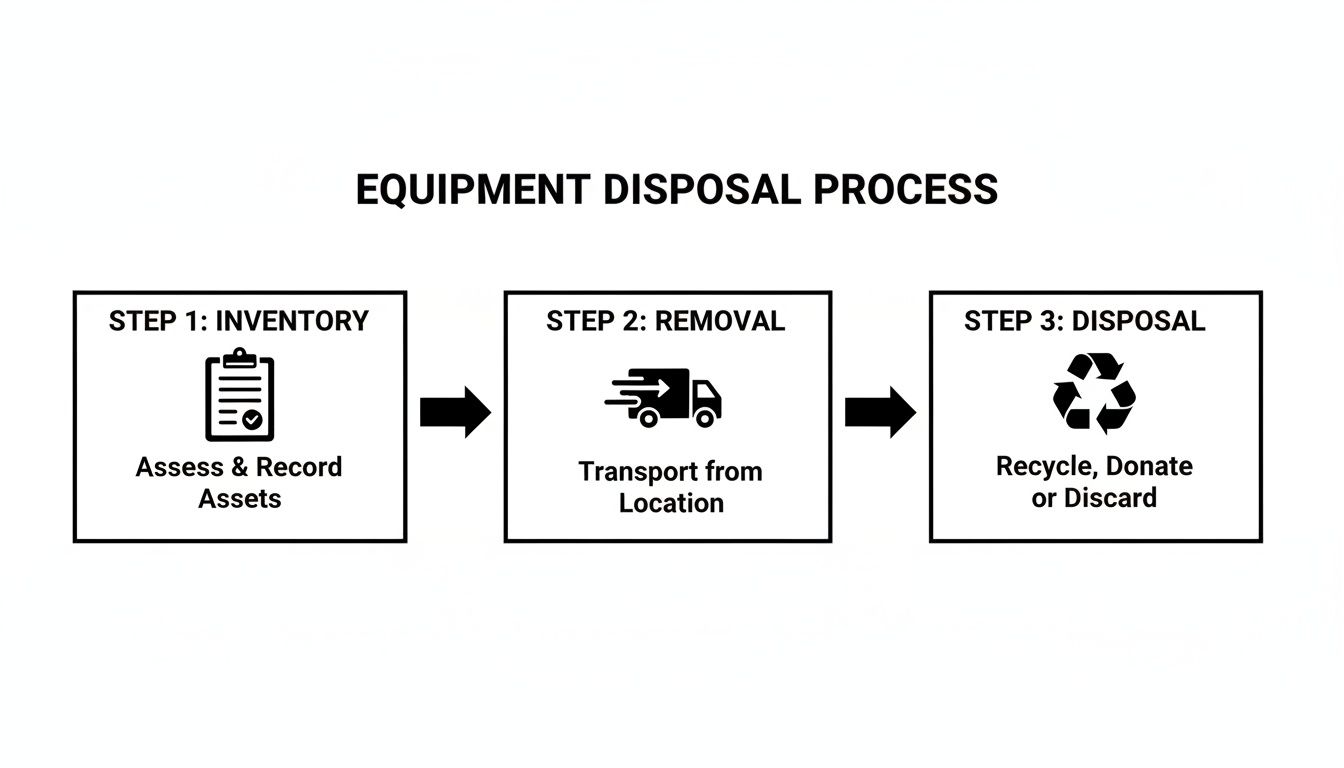
Getting these three pillars right is what separates a smooth project from a costly headache. A structured plan makes sure nothing gets missed, from the first walk-through in your local facility to the final certificates of destruction that are valid nationwide.
Why You Can't Afford to "Wing It"
Without a solid plan, you're opening the door to facility damage, lost assets, or compliance failures. A structured decommissioning process is your best defense against these problems, whether you're in a major city like Atlanta, GA, or a remote industrial park.
Think about it: a university lab can't just misplace sensitive research equipment or toss out hazardous materials incorrectly. In the same way, a data center that's closing its doors, no matter where it's located, has to guarantee 100% data destruction to prevent a catastrophic breach.
A comprehensive plan helps you nail these critical areas:
- Regulatory Compliance: Staying on the right side of local, state, and federal laws for e-waste and hazardous materials.
- Data Security: Making absolutely sure every bit of sensitive information on hard drives or other media is destroyed for good.
- Logistical Efficiency: Coordinating the de-installation, packing, and transport to keep disruptions to a minimum, whether for a single site or multiple locations.
- Sustainable Outcomes: Working with certified recyclers to make sure as much material as possible stays out of landfills.
The goal is to transform a logistical headache into a seamless, documented, and compliant process. Choosing the right partner means you're not just clearing out space; you are protecting your organization's reputation and bottom line.
Whether you're managing a local project in Georgia or coordinating a shutdown across multiple states, these principles are the same. If you're dealing with particularly sensitive assets, you might find our overview on scientific equipment decommissioning services helpful. Ultimately, this structured approach isn't just about avoiding mistakes—it's about protecting your business from start to finish.
Planning Your Project and Building an Asset Inventory
Any successful facility cleanout or equipment upgrade starts with a rock-solid plan. The first, and most critical, part of that plan is figuring out exactly what needs to go and creating a detailed asset inventory.
This single step is the foundation for everything else. It’s what we use to give you an accurate quote, plan the logistics, and make sure every compliance box is checked. If you skip this, you’re flying blind, and that almost always leads to surprise costs, delays, and a whole lot of logistical headaches.
Think of it as the blueprint for your project. You wouldn't pour a foundation without one, and the same goes for factory equipment removal & disposal services. Your asset inventory gives a disposal partner like us the hard data we need to show up with the right crew, the right trucks, and the right tools to get the job done right—whether you're in downtown Atlanta, a suburb like Norcross, or a facility across the country.
Start With a Facility Walkthrough
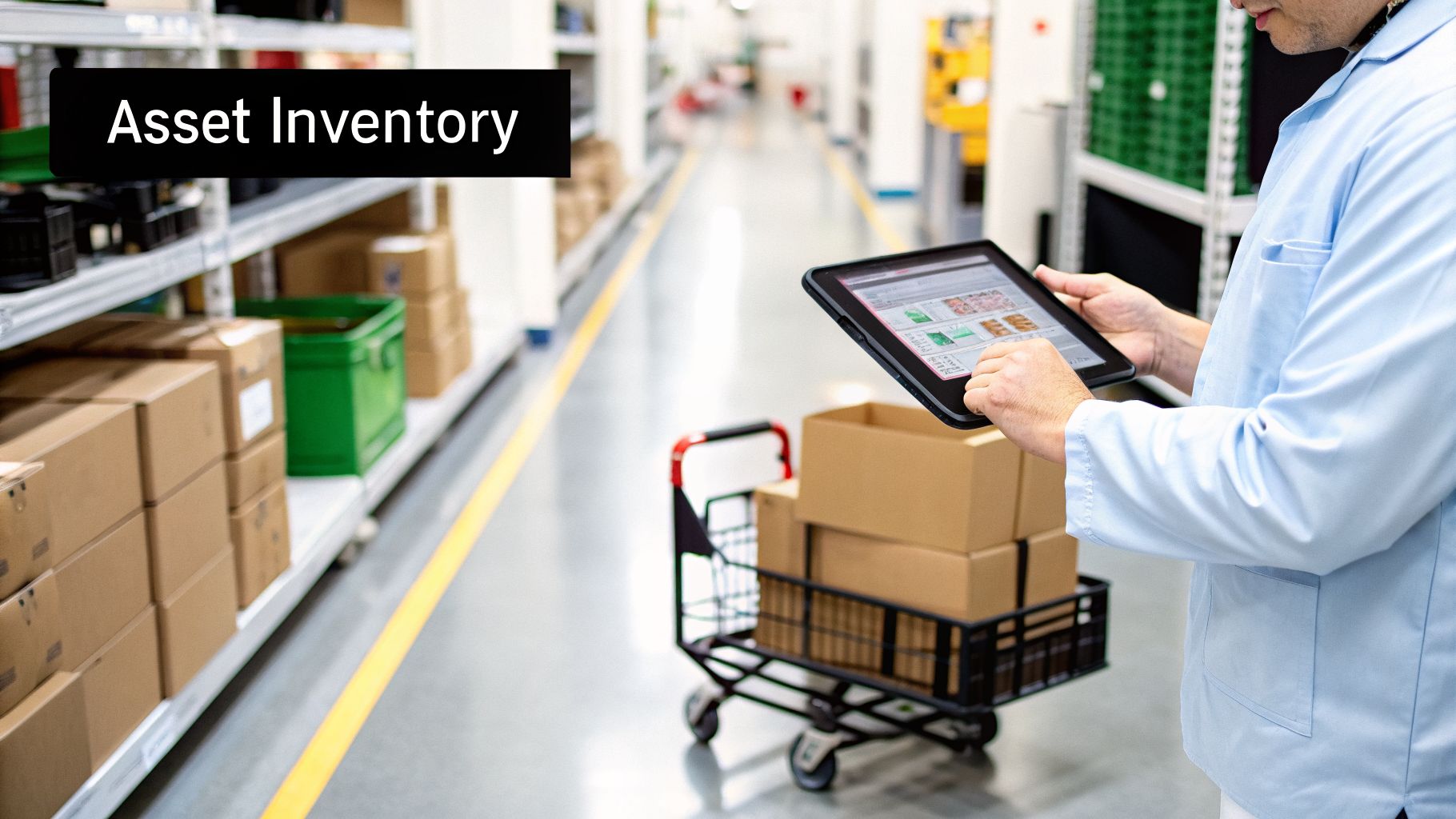
The best way to kick things off is with a physical walkthrough of your site. Your goal is to put eyes on and tag every single piece of equipment that's part of the project. It helps to bring along key people from your team who really know the equipment and its history.
And this isn’t just about the big, heavy industrial machinery. Your list has to be comprehensive. We're talking about everything from delicate lab instruments and fume hoods to entire server racks and data storage arrays. Slapping a unique tag on each item is the surest way to guarantee nothing gets missed.
Build Your Comprehensive Asset Inventory
Once you have everything tagged, it's time to get the details down on paper. A simple spreadsheet is your best friend here. The more detail you can pack into this inventory, the more accurate your initial quote will be. No surprises.
Here's a simple checklist to help you create a comprehensive inventory for your equipment removal and disposal project. Using this ensures a smooth, accurate process from start to finish.
Sample Equipment Inventory Checklist
| Asset ID / Tag | Equipment Type (e.g., Centrifuge, Server) | Manufacturer & Model | Dimensions (L x W x H) | Estimated Weight | Condition (Functional, Non-Functional) | Data Storage (Yes/No) | Location (Building/Room) |
|---|
Capturing these specifics transforms a vague request into a clear, actionable plan that any professional service provider can price and execute with confidence.
A detailed inventory is your best defense against scope creep and hidden charges. It turns a "get rid of this stuff" request into a professional project plan.
Let’s look at a real-world example. We recently worked with a university lab that was decommissioning an entire biology wing. Their inventory didn't just list the big centrifuges and biosafety cabinets. It included dozens of microscopes, incubators, and old computer workstations. If you’re dealing with a similar situation, you might find our guide on scientific equipment removal for labs and universities helpful. That level of detail told us we needed specialized dollies, secure electronics bins, and exactly how much truck space to allocate for our nationwide fleet.
Don't Forget About Hazards and Data
Two other things are absolutely vital for your inventory: potential hazards and data-bearing devices. Miss these, and you could be looking at serious security or compliance problems later on.
Potential Hazards: Does the equipment contain chemicals, bio-agents, or even radioactive sources? A fume hood could have residue, and older electronics might contain mercury or lead. Noting this is critical for the safety of the removal crew and ensures proper handling from the start.
Data Storage: Does the asset have a hard drive or any other kind of data storage? Servers, PCs, and even modern lab instruments can hold sensitive information. Identifying every single data-bearing device is the first step toward secure data destruction and protecting your organization from a breach.
Tackling the Rules: Compliance, Data Security, and Your Responsibility
Alright, you've got your inventory list. Now for the part that trips up a lot of companies: the maze of regulations and data security. This isn't just about checking boxes. Getting this wrong can lead to staggering fines, data breaches that make headlines, and a damaged reputation that’s hard to fix.
Whether you're running a facility in the Atlanta metro or managing a project across the country, the principles are the same. You need to know what you’re responsible for and find a partner who can handle it without cutting corners.
Wiping the Slate Clean: Your Data Destruction Obligations
In today's world, data security is everything. And it’s not just your servers or old computers. So many modern lab and industrial machines have hard drives or internal storage packed with sensitive information. Simply unplugging them and rolling them out the door is a huge risk.
When it's time to destroy data, you have two primary, industry-approved methods:
- Software-Based Wiping: This is where we use specialized software to overwrite a drive's data, making the original files impossible to recover. The DoD 5220.22-M 3-pass method is a common and reliable standard for this. It essentially writes over your data three times with different patterns, ensuring it's thoroughly scrambled.
- Physical Destruction: For drives that are dead, too old, or when you simply need the absolute highest level of security, nothing beats physical shredding. This is exactly what it sounds like—we run the drive through an industrial shredder that tears it into tiny metal fragments. There's no coming back from that.
A professional factory equipment removal & disposal service will guide you to the right choice based on the hardware and your company's own security rules.
Your legal responsibility for the data on your equipment doesn't end when the truck leaves your loading dock. It ends when you have a Certificate of Data Destruction in hand, proving every bit was verifiably and permanently destroyed.
Meeting Environmental and Industry Rules
Beyond data, the equipment itself is subject to some pretty strict environmental laws. You can’t just haul old machinery and electronics to the dump anymore—it’s often illegal and always irresponsible. E-waste is full of hazardous materials like lead, mercury, and cadmium that can leach into the soil and groundwater.
This is a massive deal for specific industries, no matter their location:
- Healthcare Facilities: If a piece of equipment ever touched patient data, HIPAA (Health Insurance Portability and Accountability Act) rules apply. A breach here can be financially catastrophic. We provide a documented chain of custody and certified data destruction, which is non-negotiable for our healthcare clients nationwide.
- Research & Industrial Labs: We see this a lot, from the research corridor in Atlanta, GA, to tech hubs in California. Equipment can be contaminated with chemical or biological residues. Following proper decontamination procedures is critical for safety and for staying compliant with EPA (Environmental Protection Agency) and OSHA (Occupational Safety and Health Administration) standards.
There’s a good reason for this scrutiny. The global market for responsible industrial waste management is on a tear, projected to jump from USD 1,065.4 billion in 2023 to an incredible USD 2,703.3 billion by 2033. This explosion is being fueled by tough regulations, as detailed in this recent industrial waste market report, pushing companies to dispose of assets the right way.
The Power of Paperwork
So, how do you prove you did everything by the book? It all comes down to documentation. Any reputable disposal partner will give you official certificates that act as your legal proof of compliance. These are your get-out-of-jail-free cards during an audit.
You should always walk away with two key documents:
- Certificate of Data Destruction: This lists the serial numbers of every single hard drive that was wiped or shredded, confirming it was handled according to industry standards.
- Certificate of Recycling/Disposal: This certifies that your equipment was recycled or disposed of in an environmentally sound way, following all federal, state, and local laws.
Without this paper trail, you have no proof your assets were managed correctly. You can learn more about how we handle secure data destruction and documentation to give our clients complete peace of mind. These certificates are what officially close the loop, protecting your company long after the equipment is gone.
Managing On-Site De-Installation and Logistics
With your inventory locked in and compliance needs mapped out, it’s time for the physical removal. So, what should you expect on removal day? This is where a professional team turns your detailed plan into reality, executing a smooth exit with as little disruption to your operations as possible, whether you have one site or many.
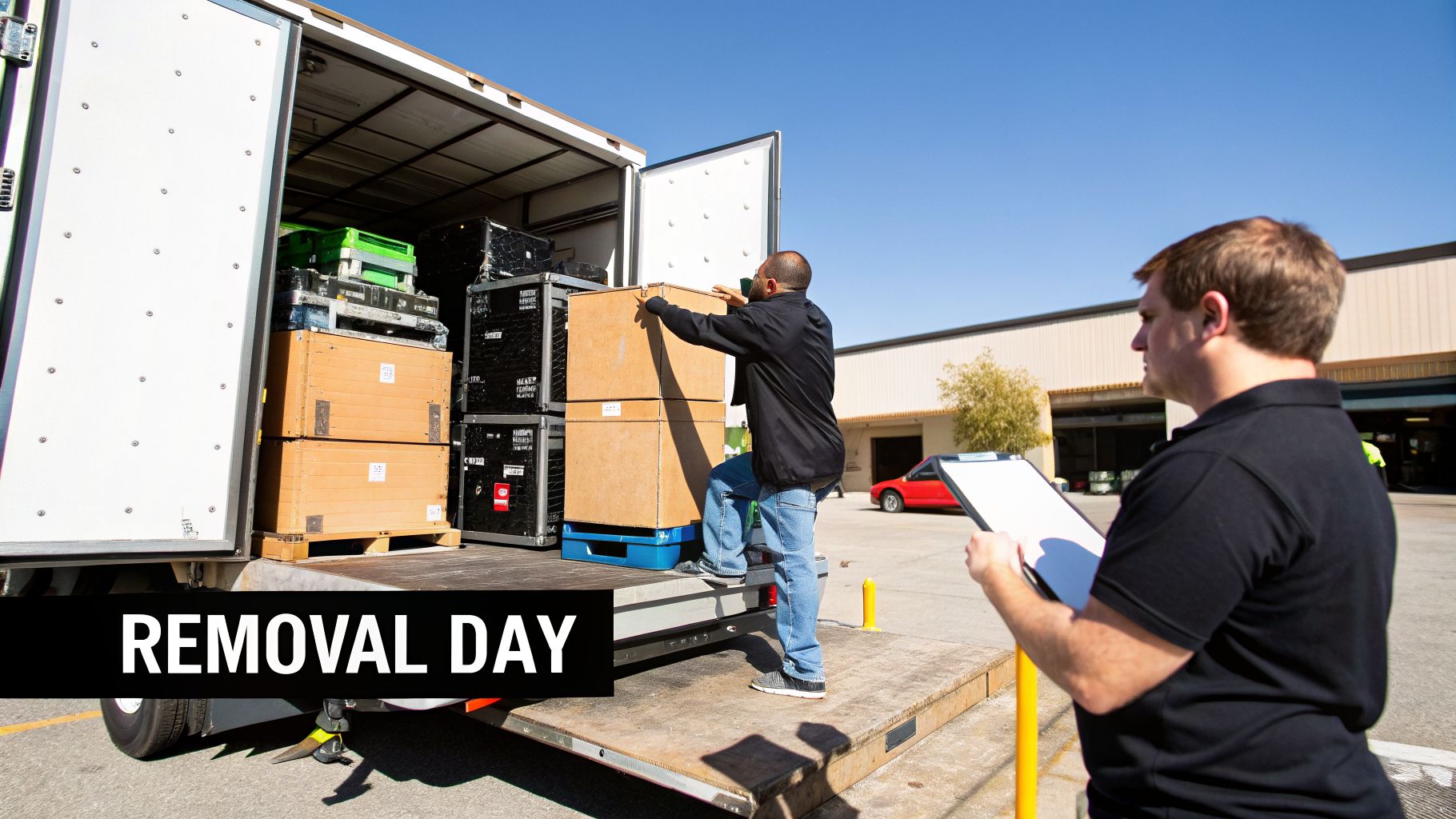
The arrival of our crew is when the hands-on work begins. This is a lot more than just heavy lifting—it’s a carefully coordinated effort focused on safety, efficiency, and making sure your assets are protected. The team lead will usually start with a quick walkthrough to confirm the scope of work and see if anything has changed since our initial assessment.
A Look at the On-Site Operation
Dismantling and removing equipment is methodical. Every single item is handled based on its specific requirements, whether it's heavy machinery that needs specialized rigging or a delicate instrument that requires careful packing.
- Systematic De-installation: Our crews work systematically, often starting at the back of a facility and moving forward. This simple strategy prevents bottlenecks and keeps a clear path for moving large items. We use the right tools to safely disconnect equipment from power, plumbing, and data lines.
- Secure Packing and Staging: Sensitive instruments are carefully wrapped and packed into secure bins or crates. Bigger pieces are staged near exit points, ready for loading. This keeps the worksite clear and prevents accidental damage.
- Efficient Loading: A professional factory equipment removal & disposal service uses its own dedicated, company-owned trucks. This detail is critical for both local and nationwide projects. It means the same team that de-installed the equipment is the one loading it, ensuring a seamless chain of custody from your door to its final destination.
For particularly large or complex projects, the expertise of dedicated Commercial movers can add another layer of efficiency, complementing the specialized skills of an equipment disposal team.
Real-World Scenario: A Data Center Shutdown in Norcross
Picture a corporate data center shutdown in Norcross, GA. The job is to clear out hundreds of servers, storage arrays, and networking racks. A coordinated team arrives and immediately splits up. One group starts disconnecting servers while another begins wrapping and palletizing the storage arrays.
As each rack is emptied, it’s broken down and moved to a staging area. All hard drives are pulled and placed in locked, secure containers for transport to the data destruction facility. The whole operation is a well-oiled machine, clearing the data hall with a precision that minimizes risk.
On removal day, our main goal is to take the entire logistical burden off your shoulders. Your team shouldn't be worrying about moving heavy equipment; they should be focused on their own work.
This kind of specialized service is a direct response to a growing need. The global waste disposal equipment market was valued at USD 4.7 billion in 2026 and is projected to hit USD 6.08 billion by 2031. For organizations across the country—from hospitals and universities to corporate labs—this highlights the pressure to decommission assets the right way.
The Final Site Sweep
The job isn’t done once the last piece of equipment is on the truck. A reputable partner will always perform a final site sweep. This means cleaning up any debris left from the removal and making sure your facility is left in a clean, "broom-swept" condition. It’s a mark of professionalism and respect for your property.
This meticulous on-site management is especially important if you are moving to a new facility, not just clearing out an old one. For those types of projects, our guide to laboratory moving services offers more insight into those logistics.
Ultimately, a successful removal day comes down to a safe, organized, and efficient process that leaves your space ready for its next chapter.
How to Choose the Right Disposal Partner
Picking the right company for your factory or lab equipment removal is hands down the most critical decision you'll make. This isn't just about hauling away old machinery; it's about risk management. The wrong partner can leave you with compliance nightmares, a devastating data breach, or a surprise bill that blows your budget.
You're looking for a team with proven experience, not just a truck and a crew. This is true whether you're in the Atlanta area, where tech and biotech create unique challenges, or any other industrial hub nationwide. You need to ask the tough questions, and a professional, transparent partner will be ready to answer them.
Key Questions to Vet Potential Partners
Before you even think about signing a contract, get these questions answered. Their responses will tell you everything you need to know about their process and professionalism.
Do you own your fleet or subcontract logistics? This is a big one. A company that owns its own trucks has total control over the chain of custody. This is essential for both local pickups and complex nationwide logistics. Subcontracting can create serious security gaps and finger-pointing if something goes missing or gets damaged.
What are your specific certifications for data destruction and recycling? Don't accept vague answers. Ask to see proof of R2 or e-Stewards certifications. These aren't just fancy logos; they prove the vendor adheres to the highest industry standards for environmental protection and data security across all its operations.
Can you provide a complete, serialized chain-of-custody report? From the moment an asset leaves your dock, you need a paper trail. This documentation is your legal proof that every single piece of equipment was handled, transported, and disposed of correctly.
What are your insurance and liability limits? Stuff happens. Make sure they carry sufficient liability insurance to cover everything from an on-site accident to a data breach. This protects your organization from financial fallout.
When looking into a company, check out their services to make sure they can actually handle the scope of your project.
A top-tier partner doesn’t just remove equipment; they provide a risk-management service. Their job is to shield your organization from liability through a secure, documented, and compliant process.
Spotting Red Flags Early
Knowing what to look for is just as important as knowing what to ask. A few warning signs can quickly tell you if a vendor is likely to cut corners, leaving you exposed.
Be very skeptical of any company that shows these signs:
Vague or "Bundled" Pricing: If you get a quote with just one bottom-line number, push back. A transparent partner will provide a detailed breakdown of costs for labor, logistics, recycling fees, and data destruction. No surprises.
A Limited Scope of Accepted Items: A real, full-service provider can handle almost everything on your inventory list. If they only want to "cherry-pick" the high-value items, you'll be left scrambling to find another solution for the rest.
No Details on Downstream Partners: If they can't tell you exactly where your e-waste is going for processing—and provide the certifications for those downstream recyclers—that's a huge red flag. This often hides irresponsible dumping practices.
Hesitation to Provide Sample Documents: Any reluctance to show you a sample Certificate of Destruction or Certificate of Recycling is a deal-breaker. That paperwork is your only legal proof that you did the right thing.
The Nationwide and Local Atlanta Advantage
Whether you're closing a single facility in metro Atlanta or managing a complex, multi-state shutdown, find a partner with the logistical chops to handle it. A nationwide network is a good indicator of experience with different state regulations and complex logistics.
At the same time, a strong local presence—like having an operational hub in Norcross for the Atlanta market—means faster response times and people who understand the local traffic and facility access challenges. The best partner for your factory equipment removal & disposal services often gives you both: nationwide capability with the hands-on service of a local expert.
The Final Step: Sustainable Disposal and Your Proof of Compliance
Think the job is over once the equipment is loaded onto the truck? Not even close. The final phase of any professional factory equipment removal & disposal service is what protects your company from future liability: ensuring every piece is disposed of compliantly and getting the paperwork to prove it.
This is where the real work of responsible recycling begins. Once your old assets arrive at a certified processing facility, they are carefully deconstructed to recover as much raw material as possible.
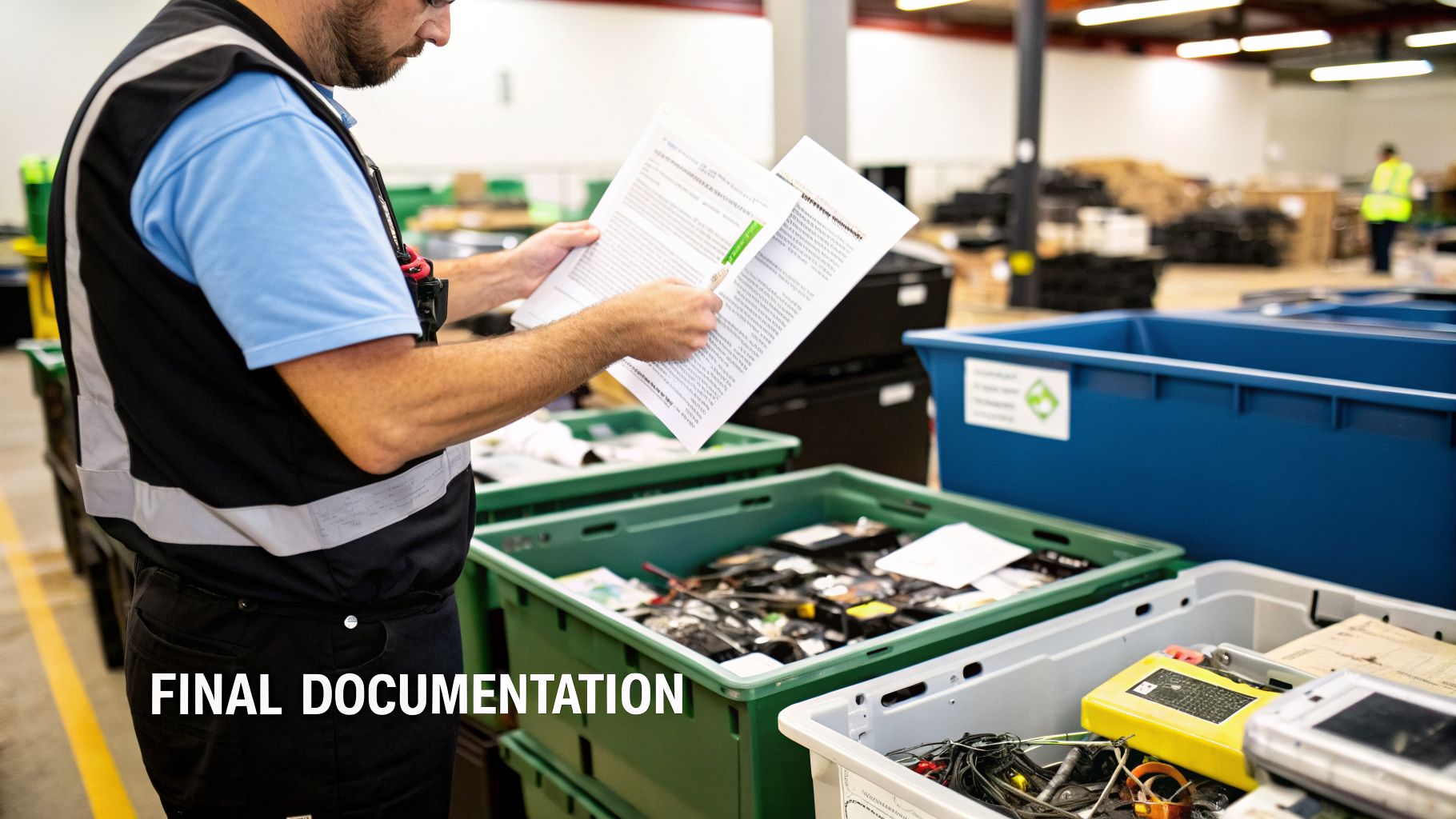
What Happens After It Leaves Your Facility?
The main goal is to keep your equipment out of a landfill. It’s a detailed process that turns old machinery back into valuable commodities.
Here’s a quick look at how it works:
- Segregation: Metals, plastics, glass, and circuit boards are all sorted and separated.
- Processing: Common metals like steel, aluminum, and copper get shredded down and sent to smelters to create new raw materials.
- Hazardous Material Management: This is critical. Components with hazardous materials—like mercury from old switches or lead in CRT screens—are carefully isolated and handled according to strict EPA guidelines to prevent environmental contamination.
This isn’t just good environmental practice; it’s a major part of the modern economy. The market for waste management equipment is expected to grow from USD 19.27 billion in 2025 to USD 33.63 billion by 2034. With waste recycling machinery already making up 35.40% of that revenue, it's clear that specialized recycling is the future. You can see the detailed projections in this waste management equipment report.
Why the Final Paperwork Is Everything
All that responsible recycling means nothing for your compliance records without the final documentation. This isn't optional—it’s the official proof that shields you from legal and financial risk. It's your auditable record of a job done right.
Your Certificate of Recycling is more than just a piece of paper—it’s the official record that releases your company from liability and proves your commitment to corporate social responsibility (CSR). It confirms your assets were not illegally dumped or exported.
This paperwork provides total peace of mind for your stakeholders, auditors, and leadership team. It confirms that every asset was tracked and managed correctly from start to finish.
You can see what this critical document includes in this sample certificate of destruction. It's the final step that solidifies your brand’s reputation and ensures a fully documented, sustainable outcome for your project, whether you’re a local Atlanta-area business or a nationwide enterprise.
Common Questions About Equipment Disposal
When it's time to clear out a lab, factory, or data center, a lot of questions come up. We get calls every day from facility managers, both here in Atlanta and across the country, who need straight answers. Here are a few things people often ask us.
What Kind of Equipment Can You Take?
Honestly, just about everything. We’re set up for a complete, wall-to-wall cleanout.
That means we handle the small stuff, like microscopes and centrifuges, all the way up to massive industrial machinery, chemical fume hoods, and every piece of IT e-waste you can imagine. Our teams are ready for servers, computers, networking gear, and all the peripherals—no matter the facility, we provide a single-source solution for your factory equipment removal & disposal services.
How Do You Figure Out the Cost for Removal?
There's no simple price list for a project like this because every facility and every inventory is different. The final cost really comes down to a few key things.
We look at factors like:
- The total amount and types of equipment you have.
- Logistical hurdles, such as navigating stairs, not having a loading dock, or dealing with tight spaces.
- Your location, whether you're right here in Atlanta, GA, or in another state requiring nationwide service.
- Any special handling that’s needed for sensitive assets or equipment that once handled hazardous materials.
We only give a transparent, no-obligation quote after we’ve seen a detailed inventory. It's the only way to give you an accurate price without any surprise fees later on.
The best quotes are always built on a detailed asset inventory. The more you can tell us upfront about your equipment and your building's layout, the more precise our estimate will be.
How Can We Be Sure Our Data Is Secure?
We guarantee total data security with a proven, two-step process that satisfies strict compliance rules like HIPAA. First, for any hard drives that still work, we perform a complimentary DoD 5220.22-M 3-pass data wipe. This is a government-standard method for completely sanitizing digital media.
For any drives that are old, broken, or just not functional, we use secure physical shredding. This process destroys the drive completely, making it impossible for anyone to recover the data. Once we're done, you get a formal Certificate of Data Destruction for your records, giving you a fully documented and auditable trail for your local or national operations.
Ready to clear out your facility with a team you can trust? Scientific Equipment Disposal offers a secure, compliant, and sustainable solution for your lab, data center, or industrial plant nationwide. Learn more about how we can help.