Secure Server Disposal Services in Gwinnett County, Georgia and Nationwide

Getting rid of old servers isn't just a cleanup task—it's a critical security and compliance move. For any business in Gwinnett County, GA or across the United States, our professional server disposal services are the only way to securely decommission aging IT hardware, protecting your sensitive data and keeping you on the right side of the law.
Think of it like decommissioning a bank vault. You wouldn't just walk away; you'd make absolutely sure the valuables are secured before dismantling the structure.
Why Secure Server Disposal Is Critical For Gwinnett Businesses
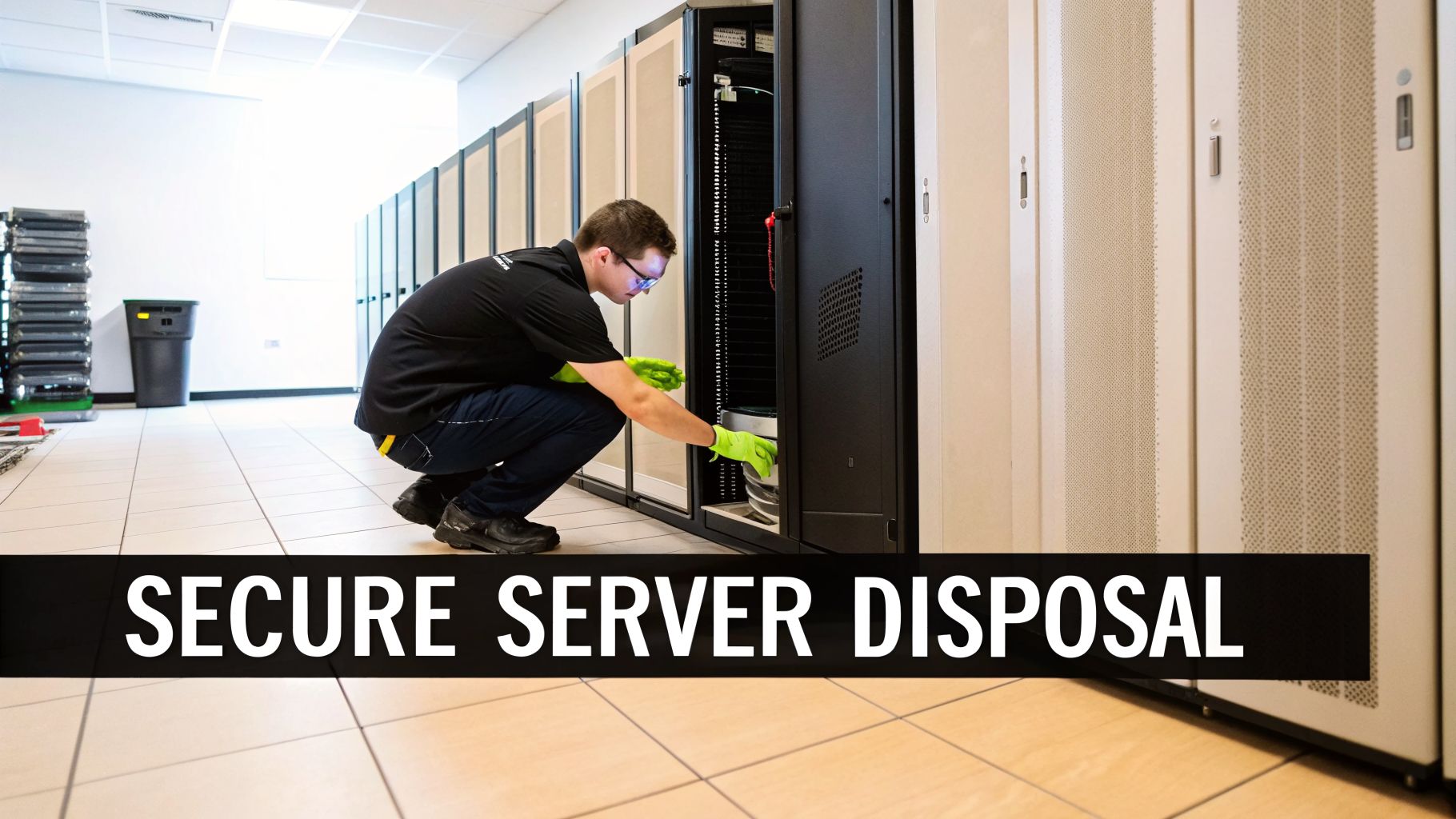
As Gwinnett County’s tech scene grows, so does the headache of dealing with old IT equipment. A server that’s reached the end of its life isn’t just another piece of office junk to toss out or shove in a storage closet. It's a ticking time bomb, loaded with years of confidential company records, customer information, and private trade secrets. This challenge is not unique to Georgia; it's a nationwide issue for businesses of all sizes.
Failing to dispose of these assets properly is a massive gamble. Even if you've "deleted" the files, data can often be recovered from the hard drives, leaving the door wide open for identity thieves and corporate spies. Just one discarded server can contain enough information to spark a devastating data breach, leading to huge financial losses, legal battles, and a reputation that’s damaged beyond repair.
The Growing E-Waste Problem In Georgia and Across the Nation
The sheer volume of electronic waste is a huge issue, both here at home and across the country. Projections show the U.S. will generate over 7 million tons of e-waste by 2026, and only a tiny fraction of that gets recycled the right way.
This national problem hits close to home for us in Gwinnett County, especially since we're home to Norcross—North America's sixth-largest data center market. As these facilities and other local businesses upgrade their tech, the pile of old servers and electronics is only going to get bigger. That makes professional disposal an essential partnership for any responsible company, whether in Georgia or any other state.
This mountain of e-waste puts a double burden on businesses. You have to protect your data, and you also have a responsibility to get rid of electronics in an environmentally safe way. Just throwing old servers in a dumpster can lead to stiff fines and contributes to landfill pollution.
The core issue is that a server's end-of-life is a critical security event. Treating it as a simple janitorial task exposes a business to significant risks that are easily avoidable with professional handling.
Key Risks Of Improper Server Disposal For U.S. Businesses
The fallout from mishandling server disposal can be severe. Businesses here in Gwinnett County and across the nation are up against real threats that go way beyond losing a piece of old hardware.
The table below breaks down the immediate dangers that companies face when they skip professional disposal services.
| Risk Category | Specific Threat | Potential Consequence |
|---|---|---|
| Financial Penalties | Fines from EPA violations for improper dumping or non-compliance with data privacy laws like HIPAA. | Penalties can easily climb into the tens of thousands of dollars for each violation. |
| Legal Consequences | Lawsuits from customers or employees whose data was exposed from a server you threw away. | Costly legal battles, settlements, and court-mandated changes to your business practices. |
| Reputational Damage | Loss of trust from the community and your clients after a preventable data breach becomes public. | A tarnished brand name, lost customers, and difficulty attracting new business for years to come. |
As you can see, the stakes are far too high to take any chances.
Folding secure server disposal into your comprehensive cybersecurity strategy is a non-negotiable step to guard against data breaches and maintain the trust you've built. Ultimately, choosing professional server disposal services in Gwinnett County Georgia isn't an expense—it's a smart business decision that protects your company's future.
To get a better sense of the full scope of managing old technology, you may want to check out our guide on IT asset disposition services in Gwinnett County at https://www.scientificequipmentdisposal.com/it-asset-disposition-services-in-gwinnett-county-ga/.
Making Sure Your Data Is Gone for Good
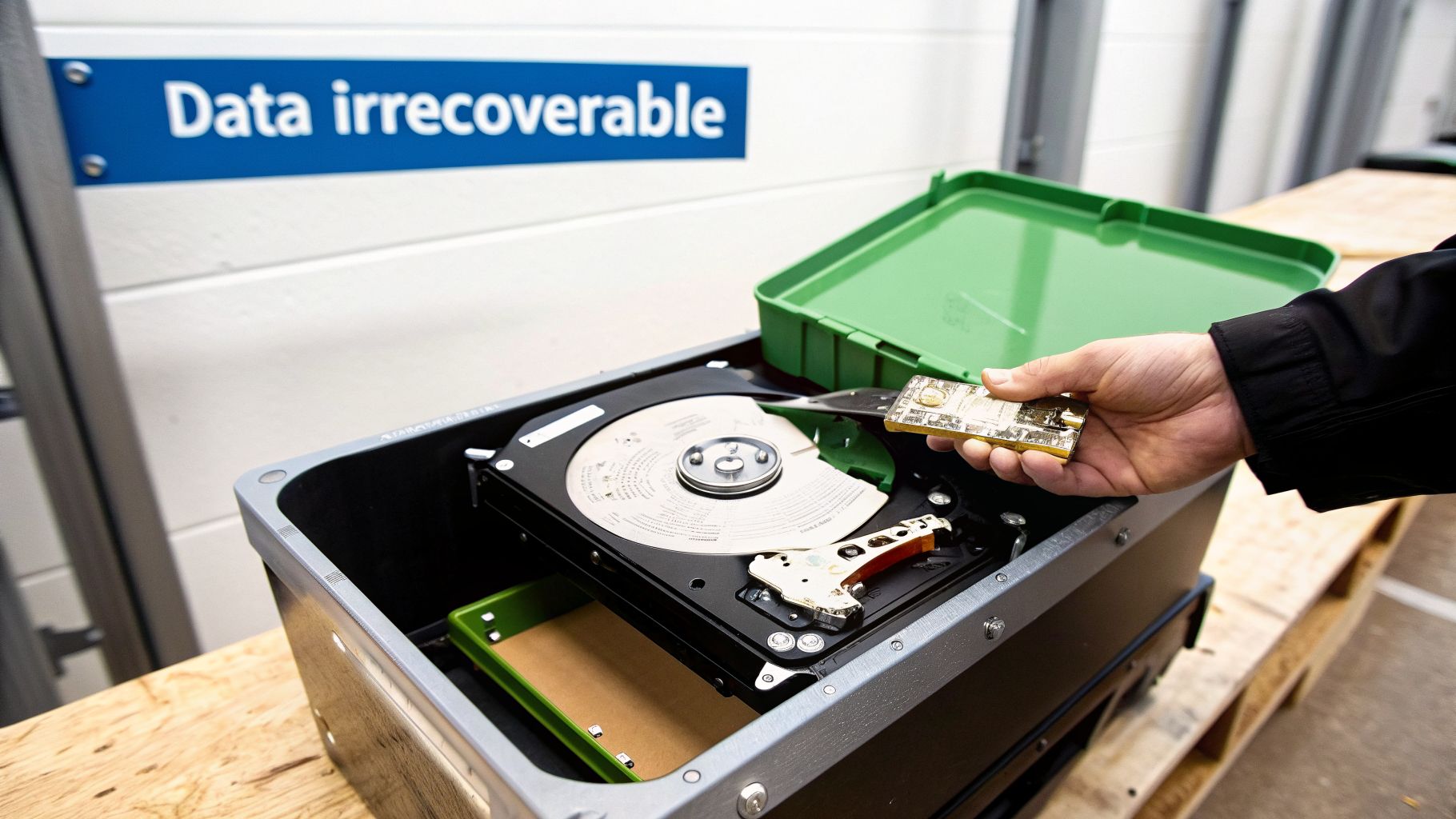
When you retire a server, what really happens to the data? Simply hitting 'delete' or even reformatting a hard drive isn't enough. Think of it like crumpling up a sensitive blueprint and tossing it in a public dumpster—that information is still very much recoverable for someone who knows what they're doing.
This is a point we can't stress enough for IT managers and compliance officers across Gwinnett County and the entire country. Real data security for old servers means making that data permanently and irreversibly gone. Anything less is a gamble with your company's reputation and security.
Thankfully, there are proven, ironclad methods to make data completely unrecoverable. These aren't just about hiding information; they're about total obliteration.
Software Sanitization: The Digital Overwrite
One of the most trusted methods is software sanitization. It's like digitally sanding down a wooden board. You aren't breaking the board, but you're removing every trace of what was written on it, layer by layer, until it’s perfectly clean.
The whole point is to overwrite the drive’s entire surface—not just once, but multiple times with specific data patterns. This process scrambles any residual magnetic signatures, making it impossible for even advanced forensic tools to reconstruct the original files.
The gold standard here is the DoD 5220.22-M 3-pass sanitization. This is a U.S. Department of Defense protocol that uses a specific three-step overwrite, which is why it's trusted for high-level government and enterprise security.
Here’s a simple breakdown of how it works:
- Pass 1: Writes a pattern of all zeros across the entire drive.
- Pass 2: Follows up by writing a pattern of all ones.
- Pass 3: Finishes with a pass of random characters.
For any business that might want to reuse or resell its hard drives, this is the perfect solution. It securely wipes the drives clean before they ever leave your facility.
Physical Destruction: The Final Word in Security
While software wiping is incredibly thorough, some situations just call for a more absolute approach. When you're dealing with failed drives, obsolete hardware, or the most stringent security protocols, physical destruction is the only way to go.
This method leaves absolutely zero room for doubt. It’s the difference between using a paper shredder and an industrial woodchipper on your sensitive documents. The storage media is physically annihilated, so data recovery is simply not possible.
For organizations that need 100% verifiable, failsafe destruction, this is the route we recommend. It offers total peace of mind that your data will never see the light of day again.
The main technique we use is industrial shredding. We feed hard drives, SSDs, and other media into high-torque shredders that grind them into small, twisted metal fragments. The pieces are unrecognizable and completely useless. For a closer look, you can check out our guide on professional hard drive shredding.
Deciding between these two methods comes down to your company's security policies, compliance rules, and whether the drives have any resale value. As specialists in server disposal services in Gwinnett County Georgia and nationwide, we can look at your inventory and recommend the right course of action to ensure your data is destroyed permanently and verifiably.
Navigating Data Compliance Laws in Georgia and Beyond
Getting rid of old servers isn't just a matter of cleanup; it's a serious legal responsibility. For any business in Gwinnett County or elsewhere in the U.S., how you handle that last step is tied directly to a tangled mess of data privacy laws. Get it wrong, and you could be facing staggering fines and a damaged reputation.
Think of it like this: a restaurant has to follow strict health codes, and in the same way, your business has to follow data codes. These rules are in place to protect your customers and hold you accountable for the information you’ve collected. That's exactly why professional server disposal services in Gwinnett County Georgia and our nationwide solutions are structured to keep your organization compliant and out of trouble.
Federal Mandates With Local and National Impact
Many of the toughest data protection laws come from the federal level, but they hit home for local Gwinnett businesses and companies nationwide. Industries like healthcare and finance are under a microscope, with ironclad rules on how data must be managed from the moment it's created to the day it's destroyed.
Two of the biggest ones you need to know are:
- HIPAA (Health Insurance Portability and Accountability Act): This is the gold standard for protecting sensitive patient health information (PHI). Any hospital, clinic, or healthcare provider has to make sure PHI on old servers is 100% unrecoverable.
- FACTA (Fair and Accurate Credit Transactions Act): This law applies to any business using consumer reports—from banks to car dealerships. It demands you properly destroy that information before you throw out the hardware, all to prevent identity theft.
Imagine a medical clinic in Lawrenceville upgrading its server room. If they just toss their old equipment without certified data destruction and patient records get out, they’re looking at crippling HIPAA fines—potentially millions of dollars—not to mention the complete loss of patient trust.
State-Specific Data Privacy Rules
On top of federal laws, states have their own rules that add another layer of responsibility. The Georgia Personal Identity Protection Act (GPIPA) makes it mandatory for businesses to notify people if their personal information is compromised in a data breach. Other states, like California with its CCPA/CPRA, have even stricter requirements.
But here’s the critical part: many state laws require businesses to "properly dispose of business records… by shredding, erasing, or otherwise modifying the personal information in the records to make it unreadable or indecipherable." This isn't a suggestion; it's a legal command.
This state-level requirement is exactly why you need a documented, defensible disposal process. Beyond state rules, it's also smart to understand broader frameworks like the HIPAA compliance standards, which offer a great blueprint for rigorous data handling.
The Role Of Auditable Compliance Documentation
So, how do you prove you did everything right? This is where professional documentation becomes your legal shield. A reputable server disposal partner will provide two key documents that act as your official proof of compliance.
- Chain of Custody: This log meticulously tracks your servers from the moment they leave your control. It records every single handoff, creating an unbroken and secure chain of responsibility right up until the data is gone for good.
- Certificate of Destruction: Once the data has been wiped or the drives have been physically shredded into tiny pieces, you get this certificate. It’s a formal document that confirms the "what, when, where, and how" of the destruction, complete with the serial numbers of the destroyed hard drives.
These aren't just receipts; they are crucial legal records. If you ever face an audit or a legal question, a Certificate of Destruction is your undeniable proof that you took every necessary step to protect sensitive data. To see why this is so important, take a look at our article explaining what a Certificate of Destruction covers and why it’s essential for your records.
The Step-by-Step Server Disposal Process
So, what actually happens to your old servers once they leave your facility? For many IT managers in Gwinnett County and across the country, the process can seem like a black box, full of questions about security and compliance. We believe in total transparency. Our professional server disposal service is a clear, structured, and secure path from start to finish.
Let’s walk through exactly how we handle a server rack from the moment we hear from you to the final certification, so you know precisely what to expect for your next IT refresh.
Step 1: Initial Consultation And Quote
It all starts with a simple conversation. You’ll connect with one of our disposal specialists to go over your project's details. Are we talking about a single server, or is it time to decommission an entire server room? Do the drives have potential resale value, or are they destined for the shredder?
We’ll gather all the key details to build a straightforward plan and a transparent quote. This includes the quantity of equipment, your specific location, and any compliance mandates you’re working under, like HIPAA or FACTA. This way, you know the full scope and cost right from the beginning.
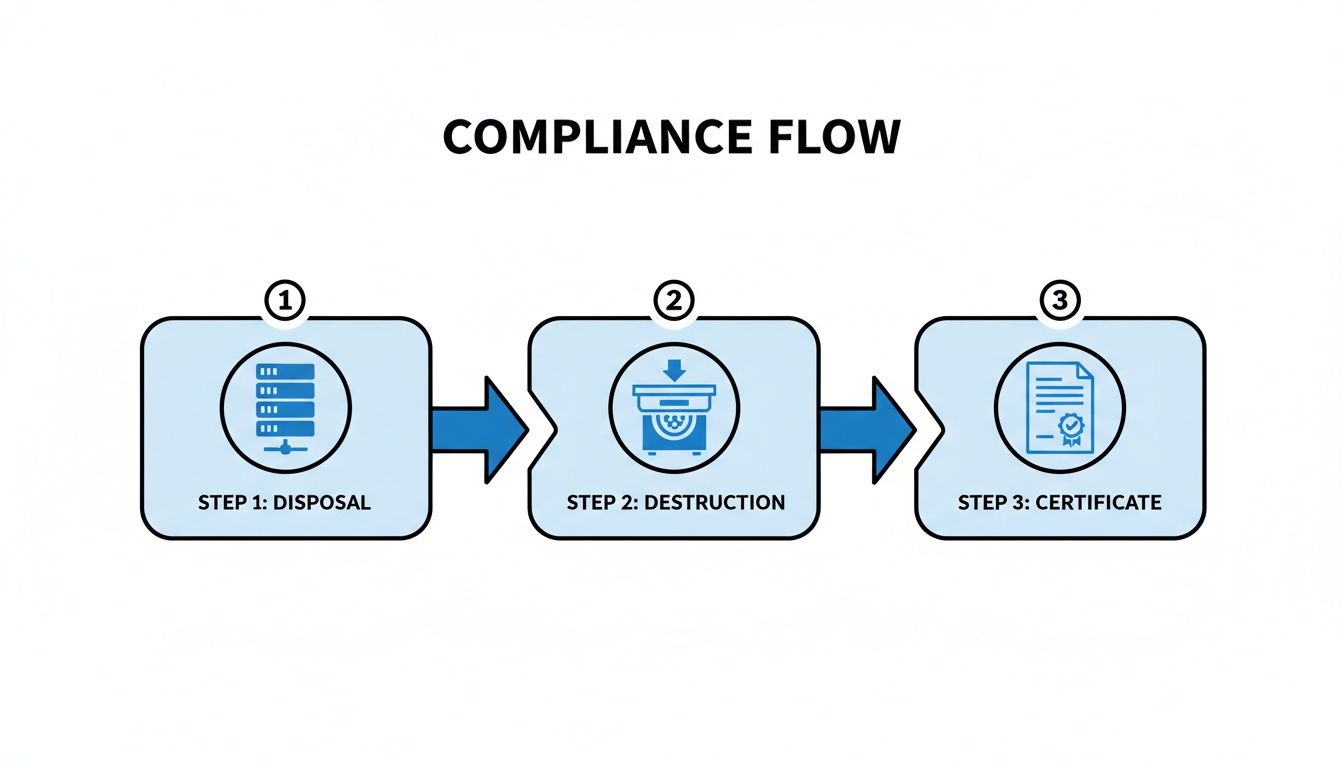
As you can see, the entire process is built for maximum security and complete accountability.
Step 2: Secure On-Site Logistics And Transport
Once you approve the plan, our team gets to work. Trained technicians will arrive at your site—whether it’s a corporate office in Suwanee, a data center in Norcross, or a facility anywhere in the U.S.—ready to manage all the physical de-installation. This is a specialized crew, not a standard moving company, trained specifically for handling sensitive IT hardware.
On-site, our team handles everything:
- De-installation: Carefully disconnecting all servers from racks, cabling, and power sources.
- Inventory: Creating a detailed catalog of each asset, capturing serial numbers to establish a clear chain of custody.
- Secure Packing: Safely palletizing and wrapping the equipment to prevent any damage during transit.
After every item is logged, it’s loaded into a secure, GPS-tracked vehicle. This provides a documented, monitored journey from your facility to our certified processing center, giving you auditable proof of secure handling.
Step 3: Data Destruction And Asset Processing
When the equipment arrives at our secure facility, the first thing we do is cross-check the inventory against the manifest from your location. Now for the most critical step: permanent data destruction. Based on our initial consultation, your hard drives are processed using one of two industry-standard methods.
Data Sanitization vs. Physical Destruction
Choosing between wiping and shredding depends on your security needs and the value of your hardware. Here’s a quick breakdown to help you decide.
| Method | Process Explained | Best For | Compliance Level |
|---|---|---|---|
| Data Sanitization | We use DoD 5220.22-M 3-pass wiping software to overwrite every single sector of the drive, making data irrecoverable. | Newer, functional drives that have resale or redeployment value. | High – Meets most data privacy regulations. |
| Physical Destruction | Drives are fed into an industrial shredder that grinds the platters and electronics into small metal fragments. | Older, failed, or end-of-life drives; or for maximum security assurance. | Absolute – Exceeds all compliance standards. |
This dual-method approach gives you flexibility. You can securely erase data from newer assets to recover value while ensuring older or highly sensitive hardware is completely destroyed—all within one compliant process.
Step 4: Responsible Recycling And Final Certification
With all data verifiably destroyed, our focus shifts to environmental stewardship. The now-inert server components are completely disassembled. All materials—steel, aluminum, copper, and plastics—are carefully segregated and directed to our certified downstream recycling partners.
This R2-compliant process ensures that nearly 100% of the material is kept out of landfills, meeting both local Gwinnett County and national environmental standards.
Finally, we send you the most important document of the entire service: the Certificate of Destruction. This legally binding certificate is your official proof of compliance. It lists the serial numbers of the assets we processed and confirms the date and method of destruction, giving you a complete, auditable trail that closes the loop on your liability.
This comprehensive approach is crucial for servers and all other types of IT hardware. To learn more about managing a wider range of assets, check out our guide to data center equipment recycling in Gwinnett County, GA.
Who Needs Server Disposal in Gwinnett and Metro Atlanta
The need for professional server disposal isn't a niche problem. We see it across every major sector in Gwinnett County, the greater Metro Atlanta area, and throughout the United States. From sprawling hospital networks to local government offices, organizations of all sizes eventually have to retire old IT hardware. The one thing they all have in common? They absolutely must protect sensitive data and meet tough compliance rules.
Think of it this way: you wouldn't take a high-performance race car to a mechanic who only works on school buses. The server disposal needs of a hospital are worlds apart from a corporate data center, even if the end goal—total data destruction—is the same. Our server disposal services in Gwinnett County Georgia are built to handle these unique, industry-specific demands.
Hospitals And Medical Labs
For any healthcare provider, getting rid of old servers is a high-stakes job ruled by the Health Insurance Portability and Accountability Act (HIPAA). One single server can hold the electronic Protected Health Information (ePHI) for thousands of patients. A mistake here isn't just an oversight—it's a major violation that can bring on seven-figure fines and destroy a facility's reputation.
Picture a medical lab in Snellville upgrading its equipment and taking the old servers offline. Those drives are packed with patient test results, personal details, and billing histories.
- The Challenge: The lab has to prove, without a doubt, that every last byte of ePHI was wiped clean according to HIPAA standards before the hardware is touched by a recycler.
- The Solution: We provide on-site asset tagging, certified DoD 5220.22-M data sanitization or physical shredding, and issue a formal Certificate of Destruction. This is the hard-copy proof you need to pass any audit and avoid legal trouble.
Universities And School Systems
Educational institutions are constantly cycling through a massive inventory of IT assets. Their servers are loaded with everything from confidential student records and faculty research to financial aid information. When it's time for a bulk refresh—often during summer break—it creates a huge security and logistical headache.
Take a large school district in Buford, for example, refreshing servers across two of its high schools. You're talking about hundreds of hard drives filled with student data protected under the Family Educational Rights and Privacy Act (FERPA).
The sheer volume of equipment makes trying to manage this in-house almost impossible. A coordinated, professional service is the only way to guarantee no drive gets missed, preventing a data breach that could impact thousands of students and their families.
Corporate Data Centers
Gwinnett County, especially around cities like Norcross and Suwanee, is a major hub for data centers. These facilities are the engines of our digital economy, and they're always undergoing large-scale equipment upgrades. Decommissioning hundreds of servers at once demands perfect planning to keep an unbreakable chain of custody without disrupting live operations.
A biotech firm in Suwanee closing down a research lab is a perfect case. They have a tight deadline to vacate the building, but they also have to make sure years of proprietary R&D data is destroyed for good. A specialized disposal partner can run the entire project—from de-installing racks and secure transport to certified destruction and recycling.
Government Agencies
From Lawrenceville to the surrounding communities, local and state government offices handle our most sensitive information. We're talking citizen records, financial data, and law enforcement files. When these agencies dispose of assets, the process has to be completely secure, transparent, and documented for public accountability.
For a county government office retiring its file servers, there is zero room for error. They need a partner who provides:
- Secure Logistics: Vetted technicians and GPS-tracked trucks to ensure assets are secure from the moment they leave the building.
- Auditable Reporting: Detailed inventory lists and serialized Certificates of Destruction are non-negotiable for internal audits.
- Compliance: Strict adherence to all local, state, and federal data security regulations is a must.
At the end of the day, it doesn't matter if you're a hospital protecting patient data or a data center clearing out old racks. The core need is identical. Professional server disposal services in Gwinnett County Georgia and across the U.S. deliver the expertise required to protect your organization, guarantee compliance, and give you complete peace of mind.
How to Schedule Your Server Disposal Service
Taking the final step to get your old servers securely off-site should be the easiest part of the job. We've designed our entire process to be simple and quick, giving you a direct path to compliance and total peace of mind. When you need professional server disposal services in Gwinnett County, Georgia, or anywhere nationwide, a quick call or message is all it takes to get a no-obligation quote.
Our job is to take the entire logistical burden off your team's shoulders. You get the confidence that comes from knowing a single, certified vendor is handling every last detail—from the moment we arrive for pickup to the second you receive the final Certificate of Destruction.
Our Simple Scheduling Process
We know your time is valuable. That’s why we’ve boiled down our scheduling process to just a few quick steps. It doesn't matter if you have a single server rack or an entire data center to decommission; our national team is ready to get it done.
- Request a Quote: The whole process starts when you reach out with the details of your project. We'll just need to know the amount of equipment you have, your location, and if you have any specific compliance requirements we need to meet.
- Receive Your Plan: We'll turn that information into a transparent quote and a clear project plan. This document lays out everything, from the logistics and transport to the exact data destruction methods we'll be using.
- Schedule Your Pickup: Once you give the plan a thumbs-up, we'll work with you to find a pickup time that fits your schedule. Our crew handles all the heavy lifting and ensures every asset is securely transported.
This is how we guarantee minimal disruption to your daily operations while providing maximum security for your sensitive data.
Serving All Of Gwinnett And Beyond
Our roots are right here in Gwinnett County, and we're proud to offer our services to businesses in our local community and across the entire United States. Whether you're in the heart of the county or in another state, our fleet is ready to roll.
We provide full coverage across Gwinnett, including all the major business hubs like:
- Lawrenceville
- Duluth
- Norcross
- Suwanee
- Buford
The biggest advantage of working with us is getting fast, responsive service with the certified capabilities needed to meet nationwide compliance standards. We offer the agility of a local provider backed by the power of a national logistics network.
Beyond Gwinnett, our service area covers the entire Metro Atlanta region and extends to all 50 states. We make sure businesses everywhere can get access to secure, compliant, and professional IT asset disposition.
Ready to clear out that old equipment and lock down your data for good? The next step is easy. You can schedule a pickup today and let us handle all the complex details so you can get back to focusing on your business.
Common Questions About Server Disposal
When it's time to retire old servers, we find that IT managers and business owners in Gwinnett County and across the country often have similar questions. Here are some of the most common ones we get, with straightforward answers to help you navigate the process.
Do You Only Work In Gwinnett County?
While we are proud to offer server disposal services in Gwinnett County, Georgia, our teams operate all across the United States. We regularly handle projects from downtown Atlanta to Los Angeles, ensuring every business has access to secure and professional IT disposal.
How Much Does Server Disposal Cost?
There's no simple, one-size-fits-all price because every job is different. The final cost really comes down to a few key details about your project.
Your quote will be based on:
- The amount of equipment: How many servers and other assets need to be processed.
- Logistics: Factors like whether you need us to handle on-site de-installation and how accessible your facility is.
- Data Destruction: Your choice between software wiping and physical shredding will also affect the cost.
We always provide a transparent, no-obligation quote before any work begins, so you’ll see all the costs upfront.
As part of our standard service, we include free hard-drive wiping using the DoD 5220.22-M 3-pass method. This gives you outstanding security at a great value. If your compliance rules demand total physical destruction, we also offer shredding for an additional fee.
What Happens to the Servers After You Destroy the Data?
Once the data is gone for good and we've verified it, the servers are taken apart completely. Our commitment is to responsible recycling, which means absolutely nothing ends up in a landfill.
Every component—steel, aluminum, plastics, and the precious metals found on circuit boards—is sorted and sent to our certified downstream recycling partners. This R2-compliant process guarantees that nearly 100% of the material is recovered and repurposed, helping you meet environmental standards and your own corporate sustainability goals. It’s a core part of how we do business nationwide.
Ready to get those old servers handled the right way? Contact Scientific Equipment Disposal for a free, no-obligation quote for your Gwinnett County business or any location in the U.S. Our experts will manage the entire process, giving you complete peace of mind. Learn more and schedule your service today.