Medical Equipment Recycling vs Disposal: Choosing the Best Path in 2026


When it's time to retire old medical equipment, your facility faces a big decision: recycle or dispose? This isn't just about clearing out a storage room. How you answer that question has real-world consequences for your budget, your legal compliance, and your organization's reputation, whether you're a local clinic or a national healthcare system.
While simply tossing old equipment—disposal—might seem like the easiest route, it’s often the riskiest. A thoughtful recycling strategy, on the other hand, offers a much smarter path forward by recovering value, guaranteeing data security, and demonstrating a commitment to sustainability for facilities nationwide.
The Strategic Choice Between Recycling and Disposal
For any healthcare or research facility, managing the lifecycle of equipment is a constant operational challenge. That moment an asset reaches the end of its useful life, the decision to recycle or dispose isn't just a janitorial task; it’s a strategic one. It's about smart financial planning, staying on the right side of the law, and being a good environmental steward, no matter where your facility is located.
Disposal usually just means sending equipment to a landfill. It feels quick, but this "out of sight, out of mind" approach comes with hidden costs and serious environmental liabilities. Recycling is a completely different, circular process. It involves de-manufacturing equipment to reclaim valuable materials like metals and plastics that can be used again. You can see how this works by learning more about a proper medical equipment recycling program.
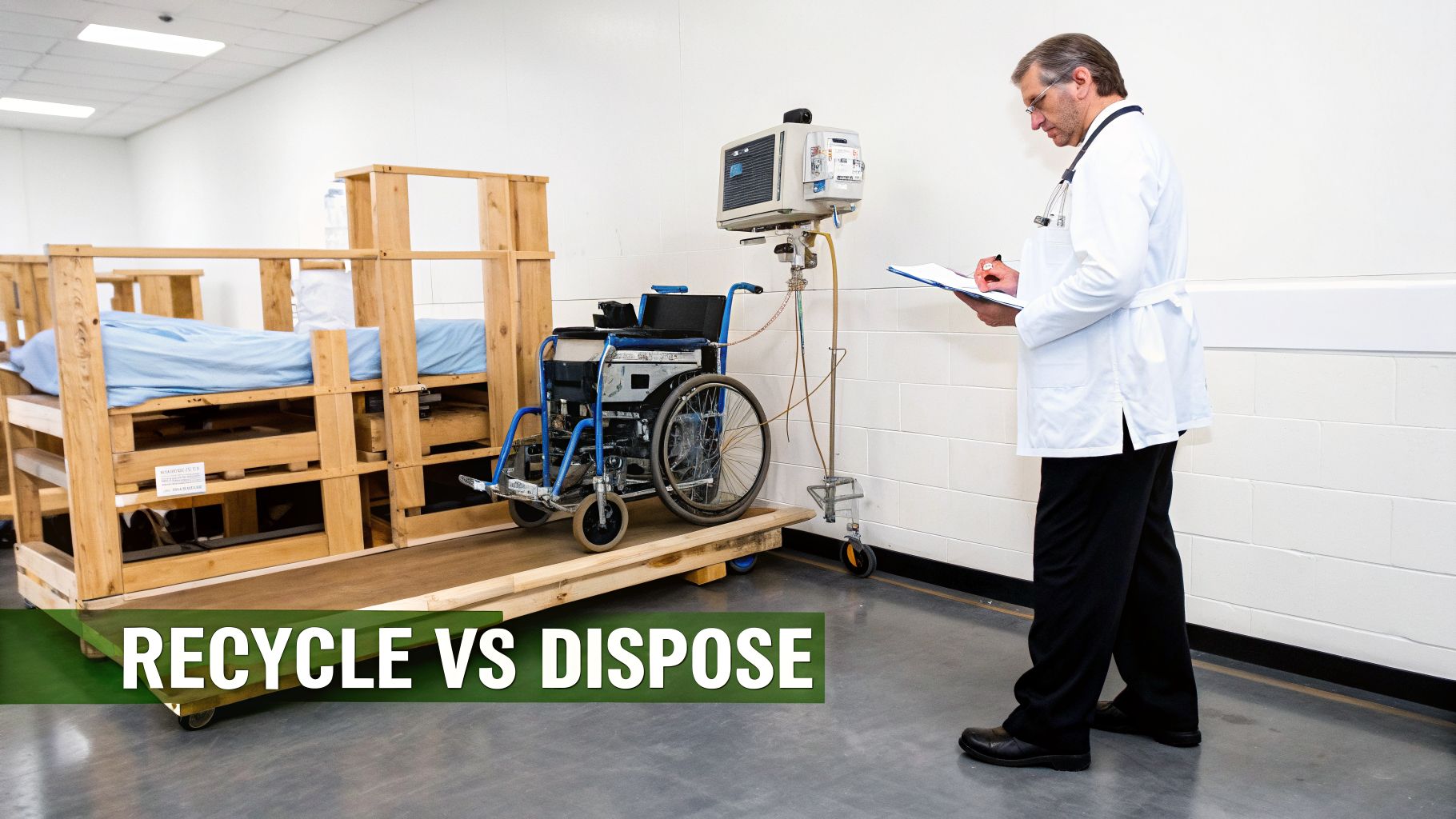
Why Recycling Matters More Than Ever
Let's be blunt: our healthcare infrastructure is expanding, and so is the mountain of medical waste. Simply throwing it all away is an incredibly inefficient model. Consider that the global market for medical waste containers—most of which feed directly into disposal systems—is projected to jump from USD 2.25 billion in 2025 to USD 3.88 billion by 2032.
This trend represents a huge missed opportunity. Much of that "waste" is full of valuable rare earth metals and other reclaimable materials. Recycling not only captures this value but also prevents complex electronics from being dumped in landfills or exported as e-waste.
Working with a certified recycling partner is the best way to navigate this landscape. Whether you need local service or a provider with a national reach, the right partner protects your organization from the legal headaches of improper disposal and solidifies your reputation as an environmentally responsible leader.
| Aspect | Medical Equipment Disposal | Medical Equipment Recycling |
|---|---|---|
| Primary Goal | Quick removal of unwanted assets. | Securely recover value and destroy data. |
| Process | Equipment is hauled to a landfill or incinerator. | Equipment is de-manufactured, sorted, and processed for material reuse. |
| Environmental Impact | High. Adds to landfills and risks soil/water contamination. | Low. Conserves resources and cuts down on e-waste. |
| Data Security | High risk. Data-bearing devices are often left intact and exposed. | High security. Includes certified data wiping and physical shredding. |
| Compliance Risk | Significant. High potential for costly EPA and HIPAA violations. | Mitigated. A documented chain of custody proves compliant handling. |
Recycling vs. Disposal: Understanding the Two Paths
When you're deciding between medical equipment recycling and disposal, you need to know exactly what you're choosing. These aren't just two words for getting rid of old gear. At their core, they represent completely different mindsets—one is a dead end, and the other is a continuous loop. Making the right call affects your budget, your legal standing, and your facility’s reputation.
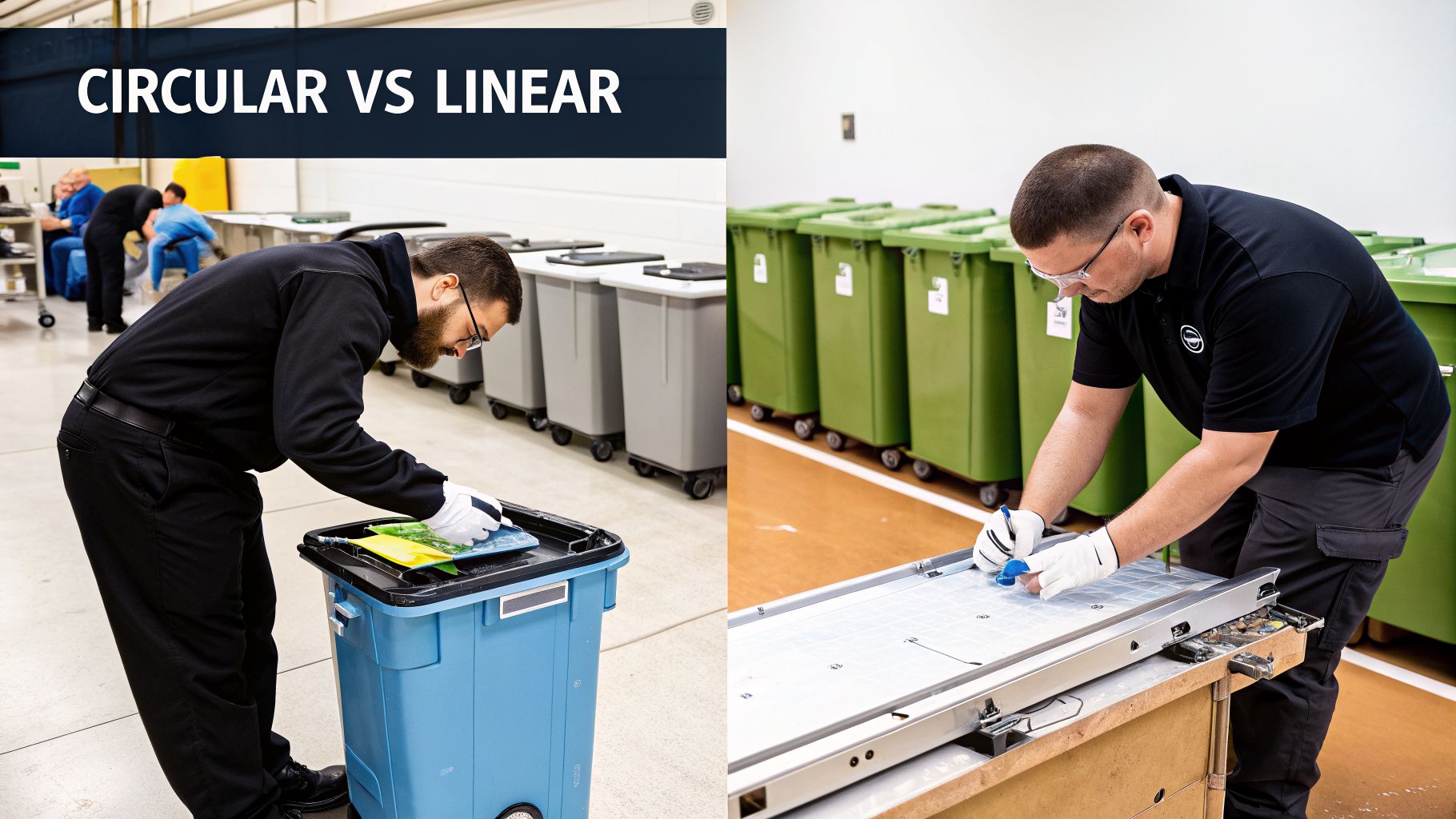
What is Medical Equipment Disposal?
Think of medical equipment disposal as a one-way street. Its only goal is removal. The process is simple: retired assets get picked up and hauled to their final stop, which is almost always a landfill or an incinerator. Once it's dumped, the process is over.
This approach seems fast and easy, but that simplicity is where the risks are hiding. If you’re not careful, devices full of sensitive data can get exposed. Hazardous materials can leach into the ground. Both of these mistakes can lead to major fines and compliance headaches.
What is Medical Equipment Recycling?
Medical equipment recycling is a much smarter, circular process focused on resource conservation and complete security. Instead of treating an old machine like trash, recycling sees it as a collection of valuable raw materials. This is the foundation of responsible laboratory equipment recycling and disposal solutions.
The recycling workflow has several key steps:
- De-manufacturing: We carefully take apart each piece of equipment to get to its core components.
- Data Destruction: Any hard drives or storage media are physically shredded or wiped clean using certified methods. The data is gone for good.
- Material Sorting: We separate everything into clean streams—metals, plastics, glass, circuit boards, and more.
- Processing: Those sorted materials are then cleaned up, refined, and prepared to be sold back to manufacturers.
This circular approach turns what could be a liability into a genuine asset. For example, recycling the copper from old electronics uses up to 85% less energy than mining new copper ore.
The difference here is massive, whether you're a major hospital system in Atlanta or a small clinic in a rural town. Disposal might seem like a quick fix, but you're just pushing environmental and data security risks down the road for someone else—or your future self—to deal with.
Recycling, on the other hand, handles that responsibility upfront. It creates a documented, secure, and sustainable path for your retired assets. It actively stops waste, saves natural resources, and gives you a clear audit trail to prove compliance. This turns the choice between medical equipment recycling vs. disposal from a waste problem into a strategic decision about managing your assets correctly.
Comparing Costs, Compliance, and Environmental Impact
Deciding between medical equipment recycling and disposal isn't just about clearing out space. It's a critical decision that hits your budget, your legal standing, and your facility’s reputation. While just throwing equipment away might seem simpler upfront, a closer look shows that proper recycling almost always provides better long-term value and security for facilities across the US.
The initial price tag is where most people start comparing, but that's a classic mistake. To understand the true cost, you have to look past the hauling fee and consider the whole financial picture, including hidden risks, long-term liabilities, and even potential cash back.
A Deeper Look at Financial Costs
Disposal often looks cheaper on the surface. You get a quote for a truck to haul everything to the landfill, you pay the invoice, and the equipment is gone. Simple, right? The problem is that this price tag doesn't cover the huge financial risks of doing it wrong, like massive EPA fines for dumping hazardous e-waste or penalties for HIPAA violations if patient data isn't completely destroyed.
Recycling, on the other hand, comes with service fees for certified de-manufacturing, data destruction, and materials processing. Yes, this upfront cost can be higher than a basic disposal quote, but think of it as an insurance policy. It protects you from catastrophic compliance failures down the road.
A single HIPAA violation can cost a healthcare facility anywhere from $100 to $50,000 per violation record, with a staggering annual maximum of $1.5 million. Certified data destruction, which is a core part of the recycling process, wipes out this risk entirely, making it one of the smartest financial moves you can make.
Better yet, recycling can actually put money back in your pocket. A lot of medical and lab equipment is packed with valuable commodities like copper, aluminum, and stainless steel. A certified recycling partner can recover these materials and often provide a rebate, helping to offset—or even exceed—the initial service costs.
Navigating the Complexities of Compliance
Compliance is where the medical equipment recycling vs disposal debate gets really serious. Sending equipment to a landfill is a high-stakes gamble. Your organization remains legally responsible for that asset "from cradle to grave." If it's dumped improperly or sensitive data is exposed later on, the liability trail leads straight back to you.
This creates a massive headache, especially for healthcare providers who have to follow a strict set of rules nationwide:
- HIPAA: The Health Insurance Portability and Accountability Act is non-negotiable. It requires the absolute destruction of all electronic Protected Health Information (ePHI) before equipment ever leaves your facility.
- EPA Regulations: Under the Resource Conservation and Recovery Act (RCRA), many electronic components are classified as hazardous waste. Tossing them in a landfill isn't just irresponsible—it's illegal.
Certified recycling gives you a clear, defensible compliance strategy. A professional partner provides a full chain of custody from the moment your equipment is picked up. This includes documented, certified data destruction and proof that every component was handled according to federal and state environmental laws. That paperwork is your shield if regulators ever come knocking.
To make it simple, here’s a quick-reference summary comparing the key aspects of medical equipment recycling and traditional disposal for healthcare and lab facilities.
Recycling vs. Disposal: A Head-to-Head Comparison
| Factor | Medical Equipment Disposal | Medical Equipment Recycling |
|---|---|---|
| Financial Outlook | Lower upfront cost but high risk of hidden fees and fines. No potential for material rebates. | Higher initial service fee but protects against major compliance penalties. Offers potential for revenue from recovered materials. |
| Compliance Risk | High. You retain cradle-to-grave liability for HIPAA and EPA violations, with little to no documentation to prove proper handling. | Low. A certified partner provides a full chain of custody, including a Certificate of Data Destruction, shifting liability. |
| Environmental Footprint | Negative. Contributes directly to landfill burden, e-waste pollution, and the consumption of virgin resources. | Positive. Conserves natural resources, reduces carbon emissions, and promotes a circular economy. |
As you can see, while disposal might seem like the path of least resistance, recycling is the far smarter choice for protecting your facility's finances, legal standing, and reputation.
The Stark Environmental Differences
The environmental impact of your choice is huge and undeniable. Disposal is a one-way ticket to the dump. When a complex piece of medical equipment gets buried in a landfill, it doesn't just take up space. It can leach hazardous materials like lead, mercury, and cadmium into the soil and groundwater for decades. It's a complete waste of all the resources and energy that went into making it.
Recycling flips the script. It follows a circular model, treating retired equipment not as trash, but as a valuable source of raw materials. This mindset is becoming more and more critical as the world looks for sustainable solutions.
That’s exactly why the global medical device recycling market is projected to grow significantly through 2032. This boom is fueled by the clear environmental and financial benefits of pulling valuable metals and plastics out of old equipment so they can be used again.
By choosing to recycle, your facility becomes an active part of this positive change. For those looking to go even greener, our guide on implementing sustainable laboratory practices offers more great ideas. This one decision helps conserve natural resources, cuts down the carbon footprint from mining and manufacturing, and protects ecosystems from toxic e-waste. It sends a powerful message about your organization's commitment to being a responsible corporate citizen.
Meeting HIPAA and EPA Regulatory Requirements
When it comes to getting rid of old medical or lab equipment, you can't just toss it in a dumpster and hope for the best. The decision to recycle versus dispose of your assets is loaded with legal requirements, mostly coming from two major federal agencies: HIPAA for patient data and the EPA for environmental safety.
Ignoring these rules isn't just a bad idea—it's a massive risk. You have to know what's expected of you, because federal and state regulators have very specific rules about protecting both sensitive information and the environment. Getting this wrong can lead to serious fines and legal headaches.
The HIPAA Security Rule and Data Destruction
The Health Insurance Portability and Accountability Act (HIPAA) is direct and to the point: your facility is legally on the hook for protecting electronic Protected Health Information (ePHI) from the moment it’s created until it’s permanently destroyed. That responsibility doesn't just vanish when a machine is unplugged for the last time. The HIPAA Security Rule demands that any ePHI on a device must be made totally unreadable, indecipherable, and impossible to recover before it ever leaves your sight.
A lot of people think hitting "delete" or reformatting a hard drive is good enough. It's not. Data can easily be pulled from wiped drives, which leaves your organization wide open to a data breach and the crippling fines that follow.
This is exactly where a certified recycling partner has a huge advantage over simple disposal. A proper, compliant recycling program always includes documented data destruction. Professional recyclers use federally approved methods to guarantee every last bit of data is gone for good.
These methods include:
- DoD 5220.22-M Wiping: This is a multi-pass process that overwrites the entire hard drive with random patterns of ones and zeroes. It effectively sanitizes the drive, making the original data completely unrecoverable.
- Physical Shredding: For equipment that’s broken or held extremely sensitive information, nothing beats physical destruction. Industrial shredders turn hard drives and other media into tiny, shredded pieces of metal and plastic that can never be reassembled.
- Certificate of Destruction: Once the data is destroyed, a certified partner gives you a Certificate of Data Destruction. This is your legal proof, a document showing you followed a secure chain of custody and met your HIPAA obligations. You can see how this all comes together in our guide on HIPAA compliant medical equipment disposal services.
EPA Regulations and Hazardous E-Waste
On top of the data security rules, you've got environmental regulations from the Environmental Protection Agency (EPA) to worry about. The Resource Conservation and Recovery Act (RCRA) classifies many common parts in medical and lab equipment as hazardous waste.
This covers things you’ll find in almost any facility, such as:
- Old monitors with Cathode Ray Tubes (CRTs), which are full of lead.
- Circuit boards, which often contain lead, mercury, and cadmium.
- Batteries, filled with corrosive acids and heavy metals.
Throwing these materials into a landfill isn't just bad for the environment—it's often illegal. Many states, including Georgia, have their own e-waste laws banning these items from regular trash. For healthcare organizations, this means treating compliance as a continuous system, not just something to think about during an audit.
If you choose the disposal route, you're risking fines for violating RCRA and state laws. And with "cradle-to-grave" liability, your responsibility doesn't end when the equipment is hauled away. If those assets are found illegally dumped months or years later, the legal and financial mess comes right back to you.
Certified recycling is the clear, compliant solution here. It ensures all those hazardous materials are managed, recovered, and processed according to strict EPA rules. A good recycling partner documents the entire trail, giving you the proof you need to show you’ve acted responsibly and protecting you from massive regulatory penalties. For managing both data and environmental risks, recycling is simply the smarter, safer path.
A Framework For Choosing The Right Option
Alright, let's move from theory to practice. As a facility or lab manager, you need a clear, repeatable process for deciding what to do with retiring assets. The choice between medical equipment recycling vs disposal isn't one decision—it's a series of evaluations you have to make for every single piece of equipment you’re taking offline.
Having a structured approach is the only way to ensure every item is handled in a compliant, secure, and responsible way. This helps you get past the "one-size-fits-all" trap and apply the right process to the right equipment, whether your facility is here in Atlanta or anywhere else in the country.
The Core Decision Matrix
To make your life easier, we recommend evaluating each retired asset with a simple decision matrix. It really just comes down to asking a sequence of questions that point you to the correct path. The big factors are always data sensitivity, physical condition, contamination risk, and material makeup.
Start by asking these four critical questions about any piece of equipment:
- Does it store electronic data? Anything with a hard drive, memory card, or internal storage holds data. This includes servers, computers, and even advanced imaging machines. If it stores ePHI, secure and documented data destruction isn't just a good idea—it's a non-negotiable first step.
- Does it contain hazardous materials? A surprising amount of electronics contain lead, mercury, or cadmium. The EPA’s Resource Conservation and Recovery Act (RCRA) classifies these as hazardous e-waste, and it's illegal to dump them in a landfill in many states.
- Has it been exposed to biohazards? Equipment that was used in patient care or lab settings could have come into contact with biological agents. Your facility is on the hook for full decontamination and certification before anyone can handle it for recycling.
- Is it in refurbishable condition? If a machine is still functional and not completely obsolete, donation or resale might seem like an option. Just remember, this path still demands certified data sanitization and a clean, documented transfer of liability.
This decision tree gives you a visual for mapping out the first few compliance steps for any piece of equipment.
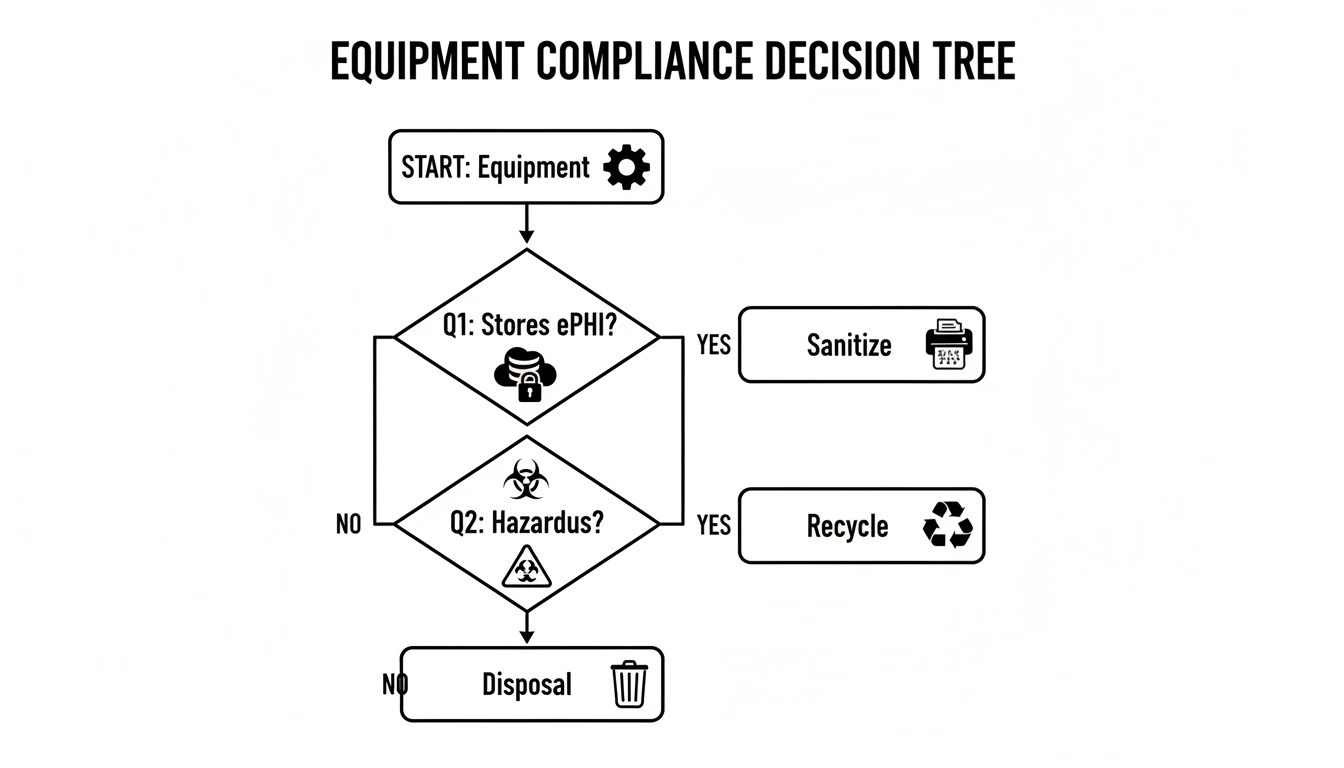
As the flowchart shows, the minute ePHI or hazardous materials enter the picture, simple disposal is off the table. You're immediately routed toward a process that requires certified sanitization and recycling.
Applying The Framework: Real-World Scenarios
Let's walk through how this works with common situations we see every day from lab and facility managers across the country.
Scenario 1: A Decommissioned MRI Machine
An MRI is a beast of an asset. It’s a complex mix of powerful magnets, high-end electronics, and valuable metals like copper.
- Data: Yes. It absolutely stores patient scans, which is protected ePHI.
- Hazards: Yes. The electronic components are regulated e-waste.
- Decision: This requires a specialized recycling partner. The job has to start with on-site, certified data destruction. After that, the unit must be professionally de-installed and broken down to recover valuable metals and manage the electronics responsibly. Simple disposal is not a compliant option. Period.
Scenario 2: A Server Rack With Patient Data
That old rack of servers humming in a closet is one of the highest-risk assets in your facility.
- Data: Absolutely. The hard drives are packed with sensitive ePHI.
- Hazards: Yes, the circuit boards and power supplies are considered e-waste.
- Decision: Data destruction is the number one priority. Best practice is the physical shredding of every single hard drive to make the data 100% unrecoverable. You must get a Certificate of Destruction for your HIPAA audit trail. Only then can the leftover server chassis and components be sent for proper e-waste recycling.
For assets containing large volumes of ePHI, physical destruction is the gold standard. It eliminates any possibility of data recovery and provides the strongest legal proof of compliance.
Scenario 3: Retiring Lab Centrifuges
You have a batch of old centrifuges that just don't meet performance standards anymore.
- Data: Probably not, unless it’s a modern "smart" model that tracks user logs.
- Hazards: Yes, it contains a motor and electronic circuit boards. It also might have been exposed to biohazardous materials during its service life.
- Decision: First things first: your facility’s EHS department has to perform and document a full decontamination. Once you have that "certified clean" tag, the centrifuges must go to an electronics recycler who can properly handle the motors and circuitry. Tossing them in a dumpster would almost certainly violate state e-waste regulations.
Vetting Your Service Provider
Your decision-making framework is only as good as the partner you hire to execute it. When you're looking at vendors for medical equipment recycling nationwide, you need to see proof of their capabilities and compliance.
Here are the crucial credentials to ask for:
- R2 or e-Stewards Certification: These are the top-tier, third-party certifications for responsible electronics recycling. They're your assurance that a vendor follows strict rules for environmental safety and data security.
- Transparent Reporting: A good partner provides a complete chain-of-custody paper trail. This includes a Certificate of Data Destruction and detailed recycling reports you can keep on file.
- On-Site Capabilities: For large, heavy, or highly sensitive equipment, a vendor with their own fleet and trained technicians is a lifesaver. Having a team that can perform on-site de-installation and data destruction is invaluable, especially for facilities in busy metro areas like Atlanta.
Choosing a partner who checks these boxes is the final step in making sure your framework leads to secure, compliant, and sustainable results.
How a Specialized Partner Simplifies Equipment Disposition
Juggling the rules for medical equipment recycling and disposal is a massive headache for any healthcare or research facility. You're trying to balance HIPAA, EPA regulations, and your own sustainability goals, and it can feel like an impossible task. This is exactly where a specialized disposition partner comes in, turning a chaotic process into something clear, compliant, and manageable.

A full-service provider like Scientific Equipment Disposal (S.E.D.) becomes your single point of contact for everything. Instead of trying to coordinate different vendors for logistics, data destruction, and recycling, you get one team that handles it all. This approach is a lifesaver for facilities nationwide, especially those dealing with large-scale lab decommissions or major office cleanouts.
Ensuring Bulletproof Compliance and Security
The single biggest reason to work with a specialist is guaranteed compliance. A certified partner removes all the guesswork by creating a documented, auditable trail from the moment we arrive until the final report. This isn't just helpful—it's critical for meeting today's strict regulatory standards for local and national organizations.
We provide this peace of mind through a few key services:
- Certified Data Destruction: We perform free DoD 5220.22-M 3-pass sanitization on every functional hard drive, making ePHI completely unrecoverable. For drives that don't work, we offer physical shredding to guarantee total data elimination and full HIPAA compliance.
- Documented Chain of Custody: We track every asset at every step, from the initial de-installation to its final recycling certificate. This paperwork is your legal proof that everything was handled according to EPA and state rules.
When you hand over your assets to a certified partner, you're also transferring the liability for proper disposal. This is your shield against the massive fines and brand damage that come from a data breach or improper waste handling.
A Single Solution for Lab and IT Assets
Healthcare facilities are filled with more than just medical devices. There's a huge inventory of IT hardware, office electronics, and all kinds of specialized lab equipment. A major benefit of working with S.E.D. is that we know how to manage this entire mix of assets. We understand the specific needs for both sophisticated laboratory instruments and standard IT infrastructure, offering our services across the United States.
It doesn't matter if you need to retire a centrifuge, a server rack, or an entire floor of computers—we have the expertise to get it done. Our on-site crews manage the de-installation and logistics, carefully packing and moving everything from delicate analyzers to heavy machinery. This frees up your staff to focus on what they do best.
By providing comprehensive medical equipment removal and disposal services, a dedicated partner ensures that every single item—from a pipette to a patient monitor—is processed securely and sustainably. We turn a complex compliance puzzle into a simple, reliable solution that delivers total peace of mind.
Your Top Questions About Medical Equipment Disposition, Answered
When you're dealing with old medical equipment, a lot of practical questions come up. Whether you're a lab manager in Atlanta or a hospital administrator across the country, getting the right answers is the only way to make decisions you can stand behind.
Let's cut through the noise and address the most common concerns we hear every day.
Is Recycling Medical Equipment More Expensive Than Disposal?
Not always. It’s a common myth that just tossing equipment is the cheaper route. While certified recycling has an upfront service fee for proper handling and paperwork, it’s your best defense against massive EPA fines and the crippling cost of a data breach.
Disposal might look cheaper on the surface, but it's loaded with hidden financial time bombs. Plus, some of your retired assets might have real value. We often find that materials like copper and aluminum, or even whole high-value devices, can qualify for a rebate. This can seriously offset your initial costs, making proper recycling the smarter financial move in the long run.
What Kind of Medical Equipment Has To Be Recycled?
As a rule of thumb, if it has a circuit board, a screen, or a battery, it needs to be recycled. This covers a huge amount of the equipment you see in healthcare and research facilities every day:
- Patient monitors and infusion pumps
- Lab analyzers and centrifuges
- Old computers, servers, and all the IT hardware that supports them
These items are classified as e-waste. They’re often full of hazardous stuff like lead and mercury, which is why dumping them in a landfill is illegal in many states. It’s a major compliance and environmental risk you just can’t afford to take.
A big misconception we see is that only the big, complicated machines require special handling. The truth is, even small electronic devices are considered e-waste and legally must be kept out of landfills and sent to a certified recycler.
How Do I Make Sure Our Data Is Destroyed and We’re HIPAA Compliant?
This is non-negotiable. You have to work with a certified partner who provides documented, permanent data destruction. Look for a provider that uses validated methods like DoD 5220.22-M standard data wiping, degaussing for magnetic media, and of course, physical shredding.
And always, always get a Certificate of Data Destruction. This piece of paper is your legal proof that you followed a secure chain of custody. If you’re ever audited, this certificate is your get-out-of-jail-free card.
Can We Recycle Contaminated or Biohazardous Equipment?
This all comes down to proper pre-treatment, which is your facility's responsibility. Before any equipment leaves your site, your team must decontaminate it according to OSHA and CDC guidelines. Once an item is certified clean, it's safe for our team to handle and recycle.
But if a piece of equipment simply can't be fully decontaminated, it has to be managed as regulated medical waste. Those items are not eligible for standard electronics recycling.
Handling these rules doesn't have to be complicated. With an expert partner, it’s a straightforward process. Scientific Equipment Disposal gives healthcare facilities in Atlanta and nationwide a single point of contact to make sure every asset is managed securely, sustainably, and by the book.
To see how we can take this off your plate, learn more at https://www.scientificequipmentdisposal.com.