Electronic Recycling Free Pick Up for Businesses: Secure, Nationwide, and Local Solutions

Got a storeroom full of old IT gear or retired lab machinery? Figuring out what to do with it all can feel like a massive headache, whether you're a business in Atlanta, GA, or a corporation with facilities across the country. But here's the good news: getting a professional team to come to your facility and haul it all away—securely and for free—is a real, practical option for busy organizations nationwide.
Let's walk through how to arrange a zero-cost, on-site collection for your business-grade assets, available both locally and across the United States.
Arranging Your Free On-Site E-Waste Pick Up
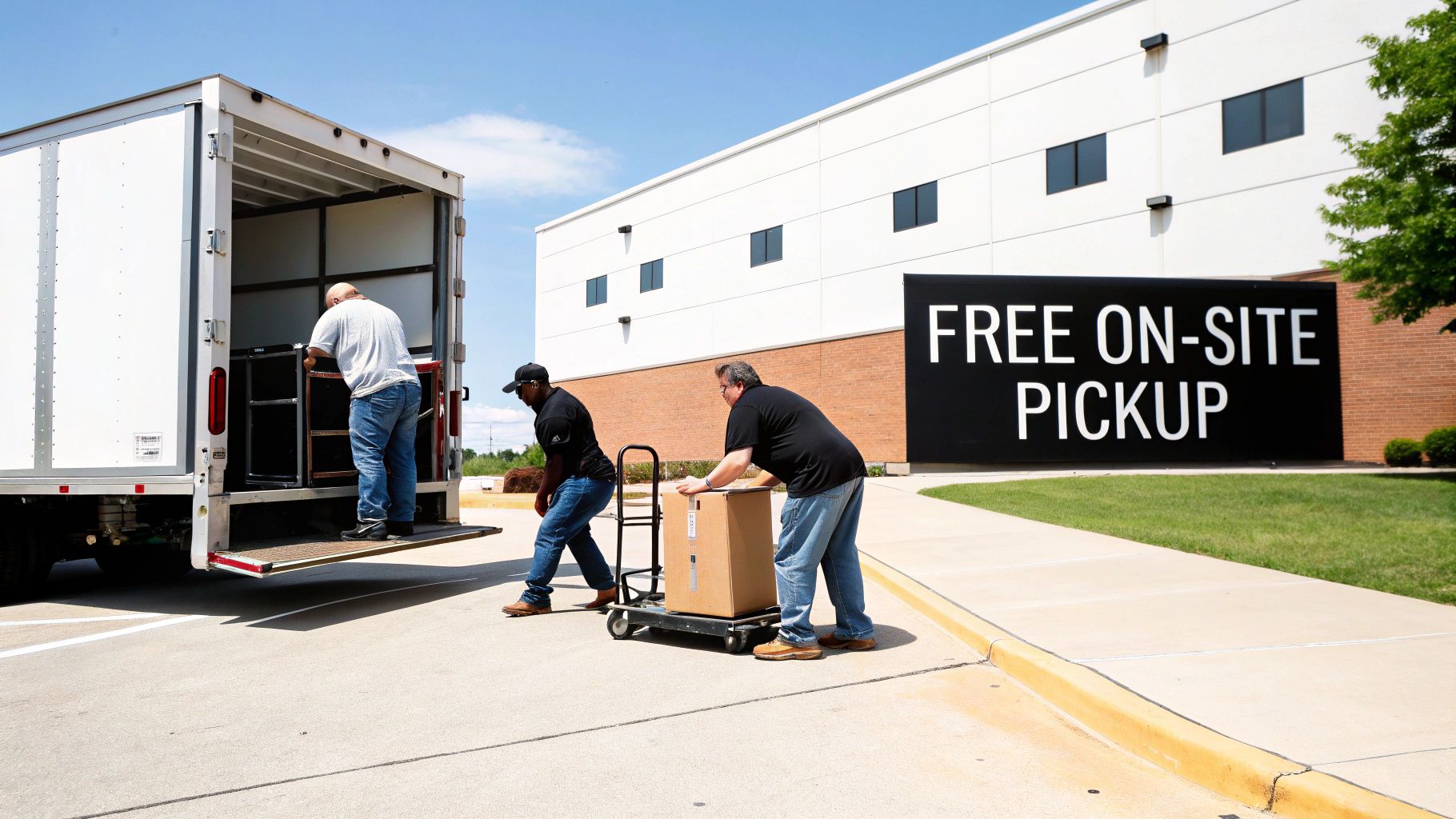
Whether an equipment upgrade has left you with pallets of old servers in California or a lab decommission project in Georgia means clearing out centrifuges and incubators, the disposal question always comes up. For hospitals, universities, and corporate IT departments nationwide, the stakes are high. You're juggling data security, environmental compliance, and the sheer physical effort of moving heavy, bulky items.
This is exactly where a professional e-waste service with its own box-truck fleet comes in. It completely takes these burdens off your shoulders, offering electronic recycling free pick up services from coast to coast.
The whole process is designed to be dead simple, requiring almost no effort from your team. Forget about wrangling multiple vendors or asking your staff to do the heavy lifting. A dedicated national service can handle everything from de-installing and packing equipment right on-site to managing all the logistics and providing final documentation. It turns a complicated operational challenge into a simple, scheduled event.
What’s In It for Your Organization?
Choosing a specialized service is about more than just convenience; it delivers real, measurable value. The benefits hit on the biggest concerns we hear from facility managers and IT directors every day, no matter their location.
By partnering with a professional e-waste recycler, you're not just clearing out old equipment; you're making a strategic decision that benefits your bottom line, compliance posture, and sustainability goals.
The table below breaks down the key advantages.
Key Benefits of Professional E-Waste Pick Up Services
| Benefit | Impact for Your Organization |
|---|---|
| Significant Cost Savings | You completely avoid transportation fees, labor costs for your staff, and potential disposal charges that can quickly pile up. |
| Guaranteed Regulatory Compliance | Secure data destruction, including DoD 5220.22-M wipes, meets tough standards like HIPAA, protecting you from liability. |
| Responsible Environmental Stewardship | Your assets are kept out of landfills and are processed at certified facilities, directly supporting your sustainability goals. |
| Operational Efficiency | Frees up your internal teams to focus on core tasks instead of spending hours on equipment removal and logistics. |
Ultimately, a professional service transforms a potentially costly and risky disposal task into a secure, compliant, and cost-neutral operation.
The demand for these services is exploding. The global electronics recycling market, valued at USD 43.2 billion in 2025, is projected to hit a staggering USD 147.9 billion by 2035. PCs and laptops make up about 45% of that stream, while industrial sectors like labs and research facilities drive another 40%. This just shows how critical professional disposal solutions have become for businesses everywhere.
When you're ready to clear out that surplus equipment, you can book a time that fits your schedule. Just use a simple online form to schedule a free e-waste pickup in the Atlanta area or for your nationwide locations.
Qualifying for a Free Pickup and What We Accept
So, how do you know if your pile of surplus equipment qualifies for a free electronic recycling pickup? It really boils down to two things: the type of gear you have and the total volume.
Our free service is built for business-grade assets. The whole model works because the value we recover from recycling the materials covers all the costs of labor, logistics, and transportation. This is how we can offer a zero-cost solution for organizations clearing out large quantities of IT, server, networking, and lab equipment. It works for our nationwide clients and for local Atlanta-area businesses alike, whether it's a hospital decommissioning an entire wing or an IT team refreshing their server racks.
The key takeaway? Think business-grade, not the stuff you have in your home office. We focus on the heavy-duty equipment that keeps organizations running across the U.S.
What We Typically Accept for Free
Our specialty is commercial and enterprise-level equipment. Focusing on this niche means we have the right tools and, more importantly, the right experience to handle complex de-installations and secure logistics for valuable or sensitive gear. A facility manager at a research university in Texas or an IT director at a tech firm in New York can feel confident scheduling a pickup for these items.
Here are a few common examples of equipment that qualifies:
- IT and Networking Gear: Servers, storage arrays (SANs), network switches, routers, and uninterruptible power supplies (UPS).
- Business Computers and Peripherals: We're talking bulk quantities of desktops, laptops, monitors, keyboards, and mice from an office cleanout.
- Scientific and Laboratory Equipment: This includes centrifuges, incubators, spectrometers, fume hoods, and other specialized machinery you'd find in a lab.
- Telecommunications Systems: Old office phone systems, VoIP equipment, and other communication hardware.
The principle is pretty straightforward: if the equipment has enough residual value through responsible recycling, the pickup is free. This approach is critical for tackling the global e-waste crisis, which is growing at an alarming rate and expected to generate over 60 million metric tons in 2025. You can find some eye-opening industry reports on this issue if you're curious about the fastest-growing waste stream on the planet.
For a really detailed breakdown, check out our complete list of accepted items. This guide gives you the specifics on hundreds of different equipment types so you can see exactly where your assets fall.
Understanding Common Exceptions and Exclusions
While we try to take a wide range of electronics, some items just don't fit into the free pickup model. This usually happens for one of two reasons: they contain hazardous materials that cost money to dispose of safely, or they have zero recoverable value to offset our logistics costs.
We believe in being upfront, so you know exactly what to expect.
Here’s a quick look at items that might not qualify or could require a fee:
- Consumer-Grade Appliances: We don't accept things like refrigerators, microwaves, or air conditioners.
- Items with Hazardous Components: Old CRT monitors (the big, bulky ones), fluorescent bulbs, and anything containing mercury often have disposal fees attached.
- Low-Value or Non-Electronic Items: Office furniture, loose batteries, and single-item residential pickups aren't a fit for our free commercial service.
If your inventory is a mixed bag of qualifying and non-qualifying items, don't sweat it. Just send us a list or snap a few photos of what you have. Our team will give you a clear, transparent assessment, letting you know exactly what we can take for free and outlining the best options for everything else. No surprises on pickup day.
Ensuring Data Security and Regulatory Compliance
When you schedule an electronic recycling free pick up, you're handling a logistics problem, sure. But for any modern organization—especially if you're in healthcare, research, or finance—you're also opening up a much bigger question: what happens to our data?
Getting old hardware out the door is one thing. Making absolutely certain the sensitive information on it is gone for good isn't just a "best practice"; it's a non-negotiable legal and ethical requirement. We've seen firsthand how a single data breach can lead to crippling fines and permanently tarnish a hard-earned reputation. That's why we believe a rock-solid data destruction plan is the foundation of any responsible e-waste strategy.
And this isn't about just hitting "delete." Anyone with basic recovery software can pull data from a formatted hard drive. Real data sanitization requires proven, verifiable methods that guarantee that information is irrevocably destroyed.
Choosing the Right Data Destruction Method
Not all data is created equal, and neither are the methods to destroy it. Your best option hinges on the type of media, your industry's specific compliance rules (like HIPAA), and whether the hardware has any life left in it for reuse. The two main paths are data wiping and physical shredding.
Let's walk through a real-world scenario. A hospital is upgrading its servers that manage thousands of electronic health records (EHR). The old hard drives are still perfectly functional and have resale value. This is the ideal situation for software-based data wiping.
We use the DoD 5220.22-M 3-pass wipe, a sanitization standard originally developed by the U.S. Department of Defense. This process overwrites every single sector of a hard drive with new data in three distinct passes, making the original information completely unrecoverable.
Key Takeaway: For functional, modern hard drives that can be refurbished and resold, a DoD 3-pass wipe is a secure and environmentally responsible choice. It ensures total data destruction while allowing the hardware to have a second life.
The whole process is meticulously documented. Each drive is cataloged by its unique serial number. Once the wipe is complete, we issue a Certificate of Data Destruction, giving you a serialized, auditable report that proves every drive was sanitized. It’s the kind of documentation a compliance officer loves to see.
When Physical Shredding Is the Only Answer
Sometimes, wiping a drive just isn't an option. For obsolete media like old backup tapes, drives that are dead on arrival, or situations demanding the absolute highest level of security, physical destruction is the definitive answer. Think of it as the final, irreversible end for that data.
Back to our hospital example. During the server room cleanout, the IT team finds a box of ancient backup tapes and a few solid-state drives (SSDs) that have failed. You can't wipe this stuff. This is where shredding comes in.
The process is exactly what it sounds like. We feed the hard drives, SSDs, tapes, and other media into industrial shredders that grind them into small, mangled pieces of metal and plastic. It completely destroys the storage platters and memory chips, making data recovery physically impossible.
Here’s when shredding is the go-to choice:
- Non-Functional or Damaged Drives: If a drive won't even power on, you can't run wiping software on it. Shredding is the only way.
- Obsolete Media: Old tech like magnetic tapes or optical disks are prime candidates for physical destruction.
- Strict Compliance Mandates: Some internal security policies or regulations like HIPAA explicitly require physical destruction for certain data.
- Maximum Security: For top-secret R&D data or other highly sensitive information, some organizations simply prefer the finality of shredding.
You can get a deeper look into how these methods align with your organization's needs by reading about our secure data destruction services and compliance standards.
Choosing between these methods is a critical step in protecting your organization's sensitive information. Here’s a quick comparison to help you decide what’s right for your assets.
Data Destruction Methods Compared
| Method | Best For | Compliance Level | Cost |
|---|---|---|---|
| Data Wiping (DoD Wipe) | Functional HDDs & SSDs intended for reuse or resale. | High (Meets HIPAA, DoD 5220.22-M, NIST 800-88 standards). | Generally lower, as asset value can be recovered. |
| Physical Shredding | Non-functional drives, old media (tapes), or for maximum security mandates. | Highest (Irreversible physical destruction). | Can be higher, as it eliminates any potential resale value of the drive. |
Ultimately, both methods provide a secure outcome. The best choice comes down to balancing asset value, media type, and your specific security requirements.
Documenting the Chain of Custody
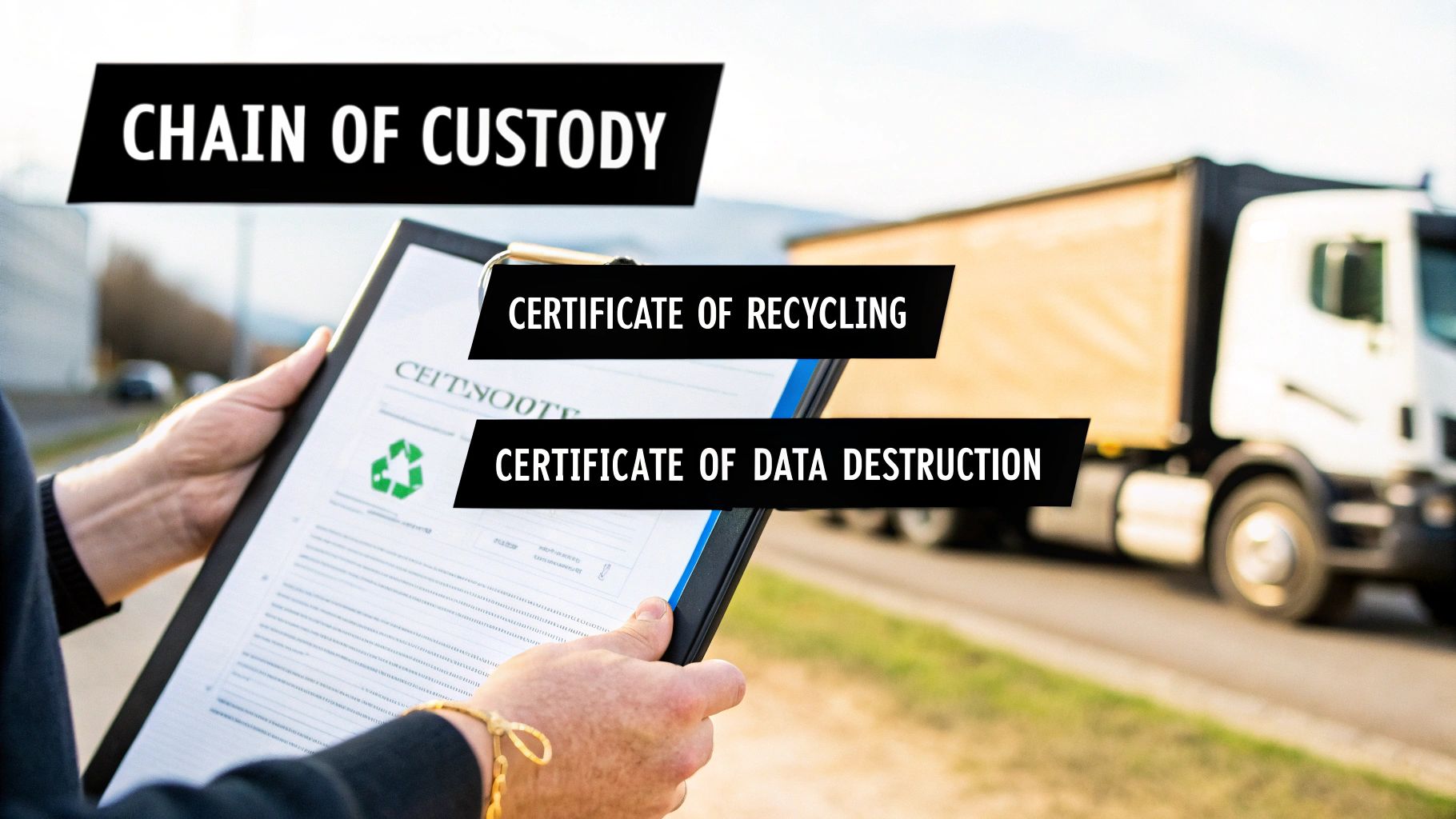
At the end of the day, proof is everything. Any professional e-waste partner must provide a clear, unbroken chain of custody from the moment your equipment is picked up. This paper trail is your concrete evidence that every single data-bearing device was handled securely and destroyed properly.
It starts with a detailed inventory at your facility and concludes with two essential documents:
- Certificate of Data Destruction: This document lists the unique serial number of every hard drive that was wiped or shredded, detailing the method used for each one.
- Certificate of Recycling: This confirms that all other assets were processed in an environmentally compliant manner at certified recycling facilities.
These certificates are your shield. They provide the auditable proof you need for internal security audits, regulatory check-ins, and sustainability reports, giving you complete peace of mind that your assets—and your data—were handled the right way.
How to Prepare for a Smooth Equipment Pick Up
So, you’ve scheduled your electronic recycling free pick up. Now what? A little bit of prep work on your end can make the actual pickup day go incredibly fast, keeping things safe and efficient for everyone involved.
The good news is our team is there to handle all the heavy lifting—literally. From de-installing server racks on-site to carefully packing up delicate lab instruments, our entire process is designed to minimize disruption. We want to require as little of your staff’s time as possible.
Your main job is just to clear the path and point us in the right direction. Thinking through the logistics beforehand helps our crew get in, load the equipment, and get out of your hair without a single hitch.
Creating a Clear Game Plan for Pickup Day
The smoothest jobs we’ve ever managed—from multi-floor lab cleanouts at hospitals to complex data center decommissioning projects across the U.S.—all started with a simple plan. Before our truck shows up, just take a quick walk from where the equipment is sitting to your loading dock.
Thinking through these simple points will make all the difference:
- Designate a Single Point of Contact: Having one person from your team assigned to meet our crew is a game-changer. This person can grant access, show us the equipment, and sign off on the initial paperwork.
- Clear All Pathways: Make sure hallways, doorways, and corridors are free of boxes or other obstacles. A clear path is a safe path, and it speeds up the removal process dramatically.
- Identify the Best Access Point: Let our logistics team know which loading dock or entryway works best for a large box truck. If you know about any potential challenges, like a steep ramp or a dock that’s always busy, giving us a heads-up is a huge help.
It’s a lot like getting ready for movers at your house. A little prep work makes the whole day run better for everyone.
We often see facilities with heavy equipment stashed on upper floors or tucked away in basements. Don't worry about this. Our teams come equipped with everything from heavy-duty dollies to pallet jacks to safely handle stairs and elevators. Just let us know ahead of time so we can plan for it.
The global e-waste management market is absolutely booming, projected to jump from $70 billion in 2024 to $81.27 billion in 2025. This growth is fueled by organizations like yours constantly upgrading their technology. For busy medical labs, universities, and government offices nationwide, having a service that can manage everything from pipettes to entire storage arrays is no longer a luxury—it's essential.
Inventory and Special Instructions
You don't need a super-detailed, itemized list, but having a general inventory of what we’re picking up is incredibly helpful. It helps our team double-check that they have everything you wanted gone, ensuring nothing gets left behind or taken by mistake.
A simple spreadsheet or even just a few photos of the equipment will do the trick.
Most importantly, be sure to flag any specific de-installation needs. For instance, if a large fume hood is hardwired into the wall or a server rack needs to be carefully disconnected, letting us know in advance means we’ll arrive with the right tools and personnel for the job.
This visual shows exactly how we ensure your data is handled securely after it leaves your facility.
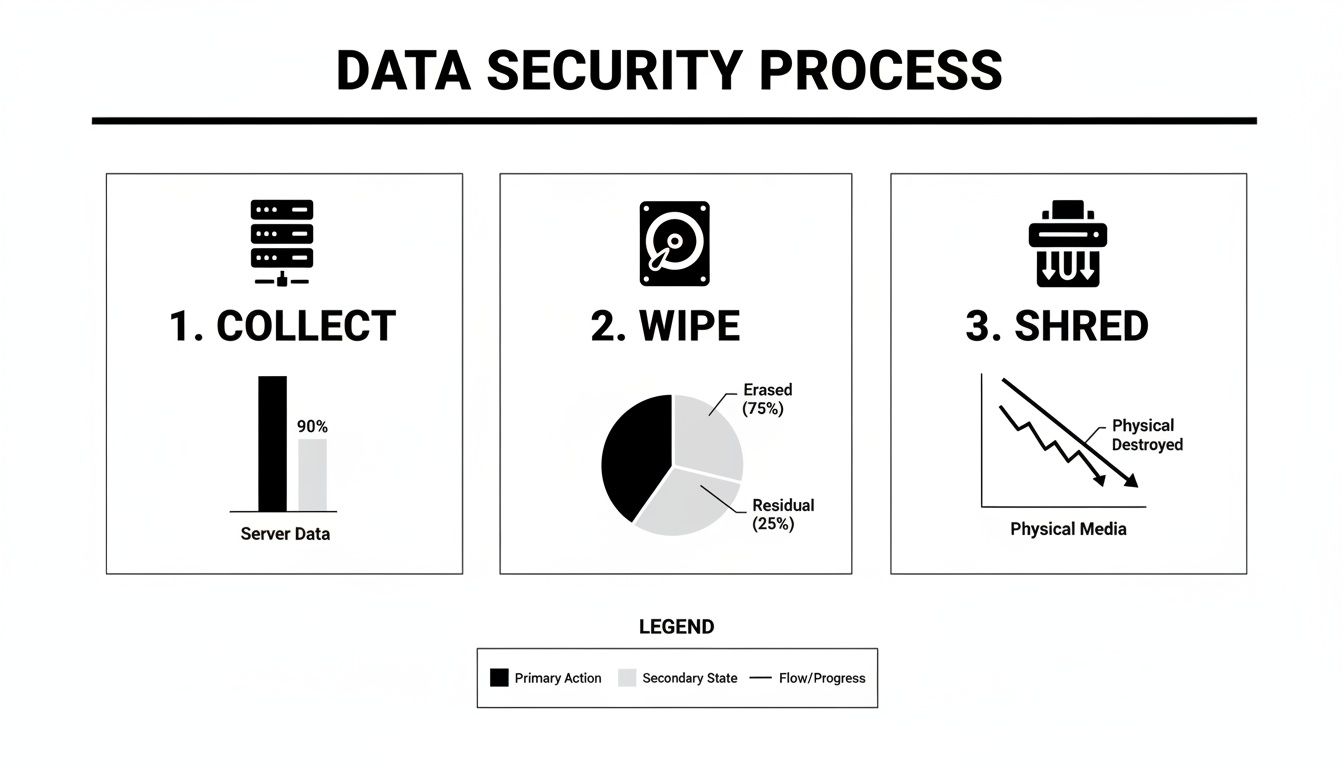
As the graphic shows, every single data-bearing device is collected and then subjected to either a secure wipe or physical shredding. It’s a simple, effective process that guarantees no sensitive information ever leaves your control.
Following this straightforward playbook turns what could be a major logistical headache into a simple, coordinated event. To see how these prep steps fit into the bigger picture, you can learn more about how our pickup process works from start to finish. From the moment you fill out our web form to the day you receive your final documentation, you'll have a clear view of the entire journey.
What Happens After Pickup? Your Documentation and Asset Journey
Once our truck pulls away from your facility, your part of the job is done. But for us, the most critical work is just starting. This is where the meticulous process of sorting, data destruction, and responsible materials recovery begins, culminating in the official documentation that proves you've met your compliance and sustainability goals.
This isn't just about getting a receipt; it’s about closing the loop on your asset disposition lifecycle. For any organization, but especially those in America's medical, academic, or corporate sectors, a clear, auditable paper trail is non-negotiable. These documents are your definitive proof that every piece of equipment was handled securely and ethically, protecting you from legal and financial headaches down the road.
The Certificate of Recycling: Your Proof of Environmental Compliance
The first key document you’ll receive is the Certificate of Recycling. Think of this as the official record confirming your equipment was properly processed, not just dumped in a landfill. It certifies that all your non-data-bearing assets—from lab centrifuges to network switches—were handled according to strict state and federal environmental regulations.
This certificate is more than just a formality. It’s a vital tool for your organization:
- Internal Audits: It provides the concrete evidence needed for internal reviews of your asset management and disposal policies.
- ESG Reporting: For companies focused on Environmental, Social, and Governance metrics, this document is a tangible asset for your sustainability reports.
- Regulatory Peace of Mind: It demonstrates due diligence in adhering to environmental laws, protecting your organization from hefty fines.
A Certificate of Recycling is your assurance that your organization acted as a responsible environmental steward. It formally transfers liability for the physical equipment from you to the certified recycler.
The Certificate of Data Destruction: Verifying Absolute Security
For any device that held sensitive information, from server hard drives to employee laptops, the Certificate of Data Destruction is arguably the more critical document. This is your auditable proof that every bit of data was permanently and irrevocably destroyed. Without it, you’re leaving your organization exposed to massive data breach risks.
This certificate provides a detailed, serialized account of every single data-bearing device we process. It lists the unique serial number of each hard drive and specifies the exact destruction method used—whether it was a DoD 5220.22-M 3-pass wipe or physical shredding. This level of detail is crucial for meeting tough compliance standards like HIPAA, giving you a bulletproof record for any audit.
Tracing the Journey After It Leaves Your Facility
So, what really happens to your equipment after it leaves your facility? We believe in total transparency, so let’s walk through the journey.
Once the assets arrive at our secure processing facility, our technicians immediately begin a careful triage process, sorting everything into distinct streams:
- Data-Bearing Devices: All hard drives, SSDs, and other media are immediately quarantined and moved to our secure data destruction area for wiping or shredding. No exceptions.
- Equipment for Reuse: Functional items like newer servers, monitors, or lab instruments are tested, refurbished, and prepared for a second life on the secondary market.
- End-of-Life Electronics: Assets that are too old or damaged for reuse are systematically de-manufactured.
This last step is where true recycling happens. The equipment is broken down into its core components—metals, plastics, circuit boards, and glass. These raw materials are then sent to our certified R2 or e-Stewards downstream partners to be refined and reintroduced into the manufacturing supply chain. This is how we ensure valuable resources are recovered, hazardous materials are managed safely, and the loop is officially closed on your asset's lifecycle.
Got Questions About Our Free E-Recycling Pickups?
Even after outlining the process, it's completely normal to have a few questions, especially when you're dealing with valuable or data-sensitive equipment. We get it. Over the years, we've heard just about every question you can imagine from hospitals, labs, and IT departments across the country.
We’ve pulled together the most common ones to give you straight, practical answers. Our goal is simple: total clarity, so you can move forward with confidence.
Is This Electronics Recycling Pickup Service Actually Free?
Yes, for our commercial clients with a decent amount of business-grade IT, server, networking, or lab equipment, the pickup and recycling service is 100% free. How? The value we recover from reusable assets and raw materials covers all our logistics, labor, and transportation costs. You get a secure, compliant disposal solution at absolutely no cost to you.
The only exceptions are for specific items that have a built-in disposal fee (like old, bulky CRT monitors) or for pickups that don't quite meet our minimum volume. In those rare cases, we are always transparent and provide a quote upfront. No surprises on pickup day.
What Kind of Equipment Do You Not Take for Free?
We specialize in a pretty wide range of business, IT, and laboratory electronics. That said, some things do fall outside the scope of our free service.
As a general rule, we can't accept these items as part of a free pickup:
- Household appliances (refrigerators, microwaves, AC units, etc.)
- Single items or very small residential-style pickups
- Things that are mostly non-electronic, like office furniture
- Materials with inherent disposal costs, such as loose batteries or light bulbs
If you have a mixed bag of assets, no problem. Just shoot us an inventory list or a few photos. Our team can quickly tell you what qualifies for free removal and suggest the best disposal path for everything else.
How Do You Guarantee Our Sensitive Data Is Protected?
Data security isn't just a feature of our service; it's the foundation of it. From the moment a device with data leaves your facility, it’s managed under a strict, documented chain of custody. We built our entire process to meet the tough compliance standards of industries like healthcare, finance, and research.
Our standard service includes a DoD 5220.22-M 3-pass data wipe for all functional hard drives, free of charge. This method overwrites the data completely, making it impossible to recover.
For clients with stricter security protocols or for non-working drives where a software wipe won't work, we offer physical shredding. This is the ultimate peace of mind—the drives are ground into tiny fragments, making data recovery physically impossible.
No matter which method we use, you'll receive a serialized Certificate of Data Destruction. This document gives you an auditable, ironclad record for every single drive we handle, proving your compliance with regulations like HIPAA.
How Far in Advance Should We Schedule a Pickup?
We're known for being fast. Our nationwide logistics network, including our local fleet of box trucks in the Atlanta metro, allows us to often schedule a pickup within just a few business days, anywhere in the continental U.S.
For bigger projects—think a full data center decommissioning or clearing out multiple floors of a lab—we recommend giving us a heads-up of one to two weeks. This just gives our logistics team enough time to line up the right-sized crew, truck, and equipment to make the removal seamless and minimize any disruption to your work.
As you explore your options, it's smart to know what to look for in a partner. We put together a guide on how to evaluate Atlanta-area electronic waste recycling companies that can help you ask the right questions and find the perfect fit for your security and compliance needs.
Ultimately, whether your project is big or small, we’ll work with you to lock in a date and time that fits your timeline perfectly.
At Scientific Equipment Disposal, we make electronic and lab equipment recycling secure, compliant, and cost-free for organizations across the U.S., including the Atlanta area. Let us handle the heavy lifting so you can stay focused on what you do best. Contact us today to schedule your free on-site pickup!