A Guide to the Certificate of Destruction Form: Nationwide & Local Solutions

A Certificate of Destruction, often called a CoD, is an official document that serves as your legally defensible proof that sensitive assets have been destroyed permanently and securely. It’s much more than a simple receipt; think of it as a critical liability shield. Whether you're managing a single site locally or coordinating disposals across the country, this form confirms that items like old hard drives, servers, or proprietary lab equipment were disposed of following established security protocols.
What a Certificate of Destruction Form Truly Represents
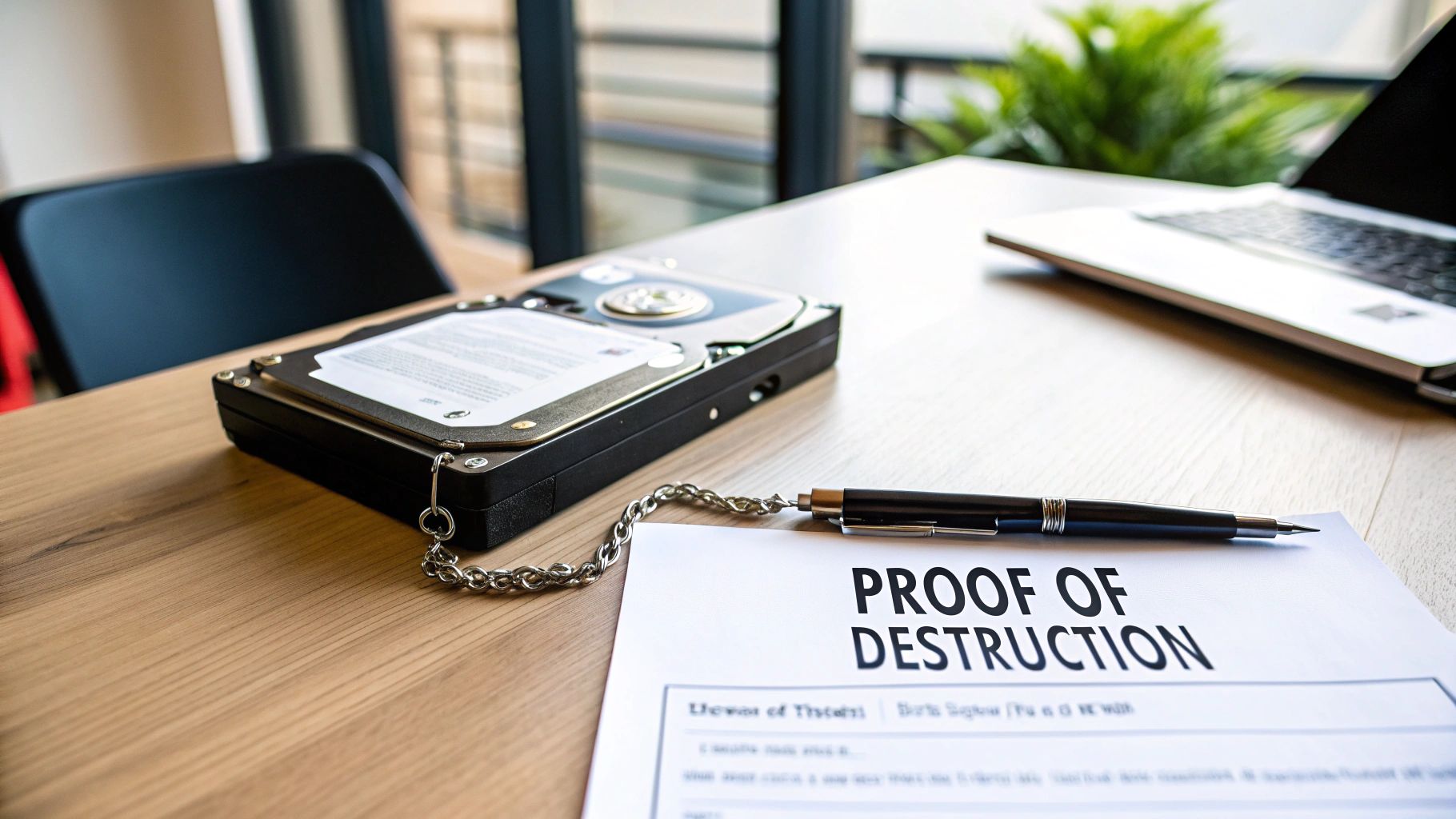
Consider a Certificate of Destruction the final, authoritative chapter in an asset's lifecycle. It’s the tangible proof that your organization fulfilled its duty to protect sensitive information, closing the loop on data security and asset management. For maintaining a secure chain of custody—from a local pickup in Atlanta, GA, to a nationwide logistics operation—this document is absolutely non-negotiable.
This chain of custody is the documented trail that follows your assets from your facility all the way to their final destruction. A proper CoD solidifies this chain, proving that every single step was handled securely.
The Growing Need for Verifiable Destruction
The demand for this level of documentation has been skyrocketing, a trend you can see reflected in market growth. The global hard drive destruction service market was recently valued at USD 1.65 billion and is projected to soar to USD 5.05 billion by 2035. That's a robust 10.7% CAGR.
This surge isn't surprising. It’s driven by stricter data privacy regulations like HIPAA and CCPA and the constant rise of cyber threats. For any organization, from a local Atlanta hospital managing patient records to a nationwide corporation safeguarding trade secrets, this form is a cornerstone of a sound risk management strategy.
It’s the definitive proof that your assets were handled with the security they demand. Our team can walk you through the specifics of our secure data destruction services, available nationwide.
A Certificate of Destruction transforms a potential liability into a documented, closed case. It's the evidence that you’ve met both legal and ethical obligations to protect stakeholder data, effectively ending the lifecycle of sensitive assets.
Key Information on a Certificate of Destruction Form
To hold up in an audit and be considered legally valid, a Certificate of Destruction must include several key pieces of information. Each detail helps create an indisputable record of the disposal event, leaving no room for questions.
| Data Field | Description | Why It's Important |
|---|---|---|
| Unique ID Number | A serial or transaction number specific to the CoD itself. | Allows for easy tracking, retrieval, and referencing during audits. |
| Client Information | The full legal name and physical address of your organization. | Clearly identifies who the disposed assets belonged to. |
| Detailed Asset List | An inventory of every item destroyed, with make, model, and serial numbers. | Vague descriptions like "10 hard drives" won't cut it. This proves exactly what was destroyed. |
| Method of Destruction | A specific description of the destruction process (e.g., shredded, degaussed). | Confirms the destruction method met required security standards (e.g., HIPAA, NIST). |
| Date & Location | The exact date and physical address where the destruction occurred. | Establishes a precise timeline and location for the chain of custody. |
| Chain of Custody | Names and signatures of every person who handled the assets. | Documents the secure transfer of assets from your facility to the final destruction. |
| Authorized Signatures | Signatures from your representative and the destruction vendor. | Creates a legally binding acknowledgment and solidifies accountability. |
These components work together to provide a complete, auditable record. Without them, the document loses its power as a tool for compliance and risk management.
Why Compliance Hinges on Proper Documentation
Failing to properly document the destruction of your assets isn't just a simple clerical error—it's a massive compliance risk that can bring devastating financial and reputational damage. The certificate of destruction form is your frontline defense during an audit. It’s the official record that proves you acted with due diligence and followed all required protocols, turning an operational task into a legally defensible action.
For organizations everywhere, from a lab in Boston to a data center in Dallas, this is about more than just good housekeeping. It's about mitigating risk. A certificate formally transfers liability from your organization to the disposal vendor, closing the loop on an asset's lifecycle and shielding you from any future claims of negligence or improper handling.
The High Stakes of Non-Compliance
The legal landscape is littered with regulations mandating the secure disposal of sensitive information, and the penalties for failing to provide proof are severe.
Thinking you can skip this step is a costly mistake. Under HIPAA, U.S. healthcare providers can face fines up to $1.5 million annually per violation category—and a missing certificate can signal willful neglect. The GDPR is even tougher on businesses handling EU data, with fines climbing to €20 million or 4% of global revenue. Regulations like FACTA and GLBA also require secure disposal of consumer financial data, making a CoD your essential piece of legal evidence.
And these rules don't just apply to giant corporations. Any entity that handles protected data, from a local clinic in Georgia to a nationwide university system, falls under their scope.
Real-World Scenarios Where a CoD is Crucial
Imagine a hospital decommissioning a lab. They need to get rid of centrifuges, analyzers, and the computers that ran them. What if patient data is still lurking on those hard drives? Without a certificate of destruction that details the shredding of each drive by serial number, the hospital has zero proof it protected patient health information (PHI) if a data breach surfaces later.
Here’s another common situation: a national retail chain upgrades its point-of-sale systems across hundreds of stores. Tossing old servers and storage arrays without a detailed CoD for each location is a huge gamble. If just one of those drives ends up on the secondary market with retrievable company secrets, the fallout could include corporate espionage, intellectual property theft, and irreversible brand damage.
A Certificate of Destruction isn't an expense—it's a critical investment in avoiding legal battles, steep fines, and the public relations nightmare that follows a data breach. It's your proof that you took every reasonable step to protect sensitive information.
Building Your Defense with Documentation
A huge piece of this is having a clear document retention policy. This policy should dictate exactly how long you need to keep records before they are securely destroyed. HIPAA, for example, requires that you hang on to documents like a CoD for a minimum of six years.
Your documentation strategy should be built on a few key practices:
- Detailed Asset Inventory: Before anything leaves your facility, create a meticulous list of every asset. Include the make, model, and serial number. This list needs to match the one on the final certificate, no exceptions.
- Vendor Due Diligence: Make sure your chosen disposal partner has a proven track record. Whether they're handling nationwide projects or local pickups, they must provide compliant documentation as a standard part of their service.
- Secure Storage: Keep your certificates organized and safe. This could be a digitally encrypted folder or a physically locked file cabinet. The important thing is that they are readily available the moment an auditor asks for them.
When you treat the certificate of destruction as a core piece of your compliance strategy, you shift from a reactive to a proactive stance. You can learn more about how a professional partner manages this process in our overview of IT asset disposal services. This approach doesn't just check a box; it builds a rock-solid defense that protects your organization from the ground up.
Your Free Certificate of Destruction Form Template
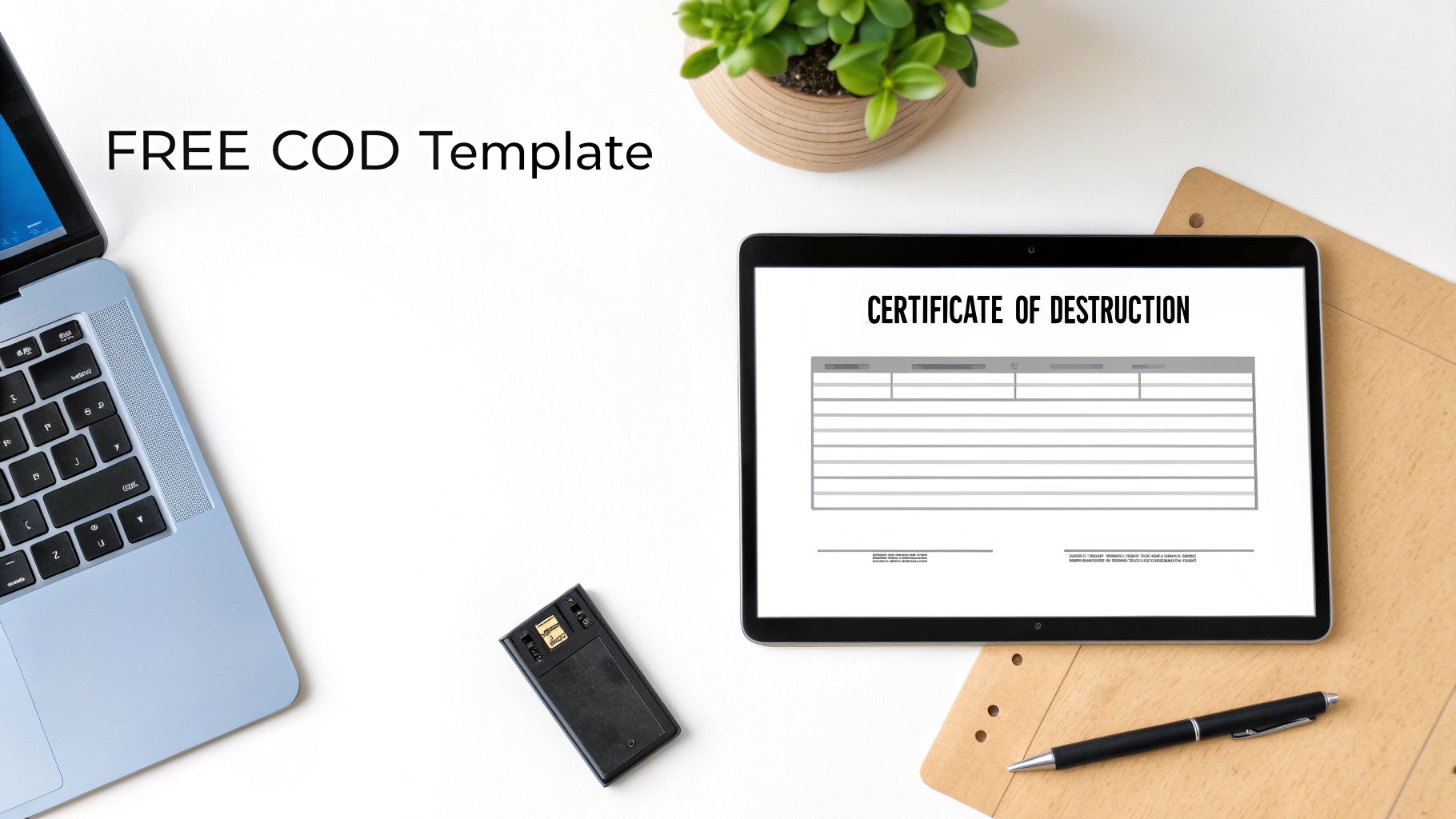
Knowing the theory behind a certificate of destruction form is one thing, but having a practical, ready-to-use tool makes all the difference. To help you get started, we've put together a free template that covers all the bases for creating a compliant and audit-ready record.
Think of this as a solid starting point for any organization, whether you are a local business in Atlanta or a national enterprise. It’s designed to make sure you capture all the critical details needed for a secure chain of custody.
- Download Your Free Certificate of Destruction Form – PDF Version
- Download Your Free Certificate of Destruction Form – Word Version
The Microsoft Word version is fully editable, which is a real time-saver. You can easily add your company logo, pre-fill your business name and address, and create a master template. This little bit of prep work helps cut down on errors and speeds things up for future disposals.
A Look at a Filled-Out Example
Let's walk through a real-world scenario to see exactly how this document works in practice.
Imagine a local medical clinic, "Northside Health Partners" in Atlanta, needs to decommission several pieces of IT equipment and an old lab centrifuge. They need one clear, consolidated record for their compliance files.
Here’s what their completed certificate of destruction form would look like:
Certificate of Destruction – Example
- CoD Unique ID: 2024-GA-8814
- Client: Northside Health Partners, 123 Peachtree St, Atlanta, GA 30303
- Destruction Vendor: Scientific Equipment Disposal, 555 Techwood Dr, Norcross, GA 30071
- Date of Destruction: October 28, 2024
- Location of Destruction: S.E.D. Secure Facility, Norcross, GA
Asset Details:
Item # Type Manufacturer Model Serial Number Destruction Method 1 Lab Centrifuge Thermo Scientific Sorvall ST 8 42358911 Mechanically Crushed 2 HDD Seagate BarraCuda ZN1J7Y8P Physically Shredded 3 HDD Western Digital WD Blue WCAS84219P Physically Shredded 4 Server Dell PowerEdge R740 JXF45G2 Physically Shredded Signatures:
- Client Rep: Jane Doe, Office Manager, Northside Health Partners
- Vendor Rep: John Smith, Destruction Specialist, S.E.D.
Breaking Down the Key Fields
So, why is each piece of this information so important? Every field plays a part in creating an airtight record that will stand up to scrutiny during an audit.
Client and Vendor Information
This first section clearly identifies who's involved. Having the full legal names and addresses is non-negotiable for accountability. The Unique ID (2024-GA-8814) acts as a reference number, allowing both the clinic and the vendor to pull up this specific record instantly if questions ever arise.
Date and Location of Destruction
These details provide a concrete timestamp and location for the event. Specifying that destruction occurred at a secure facility adds another layer of credibility, proving the assets were handled in a controlled environment from start to finish.
The Asset Details Table
This is where the real work happens. Vague descriptions are a huge compliance red flag.
- Unique Identification: Notice that every single item has a specific make, model, and serial number. There's zero ambiguity about exactly what was destroyed.
- Mixed Asset Types: This single form efficiently handles both lab equipment (the centrifuge) and IT hardware. This is a common situation for healthcare and research facilities, and it keeps the paperwork streamlined.
- Specific Destruction Method: The method isn't just listed as "destroyed." It clearly states "Mechanically Crushed" for the non-data-bearing equipment and "Physically Shredded" for the hard drives and server. That detail is proof that the right methods were used for each asset type, meeting different compliance needs on the same document.
By filling out each section with this level of detail, Northside Health Partners has created a robust, audit-proof record that validates their entire asset disposition process.
Managing Your Destruction Records for Audits
Getting a certificate of destruction form in your hands is a huge step, but the work isn’t over. How you manage and hold onto these records is what really protects your organization from headaches during future audits or legal questions. Your internal process for handling these documents is just as critical as the destruction event itself.
A rock-solid workflow ensures every certificate is accounted for, stored safely, and easy to pull up the second an auditor asks for it. Trust me, failing to produce that document can be just as damaging as failing to destroy the asset in the first place.
Creating a Clear Internal Workflow
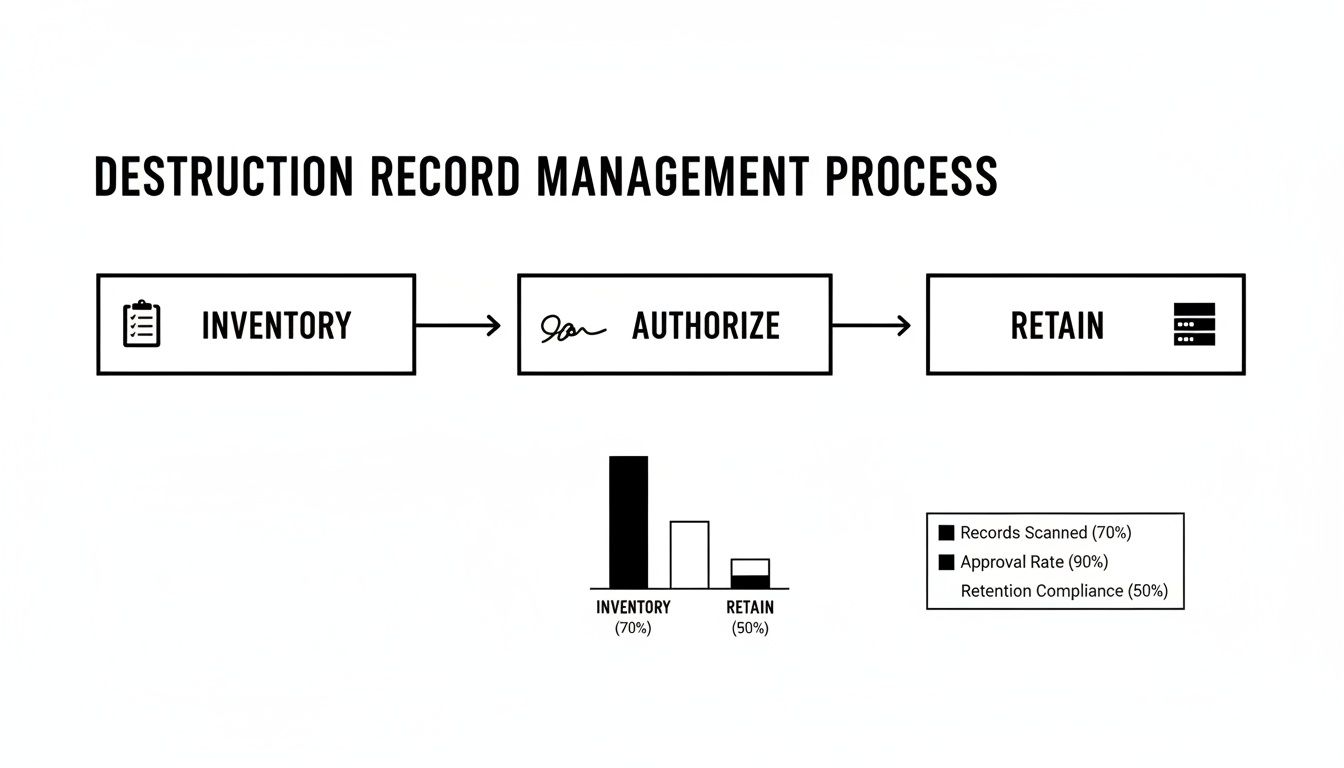
The management process should start long before any equipment leaves your facility. It all begins with a detailed inventory list—every make, model, and serial number needs to be logged. Getting this right from the start prevents major discrepancies later on.
Once your inventory is locked in, you need a clear line of command. Designate specific people, like an IT manager or compliance officer, who have the authority to greenlight the destruction. This simple step prevents unauthorized disposals and keeps everyone accountable. When the certificate comes back from your vendor, that same person should be the one to check it against the original inventory list before it gets filed away for good.
Proper record management turns your Certificate of Destruction from a simple document into an active compliance tool. It’s the final, crucial step that ensures your due diligence is defensible years after the assets are gone.
Understanding Record Retention Policies
So, you've got the signed and verified certificate. How long do you actually need to keep it? The answer really depends on your industry and the specific regulations you have to follow. This isn't a one-size-fits-all situation; it's a hard compliance requirement for businesses nationwide.
For example, healthcare organizations are bound by HIPAA, which mandates a strict six-year retention period for any documentation related to the disposal of Protected Health Information (PHI). Other industries might have shorter—or even longer—timelines. To stay on top of it all, it's wise to adopt robust document management practices.
Certificate of Destruction Retention Guidelines
Here's a quick reference guide to help you figure out the retention requirements for your sector.
| Regulation | Applicable Sector | Minimum Retention Period |
|---|---|---|
| HIPAA | Healthcare, Health Insurance | 6 Years |
| FACTA | Financial Services, Creditors | 5 Years |
| Sarbanes-Oxley (SOX) | Publicly Traded Companies | 7 Years |
| PCI DSS | Any entity handling cardholder data | 1 Year (for audit trail history) |
| GDPR | Entities processing EU resident data | As long as necessary, but no longer |
These are just common baselines. Always double-check the specific rules that apply to your organization to ensure you're fully compliant.
The data destruction market is exploding for a reason. In 2023, it was valued at USD 9.23 billion and is projected to hit USD 24.24 billion by 2030. That growth is fueled by massive data volumes and tightening privacy laws, which makes a certificate of destruction your essential, audit-proof evidence.
Secure Storage Best Practices
How you store your certificates is just as important as how long you keep them. Your two main goals here are security and accessibility. Whether you're a hospital in Atlanta or a corporation with offices across the country, you need a system that protects these documents but still lets you retrieve them quickly.
You've got two solid options:
- Digital Archives: This is the most efficient method today. Storing scanned PDFs in a secure, encrypted, and regularly backed-up folder makes life so much easier. You can search by serial number or date, and you're protected from physical damage like a fire or flood.
- Physical Files: If you prefer hard copies, they absolutely must be kept in a locked, fire-resistant filing cabinet with strictly limited access. While it's becoming less common, some organizations still like having physical copies for redundancy.
Many of our clients use a hybrid approach—a primary digital archive with physical backups. The main takeaway is to treat your destruction records with the same level of security you'd give any other critical compliance document. Proper storage means that when an auditor asks for proof, you can hand it over instantly. For more tips on compliant disposal, check out our guide on IT equipment recycling.
Our Secure Process From Pickup to Proof
Knowing what a compliant certificate of destruction form should include is one thing, but seeing how a truly secure process works from start to finish is what provides real peace of mind. Let’s pull back the curtain and show you exactly how we handle your assets—from the moment our team arrives at your facility anywhere in the nation to the second we issue your final proof of destruction.
Our entire process is built on a foundation of strict protocols and clear, defensible documentation. We aim for a seamless and secure service that protects your organization at every single step.
The Chain of Custody Starts at Your Door
The security of your assets begins the instant they leave your control. Our professional, uniformed team arrives at your location—whether it's a hospital in Atlanta, a corporate office in Chicago, or a university lab in California—with all the necessary equipment to safely de-install, pack, and transport your items.
This first step is absolutely critical for maintaining an unbroken chain of custody.
- On-Site Inventory Verification: Before a single item is loaded, our technicians meticulously verify everything against your asset list. We confirm every make, model, and serial number to ensure the final certificate perfectly matches what you handed over.
- Secure Logistics: All assets are transported in our own fleet of locked box trucks. This completely eliminates the risks that come with using third-party logistics and keeps your equipment under our direct control from your site to our secure facility.
This detailed approach ensures there are zero gaps in the documentation trail. You can explore the full breakdown of our structured approach and see how our asset disposal process works.
Data Destruction Methods Tailored to Your Needs
Once your assets arrive at our secure facility, we get to work using destruction methods that meet the highest industry and government standards. We know that different assets require different handling, especially when it comes to devices that hold sensitive data.
For hard drives and other media from equipment that might be reused, we use DoD 5220.22-M 3-pass data wiping. This technique overwrites the entire drive with patterns of ones and zeros multiple times, making the original data impossible to recover. It's a powerful sanitization method that allows the hardware to be safely recycled or refurbished.
But for obsolete, damaged, or highly sensitive media, physical destruction is the only answer. We use industrial-grade shredders to reduce hard drives, servers, and other electronics to small, mangled fragments. This is the ultimate guarantee that your data is gone for good.
A professional destruction service offers more than one method because security isn't one-size-fits-all. The right technique—whether it's sanitization or shredding—is chosen to meet your specific compliance needs for each asset.
Issuance of Your Certificate of Destruction
After the destruction is complete, we move to the final, crucial step: issuing your documentation. This is where all our careful tracking and verification come together to create your legally defensible record.
We issue your certificate of destruction form quickly, typically within 3-5 business days of processing. The certificate is sent to you digitally, giving you a secure and easily accessible record for your compliance files.
This document will contain all the critical information we've discussed, including:
- A unique CoD identification number for easy tracking.
- A detailed list of every single asset destroyed, complete with serial numbers.
- The specific destruction method used for each item (e.g., "DoD 3-pass wipe" or "Physically Shredded").
- The date and location where the destruction took place.
- Authorized signatures from both our team and yours, finalizing the transfer of liability.
This structured workflow shows the key stages of creating and managing your destruction records, from the initial inventory to final retention.
Our goal is to deliver more than just a disposal service; we provide a complete, documented solution that gives you absolute confidence. From nationwide corporations to local Atlanta businesses, our process ensures your organization is protected, compliant, and secure.
Common Questions About Destruction Forms
When it comes to the finer points of a certificate of destruction form, a lot of practical questions come up. We hear them all the time from hospital administrators in Atlanta to project managers handling nationwide facility shutdowns. Getting the right answers is crucial for staying compliant and giving you peace of mind.
Let's walk through some of the most common questions we get from clients, moving past the theory and into how this all works in the real world.
Do I Need Separate Certificates for Lab Equipment and IT Hardware?
This is a great question, and the answer is usually no—you don't need separate forms. A single, well-documented CoD can cover multiple types of assets from the same pickup, as long as every item is properly identified. This is standard practice for both local and national service providers and makes record-keeping much simpler on your end.
For example, a CoD we issue for a hospital client in Georgia might list a lab centrifuge alongside a pallet of computer hard drives, all on the same form.
The key is the level of detail. The certificate has to specify the make, model, and serial number for every single asset. It will also clearly state the different destruction methods used—like "mechanically crushed" for the centrifuge and "physically shredded" for the hard drives. This creates a complete, auditable trail for everything we process for you, all in one document.
What Happens If I Lose My Certificate of Destruction Form?
Losing a CoD can be a moment of panic, especially if you have an audit coming up. This is exactly where working with a professional, certified vendor pays off. Reputable partners know these documents are critical for your compliance long-term, whether you're a local business or a national one.
We keep secure digital copies of every certificate we issue for the full retention period required, which can be six years or more under regulations like HIPAA.
If you ever misplace your copy, all it takes is a quick email or phone call to us, and we'll send you a replacement. It’s a vital safety net for your records that you just don't have if you handle destruction in-house or use an uncertified provider.
A professional vendor's record-keeping acts as your compliance backup plan. It ensures that even if your internal files are lost or damaged, the legally defensible proof of destruction is still secure and accessible when you need it most.
Is a Certificate of Destruction the Same as a Certificate of Recycling?
No, they are not the same, and it's vital to know the difference. These two documents serve very different but equally important purposes. A truly thorough disposal partner should provide both.
Here’s an easy way to think about it:
- A Certificate of Destruction is your security and liability document. It's your legal proof that equipment with sensitive data or proprietary designs was completely destroyed, protecting you from data breaches and compliance failures.
- A Certificate of Recycling is your environmental stewardship document. It confirms that the raw materials from your e-waste—metals, plastics, circuit boards—were handled responsibly and kept out of landfills.
Getting both certificates allows your organization to confidently prove it has met its data security obligations and its environmental sustainability goals. It’s the complete package. If you’re handling a mix of assets, our guide on professional computer disposal services offers more helpful details.
How Soon Will I Get the Certificate After Pickup?
The timeline for getting your certificate of destruction form is built around accuracy and verification. The physical destruction of your assets happens quickly once they arrive at our secure facility, but the paperwork has to be perfect to be audit-proof.
Typically, you can expect to receive a digital copy of your certificate via email within 3-5 business days after we've processed your equipment.
This window gives our team the time needed to meticulously check every serial number from the initial pickup against the final destruction logs. We confirm every detail—client name, asset list, destruction methods—is 100% accurate before we issue the final, signed document. That diligence is what makes the certificate a legally defensible tool for your compliance team, no matter where in the U.S. you operate.
Ready to ensure your asset disposal process is secure, compliant, and fully documented? The team at Scientific Equipment Disposal provides a seamless service from secure pickup to the issuance of your official Certificate of Destruction, serving clients locally and nationwide. Visit https://www.scientificequipmentdisposal.com to schedule your service and get the peace of mind you deserve.