Business Electronics Recycling in Gwinnett County GA: A Nationwide & Local Guide

When your Gwinnett County business needs to offload old electronics, it's about more than just clearing out a storage closet—it's about security, compliance, and environmental responsibility on a national scale. Handling this correctly means working with a certified local specialist like Scientific Equipment Disposal (S.E.D.). Right here in Norcross, we serve businesses across Gwinnett County and nationwide, turning a major headache into a simple, secure, and fully documented process with secure on-site pickup, certified data destruction, and a strict zero-landfill policy.
Your Partner for Compliant Business E-Waste Recycling in Gwinnett
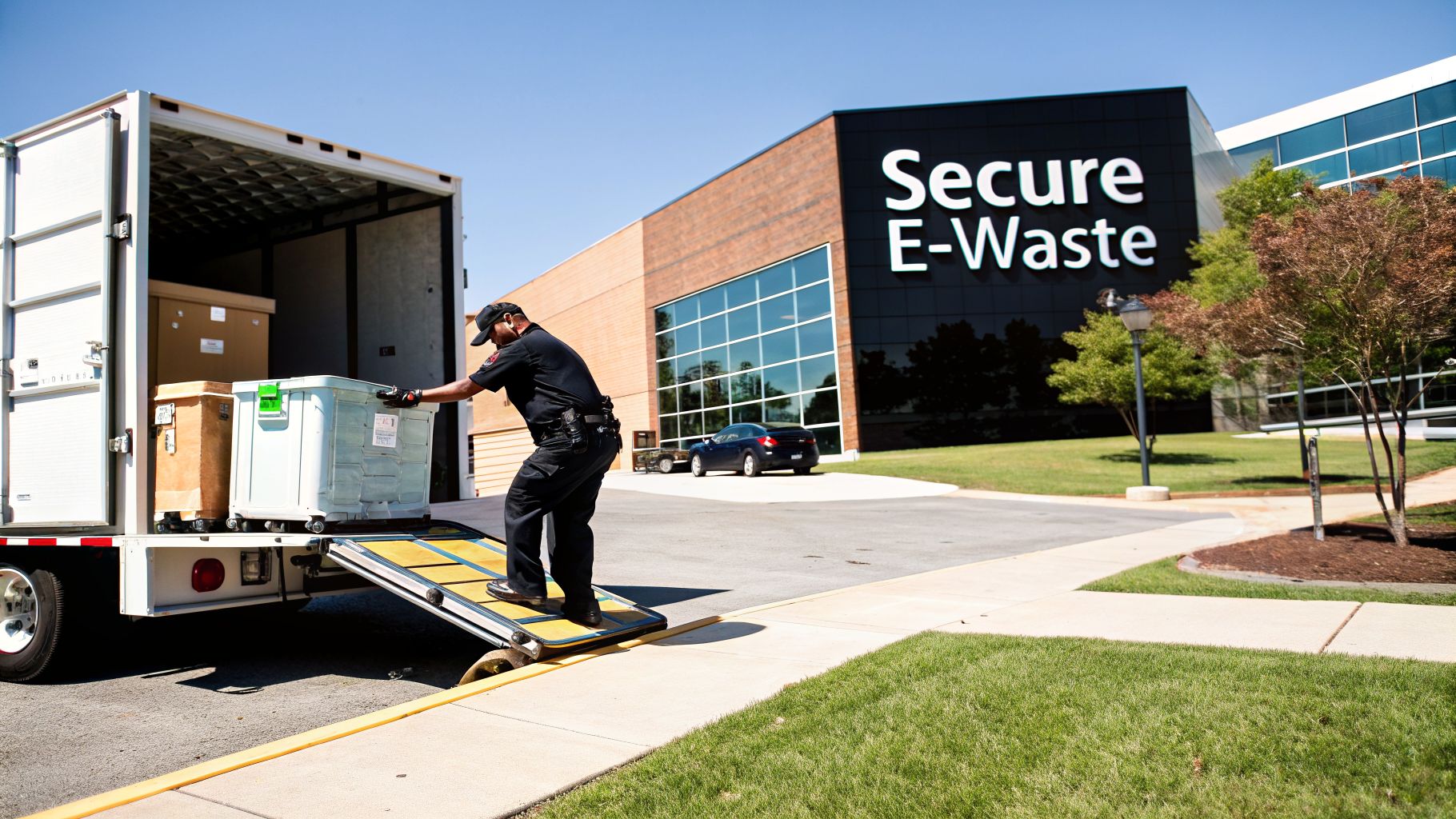
When your company's servers, computers, or lab instruments hit their end-of-life, the responsibility for what happens next is squarely on your shoulders. It’s a critical business task that touches on national data security laws, environmental regulations, and your own operational efficiency.
For organizations across bustling Gwinnett County—from tech startups in Lawrenceville to medical centers in Duluth—and for national corporations with multiple locations, the sheer volume of outdated equipment can feel overwhelming.
The problem has multiple layers. Every single piece of equipment, from a desktop PC to a complex server array, can hold sensitive data. Tossing these assets into a regular dumpster or leaving them for a municipal pickup day opens the door to massive risk. Just one hard drive that isn't properly sanitized can trigger a catastrophic data breach, leading to hefty fines under federal laws like HIPAA or FACTA and destroying the reputation you’ve worked so hard to build.
The Pitfalls of DIY and General Disposal
It's tempting to take what looks like the easy route for disposal. But those shortcuts often hide serious risks for any U.S. business. Your general waste hauler isn't trained or equipped for the security and environmental needs of e-waste. And while community drop-off days are great for residents, they just don't offer the compliance-focused services a business of any size needs.
These methods almost never provide the critical paperwork your business needs to prove due diligence.
- Certificates of Destruction: This is your auditable proof that every data-bearing device was permanently sanitized or physically destroyed, essential for national compliance.
- Serialized Asset Tracking: You get a detailed report that tracks every asset from the moment it leaves your facility to its final disposition, providing a nationwide chain of custody.
- Recycling Certificates: This document confirms all materials were handled according to environmental laws and kept out of landfills, a key component of Corporate Social Responsibility (CSR) programs.
Without this paper trail, you have zero proof you acted responsibly if an auditor or a data breach investigator comes knocking. That's a liability no Gwinnett organization or national enterprise can afford.
Key Takeaway: The path of least resistance—a dumpster or a residential event—is almost always the path of greatest risk. Real security for your business, whether local or national, comes from a documented, certified process managed by a specialist.
The Professional Advantage with a Local and National Partner
To help your organization decide on the best path forward, we've put together a quick comparison of the most common options available to businesses in Gwinnett County and across the United States.
Choosing Your E-Waste Disposal Method
| Consideration | Professional Recycling Partner (S.E.D.) | DIY or Municipal Options |
|---|---|---|
| Data Security | Guaranteed data destruction (DoD wiping, shredding) with certification, meeting national standards. | No security guarantees; high risk of data exposure. |
| Compliance | Fully compliant with HIPAA, FACTA, etc. Provides all required documentation for national audits. | Non-compliant for business needs. No auditable paper trail. |
| Logistics | Secure on-site pickup, packing, and transport handled for you in Gwinnett and beyond. | You are responsible for all packing, transport, and labor. |
| Asset Tracking | Serialized inventory report for every item, providing a complete chain of custody. | No tracking; assets are unaccounted for after drop-off. |
| Environmental Impact | Zero-landfill policy. Materials are recycled responsibly across the U.S. | Items often end up in landfills or are shipped overseas. |
| Liability | Liability is transferred to the certified recycler, protecting your business nationwide. | All liability for data breaches and improper disposal remains with you. |
As the table shows, partnering with a professional provides a clear advantage in every critical area, protecting your business from the significant risks tied to improper e-waste disposal.
This is exactly where a dedicated partner for business electronics recycling in Gwinnett County, GA, with nationwide reach makes all the difference. Working with a local expert like S.E.D. means you get a service built for business realities. We understand the logistics of operating in Peachtree Corners or Suwanee and provide on-site services that fit your schedule, while also having the capability to manage projects across state lines. If you want a deeper look at what sets a certified provider apart, you can explore the benefits of working with an established e-waste recycling company.
Our entire process is designed to address the top concerns of IT managers, facility directors, and business owners. We deliver secure, on-site logistics, certified data destruction, and a solid commitment to sustainability, turning a risky chore into a streamlined, safe, and professional operation.
Why Gwinnett County Champions Secure E-Waste Management
Gwinnett County is more than just a suburb of Atlanta—it's a major economic hub. As a key part of the metro area's booming technology and life sciences corridor, the county is packed with businesses generating a huge volume of specialized, data-sensitive electronic waste.
This isn't your typical household e-waste. We're talking about a constant flow of servers, network gear, lab instruments, and computers filled with proprietary data. For every innovative company in Peachtree Corners or expanding lab in Lawrenceville, there’s a trail of obsolete electronics left behind.
Improper disposal here is a massive risk. It’s not just an environmental issue; it’s a direct threat to the community's economic security. A single data breach from a carelessly tossed hard drive could be financially devastating for a local business, with repercussions that damage trust nationwide.
The Government's Proactive Stance on E-Waste
Gwinnett County's leadership understands these risks. They've shown a clear commitment to creating a secure and sustainable environment by investing in responsible electronics recycling infrastructure. The county government isn't just making suggestions; it's actively finding expert partners to manage its own assets, setting a powerful example for the private sector.
A perfect example is a recent major initiative. In late 2025, Gwinnett County issued a formal Request for Proposal (RP017-25) to find qualified providers for a large-scale electronics recycling and value recovery contract.
This multi-year agreement, valued between $500,000 and $2,000,000, sets incredibly strict requirements. It demands absolute data security, environmentally sound processing, and mandates that all work must happen within a 150-mile radius to prioritize regional expertise.
This move sends a clear message: Gwinnett County demands a higher standard for business electronics recycling in Gwinnett County GA.
Aligning Local Policy with Business Needs
This government-led focus on security and local processing directly helps area businesses. When the county itself mandates certified data destruction and responsible handling of e-waste, it creates a benchmark for compliance that benefits everyone. It helps build an ecosystem where secure, professional e-waste management is the standard.
This alignment offers several key advantages for companies in Gwinnett:
- A Clearer Path to Compliance: Local policies that mirror federal regulations like HIPAA and FACTA simplify the compliance journey for businesses.
- Regional Economic Support: Prioritizing local processors keeps investment in the community and ensures companies have responsive, nearby partners.
- Enhanced Data Security: A community-wide focus on secure disposal lowers the overall risk of data breaches, protecting businesses and residents alike.
By championing secure e-waste management, Gwinnett County isn't just managing waste. It's actively building a safer and more competitive business environment where companies can confidently manage their old assets without compromising security.
S.E.D.'s Norcross-based operations are perfectly positioned to meet these exact needs. Our certified data destruction services, zero-landfill policy, and regional focus make us an ideal partner for any Gwinnett organization looking to meet these high standards.
For those just starting to plan, our guide on where to recycle computers in Gwinnett County, GA offers more practical insights. We provide the secure, auditable, and environmentally responsible solutions that Gwinnett's forward-thinking policies demand.
Creating Your E-Waste Decommissioning Plan
Any big project, whether it’s an office refresh or a full-scale lab decommission, lives or dies by its plan. Just piling old equipment in a storage room and hoping for the best is a surefire way to create security holes and logistical nightmares. A real strategy is your only defense against data breaches and compliance fines.
This isn't something you can throw together at the last minute. The real work starts long before you unplug the first machine. It’s a methodical process: cataloging what you have, identifying where the risks are, and then bringing in a professional partner to make sure it all goes off without a hitch. For any Gwinnett County business or lab, this plan is the foundation of a secure, efficient project.
This diagram shows the main drivers pushing Gwinnett organizations toward formal e-waste planning.
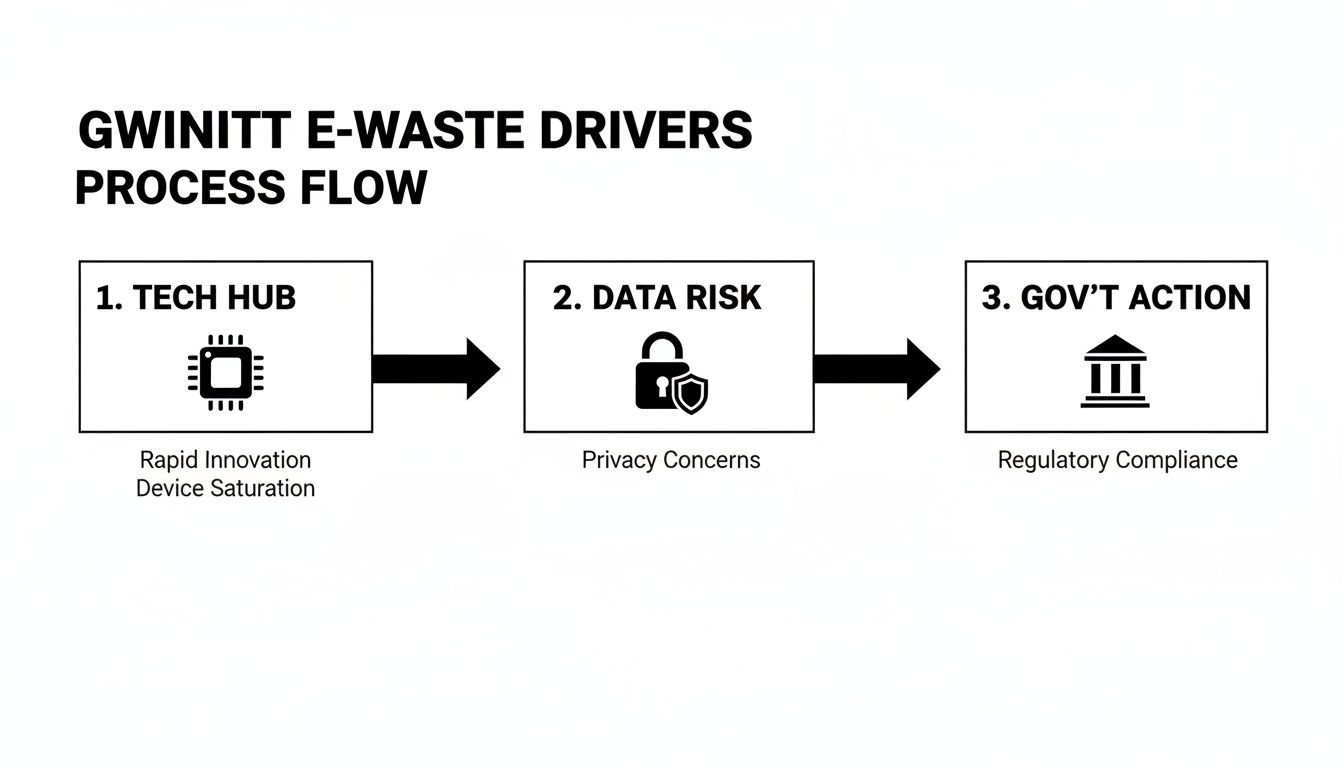
It’s a mix of our county's booming tech scene, the ever-present risk of data exposure, and increasing government oversight that makes a solid disposal plan so critical.
Conduct Your Initial Asset Inventory
First things first: you can't get rid of it if you don't know what "it" is. An initial asset inventory is the first real step. This isn't just about counting old PCs; it’s about creating a master list of every single electronic asset you plan to decommission.
For a small office in Duluth, a simple spreadsheet might do the trick. But for a large research lab over in Lawrenceville, you're probably looking at a more complex database to track hundreds of specialized instruments, servers, and peripherals.
Make sure your inventory captures:
- Asset Type: (e.g., Laptop, Server, Centrifuge)
- Manufacturer and Model: (e.g., Dell Latitude 7420, HP ProLiant DL380)
- Serial Number or Asset Tag: This is crucial for tracking and chain of custody.
- Physical Location: (e.g., Building C, Room 201)
- Data-Bearing Status: A simple "Yes/No" to flag devices needing secure data destruction.
This list becomes the master document for the entire project. It's what we use to give you an accurate quote and what you use to ensure every single item is accounted for.
Flag All Data-Bearing Devices
With your inventory in hand, the next critical job is to go through it line by line and identify everything that stores data. And I mean everything. This goes way beyond just computers and servers.
Any device with internal memory—from office multifunction printers with cached documents to networking hardware with configuration files—is a potential data security risk. These items must be flagged for specialized handling.
This step is non-negotiable. Missing even one old hard drive can lead to a devastating data breach. For a healthcare provider, that could mean a massive HIPAA fine. For a tech company, it could mean losing valuable intellectual property. The stakes are simply too high to overlook this.
Engage a Professional for a Logistics Plan
Once you have your inventory and have flagged all the data risks, it's time to bring in a certified recycling partner. A professional service like S.E.D. will take your asset list and build out a logistics plan tailored specifically for your Gwinnett County facility or multiple locations nationwide.
This plan answers all the key operational questions:
- On-Site Services: Do you need equipment de-installed from server racks or disconnected from individual workstations?
- Packing and Staging: Where can we consolidate assets for pickup to keep your business running smoothly?
- Scheduling: What’s the best day and time to show up so we don’t interfere with your normal operations?
Working with a local expert turns a simple list of equipment into a concrete, executable project. Our detailed guide on IT asset disposal dives deeper into this planning phase. It’s all about proactive coordination to ensure a smooth, secure pickup with zero surprises.
Finally, you’ll need to decide on the right data destruction method. Will you opt for DoD 5220.22-M 3-pass wiping, which sanitizes drives so they can be reused? Or is physical shredding the better choice for obsolete or damaged media? We can help you decide based on your own security policies and the types of assets you have, making sure your Gwinnett business stays compliant and secure from start to finish.
Mastering Data Security and Compliance in Gwinnett
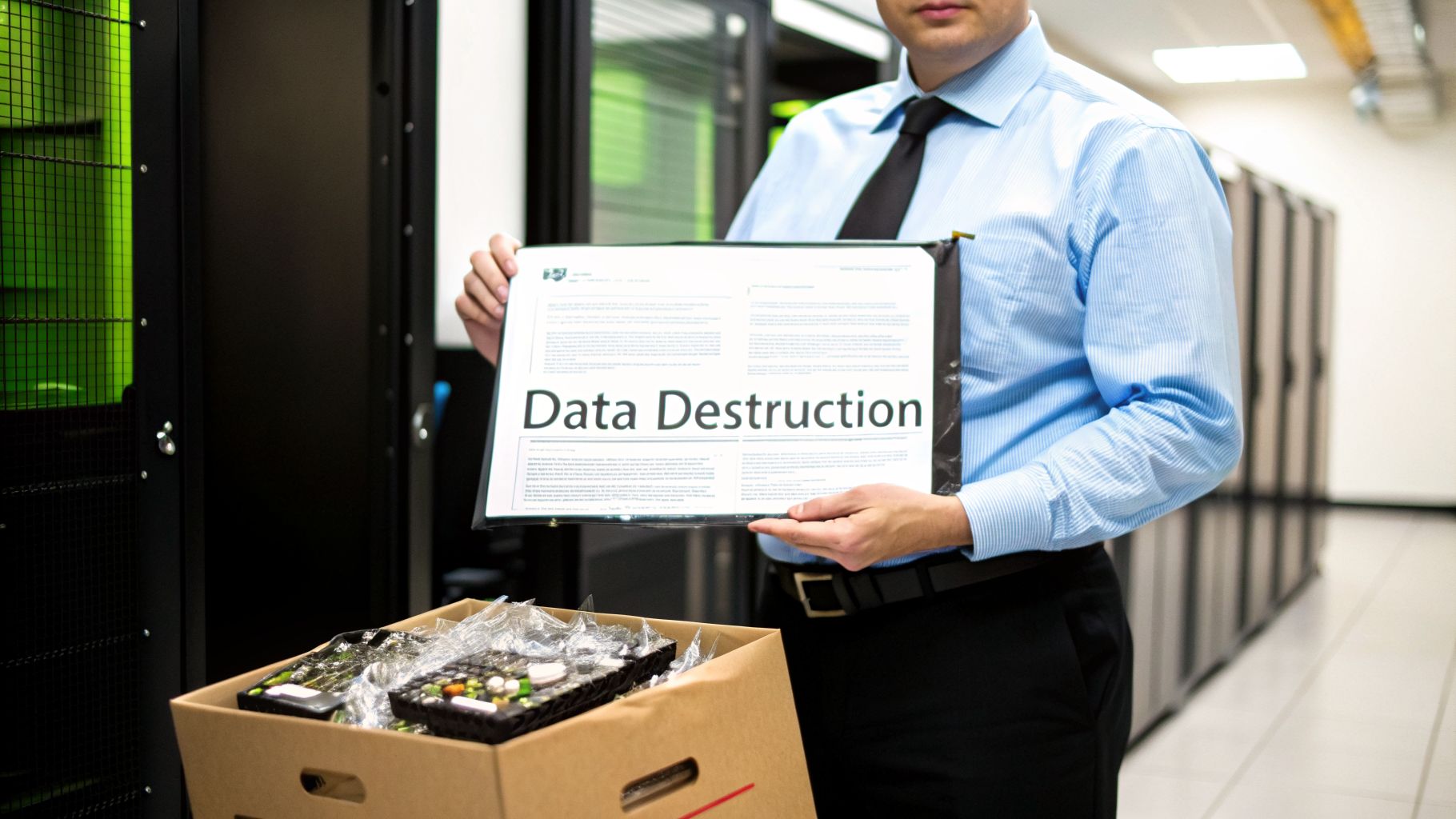
When it comes to electronics recycling for any Gwinnett County business, hospital, or school, let’s be clear: data security is everything. Anyone can haul away old equipment. The real work—and the biggest risk—is making absolutely certain the sensitive data on that equipment is gone for good.
If you’re managing a business electronics recycling in Gwinnett County GA project, you’re not just dealing with logistics; you're up against a wall of compliance rules. These aren't just best practices. They’re legally binding federal and state regulations, and the penalties for ignoring them are severe.
This is exactly why a certified, documented process is non-negotiable. It’s not about taking someone’s word that your drives were wiped. It’s about getting proof—an auditable paper trail that shows you met every single requirement.
Navigating Industry-Specific Compliance
The compliance standards you have to meet depend entirely on what you do. A medical clinic in Gwinnett has a different set of rules than a law firm in Lawrenceville or a school district office in Suwanee.
Here are the big ones we see every day with Gwinnett organizations:
- HIPAA (Health Insurance Portability and Accountability Act): For any healthcare provider, from large hospitals to small dental offices, HIPAA is absolute. It demands total protection of patient health information (PHI). Any device that ever touched PHI must be verifiably sanitized or destroyed. No exceptions.
- FERPA (Family Educational Rights and Privacy Act): Schools, colleges, and universities throughout Gwinnett County are responsible for protecting student records. That data lives on everything from laptops and tablets to the servers in the back office.
- FACTA (Fair and Accurate Credit Transactions Act): This applies to financial firms, car dealerships, and any business that handles consumer credit information. When you dispose of old hardware, that customer data must be completely unrecoverable.
Get this wrong, and you could be looking at crippling fines, lawsuits, and a loss of trust that can be impossible to win back.
Expert Insight: Think of compliance as more than just a box to check. It’s a commitment to permanently destroying sensitive data, backed by documentation that will hold up in an audit. Anything less leaves your organization exposed.
Choosing the Right Data Destruction Method
Once you've identified all your data-bearing devices, the next big decision is how to destroy the information on them. The two industry-standard methods we use are data wiping and physical shredding. The right call depends on your own security policies, the condition of the hardware, and whether it has any resale value.
DoD 5220.22-M 3-Pass Wiping
This is a software-based approach where we overwrite the entire hard drive with patterns of ones and zeros several times, making the original data impossible to retrieve.
- Best For: Functional, newer hard drives and SSDs that could be refurbished.
- Benefit: This lets you recover some value from your assets while guaranteeing data is gone. It's both cost-effective and a great environmental choice.
Physical Shredding
Just like it sounds. We feed the hard drive into an industrial shredder that grinds it into tiny metal fragments.
- Best For: Old, damaged, or non-working hard drives. It's also the choice for organizations with a strict "no-reuse" policy.
- Benefit: This is the ultimate proof of destruction. When a drive is turned into a pile of metal, there’s no question the data is destroyed forever.
For a closer look at these methods, check out our guide on secure hard drive destruction in Gwinnett County, Georgia.
Scenario: A Gwinnett Financial Firm’s Server Upgrade
Here’s a common situation we handle. A financial advisory firm in Peachtree Corners needed to upgrade its server room. They had a rack of old servers filled with years of client financial data, putting them squarely under FACTA compliance rules.
They called us for a complete solution. Our team went on-site, de-installed the servers, and matched every serial number to the firm's asset list for accountability. Since the servers were older and held such sensitive data, the firm chose physical shredding. We pulled the hard drives, recorded their serial numbers, and brought them back to our Norcross facility in a secure, locked transport.
A few days later, the firm had a Certificate of Destruction in hand. This is a legal document that lists the serial number of every single drive we shredded, creating a perfect, auditable trail proving they met their FACTA obligations. That's the peace of mind you get with a professional service.
To ensure your e-waste decommissioning aligns with legal requirements, understanding broader data privacy regulations is key. Learn more about effective compliance mapping for businesses, including guides on GDPR and HIPAA, to further safeguard sensitive information.
E-Waste Solutions for Gwinnett Schools and Universities
Schools and universities in Gwinnett County have a bigger e-waste problem than almost anyone else. The constant cycle of student laptops, classroom tablets, and sophisticated lab equipment creates a disposal headache that a typical office just doesn't see.
Managing this never-ending stream of outdated tech is a massive logistical and security puzzle. It’s not just about getting rid of old hardware; it's about protecting student privacy, meeting strict regulations, and making the most of tight budgets. A specialized recycling program is really the only way to tick all those boxes.
The E-Waste Mountain in Gwinnett’s Schools
The sheer volume of electronics flowing through a school system is staggering. Take Gwinnett County Public Schools, one of Georgia's largest districts with over 180,000 students. Their commitment to digital learning means thousands of devices are constantly being deployed and retired.
This creates a mountain of e-waste that needs a solid, sustainable solution—one that secures sensitive student data under FERPA and supports digital equity. With EPA estimates showing only about 20-25% of e-waste is properly recycled nationwide, the need for proactive partners in Gwinnett is obvious. You can read more about Gwinnett's local recycling needs on reworxrecycling.org.
For school administrators and IT staff, this constant turnover creates several major headaches:
- Data Security: Every single device holds student records and faculty information protected by the Family Educational Rights and Privacy Act (FERPA). A breach is not an option.
- Logistical Hurdles: Just organizing the collection of thousands of devices from dozens of different schools is a huge job.
- Storage Issues: Old, obsolete equipment quickly eats up valuable storage space that could be used for actual school supplies and activities.
- Leading by Example: As community leaders, schools have a duty to model environmentally responsible practices for their students.
Solutions Built for Schools
A one-size-fits-all plan simply won't cut it for the education sector. A partner specializing in business electronics recycling in Gwinnett County GA for schools understands these unique pain points and builds a program to solve them.
This means providing a service that goes way beyond a simple pickup. We start by building a process that works with the academic calendar, often scheduling major cleanouts during summer or holiday breaks to cause zero disruption.
Key Insight: For schools, successful e-waste management is a cycle. It demands a partner who can handle massive pickups, guarantee data destruction, and provide the paperwork you need for compliance audits.
For instance, when a university science department renovates its labs, it's not just swapping out old computers. It's decommissioning complex scientific instruments that need special handling. S.E.D. has comprehensive solutions for exactly these projects. You can check out our guide on laboratory cleanout services for universities and labs to see how we manage these jobs.
A program that truly works for schools will always provide:
- Serialized Asset Tracking: We create a detailed inventory report that tracks every laptop, server, and tablet from your school to its final disposition. This gives you a rock-solid chain of custody.
- Guaranteed FERPA Compliance: Every device with a hard drive undergoes certified data destruction, either through DoD-compliant wiping or physical shredding. You get a Certificate of Destruction as proof.
- Zero-Landfill Policy: Our commitment to sustainability means all materials are responsibly recycled. This helps you strengthen your green campus initiatives and teach by example.
By working with an expert, Gwinnett schools can turn a massive disposal problem into a secure, compliant, and sustainable process. You protect sensitive data, free up space and resources, and let your educators get back to their real mission.
Frequently Asked Questions About Business E-Waste Recycling
Even with the best plan, you’re bound to have a few questions when it’s time to deal with old electronics. We get it. IT managers and business leaders across Gwinnett County and the nation often run into the same concerns about logistics, costs, and data security.
Here are some straight answers to the questions we hear most often. Our goal is to give you the practical info you need to make the right call for your business.
What Types of Business Electronics Can Be Recycled?
We take just about everything. Our goal is to be your one and only call for a full cleanout, so you aren't stuck trying to coordinate multiple vendors for one project, whether you're in Gwinnett County or anywhere else in the U.S.
Our recycling services cover a huge range of IT, office, and lab equipment:
- Standard Office IT: Desktops, laptops, servers, and all types of monitors (yes, even the old, heavy CRT models). We also take networking gear like switches and routers, plus all your peripherals—printers, keyboards, mice, you name it.
- Specialized Laboratory Assets: We're fully equipped to handle scientific instruments, centrifuges, diagnostic equipment, and even large-scale analytical machines.
- Data Center Hardware: This includes everything from server racks and storage arrays to uninterruptible power supplies (UPS) and all the cabling and components that go with them.
We aim to make business electronics recycling in Gwinnett County GA simple by accepting nearly any asset you need to retire. If you've got a particularly unique or specialized piece of equipment, just give our Norcross office a quick call to confirm.
What Is the Cost for Business E-Waste Recycling?
There's no simple, one-size-fits-all answer here—the cost really depends on what you have. We build our quotes based on your specific inventory list so there are never any surprises.
In many situations, the service is surprisingly affordable. For newer IT assets that still have some value—like modern servers, laptops, or networking gear—the recycling service is often no charge. We’ve even had projects where those assets generate a cash return for the company.
On the other hand, some items will have a fee. This is usually for equipment that needs special handling because of hazardous materials or simply has no resale value. A classic example is an old CRT monitor, which contains leaded glass and costs more to process safely. We’ll always give you a clear, itemized breakdown of any costs before you move forward.
How Does On-Site Pickup and Logistics Work in Gwinnett?
As a local company based right here in Norcross, we provide a complete, hands-on logistics service across all of Gwinnett County and offer scalable solutions for national clients. Our professional crew and fleet of trucks come right to your building to manage the entire process. You won't have to lift a finger.
Our team can handle it all:
- De-installation: We’ll safely de-install servers from their racks, disconnect workstations, and get everything ready for removal.
- Secure Packing: We carefully pack and wrap sensitive assets on-site to make sure they are protected on the way back to our facility.
- Flexible Scheduling: We’ll work with your schedule to find a time for the pickup that causes the least amount of disruption for your team.
Whether you're in Lawrenceville, Duluth, Peachtree Corners, or anywhere in between, our crew handles all the heavy lifting. You just point, and we'll take care of it.
Key Takeaway: Using a professional pickup service means your own team doesn't have to waste time and effort on decommissioning. They can stay focused on their real jobs while we manage the cleanout securely and efficiently.
How Quickly Can You Schedule a Pickup in Gwinnett County?
Our Norcross headquarters gives us a huge advantage in serving the entire Gwinnett area quickly. For most projects, we can have a truck at your location within just a few business days after we finalize the service agreement.
We know that things can change fast in business. If you’re facing an urgent deadline—like an end-of-lease cleanout, an office move, or a last-minute shutdown—we can often arrange for expedited service. The best way to get an exact timeline is to call us with your inventory and project details.
Ready to stop worrying about your old electronics and lab equipment? Contact Scientific Equipment Disposal today for a straightforward quote and see how easy compliant recycling can be for your Gwinnett County business or national enterprise. Visit us at https://www.scientificequipmentdisposal.com to get started.