A Guide to Scientific Equipment Decommissioning Services

When a lab, hospital, or data center is ready to upgrade, move, or shut down, you can't just unplug the complex equipment and haul it to the curb. That's where scientific equipment decommissioning services come in—it's the critical step that happens between an asset's last day on the job and its final, certified disposal. Whether you are in a major hub like Atlanta or anywhere across the nation, this process is key to a secure transition.
Decoding Scientific Equipment Decommissioning
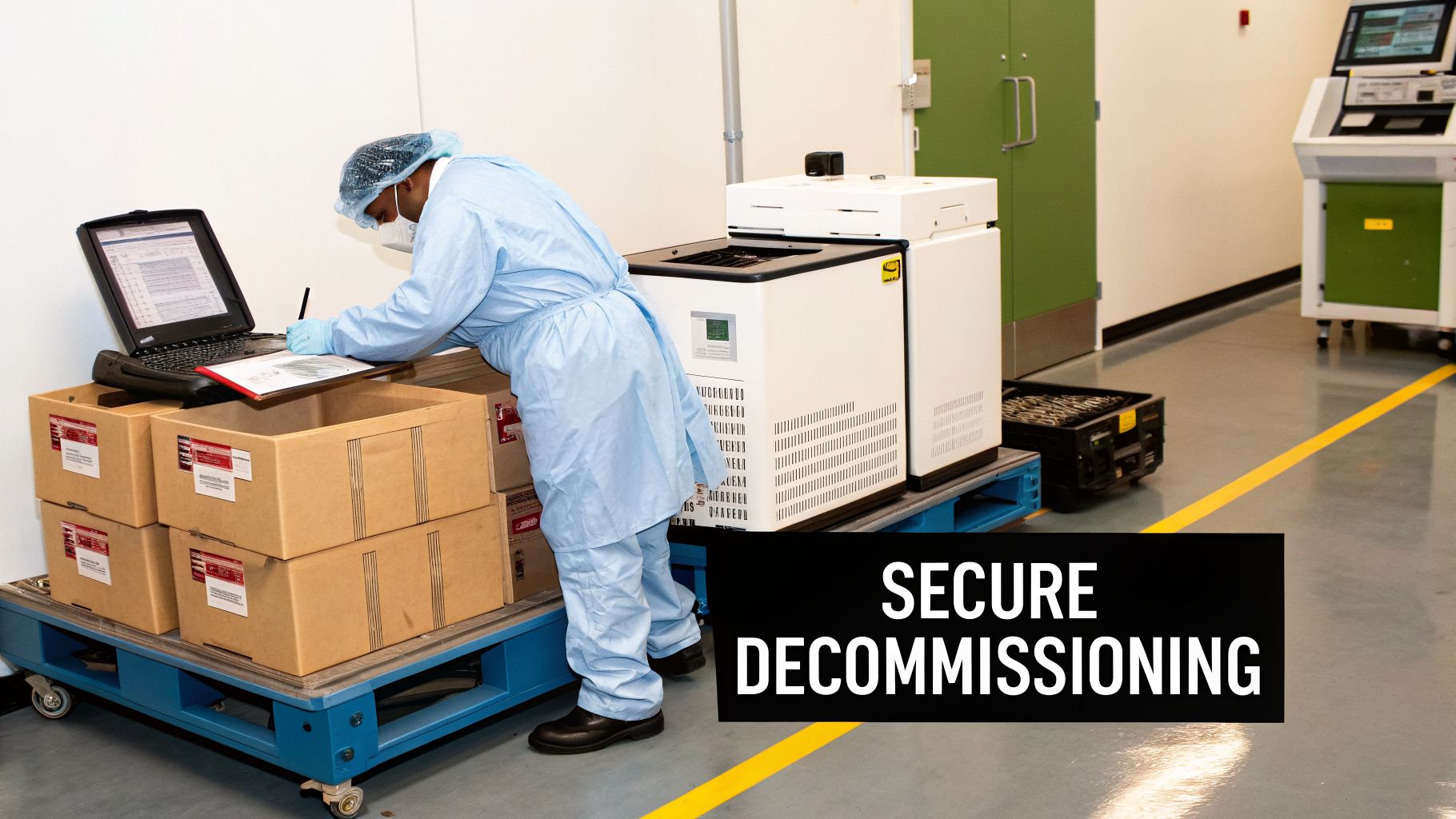
Think of it less like a simple move-out and more like clearing a secure government facility. It’s not about just packing boxes. This is a methodical, end-to-end process built to manage serious risks, from protecting sensitive data to meeting strict government regulations.
For any organization, from a local lab in Atlanta to a nationwide healthcare system, that deals with high-value assets and confidential information, getting this right is non-negotiable. One wrong move can lead to devastating data breaches, stiff environmental fines, and a major hit to your bottom line. We provide these critical services nationwide.
More Than Just Removal
Decommissioning isn't a single action; it’s a full-blown project that ties together logistics, data security, and regulatory compliance. We're not just movers hauling away old machines. We're a team executing a structured plan to shield your organization from the hidden liabilities that come with equipment retirement, offering services locally and across the U.S.
Decommissioning transforms a potential liability into a documented success. It provides an auditable trail that proves your organization has met its legal and ethical obligations for data protection and environmental responsibility.
Key Components of Decommissioning Services
A professional partner handles the entire asset retirement lifecycle, making sure nothing gets missed. The service breaks down into several key phases that all work together, available to clients from coast to coast. You can learn more about how to dispose of scientific equipment safely in our detailed guide.
Here’s what that process looks like:
- Detailed Asset Inventory: First, we catalog every single piece of equipment slated for decommissioning, paying close attention to any device that holds data or contains potential hazards.
- Professional De-installation: Our national team safely disconnects and preps everything for transport, from delicate lab centrifuges to entire server racks.
- Certified Data Destruction: We ensure every bit of sensitive information on hard drives and other storage is completely destroyed, following strict standards like HIPAA and DoD 5220.22-M.
- Secure Logistics: Your assets are transported from your facility, whether in a dense urban center or a remote location, to our certified plant in a dedicated, GPS-tracked fleet. No exceptions.
- Compliant Recycling and Disposal: Materials are responsibly recycled, and any hazardous waste is disposed of according to all local, state, and federal environmental laws.
- Final Certification: You receive official Certificates of Destruction and Recycling, giving you the documentation you need for any audit or compliance check.
Why Compliance and Data Security Are The Core of Decommissioning
When you're dealing with sensitive information, whether at a Georgia research university or a national hospital system, retiring old equipment is about much more than just making space. Proper scientific equipment decommissioning is built around one thing: ironclad compliance and data security. This isn't just a hauling service; it's a systematic process to eliminate risks that could cost you dearly in fines and reputation, wherever your facility is located.
Just think about what could happen if a patient's medical records from an old diagnostic machine fell into the wrong hands. The fallout is more than just bad press—it can lead to staggering fines and completely shatter the trust you've built. A certified decommissioning process is what turns that huge liability into a secure, documented, and compliant project.
The Rules and Regulations You Can't Ignore
Getting rid of scientific and medical assets isn't as simple as dropping them off for recycling. You're dealing with a complex web of federal and state laws designed to protect both private data and the environment. Getting this wrong, even by accident, can lead to serious trouble. Our nationwide service ensures you're covered no matter where you operate.
Here are the key regulations that make professional decommissioning so essential:
- Health Insurance Portability and Accountability Act (HIPAA): This is the big one. HIPAA demands strict protection for all Protected Health Information (PHI). Any piece of equipment that ever stored, handled, or sent patient data—from an imaging machine to a front-desk PC—must have its data professionally destroyed before it leaves your control.
- Environmental Protection Agency (EPA) Rules: A lot of lab gear contains hazardous materials like lead, mercury, or other chemicals. These items have to be disposed of according to specific environmental protocols to keep them out of our soil and water.
- State-Specific Regulations: States like Georgia have their own e-waste and data security laws, adding another layer of rules you have to follow. A partner with nationwide experience is familiar with these varying state requirements.
A professional partner already knows these requirements inside and out. They make sure every step is compliant, documented, and gives you a clear paper trail for any audit.
Data Destruction: The Only Guarantee for Security
Simply hitting "delete" or reformatting a hard drive just doesn't cut it. Data recovery tools can easily pull back information you thought was long gone. To truly be compliant and secure your data, you need methods that make recovery impossible.
Think of a hard drive like a book. Deleting a file is like tearing out the table of contents—the chapters are still there, just harder to find. True data destruction is like putting the entire book through a shredder, ensuring no one can ever read it again.
This is where specific data sanitization standards come in. The most widely recognized is DoD 5220.22-M, a process first created by the Department of Defense. This technique overwrites the hard drive's data multiple times with meaningless patterns, making the original information completely unrecoverable.
Why a Verifiable Chain of Custody Matters
From the second an asset is unplugged in your facility, you need to know where it is and that it's secure. A certified vendor establishes a strict chain of custody, which is basically a documented log that tracks every piece of equipment from your location—be it an Atlanta lab or a research facility in California—to its final recycling or destruction.
This process includes:
- Secure Logistics: Using dedicated, GPS-tracked vehicles to transport your assets nationwide, preventing any chance of loss or theft along the way.
- Asset Tagging and Inventory: Every single device that holds data is individually tagged, logged, and tracked through the entire process.
- Final Certification: Once everything is destroyed and recycled, you get the official paperwork to prove it.
This documented journey is your proof that you did everything right. To see what this final verification looks like, you can learn more about the Certificate of Destruction and how it protects you. Ultimately, choosing professional scientific equipment decommissioning services is an investment in managing risk and protecting your organization’s data, reputation, and bottom line.
The Step-By-Step Decommissioning Process
A proper equipment decommissioning isn't just about hauling away old gear. It's a detailed process we've perfected to make sure everything is handled securely, compliantly, and efficiently. Think of it less like a simple removal and more like a carefully managed project with a clear beginning, middle, and end.
We’ve broken down our entire end-to-end service into a clear roadmap. This way, lab managers, IT directors, and facility operators know exactly what’s happening at every stage. Each step builds on the last, creating a seamless, auditable trail that protects your organization from start to finish, whether you're here in Atlanta or anywhere else nationwide.
Phase 1: Initial Strategy And Scope Definition
First things first, we sit down with your team to map out the project. This is the planning stage where we define the "what, when, and how." We work with you to set clear goals, establish a realistic timeline, and draw firm boundaries around the project scope. It's all about getting on the same page before a single piece of equipment is unplugged, no matter your location in the U.S.
This initial chat is crucial for preventing surprises and scope creep down the line. We’ll nail down the answers to key questions: Are you shutting down a facility, upgrading a lab, or just clearing out old assets? What’s your target completion date? Do we need to work around active labs or sensitive hospital hours?
Phase 2: On-Site Asset Inventory And Tagging
Once the strategy is locked in, our team comes to your site to catalogue every single asset you want gone. This is much more than a simple headcount. We conduct a thorough inventory, creating a detailed manifest that becomes the foundation for the entire project. Our teams are available for on-site service nationwide.
During the inventory, we focus on two critical tasks:
- Flagging Data-Bearing Devices: Every server, workstation, and piece of diagnostic equipment with a hard drive or internal storage is identified and tagged for secure data destruction. This is a non-negotiable step for protecting patient, research, or financial data and ensuring HIPAA compliance.
- Noting Potential Hazards: We also identify any equipment that might contain biological or chemical residues. For labs, understanding the right protocols for the sterilization of equipment is a crucial prerequisite for everyone's safety.
This meticulous tagging system gives us an ironclad, auditable record that follows each asset through every step of the process.
Phase 3: Professional De-Installation And Segregation
With every asset accounted for, the physical work begins. Our trained technicians get to work de-installing all the equipment, from heavy, complex machinery to delicate lab instruments. This is precise, careful work—definitely not a job for a standard moving crew—and it's a service we provide across the country.
Safety and organization are our top priorities here. We carefully disconnect all systems, manage the cable cleanup, and get everything ready for transport. Assets are then sorted and segregated based on their next destination. Items flagged for data destruction are kept separate from assets going straight to recycling, ensuring there's no confusion or cross-contamination.
Phase 4: Secure On-Site Data Destruction
For many organizations, this is the most important part of the whole process. To give you absolute peace of mind, we can perform all data destruction right at your facility while you watch. This service is available at any client site nationwide and completely eliminates the risk of a data breach while assets are in transit.
When we destroy data on-site, sensitive information never leaves your building intact. It's the ultimate security guarantee, turning a potential risk into a verified, witnessed event.
We use methods that meet the highest industry standards, rendering data 100% irrecoverable. This usually means DoD 5220.22-M standard data wiping for drives that might be reused or physical shredding for any that are obsolete or have failed. You get to see your hard drives turned into fragments, and we document the serial number of every single one.
This workflow is all about identifying risk, applying the right method, and getting verifiable proof.
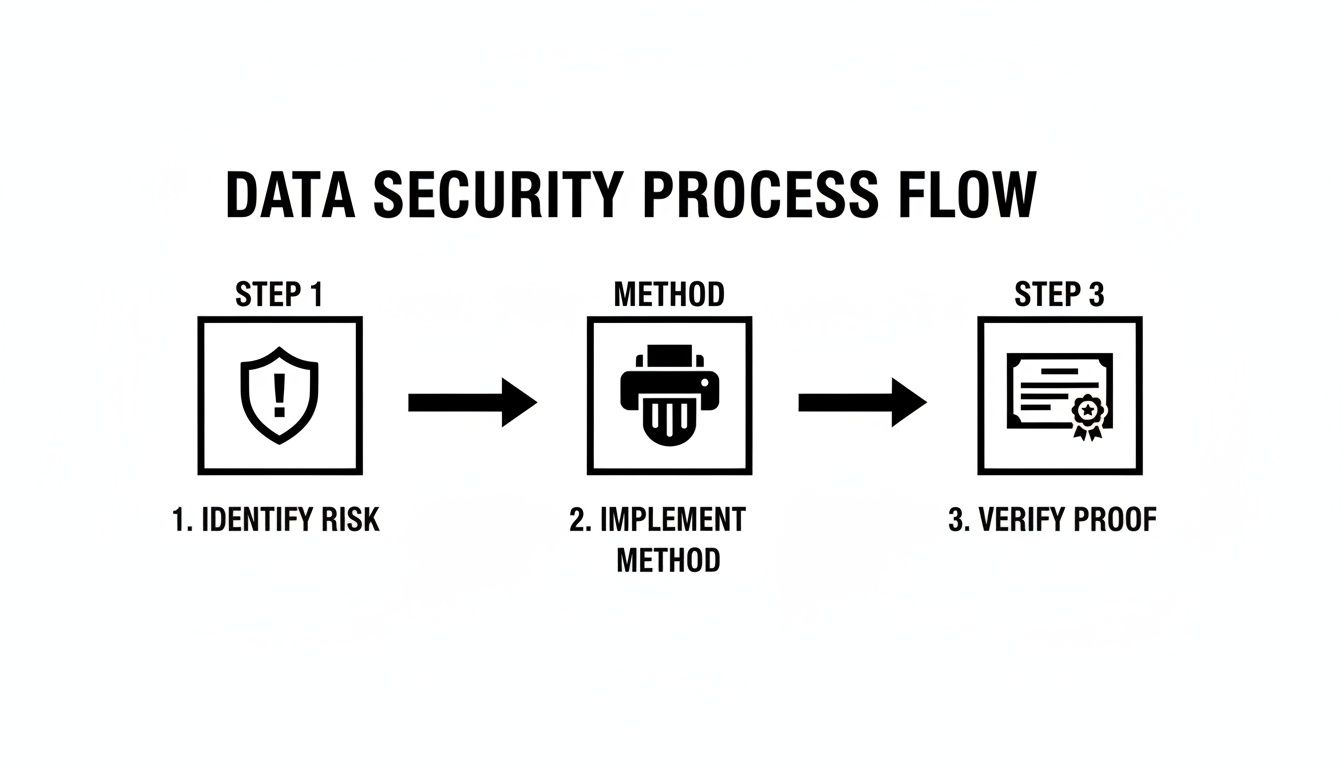
As you can see, a secure process isn't truly complete until you have the certificate in hand that proves the risk has been handled.
Scientific Equipment Decommissioning Checklist
To help you stay organized, here's a simple checklist that breaks down the key actions and compliance checkpoints for each phase of the project.
| Phase | Key Action Items | Compliance Checkpoint |
|---|---|---|
| 1. Planning | Define project goals, set timeline, identify operational constraints, and agree on the scope of work. | Internal stakeholder sign-off on the project plan. |
| 2. Inventory | Conduct a physical audit, tag every asset, and identify all data-bearing and potentially hazardous items. | Creation of a master asset list (manifest) with serial numbers. |
| 3. De-Installation | Safely disconnect and remove all equipment. Segregate assets based on their disposal path (data, recycle). | Verification that all equipment matches the inventory list before removal. |
| 4. Data Destruction | Perform on-site or off-site data wiping or shredding. Document serial numbers of all destroyed media. | Witness the on-site destruction; prepare for Certificate of Data Destruction. |
| 5. Logistics | Securely pack and transport all assets using a GPS-tracked, company-owned fleet. | Document the chain of custody at every handoff point, from your site to our facility. |
| 6. Disposition | Process assets at a certified facility for responsible recycling or remarketing. | Ensure downstream partners are R2v3 or e-Stewards certified for environmental compliance. |
| 7. Reporting | Compile all documentation into a final compliance package and deliver it to your team. | Receive and file the Certificate of Destruction and Certificate of Recycling for your records. |
This checklist ensures no critical step is overlooked, providing a clear and auditable path from start to finish.
Phase 5: Secure Logistics And Chain Of Custody
Once everything is de-installed and any on-site data destruction is complete, we load it all onto our secure, GPS-tracked trucks for transport. We handle the logistics ourselves with our own fleet and drivers—we don’t outsource this to a third-party freight company. We maintain control from your door to ours, offering nationwide coverage.
This strict chain of custody is documented at every point of transfer. It creates a complete, unbroken audit trail from your facility, whether in Georgia or any other state, all the way to our final processing center.
Phase 6: Certified Recycling And Disposition
When the assets arrive at our facility, they are processed according to the plan we established. Electronics are broken down and directed to our R2v3 or e-Stewards certified downstream recycling partners. This is your guarantee that all materials are handled in an environmentally responsible way, keeping hazardous e-waste out of landfills.
Phase 7: Final Compliance Reporting
The final step is closing the loop. We provide you with a comprehensive reporting package that serves as your official proof of compliance and secure disposal.
This package always includes:
- A Certificate of Data Destruction: This document lists the individual serial numbers of every hard drive and storage device we destroyed.
- A Certificate of Recycling: This confirms that all your non-reusable assets were processed in line with environmental regulations.
- A Complete Asset Manifest: This final report reconciles with the initial on-site inventory, completing the audit trail from end to end.
This structured, seven-phase process ensures every part of your equipment decommissioning project is managed securely, transparently, and in full compliance with all regulations.
How Decommissioning Works for Organizations Nationwide
Let's move past the theory and look at what scientific equipment decommissioning services actually look like on the ground. For organizations in the Atlanta metro area—from sprawling hospitals in Midtown to the tech hubs of North Fulton—the challenges aren't just academic. They're real, and they’re right outside your door. We'll also explore how these services scale for clients across the country.
Here’s a look at how we apply these principles to solve complex problems for both local and national institutions. These aren't generic case studies; they reflect the specific logistical, security, and compliance hurdles that hospitals, universities, and data centers face. Each situation demands a tailored approach, proving there’s no such thing as a one-size-fits-all solution.
A Major Hospital System Upgrading Imaging Labs
Picture a large hospital near Emory University that's upgrading its entire radiology department. This means decommissioning several massive, multi-ton MRI and CT scanners. This job is far more than just heavy lifting; it's a mission-critical operation tangled up with patient data, serious logistics, and public safety.
The challenges are immediate and non-negotiable:
- HIPAA Compliance: Every scanner holds hard drives and internal systems that have stored thousands of patient records, or Protected Health Information (PHI). That data has to be professionally and verifiably destroyed according to federal law before a single bolt is loosened.
- Logistical Complexity: These are enormous, sensitive machines, often buried deep within an active hospital. Getting them out means careful, strategic planning to navigate tight corridors, utilize service elevators, and work after-hours to avoid disrupting patient care.
- Asset Management: The hospital’s risk management and legal teams need a perfect, unbroken chain of custody. They require a final Certificate of Destruction for every single data-bearing part to close the loop on compliance.
As a partner with years of experience both locally in the Atlanta area and with healthcare systems nationwide, we know how to coordinate with facility managers, de-install the equipment without incident, and perform data destruction right on-site. We understand the rhythm of a busy medical center, ensuring the project stays on schedule without ever getting in the way of the hospital's life-saving work.
For healthcare providers, the decommissioning process is an extension of patient care. Protecting data from retired medical equipment is just as critical as protecting it within the hospital's live network.
A Georgia University Consolidating Research Facilities
Now, think about a major Georgia university that's consolidating two older biology labs into a brand-new research facility. The project involves a massive and wildly varied inventory. We're talking about everything from benchtops crowded with centrifuges, incubators, and spectrometers to dozens of IT workstations and servers.
The university’s compliance and environmental health & safety (EHS) departments have their own strict rules. They need a partner who can handle a mixed bag of assets, where each item has a different end-of-life protocol. This includes dealing with equipment that may have been exposed to biological or chemical agents and requires special handling.
In a scenario like this, the job is all about meticulous sorting and segregation. A specialized provider has to:
- Catalogue Diverse Assets: Build a detailed manifest that clearly separates general electronics from specialized scientific instruments.
- Verify Decontamination: Confirm that any equipment from a BSL-rated lab has been properly decontaminated and tagged with a certification from the university's safety officer before it's moved.
- Manage Data and Recycling: Securely wipe all data from workstations and servers, while making sure the lab-specific equipment is routed for proper materials recycling.
By managing this whole headache, a decommissioning specialist gives the university a single point of contact and one final report. That report confirms every asset was handled exactly according to institutional and state environmental standards. For any organization wanting to dig deeper into local rules, a partner with deep knowledge of certified recycling in Atlanta, GA is invaluable.
A National Corporation Retiring Data Center Servers
Finally, let's look at a national corporation retiring servers from multiple data centers, including a key site in the Alpharetta, Georgia area and others across the U.S. For a company like this, data security isn't just a priority—it's everything. One lost drive or one improper wipe could trigger a catastrophic data breach, costing millions and shattering customer trust.
Here, the entire project hinges on absolute, verifiable data destruction. The client requires DoD 5220.22-M 3-pass sanitization for any drives that might have resale value and physical shredding for everything else. Often, they want on-site shredding so their IT teams at each location can witness the destruction. A flawless chain of custody is mandatory, tracking every asset by serial number from the server rack to its final disposition.
On top of that, the company wants to see if there's any value left in the hardware by remarketing newer components to help offset the project's cost.
A professional partner with nationwide reach delivers on all of this. They provide secure, GPS-tracked transport from any site in the country, document the serial number of every single shredded drive, and give the client a transparent, consolidated report on any value recovered from resold assets. This approach transforms a high-risk liability into a secure, documented, and even partially self-funded project.
Understanding Decommissioning Costs and Timelines
When you’re planning a lab cleanout, two questions always jump to the front of the line: "What will this cost?" and "How long will it take?" Of course, the answer is never one-size-fits-all. The budget and schedule for professional scientific equipment decommissioning services are shaped by the unique details of your project.
Getting a handle on these factors is the key to setting realistic expectations. A simple local project, like clearing out a few benches in a small clinic, is a world away from a full-scale, multi-state lab shutdown. The complexity, volume, and type of equipment are what really drive the final cost and timeline.
Key Factors That Drive Project Costs
Decommissioning costs aren't pulled out of thin air. They’re directly tied to the labor, logistics, and specialized work your specific project requires. A professional provider will walk through these details to build an accurate, transparent quote, so you can avoid the surprise fees that often pop up on disorganized jobs.
Here are the main elements that will shape your budget:
- Equipment Volume and Type: The sheer amount of equipment is a major driver. More assets mean more hands needed for inventory, de-installation, and transport. The type of equipment is just as important—moving a massive, delicate MRI is a much different task than handling a few standard PCs.
- Data Sanitization Requirements: The level of data security you need has a direct impact on cost. A standard DoD 5220.22-M 3-pass wipe is a different process and price point than physical destruction. On-site shredding, which offers the highest level of security, often means bringing specialized machinery to your facility, which adds to the expense.
- Logistical Complexity: Where your equipment is located plays a huge role. Assets on the ground floor with easy loading dock access are straightforward to move. Equipment on the 10th floor of a downtown Atlanta high-rise, or at multiple sites across the country, requires more coordination and planning.
- Value Recovery Potential: It’s not all about costs. If you have newer, functional equipment, it might have significant resale value. A good partner will assess your assets for any remarketing potential, which can generate a credit to help offset the overall project cost.
The whole point of a professional quote is transparency. It should clearly break down the costs for labor, logistics, data destruction, and recycling. It should also show any potential credits from asset resale. This protects you from vague "per-pound" pricing that can hide the true cost of the job.
Mapping Out Typical Project Timelines
Just like costs, timelines can vary widely. A decommissioning project might take a single day or stretch over several weeks, depending entirely on the scope of work. Working with a provider who serves both local Atlanta clients and nationwide organizations ensures they have the experience to manage projects of any scale.
- Small Projects (1-3 Days): Clearing out a small office or a handful of lab instruments can often be done very quickly. This usually involves a small crew and a single truckload of assets.
- Medium Projects (1-2 Weeks): A mid-sized lab cleanout or retiring a few server racks in a data center demands more detailed planning. This means more time for inventory management and coordination.
- Large-Scale National Projects (2+ Weeks): Full facility shutdowns or multi-site projects are major logistical operations. These require multi-phase planning, extensive on-site work, and coordination across different locations, often taking several weeks to go from the first step to the final certification.
Cost and Timeline Driver Comparison
To put it all in perspective, let's look at how these factors play out in two very different scenarios: a simple clinic cleanout versus a complete lab shutdown.
| Factor | Simple Project Example (Small Clinic) | Complex Project Example (Full Lab Shutdown) |
|---|---|---|
| Equipment Type | Standard exam tables, PCs, basic diagnostics | Diverse mix of centrifuges, spectrometers, fume hoods, servers, and heavy industrial machinery |
| Data Destruction | Off-site wipe of a few hard drives | On-site shredding of hundreds of hard drives to meet strict HIPAA and proprietary research security protocols |
| Logistics | Ground-floor access, easy parking | Multi-floor facility, requiring freight elevator scheduling and after-hours work |
| Value Recovery | Minimal to none | Significant potential to recover value from newer servers and specialized instruments |
| Estimated Timeline | 1-2 days | 3-4 weeks |
Ultimately, understanding these drivers helps you plan more effectively. It also ensures you find a partner who can give you a clear, detailed roadmap for your specific scientific equipment decommissioning services needs, whether local or nationwide.
How To Choose The Right Decommissioning Partner

When it comes to scientific equipment decommissioning services, picking your partner is the single most important decision you'll make. This choice is what stands between a smooth, compliant process and a nightmare of data breaches and regulatory fines.
You have to be able to tell the difference between a true, certified professional and a simple electronics hauler who just shows up with a truck. Think of it like hiring a professional service provider for any other critical business need—the vetting process is everything. For labs and data centers, this means digging into specific certifications, security practices, and logistical expertise that general movers just don’t have.
Key Criteria for Vetting a Decommissioning Vendor
Before you sign on the dotted line, run any potential partner through this checklist. These are the absolute essentials, whether your facility is in Atlanta or anywhere else in the country.
- Top-Tier Certifications: The vendor absolutely must hold either an R2v3 or e-Stewards certification. These are the gold standards in our industry for a reason. They guarantee that your assets are handled ethically and in an environmentally sound manner, protecting your reputation.
- Documented Data Security Protocols: Don't just take their word for it. Ask to see their standard operating procedures for data destruction. They should be able to walk you through their process for DoD-standard wiping and physical shredding, giving you a clear, auditable path to HIPAA compliance.
- Proof of Adequate Insurance: Your partner needs to be fully insured. This means carrying robust policies for general liability, errors and omissions, and especially pollution liability. This is your safety net if something goes wrong, like an accidental data leak or environmental issue.
- In-House Nationwide Logistical Capabilities: Do they run their own trucks, or do they subcontract the transportation? A company with its own GPS-tracked fleet has total control over the chain of custody. This is a massive security advantage you can’t get with third-party movers.
Critical Questions to Ask a Potential Vendor
When you start talking to vendors, their answers to these questions will tell you everything you need to know. Confidence and transparency are great signs. If you get hesitation or vague responses, consider it a major red flag. This is especially true when you're looking at a complex project like scientific equipment removal for labs and universities.
A truly professional partner views themselves as an extension of your compliance team. Their goal isn't just to remove equipment but to provide a secure, auditable, and risk-free service that protects your organization's reputation.
Here are the non-negotiable questions to ask:
- Can you provide a sample Certificate of Destruction? You need to see exactly what their documentation looks like. Does it include individual serial numbers for every asset? If not, it's not a real audit trail.
- Describe your chain of custody process from pickup to final disposition. They should be able to talk you through every single step, from the moment they tag an asset on-site to its secure transport and check-in at their facility.
- Are your employees background-checked and trained in data security? The people physically handling your equipment are the front line of your data security. They must be trustworthy and properly trained.
- What is your process for asset value recovery? If you have newer equipment that still holds value, a good partner will have a clear, transparent system for assessing that value and offering you a credit or buyout.
Got Questions About Scientific Equipment Decommissioning? We've Got Answers.
Here are some of the most common questions we get about professional scientific equipment decommissioning. We want to give you clear, straightforward answers so you can move forward with confidence, whether your project is right here in the Atlanta area or across the country.
What Types Of Lab And Medical Equipment Do You Handle?
We handle just about everything you'd find in a laboratory, hospital, or data center, providing services nationwide. This covers the small benchtop gear like centrifuges and pipettes all the way up to massive systems like fume hoods, biosafety cabinets, and heavy industrial machinery.
Of course, that also includes all the IT assets that go along with them—servers, computers, and storage arrays that need certified data destruction.
Is Our Project Too Small For A Professional Service?
Not at all. No project is too small. While we often manage huge facility-wide clear-outs for national clients, we're just as happy to help with smaller local jobs.
Whether you're clearing out a single lab room, retiring a handful of medical devices, or just need to get rid of a dozen old workstations, our team will put together a plan that makes sense for your needs and budget.
A lot of people think professional decommissioning is only for massive projects. The truth is, the compliance and data security risks are there no matter the size, which makes certified disposal a smart move for any organization.
What Proof Do We Get That Our Data Is Actually Destroyed?
You will receive a formal Certificate of Data Destruction. Think of this as your official, legally-binding audit trail. It confirms that every single data-bearing device was sanitized or physically destroyed according to strict standards like HIPAA and DoD 5220.22-M.
The certificate even lists the unique serial numbers of every hard drive and storage device we process, giving you undeniable proof that you’ve met your compliance obligations.
How Do We Get Started In The Atlanta Area or Anywhere in the U.S.?
Getting started is easy. Just give our team a call for a no-obligation chat. We'll talk through your project's scope, what's on your inventory list, and your timeline to put together a clear, itemized proposal.
Once you give the green light, we’ll work with your facility manager to schedule everything. We'll handle the on-site de-installation and pickup at your location, whether you're in metro Atlanta, elsewhere in Georgia, or any other state.
Ready to clear out your retired assets with a secure, compliant, and hassle-free process? Contact Scientific Equipment Disposal today to schedule your pickup and get a free, transparent quote. Visit us at https://www.scientificequipmentdisposal.com to learn more.