Lab Equipment Lab Disposal: A How-To Guide for 2026

A lab closure rarely starts with disposal. It starts with a deadline.
A lease is ending. A renovation is approved. A principal investigator is retiring. A hospital department is replacing analyzers and needs the old line gone before the new one arrives. Then someone looks around the lab equipment lab and realizes the room holds far more than benches and boxes. It holds centrifuges, incubators, freezers, fume hoods, monitors, control boards, old lab PCs, embedded drives, chemical residue, and years of undocumented decisions.
At this stage, most projects either get controlled early or drift into avoidable risk.
Facility managers usually do not struggle because they lack effort. They struggle because decommissioning cuts across too many domains at once. Environmental health and safety, IT, compliance, facilities, procurement, legal, and the lab itself all own part of the problem. If no one creates one operating plan, the project turns into a series of rushed handoffs.
The Challenge of Lab Equipment Lab Decommissioning
The hardest part of a lab equipment lab shutdown is not lifting heavy equipment. It is managing everything attached to that equipment.
A benchtop centrifuge might look simple until someone confirms whether it was used with biological material, whether its drain lines were cleared, whether it contains internal storage, and whether transport requires decontamination records. A hospital analyzer raises the stakes further because it may have processed protected health information. A university freezer may be “empty” but still contain residue, unlabeled racks, or forgotten samples in secondary compartments.
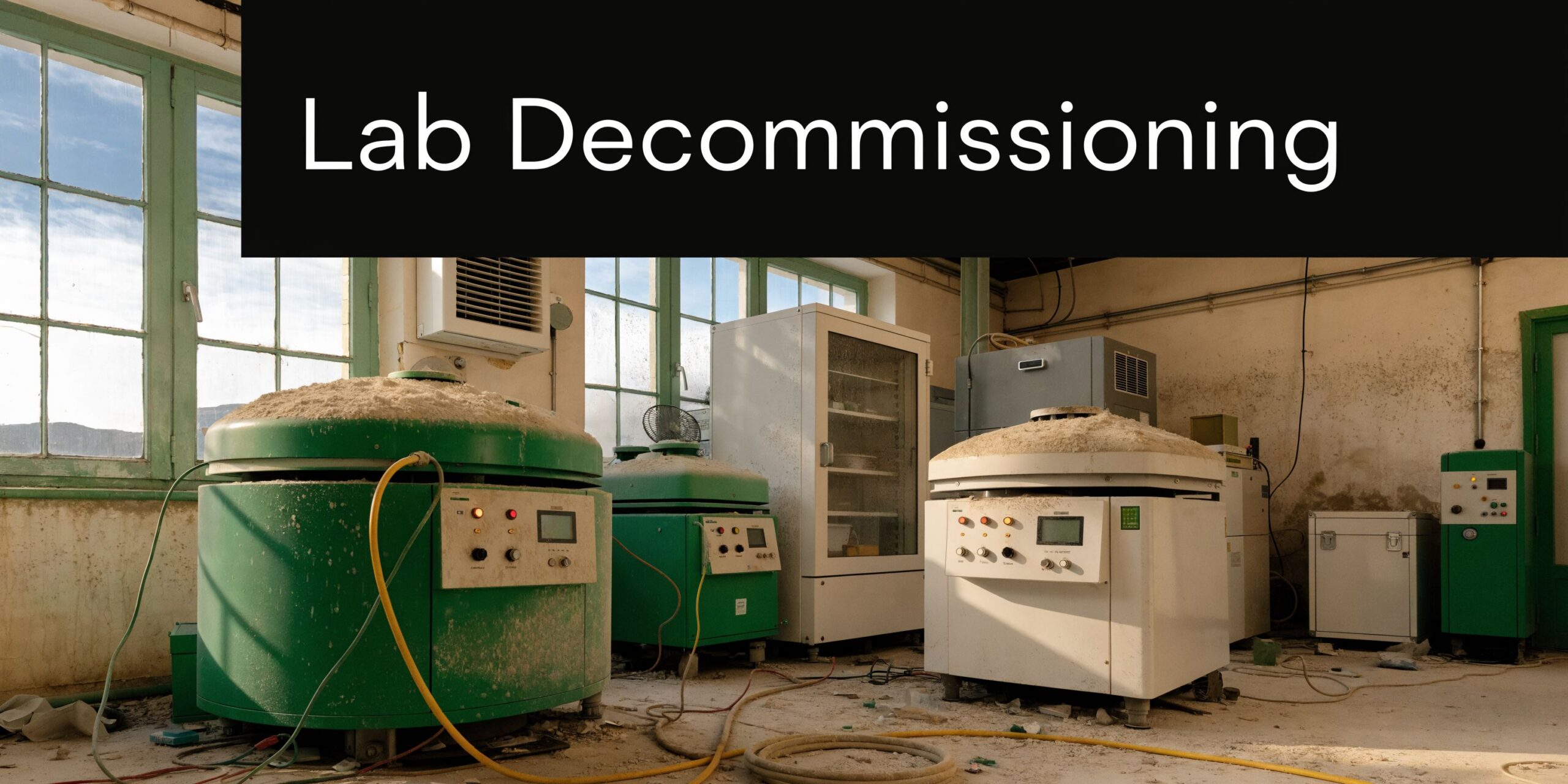
The scale of the issue is not theoretical. Healthcare facilities worldwide generate more than 6,600 tonnes of medical equipment waste each day, according to a 2025 environmental impact report covering devices such as MRI and CT scanners, monitors, infusion pumps, laboratory analyzers, centrifuges, and diagnostic systems with embedded computers or sensors (medical equipment waste data).
Why routine cleanout thinking fails
Standard surplus workflows do not work well for lab environments.
A normal office cleanout assumes furniture, monitors, and basic electronics. A lab decommission assumes possible biohazards, chemical exposure, utility disconnect sequencing, chain of custody, and disposal restrictions. Even a “small” project can involve multiple waste streams and several approval gates before anything leaves the room.
Three mistakes show up repeatedly:
- Treating disposal as the final step: Data review, decontamination planning, and asset triage should happen before movers arrive.
- Letting each department work from its own list: The lab manager, EHS, facilities, and IT often maintain separate inventories. That creates conflict on pickup day.
- Assuming old instruments are harmless: Age does not reduce compliance risk. Older systems often have worse documentation and more uncertain internal storage.
Tip: If your team cannot answer who used the instrument last, what it touched, and whether it stores data, the item is not ready to move.
For Atlanta facilities and national organizations managing multi-site closures, the safest approach is a coordinated decommission process that combines inventory, decontamination, data handling, and downstream recycling. Practical guidance on managing laboratory e-waste and electronics helps frame the job correctly from day one.
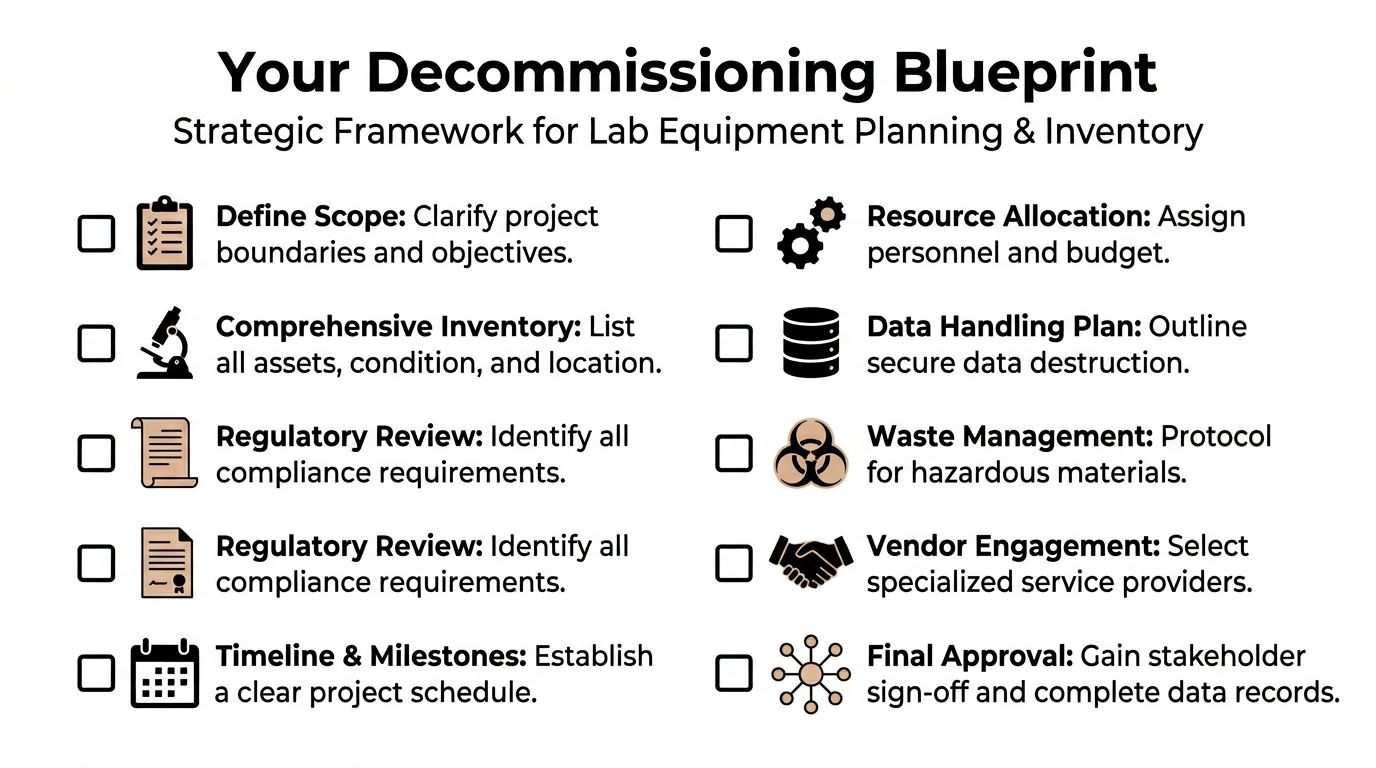
Your Decommissioning Blueprint Planning and Inventory
Most failed decommissions do not fail in the truck bay. They fail in the audit.
When teams skip the planning stage, they miss hidden hazards, underestimate labor, and discover sensitive assets too late. In laboratory decommissioning, the initial detailed lab audit phase following ANSI/ASSE Z9.11-2016 standards achieves success rates exceeding 95% in compliant project execution when conducted professionally, while incomplete inventories in DIY projects lead to regulatory violations in 30-40% of cases, causing delays and fines (lab audit and inventory guidance).
Build one decision team
The first practical move is naming a small working group that can make decisions quickly.
For a hospital lab, include facilities, compliance/privacy, biomedical or clinical engineering if applicable, IT, and the department owner. For a university lab, add the principal investigator, EHS, department administration, and facilities planning. For a corporate or industrial lab, include operations, EHS, IT asset management, and procurement.
Keep the team small enough to move, but broad enough to answer these questions:
| Question | Who usually owns it |
|---|---|
| What is staying, moving, selling, or retiring | Lab leadership and facilities |
| What requires decontamination approval | EHS or biosafety staff |
| What may contain regulated data | IT, privacy, compliance |
| What utilities must stay active until late stage | Facilities and vendors |
| What lease or site obligations apply | Real estate, legal, facilities |
A project slows down when these answers emerge one item at a time. It speeds up when they are resolved during the first walkthrough.
Audit the room like you will not get a second chance
A useful inventory is not a simple asset list. It is a disposal map.
Record the obvious fields first: item type, manufacturer, model, serial number, location, and physical condition. Then capture the fields that drive risk:
- Use history: Biological, chemical, radiological, general dry use, or unknown
- Data risk: Embedded PC, touchscreen controller, removable media, networked connection, or no known storage
- Disposition path: Reuse, relocation, resale review, recycling, or regulated disposal
- Removal notes: Requires rigging, utility disconnect, OEM disassembly, refrigerant handling, or crate protection
- Approval status: Awaiting lab signoff, EHS clearance, IT clearance, or ready for pickup
Many teams discover at this point that “miscellaneous bench equipment” is not a category. It is a warning sign.
Different lab types need different timelines
The same 90-day window means different things depending on the site.
Hospital timelines
Hospitals usually need the earliest review of data-bearing assets and the strictest chain of custody. Clinical analyzers, diagnostic peripherals, and attached PCs should be flagged at the opening audit, not near pickup day. Patient-facing operations also make scheduling tighter. Shutdown work often has to avoid care windows, loading congestion, and infection control conflicts.
University timelines
Universities often struggle with ownership clarity. One room may contain departmental property, grant-funded assets, student-built devices, and items nobody has touched in years. Build extra time for principal investigator review, EH&S forms, and abandoned material identification.
Corporate lab timelines
Corporate sites move faster once legal hold, data retention, and procurement questions are settled. The issue is usually speed with documentation. Operations wants space back quickly, but compliance still needs a clean paper trail for every regulated item.
Tip: If the lab is closing because of a move or lease turnover, lock the inventory cutoff date early. After that date, no asset should leave, swap rooms, or change status without updating the master list.
What works in the field
The teams that finish smoothly do three things well.
One, they assign a single inventory owner. Not five partial owners. One owner.
Two, they physically tag equipment in the room. A spreadsheet alone is not enough when movers, EHS staff, and lab personnel are all looking at the same benches.
Three, they separate planning from labor. The audit team decides what should happen. The removal team executes that plan.
Organizations that need support with both the inventory phase and physical removal often use providers that handle scientific asset pickup and de-installation for academic and research settings, such as lab and university equipment removal services.
Navigating Regulatory and Safety Compliance
Once the inventory is complete, the work becomes physical.
This stage can still go wrong even with a good plan. Equipment decontamination and dismantling yields 98-99% success in achieving clean conditions when teams follow validated SOPs, but pitfalls like inadequate verification cause 20-35% failure rates in swipe tests and can delay sign-off by 30-60 days (equipment decontamination and dismantling results).
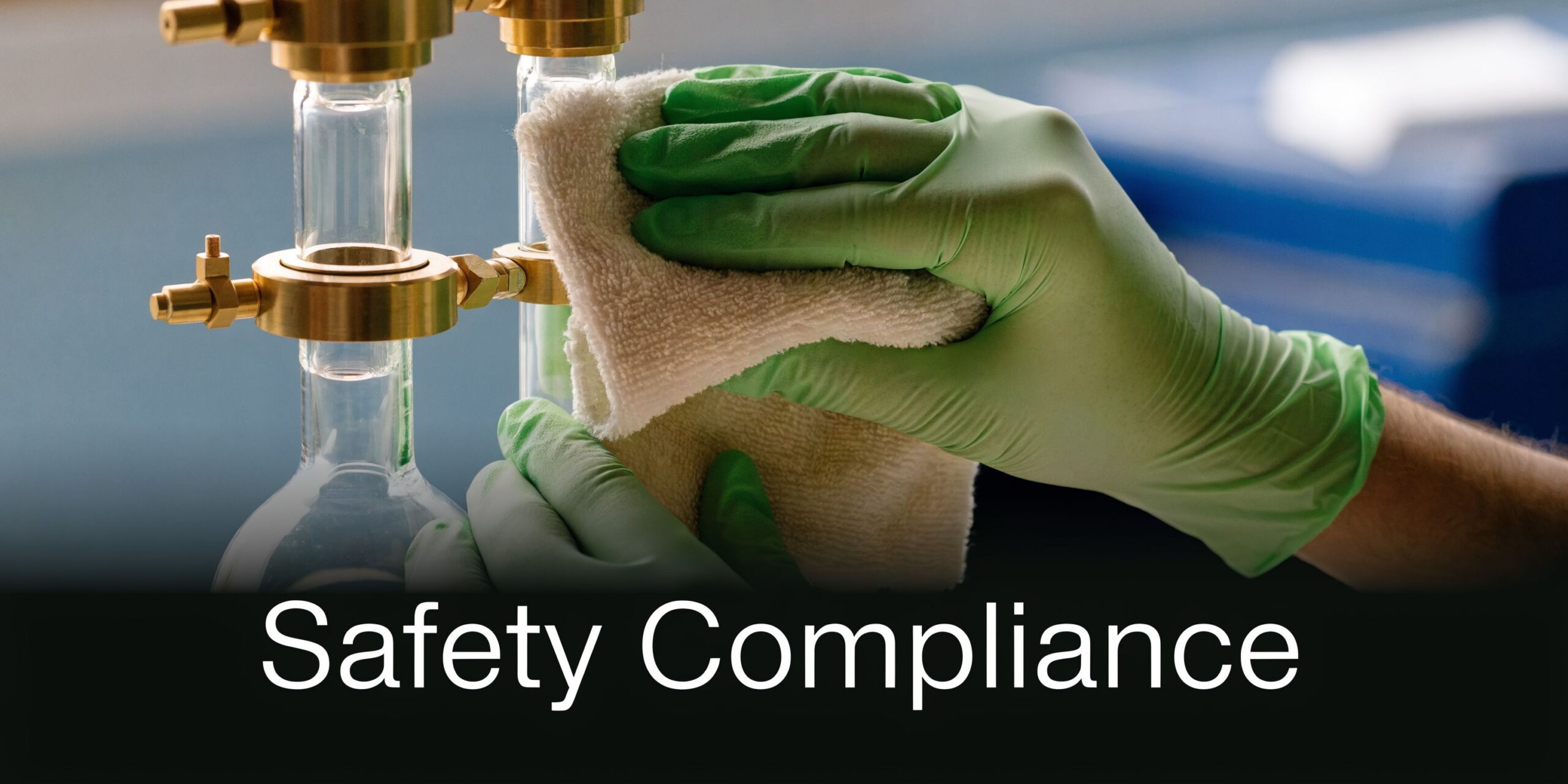
Decontamination starts with use history
Do not pick a cleaning agent because it is nearby. Pick it because the use history supports it.
Validated protocols matter because a biosafety cabinet, a centrifuge rotor chamber, and a solvent-exposed benchtop instrument do not present the same risk. The operational standard described in the verified guidance includes 10% bleach for biosafety cabinets and 70% ethanol for general surfaces within validated decontamination workflows, tied to audit findings and contaminant type.
A practical workflow looks like this:
- Confirm the contaminant profile. Use the audit, interviews, and lab records to determine whether the item saw biological, chemical, radiological, mercury, or mixed exposure.
- Lock and isolate the asset. Disconnect users first. Then control utilities in the sequence that prevents spills, residue release, or loss of safe operating state.
- Apply the right agent and dwell time. Wipe-down without dwell time is often cosmetic, not compliant.
- Drain and clear internal components. Drip trays, fluid lines, reservoirs, filters, and collection containers are common misses.
- Document what was done. Method, agent, concentration, date, and responsible party should travel with the item.
Verification is the part teams skip
A decontaminated item that cannot be verified is still a problem.
The point of swipe tests, ATP swabs, radiological checks, and decontamination tags is not paperwork for its own sake. It is evidence. Downstream handlers, transport crews, receiving recyclers, and internal compliance teams all need a basis for accepting the equipment.
A short acceptance checklist helps:
- Visible status: No residue, staining, obvious contamination, or loose contents
- Recorded method: Cleaning agent and process documented
- Verification evidence: Test result, inspection, or signed release, depending on hazard type
- Attachment to item: Tag or paperwork physically tied to the unit
- Chain continuity: The same item ID appears on inventory, test, and transport records
What not to do
Three shortcuts cause repeat trouble in the field.
First, do not remove labels before signoff. Teams sometimes strip stickers or barcodes during cleanup, then lose the identity trail that links the item to its decontamination record.
Second, do not disconnect plumbed or ventilated equipment too early. Fume hoods, washers, and certain analyzers need utilities managed in sequence.
Third, do not let “lightly used” replace actual verification. The item either cleared the process or it did not.
Tip: If the removal vendor asks for decontamination records before pickup, that is a good sign. It means the receiving side is controlling risk instead of pushing it downstream.
Safety compliance during dismantling
Dismantling is not just disassembly. It is controlled separation.
Benchtop instruments may only need wrapping, labeling, and staged loading. Larger systems often require OEM guidance, lockout procedures, fluid management, glass protection, and route planning through elevators, corridors, and loading areas. Refrigerated or utility-connected equipment adds another layer because components may require specialized handling before transport.
For sites that want a documented path aligned with environmental requirements for retirement and recycling, EPA-compliant laboratory equipment disposal practices provide a useful operating standard.
Securing Your Data Beyond Deleting Files
The most underestimated risk in a lab equipment lab is often invisible.
Many managers still focus first on chemical exposure or physical removal, then treat data as an IT cleanup task at the end. That order is backwards. If an instrument stores patient information, test results, user credentials, network settings, or research data, data security belongs in the opening asset review.
The gap is real. Verified guidance notes a significant lack of practical direction for end-of-life data security in electronics-integrated lab gear, even as more AI-driven lab tools contain non-volatile memory and few resources explain compliant 3-pass sanitization or shredding protocols needed for DoD and HIPAA-aligned handling (lab equipment data security guidance).
Why deletion is not disposal
Deleting files only changes what the user sees. It does not reliably sanitize the underlying media.
That matters because many instruments are not obvious computers. Sequencers, analyzers, spectrometers, incubators with digital controllers, and older integrated systems may store logs, user settings, sample metadata, audit trails, or exported reports in internal memory. Some include removable drives. Others hide storage on embedded boards.
A workable risk screen is simple:
| Asset type | Data question to ask |
|---|---|
| Analyzer or diagnostic system | Did it process patient or subject data |
| Instrument with touchscreen or onboard software | Does it retain users, methods, logs, or exports |
| Attached workstation or thin client | Is local storage enabled |
| Retired server, NAS, or lab PC | Has media been sanitized or destroyed |
| “Dumb” device with modern controls | Has anyone confirmed there is no non-volatile memory |
When wiping works and when shredding is required
Software-based sanitization is appropriate when the media is functional, accessible, and compatible with the sanitization method your organization accepts. For many organizations, DoD 5220.22-M 3-pass sanitization is the required standard for reusable or recyclable media because it creates a documented overwrite process.
Physical destruction becomes the right call when the drive is failed, inaccessible, obsolete, or too uncertain to trust.
That distinction matters in real projects. Teams waste time trying to “wipe” media that cannot complete the process. At that point, the safer route is controlled shredding with chain-of-custody records.
Chain of custody is the proof, not the promise
A verbal assurance that drives were wiped is not enough for a regulated environment.
The paper trail should show:
- Which asset contained data
- Who released it
- How the media was handled
- Whether it was sanitized or physically destroyed
- When the work occurred
- What certificate or disposition record closed the item
For hospitals and clinics, this is part of HIPAA risk control. For universities and research organizations, it also protects unpublished work, grant data, and confidential collaboration files. For corporate labs, it supports legal, IP, and retention obligations.
Tip: Ask vendors to identify data-bearing lab assets during intake, not only desktops and servers. The hidden risk is usually inside instruments, not beside them.
One practical option some facilities use is a provider that combines pickup with documented media handling, including secure data destruction for laboratory and IT equipment. Scientific Equipment Disposal, for example, states that it provides DoD 5220.22-M 3-pass hard-drive wiping and shredding for obsolete or nonfunctional media as part of its service model.
Managing Logistics From Lab Bench to Final Destination
Once an item is approved for removal, logistics becomes a sequencing exercise.
The order matters. Sensitive instruments should be packed after they are cleared, not while paperwork is still moving. Large systems should be routed after facilities confirms elevator access, dock access, and utility status. Multi-room projects should be staged so cleared items do not get mixed back in with active equipment.
In-house movement versus specialist logistics
An internal team can handle some jobs well. Straightforward pickups of non-hazardous, clearly tagged, unplugged bench equipment are often manageable if the site has labor, carts, packaging, and loading access.
But the risk profile changes fast when the project includes:
- Large instruments: Floor loading, route protection, lift-gate needs, or rigging concerns
- Fragile systems: Optics, glass components, calibration-sensitive assemblies
- Tight shutdown windows: Construction overlap, lease deadlines, active neighboring labs
- Mixed asset classes: Lab devices, electronics, storage media, and furniture in one pass
- Security requirements: Chain of custody from room release through outbound transport
If the move crosses into oversized or unusually heavy loads, facility managers benefit from understanding how heavy haul transportation services are planned. The transport logic is different from a routine office pickup, especially when route constraints and specialized equipment come into play.
Packing standards that protect value and reduce disputes
Good packing does two things. It prevents damage, and it preserves confidence in the chain of custody.
Use anti-static protection where appropriate. Brace doors and moving parts. Remove or separately secure accessories, trays, cords, and loose modules. Label each package to the master inventory, not with ad hoc handwritten descriptions that create receiving confusion later.
A practical staging model looks like this:
- Ready row: Cleared, tagged, documented items waiting for pack-out
- Hold row: Items pending EHS, IT, or ownership review
- No-touch row: Active equipment or excluded assets
That physical separation prevents one of the most common pickup-day failures. Someone sees an unplugged unit and assumes it is approved.
Questions to ask a logistics partner
Not every disposal company runs its own transport operation. That is not always a problem, but you should know who is touching the equipment.
Ask these questions early:
- Do you provide on-site de-installation and packing
- Do you operate your own trucks or subcontract pickups
- How do you handle chain-of-custody documentation
- Can you coordinate multi-day or phased removals
- What is your process for data-bearing assets
- How do you separate reusable, recyclable, and regulated items in transit
Facilities that want one vendor to handle de-installation, packing, and pickup often look for laboratory moving services that already support shutdowns and internal lab transitions.
Smart Choices for Recycling and Final Disposal
The last decision is not whether the equipment leaves. It is where it goes and under what documentation.
That decision affects sustainability reporting, downstream liability, and project cost control. It also affects whether useful materials stay in circulation or enter the wrong waste stream. Global e-waste volumes are rising five times faster than documented recycling rates, with an estimated 10 billion kg of large equipment not specifically recycled annually, making responsible recycling a vital secondary benefit after safe disposal (global e-waste and recycling gap).
A simple decision framework
Not every item belongs in the same channel.
| Condition and risk | Typical path |
|---|---|
| Functional, documented, low contamination risk | Reuse or resale review |
| End-of-life electronics with recyclable components | Certified recycling |
| Data-bearing media that cannot be sanitized | Physical destruction plus recycling of residual materials where appropriate |
| Contaminated or non-recoverable equipment | Regulated disposal |
The mistake is forcing every item toward resale or forcing every item toward scrap. The right path depends on condition, contamination history, documentation quality, and whether the asset still has a realistic secondary market.
Recycling is not just a sustainability line item
Recycling matters because lab and medical equipment often combines metals, boards, plastics, wiring, sensors, and components that should not go to landfill without review. It also matters because many organizations now face internal pressure to document diversion and responsible downstream handling.
That said, recycling should follow safe clearance, not replace it.
A contaminated incubator is not “green” because someone wants it off the floor quickly. A data-bearing analyzer is not ready for a recycler until storage is handled correctly. Safe disposition comes first. Material recovery follows.
How to judge a downstream outlet
A credible recycling or disposition path should answer four practical questions:
- Can they document what they received
- Can they separate data destruction from general recycling
- Can they identify items that require special handling
- Can they provide records your compliance team can retain
If those answers are vague, your organization absorbs the uncertainty.
Tip: Ask what happens after pickup. If the vendor cannot explain downstream sorting, sanitization, recycling, and final disposition in plain language, they may not control the full chain.
For hospitals, universities, government agencies, and corporate labs, the strongest outcome is usually a blended program. Reuse where feasible. Recycle where appropriate. Dispose compliantly when risk or condition leaves no other defensible option.
Frequently Asked Questions for Lab Decommissioning
How early should a decommission project start
Earlier than many organizations expect.
As soon as closure, renovation, relocation, or equipment replacement becomes likely, start the inventory and ownership review. The longer a lab has operated, the more undocumented items and exceptions you are likely to find.
Who should sign off before equipment leaves the room
At minimum, the lab owner or department lead, the relevant safety function, and the party responsible for data-bearing assets should be aligned. Facilities should also confirm disconnect and access requirements for larger equipment.
Can staff pack instruments themselves
Sometimes, yes. Routine bench items that are already cleared and easy to identify can often be packed internally.
Sensitive, plumbed, heavy, or data-bearing equipment is a different category. Those items usually justify specialist handling because one mistake can create a safety issue, break chain of custody, or eliminate reuse value.
What if nobody knows whether an instrument contains storage
Treat it as a data-risk item until someone confirms otherwise.
That is the safer assumption for modern instruments and many legacy systems with upgraded controllers. It is easier to downgrade risk after inspection than to explain why an unreviewed device left the site.
Should hospitals, universities, and corporate labs use the same checklist
No.
The core workflow is similar, but the pressure points differ. Hospitals usually need tighter data and privacy controls. Universities often need stronger ownership and lab history review. Corporate labs often need faster approvals tied to operations, legal, and asset disposition policies.
What is the most common cause of delay
Unresolved exceptions.
A single analyzer without ownership clarity, one freezer without final clearance, or one drive without approved handling can stall a whole pickup window. The fix is not working harder on removal day. The fix is surfacing exceptions earlier and assigning them to named owners.
If your facility is planning a lab closure, equipment refresh, hospital surplus project, or university decommission, Scientific Equipment Disposal is one practical option for coordinating pickup, de-installation, compliant recycling, and secure handling of data-bearing equipment in the Atlanta area. The company works with hospitals, schools, universities, corporations, and government agencies, and its service model includes box-truck logistics plus DoD 5220.22-M 3-pass hard-drive wiping and shredding for obsolete or nonfunctional media.