Your Guide to Equipment Laboratory Disposal in Atlanta and Across the US

Shutting down a lab, or even just upgrading a section of it, is a massive headache. It's packed with compliance risks and logistical nightmares that can keep any facility director up at night. A proper equipment laboratory decommissioning plan is your only real defense, making sure everything from a centrifuge to a networked computer is handled the right way.
This guide is for the lab managers and facility directors in the trenches—both here in Atlanta, GA, and across the nation—who need to turn a chaotic cleanout into a smooth, buttoned-up process. We provide services locally in the Atlanta metro area and offer nationwide solutions for organizations with multiple facilities.
Your Equipment Laboratory Decommissioning Plan
Any successful lab decommission starts with a plan. And I don't mean just unplugging machines and calling a junk guy. That's a recipe for disaster. We're talking about a strategic process that protects your organization from steep fines, data breaches, and environmental liability. Without that framework, you’re flying blind and almost guaranteed to miss a critical step.
Think of it as your pre-flight checklist. You wouldn't launch a rocket without triple-checking every system. So why would you start moving valuable—and potentially hazardous—assets without a detailed plan of attack? This plan becomes your playbook, guiding every decision from the first inventory count to the final certificate of destruction, whether your lab is in Georgia, California, or New York.
The Foundation of a Smooth Lab Cleanout
At its core, your plan is built on three key activities: figuring out what you have, understanding the risks tied to each piece, and making sure every single asset is secure before it leaves your doors. Skipping any of these is just asking for trouble down the line.
For instance, if you don't realize a piece of equipment laboratory hardware holds sensitive research data, you could be looking at a major breach. Same goes for mishandling an item that was exposed to chemical agents—that’s a direct line to EPA violations.
This initial planning phase is all about getting ahead of risk. A solid plan helps you:
- Establish Clear Accountability: Define exactly who is responsible for what, from tagging assets to coordinating with our removal team.
- Maintain Regulatory Compliance: Ensure every move aligns with HIPAA, EPA, and state rules. This is non-negotiable, especially for regulated labs.
- Create a Realistic Timeline: Break the project into manageable tasks with real deadlines. No more last-minute scrambles and costly errors.
- Budget Accurately: When you know the full scope of work, you can actually predict costs for data destruction, specialized handling, and transport.
A detailed decommissioning plan isn't just bureaucratic paperwork—it’s your primary defense against compliance failures. It turns a chaotic mess into a controlled, auditable, and secure operation.
This simple flowchart shows how these foundational steps connect. It’s a logical flow: you can't assess what you haven't inventoried, and you can't secure what you haven't assessed.
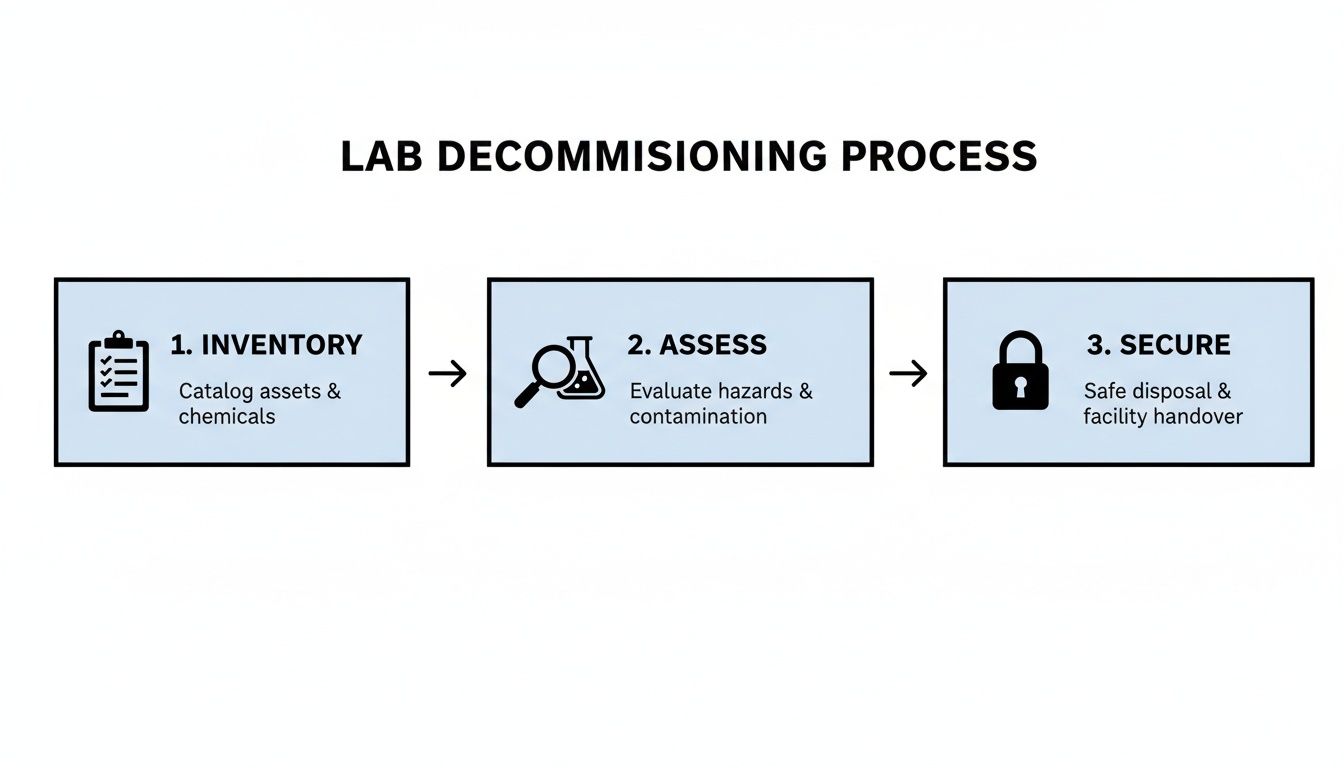
Each step builds on the last, starting with a comprehensive inventory and ending with every asset being properly secured for its final destination.
Local and Nationwide Considerations
The principles of safe lab decommissioning are the same everywhere, but logistics and local rules can throw a wrench in things. For labs in the Atlanta metro area, working with a local partner means faster response times and someone who already knows Georgia's specific disposal requirements inside and out. Our team serves businesses throughout Atlanta, Alpharetta, Marietta, and the surrounding region.
But for national companies with labs scattered across the country, you need a partner with a wider footprint. Someone who can standardize the process across all your locations, ensuring you get the same level of compliance and documentation whether your facility is in Georgia or California. We offer nationwide equipment laboratory disposal services, providing a single point of contact for all your sites.
Whether you're dealing with a single piece of equipment laboratory or clearing out an entire building, a professional partner manages the complexity. If your project is on the larger side, you may want to learn more about our dedicated research facility equipment removal services. Getting this plan right from the start sets you up for a successful, secure, and stress-free project.
Creating Your Lab Asset Inventory and Assessment

Before a single piece of equipment gets unplugged, your first job is to build a rock-solid inventory. This isn't just about counting boxes—it’s about creating a detailed master ledger that guides every single decision, from data security to regulatory compliance.
A sloppy or incomplete inventory is the fastest way to lose track of valuable assets, open up compliance gaps, and invite unnecessary risk. For labs in Atlanta and across the country, getting this first step right is what separates a chaotic, high-risk cleanout from a smooth, auditable, and secure project.
Cataloging Your Lab Assets
Start with a physical walkthrough and get everything documented. Your goal here is to capture the essential details for every asset, no matter how big or small. A simple spreadsheet is often all you need to get started.
At a minimum, your inventory should track:
- Item Type: What is it? (e.g., Centrifuge, IT Server, Fume Hood)
- Manufacturer and Model: Be specific. (e.g., Thermo Fisher, Model TSX500)
- Serial Number: This is your primary unique identifier for tracking.
- Internal Asset Tag: Your organization’s own tracking number is critical.
- Physical Condition: Note if it’s working, broken, or just parts.
- Location: Pinpoint the exact room or lab where it currently sits.
To get a handle on the financial side of things, you also need to factor in your equipment depreciation life. For a deep dive, this guide on understanding equipment depreciation life is a great resource. This helps you decide whether an item has resale value or is simply a candidate for recycling.
Conducting the Hazard and Data Risk Assessments
Once you know what you have, you need to figure out the risks tied to each item. This means running two assessments in parallel: one for physical hazards and another for data security. This isn't optional—it's absolutely essential for protecting your people, the public, and your organization's good name.
For the Hazard Assessment, you need to identify any equipment that has ever come into contact with:
- Biological Materials: This includes blood, tissues, cell cultures, or other potential biohazards.
- Chemicals: Tag anything used with corrosive, toxic, or reactive agents.
- Radiological Materials: Any item used near radioactive sources must be flagged.
This step is non-negotiable. Any equipment flagged as potentially hazardous must be professionally decontaminated before we can pick it up. Certified vendors simply cannot and will not handle contaminated equipment.
Every piece of equipment, from a PCR machine to an old freezer, must be assessed. Assuming an item is "clean" without verification is a significant safety and compliance risk. Your team's certification of decontamination is a legal attestation.
At the same time, your Data Risk Assessment needs to pinpoint any device that stores sensitive information. In modern labs, this goes way beyond just computers and servers. Many scientific instruments have internal hard drives that hold proprietary research, operational data, or even Protected Health Information (PHI).
You’ll need to flag devices like:
- Computers, laptops, and servers
- Networked instruments with internal memory (e.g., sequencers, analyzers)
- Medical devices that store patient data
- Any equipment with user logs or configurable research protocols
This two-pronged approach ensures every item is properly categorized for safe handling and compliant data destruction. To see the kinds of gear we manage, you can learn more about our process for scientific equipment removal for labs and universities.
A Practical Risk Assessment Checklist
To make this process easier, we've put together a quick-reference checklist. It's a simple tool to help your team stay consistent and make sure nothing falls through the cracks.
Below is a quick-reference table to help identify potential data and hazardous material risks associated with common lab equipment.
| Equipment Type | Potential Data Risk | Potential Hazard Risk | Recommended Action |
|---|---|---|---|
| PCR Machine | High – Stores run data, protocols, user logs | Medium – Exposure to biological samples | Certify Decontamination; Flag for DoD Wiping/Shredding |
| Lab Freezer (-80°C) | Low – Generally no data storage | High – Potential residual biological material | Certify Decontamination; Recycle as E-waste |
| IT Server | Critical – Research data, PHI, administrative files | Low – No direct material exposure | Mandatory DoD Wiping or Physical Shredding |
| Fume Hood | None | High – Exposure to various chemical agents | Certify Decontamination; Handle as Scrap/Recycling |
Using a structured approach like this transforms your inventory from a simple list into an actionable roadmap. It tells your disposal partner exactly how each piece of your equipment laboratory hardware must be handled, guaranteeing a secure and compliant decommissioning from start to finish.
Wiping and Shredding: Securing Your Lab’s Data for Good
When decommissioning your equipment laboratory, hitting 'delete' or formatting a hard drive is a recipe for a data breach. We see it all the time. In a world governed by HIPAA, HITECH, and a web of other privacy laws, true data sanitization isn't just a good idea—it's a legal must. The penalties for getting it wrong can be staggering, from massive fines to the kind of reputational damage that’s hard to walk back from.
This is where you have two core options: software-based wiping and physical destruction. Each one has its place, and knowing which to use is key to making sure your research, patient records, and proprietary data are gone forever. If you make the wrong call, your organization could be exposed long after the equipment is out the door.
The Gold Standard: Data Wiping
For hard drives that are still in working order, software wiping is your first and best line of defense. This is a far cry from just dragging files into the recycling bin. We’re talking about a rigorous, methodical process that overwrites every inch of the drive with junk data, making the original information impossible to recover.
The most trusted standard for this is DoD 5220.22-M. Developed by the Department of Defense, it’s a 3-pass overwrite that ensures nothing is left behind.
- Pass 1: Writes a specific character across the entire drive.
- Pass 2: Overwrites everything again with the complement of that character.
- Pass 3: Finishes with a random character and verifies the write was successful.
This triple-pass process essentially demolishes the magnetic signature on the platter. Even the most sophisticated forensic tools can’t put the pieces back together. It’s a secure, auditable, and cost-effective way to sanitize drives you might want to reuse or resell.
We often explain it like this: deleting a file is like tearing the table of contents out of a book. The chapters are all still there if you know where to look. DoD wiping is like scribbling over every single word on every page, three times, in different colors. The original text is gone for good.
This process is perfect for a situation we see often, like a metro Atlanta hospital retiring a fleet of patient monitors. The drives contain Protected Health Information (PHI), but the hardware itself is perfectly fine. A DoD 3-pass wipe ensures HIPAA compliance while keeping the monitors valuable for resale, and we provide a certificate of data destruction to prove it. You can learn more about our specific methods for secure data destruction.
When It’s Non-Negotiable: Physical Destruction
As good as software wiping is, it can't solve every problem. It’s useless for hard drives that are broken, electronics that won’t power on, or certain media like Solid-State Drives (SSDs). In these cases, physical destruction is the only way to be 100% certain your data is gone.
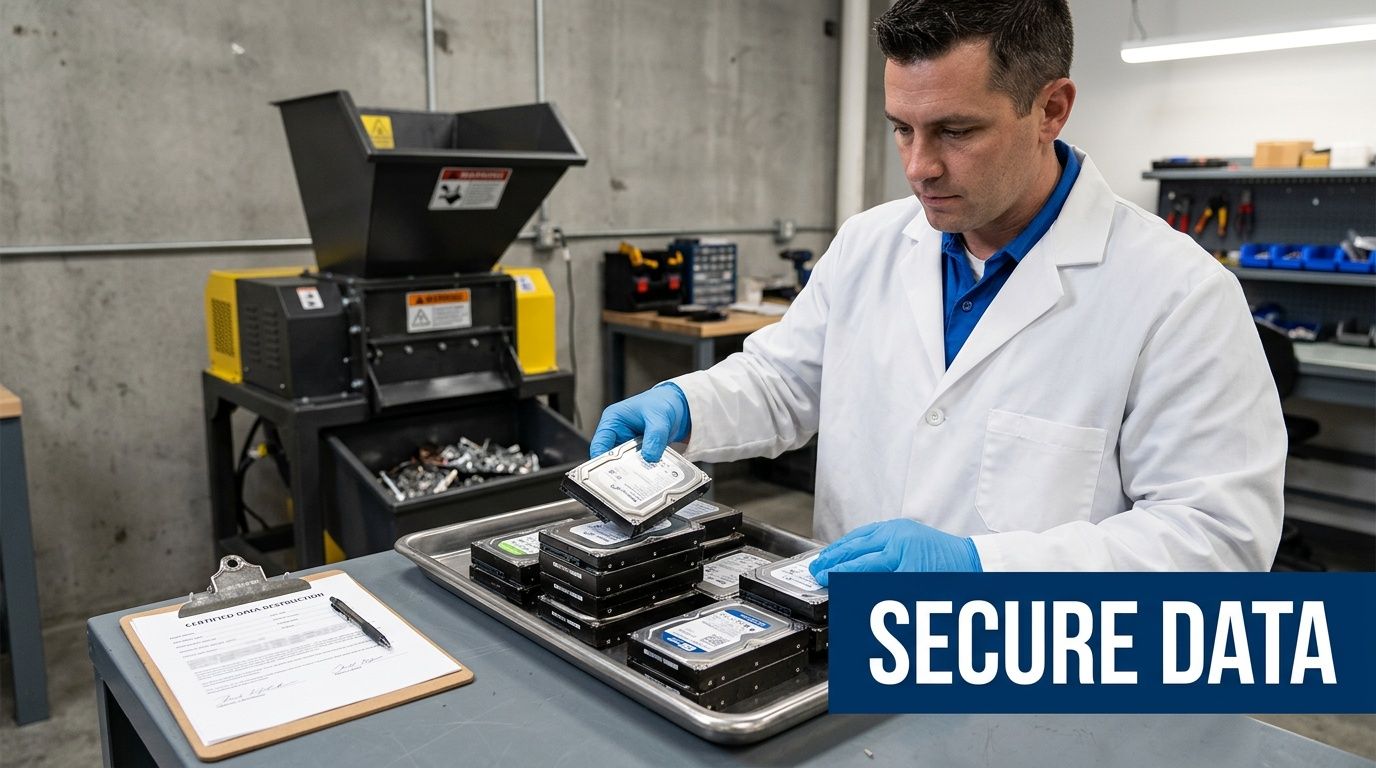
Physical destruction is exactly what it sounds like. We take the device and feed it into an industrial-grade shredder that reduces it to a pile of tiny metal fragments in seconds. There is no coming back from that.
Shredding becomes the clear choice in several scenarios:
- Damaged or Failed Hard Drives: If a drive won't even spin up, you can't run wiping software on it. Shredding is your only option.
- Solid-State Drives (SSDs): The way SSDs store data makes software wiping less reliable. Because of features like wear-leveling, you can't be sure every block has been overwritten. Physical destruction is the industry-recommended method.
- Maximum Security Needs: A research firm in Atlanta we worked with was disposing of computers with priceless R&D data. For them, the absolute certainty of physical shredding provided unmatched peace of mind.
- Other Media: This is also the best practice for backup tapes, USB drives, and other media that can’t be wiped reliably.
The choice between wiping and shredding really comes down to the type of equipment laboratory hardware, its condition, and your organization's risk tolerance. A certified partner can walk you through the decision for each asset, creating a blended approach that prioritizes security while keeping an eye on costs. This ensures your data's end-of-life is handled with absolute certainty.
Getting rid of old lab equipment isn't as simple as just calling a junk hauler. It's a process loaded with federal, state, and local rules. For any facility, from a small clinic here in Atlanta, Georgia to a university with labs across the country, one mistake can bring on heavy fines, environmental citations, and a major blow to your reputation. The only way to decommission your lab assets correctly is to know the regulatory playbook.
Two federal heavy-hitters set the rules: the Environmental Protection Agency (EPA) and the Health Insurance Portability and Accountability Act (HIPAA). The EPA has strict guidelines for e-waste, flagging many electronic components as hazardous materials that can't just be tossed in a landfill. We're talking about lead, mercury, and other toxins commonly found in scientific instruments.
Federal and State Rules You Can't Ignore
Then there's HIPAA, which is all about the data. If any of your equipment—whether it's a patient monitor or a research computer—ever touched Protected Health Information (PHI), it falls under HIPAA's non-negotiable security rules. Just wiping a drive often isn't enough; you need an auditable paper trail proving that data was destroyed beyond recovery.
Here in Georgia, you're also dealing with state-specific regulations. While most of Georgia’s e-waste laws are aimed at consumers, businesses are still held to the federal Resource Conservation and Recovery Act (RCRA), which the EPA enforces. Bottom line: if your lab generates hazardous e-waste, you're responsible for making sure it's managed by the book.
Let’s see how this plays out in the real world:
- An Atlanta-based Clinic: When a local clinic retires diagnostic tools that were used with patients, HIPAA is the top concern. Every single device needs to be checked for PHI, and any part that holds data has to be physically destroyed, usually by shredding. A Certificate of Destruction is your proof.
- A National University Research Lab: A university with campuses in multiple states getting rid of old research computers has two big responsibilities. First is the sensitive or proprietary data on the hard drives, which must be securely wiped or shredded. Second, the computers are e-waste that must be recycled under EPA rules to keep them out of landfills.
From Centrifuges to Certificates of Destruction
The sheer variety of laboratory equipment makes compliance a real challenge. Even a simple-looking device can have hidden issues. Take the centrifuge, a workhorse in nearly every lab. When older models are decommissioned, they can't just be thrown out—improper disposal could leach heavy metals from their rotors and motors into the ground. Through proper recycling, however, 95% of metals like aluminum and steel can be recovered, turning a compliance headache into a sustainable process.
This is where your documentation becomes your most important tool. A professional disposal process will give you an unbreakable chain of custody and a complete audit trail for every single asset.
The Certificate of Destruction isn't just a receipt; it's your legal proof of compliance. It demonstrates that you took every necessary step to protect sensitive data and handle e-waste responsibly, shifting liability from your organization to your certified vendor.
This is the document that will protect you in an audit. It needs to list every serialized piece of equipment, the destruction date, the method used (like a DoD 3-pass wipe or physical shredding), and a clear statement certifying compliance with all regulations.
The Advantage of a Certified National Vendor
If your organization has facilities outside of Atlanta, partnering with a certified national vendor is the smartest path forward. A single, qualified partner ensures the same high standards are met at every lab you operate, whether it’s in Georgia, New York, or California. It saves you the massive headache of trying to find and vet different local vendors for every location.
This approach gives you a single point of accountability. You get one contact, one set of standardized documents, and one unified strategy for all your laboratory e-waste. It simplifies a complex, multi-state compliance puzzle into a secure and manageable operation. For a closer look at responsible handling, see our guide on EPA-compliant laboratory equipment disposal.
You’ve inventoried every piece of equipment and completed your hazard assessments. Now for the final step: getting everything out of your facility. This is where a solid logistics plan for your equipment laboratory pickup can make or break the entire project, turning potential chaos into a smooth, orderly process.
Whether your lab is in a busy Atlanta high-rise or a sprawling suburban campus anywhere in the U.S., coordinating the physical removal is where the rubber meets the road. When you partner with a professional disposal team, you're not just hiring movers. You're bringing in specialists who know how to handle everything from de-installing heavy, bolted-down fume hoods to securely packing and transporting sensitive instruments. Our goal is to manage the entire removal with minimal disruption to your daily operations.
What Goes Into the Cost of a Lab Cleanout?
Budgeting for a lab decommissioning means looking at the whole picture. The final cost isn’t just a flat fee; it’s shaped by a few key factors that determine the time, labor, and resources needed for your specific project.
Here’s what typically drives the cost:
- Volume and Weight: This is the biggest one. The sheer amount and size of the equipment dictate how much manpower and truck space is required. A few surplus items will cost significantly less than clearing out an entire multi-room laboratory.
- Location and Access: Where is the equipment? A ground-floor lab with a loading dock is straightforward. A fifth-floor lab accessible only by a small passenger elevator presents a logistical challenge that requires more time and planning. We have experience with facilities in dense urban centers like Atlanta as well as remote research parks nationwide.
- Special Handling Needs: Bulky or delicate machinery, like a mass spectrometer or a robotic liquid handler, often requires special tools. This can include everything from pallet jacks and lift-gate trucks to, in some cases, craning services.
- Data Destruction Services: While basic software wiping is often part of the package, on-site physical shredding of hard drives and media usually comes with a separate, per-drive fee. That’s because it involves bringing specialized, heavy-duty machinery to your facility.
The single best way to control costs is to streamline the pickup process for your vendor. Time is money, and any prep work you do directly translates into a more efficient and affordable service.
By talking through these details with your disposal partner beforehand, you can get a transparent, accurate quote with no surprises. It allows you to budget with confidence and make the right calls for your project.
Insider Tips for a Flawless Pickup Day
We've managed countless lab cleanouts in Atlanta and across the country, and we've seen what works and what doesn't. A little organization on your end makes a massive difference, saving everyone time and saving you money. The trick is to minimize the work our removal team has to do once they're on-site.
Here are a few tips straight from our field teams to help you prepare:
- Create a Staging Area: If you can, consolidate all the equipment into one accessible spot. A spare storage room or an area near the loading dock is perfect. This prevents our crew from having to hunt through multiple labs, which dramatically speeds up the process.
- Label Everything Clearly: Use your inventory list to tag each piece of equipment. More importantly, separate devices that hold data from standard e-waste. This tells the team at a glance which items need secure handling versus which can go straight to recycling.
- Clear the Path: Before the crew arrives, do a quick walkthrough. Make sure hallways, doorways, and loading zones are completely free of clutter. It’s not just about efficiency—it's a crucial safety step to prevent any trips or accidents.
A well-organized staging area is the sign of a well-planned project. For organizations looking to offload assets, it's also worth seeing if your items qualify for an electronic recycling free pick up, which can help offset some of the costs. A bit of prep work makes the final step of removing your old equipment laboratory assets a quick and painless experience.
Common Questions We Hear About Lab Equipment Disposal
When it's time to clear out old lab equipment, a lot of questions pop up. We get it. Whether you're a facility director in Atlanta or a lab manager overseeing a major decommissioning project for a national corporation, you need clear answers to ensure everything is handled correctly. Here are some of the most common questions we hear from our clients every day.
What Kind of Paperwork Will I Get?
After we process your equipment, you’ll receive two key documents: a Certificate of Destruction for anything that held data and a Certificate of Recycling for all the other electronics.
Think of these certificates as your official, auditable proof that you did everything by the book. They formally document that every single asset was handled responsibly and in full compliance with both federal and state regulations, protecting your organization from any potential liability.
Do You Take Contaminated Equipment?
No. This is a big one. All equipment must be professionally decontaminated by your own team before our truck arrives. For the safety of our team and everyone else involved in transport and recycling, this is a strict, non-negotiable rule.
You are required to certify that every item is completely free of any biological, chemical, or radiological hazards. This isn't just our policy; it's a mandate from regulatory bodies to keep the entire disposal chain safe.
A question we get all the time from Atlanta’s research and biotech labs is about biohazard cabinets. The answer is always the same: a qualified professional has to decontaminate them and certify they are clean before we can touch them. There are no exceptions here.
How Do I Know if My Equipment Has Data on It?
It's safer to just assume that any device with a screen, a keypad, or internal storage has data on it. This goes way beyond the obvious stuff like computers and servers.
In modern labs, all sorts of instruments store sensitive information, often without you realizing it. This includes:
- Centrifuges that hold memory for run protocols
- Medical imaging devices with stored patient information
- Smart lab instruments containing proprietary research data
- Any hardware with user logs or the ability to connect to a network
The only surefire way to know is to conduct a detailed data risk assessment while you’re inventorying your assets. That's how you can flag every single device that needs secure data destruction.
Is It Better to Wipe or Shred Lab Hard Drives?
That really depends on the hardware itself and your security requirements. For working hard drives, DoD-compliant software wiping is an incredibly secure and budget-friendly option.
However, for some situations, physical shredding is the only way to go. It's the best or only choice for:
- Hard drives that are already dead or damaged
- Solid-state drives (SSDs), which can't be reliably wiped with software
- Any case where you need the absolute highest level of security assurance
As a certified vendor, we can look at your specific inventory of lab electronics and tell you the best destruction method for each device. The end goal is always the same: making sure your data is 100% unrecoverable.
Ready to simplify your lab decommissioning project? The team at Scientific Equipment Disposal provides secure, compliant, and sustainable solutions for labs throughout the Atlanta metro area and nationwide. Learn more at https://www.scientificequipmentdisposal.com.