Choosing a Local or Nationwide E Waste Recycling Company You Can Trust

Picking the right e-waste recycling company isn't just about clearing out old equipment. It's a critical business decision that directly impacts your data security, environmental liability, and legal standing, whether you operate from a single location or have facilities across the country. This isn't just another vendor relationship; you're choosing a partner to protect your organization from serious risk.
A properly vetted, certified partner is your shield, ensuring every asset is handled correctly from the moment it leaves your facility—no matter where that facility is located—to its final certified destruction.
Why Your Choice of E-Waste Partner Is So Critical
Let's put this into perspective. Imagine you're the IT director for a national hospital system with locations in Atlanta, Houston, and New York. It's time to decommission an entire data center in your Atlanta headquarters. Those aren't just old servers and storage arrays you're getting rid of—they're the final resting place for thousands of sensitive patient records, all protected under the strict rules of HIPAA.
If you hand those assets over to the wrong vendor, you could be facing a catastrophic data breach. We're talking about six-figure fines and the kind of reputational damage that takes years, if ever, to repair. This high-stakes reality applies to any organization handling sensitive data, from local businesses to nationwide enterprises.
This is why choosing an e-waste recycler is fundamentally a security and compliance decision. The partner you select determines whether your data stays safe and if you meet stringent environmental laws. An uncertified or careless vendor might cut corners, leading to improperly sanitized hard drives or illegal dumping—and the liability for that mess falls right back on you.
The Problem Is Only Getting Bigger
The sheer scale of the e-waste challenge is growing at a dizzying pace, and that directly increases the risk for businesses like yours.
In 2022, the world generated a staggering 62 million tonnes of electronic waste. That's an 82% jump from 2010. Worse yet, projections show that number will surge another 32% to 82 million tonnes by 2030. This tidal wave of obsolete electronics is creating a landscape ripe for errors and exploitation, dramatically outpacing legitimate recycling efforts.
For your organization, this means the volume of devices needing secure disposal is constantly climbing, magnifying the potential for a compliance failure or a major security incident at any of your locations.
To help you navigate this, we've put together a quick-glance table of the most critical factors to consider when evaluating a potential e-waste partner for local or nationwide services.
Core Factors for Evaluating an E-Waste Partner
| Factor | Why It Matters for Your Business | Top Risk to Avoid |
|---|---|---|
| Certifications | Verifies they meet industry standards for security, safety, and environmental responsibility across all operations. | Partnering with an uncertified vendor that could illegally dump your assets, leaving you liable for fines. |
| Data Security | Ensures your sensitive corporate, client, or patient data is completely and verifiably destroyed. | A catastrophic data breach from improperly sanitized hard drives, leading to massive fines and reputational ruin. |
| Chain of Custody | Provides a documented, unbroken trail of your assets from pickup to final destruction, whether from one site or many. | "Losing" assets in transit, which could be stolen for data or sold on gray markets. |
| Compliance | Protects you from fines under environmental laws (RCRA) and data privacy regulations (HIPAA, GLBA). | Being held responsible for your vendor's compliance failures, as liability often remains with the generator. |
This table sets the framework for what you need to look for, ensuring you cover all your bases and truly minimize your organization's risk.
Connecting Global Problems to Your Local Liabilities
This global e-waste crisis isn't some abstract news headline; it has direct and severe consequences for your facility. The core risks of getting IT asset disposal wrong are multifaceted:
- Hefty Data Breach Fines: Regulations like HIPAA, GLBA, and FACTA don't mess around. They impose massive financial penalties for failing to protect sensitive information, even long after a device has left your control.
- Serious Environmental Penalties: Federal and state laws, particularly the Resource Conservation and Recovery Act (RCRA), hold the original generator of the waste responsible for its proper disposal. Illegal dumping by your vendor can lead to fines pointed directly at you.
- Irreparable Reputational Damage: A public data breach or an environmental scandal can shatter the trust you've built with your customers and stakeholders, a blow from which many companies never fully recover.
Ultimately, a vetted and certified e-waste recycling company is the only reliable way to neutralize these liabilities. They provide a transparent, auditable process that protects you from the second your assets are picked up until you have a final Certificate of Destruction in hand. Fully understanding what is electronic waste recycling is the first and most important step toward building a secure, compliant, and bulletproof disposal program.
Decoding Certifications and Regulatory Compliance
Let’s be honest: choosing an e-waste recycler based on slick website claims is a huge gamble. The real proof of a vendor’s competence—and your protection from liability—lies in their certifications.
Think of it this way: you wouldn't hire an accountant who isn't a CPA. So why would you trust your organization's sensitive data and environmental reputation to a recycler without the right credentials? These certifications are your first and best defense against data breaches, environmental fines, and brand damage.
The Gold Standards: R2 and e-Stewards
When you start looking at vendors, you'll run into two names over and over again: R2 and e-Stewards. They're both good, but they come from different philosophies. Knowing the difference helps you pick a partner that matches your company's risk tolerance and environmental goals.
R2 (Responsible Recycling) is, by far, the most common standard you'll find in the United States. The latest version, R2v3, is all about a "reuse, recover, dispose" hierarchy. It also mandates tough data security protocols and requires vendors to meticulously vet every single partner they work with downstream.
- What it guarantees: An R2v3-certified recycler has a fully documented system for managing quality, environmental impact, and worker health and safety. They are required to track all hazardous materials and make data sanitization a top priority.
- Key benefit: Because it's so widely adopted, finding an R2-certified partner is much easier, whether you need a local e waste recycling company in Chicago or a nationwide service provider. It’s a solid, reliable baseline for any organization.
e-Stewards was created by the Basel Action Network, a non-profit environmental watchdog. Its foundation is a strict, non-negotiable ban on exporting hazardous e-waste to developing nations. For this reason, it's often seen as the more stringent environmental standard.
- What it guarantees: Your hazardous e-waste will not end up in a country with weak labor laws or poor environmental oversight. It also has robust data security requirements that are right on par with R2.
- Key benefit: If your organization has a strong public commitment to corporate social responsibility or a zero-tolerance policy for environmental risk, e-Stewards offers the highest level of assurance you can get.
Pro Tip: Don't just take their word for it. A reputable vendor will have no problem providing a copy of their current certificate. You should also independently verify their status on the official R2 and e-Stewards websites to make sure their certification is active.
Compliance for Sensitive Data: HIPAA and DoD
For hospitals, government agencies, labs, and universities, the general certifications are just the starting point. You need a partner who lives and breathes the regulations governing your specific type of data.
When a recycler claims HIPAA compliance, they need to show you a lot more than just a standard data wipe. Their entire process must align with the HIPAA Security Rule for protecting electronic Protected Health Information (ePHI). This means secure chain-of-custody for every single asset, access-controlled facilities, and fully documented procedures.
Likewise, DoD 5220.22-M isn't a company certification—it’s a method for sanitizing data. If a vendor says they are "DoD compliant," they're telling you their data destruction process meets this military-grade standard. Push them for details. Do they use a 3-pass wipe? A 7-pass wipe? Do they physically shred the drives? A trustworthy partner will provide a detailed Certificate of Data Destruction that lists the serial number of every drive and the exact method used. For a deeper dive, check out our guide on IT equipment recycling services.
The global numbers really drive home why this is so critical. Europe leads the world in e-waste recycling, with a formal collection and recycling rate of 42.8%. That’s over 12 points higher than the Americas (30%) and more than three times Asia's 11.8%. Europe's success comes from strong policies like the WEEE Directive. The US, meanwhile, lags at a mere 15%. This gap makes your choice of a certified, professional partner more important than ever. You can learn more about these global trends by reviewing the latest e-waste recycling market analysis.
Securing Your Data with an Ironclad Chain of Custody
Once you've confirmed a recycler's certifications, the next—and arguably most critical—step is digging into their data security protocols. We've all heard the horror stories. A single discarded server from a hospital, a forgotten hard drive from a university, or a box of old PCs from a data center can hold a terrifying amount of sensitive information.
If that data gets out, the fallout is immediate and severe, from massive regulatory fines to the kind of brand damage that takes years to repair. This is where you absolutely must understand two key concepts: data destruction methods and chain of custody. They are your best defense.
The whole point of partnering with a professional e waste recycling company isn't just to clear out old hardware. It's to completely protect the information that hardware contains. You need a partner who can give you a documented, unbroken line of sight from the moment an asset leaves your building to its final, verified destruction. There can be no gaps.
Data Destruction: Wiping vs. Shredding
Not all data destruction is the same. The method you choose really comes down to balancing security needs with potential asset value. The two industry-standard options you'll encounter are DoD-compliant data wiping and good old-fashioned physical shredding.
DoD-Compliant Data Wiping
This is a software-based process where a drive's data is overwritten multiple times, making the original information virtually impossible to get back. The most common standard is DoD 5220.22-M, which uses a 3-pass overwrite.
- When to use it: Wiping is perfect for newer, functional hard drives or devices that still have some life in them. It sanitizes the drive without damaging the hardware, which allows your recycler to resell the equipment and potentially share some of that recovered value back with you.
Physical Shredding
This is exactly as brutal as it sounds. Your hard drives are fed into an industrial shredder that pulverizes them into tiny, confetti-like pieces of metal.
- When to use it: Shredding is the only 100% foolproof method for drives that are damaged, obsolete, or too old for software-based wiping. It provides absolute, final proof that the data is gone forever, which is why it's often required for organizations with the highest security needs.
A truly professional e waste recycling company will offer both services and act as a consultant, helping you decide the best path for each type of asset. To get a better feel for how it all works, you can check out our deep dive into secure data destruction methodologies.
The Unbreakable Chain of Custody
"Chain of custody" isn't just corporate jargon—it's the documented trail that follows your assets every step of the way. It accounts for the custody, control, transfer, and final disposition of every single piece of equipment. An unbroken chain is your legal proof that everything was handled securely from start to finish.
A strong chain of custody isn't just a nice feature to have. It's the entire foundation of a secure IT asset disposition program. It turns a hopeful handover into a verifiable, auditable process that shields your organization from liability.
This process has to start the second the recycler's team walks into your facility. They should be scanning and tagging every asset on-site, creating a serialized inventory list before anything is loaded onto their truck. That initial report becomes your baseline for everything that follows.
This flowchart shows how compliance is a journey, starting with certifications, moving through data laws, and ultimately ending with environmental stewardship.
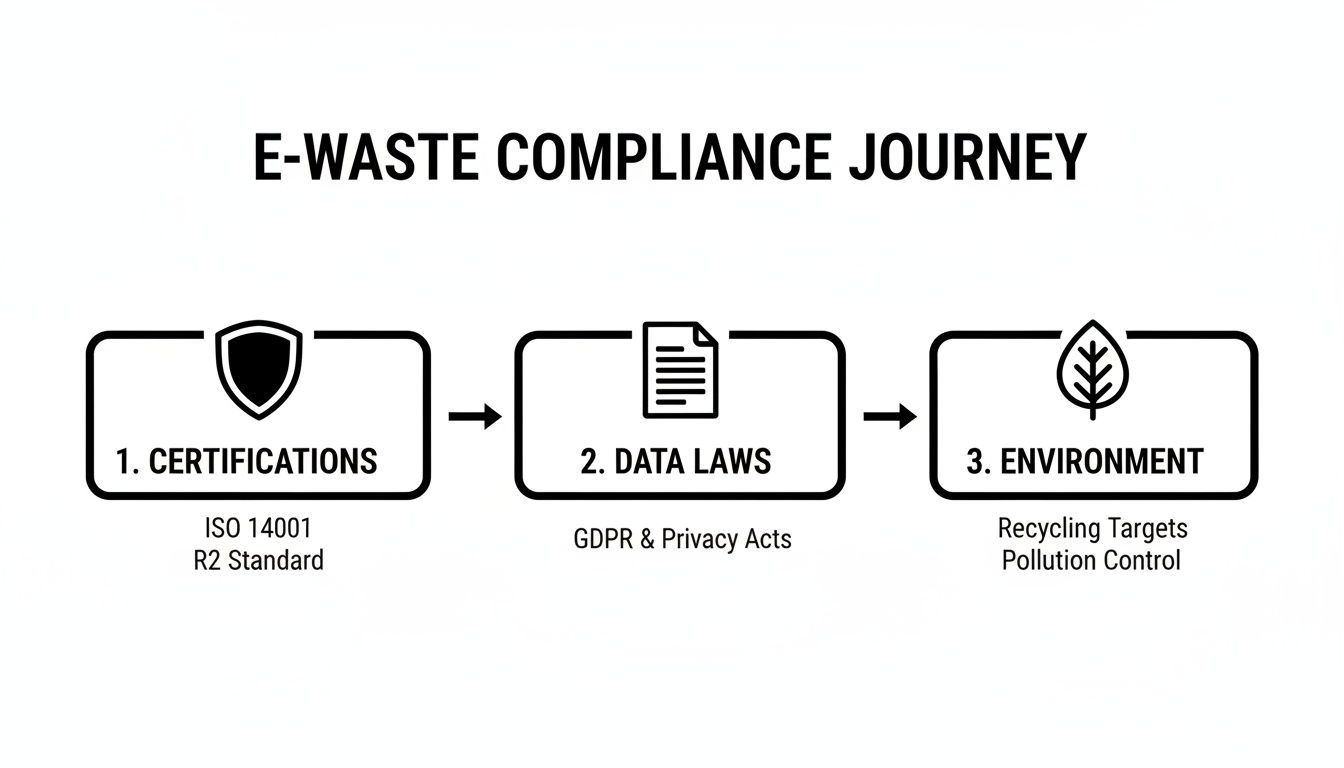
As the graphic shows, a compliant e-waste process is a multi-stage system. Data security is the central pillar that connects a vendor's credentials to their environmental responsibilities.
What to Look for in Asset Reporting
The paperwork you get back is the only tangible proof you have of a secure chain of custody. Vague or incomplete reports are a massive red flag and should make you walk away immediately. Any credible e waste recycling company will provide detailed, serialized reports that give you total transparency.
Here’s exactly what your final reporting package must include:
- An Initial Asset List: The serialized inventory of every single item they collected from your facility, created on-site during the pickup.
- A Reconciliation Report: This document confirms that every asset on the initial list arrived safely at their processing facility. No discrepancies.
- A Certificate of Data Destruction: This is the big one. It's a legally binding document that should list the unique serial number of every single hard drive and state the exact destruction method used (e.g., "DoD 5220.22-M 3-Pass Wipe" or "Physical Shredding").
If a potential partner can't show you a sample report with this level of detail, they simply can't guarantee a secure process. This documentation is your ultimate proof of due diligence and will be your best friend in any audit or legal challenge.
Evaluating On-Site Logistics and Specialized Capabilities
Certifications and data destruction policies are crucial, but they're just paper. The real test of an e-waste partner is how they perform on the ground, in your facility. The best e waste recycling company makes the whole process feel effortless for you, handling the heavy lifting and complex logistics so your team can stay focused on their real jobs.
This is especially true for large-scale projects where you can't afford operational disruptions.
Think about the sheer complexity of decommissioning an entire data center, a hospital wing, or a university research lab. This is far more than a simple dock pickup. It requires a trained, insured team to come on-site to de-install sensitive equipment, inventory every last asset, and securely pack and transport everything without getting in your way.

This kind of hands-on service is what turns a logistical nightmare into a managed, streamlined project. Instead of pulling your own IT or facilities staff off their core duties, the recycler's crew handles it all.
Why On-Site Asset Management Isn't Optional
A critical service you should insist on is on-site asset tagging and inventorying. Before a single server rack or centrifuge is unplugged, the vendor's team should be scanning barcodes and applying their own asset tags to every device. This is the first, and most important, link in a secure chain of custody.
That serialized inventory, created right there in your facility, becomes the definitive record for the entire project. It’s what you’ll use to verify that every single asset that left your building arrived safely at their facility for processing. Without this step, you’re starting with a massive security gap.
A vendor’s ability to perform detailed, meticulous work on your premises says everything about their professionalism. If their only offer is a simple truck showing up at your loading dock, they likely lack the infrastructure to handle complex projects and guarantee an unbroken chain of custody.
Handling Specialized and Non-Standard Equipment
Let's be realistic—organizations in healthcare, research, and manufacturing have a lot more than just old computers. A university lab might need to get rid of centrifuges, spectrophotometers, or chromatography systems. These aren't your typical electronics.
Specialized items like these often have unique materials or form factors that require specific handling. A top-tier e waste recycling company won't be scared off by this; they'll have the expertise and equipment to manage it all.
- Delicate Laboratory Instruments: These often need custom packing and careful handling to prevent damage or the release of any residual materials.
- Heavy Industrial Machinery: Decommissioning a plant requires a team that knows how to safely de-install and transport massive equipment.
- Oversized Medical Devices: Things like MRI components or large diagnostic machines require serious logistical planning.
When you're vetting a partner, always ask for specific examples of non-standard equipment they’ve handled. This capability means you can rely on one trusted vendor for everything, instead of juggling multiple companies for different types of assets.
Nationwide Reach vs. Local Expertise
Finally, you have to think about the provider’s logistical footprint.
For a hospital with a single campus in a metro area like Dallas, a local e waste recycling company might be the perfect fit. They know the area, can be more flexible with scheduling, and transportation is often more cost-effective. For instance, exploring options for an electronic recycling free pick up service can be a great starting point for local operations.
However, if you’re a national corporation decommissioning assets in multiple states, you absolutely need a vendor with a nationwide network. They're equipped to coordinate simultaneous pickups, enforce consistent service standards across all locations, and consolidate all your reporting. A national provider should be able to prove they can manage complex, multi-site projects without dropping the ball on security or efficiency. The right choice really comes down to the scale and geographic spread of your project.
Of course, a secure e-waste program has to make financial sense. While your top priority is always going to be mitigating risk, you can’t ignore the bottom line. Understanding the costs, potential returns, and final paperwork is what separates a good disposition strategy from a great one.
When you partner with the right e waste recycling company, you should expect total transparency on pricing, a clear path to asset recovery, and ironclad documentation that proves you did everything by the book.
This financial clarity is absolutely non-negotiable. Any vendor worth their salt will hand you a clear, itemized quote that breaks down their entire pricing structure. If you get a vague estimate or they’re hesitant to explain potential fees, consider it a major red flag.
Understanding the Pricing Models
The cost to recycle e-waste isn’t just some arbitrary number; it’s directly tied to the real-world expenses of labor, logistics, and compliant processing. Most projects fall into one of a few common pricing models.
- Per-Pound Pricing: This is the go-to for bulk disposals where you have a mix of different electronics. The recycler simply charges a set rate for the total weight of everything they collect.
- Per-Item Pricing: You’ll often see this for specific items that need special handling. Think old CRT monitors or lab equipment containing hazardous materials like mercury-containing lamps, which have their own disposal protocols.
- Project-Based or Flat-Fee Pricing: If you’re undertaking a massive project like a full data center decommission or a lab cleanout, a vendor might offer a single, all-inclusive price. This fee typically covers everything from de-installation and packing to logistics and final recycling.
I always tell clients to ask about potential hidden fees. Will they charge you for pallets and packing supplies? Is there a fuel surcharge for pickups outside a certain radius? A true professional will have no problem disclosing these costs upfront.
Don't let cost be the only thing you look at. An unusually low quote is often a warning sign. Proper, certified recycling has real costs associated with it. A vendor offering "free" services for everything might be cutting corners on data security or illegally exporting hazardous waste—leaving you on the hook for enormous liabilities.
The Upside: Cashing in on Asset Recovery
While recycling has its costs, it can also generate a surprising amount of revenue. Asset recovery, often called IT Asset Disposition (ITAD), is the process of finding equipment in your inventory that still has market value. Instead of being shredded, these assets are carefully refurbished and resold.
Now, not everything is a candidate for resale. The best items are usually newer, functional devices like servers, laptops, networking gear, and certain high-value lab instruments. An experienced e waste recycling company knows what to look for and can quickly assess your inventory to spot these opportunities.
The key here is a transparent revenue-sharing model. Your partner should provide a clear, documented process for how they value, test, and sell the equipment. At the end of it all, you should receive a detailed report showing the final sale price of each asset and your agreed-upon cut of the proceeds. For a deeper dive, our guide on IT asset disposal breaks down how this can turn a cost center into a welcome revenue stream.
The Certificate of Destruction: Your Most Important Document
Once all the equipment is picked up and processed, you should receive one final, critical piece of paper: the Certificate of Destruction (CoD). This isn't just a receipt. It's a legally binding document that serves as your official proof of compliant, secure disposal.
Think of this certificate as your ultimate shield in an audit or legal inquiry. For it to hold up, it must contain specific, verifiable details. A vague, generic document is completely worthless and leaves your organization exposed.
To be considered complete, your CoD absolutely must include:
- Unique Serial Numbers: It needs to list the serial number of every single asset destroyed, especially any device that held data.
- Method of Destruction: The document must state exactly how the data was sanitized (e.g., "DoD 5220.22-M 3-Pass Wipe" or "Physical Shredding").
- Date and Location: It has to specify when and where the destruction actually happened.
- Transfer of Custody: The certificate should legally transfer liability for the disposed assets from your organization to the recycling vendor.
This document officially closes the loop on the chain of custody, turning a complex disposal project into a fully documented, auditable, and defensible business record.
Your Essential E-Waste Partner Vetting Checklist
Talking to potential vendors is one thing, but making a confident decision requires a hands-on tool. Let's pull all the critical points we've covered into a practical checklist you can use during your vendor interviews and site visits.
Think of this as your roadmap for systematically comparing partners. It’ll help you choose an e-waste recycling company that truly aligns with your organization's strict security and compliance standards, moving you beyond glossy marketing brochures to hard evidence.
The Four Pillars of Vetting
We've structured this around four non-negotiable pillars. For each one, you'll find targeted questions to ask and a list of the must-have documentation you need to request. Don't be shy about asking for a sample Certificate of Destruction or their current proof of insurance. Taking a methodical approach like this ensures no critical details slip through the cracks.
-
Compliance and Certifications: Can they immediately provide current copies of their R2v3 or e-Stewards certifications? You need to see the actual documents, not just a logo on their website. What is their specific process for handling HIPAA or DoD-regulated data? Also, be sure to ask for their environmental compliance record to check for any violations.
-
Data Security Protocols: Ask them for a sample Certificate of Data Destruction. Does it list individual serial numbers and the exact method of destruction (e.g., wiping, shredding)? Get them to walk you through their chain-of-custody procedures, from the moment an asset leaves your dock to its final processing.
-
Logistical Capabilities: Do they offer on-site services like de-installation, palletizing, and asset tagging? This can be a huge help. What is their capacity for handling bulky or specialized lab and industrial equipment? You also need to confirm their service area—are they a local player, or can they support facilities nationwide?
-
Financial Transparency: It's crucial to request a detailed pricing sheet that breaks down all potential fees. What is their process for asset recovery, and what does their revenue-sharing model look like? Finally, ask for their current proof of liability insurance; this protects you.
By methodically running through these questions with every potential vendor, you cut right through the sales pitch. You're building a clear, evidence-based comparison that spotlights the partner best equipped to protect your organization from financial, legal, and reputational risk.
This hands-on approach guarantees you choose a partner that doesn't just haul away your old equipment but provides a secure, transparent, and fully documented service. The right e-waste recycling company delivers peace of mind through verifiable proof.
Quick-View Vendor Vetting Checklist
To make this even easier, here's a high-level checklist you can print out and bring to your vendor calls. It’s a simple way to keep track of the essentials while you're in the conversation.
| Vetting Category | Key Questions to Ask | Required Documentation |
|---|---|---|
| Certifications & Compliance | Are you R2v3 or e-Stewards certified? How do you handle HIPAA/DoD data? Can we see your environmental compliance history? | Current R2v3 or e-Stewards Certificate, Written HIPAA/DoD protocols |
| Data Security & Custody | What does your chain-of-custody process look like? What destruction methods do you use? Can you track by serial number? | Sample Certificate of Data Destruction, Chain-of-Custody form |
| Logistics & Services | Do you offer on-site de-installation and packing? Can you handle specialized/heavy equipment? What is your geographic service area? | List of on-site services, Photos of processing facility/trucks |
| Financials & Insurance | Can you provide a full fee schedule? What is your asset recovery/revenue share model? What are your insurance liability limits? | Detailed pricing sheet, Sample asset value report, Certificate of Insurance (COI) |
Using this table ensures you cover the most important bases with every single vendor, making your final comparison and decision that much clearer.
Answering Your Top E-Waste Recycling Questions
When it comes to choosing an e-waste partner, a few key questions always come up. Here are the straight answers we give organizations every day to help them navigate the process and make a confident decision.
R2 vs. e-Stewards: What’s the Real Difference?
Both R2 (Responsible Recycling) and e-Stewards are the gold standard certifications you should look for. They both guarantee a high level of environmental safety and data security. The main split comes down to their core philosophy on exporting waste.
e-Stewards was born out of the Basel Action Network, an environmental watchdog group. As a result, it enforces a strict, zero-export policy for any hazardous e-waste to developing countries. No exceptions.
R2, on the other hand, is a multi-stakeholder standard that might allow the export of certain tested, functional equipment. For most organizations, having either certification is a sign of a top-tier partner. However, if your company has an ironclad corporate social responsibility policy, the stricter environmental promises of e-Stewards often make it the preferred choice.
Can We Get Money Back for Our Old Equipment?
Yes, you absolutely can. This process is called asset recovery or IT Asset Disposition (ITAD) remarketing, and it's a great way to recoup some of your initial investment in old lab or IT gear.
If your equipment still has market value—think newer servers, laptops, or specialized lab instruments that are still functional—a good recycling partner can refurbish and resell it. They'll then share a portion of the revenue with you. Always make sure to ask a potential e-waste recycling company about their revenue-sharing model. Insist on a transparent process that shows exactly how they value, track, and report on the sale of your assets.
Be very skeptical of companies offering "free" recycling across the board. Proper, compliant recycling and data destruction have real costs. A "free" offer is often a sign that they're cutting corners somewhere—maybe by illegally exporting hazardous materials or skipping the secure data destruction you’re paying for.
What Are the Biggest Red Flags to Watch Out For?
A few warning signs should immediately raise your concern. The biggest red flags include a lack of transparent pricing—like getting vague quotes or being hit with surprise fees later on. Another is any hesitation to provide you with current, valid copies of their certifications.
You should also be wary of any company that can't show you a clear, documented chain-of-custody process. And if they balk at the idea of you visiting their facility for an on-site audit? That’s a major red flag. A reputable partner has nothing to hide.
For organizations in the Atlanta metro area and across the United States, Scientific Equipment Disposal offers a secure, compliant, and transparent partnership for all your lab and IT asset disposition needs. We provide certified data destruction and responsible recycling tailored for hospitals, universities, and corporations nationwide. Find out how we can help at https://www.scientificequipmentdisposal.com.