Atlanta Tech Layoffs and Hiring Trends Explained for 2026

The most revealing number in Atlanta's tech story isn't just how many people lost jobs. It's that one independent layoff tracker reported 3,500 tech layoffs in Atlanta in 2023, while 262,735 tech workers were laid off globally that same year, placing the metro inside a much larger correction after the pandemic hiring boom, with more than 500,000 tech jobs cut worldwide from 2022 to 2024 according to this layoff statistics roundup.
That changes the frame. Atlanta didn't experience an isolated collapse. It moved through a broad reset in tech staffing, capital allocation, and workplace footprint. For hospitals, universities, labs, data centers, and corporate offices across the metro, that reset has a very physical consequence. When teams shrink, merge, automate, or relocate, equipment doesn't disappear. It sits in server rooms, labs, offices, storage cages, and surplus closets.
That's why Atlanta tech layoffs and hiring trends explained properly should include more than labor data. Decision-makers also need to understand what happens to the assets, data-bearing devices, and specialized equipment left behind when organizations change course.
The Shifting Landscape of Atlanta's Tech Economy
Layoffs drew the headlines. The more durable shift in Atlanta has been how employers are using space, equipment, and capital after those cuts.
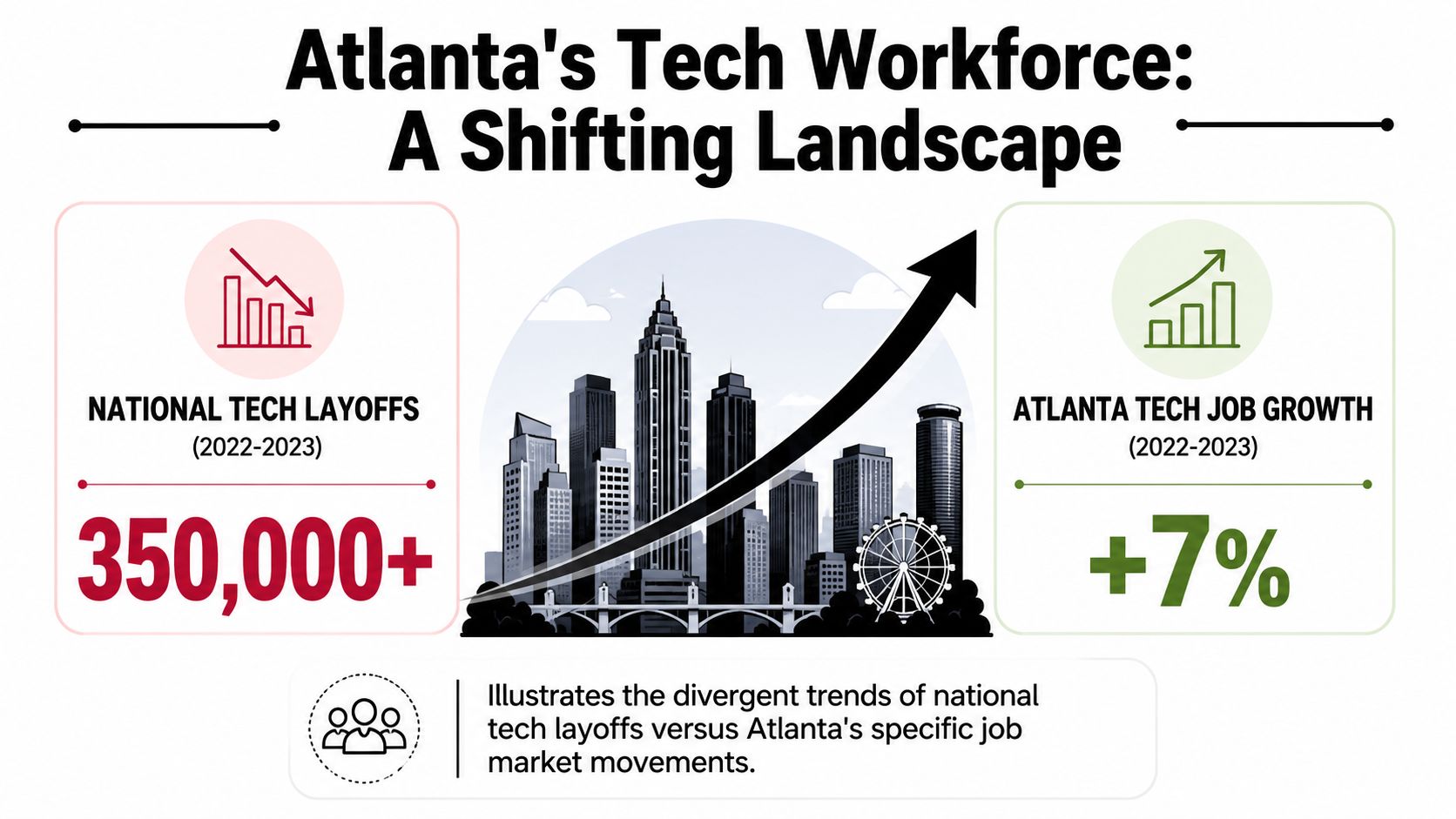
Layoffs changed the operating environment
The local issue is no longer limited to payroll. Across Atlanta, employers are reclassifying what counts as productive capacity. That shows up in smaller office footprints, fewer duplicated technical environments, delayed refresh cycles, and more scrutiny on underused devices that still carry data risk or resale value.
For asset managers, this distinction matters because temporary hiring pauses and structural workforce resets create very different disposal patterns. A short pause usually leaves equipment parked for reuse. A longer reset tends to produce assets that need a formal decision: redeploy, store, sanitize, remarket, or recycle. That decision affects carrying costs, compliance exposure, and how quickly a site can be repurposed.
The operational signal often appears months after the staffing change.
Atlanta institutions face a downstream facilities problem
Atlanta's tech economy reaches well beyond software firms. Universities, hospital systems, corporate IT groups, fintech back offices, and research operations all inherit the physical residue of strategic change. If one program contracts while another expands, the result is rarely a clean handoff. It is usually a mix of idle lab instruments, surplus endpoints, partially used furniture, legacy network gear, and rooms that still need decommissioning before facilities teams can release or redesign the space.
That is why labor data alone gives an incomplete picture of the market. The more useful question for operators is what happens inside the office, lab, clinic, or server room after a hiring plan is cut or a business unit is merged. Surplus accumulates without notice, then becomes a budget and compliance issue.
Practical rule: Workforce reductions usually reach loading docks, storage cages, and decommission schedules after they reach HR systems.
Broader company formation still matters here because new firms absorb some space and equipment while closures return more assets to the market. Leaders tracking those patterns may find a useful complement in this legal perspective on Georgia entrepreneurship, particularly when they are estimating future turnover in offices, labs, and mixed-use technical sites.
Infrastructure decisions also shape what gets consolidated and what stays local. Bandwidth, redundancy, and service quality can influence whether a team keeps a facility open, centralizes operations, or shifts workloads elsewhere. That makes this guide to Atlanta internet service providers for business operations relevant to asset planning, not just IT procurement.
Why Tech Layoffs Are Happening Now
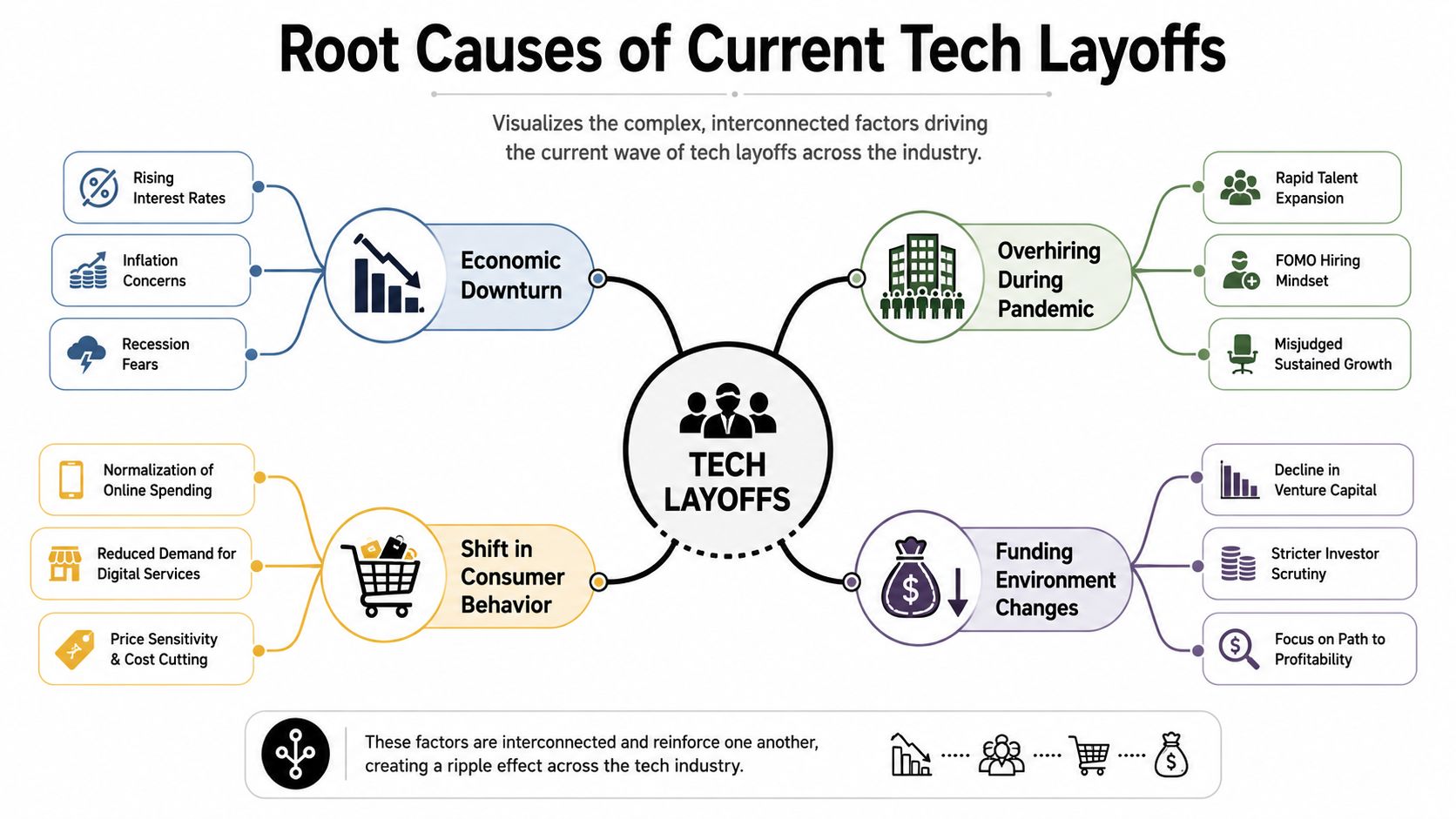
The current layoff cycle doesn't look like a simple collapse in demand. It looks more like a reallocation. Companies hired aggressively during and after the pandemic, then discovered that growth assumptions, cost structures, and headcount models no longer matched the business they had.
The market moved from emergency cuts to selective hiring
By 2025, the broad pattern had shifted. One industry tracker cited 122,549 tech layoffs across 257 companies in 2025, down from 152,922 across 551 companies in 2024, while a separate 2026 roundup reported that roughly 98 tech companies had already laid off more than 92,000 workers in the opening months of 2026, with several firms explicitly tying cuts to AI investment and efficiency programs, according to NerdWallet's layoff roundup.
That tells us something important. Fewer companies may be cutting than in the earlier wave, but reductions remain substantial. The driver isn't only weak demand. It's strategic reprioritization.
AI spending changes what gets cut
When executives redirect budget toward AI infrastructure, automation, and higher-output technical teams, they often cut elsewhere first. In practice, that can mean fewer generalized support roles, fewer duplicated teams after M&A activity, and less tolerance for underused office and hardware capacity.
A facility manager feels that before a balance sheet fully reflects it. Consider the chain reaction:
- Headcount contracts: Fewer employees need desks, monitors, docking stations, and assigned workspaces.
- Systems consolidate: Redundant servers, network gear, and storage arrays lose their operational purpose.
- Budgets tighten: Departments postpone upgrades in one area while accelerating replacement in another.
- Real estate rationalizes: Offices, lab suites, and testing rooms are closed, subleased, or reconfigured.
Tech layoffs tied to AI aren't just a labor event. They're a capital redeployment event.
That's why secure disposition planning has become a practical operations issue, not just an environmental one. Every retired laptop, rack server, external drive, and lab workstation carries some mix of residual value, compliance risk, and space cost. Organizations dealing with downsizing or platform changes usually need a process for IT asset disposal long before surplus equipment becomes a visible problem.
High-skill demand can rise while total hiring narrows
This is the paradox many headlines miss. Companies can cut broad headcount and still pay aggressively for narrowly defined capability. Roles tied to automation, cloud environments, AI operations, and infrastructure resilience remain easier to justify than broad, undifferentiated expansion.
For Atlanta facilities, that means mixed signals on the ground. One floor may empty out. Another may receive new power, cooling, and connectivity investments for more specialized workloads. The result isn't a uniform contraction. It's uneven reconfiguration, and that's much harder to manage operationally than a clean expansion or a clean shutdown.
Where Atlanta's Job Market Is Still Growing
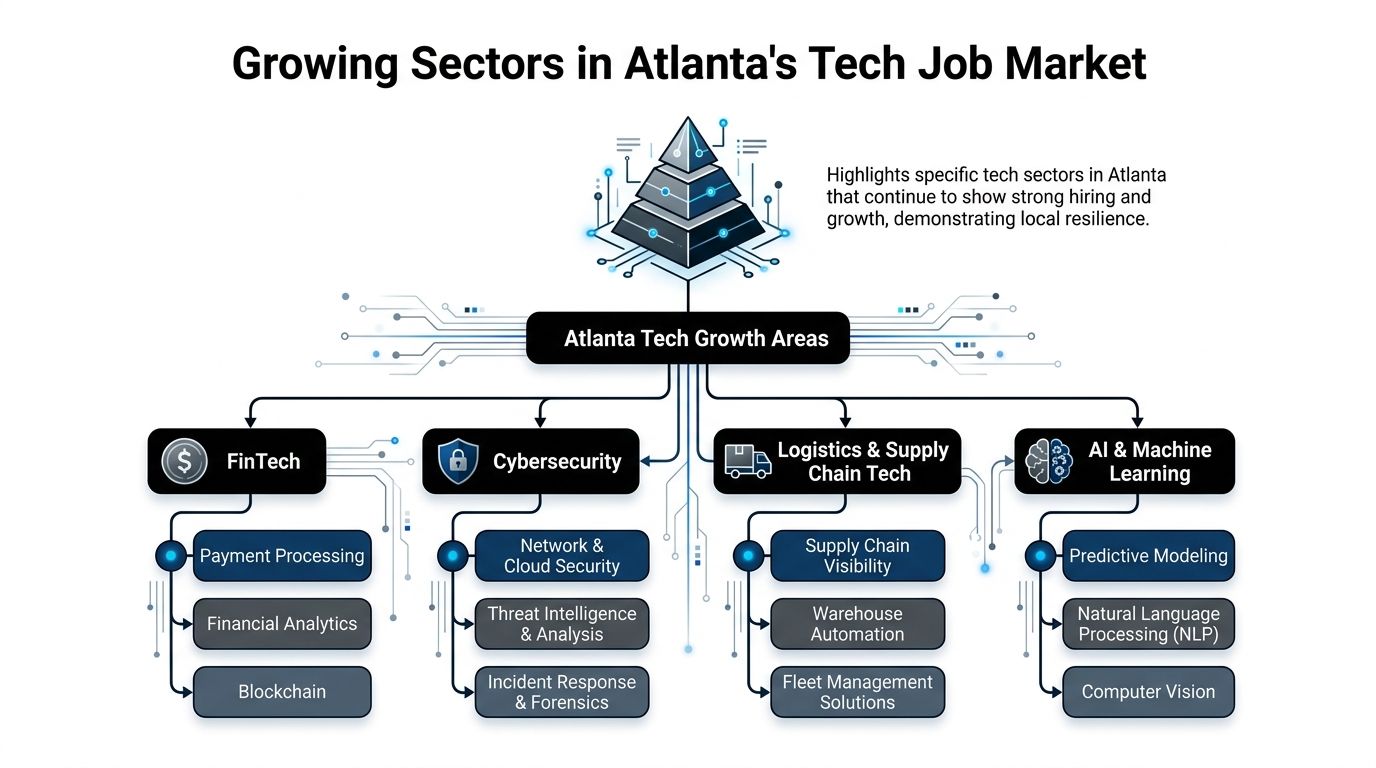
The simplest narrative says tech is down. Atlanta's actual market is more layered than that. Even while tech layoffs dominate headlines, the metro still has sectors that are expanding and absorbing talent, especially outside pure-play software hiring.
Growth is happening outside the headline category
A local roundup described Atlanta's broader market as mixed, with unemployment around 3.5%, and noted that healthcare, logistics, finance, and manufacturing remain major employers, while life sciences and AI-linked employers are still expanding. The same source highlighted UCB's announced $2 billion biologics plant expected to create 330 jobs and also noted that national tech layoffs remained high, with at least 127,000 U.S. tech workers laid off in 2025 and another 24,332 cut or scheduled for cuts in the weeks ending May 14, 2026 in the Atlanta job market discussion on Spreaker.
That combination matters. It suggests that Atlanta isn't experiencing a single-sector downturn. It's experiencing a rebalancing in which some white-collar tech functions contract while adjacent technical, operational, and scientific functions grow.
The real question is where displaced capability goes
A software engineer laid off by a consumer tech company may not move into a hospital lab role directly. But the broader technical ecosystem still benefits when healthcare systems, logistics operators, manufacturers, and life sciences facilities expand digital operations. They need infrastructure, devices, support teams, data handling, network administration, and specialized equipment.
A more useful way to read the market is through absorption paths:
| Sector | Why it matters operationally |
|---|---|
| Healthcare | Expanding clinical and lab environments create ongoing demand for regulated equipment handling and IT turnover |
| Logistics | Warehouse and supply chain tech produce steady hardware refresh cycles and facility reconfiguration |
| Life sciences | New lab buildouts and plant openings eventually generate both commissioning and decommissioning needs |
| Finance and adjacent operations | Selective hiring often comes with tighter controls over data-bearing assets and end-of-life hardware |
That's one reason telecom and connectivity planning stay relevant even outside classic tech firms. Organizations expanding in logistics, healthcare, and hybrid corporate environments still depend on stable communications infrastructure, making this look at the best telecom company options in Atlanta useful in practical facility planning.
The metro isn't asking only whether tech jobs are down. It's deciding which sectors can use technical talent, and what physical infrastructure those sectors need next.
Growth sectors also create future surplus
Expansion isn't the opposite of disposition. Fast-growing sectors often generate more turnover because they upgrade quickly, replace interim equipment, and reconfigure space as programs mature. A biologics facility, university research center, or hospital system can be in growth mode and still produce a stream of retired devices, legacy instruments, and obsolete support hardware.
That's the hidden operational overlap between hiring strength and asset management pressure. The organizations still adding jobs are often the same organizations that need the most disciplined surplus handling.
Operational Impacts for Labs Universities and Corporate IT
Layoff stories focus on workers. Operations teams inherit the physical remainder. In Atlanta, that remainder often includes lab instruments, desktop fleets, storage arrays, test benches, phones, network switches, and partially emptied rooms that still need to be secured, cleared, and documented.
Hospitals and labs
A hospital system rarely “downsizes” in the same way a software startup does. More often it consolidates service lines, updates analyzers, closes a satellite location, or retires older diagnostic support equipment after a modernization push. The result is still the same. Sensitive assets leave service before the facility team is fully prepared for removal.
The hard part isn't only transportation. It's sorting what has regulated data exposure, what can be redeployed internally, what requires de-installation, and what needs certified recycling.
A lab director may have a centrifuge in one room, aging workstations in another, and old storage media in a locked cabinet down the hall. Those items don't belong in one disposal stream, even if they leave the site on the same project timeline.
Universities and school systems
Academic institutions often feel this trend through budget shifts and program churn rather than corporate layoffs. One department closes a lab. Another receives new grant-backed equipment. An older building gets cleared for renovation. A STEM program inherits devices from a discontinued initiative.
That creates a familiar campus pattern:
- Mixed asset classes: Fume hoods, freezers, microscopes, laptops, servers, and classroom electronics all sit in different administrative silos.
- Patchy records: Procurement histories may be incomplete, especially for assets transferred between departments.
- Timing pressure: Facilities wants rooms cleared before renovation or reassignment begins.
- Risk concentration: Even aging faculty machines and lab PCs can still contain research files, student information, or credential remnants.
For schools and research institutions dealing with these handoffs, a practical reference point is understanding categories of lab equipment and related surplus items, because academic clear-outs usually involve more complexity than standard office e-waste.
Clearance projects fail when teams treat every surplus item as “just old equipment.” Some items are space burdens. Others are data risks. Others still have reuse or resale potential.
Corporate IT and data environments
Corporate IT departments face a different version of the same issue. A headcount reduction leaves behind monitor arms, thin clients, VoIP hardware, access devices, and loaner laptops. A cloud migration leaves unused servers and storage in a colocation footprint or on-prem room. A merger leaves duplicate racks, network hardware, and endpoint inventories.
The operational challenge usually breaks into three questions.
First, what still contains data?
Second, what should be redeployed, sold, recycled, or destroyed?
Third, who owns the chain of custody from rack removal to final reporting?
Facility decisions now carry security consequences
In all three environments, the pressure to clear space can conflict with the need for controlled handling. Teams want rooms empty. Compliance staff wants traceability. Finance wants value recovery where possible. Sustainability leaders want landfill diversion. Nobody wants aging equipment piling up behind locked doors for another quarter.
That's why Atlanta tech layoffs and hiring trends explained at the facility level always come back to execution. Economic realignment changes floorplans, inventories, and closure timelines. Someone then has to move the assets correctly.
Strategic Asset Disposition Planning for 2026
A strong disposition plan starts before the shutdown truck arrives. If a site waits until boxes are stacked in a hallway, it's already managing the problem at the most expensive stage.
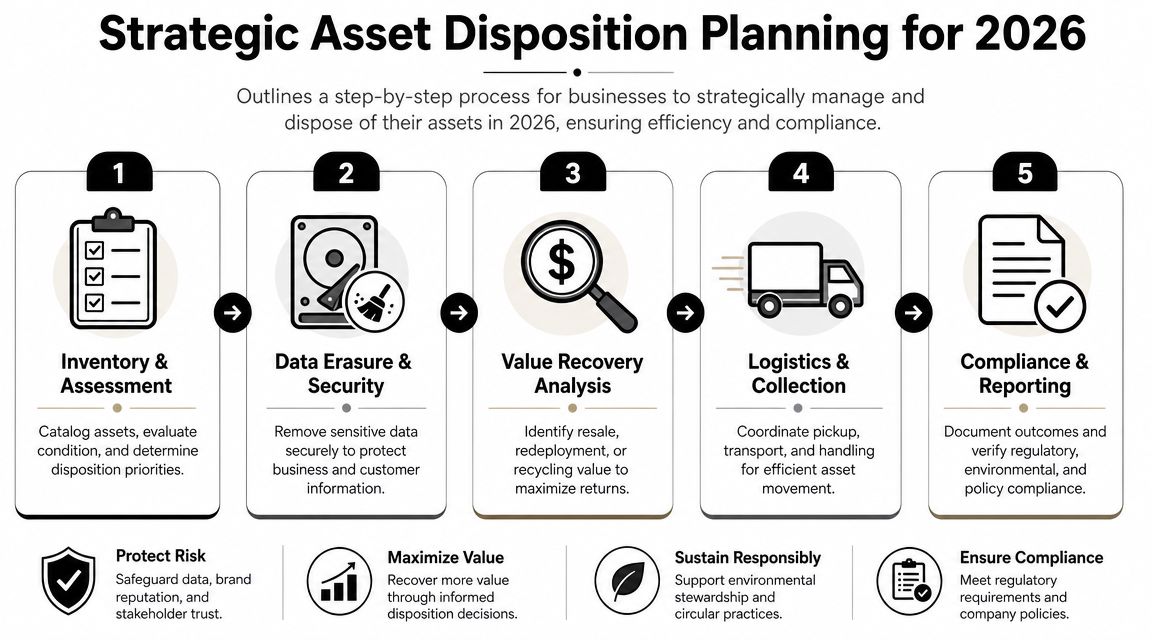
Start with inventory and classification
Create an asset list tied to location, ownership, condition, and data sensitivity. Don't rely only on fixed-asset records. Walk the site. Storage closets, staging rooms, and former employee areas often contain the equipment that never makes it into clean reporting.
Separate assets into practical groups such as data-bearing devices, general electronics, scientific instruments, furniture-adjacent tech, and regulated or restricted equipment. That makes later decisions faster and avoids sending the wrong item into the wrong stream.
Build data security into the process
Data destruction shouldn't be the last checkbox. It should guide routing from the start. If drives, laptops, workstations, servers, or storage appliances are involved, establish in advance whether sanitization, shredding, or another control path is required.
For many organizations, recognized wiping protocols such as DoD 5220.22-M 3-pass sanitization are part of that discussion, especially when internal IT, legal, and compliance teams need a defined standard. In healthcare and adjacent environments, any process also needs to support HIPAA obligations where protected information may be present.
Decision filter: If an item ever touched patient, student, employee, research, or financial data, treat chain of custody as a planning requirement, not a pickup detail.
Decide where value recovery is realistic
Not every asset should be recycled immediately. Some have secondary market value. Others are worth redeploying inside the organization. Others cost more to test, store, and remarket than they'll ever return.
A simple decision table helps:
| Asset type | Best first question |
|---|---|
| Servers and storage | Is there residual data risk that overrides resale value? |
| Lab equipment | Is it functional, complete, and suitable for secondary use? |
| Office endpoints | Can internal redeployment extend useful life? |
| Obsolete or broken electronics | Is certified recycling the lowest-risk path? |
Leaders also need to tie disposition to cost control. Surplus equipment consumes square footage, staff time, and administrative attention. Teams working to reduce overhead may also benefit from broader guidance on addressing rising technology expenses, especially when refresh cycles, support burdens, and underused hardware all intersect.
Match logistics to the facility reality
Some sites need dock pickup only. Others need de-installation, packing, liftgate service, room-by-room removal, or after-hours coordination. Labs and hospitals may need tighter route control and staging rules than a standard office floor.
That's why disposition planning should answer operational questions early:
- Who approves release of the assets
- What areas require escorted access
- Which items need serial-level tracking
- How data-bearing devices will be handled
- What final documentation finance and compliance require
Organizations that face recurring clear-outs, decommissions, or technology turnover often end up needing a more formal program for corporate e-waste solutions, not because every project is huge, but because inconsistency creates risk.
Reporting closes the loop
The final step is documentation. Inventory reconciliation, certificates tied to data destruction or recycling, and auditable reporting matter because surplus projects rarely end with operations alone. Finance, compliance, sustainability, procurement, and department heads usually want different proof that the job was completed correctly.
A disciplined plan turns what looks like cleanup into controlled asset management. That's the difference between reacting to layoffs and facility changes, and using them to reset operations cleanly.
Navigating Atlanta's Evolving Tech Landscape Responsibly
Atlanta's tech market now produces a steady stream of partial exits, team reshuffles, and selective expansions. For facilities leaders, that means employment changes increasingly arrive as operational events: abandoned workstations, underused lab rooms, retired network gear, and storage areas filling with equipment that no longer has an owner.
The business risk starts after the org chart changes.
A reduction in force can leave an office floor full of laptops, monitors, phones, and peripherals that still carry inventory, security, and accounting implications. A university budget reset can scatter usable lab assets across departments, with no single group responsible for removal or redeployment. A healthcare IT refresh can strand legacy devices in closets and staging rooms, creating exposure around data handling, chain of custody, and final documentation. Labor headlines explain why this equipment appears. They do not solve what the site has to do next.
Organizations that handle these transitions well rely on policy instead of case-by-case judgment. They set ownership before the first pickup request. They separate resale value from data risk, because a low-value device can still create a high-cost compliance problem. They set deadlines for review and removal so storage does not become the default operating model. They also require reporting that satisfies finance, compliance, sustainability, and department leadership, rather than treating clearance as a one-team task.
Operations leaders also need to account for the workforce policies that can surface during consolidations, schedule changes, and site reassignments. Questions about staffing practices do not sit inside asset disposition, but they often emerge from the same event. This overview of Georgia lunch break laws is one example of how a facility change can trigger labor-policy review alongside equipment decisions.
Responsible asset management supports resilience because it protects data, releases usable space, and keeps surplus from turning into an unmanaged liability on the balance sheet.
Atlanta will likely remain a market defined by uneven hiring, selective cuts, and ongoing facility turnover. In that environment, disposition planning is part of operational control. Institutions that treat it that way can close, consolidate, expand, or reconfigure space without leaving equipment risk behind.