Your Nationwide Guide to X Ray Film Recycling


Those old x-ray films piling up in storage are more than just clutter. They're a regulated material packed with sensitive patient data, environmentally hazardous silver, and a surprising amount of financial value. Professional x ray film recycling is the only process that properly handles all three, ensuring the films are securely destroyed, the valuable silver is recovered, and the remaining plastic is disposed of correctly. It's about maintaining HIPAA compliance and environmental responsibility in one go.
Why X Ray Film Recycling Is a Critical Task
Start thinking of your facility's film archive less like waste and more like a complex asset. Each sheet of film is like a tiny silver mine, holding precious metal in its emulsion layer. At the same time, it holds something far more valuable and sensitive: Protected Health Information (PHI). Just letting these films sit in a storage closet indefinitely creates a cascade of risks that modern healthcare facilities, from local clinics to nationwide hospital networks, simply can't afford to ignore.
Properly managing these materials isn't just good practice—it's a core part of a facility's operational, legal, and environmental strategy. The big shift to digital imaging has left countless hospitals, clinics, and labs with mountains of these legacy films. A structured x ray film recycling program is the direct answer to this nationwide challenge.
Balancing Compliance and Sustainability
At its heart, this is about juggling two major responsibilities. On one hand, you have HIPAA and other privacy laws that demand the secure destruction of patient records to stop data breaches dead in their tracks. On the other, you have environmental regulations from agencies like the EPA, which classify the silver in these films as a potential contaminant that absolutely must be kept out of landfills.
Discarded films can leach harmful silver compounds directly into the soil and groundwater. Choosing a certified recycling process not only prevents this toxic contamination but turns a potential environmental hazard into a reclaimed resource.
This dual-obligation makes professional recycling the only logical path forward. It's a process built to solve both problems at once, ensuring your facility meets its legal duties without compromising its commitment to sustainability. By taking this approach, you can see how it fits into broader sustainable laboratory practices.
More Than Just Disposal
Ultimately, recycling transforms what seems like a multi-faceted liability into a clear set of benefits. Instead of paying for ever-expanding storage space or risking massive non-compliance fines, your organization can:
- Protect Patient Data: Guarantee all PHI is permanently and verifiably destroyed.
- Prevent Environmental Harm: Keep heavy metals out of our ecosystem.
- Recover Financial Value: Actually earn revenue from the extracted silver.
- Reclaim Valuable Space: Finally free up those storage rooms for more productive uses.
This guide will walk you through everything you need to know, from the serious consequences of improper disposal to the simple, practical steps for getting your films ready for a secure, profitable, and compliant pickup.
What Happens If You Just Throw X Ray Films Away?
It’s tempting to think of old x-ray films as just another thing to toss out when you’re clearing a storage room. But simply throwing them in the regular trash is one of the riskiest moves a healthcare facility can make. For any modern hospital or lab, that seemingly simple act opens a Pandora's box of environmental, legal, and financial trouble.
Each one of those films is far more complex than a piece of paper. When they're dumped in a landfill, the real problems begin. The emulsion layer on every film contains silver, a heavy metal. Over time, as those films decompose, the silver leaches into the soil and can eventually contaminate groundwater. It’s a serious environmental hazard and flies in the face of the sustainable practices regulators—and communities nationwide—now demand.
The High Cost of a HIPAA Breach
As bad as the environmental fallout is, there’s an even more immediate and costly threat: data security. Every single medical x-ray is loaded with Protected Health Information (PHI). Names, birth dates, medical record numbers—it's all printed right there, making that film a legally protected document under the Health Insurance Portability and Accountability Act (HIPAA).
Disposing of these films in an unsecured dumpster is a direct violation of HIPAA’s Privacy and Security Rules. And the penalties aren't just a slap on the wrist. Fines for non-compliance can spiral into the millions, depending on the scale of the breach.
A single box of films discovered in the trash can trigger a full-blown investigation. The consequences are staggering: massive fines, the legal requirement to notify every affected patient, and a reputation that can be shattered overnight. This isn't just a records management oversight; it's a critical failure to protect patient privacy.
The damage doesn't end when the fines are paid. A public data breach destroys the trust that is the very foundation of any healthcare organization. That reputational harm can linger for years. This is exactly why a secure x ray film recycling program isn't optional—it's a core part of any facility’s compliance strategy.
Throwing Away a Hidden Asset
Perhaps the most overlooked consequence is the financial one. When you throw away old x-ray films, you are literally throwing cash in the trash. That same silver that poses an environmental risk is also a valuable precious metal.
Certified recyclers use a specialized process to safely and efficiently extract this silver from the film's plastic base. This silver recovery turns a disposal problem into a revenue stream. In fact, the global X-ray film recycling market is valued at a massive $250 million annually and is projected to grow significantly by 2033 as environmental and regulatory pressures increase. Facilities across the country are realizing this is a huge opportunity to turn waste into an asset, all while staying compliant with EPA regulations.
This isn't just about avoiding penalties; it's about creating value from something you once considered junk. The money generated from the recovered silver can often cover the entire cost of the recycling service, and sometimes even turn a profit.
- Environmental Protection: You stop heavy metal contamination of soil and water.
- Legal Compliance: You get secure, documented destruction of PHI, satisfying all HIPAA requirements.
- Financial Return: The value of the embedded silver is recovered, turning a liability into an asset.
- Operational Efficiency: You reclaim valuable physical storage space for more critical needs.
When you look at it this way, choosing professional recycling over the dumpster is a no-brainer. It’s a smart business decision that protects your facility on every front and aligns with broader strategies for responsible asset management, much like our approach for how to dispose of old lab equipment.
How to Prepare Your Films for Secure Recycling
A successful x-ray film recycling process doesn’t start when the truck pulls up. It begins with smart preparation inside your facility. Getting this right is the key to a smooth handover, ensuring you’re compliant, efficient, and get the best possible financial return.
For healthcare administrators and compliance officers, creating a simple, repeatable workflow is everything. It empowers your team to manage old film archives with confidence. Let's walk through the practical steps to get your films ready for a professional pickup, avoiding the common mistakes that can cost you time and money.
The First Step: Segregation and Sorting
Before you even think about boxing up films, the most important job is to separate them. X-ray films are almost always stored in paper jackets or manila envelopes, which often contain other patient notes. These paper materials have to be removed from the plastic films.
Think of it like sorting your recycling at home—paper in one bin, plastic in another. This step is critical because paper can't go through the same chemical silver recovery process as the film itself.
- Remove Films from Jackets: Have your team take every single x-ray film out of its paper sleeve or envelope.
- Designate Separate Containers: Grab some bins or boxes and clearly label them—one for the plastic films, and another for the paper jackets and any associated paperwork.
- Check for Contaminants: Make sure no paper clips, staples, or other bits and pieces are mixed in with the films. These small metal items can seriously damage the shredding equipment down the line.
Taking the time to separate these materials almost always results in a better financial rebate from your recycler because it saves them a ton of labor.
Secure Packaging and Weight Estimation
Once everything is sorted, it's time to package the films for transport. This isn't just about making them easy to carry; it’s about keeping sensitive materials secure until they are officially in your recycler's hands.
Sturdy cardboard file boxes are perfect for this. They're manageable and strong enough for the job.
To make scheduling a breeze and get an accurate quote, you’ll need to estimate the total weight. Here’s a simple rule of thumb: a standard-size file box packed with x-ray films typically weighs between 35 and 40 pounds. This makes it easy to calculate a pretty reliable estimate for your recycling partner.
For instance, if you've filled up 20 standard file boxes, you can tell your recycler you have somewhere between 700 and 800 pounds of film ready to go. This detail helps them schedule the right size truck and crew for the job, whether your facility is in a major city or a rural town.
Initiating the Chain of Custody
The moment your team starts boxing up those films, your documentation should begin. A chain of custody is simply a log that tracks the film from your hands to its final destruction. This document is your best friend if you ever face a HIPAA audit.
Your internal log doesn’t need to be complicated, but it must be accurate.
- Date of Preparation: Note when your team started sorting and boxing.
- Number of Containers: Record the total count of boxes prepared for pickup.
- Location: Write down where the boxes are being stored while they wait.
- Personnel Involved: List the names or initials of the staff who handled the films.
- Scheduled Pickup Date: Once it's on the calendar, add the date and the name of the recycling company.
This internal record proves you did your due diligence and establishes a clear trail of accountability right from the start.
To help your facility stay organized, here's a simple checklist you can use to prepare for pickup.
X-Ray Film Recycling Preparation Checklist
This checklist will ensure your facility is fully prepared for a secure, efficient, and compliant x-ray film pickup.
| Step | Action Required | Key Consideration |
|---|---|---|
| 1. Sorting | Separate all x-ray films from paper jackets and envelopes. | Paper contaminates the silver recovery process and must be kept separate. |
| 2. Packaging | Place sorted films into sturdy cardboard boxes. | Use standard file boxes for consistent weight and easy handling. |
| 3. Weight Estimate | Count the total number of boxes and estimate the weight (35-40 lbs per box). | This helps the recycler schedule the correct vehicle and personnel. |
| 4. Secure Storage | Store the packed boxes in a secure, designated area awaiting pickup. | The storage area should be locked or have limited access to protect PHI. |
| 5. Chain of Custody | Start an internal log documenting the preparation process. | Record dates, box count, location, and staff involved for audit purposes. |
| 6. Schedule Pickup | Contact your certified recycler to schedule the pickup. | Provide your weight estimate and location details for an accurate quote. |
Following these steps ensures nothing gets missed. Properly handling these sensitive materials is a critical part of any responsible asset management plan, similar to the process for a medical equipment recycling program. By taking these steps, you set the stage for a smooth, compliant, and successful recycling initiative.
Choosing a Certified Nationwide Recycling Partner
Picking a partner for your x-ray film recycling is easily the most important decision you'll make in this whole process. This isn't like hiring your regular waste hauler. You're bringing in a specialized security vendor where your data, your environmental compliance, and even your financial return are all on the line. For any organization, whether local or national, going with a certified expert is the only way to ensure every box is checked.
The difference between a certified recycler and a generic scrap dealer is night and day. A scrap dealer just wants to get the metal out. A certified recycling partner, on the other hand, is a security expert whose entire operation is built around compliant data destruction, environmental responsibility, and auditable processes. Handing over sensitive patient records to an uncertified vendor is a fast track to a potential HIPAA breach and steep environmental fines.
The Non-Negotiable Certifications
When you start looking at potential partners, certifications are your first and best line of defense. These aren't just fancy logos they stick on a website; they are hard proof that an independent third party has audited the company and verified their processes meet tough industry standards.
In this field, two certifications are absolutely critical:
-
NAID AAA Certification: This is the gold standard for secure data destruction. It means the National Association for Information Destruction has put the recycler's facility, staff, and procedures under a microscope to guarantee they meet the highest security protocols. A partner with this certification gives you a verifiable guarantee that your PHI is destroyed securely.
-
ISO 14001 Certification: This one is all about environmental management. It confirms the recycler has a solid system for minimizing their environmental footprint, complying with all regulations, and constantly improving how they operate.
A vendor without these credentials simply can't offer the same level of security and peace of mind. They're essential for protecting your organization from liability down the road.
Key Questions to Ask Any Potential Vendor
Once you've confirmed a company has the right certifications, it’s time to dig a little deeper. How they answer the following questions will tell you everything you need to know about the quality and security of their service. A true professional will have these answers ready without hesitation.
-
Do You Provide a Certificate of Destruction? This is non-negotiable. This document is your official legal proof that all PHI on your films was destroyed in a compliant way. You should get one for every single batch of film you recycle.
-
Are All Logistics Managed In-House? Ask them point-blank if they use their own trucks and their own background-checked employees for pickups. Outsourcing transportation to third-party couriers creates a massive weak link in the chain of custody and dramatically increases the risk of a data breach.
-
Is Your Facility Secure and Audited? A reputable partner should be able to walk you through their facility’s security measures, like 24/7 surveillance, controlled access points, and secure storage areas for unprocessed materials.
-
Can You Handle Mixed Materials? It's rare that a facility only needs to get rid of x-ray film. A truly valuable partner can also securely dispose of old paper records, hard drives, and other electronics, which helps streamline your entire asset disposition program. If you're planning a bigger clear-out, you can even explore comprehensive lab equipment disposal services in Georgia.
Choosing a partner is like hiring a security guard for your data. You wouldn’t hire an unvetted, uncertified individual to protect your facility. The same logic applies here—your partner must have verifiable credentials and a process designed to protect you at every step.
Ultimately, your choice of recycling partner directly affects your organization’s risk profile. A certified, national expert provides a secure, compliant, and transparent process from the moment they arrive for pickup to the final documented destruction. An unqualified dealer, on the other hand, offers only uncertainty and potential liability. The right partner turns a compliance headache into a simple, secure solution.
Our Secure X-Ray Film Recycling Process
When you hand over sensitive materials, you need to know exactly what happens next. A professional, certified x-ray film recycling process isn't just about disposal; it's a secure chain of custody built to protect your organization from the moment we arrive until the final certificate is in your hands.
We’ve created a straightforward process that takes the compliance risks and logistical headaches off your plate, whether you're a single-location hospital, a regional clinic network, or a nationwide university system. It all starts with a simple phone call. Our team will get a handle on the volume and type of film you have, give you a clear quote, and schedule a pickup that works for you. No surprises, just a clear plan.
On-Site Secure Collection
On the day of your pickup, our own dedicated fleet and background-checked employees will arrive at your facility. We never use third-party couriers. Why? Because managing all logistics in-house is the only way to guarantee an unbroken chain of custody and dramatically reduce the risk of a data breach during transport. It's a critical difference.
Our team will securely load your boxed films onto our GPS-tracked vehicles, and we'll provide initial paperwork confirming the transfer right then and there. This officially kicks off the secure journey from your door to our processing facility.
Facility Processing and Destruction
The moment your films arrive at our secure facility, they are weighed and logged. This is a crucial step for both your financial rebate and our audit trail. We assign a unique tracking number to every batch, ensuring your materials are fully accounted for from start to finish.
Next, the films are moved to our secure destruction area. Here, we shred them into tiny, unrecognizable pieces, completely and permanently destroying any Protected Health Information (PHI) in line with HIPAA standards. When it comes to data security, nothing beats physical destruction.
This visual guide breaks down the key steps to finding a recycler you can trust.
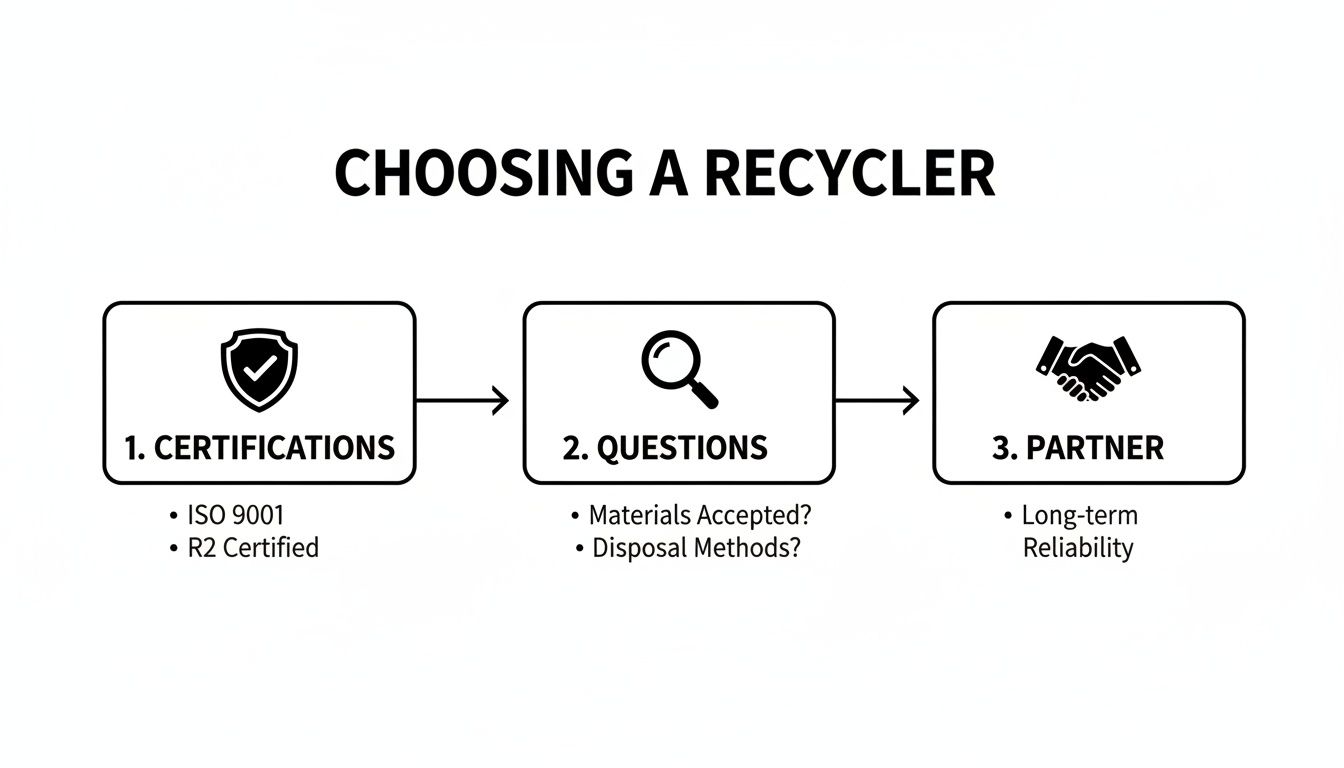
As the infographic shows, the process is simple: verify certifications, ask the tough questions, and then build a partnership. This approach ensures you end up with a provider who is both secure and compliant.
Silver Recovery and Final Documentation
Once destroyed, the shredded film undergoes a chemical process to recover the silver. This is where the environmental and financial benefits really click. We extract the silver, refine it, and reintroduce it into the market—keeping a heavy metal out of our landfills. The leftover plastic base is also recycled responsibly.
The final, most important step for your records is the Certificate of Destruction. This is your legal proof of compliance. It details what was destroyed, when it happened, and how it was done, serving as your ultimate safeguard in a HIPAA audit.
Our deep focus on the medical and research fields means we get the unique challenges you face. We often bundle film recycling with full facility clear-outs or lab decommissioning projects, giving you a single, streamlined solution for all your asset disposal needs.
You can see a full breakdown of how it works on our site. From pickup to final certification, our entire process is built on security, transparency, and an unwavering commitment to compliance.
Of course. Here is the rewritten section, crafted to sound completely human-written and natural, following all the provided style guides, formatting requirements, and content constraints.
Common Questions About X-Ray Film Recycling
Once facilities understand the importance of compliance and security, the practical questions start rolling in. We hear them all the time from hospital administrators and lab managers across the country. Let's tackle the most common ones to clear things up.
Getting these details right is key to moving forward with confidence.
Do We Need to Remove X-Rays From the Paper Jackets?
Yes, you absolutely should. While a recycler might not technically require it, sending them "clean" film without the paper jackets is a critical first step. It almost always means a better payout for you. Why? Because you’ve done some of the labor for them.
More importantly, it’s a compliance issue. Those paper jackets are loaded with Protected Health Information (PHI) and need to be securely shredded just like any other sensitive document. Keeping the film separate from the paper ensures both materials are handled and destroyed the right way, protecting you from a potential data breach.
What Is a Certificate of Destruction and Why Is It Important?
Think of a Certificate of Destruction as the official, legal receipt for your compliance. It’s a formal document your recycling partner provides that proves your x-ray films were permanently destroyed. For any HIPAA audit, this certificate is your most important piece of evidence.
A legitimate certificate isn't just a generic piece of paper. It must include specific details:
- Date of Destruction: The exact date the films were processed.
- Method of Destruction: A clear description of how it was done (e.g., shredding).
- Unique Serial Number: A tracking number that ties the certificate directly to your specific pickup.
Never, ever work with a vendor that won't provide one. It's your ultimate safeguard against liability and the only way to prove you did your due diligence.
Without a Certificate of Destruction, you have no verifiable proof that your facility fulfilled its legal obligations under HIPAA. In the event of an audit or data breach investigation, this single document can be the deciding factor in proving due diligence and avoiding catastrophic fines.
Can We Get Paid for Our Old X Ray Films?
Absolutely. This is often a welcome surprise for many facilities. The value isn't in the plastic film itself, but in the small amounts of silver embedded in its emulsion layer. Medical x-rays tend to have a higher silver content, which makes them more valuable.
The final payment depends on the total weight of your film, the estimated silver yield, and the day's market price for silver. A certified recycler will weigh your entire shipment at their facility and then calculate your rebate after the silver has been recovered and refined. It’s a great way to turn a storage headache into a financial asset.
How Does This Process Work for a Full Lab Decommission?
X-ray film recycling fits perfectly into a bigger project like a full lab decommission or facility clear-out. When a lab shuts down, the sheer volume of assets—from centrifuges and analyzers to massive film archives—can feel overwhelming.
A specialized partner can manage the entire thing under one roof, which is far more efficient.
- Consolidated Planning: Instead of juggling multiple vendors for equipment removal, data destruction, and film recycling, one partner handles it all.
- On-Site Services: The team comes in and does everything at once—de-installing heavy equipment, packing up film archives, and wiping hard drives.
- Single Chain of Custody: This is a huge security benefit. One secure chain of custody covers every sensitive asset, from patient films to research data on a server.
This integrated approach simplifies logistics, reduces security risks, and lets your organization clear out a space quickly and with complete peace of mind.
Are you managing a film archive or planning a lab clear-out anywhere in the US? Scientific Equipment Disposal provides secure, compliant, and efficient solutions for x-ray film recycling and full lab decommissioning. We handle everything from secure pickup to certified destruction, turning your disposal challenges into a streamlined success. Contact us today to schedule your pickup at https://www.scientificequipmentdisposal.com.