Medical Equipment Recycling Near Me: HIPAA-Safe Disposal for Local & Nationwide Facilities

When you're searching for "medical equipment recycling near me," whether in Atlanta or across the country, you need a partner who does more than just show up with a truck. For hospitals, clinics, and labs, the right choice means a compliant, secure, and fully documented process that protects your data and handles environmental responsibilities. True specialists manage everything from de-installation to certified data destruction, providing both local service and nationwide logistics.
Your Guide To Compliant Recycling In Atlanta and Beyond
Getting rid of outdated medical and laboratory equipment is a huge logistical headache. It's worlds away from standard e-waste removal, loaded with serious risks around data security and environmental regulations.
For facility managers, IT directors, and hospital administrators in major hubs like Atlanta or anywhere in the U.S., getting this process right is non-negotiable. A single misstep can spiral into severe HIPAA penalties, embarrassing data breaches, or steep environmental fines.
This guide is your playbook for turning that challenge into a straightforward, secure operation. We’ll cut through the regulatory jargon and lay out a clear path forward for medical equipment recycling, whether you're a local clinic or a national healthcare system. This isn't just about hauling away old machines; it's about protecting your organization from start to finish.
The United Nations reports that global e-waste volumes are rising five times faster than documented recycling. This is a flashing red light for responsible disposal, especially for specialized assets like medical equipment which contain both valuable and hazardous materials.
The entire lifecycle of medical equipment disposal demands careful planning. This visual breaks down the core stages, from taking stock of your assets to getting that final certificate of destruction.
This simple flow shows that a compliant process rests on three pillars: knowing exactly what you have, making sure it’s moved securely, and getting proof that it was disposed of correctly.
Medical Equipment Recycling At A Glance
To simplify the process, here's a quick look at the key stages involved in a compliant medical equipment recycling project. Each step is critical for maintaining security and meeting regulatory standards, no matter your location.
| Stage | Key Action | Why It Matters For Compliance |
|---|---|---|
| Inventory & Assessment | Create a detailed list of all equipment, including serial numbers and data storage status. | Establishes a clear chain of custody and identifies assets that contain Protected Health Information (PHI). |
| Data Security & Sanitization | Securely wipe or physically destroy all data-bearing devices according to NIST 800-88 or DoD 5220.22-M standards. | Prevents data breaches and ensures you meet HIPAA's stringent data privacy requirements. |
| De-Installation & Logistics | Coordinate the professional disconnection and removal of equipment from your facility. | Minimizes operational disruption and ensures assets are handled safely, especially heavy or plumbed-in units. |
| Secure Transportation | Use a recycler with secure, GPS-tracked vehicles and vetted personnel for transport. | Protects assets from theft or loss en route, maintaining the chain of custody from your door to the facility. |
| Processing & Recycling | Sort materials for commodity recovery and properly dispose of hazardous components. | Fulfills your environmental obligations under RCRA and state/federal laws by preventing toxic materials from ending up in landfills. |
| Certification & Reporting | Receive a Certificate of Destruction and a serialized report detailing the disposition of each asset. | Provides the auditable proof you need to demonstrate compliance with data security and environmental regulations. |
This table highlights that a successful project is built on a foundation of meticulous documentation and verified actions at every step.
What Is At Stake
Let's be blunt: failing to manage this process can have serious consequences. The primary concerns for any healthcare or research facility are:
- Data Security: Many medical devices—from MRI machines and patient monitors to the computers they connect to—store Protected Health Information (PHI). Improper disposal is a direct line to a HIPAA violation.
- Environmental Compliance: Medical equipment often contains materials like lead, mercury, and copper. Landfilling these items is illegal and harmful. Certified recycling is the only way to ensure these materials are recovered or disposed of safely.
- Logistical Efficiency: A facility-wide cleanout can grind daily operations to a halt. Trying to coordinate de-installation, data verification, and transport without a specialist is a recipe for delays and costly errors.
This guide gives you the framework for handling these critical tasks. For those managing research facilities, our detailed look at lab equipment disposal services in Georgia offers more specific insights for scientific assets.
By partnering with an expert who understands both the equipment and the regulations, you can ensure a secure, compliant, and efficient disposition project from start to finish.
Navigating Data Security And HIPAA Compliance
Before a single piece of equipment leaves your facility, we need to talk about data security and regulatory compliance. It's the most critical step in the process, and for healthcare providers, research labs, or government agencies nationwide, it's completely non-negotiable. Any device with a hard drive—from a server tucked away in a data closet to a diagnostic machine in an exam room—could be holding sensitive information that absolutely must be protected.
This isn't as simple as just deleting files. A standard format or dragging folders to the trash bin is nowhere near enough; that data is often easily recoverable, creating a massive liability. Think about a hospital in Texas retiring old desktop computers that once held patient records or a university lab in California getting rid of servers that stored years of proprietary research. Failing to properly sanitize those devices is a direct route to a data breach.
The High Stakes Of Non-Compliance
The Health Insurance Portability and Accountability Act (HIPAA) is the law of the land for protecting Protected Health Information (PHI). Getting this wrong isn't just a slap on the wrist. Violations can lead to crippling financial penalties, mandated corrective action plans, and permanent damage to your organization's reputation.
A single lost or improperly wiped hard drive can trigger a full-scale federal investigation. Honestly, the legal and financial fallout from that kind of event is exponentially more expensive than just paying for professional data destruction services upfront. This is why having a documented, certified process is your best and only defense.
The industry reflects this reality. The global medical waste management market is projected to hit USD 39.8 billion in 2025, with North America leading the way thanks to its strict regulations. This highlights how crucial it is to partner with a specialist who provides DoD-compliant data wiping and certified recycling, ensuring you meet HIPAA requirements while responsibly managing e-waste. You can get a deeper look into the trends shaping the medical waste solutions market and its growth.
Ensuring Data Is Gone For Good
To truly make data disappear and meet compliance standards, you have to follow established data sanitization protocols. These methods are designed to make data completely unrecoverable, which gives you both peace of mind and legal protection.
In our world, two methods are the gold standard:
- Data Wiping: This is a software-based approach where we overwrite the entire hard drive with random data, multiple times. The DoD 5220.22-M 3-pass standard is the benchmark we use, ensuring every last bit of previous information is obliterated. It’s a great option for newer devices that might be refurbished or resold.
- Physical Destruction: When a device is broken, outdated, or held extremely sensitive information, nothing beats physical destruction. We shred hard drives, solid-state drives, and other storage media into tiny, irreparable pieces. It's the ultimate guarantee.
A truly professional recycler will offer both options and walk you through which method makes sense for each specific asset. The key is to demand a serialized report listing every single drive that was wiped or destroyed.
A Certificate of Data Destruction is more than just a receipt. It's your official, auditable proof that you fulfilled your legal duty to protect sensitive information. This document should be a non-negotiable deliverable from any recycling partner you even consider.
Documentation Is Your Shield
Proper documentation is what closes the loop on your compliance duties. When your search for "medical equipment recycling near me" leads you to a potential partner, your final data security checklist should be short and sweet.
You need to walk away with two key documents:
- A Certificate of Recycling: This confirms the physical equipment was disposed of in an environmentally responsible way.
- A Certificate of Data Destruction: This is the big one. It lists the serial numbers of every single hard drive and data-bearing device that was sanitized or shredded, proving your compliance with HIPAA and other privacy laws.
These certificates are the foundation of your audit trail. They prove you took deliberate, verifiable steps to protect sensitive data. Without them, you’re leaving your organization wide open to risk. When you're ready to make sure your retired assets are handled correctly, you can learn more about our secure data destruction and recycling processes. A partner like S.E.D. provides this essential paperwork as a standard part of our service, giving you the confidence that your project is complete, secure, and fully compliant.
How To Choose The Right Recycling Partner
Picking a partner for your medical equipment disposal is a huge decision. It's one of those choices that directly impacts your organization's security, compliance, and even your public reputation. A quick search for "medical equipment recycling near me" will flood you with options, but here's the hard part: telling the difference between a real asset management partner and a basic scrap hauler.
Getting this right is the difference between a project ending with a sigh of relief and one that spirals into a compliance nightmare. This isn't just about getting a good price and scheduling a pickup. It’s about making sure the company you hire has the credentials, security protocols, and in-house team to handle sensitive, high-value assets the right way, whether you need them in your city or across state lines.
Verify Environmental And Security Certifications
First thing's first: check their certifications. These aren't just fancy logos they stick on their website; they're hard-earned proof that a vendor is held to strict, third-party standards for both environmental safety and data security. Without them, you're just taking their word for it, and you really have no guarantee where your equipment will end up.
Keep an eye out for these two critical certifications:
- R2 (Responsible Recycling): This is the gold standard for ensuring recyclers manage electronics in an environmentally sound and completely secure way. It covers everything from worker safety and data sanitization to making sure materials are tracked all the way down the line.
- e-Stewards: This is another globally recognized standard that holds recyclers to an incredibly high bar. It has a strong focus on preventing the illegal export of hazardous e-waste to developing nations, which is a massive problem in the industry.
Just asking a potential partner if they are R2 or e-Stewards certified is a powerful first move. If they say "yes," you know they're committed to audited, responsible practices.
Scrutinize The Chain Of Custody
The term "chain of custody" sounds formal, but it's simple: it's the documented paper trail of your assets from the second they leave your loading dock. A secure, unbroken chain is your best defense against theft, loss, and data breaches. Honestly, this is where you can instantly spot the difference between a premium service and a low-bid contractor.
Here’s the critical question you need to ask: Do you use your own trucks and employees, or do you subcontract logistics?
A vendor that runs its own fleet of GPS-tracked vehicles and uses its own background-checked employees offers a dramatically more secure chain of custody. The moment subcontracting enters the picture, you're introducing third-party risks that are almost impossible to control or verify.
When everything is handled in-house, fewer hands touch your sensitive equipment. That simple fact drastically lowers the risk of something going wrong. For any high-stakes project involving patient data or proprietary research, this should be a non-negotiable requirement.
Demand Clarity On Data Destruction Methods
Like we've said, data security is everything. But not all data destruction services are the same. You absolutely need a partner who can give you detailed, verifiable proof that every bit of your data has been permanently wiped out according to established government and industry standards.
Get specific with your questions about their process:
- What wiping standard do you use? You're looking for a specific, recognized protocol. The answer should be something like the DoD 5220.22-M 3-pass standard. If they give you a vague answer like "we wipe the drives," that's a major red flag.
- Do you offer on-site or off-site physical destruction? For the most sensitive data, nothing beats physical shredding. A professional service should offer this option, either at your facility or their secure location.
- Will I receive a serialized Certificate of Data Destruction? This document is your official proof of compliance. It must list the unique serial number of every single hard drive that was destroyed, giving you a clear and defensible audit trail.
Choosing the right partner means looking past the sales pitch. A vendor that can confidently and clearly answer these questions is one that takes your compliance as seriously as you do. For a deeper look at what a compliant partnership looks like, explore our comprehensive medical equipment recycling program and see the protections we build into every single project.
Coordinating Logistics For A Smooth Pickup
You’ve vetted your partner and prepped the assets. Now comes the final hurdle: actually getting the equipment out the door. This is where things can quickly spiral into a logistical nightmare, disrupting daily operations and pulling your staff away from what they’re paid to do.
Managing the de-installation of bulky, sensitive machinery takes more than just a few strong backs; it demands careful planning and flawless execution.
Think about a national hospital network closing a facility. A single project like that means coordinating with the lab manager to schedule downtime, roping in the IT department to verify every single hard drive has been wiped, and working with the facilities team to clear a safe path through hallways and loading docks. If you’re trying to juggle a separate moving company, an IT asset specialist, and a recycler, you’re now managing three different schedules, contracts, and points of contact. It’s organized chaos, and it’s wildly inefficient.
The Single-Provider Advantage
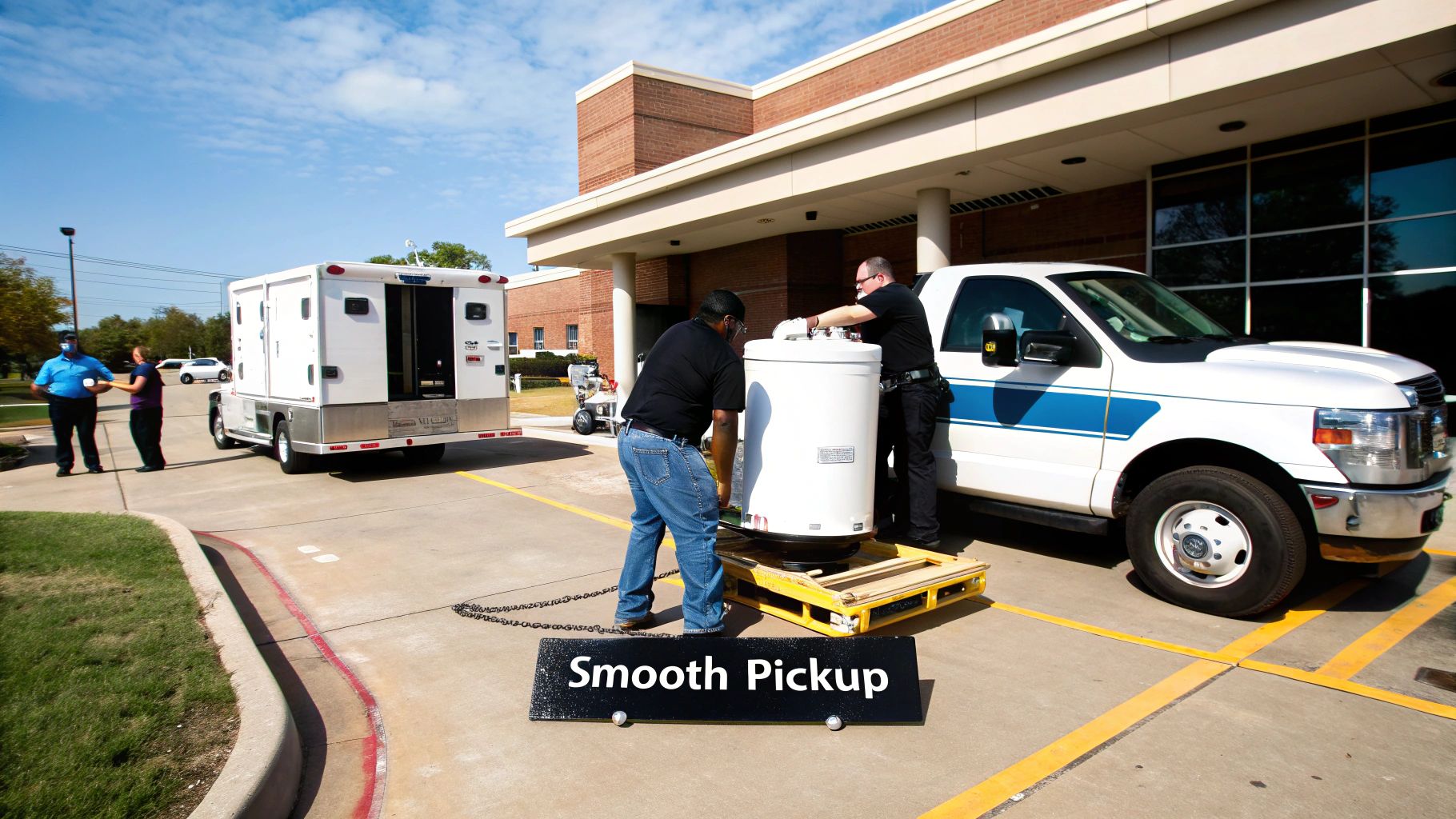
The easiest way to sidestep all that complexity is to work with a single, integrated provider. When one partner handles everything—from on-site de-installation and secure packing to transportation with their own fleet—a multi-front headache becomes one simple, managed process. It's the difference between project management chaos and streamlined efficiency.
A dedicated team shows up with the right tools and expertise for your specific equipment. They know exactly how to safely disconnect a centrifuge, dismantle a server rack, or crate a delicate diagnostic machine without causing damage or disruption. This all-in-one service saves you an incredible amount of time and frees up internal resources that would otherwise be spent corralling different vendors.
The need for these kinds of efficient services is growing fast. The recycling equipment market is projected to hit USD 7.97 billion by 2032, and the North American market alone is valued at an estimated USD 1.59 billion in 2025. This growth is being driven by the demand for processing complex waste from medical and research facilities. Companies like Scientific Equipment Disposal (S.E.D.) are a critical part of this ecosystem, handling everything from fume hoods to servers with secure, fleet-backed logistics nationwide. S.E.D.'s model provides the exact on-site de-installation and transport capabilities that facilities need for these large-scale projects.
What A Coordinated Pickup Actually Looks Like
So, what should you expect from a smooth, professionally managed pickup? The process should feel clear, concise, and built around your operational needs.
Here’s how a professional service simplifies the logistics:
- On-Site Assessment: Before pickup day, a project manager should come to your facility to map out the scope, identify potential roadblocks (like narrow doorways or stair-only access), and create a detailed removal plan.
- Flexible Scheduling: Your work comes first. A good partner will work around your schedule to minimize disruption, whether that means showing up after hours, on a weekend, or during a planned shutdown.
- Professional De-Installation: The crew arrives ready to disconnect, dismantle, and prepare every asset for transport. This covers everything from unplugging IT gear to handling plumbed-in laboratory equipment.
- Secure Packing and Loading: All items, especially those with data storage, are carefully packed and loaded into a secure, company-owned vehicle. This ensures a tight chain of custody from the moment it leaves your floor.
A coordinated pickup should feel seamless. The ideal scenario is one where the equipment just disappears—efficiently and securely—with minimal impact on your team’s productivity. You’re left with a clean space and total peace of mind.
This integrated approach is absolutely vital for large-scale projects like facility moves, lab decommissions, or data center shutdowns.
When you're ready to see how a simplified process can work for your facility, it's easy to schedule a pickup and get a clear plan from a national expert. Ultimately, the best partner is one who can manage the entire logistical chain, turning a potential operational bottleneck into a simple, secure, and successful project.
Breaking Down the Costs and Getting Your Final Paperwork
When you’re searching for "medical equipment recycling near me," the mark of a truly professional partner is total transparency. A clear, upfront quote isn't just about numbers—it's about trust. It demystifies the entire process and saves you from getting hit with surprise charges later on.
You might be surprised to learn that some of the most critical services can actually be free. High-value IT gear like servers and networking equipment often holds enough residual value to completely offset the recycling costs. We also frequently include certified data wiping using DoD standards at no charge because, frankly, it's a non-negotiable part of doing the job right.
Of course, some services will have a fee attached. These are usually the jobs that require more hands-on effort or specialized handling.
Where You Might See a Fee
Understanding where costs come from helps you budget accurately. Any detailed quote should break these items out clearly.
- Heavy-Duty De-Installation: Removing large, plumbed-in machinery like fume hoods or industrial autoclaves takes a skilled crew and the right tools. This kind of specialized labor is a common and totally justifiable charge.
- Large-Scale Project Logistics: A full lab decommission or a facility-wide cleanout is a major undertaking. The cost often reflects the extensive project management, packing, and transportation needed to pull it off smoothly.
- Hazardous Material Disposal: Standard e-waste is one thing, but equipment containing materials like mercury or lead requires special handling and disposal protocols. These extra steps come with extra costs.
- Projects Without High-Value Assets: If the job involves only older, low-value equipment with no resale potential, a service fee is usually necessary to cover the basic costs of recycling and transport. To get a better idea of what we look for, you can review a detailed list of items we typically accept for recycling value.
Why the Final Paperwork Is So Important
Once your equipment is off-site, the job isn't quite done. The final—and arguably most critical—step is receiving the official documentation that closes the loop on your compliance responsibilities. This paperwork is your legal proof that you handled everything by the book.
Your Certificate of Recycling and Certificate of Data Destruction are more than just pieces of paper. They are your defensible audit trail. This is what proves you met your obligations under HIPAA and environmental laws, protecting your organization long after the equipment is gone.
This documentation provides an official, final record of secure and compliant disposal. It’s absolutely essential for your internal records, for any potential audits, and for your own peace of mind.
The medical waste management sector is a serious business. The U.S. market alone is valued at USD 6.2 billion in 2025, and it’s part of a larger North American market projected to hit USD 13.6 billion by 2035. That scale underscores just how important cost-effective, compliant solutions are. For facilities nationwide, professional B2B services that offer certified shredding and secure fleet pickups are key to managing costs and mitigating risk.
Ultimately, a partner you can trust will give you a clear quote upfront and deliver the essential certificates without you ever having to ask. This final step is what turns a simple equipment pickup into a fully compliant, documented asset disposition project.
Your Essential Recycling Project Checklist
Let's pull all this together into a practical, scannable checklist. This is your go-to guide, designed for facility managers and IT staff who are juggling an equipment disposition project. Think of it as a chronological roadmap to walk you through the entire process, making sure no critical detail slips through the cracks.
Following these steps will make your next search for "medical equipment recycling near me" much more effective because you'll already have a solid action plan in place.
From Initial Planning To Final Sign-Off
Use this framework to keep control of the project and ensure you’re hitting all your compliance marks from day one.
-
Inventory All Equipment and Flag Data-Bearing Devices
- Pro-Tip: Start with a detailed spreadsheet. You'll want columns for item type, brand, model, serial number, and a simple "Yes/No" for data storage. This list isn't just for you—it becomes the foundation of your chain of custody documentation.
-
Verify Recycler’s Certifications and Security Methods
- Pro-Tip: Don't just take their word for it. Any reputable recycler will happily provide a copy of their R2 or e-Stewards certificate. You should also get it in writing that they will provide a serialized Certificate of Data Destruction.
-
Schedule an On-Site Assessment and Get a Quote
- Pro-Tip: A pre-pickup walkthrough with the vendor is non-negotiable. This is your chance to point out any tricky items, like plumbed-in machinery or heavy equipment tucked away in hard-to-access areas. This step is what makes the quote accurate and prevents surprise charges later.
A professional recycler will never give you a final quote without seeing the full scope of the job first. An on-site assessment isn't an upsell; it's a sign you're working with a thorough, reliable partner.
Executing The Pickup and Finalizing Documentation
With a solid plan locked in, the last phase is all about smooth execution and closing the loop on your paperwork.
-
Coordinate Pickup Logistics with Your Team
- Pro-Tip: Designate a single point of contact at your facility to work with the recycling crew on pickup day. This simple step cuts out confusion and keeps the entire process moving forward without a hitch.
-
Oversee the Removal and Sign Off on Asset Transfer
- Pro-Tip: Before that truck leaves your property, do a quick cross-check of your inventory list against what was actually loaded. Make sure you get a signed bill of lading or transfer receipt that officially confirms the recycler has taken possession of the assets.
-
Confirm Receipt of All Compliance Certificates
- Pro-Tip: The project isn't truly over until you have the Certificate of Recycling and the Certificate of Data Destruction in your hands. File these documents immediately—they are your official, auditable proof that every piece of equipment was disposed of compliantly and securely.
Answering Your Top Questions About Medical Equipment Recycling
Even the most well-thought-out plan comes with questions. When it's time for a major equipment clear-out, we hear a lot of the same concerns from facility managers and IT directors nationwide. Getting straight answers is the best way to feel confident about the process.
Let's tackle some of the most common questions people have when they start looking for "medical equipment recycling near me."
What Kinds of Lab and Medical Equipment Do You Actually Take?
This is always one of the first things people ask, and for good reason. You need to know if a recycler can handle the specific mix of assets your facility has, from benchtop devices to the server racks humming in the back room.
A reputable, specialized recycler should have no problem with a wide variety of equipment.
- General Lab Gear: Think centrifuges, incubators, microscopes, and spectrophotometers. These are standard and easily managed.
- IT & Data Center Hardware: All the electronics that power your operations are a perfect fit. This includes desktops, servers, network switches, monitors, and data storage arrays.
- Larger Machinery: Don't worry about the big stuff. Bulky equipment like fume hoods or large-scale diagnostic machines can almost always be de-installed and recycled by the right team.
The critical exception here is anything contaminated with a biological or chemical hazard. That material requires a completely different, specialized disposal process and is not something electronics recyclers can accept. Always get a clear "yes" or "no" from your vendor on your specific inventory list before you book a pickup.
How Can We Be 100% Sure Our Data is Secure for HIPAA Compliance?
Guaranteeing data security isn't just about deleting files; it's about making sure that Protected Health Information (PHI) is completely and utterly unrecoverable. For HIPAA, there's no middle ground.
The gold standard is a partner who provides certified, auditable data destruction. Look for a recycler that follows the DoD 5220.22-M 3-pass standard for wiping functional hard drives and offers physical shredding for everything else. Most importantly, you must receive a Certificate of Data Destruction that lists the serial numbers of every single drive and device destroyed. This is your non-negotiable proof of compliance.
Think of that certificate as your shield. If an auditor ever comes knocking, that document proves you did your due diligence to protect patient data.
Should We Go With a Local Recycler or a Big National Company?
When you’re searching for medical equipment recycling, you'll find both local and national options. While a hyper-local provider can be great for a small job, a partner with a national reach and local expertise often provides the best of both worlds.
Here’s what a national partner with a strong local presence brings to the table:
- Consistent, Scalable Service: A national company can service all your locations—from Florida to Washington—with the same high standards, security protocols, and documentation processes. This is vital for large healthcare systems.
- Robust Logistics and Resources: National providers have the fleet, manpower, and established processes to handle massive projects, like a full hospital decommissioning, that might overwhelm a smaller local outfit.
- A Tighter, More Secure Chain of Custody: This is the big one. A top-tier national partner uses its own trucks and its own vetted employees. This means your valuable assets are handled by one trusted team from your door to theirs, avoiding the security risks of subcontracting that are common in the industry.
That direct, in-house approach gives you the security and efficiency needed for complex hospital cleanouts or lab moves where compliance and clear communication are everything.
At Scientific Equipment Disposal, we are the secure and compliant solution hospitals, labs, and universities trust nationwide. Our in-house team manages the entire process—from on-site de-installation to certified data destruction—so your project is handled with the professionalism it deserves, no matter where your facility is located.
Ready to make your equipment disposal straightforward and secure? Visit us at Scientific Equipment Disposal to get started.