Secure Data Destruction Services in Lawrenceville GA – Protect Your Business

Imagine leaving a filing cabinet packed with your most sensitive client files and financial records unlocked on a public sidewalk in downtown Lawrenceville. It sounds crazy, but that’s essentially what happens when you toss out old computers or servers without professional data destruction.
For businesses here in Gwinnett County, across Georgia, and throughout the United States, securing your data isn't just a good idea—it's your last line of defense. This guide covers how to choose the right secure data destruction services in Lawrenceville, GA, and why it's a critical step for organizations nationwide.
Why Data Destruction Is a Critical Business Need in Lawrenceville and Beyond
Simply hitting "delete" or even reformatting a hard drive creates a dangerous, false sense of security. The truth is, that information is often still there, a phenomenon known as data remanence.
Think of it like wiping a whiteboard with a dry eraser—you can still see the faint outline of what was written before. In the same way, your "deleted" data can be pulled right back up by anyone with basic recovery software.
This puts diverse businesses—from local shops in Lawrenceville, GA, to national corporations—at serious risk.
- Healthcare Providers: Medical offices and hospitals across Gwinnett County have a legal duty under HIPAA to protect patient health information. A single data breach from an old, improperly discarded computer can result in devastating fines and legal battles.
- Tech Startups and Corporations: For companies with proprietary code, financial projections, or valuable client lists on old servers, insecure disposal is an open invitation for corporate espionage. This applies to tech hubs from Atlanta to Silicon Valley.
- Government Agencies and Contractors: Any organization that handles sensitive public or security-related information must follow strict disposal rules, like those laid out by the Department of Defense (DoD), regardless of their location.
The Hidden Liability in Old Electronics
The risk isn't just theoretical; it's amplified by the massive amount of electronic waste we generate. The global e-waste problem is a huge compliance issue. Over 62 million tons of electronics were thrown out in 2022, but only 22.3% were formally recycled.
This gap means millions of devices loaded with sensitive data are just sitting there, vulnerable. For organizations managing IT equipment retirements or lab shutdowns, whether in the Atlanta metro area or across the country, partnering with a certified provider for DoD-standard data sanitization has become an essential part of risk management.
Viewing secure data destruction not as an expense but as an essential insurance policy is the first step toward protecting your business from catastrophic liability. It’s a proactive measure that safeguards your reputation, your finances, and your clients' trust.
For any business retiring old hardware, responsible disposal is a two-part process. It involves completely destroying the data and then properly recycling the physical components. You can learn more about professional computer recycling services in Lawrenceville, Georgia to ensure your end-of-life electronics are handled in an environmentally compliant way.
Ultimately, working with a professional for secure data destruction services in Lawrenceville GA is the only way to be absolutely certain your information is gone for good.
Understanding Your Data Destruction Options
When it's time to retire old hard drives, servers, or company phones, you have a critical decision to make. What happens to the data stored on them? The right answer depends entirely on whether you plan to reuse the device or want it gone for good.
Think of it like this: you can either clean the device so it can be safely used again, or you can physically destroy it so the data can never be recovered. For businesses in Lawrenceville, the greater Atlanta area, and nationwide, knowing the difference is the first step in protecting your company from a potential data breach.
Comparing Data Destruction Methods
Choosing the right method can feel complicated, but it boils down to your specific security needs, compliance mandates, and what you plan to do with the hardware. Here’s a quick breakdown of the most common techniques we use for clients both locally and across the U.S.
| Method | How It Works | Best For | Compliance Level | S.E.D. Service |
|---|---|---|---|---|
| Data Wiping (Sanitization) | Software overwrites the entire drive with random data, making original information unrecoverable. | Reusing or reselling IT assets like computers and servers. | Meets DoD 5220.22-M standards. | Yes |
| Degaussing | A powerful magnetic field scrambles and erases the data on magnetic media like hard disk drives (HDDs). | Rapidly disabling magnetic storage before physical destruction. | High; effective but doesn't work on modern SSDs. | Yes |
| Physical Shredding | Industrial machinery grinds the storage device into tiny, unreconstructable fragments. | End-of-life devices, SSDs, and ensuring maximum security. | Highest; provides absolute, verifiable proof of destruction. | Yes |
Each method offers a different level of security. While wiping allows for asset recovery, only physical destruction guarantees data is 100% gone forever.
Data Sanitization for Device Reuse
Data sanitization, also known as wiping, is the go-to method when you want to give your equipment a second life. Simply hitting "delete" on a file is like tossing a sensitive document into an open wastebasket—anyone can just pull it out and read it.
Data wiping is the digital equivalent of using a professional-grade shredder on that paper. We use specialized software to overwrite every single bit of data on a drive, often multiple times. This process follows strict protocols like DoD 5220.22-M, which requires three passes of overwriting to ensure the original data is completely obliterated.
This method is the perfect choice for:
- Internal Redeployment: Safely move computers from one department to another.
- Equipment Resale: Recoup some of your initial investment from old but functional IT assets.
- Hardware Donations: Give back to the community by donating usable tech to schools or charities without risk.
Because the device is still perfectly functional, wiping is the most sustainable and cost-effective option for managing your IT lifecycle. You can get a closer look at how we handle this in our guide to secure hard drive destruction and sanitization.
Physical Destruction for Ultimate Security
When a device has reached the end of its useful life or contained highly classified information, there's no room for maybes. Physical destruction is the only way to be absolutely certain that data can never be accessed again by anyone. It’s the final word in data security.
We primarily use two methods for this.
Degaussing: This process subjects a hard drive to an incredibly powerful magnetic pulse, instantly and permanently scrambling the magnetic platter where your data lives. It's like wiping a VHS tape with a giant magnet—everything on it is reduced to meaningless noise. It’s incredibly fast and thorough for older magnetic hard drives and backup tapes.
Shredding: This is exactly what it sounds like, but on an industrial scale. We feed hard drives, solid-state drives (SSDs), smartphones, and other media into a shredder that grinds them into small, confetti-like pieces of metal and plastic. There is absolutely no way to put the pieces back together.
Failing to take this final step can have devastating consequences for any business.
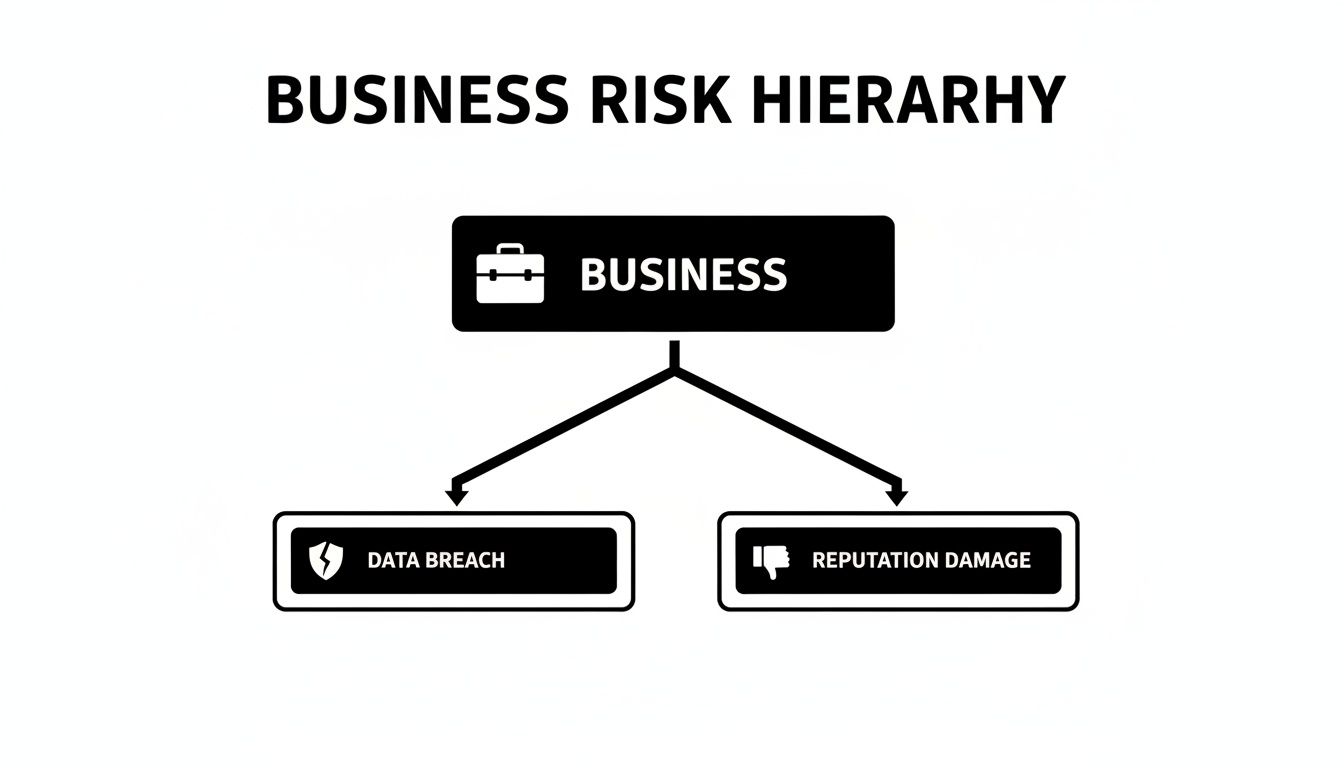
As you can see, a data breach isn't just a technical problem—it directly leads to reputation damage, financial loss, and legal trouble.
Key Takeaway: Physical destruction is more than just breaking things. It’s a precise, engineered process that provides undeniable proof that your data has been permanently eliminated, satisfying the strictest compliance and audit requirements.
For any organization around Atlanta—especially those in healthcare, finance, or government—shredding delivers total peace of mind. It ensures your retired assets will never become a future liability. Whether you need to wipe drives for reuse or shred them for complete security, a professional partner makes all the difference.
Meeting HIPAA, DoD, and Other Compliance Mandates
If you’re running a business in Lawrenceville, anywhere in the Atlanta metro, or across the U.S., you know that handling sensitive data isn't just about good practice—it's the law. Strict regulations are in place, and one misstep can lead to staggering fines, legal trouble, and a reputation that's hard to rebuild. These rules are exactly why professional, certified data destruction is so critical.
When you fail to properly destroy data, you're not just taking a chance; you're inviting risk. That's why you need a partner specializing in secure data destruction services in Lawrenceville GA who understands these complex requirements inside and out.
The Critical Role of HIPAA in Healthcare Data
For anyone in the healthcare field, from a local clinic in Gwinnett County to a major hospital network with a national presence, the Health Insurance Portability and Accountability Act (HIPAA) is a non-negotiable reality. The HIPAA Security Rule is crystal clear: you must have policies for the final disposition of electronic Protected Health Information (ePHI).
Simply put, you are legally responsible for making sure that any data on retired medical equipment, old servers, or employee computers is rendered completely unrecoverable. Tossing out an old diagnostic machine without physically destroying its hard drive is a direct violation. To fully grasp your responsibilities, you can review the specific HIPAA compliance guidelines.
Let’s look at a real-world example:
- Imagine a Lawrenceville medical clinic that just upgraded its patient check-in computers. Those old machines hold thousands of patient records—names, addresses, and private medical details. Under HIPAA, those hard drives absolutely must be professionally destroyed to prevent a data breach and avoid fines that can easily climb into the millions.
Unpacking the DoD 5220.22-M Standard
Even outside of healthcare, the Department of Defense (DoD) 5220.22-M standard is the benchmark for data sanitization. It’s not just for military and federal agencies; its thoroughness has made it a gold standard for corporate security, especially for government contractors or any company handling sensitive IP.
This standard specifies a method for overwriting data to erase it. But let's be realistic—for true, ironclad security, especially with older hardware, physical destruction is the only 100% foolproof method. It’s the only way to truly meet the intent of these tough regulations.
Think about an aerospace company near Atlanta that's decommissioning servers. If those servers held proprietary design schematics, they can't just wipe the drives and hope for the best. To eliminate every shred of risk, those drives must be physically shredded. This creates an undeniable audit trail that proves compliance and protects critically important information.
This is precisely why a documented, certified process is so important. When you absolutely have to be sure, our services for secure hard disk disposal deliver that verifiable proof of destruction.
The Growing Demand for Compliant Destruction
The need for compliant data destruction isn't just a local concern; it’s a massive global movement. The market for smart waste management and compliance is exploding, growing from USD 2.81 billion in 2025 to an expected USD 3.12 billion in 2026. Experts project it will continue climbing at an 11.30% CAGR because of stricter regulatory policies.
This isn’t just a statistic; it shows a real and growing need for secure, documented, and auditable services that meet these high standards.
For businesses all over the Atlanta area and across the country, this isn't just about following rules. It’s about protecting your assets, your customers, and your company's future. Whether you're a hospital needing HIPAA-compliant hard drive destruction or a university managing a lab decommission, partnering with a certified expert isn't just a good idea—it's a fundamental operational requirement.
Choosing Between On-Site and Off-Site Destruction Services
Once you’ve figured out how your old hardware should be destroyed, the next big question is where it should happen. Do you need the service to come to you, or can you have your equipment securely taken away? This choice between on-site and off-site services is a major decision that shapes the security, logistics, and even the cost of your project.
For any business in Lawrenceville or the greater Atlanta metro, the right answer really boils down to your specific needs. Both options are incredibly secure, but they’re built for different priorities.
On-Site Destruction: The Gold Standard for Peace of Mind
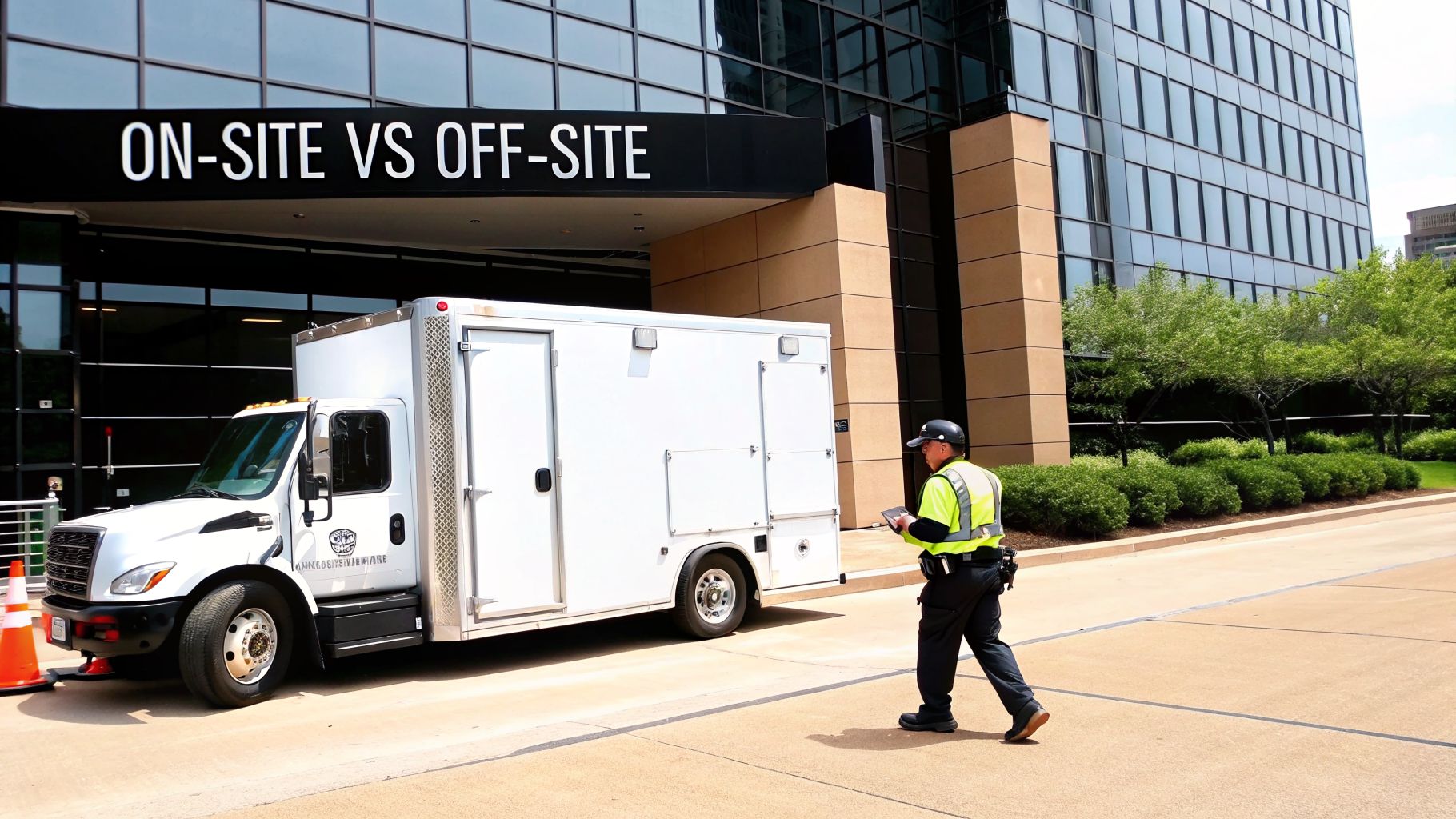
On-site destruction is just what it sounds like. We roll up to your location—whether in Lawrenceville, anywhere in Atlanta, or at your facility nationwide—with our mobile shredding truck. Think of it as a secure, industrial-grade destruction facility on wheels. This method gives you the highest possible level of transparency and is what we always recommend for organizations with ironclad security protocols.
You get to physically witness the entire destruction process, right there in your parking lot. Watching your drives turn into tiny fragments provides absolute, undeniable proof that your data is gone for good.
This is the go-to option for:
- Healthcare Providers: Hospitals and clinics can guarantee HIPAA compliance by watching hard drives full of ePHI get shredded just feet from their door.
- Government Contractors: Agencies and their partners can verify that sensitive information is destroyed to strict DoD standards without it ever leaving the property.
- Financial Institutions: Banks and investment firms can eliminate risk by having client data destroyed under their direct supervision.
The real power of on-site service is its unbroken chain of custody. Because your hard drives and media never leave your sight before being destroyed, it completely removes any risk during transport and offers verifiable security you can see with your own eyes.
Off-Site Destruction: A Convenient and Cost-Effective Solution
While on-site gives you total oversight, off-site destruction is a secure and very efficient alternative. It's a great fit for large-volume jobs or for businesses facing logistical hurdles. In an off-site scenario, your assets are securely transported from your facility to our specialized destruction plant for processing.
Now, this isn't just a matter of loading things onto a truck. The entire process is managed by a strict, auditable chain of custody from start to finish.
Here’s how our documented off-site protocol works:
- Serialized Asset Tagging: Before anything leaves your facility, every single data-bearing device is inventoried and given a unique serial number.
- Secure Transport: We place all assets into locked, sealed containers. They are then transported in GPS-tracked vehicles driven by fully background-checked personnel.
- Monitored Facility: The destruction itself happens at our secure facility, which is monitored 24/7 with strictly controlled access.
- Certified Destruction: Your assets are destroyed to the same high standards as our on-site services. Afterward, you receive a Certificate of Destruction for your records.
Off-site destruction is often the more budget-friendly route for large-scale IT asset dispositions, full lab decommissions, or when you’re dealing with bulky equipment that’s tough to handle on-site. The logistics are managed with the same care lawyers use to preserve evidence—every item is tracked from your door to our shredder. Nothing gets lost or unaccounted for.
You can learn more about our physical destruction methods, including our professional computer shredding services, to see exactly how this process provides a fantastic balance of convenience, security, and affordability for many businesses.
Why Certificates of Destruction and Chain of Custody Matter
When you get rid of old data, professional destruction isn't truly complete without verifiable proof. After all, if you can’t prove the data was destroyed, you’re just as liable as if you’d done nothing at all.
This is where two critical documents come into play: the chain of custody record and the Certificate of Destruction. These aren't just pieces of paper; they are your legal shields, especially during an audit.
Think of chain of custody like sending a valuable, registered package. You get a tracking number and can see every single hand it passes through—from the moment it leaves your facility to its final destination. This documented trail ensures nothing gets lost and everything is accounted for.
Establishing an Unbroken Chain of Custody
A proper chain of custody for your IT assets demands meticulous documentation at every single step. We handle this process with the same rigor a lawyer uses to preserve evidence, creating an auditable and defensible record from start to finish.
For businesses looking for secure data destruction services in Lawrenceville GA, and for national clients, this documented journey must include:
- Serialized Inventory: Before anything moves, each hard drive or data-bearing device is given a unique serial number and logged.
- Secure Transport: Assets are transported in locked containers using GPS-tracked vehicles, all handled by background-checked staff.
- Documented Handoffs: Every time the assets change hands—from your employee to our technician—it is signed for and recorded.
This process completely eliminates any "what if" scenarios. You get a clear, uninterrupted log of your assets from the moment we pick them up until they are physically destroyed.
A strong chain of custody is your first line of defense. It proves you maintained control and security over your sensitive data at all times, which is a core requirement for regulations like HIPAA.
The technology behind this has come a long way, too. Automation and even artificial intelligence are now part of the secure data destruction and recycling process, bringing new levels of accuracy. For instance, AI-powered optical sorters can hit 99% material-recognition accuracy, which helps identify data-bearing media before destruction. This keeps the chain of custody tight and can even lower costs for large-scale disposals while ensuring compliance.
The Certificate of Destruction: Your Legal Proof
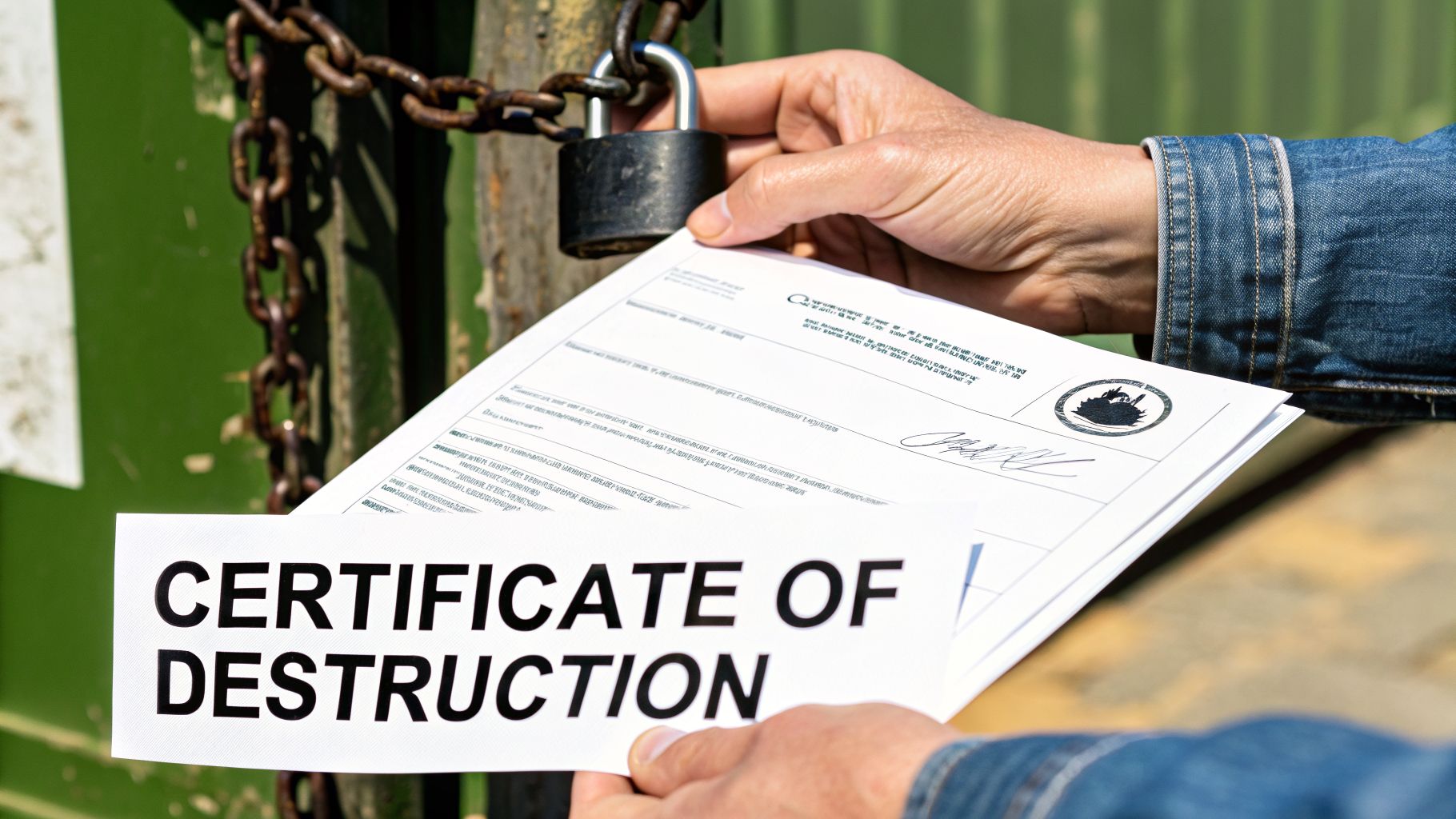
Once the chain of custody is complete and your devices have been destroyed, you receive a Certificate of Destruction. This document is much more than a receipt—it’s a legally binding record that formally transfers liability from your organization to us, the destruction vendor.
A detailed certificate is your ultimate proof of due diligence. It must include:
- A unique serial number for the certificate itself.
- The exact date and location of destruction.
- The specific destruction method used (e.g., shredding, pulverization).
- A complete, itemized list of the serial numbers for every single device that was destroyed.
This document serves as your ironclad evidence during a HIPAA audit or any internal security review. It proves you met all compliance standards with professional accountability. When you work with a certified partner, you get a document that stands up to any legal scrutiny. You can learn more about what a proper Certificate of Destruction includes and why it's so vital for your records.
How to Select the Right Data Destruction Partner
When you need to get rid of old hard drives and data-bearing devices in Lawrenceville, GA, or anywhere else, the company you choose to handle it matters. A lot. This isn't just about hiring a disposal company; it's about bringing on a security partner who can protect your organization from massive liability.
Not all providers are the same. A top-tier partner does more than just shred a few drives. They deliver a fully compliant, verifiable, and secure service that stands up to scrutiny. You need to know what to ask and what to demand as proof before you let anyone near your sensitive data.
A credible vendor will have no problem with this—in fact, they'll welcome it and have all the documentation ready.
The Essential Vendor Vetting Checklist
Before you sign on the dotted line with any data destruction partner, whether they serve the Atlanta metro area or have a national footprint, make sure they check these boxes.
- Industry Certifications: The gold standard is R2 (Responsible Recycling). Ask to see their certificate. This proves they adhere to strict protocols for data security and environmental responsibility through the entire electronics lifecycle.
- Comprehensive Insurance: They absolutely must carry serious insurance. Don't just ask about general liability; you need to see proof of specific data breach and errors & omissions coverage. This is your safety net if something goes wrong.
- Rigorous Security Protocols: How do they run their own shop? Ask about their employee screening, which should include mandatory background checks and drug testing. What about their facility? It needs 24/7 surveillance and tightly controlled access.
These qualifications aren't just "nice-to-haves." They're the absolute minimum for any company you trust with your data.
Key Questions to Ask Any Potential Vendor
Once you've covered the basics, it's time to dig into their actual process. The answers they give here will tell you everything you need to know about the quality of their service.
What is your process for asset tracking? To ensure a verifiable chain of custody and obtain reliable certificates of destruction, businesses must implement robust asset tracking best practices for all data-bearing devices. Your partner should be able to walk you through exactly how they inventory, tag, and track every single device from the moment it leaves your facility to its final destruction.
Can I witness the destruction process? A reputable vendor will always say yes. Whether it's offering on-site shredding at your location or inviting you to witness the process at their facility, this transparency is the hallmark of a secure and confident operation.
What happens to the e-waste after shredding? This is a critical question. The shredded metal and plastic shouldn't just be dumped in a landfill. A responsible partner works with certified downstream recyclers to ensure all e-waste is processed correctly, recovering valuable commodities and keeping hazardous materials out of the environment.
Key Takeaway: A trustworthy data destruction partner operates with total transparency. They can prove their certifications, show you their security measures, and give you a clear, auditable trail for every asset they handle.
By asking these direct questions, you can cut through the sales pitches and find a partner who truly meets and exceeds industry standards. It's the diligence you do now that ensures your company’s data stays secure, your compliance needs are met, and your good name is protected.
Frequently Asked Questions About Data Destruction
When you're dealing with data security, a lot of questions come up. We get it. Whether you're a hospital administrator in Gwinnett County, an IT manager for a growing Atlanta business, or a compliance officer for a national corporation, you need clear answers. Here are the most common questions we hear about secure data destruction services in Lawrenceville, GA, and beyond.
What Types of Media Can You Destroy?
These days, sensitive information is stored on a whole lot more than just computer hard drives. If a device holds digital data for your organization, we have a secure method to make sure that data is gone for good.
Our services cover just about everything:
- Traditional hard disk drives (HDDs)
- Modern solid-state drives (SSDs)
- Backup tapes and data cartridges
- Entire servers and network equipment
- Company cell phones and tablets
- Other miscellaneous electronics containing data
Basically, if it plugs in or holds a charge and stores information, we can handle it.
Is It Better to Wipe or Shred My Hard Drives?
That really comes down to one thing: what's next for the hardware? If you plan on reusing the drives or want to resell them, then a DoD-compliant data wipe is the way to go. It completely sanitizes the drive, making it safe and ready for its next life.
But for old, faulty, or outdated drives—or for any organization that can't afford to take any risks—physical shredding is the gold standard. Shredding is final. It's an irreversible process that gives you undeniable, physical proof of destruction, which is often a non-negotiable for HIPAA and other strict compliance rules.
For maximum security, nothing beats physical destruction. It removes all doubt and formally ends the life of the data-bearing device, protecting you from future liability.
Do You Serve Businesses Outside of Lawrenceville?
Yes, absolutely. We're proud of our local roots in Gwinnett County, but our service area extends well beyond Lawrenceville. We provide both on-site and off-site secure data destruction for clients all over the Atlanta metropolitan area and throughout Georgia. We also have the logistics in place to serve nationwide clients with more complex IT asset disposition projects.
How Much Do Data Destruction Services Cost?
There's no simple, one-size-fits-all price for data destruction. The final cost really depends on a few key things: the method you choose (wiping vs. shredding), how many devices you have, and whether we come to you (on-site) or you bring them to us (off-site).
Because every job is different, we provide a detailed, no-obligation quote that’s built around your specific inventory and security needs. This way, you get a clear and accurate price for your project with no surprises or hidden fees.
Ready to ensure your company’s sensitive data is destroyed securely and professionally? Scientific Equipment Disposal provides certified, compliant, and documented data destruction services for businesses, hospitals, and organizations throughout the Lawrenceville, Atlanta, and nationwide.
Protect your business today by visiting https://www.scientificequipmentdisposal.com to get a free, no-obligation quote.