A Guide to E-Waste and Lab Equipment Recycling in Atlanta GA

For Atlanta's hospitals, universities, and technology labs, disposing of old electronics and specialized scientific gear isn't as simple as using the city's curbside program. This guide is your complete roadmap for handling compliant, secure, and responsible recycling in Atlanta, GA, turning a potential regulatory nightmare into a straightforward, managed process. It’s built for organizations across the Southeast and nationwide that need to confidently dispose of everything from servers to centrifuges.
The Unique Challenge of Lab and E-Waste Recycling in Atlanta
Hospitals, research facilities, and universities in Georgia and beyond generate waste streams that standard recycling programs just can't handle. You can't just toss an old server into a general e-waste bin or leave a decommissioned centrifuge on the curb for municipal pickup—it just doesn't work that way for regulated industries.
These items are often packed with sensitive data, potentially hazardous materials, and valuable resources that need an expert touch. This is where specialized, business-to-business recycling services become absolutely critical. Unlike residential recycling, which deals with everyday household items, commercial asset disposition is built to tackle the specific legal, environmental, and data security hurdles that professional organizations in Atlanta and across the US face. It’s a process that guarantees a secure chain of custody from your facility all the way to final processing.
Why Specialized Disposal Is Critical
Let's be blunt: cutting corners on disposing of lab equipment and electronics is a huge risk. Failing to follow federal and local rules, including EPA regulations, can lead to some seriously steep fines. Even worse, a data breach from an unsecured hard drive can cause devastating damage to your reputation and finances, especially if you're governed by HIPAA. Working with a professional partner takes these risks off your plate by providing a documented, compliant service nationwide.
The need for this kind of specialized service is growing right alongside Atlanta's own recycling infrastructure. The city's municipal program has made impressive strides, doubling its diversion rate from a modest 11% in 2017 to 23% by 2022. This upward trend signals a strong regional commitment to managing waste responsibly, which helps create a great environment for specialized recyclers who can handle what the city services can't.
Choosing the right partner means ensuring every single asset, from a simple computer monitor to a complex biological safety cabinet, is handled according to the highest industry standards for security and sustainability.
This intense focus on compliance and security is exactly where a local expert like Scientific Equipment Disposal (S.E.D.) comes in. We offer a single-source solution for both your IT assets and scientific instruments, helping Atlanta-area organizations meet all their obligations without the headache. You can learn more about how we manage lab equipment disposal services in Georgia through our detailed guides.
Classifying Your Assets: Hazardous vs. Non-Hazardous
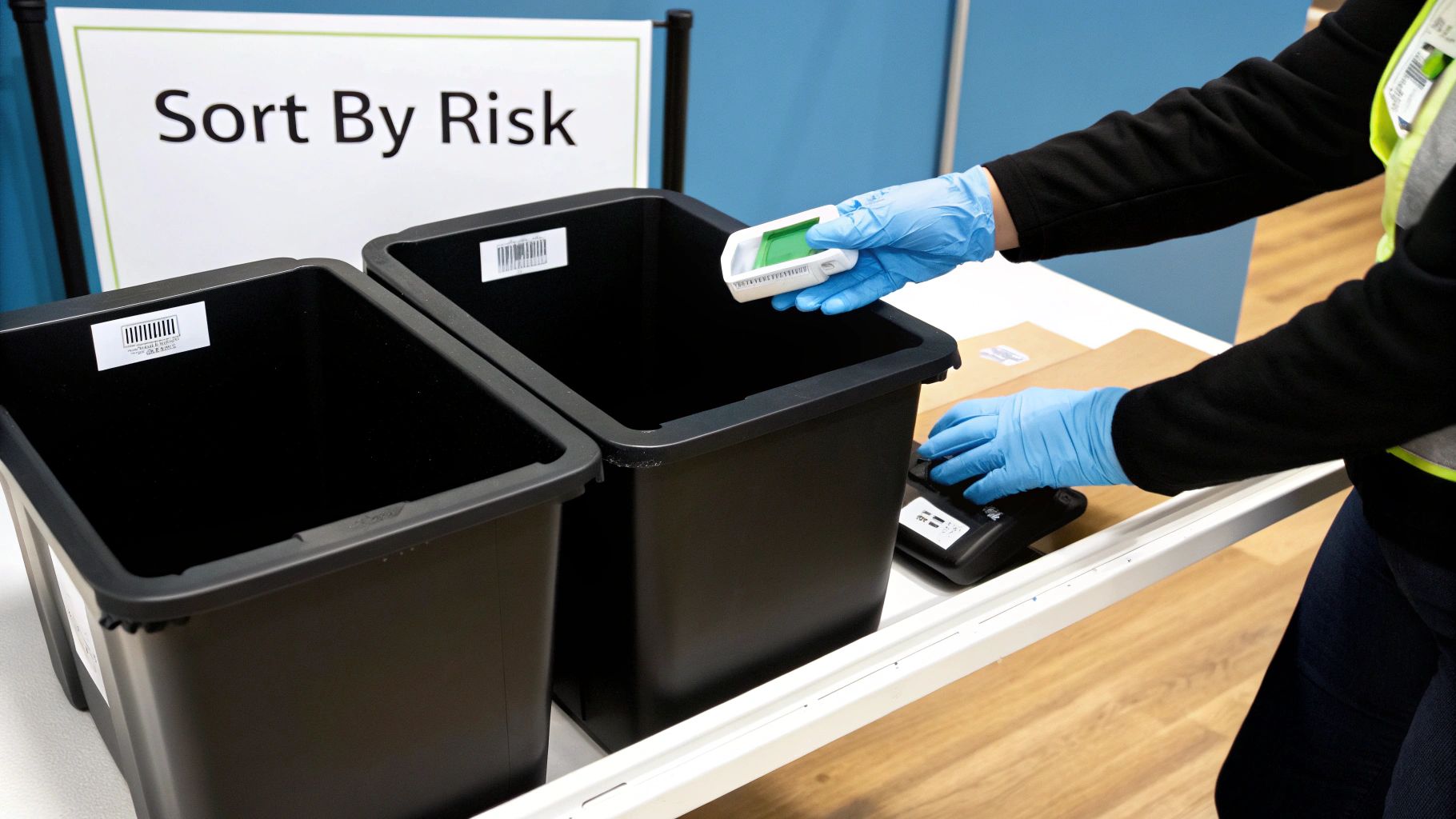
Before you can even think about disposing of old equipment, you have to know exactly what you’re working with. It's the first and most critical step in any recycling plan. Think of it like sorting laundry—you wouldn't toss delicate silks in with heavy work jeans. In the world of equipment disposal, mixing hazardous and non-hazardous assets is a recipe for compliance nightmares, hefty fines, and real environmental damage.
For any lab or business managing recycling in Atlanta, GA, this initial classification drives the entire process. It determines how equipment is handled, who can transport it, and where it ultimately ends up. Getting this wrong isn't a small oversight; it’s a major regulatory breach.
What Counts as a Non-Hazardous Asset?
Thankfully, non-hazardous assets are usually the easiest to spot. These are the items that don't contain materials posing an immediate threat to people or the planet. Most of the gear in a typical IT or lab cleanout falls into this category.
Common examples include:
- Standard IT Hardware: Think servers, desktops, laptops, keyboards, and network switches, as long as they aren't damaged or leaking battery fluid.
- General Lab Machinery: Things like PCR machines, centrifuges, incubators, and shakers are generally non-hazardous after proper decontamination.
- Metal Racks and Casings: Simple structural items like steel server racks and aluminum equipment housings are benign.
But "non-hazardous" doesn't mean you can just toss them in a dumpster. These items still need professional e-waste recycling. They’re full of valuable materials like steel, copper, and aluminum that can be recovered, not to mention other components that have no business being in a landfill.
Spotting Potentially Hazardous Materials
This is where you need to pay close attention. Potentially hazardous assets are those containing substances that are toxic, corrosive, reactive, or flammable. The EPA has very strict rules for these under the Resource Conservation and Recovery Act (RCRA), and Georgia layers its own state-specific regulations on top of that.
These risky materials can hide in plain sight. A machine that looks perfectly harmless might have a component inside that requires special handling.
The trick is to look past the machine's main job and think about what’s inside it. An old microscope seems harmless enough, but if it has a mercury-vapor lamp, it’s instantly classified as hazardous waste.
For instance, many older LCD monitors contain mercury in their backlights. That single component classifies them as universal waste. The same goes for anything with lead-acid batteries, old-school cathode ray tubes (CRTs), or circuit boards with lead solder. In a lab, the risks get even more complex. If you want to get better at spotting these, our guide on interpreting laboratory hazard signs is a great place to start.
To make things a bit easier, here’s a quick reference table to help you start sorting your assets.
Hazardous vs Non-Hazardous Lab and IT Asset Classification
| Asset Category | Non-Hazardous Examples | Potentially Hazardous Examples |
|---|---|---|
| IT & Office Equipment | Desktop Computers, Servers, Laptops (intact batteries), Keyboards, Mice, Network Switches, Metal Racks | CRT Monitors, LCD Monitors (mercury backlights), UPS Systems (lead-acid batteries), Leaking Batteries |
| General Lab Equipment | Decontaminated Incubators, Shakers, Mixers, Balances, Water Baths | Equipment with Mercury Switches/Lamps, Items Containing Oils or PCBs, X-Ray Machines |
| Analytical Instruments | Decontaminated Spectrophotometers, Gas Chromatographs (GC), High-Performance Liquid Chromatography (HPLC) systems | Atomic Absorption (AA) Spectrometers (mercury lamps), Instruments with Radioactive Sources |
| Biological Safety Gear | Decontaminated Biological Safety Cabinets, Fume Hoods (electronics only), Laminar Flow Hoods | Equipment Contaminated with Biohazards, Chemicals, or Radiological Materials (if not certified clean) |
This table is just a starting point. Always consult your EHS department or a professional disposal partner if you're unsure about a specific piece of equipment.
The Make-or-Break Role of Decontamination
In a lab environment, one of the biggest factors is whether equipment ever came into contact with biological, chemical, or radiological materials. A brand-new biological safety cabinet is non-hazardous. But one that was used to handle infectious agents? That's a different story—it's considered hazardous waste until it has been professionally decontaminated and certified clean.
This step is absolutely non-negotiable. It's what protects everyone down the line, from the movers to the recyclers. The decontamination process must be formally documented with a certificate, which acts as your proof that the gear is safe for transport. Without that piece of paper, no reputable recycling partner can legally touch it. It’s this crucial step that turns a potential biohazard back into a standard recyclable item—a cornerstone of responsible recycling in Atlanta, GA.
Why Data Security Is Non-Negotiable in E-Waste Disposal
When your organization gets rid of a computer, server, or any device with a hard drive, you’re handling a lot more than just plastic and metal. You're managing a potential goldmine of sensitive information. For any facility in the Atlanta area—whether you're dealing with proprietary research, patient records under HIPAA, or confidential business plans—this is easily the most critical part of the disposal process.
Think of it this way: dragging files to the trash bin on a computer is like leaving sensitive documents in an unlocked filing cabinet right in your lobby. The data is still there, and anyone with basic recovery tools can pull it right back out. This is a massive liability. A single data breach can lead to staggering financial penalties and completely shatter your reputation. Professional data destruction isn't just an optional add-on; it's a fundamental part of responsible asset disposition for any US business.
Beyond the Delete Key: Digital Sanitization
To truly wipe data for good, you need a process that's far more powerful than just hitting "delete." The industry standard is called data sanitization, a method that overwrites every single sector of a hard drive with meaningless data, making the original information impossible to get back. One of the most trusted methods out there is the DoD 5220.22-M 3-pass sanitization.
This technique involves three separate overwriting passes:
- First Pass: Writes a string of zeros across the entire drive.
- Second Pass: Follows up by writing a string of ones.
- Third Pass: Finishes the job by writing random characters and then verifying the overwrite was a success.
To put it another way, this process is like digitally shredding a paper document into microscopic confetti, mixing it all up, and then setting it on fire. The original document is gone forever, with zero chance of being pieced back together. That's the level of security required for any organization serious about protecting its information.
For organizations handling sensitive information, verifying that a recycling partner uses a certified sanitization method like the DoD 3-pass standard is a non-negotiable step in ensuring compliance and protecting against data breaches.
This meticulous approach guarantees that even the most sophisticated data recovery attempts will fail, giving you a certified clean slate for every device. To see how these methods meet strict compliance standards, you can learn more about our process for secure data destruction.
When Physical Destruction Is the Only Answer
Data sanitization works great for functional hard drives, but what about drives that are old, damaged, or just won't turn on? If a drive can't power up, the overwriting software can't run. This is where physical destruction becomes the only guaranteed solution.
Physical destruction is exactly what it sounds like: shredding, crushing, or otherwise pulverizing the hard drive until it’s nothing but a pile of mangled metal and plastic. This method completely destroys the drive's platters—the circular disks where data is stored—making data recovery physically impossible. There's simply nothing left to recover data from.
This brute-force approach offers the ultimate peace of mind, especially for devices that are well past their prime. It provides an absolute, verifiable guarantee that the data they once held is gone for good. By combining digital sanitization for working drives and physical destruction for non-working ones, organizations practicing recycling in Atlanta, GA can build a bulletproof data security protocol, ensuring no sensitive information ever leaves their control.
Your Step-By-Step Asset Disposition Process
Looking at a room overflowing with old equipment and turning it into a clean, compliant space can feel like an impossible job. But with a solid, structured process, that mountain becomes a molehill. By breaking it all down into clear, actionable steps, any lab or business can get its electronics and equipment handled the right way—securely and responsibly.
Think of this as your project plan for recycling in Atlanta, GA. Every phase builds on the one before it, creating a smooth path from the initial inventory count to getting that final certificate in your hands. Following this roadmap gives your team the confidence to get the job done right.
Step 1: Inventory and Segregation
The whole journey starts with one simple but critical task: figuring out exactly what you have. Before you can even think about scheduling a pickup or getting a quote, you need a detailed list of every single asset you’re getting rid of. That means writing down each item's type, model, and any unique identifiers like serial numbers or asset tags.
Once your list is ready, it's time to sort everything out. As we’ve covered, you have to separate the non-hazardous items (like old servers or decontaminated centrifuges) from the potentially hazardous ones (like ancient CRT monitors or anything with mercury). This first sort is non-negotiable for compliance and makes sure every piece of equipment goes down the right path from the very beginning.
Step 2: Partnering with a Certified Vendor
With your inventory complete, the next move is to find a professional partner. Not all recyclers are the same, especially when you're dealing with specialized lab and IT gear. You'll want to find a vendor with nationally recognized credentials like R2 (Responsible Recycling), which is a clear sign they take environmental standards and data security seriously.
A local Atlanta presence is a huge plus, too. A vendor who knows the area understands the local rules and logistical quirks. They should be able to hand over clear proof of their certifications, insurance, and downstream recycling partners, so you know exactly where your assets are headed.
Step 3: Coordinating On-Site Logistics
This is where the plan kicks into high gear. A good disposal partner will work side-by-side with you to coordinate all the on-site logistics, making sure there’s as little disruption to your daily work as possible. This isn't just about a truck showing up—it's a carefully planned operation.
A top-tier vendor will bring a few key things to the table:
- A Dedicated Fleet: Look for a company that owns and operates its own trucks. This means their team is trained, background-checked, and accountable, which isn't always the case with third-party freight services.
- On-Site Services: The vendor should be able to handle it all right there at your facility—de-installation, palletizing, packing, and loading. This saves your team a ton of time and helps prevent injuries or damage.
- Flexible Scheduling: Your partner should be willing to work around your schedule, whether that’s during normal business hours, over a weekend, or during a planned shutdown.
This kind of hands-on coordination is the hallmark of professional recycling in Atlanta, GA, and it's what makes for a smooth, efficient pickup.
Step 4: Ensuring a Secure Chain of Custody
The second your equipment leaves your building, you need an airtight, documented trail of its journey. We call this the secure chain of custody, and it's your best defense against loss, theft, and data breaches. Think of it like a sealed evidence bag, tracking every single touchpoint until the equipment is gone for good.
The process needs to be meticulous. Your vendor should give you serialized paperwork that connects directly back to your original inventory list. For devices holding sensitive data, this means tracking individual hard drives from the moment they're picked up to the moment they're destroyed. If you need a complete playbook on this, our guide on IT asset disposal dives much deeper into these crucial procedures.
This flowchart shows the critical stages of making sure data can never be recovered.
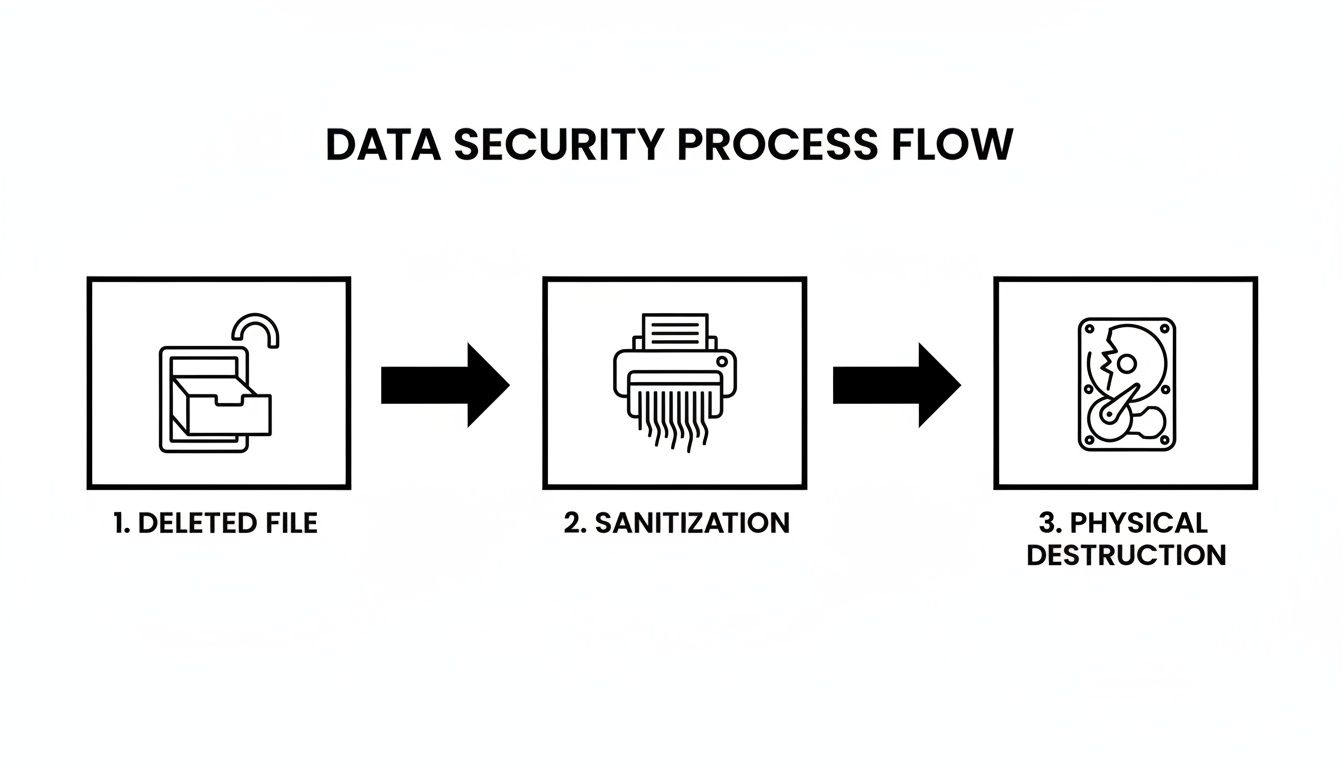
As you can see, just hitting "delete" on a file is totally insecure. Professional sanitization and physical destruction, on the other hand, provide permanent, verifiable data removal.
Step 5: Verifying Disposal with Official Certificates
The last step is maybe the most important for your records: getting the official paperwork that proves the job was done right. A reputable vendor will provide certificates that act as your legal proof of compliant disposal and data destruction.
A Certificate of Disposal and Recycling is much more than a receipt. It's a legally binding document that officially transfers liability from your organization to the recycling partner. It’s your ultimate proof that you met all your environmental and data security obligations.
This final documentation should list every asset that was processed, the specific methods used for data destruction (like sanitization or shredding), and a clear statement confirming all materials were recycled according to federal, state, and local laws. Keep these certificates safe—they're essential for any future audits and show your commitment to doing things by the book.
How to Choose the Right Atlanta Recycling Partner
Choosing a vendor to handle your lab equipment and electronic waste isn't just another logistical task—it's a critical business decision. Get it right, and you’re protected from legal blowback, financial penalties, and a PR nightmare. Get it wrong, and you could be creating massive liabilities for your organization. This requires a real vetting strategy to make sure you find a reputable and fully compliant partner for recycling in Atlanta, GA.
Think of it this way: you wouldn't hire a general practitioner for complex brain surgery. You'd want a specialist with the precise credentials and experience for that specific job. Your recycling partner is no different. They need the specialized skills to manage sensitive data, potentially hazardous materials, and intricate scientific instruments.
Core Credentials and Certifications
The absolute first filter for any potential partner is their certifications. These aren't just fancy badges for their website; they are hard-earned proof that a third-party auditor has verified their processes against strict national and international standards. The one you really need to look for is R2 (Responsible Recycling).
An R2 certification is your guarantee that a company is held to the highest standards for:
- Environmental Protection: They follow proper procedures to prevent pollution and environmental damage.
- Worker Health and Safety: Their team is protected from the hazards that come with handling e-waste.
- Data Security: They have proven, verifiable processes to completely destroy your data.
Without a credential like R2, you have no independent assurance that your assets are being managed responsibly once they leave your facility. It's a non-negotiable starting point.
Local Presence and Specialized Capabilities
While national certifications are the foundation, a strong local presence right here in Atlanta offers real, tangible benefits. A local partner knows the regional regulations inside and out and can offer more responsive, flexible service when you need it. Look for a vendor that runs its own fleet of trucks and employs its own background-checked technicians. This ensures a secure, unbroken chain of custody from your loading dock to their facility.
But logistics are only half the battle. The right partner must be able to handle your specific mix of equipment. Lots of e-waste recyclers are great with old computers and servers, but they're completely lost when faced with lab equipment. You need a vendor who is an expert in both worlds.
A truly valuable partner can manage a decommissioned biological safety cabinet with the same level of expertise as a rack of servers. This dual capability saves you the headache and extra cost of hiring multiple, separate vendors.
Before you even think about signing a contract, ask for a detailed list of the materials they accept to be sure they can handle everything on your inventory list.
Key Questions to Ask Any Potential Vendor
To properly vet a provider, you need to ask direct, specific questions that cut right through the marketing fluff. A legitimate company will have clear, confident answers ready to go. Use this checklist during your evaluation:
- "Can you provide copies of your R2 certification and liability insurance?" This is a simple yes or no. If they hesitate or can't produce them immediately, walk away.
- "Do you own your own trucks and employ your own logistics team?" This confirms they control the chain of custody and aren't just handing your sensitive assets off to unaccountable third-party shippers.
- "What are your specific procedures for data destruction, and can you provide a Certificate of Data Destruction?" They should be able to clearly detail their sanitization process (like a DoD 3-pass wipe) and their physical shredding methods.
- "How do you handle equipment with potential hazardous materials?" A competent partner will walk you through their quarantine, testing, and compliant disposal procedures for items containing things like mercury or lead.
- "What does your pricing structure look like?" Demand total transparency. A good partner gives you clear, itemized quotes without tacking on hidden fees for fuel, labor, or vague environmental surcharges.
Choosing the right electronic waste recycling company is an investment in your organization's security and compliance. By focusing on certified expertise, dual capabilities, and transparent operations, you can find a partner that turns a complex disposal project into a secure, streamlined success.
Answering Your Atlanta E-Waste Recycling Questions
Even with the best plan in place, questions pop up. It’s just part of the process when you’re dealing with something as specific as lab equipment and commercial e-waste. This is where we clear the air on the most common questions we hear from facility, IT, and lab managers all over the Atlanta area.
Think of this as the practical advice you need to handle your asset disposition with confidence. We’ll get into the real-world stuff—costs, logistics, and exactly what to do with certain types of equipment—to help you build a recycling program that actually works.
What Does E-Waste and Lab Equipment Recycling Cost?
This is usually the first question people ask, and the honest answer is: it depends. Unlike the recycling bin you put out on your curb at home (which is usually covered by city taxes), commercial services are priced based on the job itself. When a vendor puts together a quote, they're looking at the volume, type, and location of your equipment.
Several things will move the final price up or down:
- Transportation Logistics: The drive from your Atlanta facility to the processing center matters, as does the amount of hands-on labor needed to de-install and load everything up.
- Material Composition: Standard IT gear like servers and network switches often have a lower cost. Sometimes, they might even have a small return value because of the precious metals inside them.
- Special Handling: If you have items with lead-acid batteries, mercury, or other potentially hazardous materials, they require more intensive work. That extra handling adds to the cost.
- Data Destruction Services: Many partners, including us, offer standard DoD-standard data wiping as part of the service. But if you need something more specific, like on-site hard drive shredding or highly detailed reporting, there might be an extra fee.
The best thing you can do is ask for a detailed, itemized quote. A good partner will be upfront about their pricing, with no hidden fuel surcharges or surprise labor fees, so you can budget with confidence.
Do I Need to Clean Lab Equipment Before Pickup?
Yes, you absolutely do. Decontamination is a mandatory prerequisite for any piece of lab equipment that has come into contact with biological, chemical, or radiological materials. This isn’t just red tape; it’s a critical safety step for everyone who will handle that equipment, from your own team to the technicians at the recycling facility.
Before any recycling partner can legally take the equipment off your hands, your staff needs to perform a full decontamination based on established safety protocols. Once that’s done, you have to fill out and attach a Certificate of Decontamination to every single item.
This certificate is more than a piece of paper. It’s a legal declaration stating the equipment is clean, free from hazardous materials, and safe for other people to handle. No reputable recycling vendor in Atlanta will even touch the equipment without it.
This step is fundamental for compliant recycling in Atlanta, GA. It’s the official process that moves a potentially hazardous item back into the non-hazardous category so it can be safely recycled.
How Is My Data Protected During the Recycling Process?
Data security should be at the top of everyone’s list. Professional recyclers use a multi-layered approach to make sure your information is gone for good. The process starts the second your equipment is picked up, with a secure chain of custody that tracks every single data-bearing device from your door to its final destruction.
Reputable vendors rely on two primary methods to permanently wipe your data:
- Data Sanitization: For hard drives that still work, we use a software-based method like the DoD 5220.22-M 3-pass sanitization. This process overwrites the entire drive with random characters multiple times, making it impossible to recover the original data.
- Physical Destruction: When a drive is old, broken, or you just want ultimate peace of mind, physical shredding is the way to go. The hard drives are literally run through an industrial shredder that turns them into tiny metal fragments. There's no coming back from that.
After the job is done, you should always receive a Certificate of Data Destruction. This document is your official proof, detailing the methods used and verifying that your sensitive information was destroyed in full compliance with regulations like HIPAA.
What Happens to the Equipment After It's Picked Up?
Once our truck pulls away from your facility, your equipment begins a highly controlled journey. The first stop is a secure processing facility where everything is sorted and inventoried. Here, trained technicians triage the assets, separating them by material type and figuring out what can be reused versus what needs to be broken down.
From there, the process splits into a few key stages:
- Dismantling: Technicians manually take apart the equipment to separate the core components. Plastics go in one pile, metals in another, and circuit boards and wires get their own streams.
- Material Recovery: The sorted materials are then processed to pull out the valuable resources. Circuit boards, for instance, are sent for refining to extract precious metals like gold, silver, and copper.
- Responsible Disposal: Anything that simply can’t be recycled—like certain hazardous components—is disposed of following strict EPA and Georgia EPD regulations.
Certified recyclers are regularly audited to ensure every component is handled in an environmentally sound way. It's our guarantee that nothing ever ends up in a landfill.
Ready to build a secure and compliant disposal plan for your organization? The team at Scientific Equipment Disposal offers a single, reliable solution for all your lab and IT recycling needs in the Atlanta metro area and nationwide. We provide certified data destruction, on-site logistics, and responsible recycling for everything from servers to centrifuges. Contact us today to get a transparent quote and make your asset disposition process simple. Learn more at https://www.scientificequipmentdisposal.com.