Production Equipment Disposal Solutions: Secure, Compliant Asset Retirement Nationwide & Locally

Got a mountain of old lab, IT, or production equipment collecting dust? It’s more than just a logistical headache. The right production equipment disposal solutions can turn that clutter into a strategic win—ensuring your data is secure, keeping you compliant, and freeing up valuable space, whether you operate nationwide or locally.
It boils down to three core paths: sustainable recycling, value-driven resale, and secure destruction.
Decoding Your Production Equipment Disposal Options
When outdated assets start piling up, they’re not just taking up room. Each machine represents a potential data security risk, an environmental compliance liability, or even untapped cash.
For any business, from Atlanta’s bustling tech and healthcare hubs to organizations across the country, knowing how to properly decommission this equipment isn’t just a cleanup task. It's a critical business function that requires a trusted partner offering both local and nationwide services.
The real challenge is navigating the complexities. What looks like a simple disposal job can quickly become a minefield of regulations. Tossing old IT gear the wrong way can lead to a massive data breach. Mishandling lab instruments might violate environmental laws. This guide is your roadmap for turning those challenges into opportunities, no matter your location.
Your Primary Disposal Pathways
The first thing to realize is that not all equipment is the same. A one-size-fits-all approach is almost always inefficient and risky. Your inventory will likely need a mix of three primary solutions.
- Sustainable Recycling: This is the go-to, responsible choice for any non-functional or truly obsolete equipment. The goal here is to recover valuable materials like metals and plastics, keeping them out of landfills where they could leak harmful substances. This is the foundation of proper managing e-waste.
- Asset Recovery and Resale: Does the equipment still work and have some market demand? It can be refurbished and resold. This approach turns those dormant assets into a revenue stream, helping to offset disposal costs and giving the equipment a second life.
- Secure Destruction: For any device that holds data or contains proprietary technology, complete physical destruction is non-negotiable. This is the only way to guarantee that sensitive information is gone for good, protecting your organization from massive liability.
This decision tree shows you exactly how to think through the process, starting with an inventory and ending with the right disposal path for each asset.
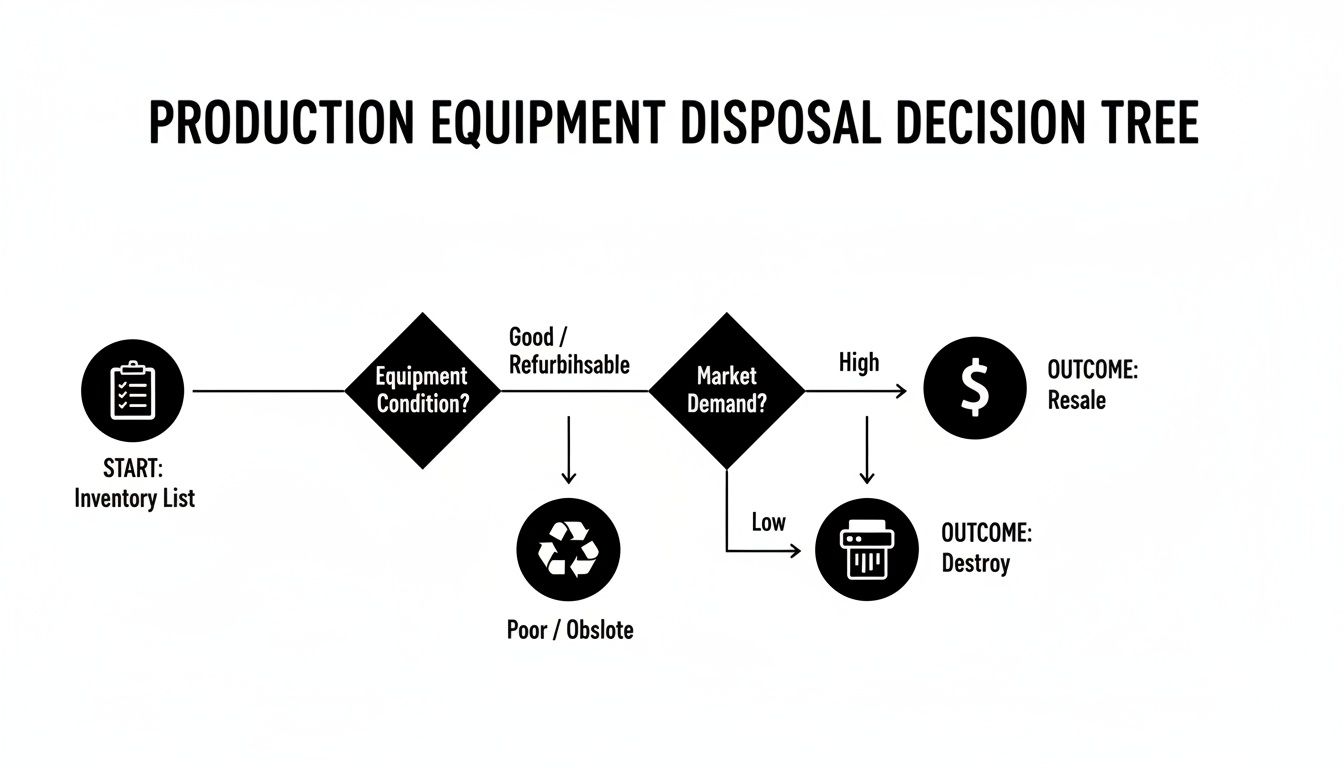
Your Production Equipment Disposal Solutions at a Glance
To make it even simpler, here's a quick breakdown of your options. Think of this table as a cheat sheet for making smart, compliant decisions about your old gear, whether you need local service in Atlanta or nationwide support.
| Disposal Solution | Primary Benefit | Best For |
|---|---|---|
| Asset Recovery & Resale | Maximum ROI | Functional equipment with market value (newer IT, specialty lab instruments) |
| Sustainable Recycling | Environmental Compliance | Obsolete, non-functional, or low-value electronics and equipment |
| Secure Destruction | Absolute Data Security | Hard drives, SSDs, backup tapes, and any proprietary hardware |
Ultimately, whether you're a nationwide corporation or a local Atlanta business, the journey starts with a thorough inventory. That initial assessment dictates your entire strategy, from on-site services to final disposition.
Getting to Grips with Core Disposal and Recovery Methods
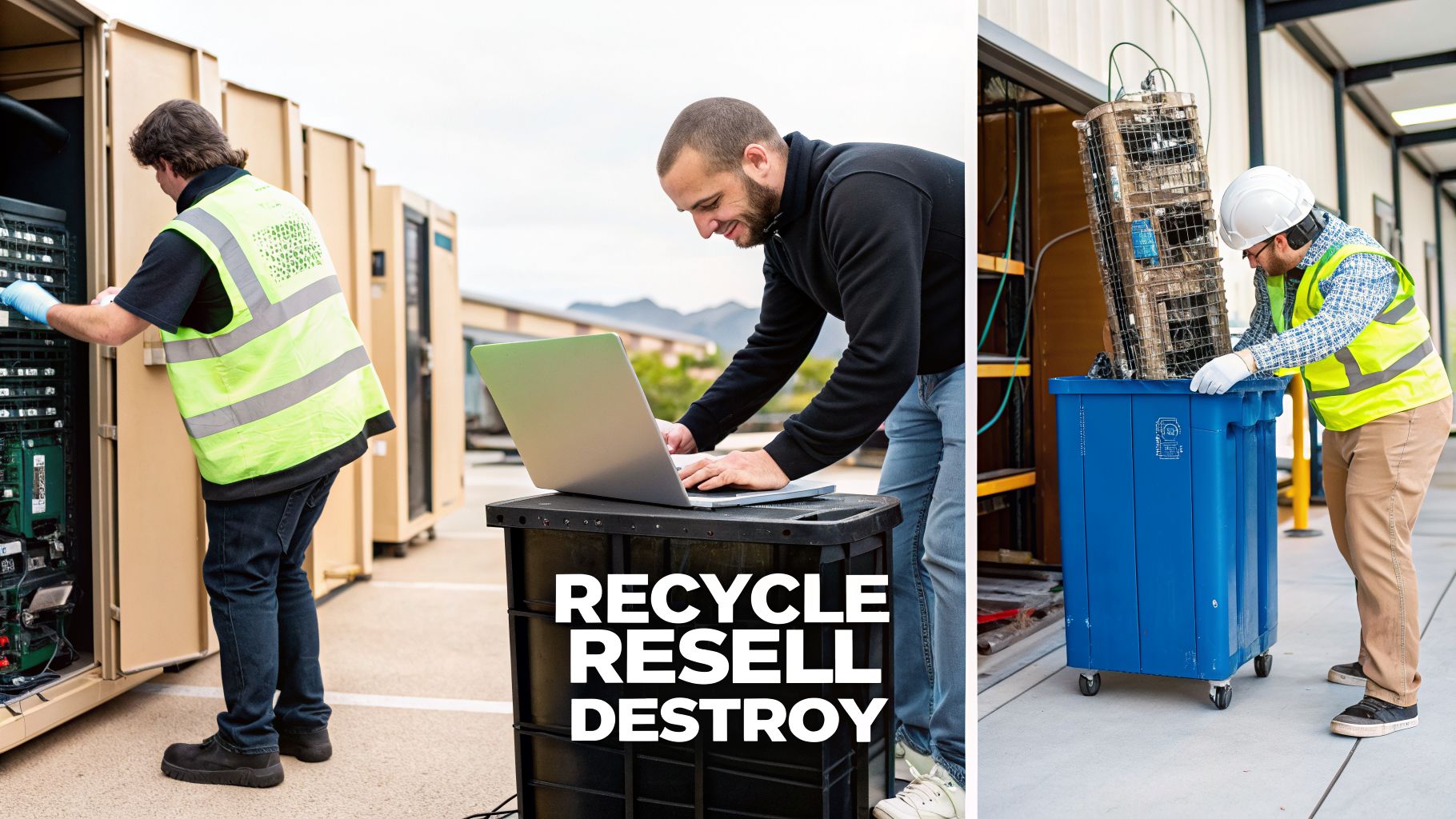
When it comes to getting rid of old production equipment, it’s not about finding one answer for everything. It’s about finding the right answer for each piece of equipment you have. We’re moving past the theory and building a real-world playbook for facility managers, IT directors, and lab supervisors on the ground, both locally and nationwide.
Every successful asset retirement strategy is built on three pillars: recycling, resale, and destruction. Each one serves a very different purpose, protecting your organization from specific risks while opening up unique opportunities. Making the right choice here is the key to maximizing your financial return and keeping your company out of trouble.
Sustainable Recycling as Urban Mining
Instead of thinking about recycling as just another form of waste management, think of it as urban mining. Rather than digging up new resources, this process reclaims valuable materials from the equipment you’re done with. That broken centrifuge or obsolete server isn't just scrap; it's a small goldmine of copper, aluminum, steel, and precious metals.
The numbers back this up. The Global E-waste Monitor reported that in 2019, the world produced a mind-boggling 53.6 million metric tons of e-waste, but only 17.4% of it was properly recycled. For research labs and corporate IT departments from Atlanta to San Francisco, that’s a huge missed opportunity. The benefits are clear—recovering copper, for instance, uses 85% less energy than mining new ore. You can explore more about how recycling recovers valuable materials on Labconscious.com.
Key Takeaway: Sustainable recycling is all about resource conservation. When you work with a certified recycler, you guarantee that hazardous materials stay out of landfills and valuable commodities get back into the supply chain. It’s a win for the environment and your corporate responsibility goals.
Asset Recovery as a Profitable Second Life
What about equipment that still works perfectly well? This is where asset recovery and resale come in. Think of it as finding a good new home for your functional but surplus assets, turning a depreciating piece of metal into a fresh revenue stream. It's easily one of the smartest financial moves you can make with old production equipment disposal solutions.
Picture a hospital upgrading its diagnostic machines or a tech firm swapping out its server fleet. The old equipment, while maybe not powerful enough for their needs, could be the perfect fit for a smaller lab, a startup, or a school with a tight budget. A professional asset recovery partner with a nationwide network handles the entire thing for you:
- Appraisal: Figuring out the fair market value of every single item.
- Logistics: Safely de-installing, packing, and moving the equipment from any location.
- Data Sanitization: Securely wiping all data to DoD standards before any resale happens.
- Sales and Marketing: Finding the right buyers and managing the sale from start to finish.
The result is cash in hand that can seriously offset the cost of the whole decommissioning project. It’s the ultimate win-win, giving valuable equipment a longer life while generating capital for your next big upgrade. This strategy is a no-brainer for specialized scientific instruments, newer IT hardware, and well-kept production machinery anywhere in the U.S.
Secure Destruction as a Fortified Digital Vault
Finally, we get to the most critical process for any device that ever held data: secure destruction. When an asset contains sensitive IP, customer details, or patient records, just recycling or reselling it isn't an option. You need absolute, verifiable proof that the data is gone for good.
Think of secure data sanitization and physical destruction as locking your data in a fortified vault and throwing away the key. The entire process is designed to be irreversible, protecting you from the nightmare of a data breach. There are two ways to get it done:
- Data Sanitization: This is a software-based approach that overwrites existing data multiple times according to strict government protocols, like the DoD 5220.22-M standard. It makes the original information impossible to recover, which is perfect if you plan to reuse or resell the drive itself.
- Physical Destruction: For hard drives that are old, broken, or held top-secret information, shredding is the only way to go. The drive is physically pulverized into tiny, unrecognizable pieces, making data recovery a physical impossibility.
For any organization dealing with HIPAA, this final step is non-negotiable. A Certificate of Destruction from your vendor is your legal proof that you did the right thing, shielding you from massive fines and reputational damage. For bigger jobs, you can learn more about how specialists handle complex decommissioning projects for manufacturers.
The Rules of the Road: Compliance and Security in Equipment Disposal
When it's time to get rid of old production equipment, overlooking compliance isn't just a paperwork error—it’s a massive financial and legal risk. Ignore the rules, and you could be looking at crippling fines, a tarnished reputation, and devastating data breaches. These aren't just suggestions; they're strict federal and state mandates with very real consequences.
For any organization, whether operating locally in the Atlanta area or managing facilities nationwide, two big areas demand your full attention: environmental protection and data privacy. Each has its own playbook, and pleading ignorance won't get you out of trouble. Any proper production equipment disposal solution has to be built on a rock-solid understanding of these regulations.
Keeping the Environment Safe (And Avoiding EPA Fines)
The U.S. Environmental Protection Agency (EPA) is the final word on handling electronic and industrial waste. A lot of your equipment, from IT hardware to specialized lab instruments, is packed with hazardous materials like lead, mercury, and cadmium. If that gear ends up in a landfill, those toxins can leach into the soil and groundwater, causing serious environmental harm and leaving your organization on the hook for cleanup costs.
Think of an old piece of equipment as a sealed container of chemicals. Just tossing it in a dumpster is like pouring those chemicals straight into the ground. A certified disposal partner is your specialized handler, making sure those materials are safely extracted and processed exactly as the EPA requires, compliant with both federal and state laws.
Imagine a university in the Atlanta metro area clearing out an old science lab. If they don't partner with a certified recycler, those discarded instruments could be improperly disposed of, making the university liable for an environmental cleanup that could cost tens of thousands of dollars and create a public relations nightmare.
The Unbreakable Rules of Data Privacy
If your organization handles any kind of personal information, data security isn't optional—it's non-negotiable. Several major federal laws lay out exactly how data-storing devices must be sanitized when they're retired.
Here are the big ones you need to know:
- HIPAA (Health Insurance Portability and Accountability Act): This is for any healthcare provider, clinic, or hospital across the U.S. That patient monitoring system, a server full of medical records, or even a simple front-desk PC must have its data completely and permanently wiped before disposal. A single slip-up can lead to fines in the millions.
- FERPA (Family Educational Rights and Privacy Act): Schools, colleges, and universities have a legal duty to protect student records. Tossing old computers or servers without professionally wiping them is a direct violation that puts sensitive student data at risk.
- GLBA (Gramm-Leach-Bliley Act): Financial institutions must safeguard consumer financial data. Any hardware that stored or even accessed that information has to be securely destroyed.
For example, a hospital discarding a patient monitoring system is a prime scenario. Without certified data sanitization that adheres to HIPAA standards, that single piece of equipment becomes a multi-million-dollar violation waiting to happen. The same risk applies to a university disposing of old administrative computers under FERPA. To get into the weeds on how this is done right, check out the best practices for secure data destruction services.
Your Essential Documentation Checklist
So, how do you prove you did everything by the book? Your documentation is your ultimate line of defense. A reputable disposal partner will give you a clear, auditable paper trail confirming every single asset was handled compliantly. When you're choosing a vendor, make sure they provide these three things:
- Certificate of Destruction (CoD): This is the most critical document for any device that held data. It's your legal proof that hard drives and other storage media were sanitized or physically destroyed according to strict standards like the DoD 5220.22-M 3-pass method.
- Detailed Recycling Reports: For all other electronics, this report should break down what materials were recovered. It confirms that all hazardous substances were managed responsibly and kept out of landfills.
- Chain of Custody Logs: This is the timeline. It tracks your assets from the moment they leave your facility to their final recycling or destruction, proving nothing got lost or mishandled along the way.
Building this airtight compliance record isn't just a "nice to have." It's the final, crucial step in protecting your organization from the serious consequences of a mistake, whether you operate in one state or fifty.
The True Scale of Lab and E-Waste Challenges
Getting rid of old equipment might seem like a simple cleanup project, but every piece of gear your lab retires connects you to a massive global challenge. The sheer volume of waste from electronics and scientific research is hard to wrap your head around.
When you grasp the scale of the problem, you start to see responsible disposal for what it is: a strategic move that protects both the environment and your organization's good name.
For facilities in Atlanta and across the country, these global numbers have real, local consequences. The challenges of electronic waste are huge, and looking at specific areas like mobile phone recycling practices helps put the bigger picture in focus. This perspective is exactly what you need when planning your own production equipment disposal solutions.
The Environmental Toll of Scientific Progress
Laboratories are incredible hubs of innovation, but they are also serious waste generators. According to the nonprofit My Green Lab, research facilities worldwide churn out up to 5.5 million metric tons of plastic waste annually.
That’s nearly 2% of the entire world's plastic waste coming from our labs. To make matters worse, labs can produce up to 12 times more waste per square foot than a typical office. The numbers don't lie.
This isn't some far-off problem. It’s happening right here in the labs at Atlanta’s hospitals, universities, and biotech companies, as well as in research centers from coast to coast. It's the mountain of plastic-heavy consumables and retired analytical instruments that need a place to go. When this equipment is done, it joins a complex waste stream that requires true expertise to handle correctly.
The Bottom Line: Your facility's surplus equipment is a drop in a massive global bucket. The only way to ensure it stays out of a landfill and meets all environmental rules is to partner with a specialist who knows the landscape, from local logistics to national standards.
The Business Case for a Circular Economy
This isn't just about "being green"—it's a smart business decision. In a world where your customers, stakeholders, and even your own team expect corporate responsibility, sustainable practices are no longer a nice-to-have.
This is the foundation of the circular economy, a model built on reusing and recycling materials instead of just throwing them away.
Adopting this mindset has clear advantages:
- Enhanced Reputation: Showing a real commitment to sustainability builds trust and strengthens your brand with everyone from investors to new hires.
- Risk Mitigation: Proper, compliant disposal protects you from steep fines and the kind of reputational damage that follows an environmental violation or data breach.
- Economic Value: Asset recovery programs can actually turn your retired equipment into revenue, proving that doing the right thing can also be profitable.
Choosing a compliant disposal partner isn’t just about clearing out a storage room. It’s a strategic choice that positions your organization for the future. Whether you’re based here in the Atlanta metro or have facilities across the U.S., the right partner ensures your production equipment disposal solutions are responsible, secure, and good for the bottom line.
How to Choose the Right Disposal Partner

Picking a partner for your production equipment disposal solutions is more than just a line item on a decommissioning checklist. The right vendor protects you from data breaches, steep environmental fines, and logistical headaches. The wrong one? They can cause all three.
This isn't about finding someone to just haul away old gear. It's about bringing in a specialist who gets the risks and opportunities tied to your specific assets, whether you're clearing out a single lab in metro Atlanta or shutting down facilities nationwide.
Think of it like hiring a key team member. You need to see credentials, a solid track record, and proof they have the logistical strength to get the job done right, wherever you are. Here’s a simple checklist of questions to help you vet potential providers and make a confident choice.
Non-Negotiable Certifications
Always start with the basics. Certifications are your proof that a company meets high industry standards for both environmental safety and data security. Without them, you’re just taking a vendor at their word—and that's a big risk.
Ask any potential partner these questions first:
- Are you R2 or e-Stewards certified? These are the two gold standards for electronics recycling. R2 (Responsible Recycling) and e-Stewards certifications mean a vendor follows strict, verified protocols. They’re a non-negotiable starting point.
- What is your downstream vendor policy? A certified partner must be transparent about where your assets go after leaving their hands. This is how you ensure your equipment doesn’t end up illegally exported or dumped in a landfill by a shady subcontractor.
Key Takeaway: Certifications are your first line of defense. They prove a vendor has invested in the right processes and infrastructure. A company without them is an immediate red flag.
Verifiable Security and Compliance Protocols
Next, get specific about their security procedures. This is absolutely critical for any equipment that ever held sensitive information, from patient records in a clinic to proprietary R&D in a lab. Following robust IT vendor management best practices is essential when vetting partners for equipment disposal.
Here’s what you need to confirm:
- Do you provide a Certificate of Destruction (CoD) for every data-bearing device? This is your legal proof that data was destroyed for good. It should detail the serial number of each asset and the destruction method used.
- What data sanitization standards do you follow? For total data erasure, a vendor must use methods compliant with government standards, like the DoD 5220.22-M 3-pass wipe. This is vital for meeting HIPAA and other privacy rules.
- Can you perform on-site services like data shredding? For maximum security, many organizations want to witness hard drives being physically shredded at their own facility. A top-tier provider will offer this service nationwide.
Logistics and Service Capabilities
Finally, make sure they can actually handle the physical work. A vendor can have every certification in the book, but if they can’t manage the logistics of your project, they aren’t the right fit. A good partner makes the process easier, not harder.
When you need a certified and experienced team, see how a professional e-waste recycling company can simplify the entire process.
- Do you have your own fleet for pickup and transport nationwide? A partner with their own trucks and drivers has direct control over scheduling and chain of custody. This is especially important for businesses needing fast, reliable service, whether locally in the Atlanta area or across multiple states.
- Can your team handle on-site de-installation and packing? Taking apart a lab or data center requires expertise. You need a crew that can safely disconnect and move heavy, fragile equipment without damaging your facility.
- Can you manage a mixed inventory of assets? Most cleanouts involve a bit of everything—IT gear, servers, bulky lab instruments, and more. The right partner can handle it all, saving you from the headache of juggling multiple vendors for one project.
Your Action Plan for Responsible Equipment Disposal
Alright, you understand the why behind proper equipment disposal. Now for the how. This is the part where we turn all that surplus equipment into a secure, compliant, and resolved issue.
The goal is simple: solve your equipment challenges efficiently and responsibly. We break it down into three straightforward steps to get you from a cluttered storage room to a clean slate.
Your Immediate Next Steps
This plan isn't about theory; it's designed for immediate action. Whether you're managing a single lab here in Atlanta or overseeing assets across the country, these are the moves that bring clarity to any decommissioning project.
Build Your Master List: First things first, you need to know exactly what you have. Walk through your facility and create a detailed inventory of every single asset you plan to retire. Be sure to note the type, model, serial number, and a quick assessment of its condition for each piece. This audit is the bedrock of your entire disposal strategy.
Tag Anything with a Memory: Now, go back through that list with a red pen (or a highlighter) and flag every device that could possibly hold sensitive data. We’re talking about the obvious stuff like servers, computers, and hard drives, but also specialized scientific instruments that often have internal storage. These items are non-negotiable—they require certified data destruction.
Call in the Experts: With your inventory in hand, it’s time to bring in a specialist. A certified production equipment disposal solutions provider can look at your list and immediately map out the best path for each item, whether that’s resale, recycling, or total destruction, and handle all the complicated logistics for you, anywhere in the U.S.
Think about the lab equipment market alone. It pulls in about $2 billion in global sales for used instruments every year—there's real value sitting in your storage rooms. At the same time, new U.S. and EU regulations are demanding carbon footprint reporting, making compliance just as critical as cash recovery. For universities and government agencies in Atlanta and beyond, having a partner with solid logistics and certified shredding is the only way to both capture that value and eliminate risk.
Taking these steps creates a clear, defensible process from start to finish. It ensures that every piece of equipment, from a basic desktop computer to a complex analytical machine, is handled the right way. This is how you protect your organization from both expensive data breaches and environmental penalties. You can also dig deeper with our guide on how to dispose of scientific equipment safely.
The last step is to simply reach out. A quick consultation or quote request is all it takes to get a professional team to solve these equipment headaches for you, ensuring your assets are retired responsibly and your organization stays secure.
Got Questions About Equipment Disposal? We Have Answers.
When it's time to clear out old equipment, a lot of practical questions come up. Whether you're a hospital administrator in Atlanta or managing facilities for a national company, you need straightforward answers.
Here’s a look at the most common concerns we hear about disposing of surplus lab and IT equipment.
What Kind of Equipment Needs a Professional Disposal Service?
Basically, any device that contains electronics, stores data, or has potentially hazardous materials needs to be handled by a pro. This covers a huge range of gear, from lab instruments like centrifuges and incubators to IT hardware like servers, laptops, and storage arrays.
Many of these items, especially anything with a circuit board, contain materials like lead and mercury. If they end up in a landfill, they can contaminate soil and water. On top of that, any device with a hard drive or flash memory is a data breach just waiting to happen. A certified production equipment disposal solutions provider will look at your entire inventory and make sure every single item is managed according to strict environmental and data security rules, nationwide.
The rule of thumb is simple: If it plugs in or holds data, it needs professional handling. This is how you protect your organization from environmental liability and a costly data breach.
How Can I Be 100% Sure My Company's Data Is Destroyed?
You get absolute certainty by working with a partner who provides either certified data sanitization or physical destruction, like shredding. If you go with software-based wiping, your vendor must follow recognized standards like DoD 5220.22-M.
The single most important thing you can do is demand a Certificate of Destruction (CoD) for every device that held data. This document is your official, auditable proof that your data was destroyed responsibly, which is critical for proving compliance with regulations like HIPAA or FERPA. For total peace of mind, you can also ask about on-site shredding or a documented chain of custody that tracks your assets from your facility to their final destruction.
Isn't It Expensive to Hire a Professional Disposal Service?
Think of professional disposal as an investment in avoiding risk, not just another line-item expense. The financial and reputational damage from one data breach or an environmental fine can completely overshadow the cost of doing things right. A single HIPAA violation, for instance, can lead to penalties in the millions of dollars.
Plus, many certified providers have programs that make the whole process surprisingly cost-effective, whether for a single site or multiple locations.
- Asset Recovery: Your functional, in-demand equipment can often be refurbished and resold. That revenue comes right back to you, directly offsetting your disposal costs.
- Consolidated Logistics: Using a single provider for everything from de-installation to recycling simplifies the project, cutting down on your internal labor costs and logistical headaches.
At the end of the day, you have to weigh the service fee against the massive potential liability of getting it wrong. Responsible disposal is one of the best insurance policies your business can have against a catastrophic event.
Ready to clear out your surplus lab and IT assets with a secure, compliant, and responsible partner? Scientific Equipment Disposal offers tailored services for Atlanta-area hospitals, universities, and corporations, as well as nationwide support for multi-location enterprises. We simplify the entire process with on-site de-installation, certified data destruction, and sustainable recycling. Request your free quote and solve your equipment challenges today.