A Guide to Manufacturing Equipment Cleanout Services

When you're dealing with a plant closure, relocation, or a major equipment upgrade, the last thing you need is another massive project on your plate. That's where manufacturing equipment cleanout services come in. We handle the entire process—from safely de-installing and packing up old machinery to ensuring any sensitive data is destroyed and everything is recycled according to regulations.
For businesses across the country, from bustling hubs like Atlanta to remote industrial parks, a professional partner turns what could be a logistical nightmare into a secure, straightforward process.
Why a Professional Cleanout Is Essential for Your Facility
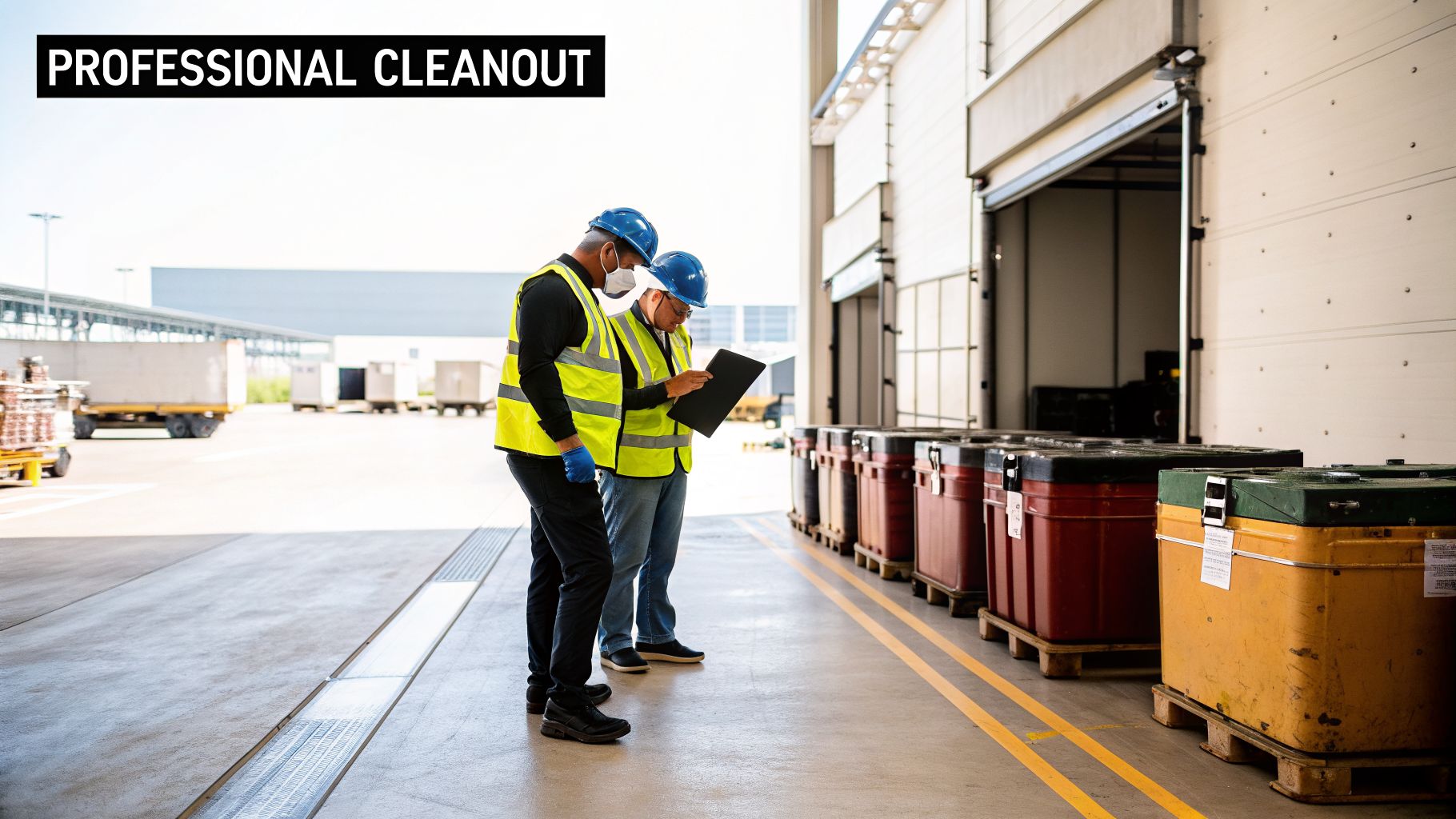
When you're staring down a facility transition, the pile-up of surplus or obsolete manufacturing equipment can feel overwhelming. This isn't just a cleanup job. It's a complex project with serious financial, safety, and environmental implications.
Trying to manage a cleanout on your own can expose your company to a lot of hidden risks. Improperly handling heavy machinery can lead to costly facility damage or, far worse, serious workplace accidents. On top of that, many pieces of equipment contain hazardous materials or sensitive company data. If that isn't managed correctly, you could be looking at steep regulatory fines and damage to your reputation that lasts for years.
A Look at In-House vs. Professional Cleanouts
To understand the difference, here’s a quick look at the key differences between managing a manufacturing equipment cleanout yourself versus hiring a specialized provider.
| Factor | In-House (DIY) Approach | Professional Cleanout Service |
|---|---|---|
| Safety & Risk | Higher risk of accidents and liability; staff may lack specialized training. | Mitigates risk with trained crews, proper insurance, and established safety protocols. |
| Compliance | Risk of overlooking complex environmental and data security regulations. | Ensures full compliance with local, state, and federal laws; provides auditable documentation. |
| Resources | Diverts your internal team from their core responsibilities, causing operational strain. | A dedicated team manages the entire project, freeing up your staff and resources. |
| Cost | Hidden costs often arise from logistics, disposal fees, and potential fines. | Provides a clear, upfront project scope and cost; can offset costs via asset recovery. |
| Efficiency | Can be slow and disorganized, extending downtime and delaying facility handover. | Streamlined process from inventory to removal, ensuring a fast and efficient turnaround. |
While a DIY approach might seem cheaper at first glance, the hidden costs and potential liabilities often make a professional service the more financially sound and secure option in the long run.
Nationwide Demand, Local Expertise
The need for these services is exploding. The global industrial cleaning market was valued at US$417.1 billion in 2025 and is on track to hit US$631.4 billion by 2032. This isn't just a number—it shows a massive shift toward keeping industrial spaces clean, safe, and compliant.
A professional cleanout partner brings that expertise directly to your facility, whether you're running a high-tech lab in a major US city or a production plant in a more remote location. They deliver real, tangible benefits:
- Risk Mitigation: Experts are trained to spot and manage hazards you might not even think of, from chemical residues inside old equipment to the electrical dangers of de-installing heavy machinery.
- Regulatory Compliance: They live and breathe the tangled web of local, state, and federal disposal regulations. They handle all the paperwork and provide you with proof, like Certificates of Destruction, to keep you audit-ready.
- Operational Efficiency: A dedicated team takes the entire project off your hands. While they handle the inventory, logistics, and removal, your own staff can stay focused on what they do best—running your business.
One of the biggest things we see people miss in a DIY cleanout is asset value. A professional service doesn't just haul things away. We assess equipment for potential resale value, which can help offset project costs through asset recovery programs.
Integrating Cleanouts into Your Facility Management
Smart facility management is all about thinking ahead. Making equipment cleanouts a regular part of your operational plan is a key step, and it fits right in with broader facility management best practices. This proactive mindset prevents old, obsolete assets from piling up, eating valuable floor space, and creating unnecessary risks.
Whether it’s a full factory equipment decommissioning or just handling a few specific assets, the right partner provides a start-to-finish solution. Find out more in our guide on https://www.scientificequipmentdisposal.com/factory-equipment-decommissioning-for-manufacturers/.
By handing your project over to a specialist, you turn a potential logistical headache into a structured, compliant, and financially smart business decision. It's about getting peace of mind and protecting your business from the serious liabilities of a cleanout gone wrong.
Your Strategic Planning and Inventory Blueprint
A successful manufacturing equipment cleanout doesn't start when the crew shows up. It starts long before, with a solid plan and a detailed inventory. Rushing this step is a recipe for disaster—it's how you get hit with unexpected costs, blown timelines, and logistical headaches.
Think of it as creating your master blueprint. You need to know the "what, where, and how" for every single item you need to get rid of. A thorough inventory prevents those last-minute surprises, like finding out a machine is still full of hazardous fluids or that a critical server was unplugged before anyone backed up the data.
Building Your Comprehensive Asset Inventory
Your first move is to catalog every piece of equipment, and I mean everything. This isn't just for the massive CNC machines and industrial presses. It includes lab fume hoods, centrifuges, IT racks, computers, and even office furniture. If you leave things off the list, you're guaranteeing delays down the road.
A simple shared spreadsheet can do the job, or you can use a more formal asset management system. Just be consistent. Here’s the critical info you need to capture for each item:
- Unique Asset ID: Give each item a simple, unique number. It makes tracking a whole lot easier.
- Item Description: Get specific. Instead of "motor," write "5HP Baldor Electric Motor."
- Location: Note the building, floor, and room number. This is essential for planning the actual removal.
- Condition: Is it working, non-functional, good for parts, or just scrap?
Real-World Scenario: We worked with a university lab shutting down an entire facility in a major Midwest city. They had hundreds of items to sort. They used a color-coded Google Sheet: green for assets they could resell, yellow for items needing decontamination before recycling, and red for pure scrap. This simple visual system saved the project dozens of hours and let the de-install crew work far more efficiently.
Documenting Condition and Special Handling Needs
Once your basic list is built, you need to add another layer of detail. This is where a simple list becomes a powerful tool for your manufacturing equipment cleanout services partner.
Add columns to your inventory to flag the important stuff. Does a machine have oils, refrigerants, or other chemicals inside? Is there a hard drive with sensitive data that needs to be securely destroyed? Taking photos of each item, especially of any existing damage or unique hookups, is incredibly helpful.
This documentation does two things. First, it helps your cleanout provider give you a truly accurate quote. Second, it flags potential hazards and special requirements that will shape the entire safety and logistics plan for the project. For a deeper dive into the disposal process, our guide on production equipment disposal solutions is a great resource.
Flagging Assets for Their Final Destination
The last piece of your planning blueprint is deciding where everything is going to end up. Not everything is destined for the scrapyard. Sorting your equipment properly is key for both financial recovery and environmental compliance.
You can usually group assets into one of three main categories:
- Resale: These are items that still work and have market value. Selling them can generate revenue to help offset the cost of the cleanout.
- Recycling: This is for equipment that doesn't work but contains valuable materials like steel, copper, and aluminum. Certified recycling makes sure these materials are recovered responsibly.
- Disposal: These are assets with no recoverable value or those containing hazardous materials that must be handled according to strict environmental rules.
This strategic groundwork is the bedrock of a smooth project. It gives everyone the clarity needed for accurate timelines, precise cost estimates, and a clean, compliant execution from start to finish.
Executing a Safe and Efficient On-Site Removal
Once your plan is locked in, it’s time to get hands-on. This is where the meticulous preparation turns into action, transforming your blueprint into a safe, efficient on-site operation that causes minimal disruption to your facility.
This stage is all about precision and a heavy focus on safety. Every machine, whether it's a massive industrial press or a delicate lab instrument, needs a specific de-installation approach. The goal is simple: protect your facility, your people, and the equipment itself from any damage during the removal.
Lockout/Tagout: The First and Most Critical Step
Before anyone touches a single bolt, lockout/tagout (LOTO) procedures are mandatory. This is a non-negotiable safety protocol. It means every energy source—electrical, hydraulic, pneumatic, or chemical—is completely shut off and locked out. A tag is then placed on the lock to show who is performing the work.
This critical step is what prevents the accidental startup of machinery during de-installation, a leading cause of serious injuries in industrial settings. A professional crew simply won't start working until every piece of equipment is verified to be in a zero-energy state.
This is the end result of a proper planning flow, which lays the groundwork for a safe removal.
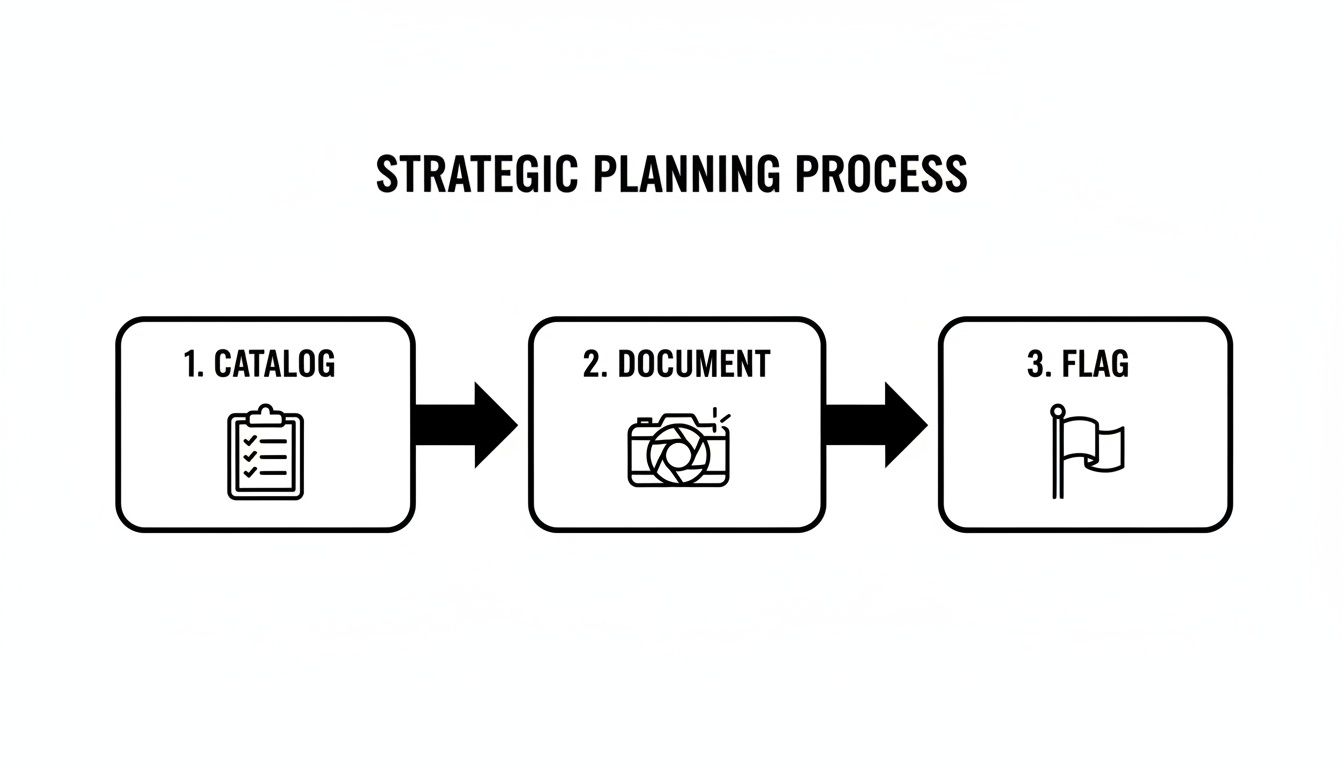
As you can see, cataloging, documenting, and flagging assets are the foundational steps that make a safe and orderly on-site removal possible.
Using the Right Tools and Techniques for Each Asset
Removing manufacturing equipment isn't a one-size-fits-all job. The tools and techniques change dramatically depending on the asset's size, weight, and sensitivity.
- Heavy Machinery: Think industrial presses or large CNC machines. These almost always require heavy-duty rigging, skates, and sometimes even cranes. A removal team has to be expert in load balancing and structural integrity to move these giants without cracking your floors or punching holes in your walls.
- Sensitive Equipment: Robotics or laboratory analyzers need a much more delicate touch. These items are often disassembled in a precise sequence, protected with anti-static wrapping, and secured in custom crating to prevent even the slightest damage during transit.
- Facility Coordination: It doesn't matter if you're in a sprawling plant in Texas or a tight urban facility in New York City. Coordination is key. This means working with building managers to reserve freight elevators, protecting flooring along the entire exit path, and scheduling the work during off-peak hours to keep disruptions to a minimum.
We see this mistake all the time: underestimating the complexity of utility disconnections. It’s not just about unplugging a cord. It means having trained technicians safely cap gas lines, drain coolant systems, and handle high-voltage electrical connections, all in close coordination with your facility staff.
Secure Packing and Palletizing for Safe Transport
Once a machine is de-installed, it needs to be prepped for its journey. Proper packing and palletizing are what guarantee the equipment arrives at its next stop—whether that's a new buyer, a recycling facility, or a disposal site—in one piece.
For assets that have reached the end of their useful life, this also means coordinating with specialized scrap metal removal services. You can find a much deeper dive into the specifics of this process in our guide on industrial equipment removal for factories.
The core packing process typically involves:
- Shrink-wrapping: A basic layer of protection against dust, moisture, and scratches.
- Banding: Securing the equipment tightly to a pallet so it can’t shift during transit.
- Custom Crating: The best option for providing maximum protection for high-value or fragile items.
By bringing together strict safety protocols and specialized removal techniques, a professional manufacturing equipment cleanout services provider ensures the on-site phase is executed flawlessly. This diligent approach protects your property and paves the way for a successful and compliant final disposition of your assets.
Mastering Compliance and Data Security
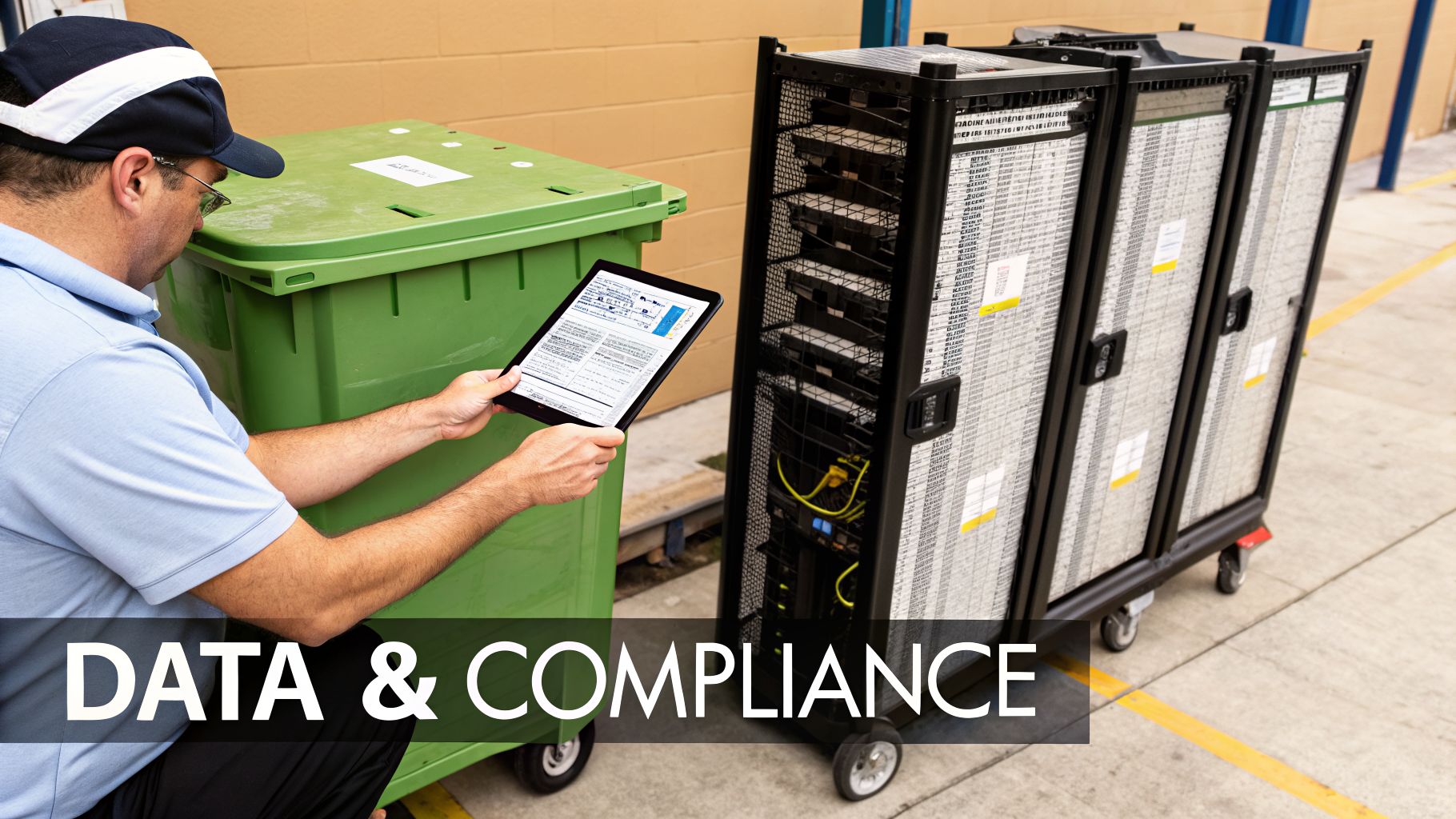
Once your equipment is loaded onto a truck, your responsibility doesn't just drive away with it. In fact, this is where your liability can actually increase, especially when it comes to compliance and data security. Mishandling e-waste or letting sensitive data slip through the cracks can lead to some seriously steep fines and a black eye for your company's reputation that's hard to recover from.
Working with professional manufacturing equipment cleanout services means you have an expert in your corner who lives and breathes these complex regulations. The rules apply to everyone, from a small local shop in North Carolina to a massive nationwide corporation with facilities across the U.S., and having a certified process is your best defense.
Navigating E-Waste and Environmental Regulations
Every piece of electronic equipment, whether it's a server, a CNC machine, or a specialized testing instrument, is governed by environmental laws at the end of its life. The Environmental Protection Agency (EPA) has very specific guidelines under the Resource Conservation and Recovery Act (RCRA) for managing e-waste. This is to stop hazardous materials from ending up where they don't belong, like in our soil and groundwater.
Make no mistake, these regulations have teeth. Non-compliance can bring on major penalties.
That's why professional cleanout services only work with certified recycling partners who follow these protocols to the letter. This ensures materials like lead, mercury, and cadmium are managed safely, and that anything valuable is recovered and put back into the supply chain.
A huge part of this is the paper trail. A reputable provider will give you a Certificate of Recycling. This is your auditable proof that every asset was disposed of in a compliant, environmentally responsible way. It’s exactly what you need for corporate social responsibility reports and to sleep well at night.
This isn't just about following rules; it's about building your brand. Showing you’re an environmentally conscious organization is a big deal to customers, partners, and even your own employees. It’s a win-win: protecting the planet while protecting your reputation.
Guaranteeing Absolute Data Destruction
In today's world, the most valuable thing you own might be sitting on a hard drive inside a machine you're about to get rid of. For industries like healthcare, finance, or government contracting, a data breach isn't just a headache—it's a full-blown catastrophe. We're talking HIPAA violations and fines that can run into the millions.
Simply deleting files or reformatting a drive is a rookie mistake. It’s surprisingly easy to recover data from wiped drives with software anyone can buy online. A professional, verifiable data destruction process isn't just a good idea; it's non-negotiable.
Here are the industry-standard methods a compliant partner will use:
- DoD-Compliant Data Wiping: For hard drives that are still functional, the gold standard is the DoD 5220.22-M 3-pass sanitization method. This overwrites every bit of the drive three separate times with different patterns, making the original data practically impossible to get back.
- Physical Shredding: For drives that are dead, solid-state drives (SSDs), or other media like backup tapes, the only way to be 100% sure is to physically destroy them. Industrial shredders turn the media into tiny, confetti-like fragments, and there's no coming back from that.
After the job is done, you should get a formal Certificate of Destruction. This document lists the serial number of every single drive that was destroyed, giving you an official record for any compliance audit. If you want to dig deeper, you can learn more about secure data destruction methods and why they're so critical.
The Journey of a Retired Server
Let's walk through a real-world example. Imagine a hospital in the Atlanta metro area is decommissioning a server from its data center. Here’s how it should go down:
- On-Site Inventory: The server's serial number is logged on-site, and its hard drives are individually identified and cataloged.
- Secure Transport: The server is moved in a secure, GPS-tracked vehicle to a certified facility. No unscheduled stops.
- Data Sanitization: The hard drives are pulled. To meet HIPAA rules, they undergo a 3-pass data wipe. The entire process is logged and verified.
- Physical Shredding: If any drive fails the wipe or is simply too old, it goes straight to the shredder and is turned into tiny pieces.
- Responsible Recycling: The rest of the server—the chassis, power supplies, and circuit boards—is taken apart. Precious metals are recovered, while plastics and other materials are sorted for recycling.
- Final Documentation: The hospital gets two key documents: a Certificate of Destruction for the hard drives and a Certificate of Recycling for the server itself. This closes the loop on their compliance obligations.
This detailed, auditable chain of custody is the core of what makes professional manufacturing equipment cleanout services so essential. It’s a complete solution that protects your data, your reputation, and the environment from start to finish.
Budgeting and Choosing Your Cleanout Partner
Getting the budget right and picking the perfect partner are two of the biggest pieces of the puzzle for any facility cleanout. We’re going to pull back the curtain on the costs of manufacturing equipment cleanout services and show you exactly what drives the final price. Knowing these details helps you budget realistically and, more importantly, can unlock some serious savings through asset recovery.
Ultimately, picking the right team—whether you're in Atlanta, GA, or anywhere else in the country—is all about asking the right questions. We've put together a pre-engagement checklist to help you screen potential providers and find a team you can trust.
Decoding the Cost of a Cleanout
Let's be clear: there's no one-size-fits-all price for an equipment cleanout. Every project is different, so quotes will always vary. A transparent partner will give you a proposal that clearly breaks down the costs based on a few key variables. Once you understand them, you can better anticipate expenses and spot opportunities to save.
Here’s what typically shapes the cost:
- Volume and Type of Equipment: The sheer quantity of your assets is a major factor. But the type of equipment matters just as much. Heavy, complex machinery that needs special rigging is a completely different job than moving standard IT hardware.
- Logistical Challenges: Site access plays a huge role. A ground-floor warehouse in suburban Atlanta with wide bay doors presents far fewer headaches than a lab on the 10th floor of a downtown high-rise with only a tiny freight elevator.
- Data Destruction Needs: The number of hard drives that need certified data wiping or to be physically shredded will directly impact your total cost. Secure, documented destruction is a specialized service, and it's priced accordingly.
- Hazardous Materials: Any equipment containing oils, coolants, chemicals, or other regulated substances requires special handling and disposal protocols. This adds to the project's cost and complexity.
It's a classic mistake to just look at the bottom-line price. A suspiciously low bid might mean they're cutting corners on insurance, compliance, or safety. A genuinely cost-effective partner gives you a clear, all-inclusive quote that guarantees a secure and compliant project from start to finish.
The Power of Asset Recovery
One of the smartest ways to manage your cleanout budget is through asset recovery. This is simply the process of finding functional or valuable equipment in your inventory that can be refurbished and sold on the secondary market. The money from those sales can dramatically offset—and sometimes even completely cover—the entire cost of the cleanout project.
A professional partner will have a solid process for this:
- Evaluation: First, they'll go through your inventory to pinpoint any assets that have resale potential.
- Valuation: Next, they determine the fair market value for each of those items.
- Logistics: They handle everything—the refurbishment, marketing, and sale of the equipment.
- Reporting: You get a detailed report and a credit against your project invoice.
This approach turns a line-item expense into a financial opportunity. To see how this works in a real-world project, you can read more about our factory equipment removal and disposal services.
This isn't just a niche practice; it's part of a much larger economic shift. The industrial cleaning services market is projected to grow by USD 20.49 billion between 2025 and 2030, largely because of stricter environmental and compliance rules. You can dig into the industrial cleaning market trends for more details. This trend shows that smart, sustainable cleanouts are becoming a key part of a company's financial strategy.
Your Pre-Engagement Checklist for Vetting Partners
Choosing a cleanout provider is a big deal. You're handing over access to your facility, your sensitive data, and your company's reputation. Before you sign on the dotted line, use this checklist to ask the tough questions that separate the true professionals from the rest. Any reliable partner should have no problem giving you clear, confident answers.
Essential Questions to Ask Potential Providers
| Category | Key Questions to Ask | What to Look For |
|---|---|---|
| Credentials & Insurance | Are you fully insured? Can you provide a Certificate of Insurance (COI)? What certifications do you hold (e.g., R2, e-Stewards)? | A "yes" to all, no hesitation. They should quickly provide a COI covering general liability, auto, and workers' comp. Certifications prove they are committed to industry best practices. |
| Process & Transparency | What is your process for asset recovery? How do you provide a chain of custody for our assets? | A clear, step-by-step breakdown of how they find value, sell assets, and report back to you. They should offer secure transport, ideally with GPS tracking. |
| Compliance & Reporting | Can you provide a Certificate of Destruction for our hard drives? Will we receive a Certificate of Recycling for all assets? | The answer must be yes. These documents are your proof of compliance for regulations like HIPAA or EPA guidelines. They are non-negotiable. |
| Local and Nationwide Reach | Can you show me examples of projects you've done in our city/state? How do you manage logistics for jobs outside your home base? | You're looking for a provider with either proven local experience or a robust logistics network capable of handling projects anywhere in the U.S. with the same level of quality and compliance. |
Asking these questions upfront ensures you end up with a partner who is transparent, compliant, and fully capable of handling your manufacturing equipment cleanout services project successfully. It's the best way to protect your organization from risk and get the most value back.
Your Top Questions About Equipment Cleanouts, Answered
When you’re staring down a massive facility cleanout, you're going to have questions. It’s a big project with a lot of moving parts. We get it. Over the years, we've heard just about every question from facility managers, IT directors, and owners responsible for these projects. Here are the answers to the ones that come up most often.
What Kind of Equipment Can You Actually Take?
Honestly, we've seen it all. A truly professional cleanout service shouldn't cherry-pick. The goal is to be your single point of contact for everything, whether it's the big stuff on the production floor or the IT gear in the back office.
We handle everything from general manufacturing machinery and highly specialized lab equipment to every last bit of IT e-waste. Think centrifuges, fume hoods, industrial presses, and entire server racks. It doesn’t matter if it’s a production line, a corporate headquarters, or a research lab—a good partner clears it all.
Just make sure to double-check with any provider upfront, especially if you have something oversized, unique, or potentially hazardous. Transparency is key; they should tell you immediately what they can and can’t handle.
Are You a Local or Nationwide Provider?
This one’s a big deal for logistics. People often see we’re headquartered in Atlanta, GA, and assume we only work locally. The reality is that an experienced provider has a solid logistics network that stretches across the country. We combine our on-the-ground expertise with the reach to manage complex, long-distance projects.
This is a game-changer for companies with more than one facility. We’ve worked with corporations that needed to decommission a lab in California and an office in New York simultaneously. A partner with a nationwide footprint ensures you get the same level of service, compliance, and reporting at every single site.
A provider's reach matters. Whether you need local expertise for a single site in the Southeast or a partner who can manage a multi-state consolidation, it's vital to choose a company with a proven track record of handling logistics at the scale you require.
How Do You Guarantee Our Data Is Secure?
Data security isn't just a feature; it’s a must-have for any compliant cleanout. Mishandling data can lead to catastrophic breaches and massive regulatory fines, so this process has to be ironclad.
Any reputable service will use DoD 5220.22-M 3-pass sanitization on all functional hard drives. This is an overwriting method that makes data recovery impossible. For anything that can't be wiped—like SSDs, damaged drives, or old backup tapes—secure physical shredding is the only way to go.
Once the job is done, you absolutely must get a Certificate of Destruction. This is your official, auditable proof that your data was handled correctly. For anyone in healthcare (HIPAA) or finance, this document is non-negotiable.
How Long Does a Cleanout Project Usually Take?
The timeline depends entirely on the size and complexity of the job. We can clear out a small office’s IT closet in a day, but a full-scale manufacturing plant decommissioning can easily take several weeks or even a few months to complete properly.
The main things that affect the schedule are:
- The Gear Itself: More equipment, especially heavy or complex machinery, simply takes more time.
- Site Access: Are we dealing with tight corridors, multiple floors, or just one small freight elevator? Those details add time and require careful planning.
- Special Requirements: If equipment needs decontamination or if there's a mountain of data to be destroyed, those steps add to the timeline.
A real pro will never give you a timeline over the phone. They’ll come on-site, walk the facility, and then build a detailed project plan with a realistic schedule before a single tool is picked up.
Can We Get Any Money Back From Our Old Equipment?
Absolutely. This is called asset recovery, and it can make a huge difference in your project's final cost. If you have newer equipment or high-demand items that are still in good working order, they can often be refurbished and sold on the secondary market.
The money from those sales is then used to offset the costs of recycling and disposing of the zero-value assets. A good partner will be completely transparent about this, giving you a clear process for how they value equipment and a detailed report showing every dollar recovered. It’s the best way to make a cleanout as cost-effective as possible.
At Scientific Equipment Disposal, we specialize in secure, compliant, and sustainable solutions for facility cleanouts nationwide. Our team takes care of everything—on-site de-installation, logistics, certified data destruction, and responsible recycling—so your project is handled right from start to finish, no matter your location.
Ready to simplify your equipment cleanout? Learn more about our services.