How to Vet Laboratory Moving Companies for a Flawless Relocation

When you hear "moving company," you probably picture a crew hauling boxes and furniture. But relocating a laboratory is an entirely different beast.
Laboratory moving companies are highly specialized partners who manage the incredibly complex process of moving sensitive scientific equipment, hazardous materials, and irreplaceable research samples. They’re not your standard movers; they provide services like custom-crating, climate-controlled transport, and regulatory-compliant handling to make sure every critical asset arrives safely, without damage or data loss. The goal is always to minimize that expensive research downtime, whether you're moving locally or nationwide.
The High Stakes of a Laboratory Move
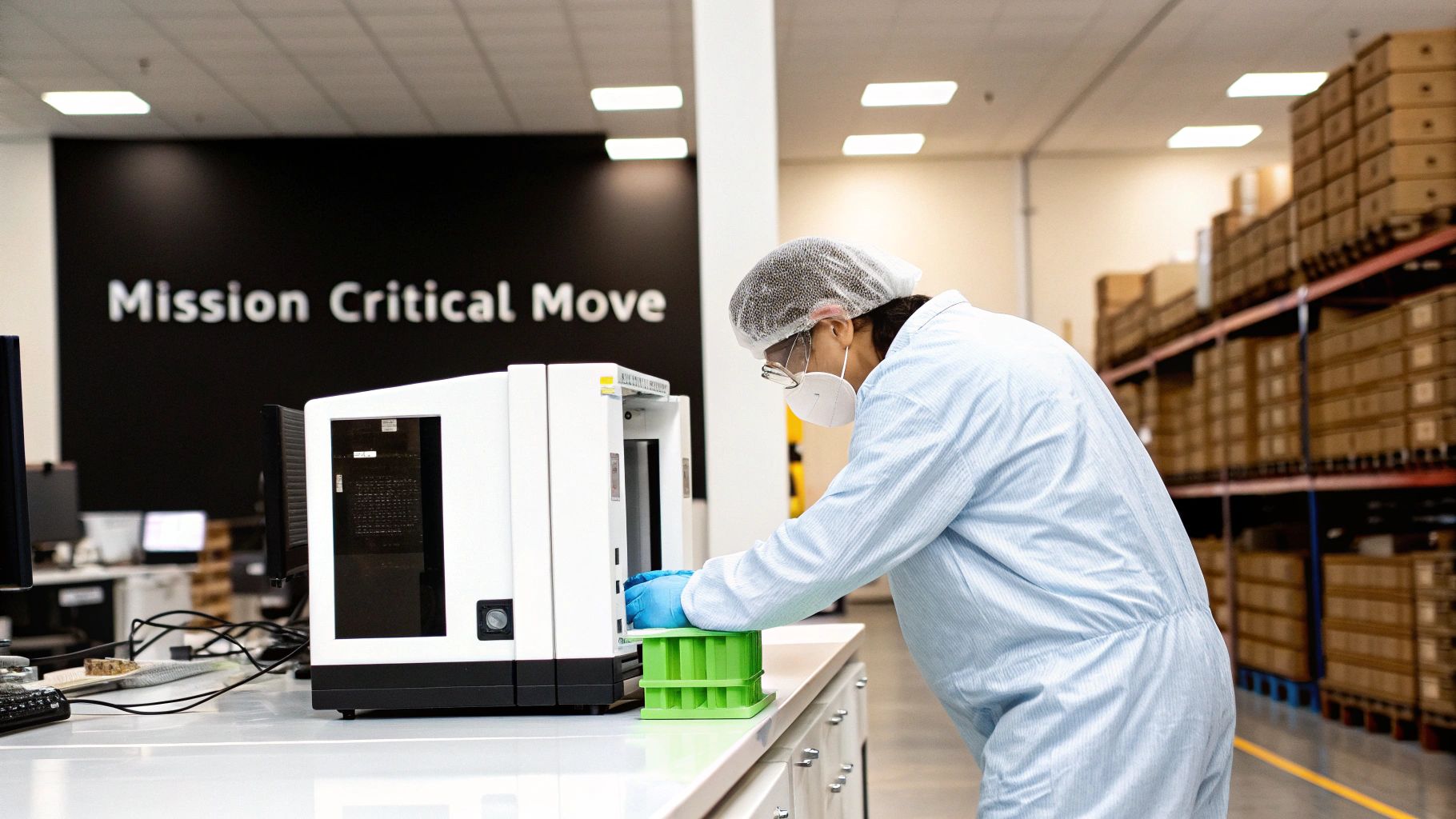
Moving a lab isn't like moving an office. It's a high-stakes, precision operation. One wrong move—a dropped sample, a damaged centrifuge, or an instrument knocked out of calibration—can trigger catastrophic financial and scientific setbacks. You're dealing with assets worth millions and research that simply can't be replicated.
This is exactly why you can't cut corners. For any lab relocation, whether it’s a local move across town or a nationwide transfer, specialized movers are non-negotiable. These experts bring a unique skill set that general movers just don't have. They understand the delicate nature of scientific equipment and know the strict protocols needed to maintain sterility, chain of custody, and regulatory compliance across state lines.
What’s Really at Risk?
The financial hit from a poorly planned lab move can be staggering. Research downtime alone can cost a mid-sized facility over $50,000 per day in lost productivity and operational costs. Then there’s the replacement cost of a damaged mass spectrometer or electron microscope, which can easily climb into the hundreds of thousands—or even millions—of dollars.
The scientific risks are just as serious. A botched move can lead to:
- Irreplaceable Sample Loss: If temperature controls fail during a cross-country transit or a sample gets contaminated, years of work can be wiped out in an instant.
- Data Integrity Breaches: Unsecured lab computers and servers are a huge risk to proprietary research data and patient information, a critical concern for hospitals needing to maintain HIPAA compliance.
- Major Project Delays: Damaged or improperly re-installed equipment can push research timelines back by months, jeopardizing grant funding and your competitive edge.
A successful lab move isn't just about getting equipment from point A to point B. It's about preserving the integrity of ongoing research, safeguarding high-value assets, and ensuring operational continuity with minimal disruption, no matter the distance.
Understanding the Difference: Standard Movers vs. Lab Specialists
It's easy to underestimate what's involved, but the gap between a standard mover and a lab relocation specialist is massive. This table breaks down exactly why you need an expert team for local and national moves.
Key Differences Between Standard Movers and Lab Relocation Specialists
| Service Aspect | Standard Moving Company | Specialized Laboratory Mover |
|---|---|---|
| Equipment Handling | General knowledge of furniture and office items. | Expertise in de-installing, calibrating, and handling sensitive instruments (e.g., mass spectrometers, microscopes). |
| Packing & Crating | Standard boxes and blankets. | Custom-built crates with shock absorption, anti-static materials, and climate control features. |
| Regulatory Compliance | Unaware of lab-specific regulations. | Deep knowledge of EPA, OSHA, DOT, and HIPAA requirements for handling hazardous materials and sensitive data locally and across state lines. |
| Chain of Custody | Basic inventory tracking. | Documented chain of custody for all samples, assets, and data to ensure integrity and security. |
| Transport | Standard trucks. | Climate-controlled, air-ride suspension vehicles for local or nationwide transport to protect against temperature fluctuations and vibration. |
| Staff Training | General moving and lifting skills. | Technicians trained in lab safety, sterile procedures, and equipment-specific protocols. |
Simply put, hiring a standard mover for a lab relocation is a gamble you can’t afford to take. The potential for equipment damage, data loss, and regulatory fines is far too high.
A Growing Market Demands Careful Vetting
The demand for expert lab movers is climbing. The global laboratory relocation service market, valued at $1,864.7 million, is expected to hit $3,500 million by 2035, growing at a rate of 5.9% annually. This boom is fueled by huge investments in R&D, particularly in biotech and pharmaceutical hubs across the United States.
For lab managers, this means you have more options, but it also means you have to do your homework. Choosing the right partner requires a close look at their experience, their understanding of safety protocols, and their ability to handle both the physical logistics and the digital security of your assets. Before you start, getting familiar with common laboratory hazard signs can give you a better sense of what to look for.
This guide will walk you through the entire process—from initial planning and vetting vendors to final decommissioning—to ensure your next lab move, whether local or nationwide, is a seamless success.
Building Your Pre-Move Relocation Blueprint
A successful lab move is built on a foundation of meticulous planning. I've seen it time and time again—rushing this critical phase is a recipe for budget overruns, extended downtime, and damaged assets. Your pre-move blueprint is the comprehensive playbook that transforms a potentially chaotic process into a structured, manageable project.

This blueprint starts long before you even think about contacting laboratory moving companies. Its whole purpose is to give you a complete picture of your project’s scope, timeline, and unique requirements. Whether you're moving to a new facility in your city or relocating an entire research operation nationwide, a well-defined plan is what minimizes disruption and gets your team back to its vital work.
Assembling Your Internal Relocation Team
First things first: pull together a dedicated internal team. This group is your central command for the entire move, responsible for coordinating with all departments, staff, and your eventual moving partner.
Assigning clear roles is non-negotiable. Your team absolutely needs:
- A Project Lead: This is your quarterback—the main point of contact overseeing the timeline, budget, and all communications.
- Department Liaisons: You need reps from each lab who intimately understand their specific equipment, workflows, and material needs. They're your eyes and ears on the ground.
- IT and Facilities Managers: These are the technical experts who will manage server disconnects, utility shutdowns, and prepping both the old and new sites.
- Safety Officer: This person ensures all protocols for handling hazardous materials and securing sensitive areas are followed to the letter.
This core team establishes the communication rhythm for the entire project. Think weekly check-ins, a shared project management tool, and clear channels for reporting issues. It’s what keeps everyone aligned from start to finish.
Creating a Comprehensive Asset Inventory
You can’t plan a move if you don’t know exactly what you’re moving. The next step is creating a detailed asset inventory—a granular list of every single item in your laboratory. Yes, this task can feel monumental, but it is absolutely essential.
Go room by room and document everything. For each major piece of equipment, your inventory must note:
- Asset Tag/Serial Number: For precise tracking.
- Dimensions and Weight: Movers need this for both local and nationwide shipping calculations.
- De-installation/Re-installation Needs: Does it require a manufacturer's technician? Note it down.
- Calibration Needs: Will it need professional recalibration after the move? Almost certainly.
- Special Handling Instructions: Make a note of any sensitivities to temperature, vibration, or static.
This inventory also forces you to make tough decisions about what stays and what goes. Identifying obsolete or non-functional assets now is crucial. For guidance on how to manage these items, this guide on how to dispose of old lab equipment is a great resource. Proper disposal is a key part of any lab decommission.
A detailed asset inventory is more than a checklist; it's a strategic tool. It informs your budget, helps you get accurate quotes from moving companies, and ensures every piece of equipment is accounted for and handled correctly.
Defining Your Timeline and Budget
With your team and inventory locked in, you can now build a realistic timeline. From my experience, a local move requires starting the planning process 6 to 9 months in advance. For a complex, cross-country relocation, you need to extend that window to 9 to 12 months.
Your timeline should map out key milestones, from initial vendor meetings to final site commissioning. Always build in a buffer for potential delays. For example, some specialized equipment can have a long lead time for de-installation services from the original manufacturer, impacting your nationwide move schedule.
Budgeting for a lab move goes way beyond the mover's quote. You have to account for these often-overlooked expenses:
- Equipment Recalibration and Certification: This is a significant post-move cost.
- Specialized Vendor Fees: For handling chemicals, biologicals, or manufacturer-specific tasks.
- Insurance: Make sure you have adequate coverage for your high-value assets for the entire journey.
- Contingency Fund: Set aside at least 10-15% of your total budget for the unexpected. Trust me, something will come up.
This detailed preparation empowers you to approach potential laboratory moving companies with clarity and confidence, ensuring any partner you vet can meet the specific, well-documented needs of your local or nationwide operation.
How to Properly Vet Your Moving Partner
Choosing a mover is the single most critical decision you'll make when relocating your lab. I've seen it firsthand: the difference between a true specialist and a general moving company is night and day. Picking the wrong team can lead to catastrophic equipment damage and delays that throw your research schedule completely off track.
This isn't about finding the lowest bidder. It's about finding a qualified partner you can trust with your most valuable, sensitive assets for a move of any distance.
The vetting process requires a sharp eye for detail. You’re looking for tangible proof of expertise, from specific insurance policies to a documented history of successful, similar projects. A true specialist will welcome your scrutiny and provide clear, transparent answers without hesitation.
Non-Negotiable Credentials and Insurance
Before you even start talking about logistics, you need to verify a potential partner's credentials. Your standard general liability insurance just won't cut it here. The risks that come with a lab move demand specialized coverage, and any legitimate laboratory moving companies will have it ready to show you, valid for both local and interstate transport.
Here’s what you absolutely must see:
- Specialized Cargo Insurance: This policy needs to cover the full replacement value of your most expensive instruments. Ask for the specific dollar amount and make sure it’s high enough to cover your assets during a cross-country move.
- Professional Liability (Errors & Omissions): This is your safety net if the mover’s negligence causes a financial loss, like extended research downtime because of a preventable mistake.
- Industry Certifications & DOT Licensing: Look for affiliations with recognized industry bodies and confirm they have the proper Department of Transportation licensing for nationwide moves.
- Safety Records: Don't be afraid to ask for their safety records, like their OSHA incident rate. A low number points to a culture of safety and careful handling.
A critical pro-tip: Always request a Certificate of Insurance (COI) directly from their insurance provider, not just a copy from the moving company. Make sure your institution is named as an "additional insured" on the policy for the entire project timeline.
Assessing Experience and Project Management Protocols
Once you’ve confirmed their credentials, it's time to dig into their real-world experience. A company that has moved hundreds of offices but only a handful of labs simply lacks the specific skillset you need. You have to get into the weeds of their project management capabilities and their track record with moves like yours, especially if it’s a nationwide relocation.
A key reason for this deep dive is the high risk of damage. In the United States, where over 6,000 pharmaceutical and biotech firms are operating, equipment damage can impact 10-15% of moves when handled by non-specialists. Vetting for deep experience is your best defense against becoming a statistic. You can discover more about laboratory relocation service market trends to get a sense of the industry landscape.
To get a true feel for a mover, ask them for:
- Case Studies: Request detailed case studies of recent local and nationwide moves they’ve managed for similar organizations—think research hospitals or universities.
- References: Get on the phone and speak directly with past clients. Ask them about the mover’s communication, their problem-solving skills, and whether they stuck to the timeline.
- Chain-of-Custody Procedures: Have them walk you through their documented process for tracking every single asset, from de-installation to re-installation, especially for long-distance transport.
Evaluating Their End-to-End Capabilities
A top-tier laboratory moving partner does a lot more than just drive a truck across the country. Their services should cover the entire lifecycle of your project, from the physical move to the compliant disposal of any assets you're leaving behind. This integrated approach makes coordination a breeze and ensures you don't have any regulatory gaps.
The best partners can handle all the complex backend logistics, including:
- Compliant Asset Disposal: A move always unearths equipment that's outdated or no longer needed. A full-service provider should offer certified disposal services to handle it properly, no matter where your lab is located.
- Data Security: For any IT assets being decommissioned, they must provide documented data destruction, like DoD-compliant wiping or physical shredding. This protects sensitive research and keeps you in line with regulations like HIPAA.
- Sustainable Recycling: A real commitment to responsible recycling is a hallmark of a modern, professional partner.
Integrating these final steps is crucial for a clean, compliant project closeout. You can learn more about how a specialized electronic recycling center handles these processes to ensure both data security and environmental responsibility. Choosing a company that provides these end-to-end services is what truly separates the specialists from the generalists.
Executing The Move From De-installation To Transport
Once you've picked your partner and signed off on the plan, it's time to get down to the brass tacks of the actual move. This is where all that meticulous preparation really starts to pay off. The "moving day" for a lab is less about brute force and more like a carefully choreographed operation involving de-installation, specialized packing, and transporting incredibly sensitive assets locally or nationwide.
The whole thing hinges on seamless coordination between your internal team and the movers' on-site crew. A truly professional laboratory moving company doesn't just show up with a truck. They arrive with a clear plan of action, ready to work side-by-side with your staff to minimize disruptions and keep any ongoing work on track.
Best Practices For De-installation And Packing
Proper de-installation is your first line of defense against costly equipment damage. This isn’t a job for generalists. Think about your mass spectrometers, incubators, or electron microscopes—many of these require specific shutdown sequences and locking mechanisms just to prevent damage during transit. Your moving partner should either have technicians trained for this or be able to coordinate directly with the original equipment manufacturers (OEMs).
After de-installation, the packing process is just as vital. Standard moving blankets and a roll of bubble wrap won't cut it here. Not even close.
Specialized packing materials are an absolute must:
- Custom Crating: For any large, fragile, or high-value instruments, custom-built wooden crates with shock-absorbing foam interiors are non-negotiable. They create a rigid shell that protects against bumps, drops, and vibrations during a long-distance move.
- Anti-Static Packaging: All your electronic components, from circuit boards to sensitive sensors, must be packed in anti-static bags. This prevents damage from electrostatic discharge, which can silently fry delicate electronics.
- Climate-Specific Materials: If you're moving anything sensitive to temperature or humidity, your movers should be using insulated containers, gel packs, or even dry ice to keep the environment stable throughout the entire trip.
This level of detail ensures every piece of equipment, whether it’s going across town or across the country, is shielded from the hazards of the road.
The Critical Role Of Climate-Controlled Transport
The journey from your old lab to the new one is fraught with risks—temperature swings, road vibrations, sudden stops. This is precisely why specialized transport is a cornerstone of any professional lab move. Your average moving truck simply can't provide the necessary protection for local or nationwide journeys.
Climate-controlled, air-ride suspension vehicles are the industry standard for lab relocations. Air-ride suspension minimizes the jolts and vibrations from the road, while climate control systems protect biological samples, reagents, and sensitive electronics from extreme heat or cold during long-haul transport.
This level of care is absolutely essential for maintaining the integrity of everything from live cell cultures to complex analytical instruments. A failure to control the transport environment can easily render samples useless or knock expensive equipment out of calibration, leading to frustrating and expensive delays when you're trying to get set up in the new facility.
This timeline gives you a high-level view of the vetting process, which is a critical step to complete long before the actual move begins.
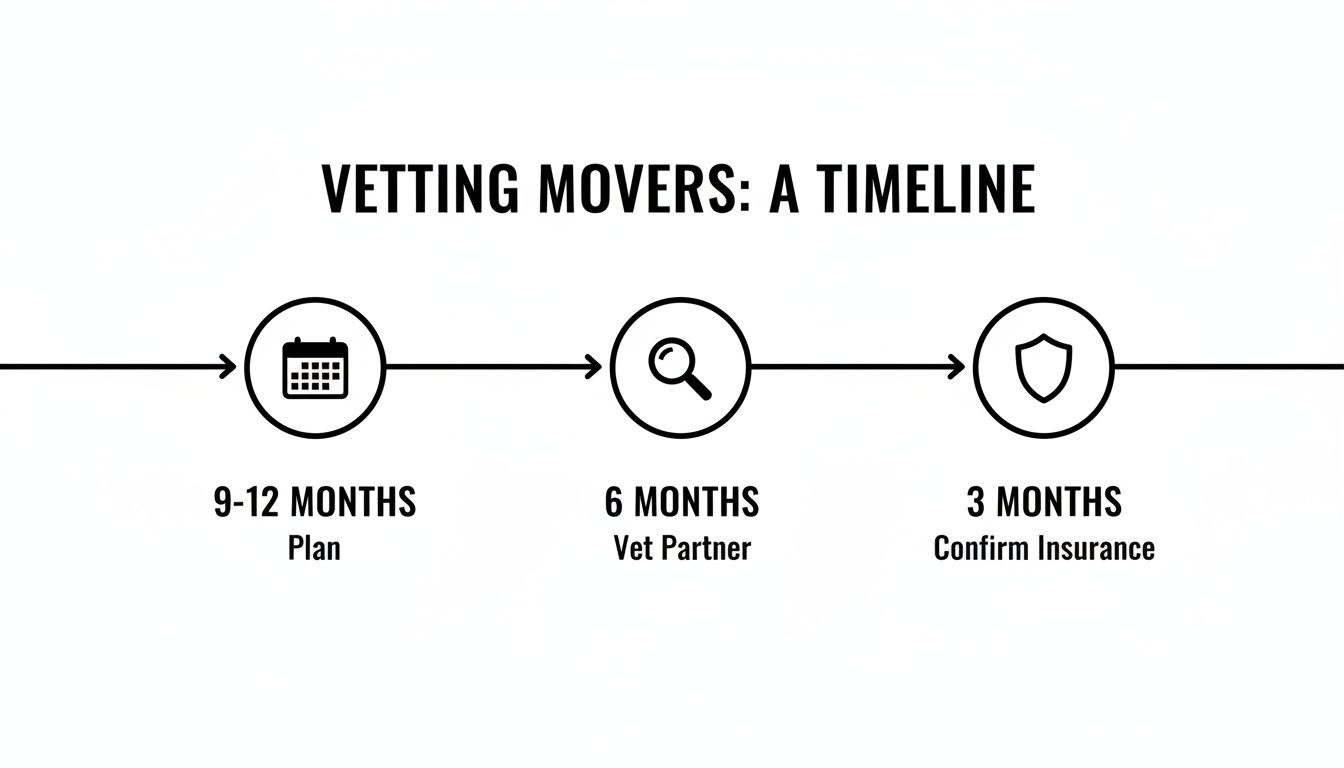
As you can see, finding the right partner is a long-term strategy. You need to start months in advance to leave enough time for thorough planning, vetting, and insurance verification.
Securing Your Digital Assets During The Move
A lab move isn't just about the physical equipment; it's a critical moment for your data security, too. Your lab's computers, servers, and hard drives hold priceless research data, and in a hospital or clinical setting, protected health information (PHI). A data breach during a move is a nightmare scenario, potentially leading to massive regulatory fines and the loss of critical intellectual property.
The global lab logistics sector is a massive industry, with medical and biology labs driving 40% of the demand. Transportation is the biggest piece of the pie, as nearly 80% of relocations require on-site de-installation to maintain Good Laboratory Practice standards and prevent contamination. While newer IoT sensors are helping cut delays by up to 25%, damage rates still hover around 5-10%, underscoring the absolute need for specialists.
Your moving partner must have a rock-solid protocol for handling every device that holds data. This should include:
- Secure Chain of Custody: A documented trail that tracks every server, computer, and hard drive from the moment it leaves your facility until it's delivered to its local or national destination.
- Data Sanitization: For any drives being decommissioned, they should offer DoD 5220.22-M 3-pass data sanitization to completely and permanently erase all information.
- Physical Destruction: For media that's obsolete or non-functional, secure shredding is the only way to guarantee the data is 100% irrecoverable.
These services are vital for maintaining HIPAA compliance and protecting your lab's most valuable digital assets. By baking data security into your moving plan from the start, you ensure your intellectual property stays protected. And once the move is complete, any leftover assets can be handled by a team providing dedicated scientific equipment disposal services to close out the project without leaving any loose ends.
Managing Post-Move Decommissioning and Disposal
You’d think the project is over once the last instrument is installed in your new facility, but you're not quite at the finish line. One of the most critical phases is still ahead: completely decommissioning the old laboratory. Getting this right is non-negotiable for meeting your lease-end obligations and closing out the project without leaving any regulatory or environmental messes behind.
This final stage is all about responsibly managing every single asset left behind. It's so much more than just clearing out a space. We're talking about a detailed process of identifying obsolete equipment, dealing with potentially hazardous materials, and making sure every disposal is compliant. Thankfully, many laboratory moving companies roll these services into their offerings, making the jump from relocation to final decommissioning seamless, whether you've moved locally or across the country.
Why You Can’t Just Toss Old Lab Gear
Tossing old lab equipment into a dumpster isn't just a bad idea—it's illegal and dangerous. Think about it: centrifuges, analytical devices, and other instruments are often full of hazardous materials like lead, mercury, and cadmium. If that stuff ends up in a landfill, you're looking at serious environmental contamination and the kind of fines from the EPA that can cripple a budget.
Then there's the data risk. Every old lab computer, server, and even the hard drives inside scientific instruments can hold a treasure trove of sensitive research data or Protected Health Information (PHI). A single data breach from a carelessly discarded hard drive can do incredible damage to your institution's reputation and bottom line.
Closing out a lab relocation properly means having a documented, auditable trail for every asset you leave behind. This includes certificates of data destruction and certified recycling, which serve as proof that you met all legal and environmental obligations.
Finding Value in Leftover Assets
Decommissioning isn't just a chore; it's a chance to adopt sustainable practices and maybe even recover some value from your old gear. Instead of adding to the e-waste problem, you can partner with a certified electronics recycler who ensures materials are properly handled and kept out of landfills. A staggering 75% of electronics can be recycled, recovering valuable materials like gold, silver, and copper.
Beyond recycling, there's a real financial upside. Not all of your leftover equipment is junk. Many pieces might still have a healthy secondary market value. A partner with experience in asset disposition can help you spot these valuable items, manage their refurbishment, and sell them, turning what you thought was waste into a welcome budget boost.
A good partner will handle the whole process, including:
- On-site Pickup and Logistics: They use their own fleet and crew to de-install and haul away everything left in your old facility.
- Certified Recycling: They make sure that any non-viable electronics and equipment are broken down and processed according to strict environmental standards.
- Data Destruction: For anything with a hard drive, they provide documented data wiping and physical shredding to guarantee your information stays secure.
The Advantage of a Single Decommissioning Partner
Trying to juggle separate vendors for moving, recycling, and data destruction just adds layers of complexity and cost to an already massive project. The smartest move is to work with a single, full-service partner who bakes decommissioning right into the overall relocation plan.
This approach simplifies everything. The same team that already knows your inventory and project goals can handle the final clean-out, making sure nothing falls through the cracks. You get one point of contact, one set of paperwork, and the peace of mind that comes from knowing your old space is clear and your compliance duties are met.
You can learn more about what this involves by exploring the processes behind secure data destruction and how it protects your sensitive information. By choosing an all-in-one provider, you ensure a clean, compliant, and successful end to your entire laboratory relocation project.
Answering Your Top Lab Relocation Questions
Even the most detailed plan can't anticipate every question. When you're staring down the barrel of a full-scale lab relocation, a lot of specific concerns pop up. It doesn't matter if you're moving across town in Atlanta or coordinating a complex, multi-state transfer—getting straight answers is key to keeping things on track.
Let's tackle some of the most common questions lab managers and facility directors ask. Think of this as a final gut-check to make sure you're ready.
How Far in Advance Should We Really Be Planning This?
You need a long runway. Period. For a standard local move, I tell clients to start the planning process at least 6 to 9 months out. If you're looking at a nationwide relocation, stretch that timeline to 9 to 12 months.
This isn't about just getting a mover on the calendar. This buffer is your best defense against chaos. It gives you the breathing room to:
- Build a truly accurate inventory of every single piece of equipment.
- Properly vet and get competitive bids from qualified laboratory moving companies for local or nationwide services.
- Get buy-in and coordinate schedules with department heads, researchers, and your IT team.
- Pinpoint the best time for the physical move to minimize operational downtime.
Trying to rush this is a recipe for disaster. You’ll miss things, break things, and hemorrhage money in lost research time. A generous planning window is the single best way to ensure your moving partner can allocate the right people and resources to your project.
What Are the Biggest Hidden Costs We Should Watch Out For?
The quote you get from a mover is just the starting point. The real budget-killers in a lab relocation almost always sneak up on you in three areas: research downtime, equipment recalibration, and improper asset disposal.
Downtime is the silent killer. For many labs, every single day you're not operational can mean tens of thousands of dollars in lost productivity, grant milestones, and overhead. It adds up frighteningly fast.
Next up is recalibration. Highly sensitive instruments—think mass specs, sequencers, or electron microscopes—can't just be plugged back in. They require a certified technician to come on-site and bring them back to spec. This service is almost never included in a standard moving quote and can be shockingly expensive, especially if it requires a technician to travel nationwide.
Finally, not having a clear plan for your old or surplus equipment will bite you. You'll get hit with unexpected fees for specialized e-waste handling or, even worse, fines for not complying with disposal regulations. Working with a partner who bundles moving with certified e-waste services helps you see these costs coming.
The biggest financial risks in a lab move are rarely on the invoice. They're the indirect costs of going dark and all the post-move expenses needed to get your new lab running and your old one properly shut down.
What Kind of Insurance Do We Actually Need?
Let me be clear: standard moving insurance is completely useless for a lab move. The value of your assets and the risks involved are in a different league. Your moving partner needs to carry multiple, specific layers of coverage valid for the full scope of your move, be it local or nationwide.
Don't just take their word for it. Insist on seeing proof of these policies:
- General Liability & Commercial Auto Liability: This is the basic, non-negotiable stuff.
- Cargo Insurance: The limit here needs to be high enough to cover the full replacement value of your most expensive piece of equipment. Ask for the specific dollar amount.
- Professional Liability (Errors & Omissions): This is critical. It protects you from financial losses if the mover makes a mistake or is negligent during the project.
Always get a Certificate of Insurance (COI) sent directly from their insurance provider, not just a copy they give you. And for true peace of mind, your organization must be named as an "additional insured" on their policy. This is a non-negotiable step that protects you from a catastrophic financial hit.
Can We Find One Company to Handle Both the Move and Equipment Disposal?
Yes, and honestly, it’s the only way to go. The best laboratory moving companies now offer fully integrated services. They manage the entire project, from the relocation logistics all the way through to final decommissioning and getting rid of old assets.
This all-in-one approach saves you a massive headache. You're not trying to juggle multiple vendors for moving, data destruction, and recycling. It drastically reduces complexity and the risk of miscommunication. Most importantly, it keeps a clear, unbroken chain of custody for every asset, whether it's going to the new lab or being retired for good. An integrated partner ensures your surplus equipment is securely handled for compliant data destruction and certified recycling, ticking every box for security and environmental regulations.
When your Atlanta-area hospital, university, or research facility needs a trusted partner for decommissioning, Scientific Equipment Disposal provides a secure, sustainable solution. We simplify the entire process with on-site de-installation, pickup, and certified recycling for all your laboratory and IT assets. Learn more about our compliant e-waste services at https://www.scientificequipmentdisposal.com.