A Guide to Safe Laboratory Equipment Disposal in Atlanta and Nationwide

When it's time to decommission a lab or upgrade your facility, the process is a lot more involved than just unplugging old machines and calling a junk hauler. If you get it wrong, you’re looking at crippling fines, data breaches that can ruin your reputation, and serious environmental violations. A smart, compliant disposal plan isn't a "nice-to-have"—it's a critical part of managing any modern facility, whether you're located in Atlanta or operate on a national scale.
The High Stakes of Laboratory Equipment Disposal
For a hospital, university, or research firm, retiring old assets is far more complex than your typical office cleanout. The very nature of laboratory equipment introduces major risks. Ignoring them can lead to devastating financial and reputational fallout for organizations, whether you're here in Atlanta or anywhere else nationwide.
These aren't just hypothetical problems; they are real-world consequences tied to some very strict government rules. Simply put, you can't afford to mess this up.
Compliance and Regulatory Penalties
The most immediate danger comes from failing to comply with a tangled web of federal and state regulations. Just tossing an old diagnostic machine into a dumpster can bring penalties from several agencies at once, regardless of your location.
For instance, any medical facility has to follow HIPAA, and that includes the data stored on your devices. A single un-wiped hard drive from a patient-monitoring system can easily trigger a multi-million dollar data breach fine. It's essential to understand the ins and outs of regulatory compliance for medical devices, because a lot of what's in your lab falls squarely into that category.
On top of that, you have environmental laws to worry about. Key regulations include:
- EPA Regulations: The Environmental Protection Agency has strict rules for e-waste across the United States. Things like lab refrigerators contain refrigerants, and older monitors might have lead or mercury. All of it requires specialized handling, not a landfill.
- OSHA Guidelines: Safety is paramount during the de-installation process. We've seen it all—injuries from mishandling heavy or bulky equipment like fume hoods or large centrifuges can quickly lead to OSHA violations and worker's comp claims.
You can get a better handle on this by reading our guide on EPA-compliant laboratory equipment disposal to make sure your process is sound.
Before we move on, it's worth summarizing the major pitfalls you're trying to avoid.
Key Risks in Laboratory Equipment Disposal
This table breaks down the main compliance, data, and environmental hazards organizations face when they try to handle lab equipment disposal without a professional, structured process.
| Risk Category | Specific Hazard | Potential Consequence |
|---|---|---|
| Regulatory Compliance | HIPAA, EPA, or OSHA violations from improper handling or disposal. | Substantial fines, legal action, and potential suspension of operations. |
| Data Security | Un-wiped hard drives or media containing patient data (PHI) or research IP. | Multi-million dollar data breach penalties, loss of public trust, and lawsuits. |
| Environmental | E-waste with hazardous materials (lead, mercury, refrigerants) ending up in landfills. | Fines for environmental contamination and significant damage to your organization's reputation. |
| Worker Safety | Injuries from de-installing heavy, bulky, or improperly decontaminated equipment. | OSHA violations, increased insurance premiums, and lost-time incidents. |
As you can see, the consequences of a misstep are severe and can impact your organization from multiple angles.
The Growing Challenge of E-Waste
The sheer volume of equipment cycling through labs is exploding. The global market for lab equipment, valued at USD 35.90 billion in 2025, is expected to rocket to USD 74.22 billion by 2035.
Here in the U.S., which is a huge hub for hospitals and universities, the market is projected to grow from USD 9.55 billion to USD 20.24 billion in that same timeframe. More growth means more upgrades, and that creates a massive stream of retired assets that have to be managed correctly, both locally and across the country. You can dig into these trends and what they mean in the full research by Precedence Research.
A professional disposal strategy is no longer a luxury—it's a core component of risk management. Partnering with a specialized vendor ensures retired assets are handled sustainably, securely, and in full compliance with all regulations.
At the end of the day, a poorly managed lab decommissioning can erode public trust and create legal headaches that last for years. A proactive, informed approach is the only way to turn this potential liability into a well-managed and responsible business practice.
Your Pre-Disposal Lab Decommissioning Checklist
A smooth lab cleanout doesn't just happen on pickup day. The real work starts long before the trucks arrive, and getting it right is the secret to avoiding major headaches and ensuring everything is handled by the book. This whole pre-disposal phase boils down to one critical task: creating a detailed inventory of every single asset.
Don't just eyeball the room and make a rough list. To do this properly, you need a precise record of everything. We're talking about documenting the big-ticket items like analytical instruments and centrifuges all the way down to the smallest pieces of electronic laboratory equipment, like digital pipettes or pH meters.
This inventory is the foundation for everything else. Without it, you can't properly sort your assets, pinpoint data security risks, or get an accurate quote from a disposal partner.
Creating Your Asset Inventory
Grab a simple spreadsheet or fire up your inventory management system. You'll want to capture a few key details for each and every piece of equipment:
- Item Name: Be specific. Instead of "centrifuge," write "Thermo Scientific Sorvall ST 8 Centrifuge."
- Manufacturer and Model Number: This is essential for figuring out value and the right disposal path.
- Serial Number: Absolutely critical for tracking and creating a chain of custody.
- Location: Simply note the room or lab number where the item currently sits.
- Condition: Is it working, broken, or only good for parts?
With this master list in hand, you can start making decisions. Go down the list and assign a status to every asset: Recycle, Resale, or Destroy. This simple system is your first step in sorting high-risk equipment from the low-risk stuff.
An accurate, itemized inventory is the backbone of a defensible disposal process. It gives you the proof you need to show that every asset was handled correctly based on its unique security and environmental needs.
Taking the time to build this list provides a clear roadmap for your disposal vendor, whether they're a local Atlanta-area provider or a national partner.
Failing to manage this process correctly can lead to some serious consequences. The risks—from fines to full-blown data breaches—are very real.
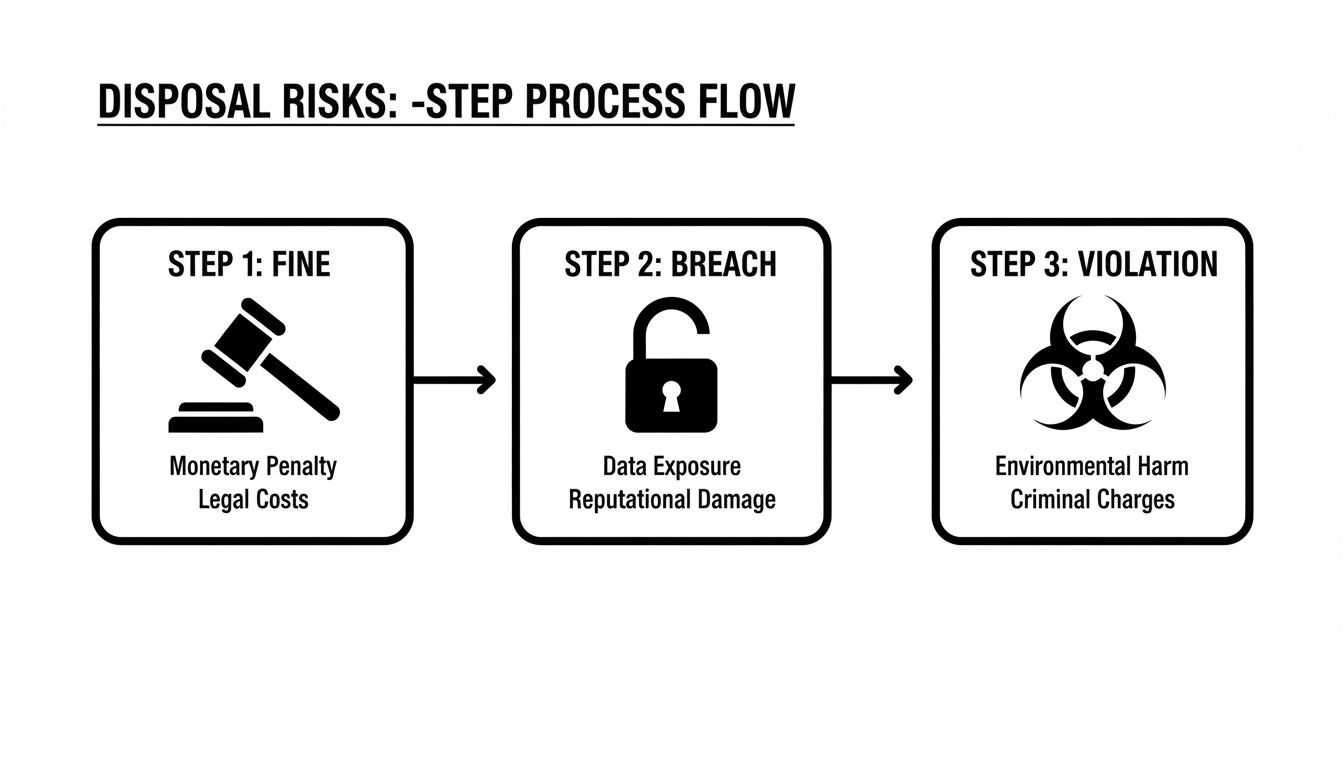
This just goes to show how a single oversight can quickly snowball into major regulatory, financial, and even environmental trouble for your organization.
Segregating Data-Bearing Equipment
Now for the most important part of your inventory: finding and flagging any equipment that stores data. It's surprising how much modern laboratory equipment has a hard drive or some form of internal memory tucked away inside.
Missing this step is one of the fastest ways to cause a data breach. We've seen it almost happen—facilities ready to discard diagnostic machines with thousands of patient records or research instruments holding priceless intellectual property. You have to work from the assumption that any electronic device could be a liability.
Make a separate, high-priority list for these items:
- Computers and Servers: These are the obvious ones, including desktops, laptops, and any server racks.
- Analytical Instruments: Many of today's spectrometers, chromatographs, and sequencers have embedded PCs that store methods and run data.
- Medical Devices: Things like patient monitors, imaging systems, and diagnostic tools are notorious for retaining protected health information (PHI).
- Network-Attached Storage (NAS): Don't forget any shared drives used for backups or data transfers.
Once you’ve identified them, physically separate these items from everything else. The best practice is to move them to a secure, locked room. If that isn't possible, at least label them clearly with something like "Contains Sensitive Data – Secure Wipe Required." This simple visual cue prevents a costly accident where a data-rich device gets mixed in with general e-waste.
This is a non-negotiable step for any lab, clinic, or hospital subject to HIPAA. To see how this fits into the larger picture, you can learn more about how comprehensive lab equipment decommissioning services work.
By running through this pre-disposal checklist, you give yourself—and your disposal partner—all the information needed for a secure and efficient cleanout. It’s the best way to protect your organization from risks that are entirely preventable.
How to Handle Data Security and Sanitization
After you've inventoried all your data-bearing assets, the real work begins: making sure not a single byte of sensitive information ever leaves your facility. A lot of people think dragging files to the trash bin or running a standard format is enough. It’s not. That data is still easily recoverable, and for any lab or clinic handling PHI or proprietary research, that’s a data breach waiting to happen.
Proper data sanitization is a non-negotiable step when disposing of laboratory equipment. It's the only way to satisfy HIPAA and protect your intellectual property. Think of it as a digital sterilization—it has to be thorough, validated, and, most importantly, documented.
Digital Wiping Versus Physical Destruction
You have two primary paths for securing that data: software-based wiping and good old-fashioned physical destruction. The right call depends on the device itself and whether it still powers on.
For functional hard drives (both HDDs and SSDs), the gold standard is a multi-pass wipe. This process overwrites the entire drive with random data, again and again, making the original information practically impossible to get back.
A single "deleted" file is all it takes to cause a major HIPAA violation. The only way to guarantee compliance is with a validated sanitization method that renders data completely unrecoverable, backed by documented proof.
The most trusted method in the industry is the DoD 5220.22-M 3-pass sanitization. This Department of Defense standard is recognized nationwide as the benchmark for securely eliminating sensitive information.
When Shredding Is the Only Option
Software wiping is great, but it doesn't work for everything. Physical destruction becomes the only secure route in a few common scenarios:
- Non-Functional Media: If a hard drive or server is completely dead and won't turn on, you can't wipe it. Shredding is the only way to guarantee data security.
- Obsolete Formats: Old backup tapes, floppy disks, or certain optical media can't be reliably wiped. Shredding is your only safe bet.
- Damaged Drives: A drive that's been dropped or has significant physical damage might not be accessible for a software wipe. In that case, it has to be shredded.
A professional disposal partner will know exactly which method to use for each device. To get into the weeds on these processes, you can read more about what’s involved with secure data destruction.
The scale of this challenge is only getting bigger. The market for laboratory equipment services is expected to climb to USD 35.4 billion by 2030. For organizations in the Atlanta metro area and other science hubs across the U.S.—from hospitals to universities—this means older equipment from past expansions is hitting its end of life. When these labs decommission assets, they're left with a major e-waste problem. Disposal firms that can handle on-site de-installation, DoD wiping, and shredding are critical for keeping data safe and keeping waste out of landfills. You can dig into this growing market in the full report from MarketsandMarkets.
Real-World Scenarios and Best Practices
Knowing the methods is one thing; applying them correctly is what keeps you compliant. Let's look at a couple of situations we see all the time.
Scenario 1: A Hospital Retiring Diagnostic Machines
A large Atlanta hospital is swapping out a fleet of ultrasound machines and patient monitors. Each one has an internal hard drive loaded with years of Protected Health Information (PHI).
- The Wrong Way: The hospital’s internal IT team formats the drives and sells the machines to a general recycler. The data is still there for the taking, creating a massive HIPAA risk.
- The Right Way: The hospital brings in a specialized disposal vendor. The vendor's team comes on-site, physically removes the hard drives, and transports them in a secure, locked container. Back at their facility, they perform a DoD 5220.22-M wipe on every single drive and provide a Certificate of Destruction that lists each serial number.
Scenario 2: A Research Firm Closing a Lab
A biotech company is shutting down a lab that has servers holding priceless research data and proprietary formulas. Some servers work fine, but a few have failed completely.
- The Right Way: The firm has a certified national vendor come in. The vendor wipes the functional drives on-site so the data never even leaves the building. The failed, unwipeable drives are physically shredded. The company gets a Certificate of Destruction covering every single asset, creating a perfect audit trail.
No matter the scenario, the process must be documented from start to finish. A Certificate of Destruction is your proof of due diligence. It must list the serial number of every drive that was sanitized or destroyed, giving you an unbroken chain of custody. In an audit, that piece of paper is your best friend.
Managing the Logistics of Equipment Removal and Transport

Once your assets are inventoried and any data-bearing devices are accounted for, you’re faced with the next major hurdle: the physical removal. Getting bulky, sensitive, or potentially hazardous laboratory equipment out of your facility isn't a job for a standard moving company. Trust us on this. It demands specialized knowledge, the right tools, and a deep respect for safety protocols to protect both the crew and your property.
This is where a professional on-site de-installation and transport service comes in. We’re not just talking about heavy lifting; this is a carefully orchestrated operation that has to align with strict OSHA safety standards, especially when you’re dealing with cumbersome items.
On-Site De-Installation and Facility Protection
The first real step in the physical removal process is the safe de-installation of your equipment. This is where an experienced crew truly proves their worth. They show up ready to handle the unique challenges labs present, from navigating tight hallways to protecting sensitive flooring.
Think about what it takes to move a large biological safety cabinet or a chemical fume hood. These pieces are often hardwired into the building’s electrical and ventilation systems and can be incredibly heavy. A professional team knows exactly how to safely disconnect these units without causing damage or creating a safety hazard.
They come prepared with the right equipment for the job:
- Heavy-Duty Dollies and Pallet Jacks: For safely maneuvering large centrifuges, incubators, and floor-standing analyzers.
- Stair-Climbing Equipment: This is absolutely essential for facilities in cities like Atlanta or other urban centers with multi-level labs and no freight elevator access.
- Protective Floor Coverings: We use Masonite or other durable sheeting to prevent scratches, dents, and scuffs on your floors.
- Specialized Straps and Padding: These secure the equipment during transit and prevent damage to both the asset and the truck itself.
Professional de-installation isn’t just about getting an item from point A to point B. It’s about doing it without damaging your facility, compromising the equipment, or violating a single OSHA safety regulation.
This careful approach ensures your lab is left in good condition, saving you from the headache and expense of repairing walls, doorways, and floors.
What to Expect from a Professional Pickup Crew
When a professional disposal crew arrives, their process should be methodical and efficient. They ought to start by reviewing the inventory list you created, confirming which items are slated for removal, and noting any special instructions for data-bearing devices.
The team leader will typically perform a walkthrough of the site to map out the safest and most efficient exit route. This means identifying potential obstacles like narrow corridors, tricky stairwells, or sharp turns. Once the plan is solid, the team gets to work.
You’ll see them systematically pack and wrap each piece of laboratory equipment. Smaller items are often consolidated into durable bins or gaylord boxes, while larger machinery is carefully loaded onto dollies. Everything is done with a clear focus on safety and efficiency. To see how this works from start to finish, you can read our detailed breakdown of scientific equipment removal for labs and universities.
The Advantage of In-House Logistics
One of the biggest differentiators you can look for in a disposal partner is whether they operate their own fleet of trucks. A vendor that has to rely on third-party freight carriers often introduces scheduling delays, communication gaps, and a lot of uncertainty.
A partner with its own box-truck fleet can offer so much more:
- Flexible Scheduling: They can work around your lab’s operational hours, including evenings or weekends, which is critical during a large-scale shutdown.
- Trained Personnel: The drivers and crew are actual employees of the company, trained specifically in handling sensitive and heavy lab assets. No random contractors.
- Nationwide and Local Reach: Whether you’re in the Atlanta metro area or need service across the country, a dedicated fleet ensures consistent and reliable logistics.
From the moment the crew arrives to the second the truck pulls away, the entire process should feel professional and seamless. This logistical expertise is what separates a true disposal specialist from a general e-waste recycler, guaranteeing your retired assets are handled with care from your door to their final destination.
Choosing the Right Disposal Partner in Atlanta and Across the U.S.
Who you trust to haul away your sensitive laboratory equipment is a bigger deal than you might think. This isn't like getting rid of old office printers. When you're dealing with diagnostic machines full of patient data or heavy-duty analytical instruments, a run-of-the-mill e-waste recycler just won't cut it. You need a specialist who gets the risks.
Picking the right partner protects you from massive regulatory fines, embarrassing data breaches, and serious environmental liability. The wrong one? It can open the door to all three. For any facility in the Atlanta area or anywhere else in the United States, the vetting process is your single most important line of defense.
Key Questions to Ask Potential Vendors
Before you even think about signing a contract, you need to ask some pointed questions. This is how you separate the real experts from the generalists who just don't understand the unique demands of a lab environment.
Get straight answers to these questions:
- Are you R2 or e-Stewards certified? These are the gold standards in electronics recycling. They're non-negotiable. A vendor without one of these certifications isn't held to the highest environmental and data security standards, and that's a huge problem.
- What are your exact data destruction methods? Don't accept a vague "we wipe the drives." You want to hear specifics, like DoD 5220.22-M 3-pass wiping and options for on-site or off-site shredding. If they can't detail their process, they don't have one you can trust.
- Do you use your own trucks and logistics team? A vendor with its own fleet has direct control over scheduling and chain of custody. One that relies on third-party freight adds complexity and reduces accountability, which is the last thing you need during a large-scale lab cleanout.
- Can I see a sample Certificate of Destruction? This document is your legal proof that the job was done right. It should detail every single serialized asset that was destroyed. Any legitimate company will be happy to show you an example.
The refurbished laboratory equipment market is booming, expected to hit USD 26.1 billion globally by 2025. But even this equipment eventually needs to be retired. For Atlanta-area clinics and universities, as well as national research institutions, proper disposal is critical to avoid major compliance headaches. That means finding local or national experts who can handle everything from on-site pickups to shredding old servers.
Spotting Red Flags Before You Commit
Some vendors can talk a good game, but their promises fall apart under a little scrutiny. Learning to spot the warning signs is just as important as asking the right questions.
A disposal partner's value isn't just in what they take away, but in the liability they prevent. A low-cost quote is worthless if it comes with the risk of a seven-figure HIPAA fine.
Be wary of any company that shows these signs. Just like there are red flags to watch out for with any contractor, the same rules apply here. Vague answers or a lack of clear documentation should be an immediate deal-breaker.
To help you compare your options, we've put together a quick checklist. Use this to gauge whether a potential partner is truly equipped to handle the job or if they're just telling you what you want to hear.
Vendor Comparison Checklist for Lab Equipment Disposal
Use this checklist to evaluate and compare potential disposal partners to ensure they meet your compliance and logistical needs.
| Evaluation Criteria | Ideal Vendor Response | Red Flags to Watch For |
|---|---|---|
| Certifications | "Yes, we are R2v3 and/or e-Stewards certified. Here is our certificate number." | "We follow those standards," or no certification at all. |
| Data Destruction | "We offer DoD 5220.22-M wiping and on-site physical shredding. You'll get serialized proof." | "We wipe everything," with no specific methods or documentation offered. |
| Logistics | "We own and operate our own fleet of GPS-tracked trucks with our own trained employees, serving clients nationwide." | Reliance on third-party LTL freight carriers; no control over the drivers. |
| Insurance | "Yes, we carry general liability, auto, and professional liability insurance. We can provide a COI." | No insurance, or refusal to provide a Certificate of Insurance (COI). |
| Transparency | "You're welcome to tour our processing facility. Here are references from other labs we've served." | No physical address listed (P.O. box only); refusal to provide references. |
| Pricing | "Our quote is all-inclusive and details every service, from logistics to data destruction." | Vague, "per-pound" pricing that hides fees; demands for cash-only payments. |
This checklist isn't exhaustive, but it covers the most critical points that separate a professional, reliable partner from a risky gamble.
Ultimately, choosing a partner for your laboratory equipment disposal in Atlanta or any other U.S. city comes down to trust and verification. You're looking for a specialist who lives and breathes regulatory compliance, data security, and safe logistics. The right partner gives you more than a pickup service—they deliver total peace of mind.
For those managing facilities in Georgia, learning more about recycling services specifically for the Atlanta area can help you make a more informed local choice.
Your Questions on Laboratory Equipment Disposal Answered
When it's time to upgrade or clear out your facility, a lot of questions pop up about how to handle old laboratory equipment. We get it. As a company that processes thousands of lab assets every year for hospitals, universities, and businesses across Atlanta and nationwide, we've heard them all.
Here are some of the most common questions we hear, with the straightforward answers you need to get the job done right.
What Types of Laboratory Equipment Require Special Disposal?
The short answer? Anything with a circuit board, a hard drive, or hazardous components. This goes way beyond your standard office computers. Many of the most specialized instruments in a lab need to be handled with care to keep you compliant and safe.
One of the biggest mistakes we see is overlooking all the hidden data-bearing devices. You have to think past the obvious IT gear. Keep a close eye on these items during your inventory:
- Analytical Instruments: That modern spectrometer, chromatograph, or DNA sequencer almost certainly has a built-in computer. It's storing methods, run data, and user info that needs to be wiped.
- Medical and Diagnostic Devices: Any machine that touches patient data—from a massive MRI down to a simple blood pressure monitor—can hold Protected Health Information (PHI). Secure data sanitization isn't just a good idea; it's a HIPAA requirement.
- Refrigeration Units: Those lab-grade refrigerators and freezers aren't like the one in your kitchen. They contain chemical refrigerants regulated by the EPA, which have to be professionally recovered before the unit can be recycled.
- General Lab Electronics: Even small benchtop gear like smart digital pipettes, pH meters, or thermal cyclers have circuit boards. They can't just be tossed in a dumpster—they have to be treated as e-waste.
A certified disposal partner can be a second set of eyes, helping you flag every single piece of regulated equipment so nothing slips through the cracks. It's a crucial step for avoiding nasty surprises like data breach notifications or environmental fines.
How Much Does Laboratory Equipment Disposal Cost?
There’s no simple flat-rate answer here. The cost to dispose of old laboratory equipment really depends on the specifics of your project. The final price tag is a mix of the total volume of assets, how complex the removal is, and exactly what services you need.
For instance, pulling heavy machinery out of a third-floor lab with no freight elevator is going to cost more than a simple ground-floor pickup. The level of data destruction you require also plays a big role in the final quote.
A good vendor will give you a transparent, itemized quote that breaks everything down. Be wary of anyone offering a vague "per-pound" price, as that's often where hidden fees for logistics, data wiping, or refrigerant recovery pop up.
Interestingly, some projects can end up costing very little—or even nothing at all. Many specialized providers, especially those in major hubs like Atlanta or serving national clients, will offer complimentary recycling for high-value IT assets like newer servers or networking gear. The resale value from that equipment can often offset the cost of handling the more complex lab instruments. The only way to know for sure is to ask for a custom quote.
What Paperwork Should I Expect After My Equipment Is Recycled?
Proper documentation is your proof of a job done right. Think of it as your get-out-of-jail-free card if an auditor ever comes knocking. Your disposal partner absolutely must provide a full documentation package once everything is finished.
You should always walk away with two key documents:
- A Certificate of Recycling: This paper certifies that all your non-data e-waste and general laboratory equipment were processed and recycled in line with federal, state, and local environmental laws. It's your proof that hazardous materials were managed correctly and nothing ended up in a landfill.
- A Certificate of Destruction: This is the big one. It's your official verification that every bit of data on your hard drives, servers, and other media was permanently destroyed to a specific standard, like DoD 5220.22-M. A legitimate certificate will list the serial number of every single drive that was wiped or shredded, giving you an unbreakable chain of custody.
Don't treat these as just another piece of paper for the filing cabinet. They are essential for proving due diligence to regulators, especially those enforcing HIPAA.
Can We Recover Any Value From Our Old Lab Equipment?
Yes, you definitely can. While a lot of decommissioned gear is truly at the end of its life, some assets might still have some cash value. This is particularly true for more recent IT hardware or certain in-demand analytical instruments that can be refurbished for the secondary market.
Some disposal vendors have asset value recovery programs. They'll assess your equipment and give you a credit or a direct payment for anything that can be resold. It’s a fantastic way to offset your disposal costs and do a good thing for the circular economy.
Just be sure to set realistic expectations. The market for used laboratory equipment can be picky, and an item's value drops fast depending on its age, condition, and model. The best move is to bring this up with your vendor from the start. They can help you figure out if resale makes sense for your bottom line and your organization's sustainability goals.
At Scientific Equipment Disposal, we provide the secure, compliant, and sustainable solutions your organization needs to manage its retired assets. We handle everything from on-site de-installation to certified data destruction, serving clients in Atlanta and nationwide to ensure your lab decommissioning is seamless and risk-free. Learn more about how we can help you at https://www.scientificequipmentdisposal.com.