A Guide to Decommissioning Laboratory and Equipment in 2026

Shutting down a lab isn't as simple as just pulling a few plugs. It’s a complex process loaded with serious financial, legal, and data security risks. For any hospital, university, or corporate lab, having a structured plan for decommissioning your laboratory and equipment isn't just a good idea; it's absolutely essential. Whether you're operating in Atlanta, GA, or anywhere else nationwide, this guide breaks down exactly why a formal plan is non-negotiable.
Why A Decommissioning Plan Is Non-Negotiable
Failing to properly manage the retirement of your lab equipment can set off a chain reaction of problems that are entirely preventable. For organizations from our home base in Atlanta to facilities across the country, the stakes are incredibly high. We're talking about regulatory compliance, data security, and even the safety of your own staff. Without a clear strategy, you’re exposing your organization to major financial penalties, legal trouble, and a damaged reputation.
And this challenge is only getting bigger. The global market for new lab equipment is exploding, projected to jump from USD 35.90 billion in 2025 to a staggering USD 74.22 billion by 2035, according to data from Precedence Research. This incredible growth means a constant cycle of upgrades and replacements. But with most instruments having a lifespan of just 5-10 years, all that new gear creates a massive wave of old equipment that needs to be disposed of responsibly. For Atlanta-area hospitals and research centers nationwide, that means dealing with strict EPA and HIPAA mandates head-on.
The Hidden Costs of Improper Disposal
So many organizations underestimate the real-world risks of an unplanned decommissioning. These aren't just minor administrative headaches; they are serious threats to your business, whether you're a local clinic or a national research institution.
- Data Security Breaches: Lab instruments and their computers often hold incredibly sensitive information. For medical facilities, this is Protected Health Information (PHI). One wrong move during disposal can lead to a data breach, triggering severe HIPAA violation penalties and shattering patient trust.
- Environmental Fines: A lot of this equipment is classified as e-waste, and many pieces contain hazardous materials. Simply tossing them in a dumpster is a direct violation of EPA regulations and can result in substantial fines anywhere in the U.S.
- Staff Safety Hazards: Before any equipment can be moved, it must be completely decontaminated from any biological, chemical, or radiological materials. Skipping this critical step puts your own staff, the moving crew, and recycling technicians in harm's way.
We've seen it time and again: the core issue is that many organizations see equipment disposal as a simple removal task. In reality, it’s a detailed compliance project. A formal plan shifts the focus from just "getting rid of it" to "managing its end-of-life responsibly."
To help visualize this, we've broken the process down into key phases. Think of it as a roadmap to get from a cluttered, outdated lab to a clean, compliant, and closed-out project.
Here’s a table that summarizes the essential stages of a successful decommissioning project.
Key Phases of Laboratory Equipment Decommissioning
| Phase | Objective | Key Action Items |
|---|---|---|
| Planning & Inventory | Create a master list of all assets and define the project scope. | Asset tagging, condition assessment, develop project timeline and budget. |
| Decontamination | Ensure all equipment is safe for handling and transport. | Follow established protocols (chemical, biological, radiological), complete and affix decontamination forms. |
| Data Security | Eradicate all sensitive data from storage media. | DoD 5220.22-M wiping, physical shredding of hard drives, issue Certificates of Data Destruction. |
| Logistics & Removal | Safely de-install and transport assets from the facility. | Coordinate with facilities, disconnect utilities, professionally pack and move equipment. |
| Final Disposition | Recycle, resell, or dispose of assets in a compliant manner. | Partner with certified e-waste recyclers, document chain-of-custody, obtain Certificates of Recycling. |
This structured approach ensures nothing falls through the cracks, giving you a clear, auditable trail from start to finish.
The infographic below illustrates the three essential pillars of any successful lab decommissioning project.
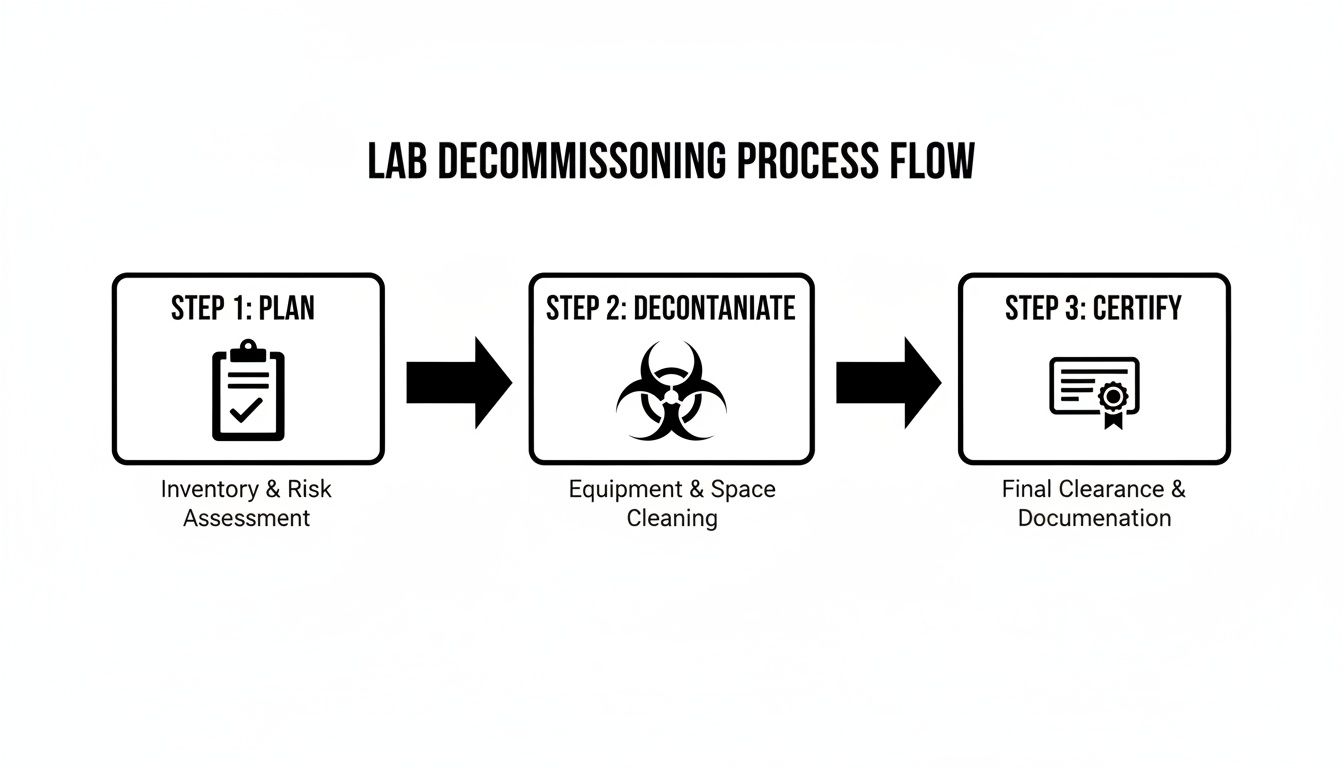
As you can see, a compliant process always starts with solid planning, moves through critical safety steps like decontamination, and finishes with official certification. Each phase is built on the one before it, creating a closed-loop system you can trust.
Working with a specialist who genuinely understands the fine points of handling scientific assets makes the entire process seamless. They bring the experience needed for everything from on-site de-installation and transport to certified data destruction and compliant recycling, serving clients locally in Georgia and nationwide. For a deeper dive, check out our guide on managing e-waste. This approach turns a potential liability into a well-managed, risk-free conclusion to your equipment's lifecycle.
Before a single piece of equipment gets unplugged or moved, you need a plan. And the very first step—the one that makes or breaks the entire project—is building a rock-solid asset inventory. We can't tell you how many decommissioning jobs get bogged down because a few critical items were tucked away in a storage closet and forgotten.
A detailed inventory isn't just about counting things. It’s your roadmap for safety, logistics, and compliance. It’s the single source of truth for your team and any disposal partner you bring in. Get this part right, and everything else flows smoothly.
Building Your Master Asset List
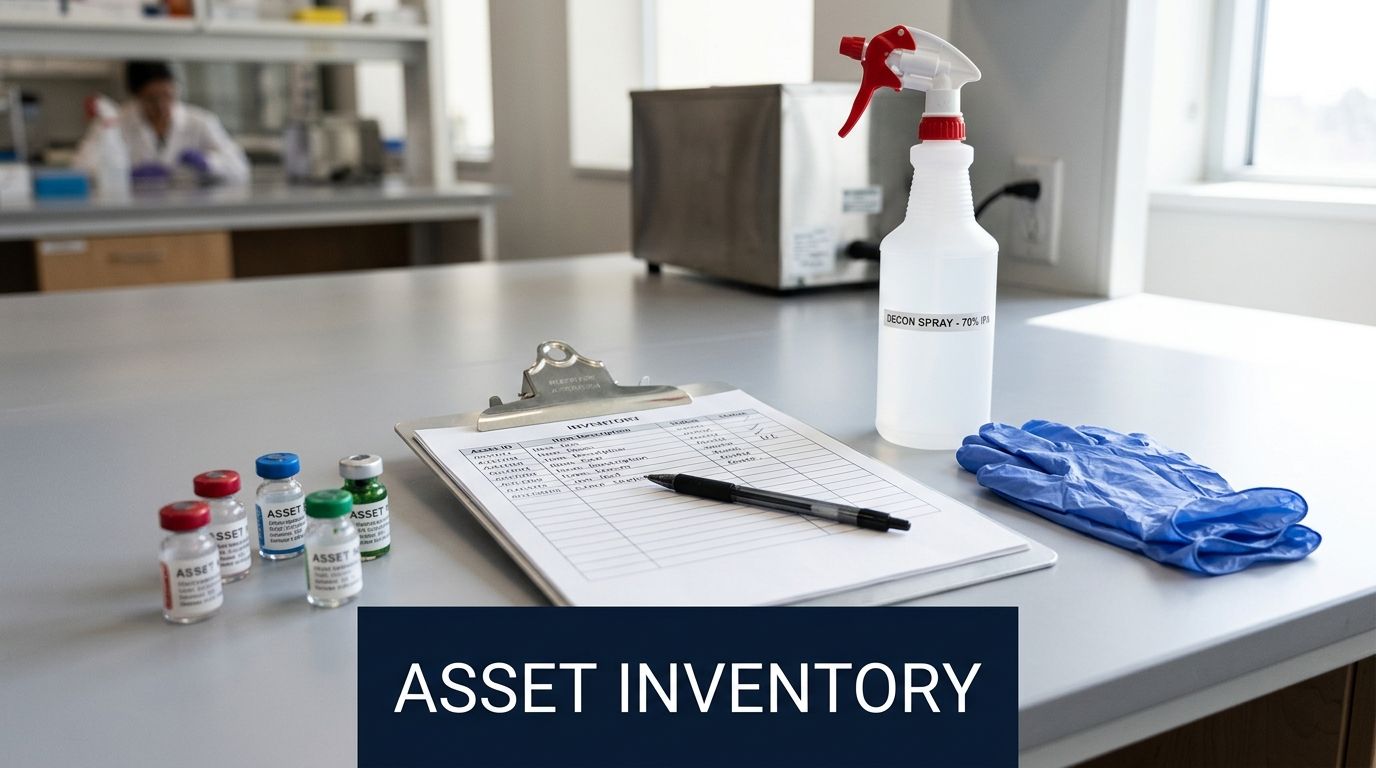
Your goal here is a master spreadsheet or database. This document will become the command center for the whole operation. Don't skimp on the details—the more information you capture now, the fewer headaches you'll have later.
For every single piece of lab equipment, make sure you document:
- Asset ID: A unique number you assign to track each item.
- Equipment Type: Be specific. Is it a Centrifuge, Microscope, HPLC System, or a PCR Machine?
- Manufacturer and Model: This is crucial for figuring out resale value and proper handling procedures.
- Serial Number: This is non-negotiable. It's essential for chain-of-custody, data destruction certificates, and tracking.
- Location: The exact room or lab bench where the asset currently lives.
- Condition: Is it working, broken, or only good for parts? Be honest.
- Decontamination Status: Add a column you can update later. Mark it "Pending," "Completed," or "N/A."
A detailed inventory isn't just for logistics; it’s a crucial risk management tool. By documenting the serial number and decontamination status of every asset, you create an auditable record that demonstrates due diligence and protects your organization from potential liability.
The Critical Steps of Decontamination
Once the inventory is locked down, it’s all about safety. Decontamination is the process of cleaning equipment to remove or neutralize any hazardous materials, making it safe for our team—and yours—to handle and transport. This is a non-negotiable step governed by strict OSHA guidelines, especially in labs that work with biohazards, chemicals, or radiological materials, and applies to facilities in every state.
The right procedure depends entirely on what the equipment was used for. This is work for trained personnel who know the risks and have the right personal protective equipment (PPE).
Real-World Scenario: A University Research Lab
Let's say a university biology lab in Atlanta, GA is closing its doors. Their inventory is full of biosafety cabinets, cell culture incubators, and freezers that once held biological samples. Here’s how the decontamination process would typically unfold:
- Biohazard Handling: First, any leftover biological materials are carefully disposed of according to the university’s own bio-waste protocols.
- Surface Decontamination: Next, trained staff in full PPE will meticulously clean all surfaces of the cabinets and incubators. The go-to is usually a 10% bleach solution, but other approved disinfectants can also be used.
- Documentation: After each piece is cleaned, a "Decontamination Verification" form is filled out, signed, and physically attached to the equipment. This tag proves what was done, when it was done, and who did it.
If you want to dig deeper into the science behind this, our detailed guide on the sterilization of equipments covers the various methods and why they matter.
From Inventory to Actionable Plan
With a complete asset list and a clear decontamination protocol in hand, you're ready to take action. This is the documentation a service provider—whether they're local to Atlanta or across the country—needs to give you a truly accurate quote and a realistic timeline. It tells them what kind of crew, packing supplies, and trucks to bring.
The last thing to do in this phase is to physically label every item. A simple tag on each piece of equipment showing its asset ID and confirming its decontamination status is a lifesaver for the logistics team. It prevents any mix-ups on pickup day and ensures the entire removal process is safe, secure, and efficient.
Implementing Bulletproof Data Security for Lab Assets
Let's talk about one of the biggest liabilities in lab decommissioning: data. A single hard drive from a seemingly harmless piece of laboratory and equipment can become a full-blown catastrophe if it falls into the wrong hands.
Failing to properly secure data isn't just an oversight; it's a legal and financial time bomb, especially for facilities governed by HIPAA or handling proprietary research. And no, dragging files to the trash bin on a desktop does absolutely nothing. The data is still there, waiting to be recovered.
True data security is about a verifiable, irreversible process. You need proof that every byte of sensitive information is gone for good. This isn't a place to cut corners—it’s where professional standards are non-negotiable for lab equipment disposal nationwide.
The Gold Standard for Data Wiping
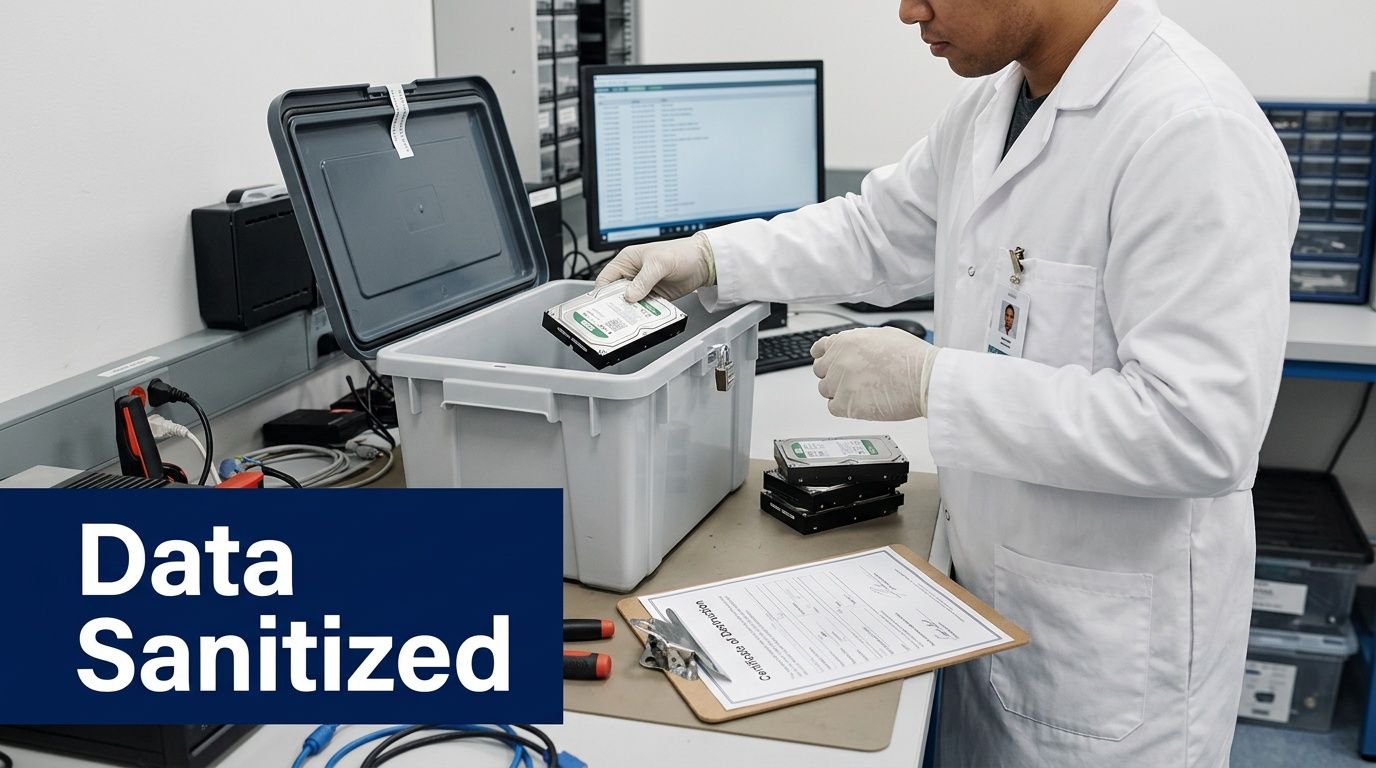
For any functional, spinning hard disk drive (HDD), the benchmark for data sanitization is the DoD 5220.22-M 3-pass wiping standard. This method, originally created for the U.S. Department of Defense, writes over every single sector of the drive with new data, not once, but three times.
Think of it as digital shredding. It scrambles the original information so thoroughly that no current technology can piece it back together. This is the method we use to ensure any Protected Health Information (PHI) is completely destroyed, meeting the strict demands of HIPAA.
The most significant risk in equipment disposal is often invisible. A single hard drive from a decommissioned piece of laboratory equipment can contain thousands of patient records or proprietary research data. Proper sanitization isn't just a best practice; it's your primary defense against a data breach.
When Physical Destruction Is Necessary
Data wiping works flawlessly for traditional magnetic hard drives, but it's not a one-size-fits-all solution. In many cases, the only way to guarantee data is gone is to physically destroy the media.
Physical destruction is the only foolproof method for:
- Solid-State Drives (SSDs): Because of the way SSDs store data, wiping software can't reliably erase every block. Shredding is the only way to be 100% certain the data is irretrievable.
- Non-functional Media: If a drive, backup tape, or flash drive is dead and won't power on, wiping software is useless. Physical destruction is your only path forward.
- Backup Tapes & Optical Media: LTO tapes, CDs, DVDs, and other similar media can't be wiped. They must be shredded to permanently destroy the information they hold.
Knowing which method to use for which type of media is a critical part of a secure disposal plan. You can learn more about our process and commitment to safeguarding your information in our overview of secure data destruction services.
Data Security in Action: A Hospital Scenario
Picture this: a hospital in the Atlanta metro area is overhauling its entire diagnostic lab. They're dealing with dozens of analyzers, workstations, and servers—all loaded with years of patient data.
Our team arrives on-site to handle the data security. First, we inventory every single drive, tracking each one by its unique serial number.
The functional HDDs are connected to our wiping stations, where they undergo the full DoD 3-pass process. For all the SSDs and a handful of older, failed drives, we bring in a mobile shredding unit. Right there in the hospital's parking lot, we physically shred the drives into confetti-sized pieces.
This isn't a niche problem. The market for laboratory equipment services is expected to reach USD 35.4 billion by 2030, largely due to these strict regulatory demands. With 20-30% of lab assets failing or being decommissioned each year, the need for certified partners who can both recycle equipment and securely destroy data is more urgent than ever for facilities nationwide.
Finally, the hospital receives a Certificate of Destruction. This isn't just a piece of paper; it's a legally binding document. It lists the serial number of every single drive that was wiped or shredded, creating an ironclad, auditable record that closes the chain-of-custody. This proof of due diligence is essential, and it aligns with best practices like encrypting data and backups to ensure total compliance. That certificate is the hospital's shield against any future claims.
Coordinating Logistics for De-Installation and Transport
You’ve inventoried the assets, handled decontamination, and wiped the hard drives. Now comes the hard part: physically getting all that laboratory and equipment out the door. This is where a smooth project can turn into a logistical nightmare if you're not careful.
Moving bulky, sensitive, and sometimes hazardous equipment is more than a simple moving job. It's a carefully choreographed process. Without a solid plan, you're looking at hallway gridlock, unavailable loading docks, damaged equipment, and even safety incidents.
Why You Need a Specialized Removal Service
Thinking of having your own staff handle a large-scale equipment removal? Think again. Your team members are brilliant scientists, researchers, and clinicians, but they aren't professional movers trained to handle a 500-pound centrifuge.
Trying to DIY this is a recipe for disaster. A specialized removal partner brings the right tools, trucks, and most importantly, experience to the table, whether for a local job in Georgia or a national project.
They'll manage the entire on-site process for you:
- Expert De-installation: Safely disconnecting equipment from power, water, and gas lines, and unbolting units anchored to the floor.
- Professional Packing: Using materials like anti-static wrap and custom crating to protect delicate instruments for the move.
- Efficient Transport: Loading everything onto a fleet of trucks, often with lift gates, for secure transport away from your facility.
This frees up your valuable staff to focus on their actual jobs, not wrestling with heavy machinery. You can get a better sense of how a structured process works by reading more about our approach to scientific equipment removal for labs and universities.
Coordinating With Your Facilities Team
During a lab cleanout, your facilities manager is your most important ally. You need to work hand-in-hand with them to avoid bottlenecks and ensure the actual removal day goes off without a hitch.
Make sure you schedule these key details well in advance:
- Elevator Access: If your lab isn’t on the ground floor, booking exclusive time for the freight elevator is non-negotiable.
- Clear Exit Routes: Map out the path from the lab to the loading dock ahead of time. Clear all hallways and schedule the removal for off-peak hours to avoid disrupting normal business.
- Power Shutdowns: For hard-wired equipment, coordinate with facilities to safely kill the power before the de-installation crew arrives.
- Loading Dock Access: Reserve the loading dock. The last thing you want is your truck waiting while other deliveries are being unloaded.
A Real-World Example: The Weekend Lab Move
A corporate R&D facility near Atlanta was consolidating labs and had to move over 200 pieces of equipment. By planning with their disposal partner three weeks in advance, they scheduled the entire job for a single weekend. This included dedicated elevator blocks and pre-cleared exit routes, which slashed the project downtime by an estimated 50%. On Monday morning, it was business as usual.
This kind of proactive planning is what separates a successful project from a chaotic one. With North America holding a commanding 35% share of the global laboratory equipment market, the pressure on facilities to manage surplus assets efficiently is immense.
Finally, remember that some of your equipment may still contain hazardous materials, even after decontamination. Transporting these items is a regulated activity. For instance, understanding the rules for shipping dangerous goods Class 8 (corrosives) is critical for compliance. A professional partner will know these regulations inside and out, ensuring every item is transported safely and legally.
Where Your Equipment Goes Next: Compliant Recycling and Final Certification
Just because your old lab equipment is loaded onto a truck doesn't mean the job is done. Far from it. What happens next is arguably the most critical part of the entire process—ensuring every piece is recycled or disposed of in a fully compliant, environmentally sound way.
This isn't just about ticking a box for your corporate social responsibility report. It's about protecting your organization from massive EPA fines and safeguarding your reputation. Simply put, sending old centrifuges, analyzers, or any e-waste to a landfill is not an option. You need a partner who knows exactly how to handle this for any location in the U.S.
What Real Recycling Looks Like
A certified recycling specialist does a lot more than just shred metal. They manage a complex and highly detailed downstream process designed to reclaim as much material as possible. We've seen it firsthand—it's a fascinating mix of disassembly, sorting, and refining.
This is where the real environmental and economic benefits kick in, as valuable commodities are pulled out and put back into the manufacturing stream.
- Metals Recovery: Everything from the steel housings and aluminum frames to the copper in the wiring is separated and smelted down for reuse.
- Plastics Processing: The various plastics used in equipment casings and components are sorted, shredded, and processed into raw material for new products.
- Circuit Board Refining: This is where the magic happens. Specialized refiners use chemical processes to extract precious metals like gold, silver, and palladium from circuit boards.
When you choose a partner, look for R2 (Responsible Recycling) or e-Stewards certifications. This is your guarantee that your equipment won’t be illegally shipped overseas or dumped in a landfill. It’s the gold standard that ensures the entire process is handled safely and ethically, a critical point for any lab, hospital, or university.
Making this choice says a lot about your organization's commitment to doing things the right way. It shows you value genuine environmental stewardship, not just meeting the bare minimum. For a deeper dive into the rules, check out our guide on EPA compliant laboratory equipment disposal.
Getting Your Proof: The Final Paperwork
If I can give you one piece of advice, it's this: don't close the project until you have the paperwork in hand. This final documentation is your legal proof that you followed every rule and fulfilled your obligations. Without it, an audit down the road could become a nightmare.
Once everything has been processed, your disposal partner must provide two key documents. These certificates officially close the chain-of-custody loop and prove what happened to every asset that left your building.
The Certificate of Recycling
This document confirms that all your non-data-bearing equipment was received and processed according to all federal, state, and local environmental laws. It's the official record showing that the materials were responsibly recycled, not trashed.
The Certificate of Destruction
This is your data security guarantee, and it needs to be detailed. As we covered before, this certificate should list the unique serial number of every single hard drive, solid-state drive, or data-bearing device that was wiped or physically shredded. No exceptions.
This isn't just bureaucratic red tape; these documents are your shield. They are the official, auditable record proving you did everything right. For a hospital, this is non-negotiable for HIPAA. For a corporate R&D lab, it's proof you protected your trade secrets. For any organization, it’s the final, crucial step to doing this job correctly.
Your Top Lab Decommissioning Questions Answered
Even with the best plan, staring down a lab full of old equipment can feel overwhelming. After guiding countless organizations through this—from Atlanta-area hospitals to national research universities—we’ve heard just about every question there is. We've compiled the most common ones here to give you some clear, straightforward answers.
Think of this as a conversation with someone who's been in the trenches. These are the real-world questions our clients ask, and the practical answers you need to get the job done right.
What Types of Laboratory and Equipment Can Be Recycled?
This is almost always the first question, and the answer is usually much broader than people think. A proper disposal program shouldn't cherry-pick—it should handle just about everything that powered your lab's operations, wherever your facility is located.
A truly comprehensive partner will take it all, not just the easy stuff. This includes:
- General Lab Equipment: Think centrifuges, incubators, shakers, hot plates, and microscopes. All of these are fully recyclable.
- Analytical Instruments: Yes, even the complex machines. We're talking mass spectrometers, HPLC systems, PCR machines, and flow cytometers.
- Associated IT and Electronics: This is a big one that often gets overlooked. It’s all the computers, servers, monitors, data storage arrays, printers, and network gear that made the science happen.
The short answer? If it has a plug, a battery, or a circuit board, it should be on the list for recycling. The goal is total clearance. Always double-check with your partner by reviewing their accepted items list so nothing gets left behind.
The best decommissioning projects end with a "broom clean" facility. A good partner takes it all, from a single pipette to a massive analytical system, ensuring you're left with an empty space and total compliance.
How Can I Guarantee My Sensitive Data Is Destroyed?
This is non-negotiable. Whether you're dealing with patient data covered by HIPAA or your own proprietary research, the liability from a data breach is massive. You can't just hope for the best.
The only way to be certain is with certified, auditable data destruction that follows established industry standards. This isn't just about wiping files; it's about providing legal proof.
You have two primary methods, and a good partner will offer both:
- DoD 5220.22-M 3-Pass Data Wiping: This is the gold standard for functional hard disk drives (HDDs). The process overwrites the entire drive with data three separate times, making the original information impossible to recover with any current technology. It's more than enough to satisfy HIPAA requirements.
- Physical Shredding: For solid-state drives (SSDs), which can’t be reliably wiped clean, this is the only answer. The same goes for any broken hard drives, old backup tapes, or other media. The drives are physically shredded into tiny, confetti-sized pieces.
Never accept a simple promise. You need a Certificate of Destruction that lists the serial number of every single drive and storage device that was destroyed. This document is your legal audit trail.
What Is the Cost to Dispose of Old Lab Equipment?
It's easy to focus on the price tag, but it's smarter to think of this as an investment in risk mitigation and compliance. The cost isn't just for hauling stuff away; it's for peace of mind. The final price can depend on the volume of equipment, how much on-site work is needed, and your location—from a lab in Georgia to a hospital system spread across multiple states.
But here's the good news: many specialized recyclers, especially those in hubs like the Atlanta metro area, have made their programs incredibly cost-effective. Some can even offer free pickup services for qualifying truckloads of equipment, often bundling in data destruction at no additional cost. This removes the financial roadblock to doing things the right way.
The best way forward is to request a custom quote based on the asset inventory you've already built. This ensures you get a firm price with no surprises.
What Final Documentation Should I Expect?
This is the last and arguably most important piece of the puzzle. Without the right paperwork, you have no legal proof that you handled the decommissioning process responsibly. This is what protects your organization from future audits or liability.
Once the job is done, you should receive two critical documents from your disposal partner. The project isn't truly finished until you have these in hand.
Look for these two certificates:
- A Certificate of Recycling: This document confirms all your non-data-bearing e-waste was processed in an environmentally sound way, in full compliance with EPA and local regulations.
- A Certificate of Destruction: This is your data security guarantee. It must provide a detailed, itemized list with serial numbers for every single hard drive or storage device that was wiped or shredded.
These certificates are more than just paperwork; they are your legal shield. For any lab, clinic, or research facility in Atlanta or across the country, this documentation is the final, essential step to a secure and successful project.
Are you planning a lab cleanout or facility shutdown? Scientific Equipment Disposal offers comprehensive, compliant solutions for disposing of your old laboratory and equipment. From our base in the Atlanta area, we provide on-site de-installation, secure data destruction, and certified recycling to ensure your project is handled professionally from start to finish, both locally and nationwide. Contact us today for a custom quote at https://www.scientificequipmentdisposal.com.