Secure IT Equipment Recycling Services in Snellville GA

A lot of IT recycling problems in Snellville start the same way. A clinic upgrades workstations. A lab retires an analyzer tied to an old PC. An office server gets replaced and nobody wants to touch the stack of drives, cables, monitors, and backup devices now sitting in a locked room.
That pile isn’t just taking up space. It can hold regulated data, create internal audit questions, and turn a simple cleanout into a chain-of-custody problem if the wrong vendor handles it. Facility managers usually know this. What they often need is a clear path that removes risk without creating extra work for their team.
That’s where IT Equipment Recycling Services in Snellville GA need to be judged differently. For business and institutional clients, the standard isn’t “can someone haul this away.” The standard is whether the process protects data, supports compliance, and handles equipment responsibly from pickup through final disposition.
Your Guide to Secure IT and Lab Equipment Recycling in Snellville
Monday morning in Snellville often starts the same way. A server refresh finished over the weekend, a few retired workstations are stacked in a storage room, and someone from the lab asks what to do with an analyzer PC and two loose drives that still need documented destruction. At that point, the job is no longer facilities cleanup. It is asset disposition with compliance exposure attached.
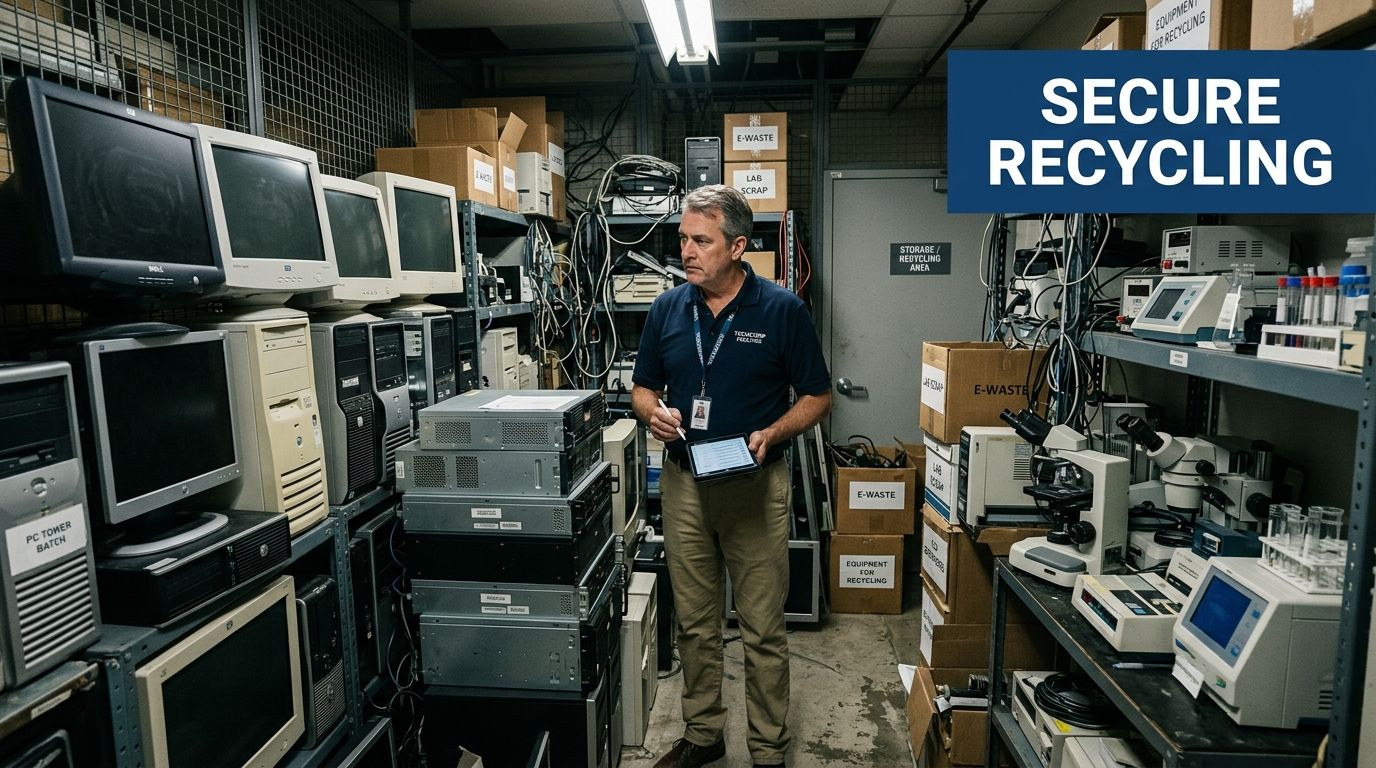
For regulated organizations in Gwinnett County, the primary question is not who will pick the equipment up. The primary question is who can document custody, separate reusable assets from destruction candidates, and process both standard IT gear and specialized lab equipment under one controlled workflow. Municipal drop-off programs and generic junk haulers serve a different purpose. They are not built for audit trails, serialized inventory, or media destruction tied to internal records.
That distinction matters in Snellville because many facilities here operate inside the Atlanta metro but answer to enterprise compliance standards set somewhere else. A local medical practice may need HIPAA support. A regional lab may need documented handling for embedded storage. A corporate office may need disposition records that satisfy internal security and procurement teams. S.E.D. handles those requirements as one coordinated project, with pickup, tracking, data destruction, recycling, and reporting managed together.
What facility managers need from the process
In practice, the same operational questions come up on almost every job:
- Which assets still contain data
- Which items need de-installation or staged removal
- Which devices can enter reuse or parts recovery
- Which media or systems require destruction
- Which records need to go back to compliance, IT, and facilities
I tell clients to treat retired IT and lab equipment the same way they treat any other controlled asset leaving the building. If it came from a patient area, a research space, a server room, or an access-controlled office, the disposition plan should match that risk. That keeps the process clear for your team and defensible during audits.
Why a specialized local partner changes the outcome
Snellville organizations benefit from short-haul logistics and local scheduling, but local presence alone is not enough. The provider also needs enterprise-grade discipline. That means clear chain of custody, crews that know how to work inside active facilities, and downstream processing that aligns with both environmental standards and regulated data handling.
End-of-life planning also supports broader sustainable IT practices. Equipment that can be remarketed or harvested for usable components should be separated before scrap processing begins. Equipment that has reached final retirement should move through certified recycling channels, not informal disposal streams that create environmental or reporting problems later.
If you are comparing options, review what a specialized IT equipment recycling service for business and laboratory environments includes. The gap between basic electronics pickup and secure enterprise disposition is where risk usually shows up, especially for Snellville facilities managing mixed inventories across offices, clinics, and labs.
Accepted IT and Laboratory Assets for Recycling
A Snellville facility cleanout usually includes more than one asset class in the same room. An IT closet may hold servers, battery backup units, old switches, and a box of loose drives. A lab may have benchtop instruments, the control PC beside them, and printers or label systems tied to the workflow. Those items should not be packed and processed the same way.
At S.E.D., we sort incoming projects by three factors first. Data-bearing risk, removal requirements, and the correct downstream path. That approach is practical for facility managers because it tells your team what needs documented handling, what needs technical de-installation, and what can move as standard electronic recycling.
Data center and IT infrastructure
This group usually carries the highest security exposure and the most site coordination. Equipment may be mounted in racks, connected to live networks, or stored after a partial refresh with missing asset records.
Typical assets include:
- Servers from offices, clinics, labs, and branch server rooms
- Storage arrays and backup hardware
- Network switches, firewalls, and routers
- Rack-mounted appliances and related power electronics
- External drives, backup media, and retired hard drives
The trade-off here is simple. These devices often look like ordinary surplus to non-specialized haulers, but they require more controlled handling. A facility manager needs a crew that can identify probable data-bearing media, remove equipment without disrupting adjacent systems, and separate drives or backup media for the correct destruction path.
End-user electronics
This category creates the most volume during office moves, lease turnovers, and refresh cycles across the Atlanta metro. The equipment is easier to move than rack gear, but it still needs structure if your organization has retention rules, internal asset controls, or regulated data concerns.
Common examples include:
- Desktop computers
- Laptops
- Monitors
- Keyboards, mice, and docking accessories
- Printers and office peripherals
- Cables, adapters, and small electronics
For residents and very small quantities of low-risk electronics, the City of Snellville’s Recycling Center at 2531 Marigold Road accepts electronics and lists operating hours of 8 am to 5 pm Monday-Saturday on the City of Snellville recycling page. The city also lists curbside recycling subscription details there.
For a business, healthcare practice, research group, or multi-department office, a B2B service is required when the project involves chain of custody, on-site removal, serialized inventory control, or documented data destruction. Municipal programs serve an important public role, but they generally are not set up for de-installation inside active facilities, audit-ready reporting, or regulated asset streams.
That distinction matters in Snellville. A public drop-off option may work for a few household devices. It does not replace a managed pickup for a medical suite, a university lab, or a corporate office closing out multiple rooms at once.
Scientific and medical instruments
Generic electronics recyclers often fall short. Lab and clinical equipment may contain embedded computers, specialty boards, pumps, optics, or components that require careful removal before final processing. Some units also come from controlled environments where your staff needs clear instructions before anything is touched.
Examples often include:
- Centrifuges
- Incubators
- Microscopes
- Analyzers
- Pipette-related support electronics
- Workstation-controlled instruments
- Lab PCs attached to testing systems
Some of these assets still have remarketing or parts-recovery value. Others belong in material recycling after safe teardown. The decision should be made by a team that understands both equipment value and compliance exposure, especially for regulated industries around Snellville that cannot afford a loose chain of handling.
Accepted equipment by category
| Category | Accepted Items |
|---|---|
| Data Center & IT Infrastructure | Servers, storage arrays, networking gear, backup devices, hard drives, rack-mounted electronics |
| End-User Electronics | Desktops, laptops, monitors, keyboards, mice, printers, docking stations, office peripherals |
| Scientific & Medical Instruments | Centrifuges, incubators, microscopes, analyzers, lab-attached computers, instrument control hardware |
| Supporting Electronics | Cables, adapters, accessories, small electronic components, related office and lab support devices |
If you are building an internal inventory before pickup, this reference list of accepted IT, electronics, and laboratory equipment helps teams sort mixed assets by room or department.
What works on pickup day
The cleanest projects start before the truck is scheduled. Group equipment by how it must be removed, whether it may contain data, and whether the item needs special handling because of size, fragility, or lab use.
A room-by-room review usually prevents the problems that slow projects down. Staff are not left guessing which devices need records, which units require technical removal, or which older instruments should be kept separate from standard office electronics. That is the difference between a basic recycling pickup and a controlled disposition project built for enterprise and regulated environments.
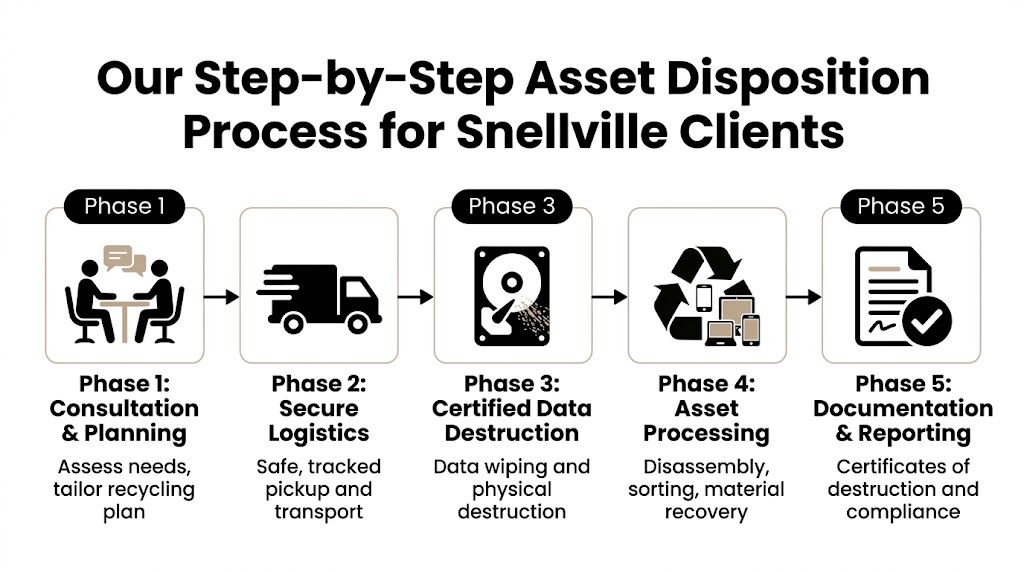
Our Step-by-Step Asset Disposition Process for Snellville Clients
A facility manager in Snellville usually calls us at the same point. The refresh is approved, old equipment is stacking up in offices or labs, and someone needs a pickup plan that will hold up under internal review. At that stage, the question is not whether the assets can be removed. The question is whether they can be removed without creating data exposure, workflow disruption, or documentation gaps.
At S.E.D., we run these projects as controlled asset disposition jobs, not as bulk junk removal. That distinction matters for medical practices, research groups, schools, manufacturers, and any Atlanta-area organization that may need proof of what left the building, how it was handled, and what happened to data-bearing devices after pickup.
Phase one consultation and planning
The first step is scoping the job correctly. We confirm what equipment is being retired, where it sits, how it is accessed, and whether any assets need technical removal or shutdown coordination.
For a Snellville outpatient office, that often means separating standard office hardware from systems tied to patient workflows. For a lab, it can mean accounting for instrument control computers, bench-top devices, and fragile equipment that cannot be treated like routine office electronics. For a corporate site, the main issue is often timing. Daytime pickup may interfere with staff, while after-hours access requires building coordination.
We answer a short set of practical questions early:
- Which rooms or departments are involved
- Which assets may contain data
- What equipment needs de-installation instead of simple removal
- Are there stairs, elevators, loading docks, or access restrictions
- What records will facilities, IT, or compliance need after the job closes
Good planning reduces delays on pickup day. It also keeps your staff from making disposal decisions in the hallway while equipment is already in motion.
Phase two on-site coordination
Pickup day should be controlled and quiet. Your staff should not be hunting for carts, wrapping monitors, or figuring out how to move a lab instrument through a narrow doorway.
That is one of the clearest differences between a specialized ITAD partner and a general recycling option. Some vendors expect the client to stage, palletize, or pre-sort everything before the truck arrives. We build labor and handling into the plan so the site team is not turned into the removal crew.
For facility managers, that trade-off is simple. Pre-staging everything can reduce pickup time, but it pushes work and risk back onto your department. A managed removal takes more coordination on our side, yet it gives you tighter control over chain of custody, room access, and asset segregation.
Phase three secure logistics
Once an item leaves its room, the logistics process matters as much as the recycling process. Equipment needs to stay identified, grouped correctly, and loaded in a way that matches the documented scope.
We keep handoffs limited because every extra transfer creates another chance for loss, damage, or confusion. Data-bearing assets should not be mixed casually with scrap peripherals. Lab systems should not be stacked like surplus office chairs. If a vendor cannot explain the custody path between pickup and processing, the risk has not been managed. It has just been moved off-site.
Our IT asset disposition services in Gwinnett County GA are built around that discipline. The goal is straightforward: the right vehicle, the right labor, the right loading sequence, and records that match the project you approved.
Phase four processing and data destruction
After transport, assets are evaluated by condition, data risk, and recovery potential. Some equipment can be refurbished or harvested for useful components. Some material belongs in responsible recycling streams. Data-bearing media follow a separate path because they create a separate liability.
Local convenience stops being enough. Municipal drop-off programs and small local recyclers may be fine for household electronics, but regulated organizations in Snellville usually need stronger controls. A healthcare office, education client, or lab cannot rely on a vague promise that devices were "taken care of."
That expectation is well understood in discussions of data security and compliance in lab environments, where the handling standard has to reflect the sensitivity of the work. In practice, that means identifying media correctly, routing it into the right destruction workflow, and preventing mix-ups between reusable equipment and assets that must be destroyed.
Common processing paths include:
- Reuse review for functional devices with remaining service life
- Media segregation for drives and other storage devices requiring controlled handling
- Parts and material recovery for equipment at end of life
- Special handling for laboratory or technically sensitive equipment
Phase five documentation and reporting
Documentation is what turns a pickup into a defensible disposition record. Without it, a project may look complete on the loading dock and still fail an audit later.
Most Snellville clients ask for some combination of the following:
- Asset summaries showing what was collected
- Chain-of-custody records tied to the removal
- Certificates of Destruction for applicable media or devices
- Project confirmation showing the agreed disposition was completed
This part matters most after the equipment is gone. IT may need it for asset retirement. Facilities may need it for project closeout. Compliance, legal, or leadership may need it months later when nobody wants to reconstruct the job from email threads.
A controlled process keeps all of that organized from the start. It protects the site, reduces pressure on your internal teams, and gives you a local partner in the Atlanta metro that can handle regulated equipment the way generic recycling services cannot.
Data Destruction and Compliance Certifications for Your Protection
For regulated organizations, data destruction is the center of the project. Everything else is secondary.
A retired computer can still hold protected health information, research data, student records, HR files, financial records, saved credentials, or cached documents long after it has stopped being useful to your staff. Formatting a drive doesn’t solve that problem. Sending it out with general scrap definitely doesn’t.
What proper sanitization looks like
The benchmark that matters here is method, not marketing language. According to STS Electronic Recycling’s Georgia service-area information, NIST-compliant and DoD 5220.22-M 3-pass sanitization overwrites data three times to render it forensically unrecoverable, reducing the probability of data remanence to less than 1 in 10 trillion. That page describes the standard as a safeguard for medical labs and government agencies handling sensitive information and notes that it exceeds a simple format or single-pass wipe on STS Electronic Recycling’s Georgia service page.
That’s the practical dividing line. Real sanitization is deliberate, documented, and appropriate to the media. It isn’t a quick reset. It isn’t deleting folders. It isn’t trusting that old hardware is “probably empty.”
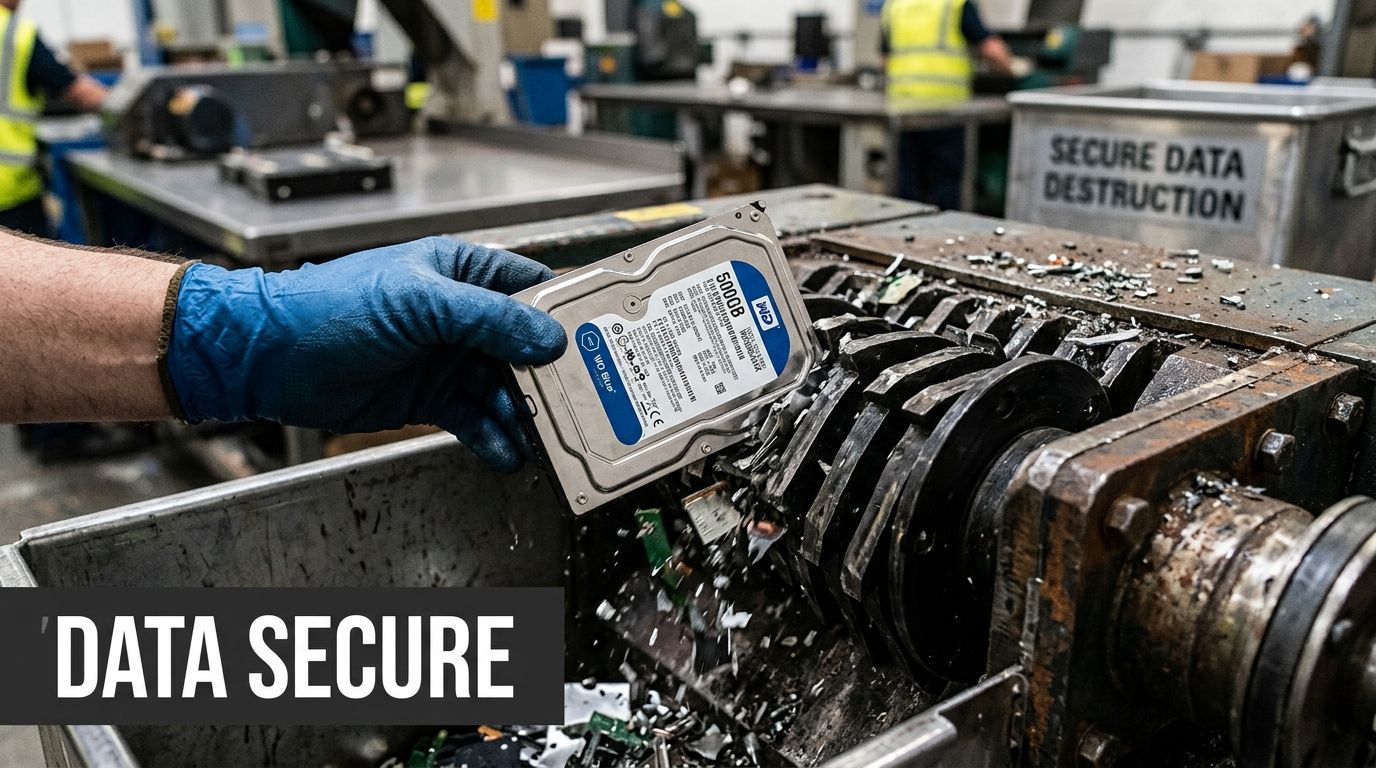
Wiping versus shredding
Different media require different end-of-life decisions.
Use cases often break down this way:
- Reusable drives may be candidates for compliant wiping when the media is functional and the disposition plan supports reuse.
- Nonfunctional media usually belongs in physical destruction because wiping isn’t reliable if the drive can’t be processed correctly.
- High-security environments may choose shredding even when a drive still works, because policy and risk tolerance justify direct destruction.
That’s why an experienced provider doesn’t use a one-size-fits-all script. The right answer depends on media condition, data classification, and the client’s internal requirements.
Risk check: If you can’t prove how data-bearing devices were handled, you don’t have a defensible disposal record.
Why chain of custody matters
Chain of custody means there’s a documented path from collection through transport and processing. For a facility manager, that record matters because it shows who handled the equipment, when it moved, and what final action was taken.
Without that record, a disposal event can create uncertainty at exactly the wrong time. If legal, compliance, or executive stakeholders ask what happened to a batch of retired drives, “we scheduled a pickup” isn’t enough.
What a Certificate of Destruction does
A Certificate of Destruction gives your organization a formal record that specific data-bearing materials were destroyed under the agreed process. It isn’t just a receipt. It’s part of your audit trail.
Healthcare groups, educational institutions, research organizations, and public agencies all benefit from that clarity. It supports internal policy enforcement and makes external review easier.
Organizations managing sensitive scientific environments also need to think beyond the drive itself. Device retirement often intersects with broader operational controls around systems, access, and handling procedures. This overview of data security and compliance in lab environments is a useful companion read for teams building stronger processes around regulated equipment.
For local organizations that need a practical service path, this page on secure data destruction in Snellville GA shows what to look for when evaluating a vendor.
Logistics Scheduling and Case Studies from Gwinnett County
Scheduling is where a good recycling plan becomes real. Facility managers don’t need drama on pickup day. They need a crew that shows up prepared, understands access constraints, and clears equipment without disrupting the building.
The local advantage in Gwinnett County is that many projects share the same operational realities. Medical offices have patient traffic. Schools and colleges have move-out windows. Corporate offices have access controls and limited loading zones. Labs have equipment that can’t easily be dragged onto a cart.

A clinic server room cleanout
A small medical group in the Snellville area may only have a handful of old servers, backup devices, and front-desk workstations to remove. On paper, that sounds simple.
In practice, these projects usually involve tighter handling requirements than larger office pickups. The equipment often sits in active patient environments. Staff need the work done with minimal disruption. Management wants a record of what left the building. The right plan is a scheduled removal window, direct loading, and a documented disposition path for the data-bearing devices.
A college lab upgrade in Gwinnett County
Campus projects often look different. Instead of one room full of obvious IT assets, there may be a mix of decommissioned lab instruments, attached computers, displays, and network gear spread across departments.
What works here is staged coordination. The facilities team identifies access windows. Department heads confirm what’s approved for release. The pickup crew removes equipment by area, rather than forcing campus staff to centralize everything beforehand.
That lowers disruption and reduces the risk that approved items get mixed with active equipment.
A corporate office electronics refresh
Office refreshes create a different problem. Volume builds quickly, but it comes from many small endpoints. One department has monitors. Another has docking stations and old laptops. A storage room fills with cables, printers, and retired desktops.
These projects move best when clients provide a basic room list and note any devices that still need signoff from IT. Once that’s done, the pickup can be organized around floor access, freight elevator availability, and loading sequence.
The easiest pickups happen when the client identifies decision-makers before the truck arrives.
How scheduling usually works
For Snellville organizations, the scheduling process is usually straightforward if a few details are settled early.
- Confirm scope first so the pickup team knows whether the project is a cart-out, de-installation job, or mixed lab and IT removal.
- Flag sensitive areas such as clinics, research spaces, records rooms, and server closets.
- Set site access rules including badges, dock instructions, elevator reservations, or after-hours preferences.
- Identify internal approvals if some assets are awaiting signoff from IT, compliance, or department leadership.
If you’re planning a larger collection, a local starting point is to review options for free business electronics pickup in Gwinnett County GA, especially when multiple categories of devices need to move at once.
What affects project cost
Pricing usually depends on the work required, not just the existence of equipment.
The biggest drivers tend to be:
- Volume and mix of assets
- Whether on-site de-installation is needed
- Physical access conditions
- The presence of data-bearing media
- Whether the project includes specialized lab equipment
That’s why simple phone quotes are often less useful than a scoped assessment. The more accurately the job is defined, the fewer surprises both sides deal with later.
Frequently Asked Questions about IT Recycling in Snellville
Is there a minimum amount of equipment required for a business pickup in Snellville
That depends on the provider, the asset mix, and the travel and labor involved. In practice, many business pickups become worthwhile when equipment includes multiple devices, data-bearing media, or items that require on-site handling.
If your quantity is small, don’t assume it isn’t serviceable. Ask based on the actual inventory, not just item count. A few servers and drives may require more care than a large pile of low-risk peripherals.
Do we need to box or palletize equipment before pickup
Often, no. For many business and institutional projects, especially where de-installation or room-by-room removal is involved, the better service model is for the pickup team to handle the physical removal.
That’s especially important for labs, clinics, and offices where staff time is limited and equipment may be awkward or sensitive to move.
Can old hard drives be wiped instead of shredded
Sometimes, yes. It depends on whether the drives are functional, whether the client allows sanitized reuse, and what the organization’s own policy requires.
If the media is damaged, nonfunctional, or tied to a higher-security disposition policy, shredding is usually the cleaner answer. The right process is the one that aligns with your compliance obligations and leaves a defensible record.
What if we have both lab equipment and standard office electronics
That’s common. Many pickups involve a mixed inventory.
The key is to identify which assets are ordinary office electronics, which are data-bearing IT devices, and which are specialized instruments. Once those groups are separated, the logistics plan becomes much easier to manage and the downstream processing can follow the right path for each type.
Will municipal recycling work for our business
It may work for very limited situations, especially if you’re dealing with straightforward electronics and no regulated data concerns. But once you have compliance obligations, chain-of-custody needs, or specialized equipment, a business-focused recycling service is usually the safer choice.
That difference matters most for healthcare, education, research, government, and corporate environments where disposal records may be reviewed later.
Do recyclers ever purchase equipment with resale value
Sometimes. Functional business equipment, reusable systems, or certain instruments may have remarketing or refurbishment value depending on age, condition, and demand.
That evaluation should happen case by case. Don’t assume old equipment is worthless, but don’t build a project plan around resale unless the provider confirms it after review.
How should we prepare for pickup day
The best preparation is organizational, not physical.
A simple checklist helps:
- Identify what’s leaving by room, closet, or department
- Separate uncertain items that still need approval
- Mark restricted areas where vendor access needs escorting
- Notify internal stakeholders such as IT, facilities, compliance, and department managers
- Keep active equipment clearly excluded from the removal zone
If you do those five things, pickup day usually goes much more smoothly.
What sustainability information should we ask for
Ask for clear reporting on the disposition path. You want to understand whether equipment was recycled, refurbished, or destroyed, and whether the process aligns with your organization’s environmental standards.
For many clients, the goal is straightforward. They want proof that retired equipment was handled responsibly and not treated like general trash. Good reporting supports internal sustainability and procurement conversations even when the organization doesn’t need a formal public-facing metric package.
How quickly should we act on stored retired equipment
Sooner than ideal. The longer retired devices sit in closets, cages, or back rooms, the more likely they are to be forgotten, moved without tracking, or handled inconsistently.
Stored assets create operational drag. If they also contain data, they create avoidable exposure. Once equipment is out of service and approved for disposition, it’s better to move it through a controlled process than let it age into a problem.
What should we look for in an IT recycling partner in Snellville
Focus on operational specifics:
- Can they handle on-site de-installation
- Do they understand regulated environments
- Can they manage mixed IT and lab inventories
- Will they provide documentation
- Is their data-destruction process clearly defined
- Can they coordinate logistics without burdening your staff
Those questions reveal more than a marketing brochure ever will. The right provider makes the process feel controlled from the first call through final documentation.
If you’re dealing with retired servers, office electronics, lab workstations, or mixed e-waste in Snellville, the next step is simple. Get the inventory reviewed, identify the data-bearing devices, and build the pickup around your compliance needs rather than trying to improvise around a storage-room problem.
Scientific Equipment Disposal helps Snellville organizations remove that burden with secure, business-to-business recycling and disposition services for IT and lab assets across the Atlanta metro. If you need a practical plan for pickup, de-installation, data destruction, or full facility cleanout, request an assessment from Scientific Equipment Disposal.