IT Equipment Recycling Services in Grayson GA: Secure Guide

You probably have a back room, closet, lab corner, or server rack holding equipment nobody wants to touch. Old desktops from a refresh. Retired switches. A freezer controller with an embedded drive. A few laptops with unknown data on them. Maybe a stack of analyzers and centrifuges that straddle the line between lab equipment and IT.
That’s where IT Equipment Recycling Services in Grayson GA gets complicated.
For facilities in Grayson and the wider Gwinnett area, the challenge usually isn’t deciding whether equipment has to go. It’s figuring out how to move it out securely, document the chain of custody, avoid compliance mistakes, and keep logistics from becoming a budget headache. Atlanta has plenty of recyclers, but metro-edge locations often run into slower scheduling, vague pickup terms, and services built for standard office electronics rather than mixed lab and IT environments.
A good IT asset disposition program solves all of that in one motion. It protects data, routes equipment through compliant recycling channels, and gives your facility team documentation you can hand to compliance officers, auditors, or leadership without scrambling later.
Why Professional IT Recycling is Non-Negotiable in Grayson
Throwing obsolete IT equipment into a general cleanout stream is risky. So is treating recycling like a basic hauling job. Once a device has stored data, touched regulated workflows, or entered a medical, education, or research environment, disposal becomes a risk-management decision.
That matters in Grayson because many organizations here operate with smaller on-site teams than downtown Atlanta facilities. A clinic manager, lab director, school IT lead, or operations coordinator may be handling decommissioning on top of other responsibilities. When that happens, equipment often sits longer than it should, and undocumented storage creates its own problems.
The risk is two-sided
One side is data security. A deleted file isn’t the same thing as a sanitized drive. Devices can still contain patient information, employee records, research data, student records, credentials, or network configurations long after they leave daily use.
The other side is environmental compliance. Electronics contain materials that can’t be handled like ordinary trash. If your organization can’t show how equipment was processed, who handled it, and where it went, you’ve created an avoidable compliance gap.
Practical rule: If an asset ever stored data or plugged into your network, treat its disposal like a controlled process, not a pickup request.
The broader market trend reinforces the point. Global e-waste generation is accelerating, while documented formal collection and recycling is growing at a pace nearly five times slower than e-waste generation itself, according to the Global E-Waste Monitor 2024 coverage in Waste Management World. That gap means a huge volume of electronics still moves through improper or poorly documented disposal channels.
For a Grayson facility manager, that isn’t abstract. It means you should assume not every downstream vendor operates with the same controls, certifications, or reporting discipline.
What fails in the real world
Several disposal approaches look cheap at first and create problems later:
- Informal liquidation often leaves data-bearing assets without verifiable sanitization records.
- General junk removal may clear space quickly but usually doesn’t provide the audit trail needed for regulated environments.
- DIY storage and slow rollouts can leave obsolete assets sitting on-site for months, unmanaged and untracked.
- Free pickup offers can sound attractive until you discover exclusions, volume thresholds, or missing documentation.
What works is a provider that treats decommissioning as a controlled chain of custody. That means serialized handling, documented pickup, clear disposition paths, and proof of what happened to every class of asset.
For organizations managing recurring technology turnover, working with a specialized e-waste recycling company is usually the difference between a documented process and a guessing game.
Why this hits healthcare, education, and labs hardest
Hospitals, clinics, universities, and research facilities generate unusually messy retirement streams. They don’t just retire standard laptops and monitors. They retire workstations connected to instruments, embedded controllers, local storage inside specialty devices, and hybrid equipment that falls between facilities, IT, and compliance teams.
That’s why professional IT recycling isn’t just about sustainability. It’s about assigning responsibility clearly, closing audit gaps, and making sure old assets don’t become tomorrow’s incident report.
The Complete IT Equipment Recycling Process Explained
A strong ITAD process should feel boring in the best possible way. Nothing should be improvised. Every handoff should be documented. Every asset should move through a clear path from pickup to final disposition.
Think of the process as a secure chain of custody. If that chain breaks at any point, whether on-site, in transit, or during processing, your risk goes up.
Intake starts before anyone loads a truck
The first step is scoping. A competent recycler asks what types of assets you have, where they’re located, whether any contain regulated data, whether de-installation is required, and whether the load includes standard IT, specialty electronics, or lab-linked devices.
At this stage, the facility team should identify:
- Which assets are data-bearing
- Which assets may have resale or reuse value
- Which items need physical removal from racks, benches, carts, or storage rooms
- Whether any equipment requires client-side decontamination before pickup
A vague inventory doesn’t stop a project, but it does slow down quoting and scheduling. The best projects start with at least a working list, room by room or department by department.
On-site handling should be serialized and controlled
Once technicians arrive, the process should move from estimate to evidence. Assets are typically tagged, counted, and grouped by handling path. Data-bearing items should never be mixed casually with low-risk peripherals.
Chain of custody takes on tangible importance. Good teams don’t just “take the stuff.” They record what they received, where it came from, and how it will be processed. In healthcare and research settings, that matters as much as the recycling itself.
The pickup isn’t the end of the job. It’s the first auditable step.
Practical on-site tasks often include:
- De-installation: Removing servers, workstations, networking gear, or connected devices from active spaces
- Segregation: Separating storage media, reusable equipment, scrap units, and specialty electronics
- Packing for transit: Using containers, pallets, or protected loading methods that reduce breakage and miscounts
- Documentation: Logging asset identifiers where available, especially for drives, servers, and managed devices
Data sanitization is where weak vendors get exposed
For data-bearing assets, the question isn’t whether data was “deleted.” The question is whether sanitization met a recognized standard and can be proven later.
Certified ITAD providers can achieve 99.9% data recovery prevention rates by following NIST 800-88 guidelines, using multi-pass overwrite software followed by physical verification, while simple deletion can still allow for up to 80% data recovery with forensic tools, according to POSRG’s ITAD process overview.
That difference is why professional sanitization matters.
A typical controlled path may include software-based wiping for functional drives and physical destruction for failed, obsolete, or nonstandard media. Tools and methods vary by asset, but the principle doesn’t. You need a documented method tied to the device.
Final disposition should split assets by best outcome
Not every retired item should be shredded. Some equipment still has useful life. Some should be harvested for parts. Some belongs in material recovery. A mature recycler sorts accordingly.
A practical disposition model usually looks like this:
| Path | Best use case | What the client should receive |
|---|---|---|
| Reuse or refurbishment | Functional assets with remaining value | Asset reporting and disposition record |
| Data sanitization and resale | Standard laptops, desktops, or servers that pass testing | Sanitization proof and inventory detail |
| Physical destruction | Failed drives, obsolete media, damaged storage | Certificate of destruction |
| Commodity recycling | Non-functional electronics and peripherals | Recycling documentation |
The closeout package matters more than most teams expect
At the end of the project, your organization should have paperwork that ties the entire event together. That may include pickup records, serialized reports where applicable, data destruction confirmation, and summary disposition details.
If a recycler can remove equipment quickly but can’t document what happened after pickup, the process isn’t finished. It’s just hidden from view.
Mastering Data Security and HIPAA Compliance
For healthcare and research organizations, the hardest part of IT recycling usually isn’t transportation or sorting. It’s proving that data was handled properly across nonstandard devices, mixed asset types, and departments that don’t always share the same records.
That’s why compliance has to be designed into the disposition workflow from the first inventory review.
Hybrid lab-IT assets are the blind spot
A lot of Atlanta-area recycling content assumes your environment looks like a normal office. That’s not true for many Grayson-area clinics, labs, and university departments. They’re retiring centrifuges with embedded boards, analyzers tied to local workstations, imaging accessories, benchtop equipment with storage, and older instruments that nobody has fully mapped.
That category is where sloppy language from vendors becomes dangerous.
A significant gap exists in the Atlanta recycling market for handling hybrid lab-IT assets. While 70% of providers claim secure wiping, only 25% use certified 3-pass sanitization for non-standard drives found in medical and lab equipment, and Georgia saw a 12% rise in lab-data incidents, according to the Atlanta electronics recycling analysis at PC Liquidations.
If your equipment list includes anything outside ordinary laptops and desktops, ask very direct questions about how the vendor identifies embedded storage, removable media, and nontraditional drives.
What compliance proof should look like
A verbal assurance doesn’t help in an audit. A line item that says “disposed” doesn’t help either.
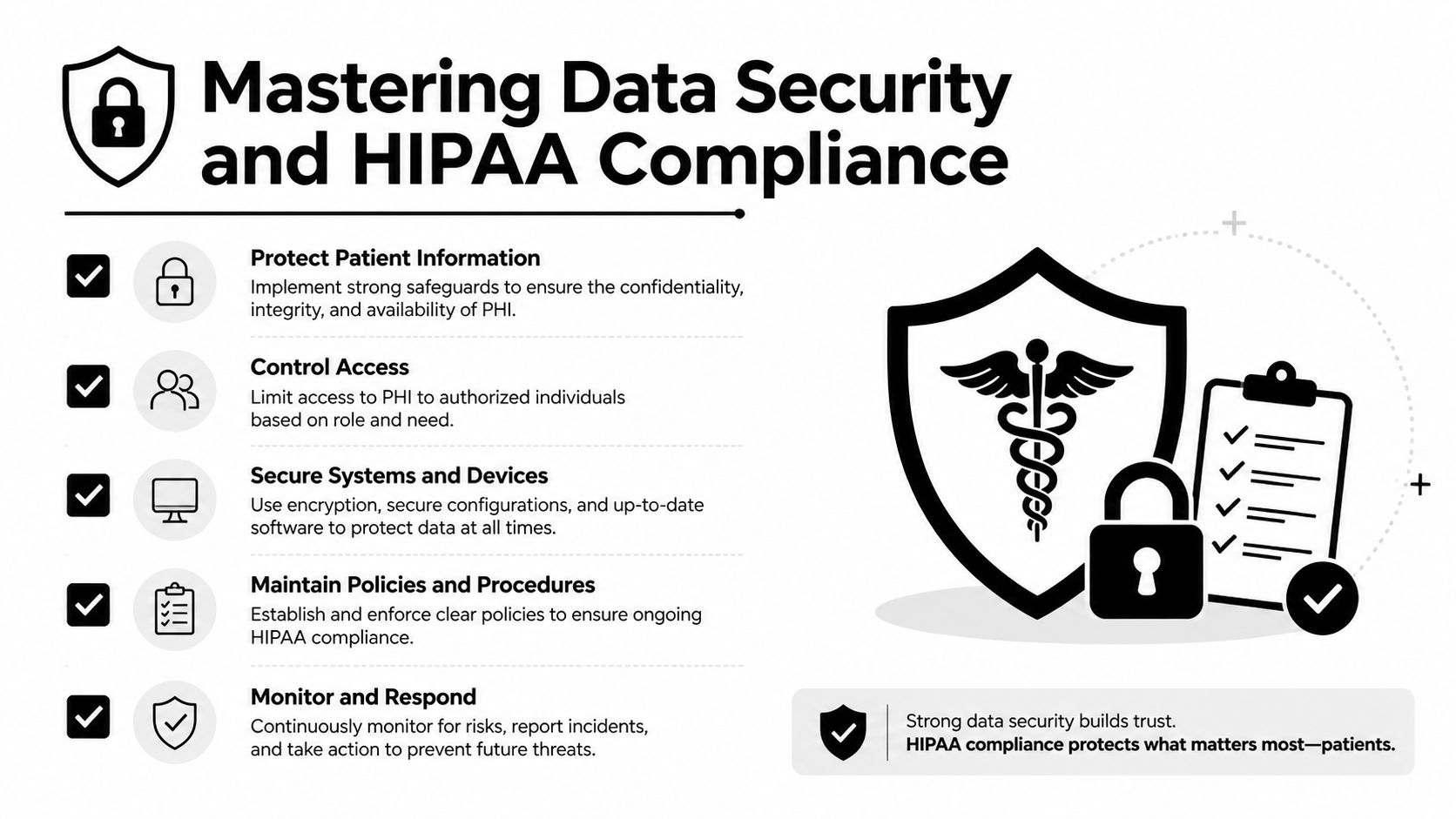
For regulated environments, documentation should connect the asset, the sanitization method, and the final outcome. That’s the role of a Certificate of Data Destruction or equivalent destruction record. It shows that the organization took deliberate steps to render data inaccessible and can trace that action back to a pickup event or inventory list.
A useful compliance file usually includes:
- Asset identification: Serial numbers, tags, or grouped inventory references where available
- Method used: Sanitization, shredding, or another documented destruction path
- Date and custody trail: When the item was received and processed
- Responsible processor: The party that performed the work under controlled procedures
For teams trying to standardize records before an audit or internal review, tools focused on document intelligence for HIPAA can help organize policy, retention, and evidence workflows around regulated data handling.
HIPAA, NIST, and the practical standard
HIPAA doesn’t tell you to press one button or use one software product. What it demands is reasonable protection for protected health information and evidence that your processes support that duty.
NIST-based sanitization standards matter because they give organizations a recognized framework for handling storage media. In practice, that means your recycler should be able to explain when they use software wiping, when they escalate to physical destruction, and how they verify either method.
If a vendor says “we wipe everything securely” but can’t explain how they handle failed drives, embedded media, or device-specific storage, keep asking questions.
That’s especially important for decommissioned lab systems. Some equipment contains storage in places that aren’t obvious to a facilities coordinator or general recycler. A disciplined process identifies those risks before assets leave the building.
If your project includes media destruction needs, a provider focused on secure hard drive destruction in Grayson GA should be able to walk through both software sanitization and shred-based destruction in plain language.
Questions worth asking before pickup
Use these as a quick screening checklist:
- How do you identify non-standard or embedded storage in lab equipment?
- When do you wipe versus shred?
- What proof do you issue after processing?
- Can you maintain chain of custody from on-site pickup through destruction?
- How do you separate decontamination responsibility from data destruction responsibility?
The right provider won’t treat those questions as edge cases. In healthcare and research, they’re standard.
Logistics and Accepted Assets for Atlanta Area Facilities
The most overlooked part of IT Equipment Recycling Services in Grayson GA is geography. A recycler based for central Atlanta pickups may still serve Gwinnett County, but that doesn’t mean the experience is built for your location.
For Grayson-area facilities, logistics shape everything. They affect scheduling, labor planning, loading access, and whether a “free pickup” stays free once the route gets more complicated.
Why Grayson jobs get priced differently
Metro-edge service usually looks straightforward on a website and becomes more restrictive during scheduling. The problem isn’t just distance. It’s route density, crew allocation, and whether the provider can justify a truck run for your volume and asset mix.
That’s why this market detail matters. An EPA-cited issue noted in Grayson-focused recycling coverage is that 40% of small-town businesses face 20-50% higher disposal fees due to transport, as discussed by Reworx Recycling’s Atlanta e-waste page. For facility managers, that explains why some quotes change after the first call or why pickup windows suddenly stretch.
Providers with their own local fleet and on-site capabilities usually handle this better because they control routing and labor directly instead of trying to bolt your project onto a downtown-first schedule.
What facilities usually need removed
Most Grayson projects involve a mixed stream, not a single asset class. That’s especially true for clinics, schools, municipal sites, and research operations.
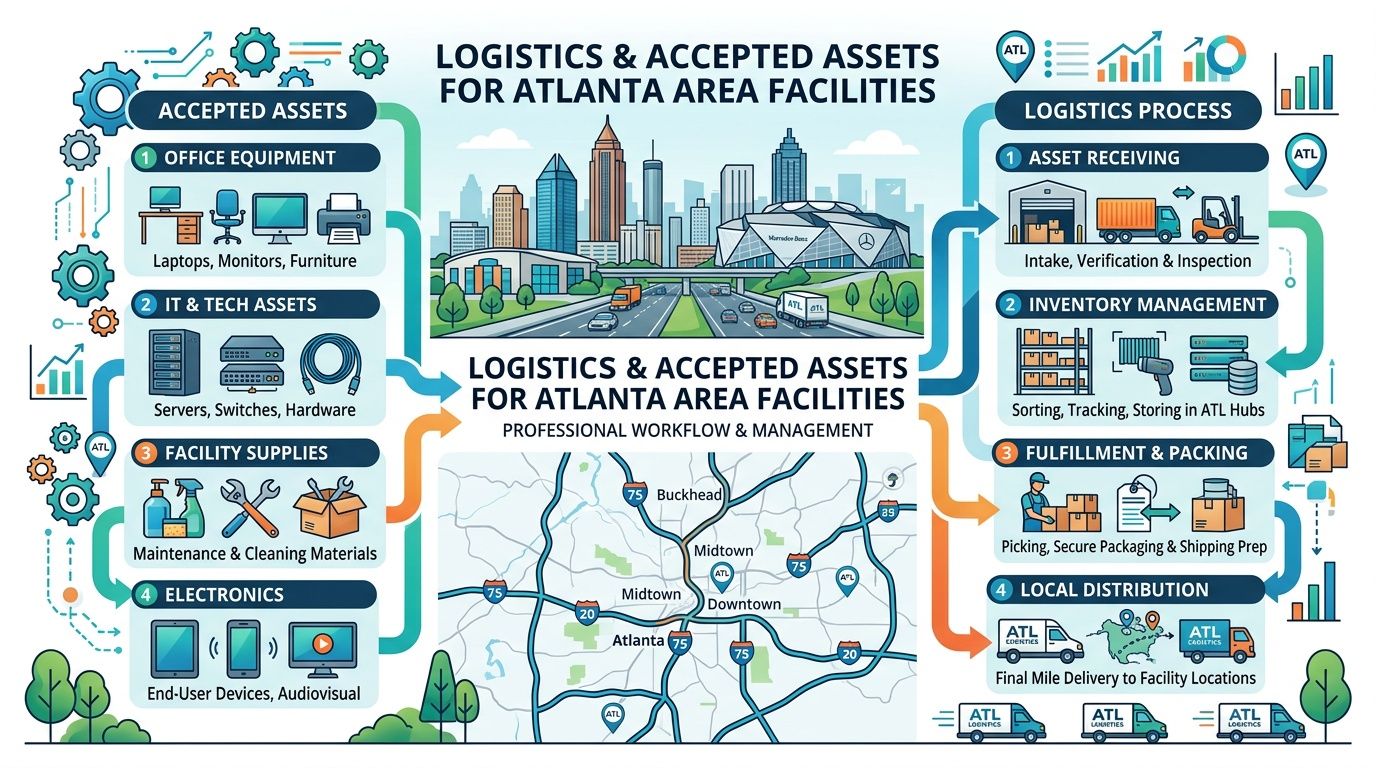
Common categories include:
- End-user devices: Laptops, desktops, tablets, thin clients, and monitors
- Infrastructure gear: Servers, racks, switches, firewalls, UPS units, and storage arrays
- Office electronics: Printers, copiers, phones, scanners, and accessories
- Lab-adjacent electronics: Instrument controllers, embedded PCs, analyzers, benchtop devices, and data-bearing peripherals
- Support equipment: Keyboards, cables, docking stations, power supplies, and small mixed electronics
The tricky part isn’t whether these items can be recycled. It’s whether the vendor knows how to separate standard e-waste from specialized assets that require different intake handling.
A detailed accepted items list for business recycling projects helps facility teams pre-sort what can move together and what may need special handling.
On-site realities that affect project success
Good logistics planning starts with the building, not the truck.
A few examples make the point:
- A medical office with elevator access needs different loading coordination than a ground-floor warehouse.
- A school district clearing multiple campuses needs staged pickups and room-level labeling.
- A lab shutdown may require de-installation from benches or casework before anything is ready to move.
The fastest projects aren’t always the ones with the smallest volume. They’re the ones where access, asset grouping, and internal sign-off were handled before pickup day.
What works better than broad metro service
For Grayson and nearby communities, the strongest model is local staging plus direct pickup capability. That reduces the chance that your job gets deprioritized behind larger central-city routes.
A practical checklist before scheduling:
| Question | Why it matters |
|---|---|
| Do you have your own pickup fleet? | It affects flexibility and route control |
| Can you de-install equipment on-site? | It prevents your staff from becoming movers |
| Do you accept mixed IT and lab assets? | It avoids splitting the project across vendors |
| Will you document chain of custody at pickup? | It supports compliance and internal controls |
A facility manager shouldn’t have to translate between IT, compliance, and a generic hauling team. The vendor should already understand how those pieces fit together.
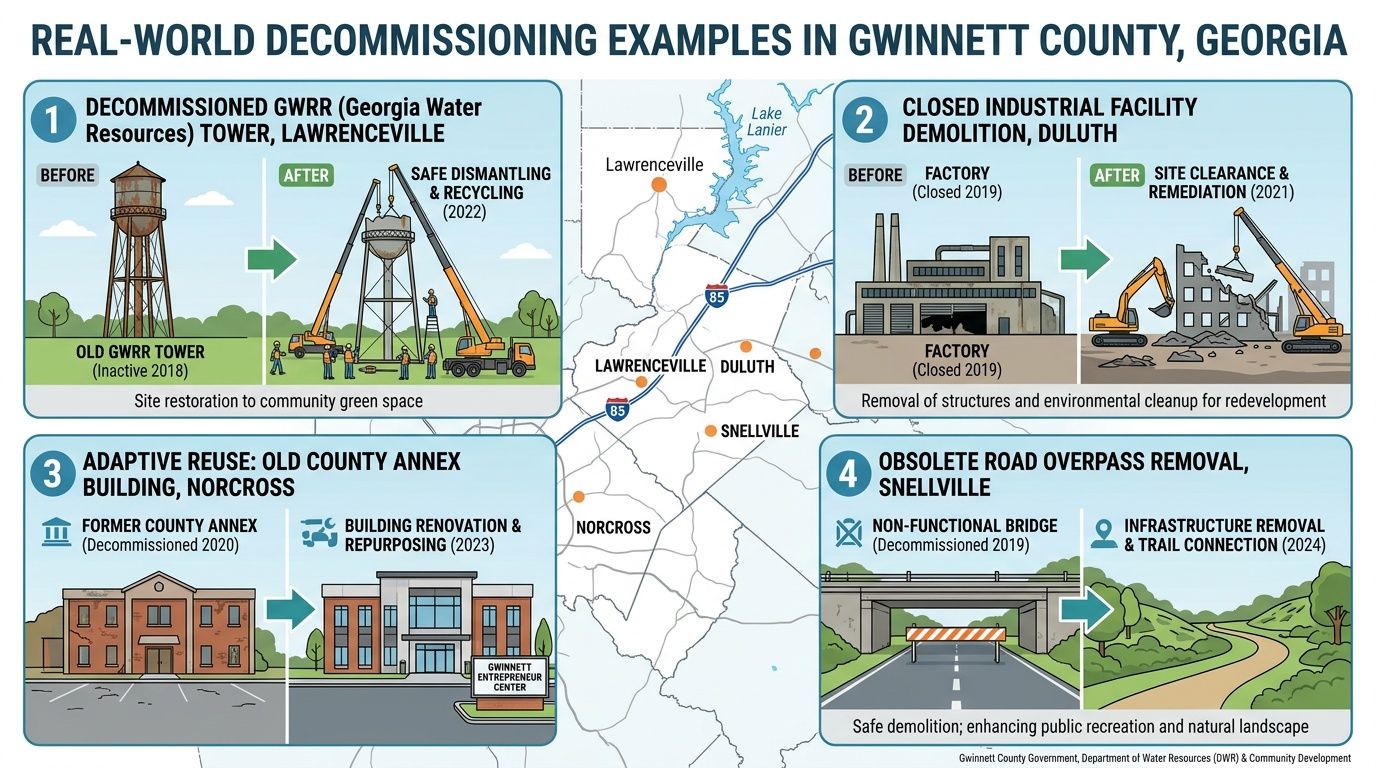
Real-World Decommissioning Examples in Gwinnett County
Most decommissioning projects don’t fail because the recycling itself is difficult. They fail because ownership is fuzzy. IT thinks facilities is handling it. Facilities assumes compliance has already reviewed it. Compliance expects a destruction certificate that no one requested up front.
That’s why real projects tend to look similar even when the asset lists are different.
Clinic refresh in the Lawrenceville area
A multi-provider clinic replaces front-desk systems, nurse-station workstations, and a small server cabinet. The operational problem isn’t volume. It’s timing. They can’t leave retired devices in patient areas, and they can’t afford confusion around who documented the data-bearing items.
The workable approach is a short on-site window, immediate segregation of storage-bearing devices, and a clear destruction record tied back to the clinic’s internal asset list. Projects like this reward tight chain-of-custody handling more than brute hauling capacity.
School technology retirement across multiple rooms
A Gwinnett-area education site clears older classroom computers, lab peripherals, and network gear from several spaces at once. Here, the challenge is coordination. Equipment is scattered, labels are inconsistent, and the school wants the space back quickly.
A recycler serving this kind of environment needs room-by-room removal discipline and clean reporting after the fact. It’s less about a single pile of e-waste and more about moving multiple categories without creating inventory confusion.
Research facility shutdown with mixed assets
A biotech or university research department closes a room that contains standard IT, instrument-connected controllers, monitors, and niche electronics. In such cases, many general recyclers lose the thread because the load isn’t purely office equipment and isn’t purely lab equipment either.
Georgia’s ITAD infrastructure includes programs compliant with R2v3, ISO, and state EPD standards for enterprise-scale decommissioning, which supports auditable handling of servers, networking hardware, and data-center-class equipment in Atlanta-area institutions, as described in this Georgia data center ITAD overview. In practical terms, that established ecosystem helps complex projects move through a documented downstream chain instead of an improvised one.
Server room retirement before a lease exit
A small corporate or medical office in Gwinnett vacates a suite and needs the server room emptied before turnover. The problem is access and accountability. Racks have to be broken down, storage media handled correctly, and the landlord timeline doesn’t care how many internal approvals are still pending.
For these jobs, a specialized partner in data center equipment recycling in Gwinnett County GA is usually a better fit than a general recycler because the work includes de-installation, media handling, and a more exacting documentation trail.
Good decommissioning work feels organized on the client side. Departments know what left, when it left, and how it was processed.
Planning Your IT Equipment Disposal Project
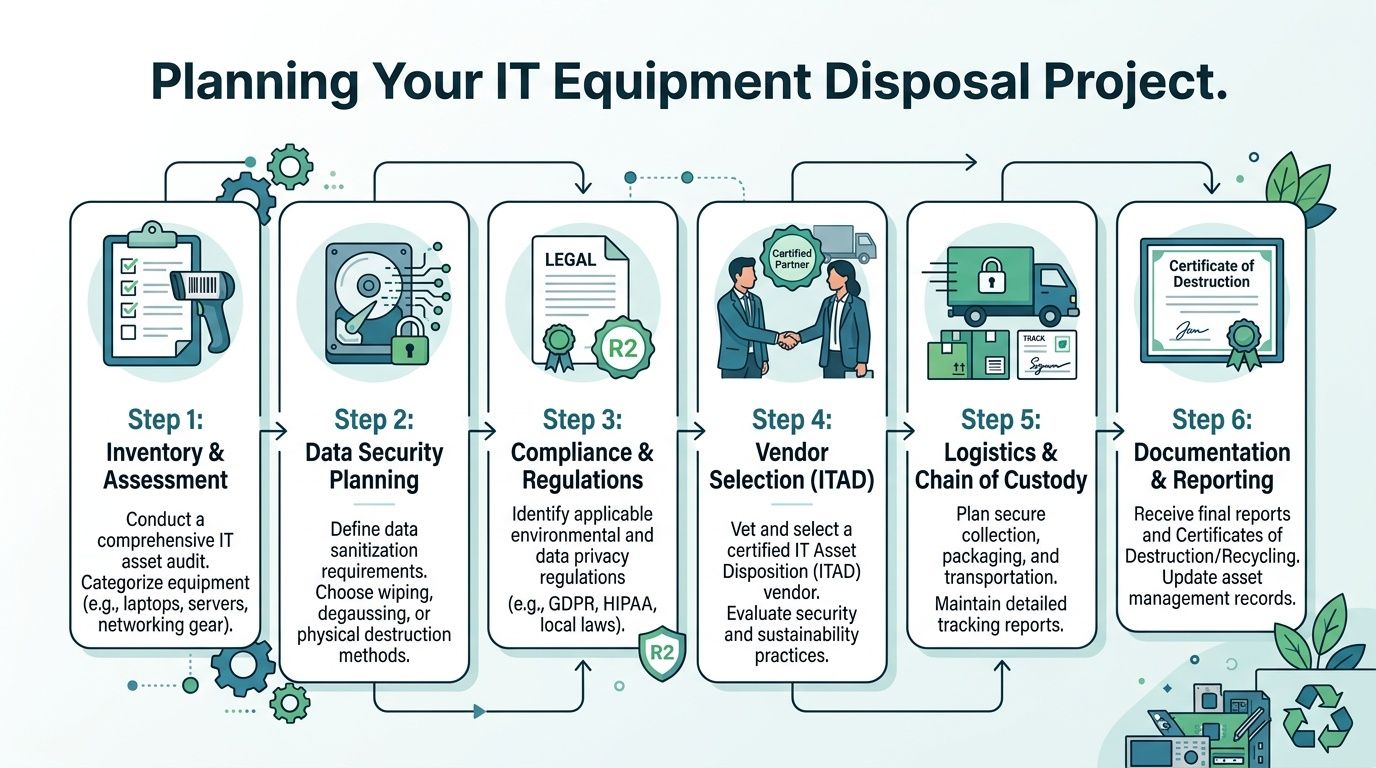
Most disposal projects go smoother when the facility manager answers a few operational questions before requesting a quote. That doesn’t mean building a perfect spreadsheet. It means knowing enough to avoid avoidable change orders, delays, and internal confusion.
What to define before pickup
Start with the project boundaries.
Ask these questions internally:
- What’s leaving the building now? Separate immediate removals from “maybe later” storage.
- Which items contain data? Flag servers, PCs, laptops, removable media, and anything with embedded storage.
- What access constraints exist? Note elevators, loading docks, stairs, security sign-in, or after-hours requirements.
- Does anything need decontamination first? This matters for lab and medical environments.
- Who signs off on final documentation? Decide that early.
This early scoping reduces the back-and-forth that drags out scheduling.
Cost and value move together
A lot of teams only ask what disposal will cost. That’s too narrow. The better question is what the full disposition mix looks like after secure processing.
Certified recycling can recover over 95% of critical materials from decommissioned hardware while diverting 99% from landfills, and buyback programs can offset disposal costs with payouts such as $2-5 per unit on wiped laptops, according to New Life Technology Group’s recycling overview. Not every project produces resale value, but some definitely do, especially when assets are tested, wiped, and separated correctly.
That means planning should account for both sides:
| Planning factor | Why it affects the project |
|---|---|
| Asset mix | Servers, laptops, lab electronics, and peripherals don’t follow the same disposition path |
| Data destruction needs | Wiping and shredding require different handling and documentation |
| Building logistics | Labor changes when crews need de-installation or difficult access |
| Recovery potential | Functional assets may offset part of the overall cost |
What a useful quote request includes
A strong quote request usually contains a simple asset summary, your location, preferred timing, whether on-site labor is needed, and whether the project includes regulated data or hybrid lab-IT equipment.
If you’re building a formal disposal plan, start with a provider focused on IT asset disposal for regulated and technical environments. The right conversation should clarify scope, documentation, and logistics before pickup day, not after the truck is loaded.
Frequently Asked Questions About IT Recycling
Do I need a Certificate of Destruction for every project
If your equipment contained sensitive, regulated, or business-critical data, you should expect documented proof of destruction or sanitization. That record supports audits, internal compliance reviews, and leadership reporting.
What’s the difference between data wiping and shredding
They serve different purposes. Wiping is used when media is functional and can be sanitized to a recognized standard. Shredding is used when media is failed, obsolete, or requires physical destruction.
| Feature | Data Wiping (Sanitization) | Physical Shredding |
|---|---|---|
| Primary purpose | Render stored data inaccessible through software-based erasure | Destroy media physically so it can’t be reused |
| Best fit | Functional drives and devices that can be processed electronically | Failed drives, damaged media, or high-risk storage |
| Asset recovery potential | Higher, because equipment may remain reusable | Lower, because media is destroyed |
| Documentation | Sanitization records and related reporting | Certificate of destruction and destruction records |
| Common use case | Laptops, desktops, servers that still operate | Obsolete or nonworking hard drives and SSDs |
Do recyclers pick up small loads in Grayson
That depends on the provider’s route structure, fleet, and asset mix. Grayson jobs sometimes get treated differently than central Atlanta pickups, so ask about service radius, minimums, and whether mixed loads improve scheduling.
Can recyclers take lab equipment that may be contaminated
Recyclers can often take the equipment after your organization completes required decontamination. The facility should confirm decontamination status before pickup, especially for medical and research devices.
What’s the most common mistake facilities make
They wait too long to classify what’s data-bearing and what isn’t. Once assets are piled together without a plan, inventory control and compliance documentation get much harder.
If your organization needs a practical path for retiring computers, servers, storage media, and lab-linked electronics, Scientific Equipment Disposal helps Grayson-area facilities manage pickup, de-installation, secure data destruction, and compliant recycling without the usual confusion around logistics or documentation.