Your Complete Guide to Industrial Equipment Recycling and Disposal

When you hear "industrial equipment recycling," you might picture a simple trash pickup. But for specialized equipment from labs, data centers, and industrial sites, it's a whole different ballgame. This is a specialized process for sustainably managing outdated or non-functional assets, involving compliant handling, secure data destruction, and environmentally responsible recycling. This guide covers industrial equipment recycling and disposal for businesses both locally and nationwide.
Your Guide to Industrial Equipment Disposal
So, what really happens when a hospital lab upgrades its diagnostic machines or a data center decommissions a row of servers? It’s not just a matter of hauling away old gear. It's a critical business function governed by strict regulations and serious financial risks, whether you're a local business or a national corporation.
Think of it less like a spring cleanout and more like a controlled, strategic operation.
Proper industrial equipment disposal is non-negotiable for facilities ranging from hospitals and research labs in cities like Atlanta, GA, to corporate data centers with a nationwide footprint. Every single step must be planned and executed perfectly to guarantee full compliance and protect your organization, wherever you operate.
What This Process Involves
At its heart, professional equipment disposal is about three things: protecting the environment, securing your data, and following the rules. Dropping the ball on any of these can lead to massive fines, a damaged reputation, and even legal trouble. A partner with nationwide service capabilities ensures consistent compliance across all your locations.
Some of the most common equipment requiring a certified partner includes:
- Laboratory Instruments: Items like centrifuges, mass spectrometers, incubators, and fume hoods that might contain hazardous materials.
- IT and Data Center Hardware: The servers, storage arrays, computers, and networking gear that hold your most sensitive information.
- Medical Devices: Patient monitors, imaging machines, and other electronics that fall under strict HIPAA regulations.
The goal is to move beyond simple waste hauling and adopt a mindset of responsible asset lifecycle management. A certified partner with nationwide reach ensures that your retired equipment becomes a closed-loop success story, not an environmental or legal liability.
A Structured Approach to Disposal
A successful project always follows a clear, documented path. This structured approach is the only way to maintain a secure chain of custody and get auditable proof of compliance.
Whether you run a single lab in a specific city or manage sites across the country, understanding this lifecycle is your first step toward a risk-free decommissioning project. For a deeper dive, you can learn more about managing e-waste in our detailed guide.
The table below breaks down the essential stages for responsibly handling industrial, lab, and IT equipment.
The Industrial Equipment Disposal Lifecycle
| Stage | Key Action | Primary Goal |
|---|---|---|
| Inventory and Assessment | Cataloging all assets and identifying data-bearing or hazardous items. | To create a clear scope of work and identify compliance requirements. |
| De-installation and Logistics | Professionally disconnecting, packing, and preparing equipment for transport. | To ensure safe removal without disrupting ongoing operations. |
| Secure Transit | Using a dedicated, secure fleet to transport assets to the processing facility. | To maintain an unbroken and documented chain of custody. |
| Processing and Recycling | Performing certified data destruction and separating materials for reuse. | To meet EPA and data privacy standards (e.g., HIPAA) and maximize sustainability. |
| Final Certification | Issuing a Certificate of Disposal to document the entire process. | To provide official proof of compliant and secure asset disposition. |
Following these steps with a trusted partner takes the guesswork and risk out of the equation, leaving you with peace of mind and documented proof that the job was done right.
Navigating Disposal Regulations and Compliance
Getting rid of old industrial equipment isn't just a matter of hauling it away. You're actually navigating a complex map of rules that span federal, state, and even city-level jurisdictions. Trying to ignore this map is not an option—pleading ignorance won't protect you from massive fines, legal trouble, or a serious hit to your company's reputation.
The Environmental Protection Agency (EPA) sets the baseline rules for the entire country, especially when it comes to e-waste. This federal framework is designed to keep hazardous materials from electronics and lab gear out of our landfills. But those federal guidelines are just the starting point.
Understanding Federal and Local Mandates
Every business has to work within a multi-layered system of rules. While the EPA’s Resource Conservation and Recovery Act (RCRA) covers hazardous waste nationally, many states and cities—from New York to California and right here in the Atlanta metro area—have their own, often stricter, e-waste laws. This creates a patchwork of compliance that demands both national awareness and local expertise.
A disposal plan that’s perfectly fine in one state could get you into hot water in another. Think of it like this:
- Federal EPA Rules: These are the broad, nationwide standards for identifying and managing hazardous electronic waste to protect the environment.
- State-Specific Laws: Many states have their own recycling programs that require certain electronics to be collected and processed in a specific way.
- Local Ordinances: Your city or county might add another layer, like banning electronics from landfills entirely, which means you need a special disposal route.
You need a partner who understands the whole picture—from federal laws down to specific local rules—to make sure your project is 100% compliant, no matter your location.
Data Security Regulations Like HIPAA
On top of the environmental rules, data security laws add another critical layer of responsibility. This is especially true for any medical, financial, or corporate facility, both locally and nationwide. Regulations like the Health Insurance Portability and Accountability Act (HIPAA) aren't just suggestions; they are legally binding, and the penalties for getting it wrong are severe.
If you're a healthcare provider, tossing out an old medical device or server without first verifiably destroying all the protected health information (PHI) on it is a major breach. A recent study found that healthcare data breaches cost an average of $11 million per incident. That number alone shows why compliance isn't just a legal issue—it's a financial one. Old equipment isn't just junk; it's a potential data bomb.
You can learn more by checking out our guide on EPA-compliant laboratory equipment disposal.
The Role of a Documented Chain of Custody
So, how do you prove you followed all these environmental and data security rules? The answer is a rock-solid chain of custody. This is much more than a simple receipt; it's your organization's legal and financial shield. It’s an unbroken, detailed log that tracks your equipment from the moment it leaves your building—whether in Atlanta or Anchorage—to its final, certified destruction.
A documented chain of custody is your auditable proof that every piece of equipment was handled securely and in full accordance with all applicable environmental and data privacy laws. It transfers liability from your organization to your certified disposal partner.
This documentation is non-negotiable. It proves every step was handled correctly, from the on-site pickup and secure transport to the certified data destruction. Without it, you have no real defense if an auditor comes knocking. A professional partner provides this as a standard part of their service, giving you the verifiable proof you need for true peace of mind.
Why Data Security Is Non-Negotiable in Equipment Disposal
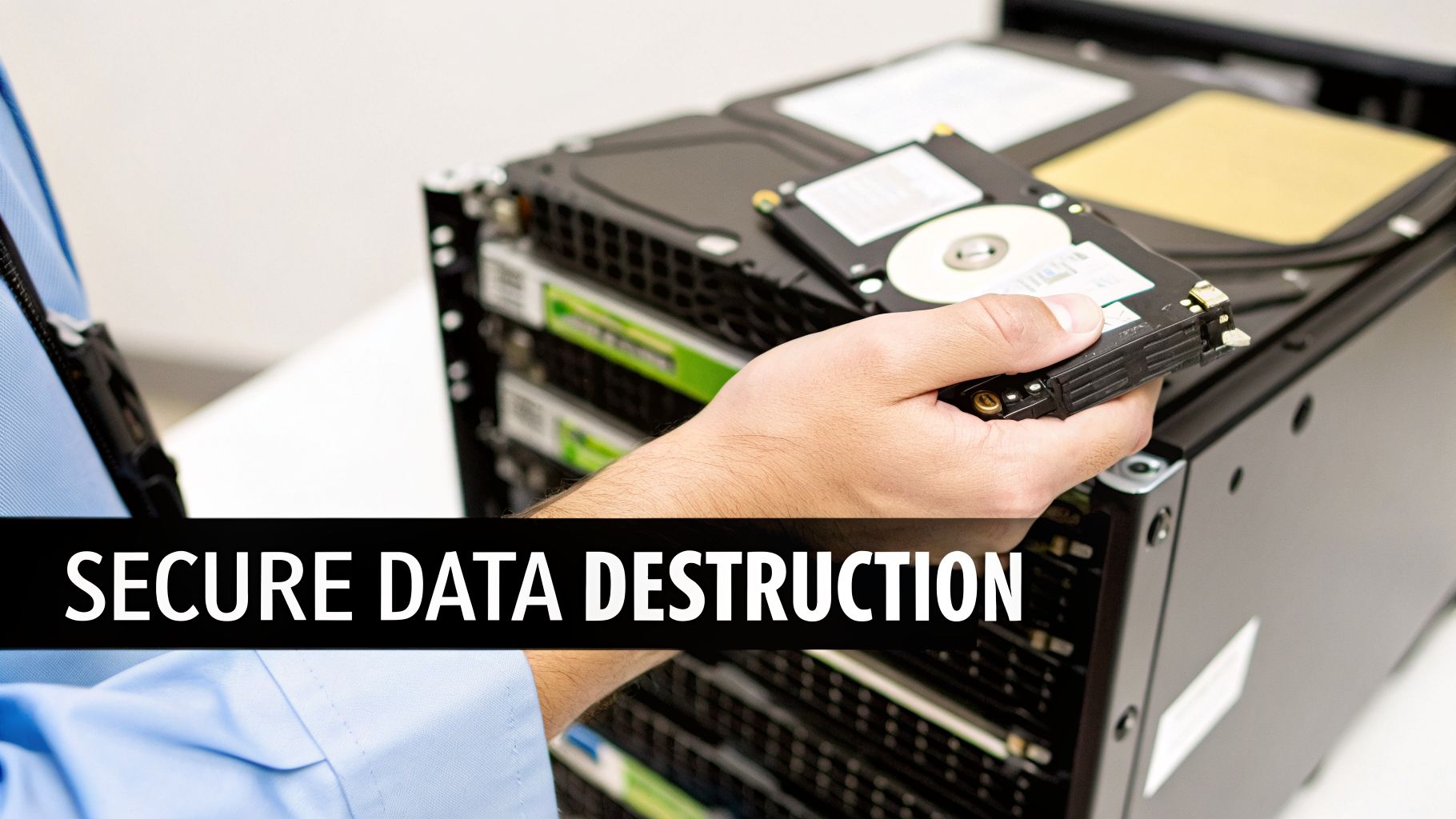
When you're retiring old industrial equipment, data security isn't just another item on the checklist—it's everything. Think about all the machines you're decommissioning: old servers, lab instruments, even company laptops. Each one could be a data time bomb waiting to go off.
If not handled with extreme care, they can blow a hole in your company’s finances and reputation. A single forgotten hard drive can trigger a massive data breach, exposing sensitive client files, your company's secret research, or protected health information (PHI). This isn't just a bad day at the office; it's a disaster with serious legal and financial fallout. Secure data destruction is how you defuse these devices before they ever leave your control.
This is a core part of risk management for any serious business, from a local Atlanta startup to a national enterprise. The market reflects this growing need. The recycling equipment and machinery sector was valued at USD 1.2 billion in 2026 and is on track to hit USD 2.2 billion by 2035, pushed by stricter regulations and better technology. You can explore the complete market research to understand more about these industry trends.
Deletion Is Not Destruction
Here’s a common—and dangerous—misconception: hitting "delete" or reformatting a drive erases the data for good. It absolutely does not. These actions usually just remove the pathway to the data, leaving the files themselves completely intact and recoverable with simple, widely available software.
It’s like tearing the table of contents out of a book. The chapters are all still there; you just have to flip through the pages to find them. For a data thief, finding that "deleted" information is child's play.
That’s why you need professional data sanitization. It's the only process that deliberately and permanently destroys the data stored on a memory device, making it impossible to get back.
Understanding Data Sanitization Standards
To truly wipe data clean, you have to go way beyond the delete key. Certified disposal partners rely on government and industry-approved standards to guarantee information is gone forever. The two main approaches are software-based sanitization and old-fashioned physical destruction.
A go-to method we use is the DoD 5220.22-M 3-pass sanitization standard. This technique overwrites the entire hard drive with patterns of ones and zeros three separate times, turning your original data into meaningless digital static.
This government-grade technique ensures that even the most advanced recovery tools cannot restore the original information. It provides a verifiable, auditable method for destroying data on functional drives that may be resold or reused.
For a closer look at the technical side, check out our guide on how to approach secure data destruction services.
When Physical Destruction Is the Only Option
In some cases, software-based wiping isn't enough, or it's just not an option. For hard drives that are damaged, for solid-state drives (SSDs), or for equipment holding extremely sensitive information, physical destruction is the only way to be 100% sure. And no, this doesn't mean taking a hammer to it in the parking lot.
This is a controlled, industrial process that includes:
- Shredding: We feed hard drives and other media into industrial-grade shredders that grind them into tiny, confetti-like metal fragments. This is the most common and secure method for media at the end of its life.
- Degaussing: This involves using a powerful magnetic field to completely scramble the magnetic signature on a hard drive. It instantly renders the drive unusable and its data unrecoverable.
- Disintegration: For top-secret data, this method takes shredding a step further, grinding the media down into a fine powder. It offers the absolute highest level of security.
Choosing between sanitization and physical destruction really comes down to the media type, its condition, and your own internal security policies. A certified partner can walk you through the right choice for each asset, giving you total compliance and peace of mind.
Your Step-By-Step Decommissioning Workflow
Getting rid of old industrial equipment isn't something you can just wing. A successful project—whether it's clearing out a local lab, a regional data center, or a nationwide factory network—needs a clear, methodical playbook. Without one, you’re just guessing, and that’s a recipe for risk, compliance headaches, and costly mistakes.
Treating decommissioning like a well-managed project is the key. This approach gives you a solid framework for a smooth and compliant process, whether you need local service in Atlanta or a coordinated nationwide rollout. Let’s break down this complex job into five manageable stages.
Phase 1: Inventory and Assessment
First things first: you have to know exactly what you're dealing with. This means creating a detailed inventory of every single asset you plan to get rid of. Think of it less like a simple list and more like a strategic audit.
You need to sort through everything and identify what's what. Some newer lab instruments might have resale value. Other things, like old servers or contaminated machinery, are headed straight for recycling or destruction. Most importantly, you must flag every single device that might be holding sensitive data.
- Actionable Tip: Fire up a spreadsheet and tag each item. Note its type (e.g., IT hardware, lab instrument), condition, and whether it has a hard drive or memory. Getting this categorization right from the start makes everything that follows much easier.
Phase 2: Logistics Planning
Once your inventory is locked down, you can figure out the "how" and "when." Logistics planning is all about coordinating the physical removal to cause as little disruption as possible to your day-to-day operations. This is absolutely critical in live environments like a busy hospital or an active data center anywhere in the U.S.
This is where you map out the entire project. You'll figure out what resources you need—like the right size truck and the number of technicians. You’ll also set a schedule for the de-installation and pickup, coordinating between your team and your disposal partner. The demand for these services is skyrocketing; the global recycling equipment market was valued at USD 31.38 billion in 2026 and is projected to hit around USD 50.24 billion by 2034.
Proper logistics planning is the difference between a smooth, efficient teardown and a chaotic process that interrupts business, poses safety risks, and leads to costly delays.
Phase 3: On-Site De-installation
This is where the plan springs to life. On the scheduled day, a professional crew arrives to systematically disconnect, dismantle, and prep the equipment for its journey. An experienced national team knows you don't handle delicate scientific instruments in a California lab the same way you handle heavy-duty industrial machinery in a Texas factory.
For example, clearing a server room means carefully unplugging and removing racks without knocking adjacent live systems offline. In a manufacturing plant, this could involve complex rigging to safely haul out massive presses or assembly line components. You can dive deeper into this process in our guide on factory equipment decommissioning for manufacturers.
Phase 4: Secure Transit
With everything packed and ready, it’s time to move it securely. This isn't a job for a standard moving company. Secure transit means using a dedicated fleet of vehicles, operated by vetted drivers, to transport your assets directly to the processing facility with no unscheduled stops, whether the pickup is across town or across the country.
This step is a crucial link in the chain of custody. The trip from your site to the recycler's warehouse must be unbroken and fully documented. This ensures nothing gets lost, stolen, or mishandled on the way—a non-negotiable for any device that once held sensitive data.
Phase 5: Final Processing and Certification
This is the last stop, where the actual recycling and disposal happens. Once at the secure facility, every asset is triaged based on your initial assessment.
Here's a breakdown of what happens next:
- Data Destruction: All data-bearing devices are either wiped clean using certified methods (like the DoD 3-pass wipe) or physically shredded into tiny pieces.
- Material Separation: Equipment is taken apart, and materials like metals, plastics, and glass are carefully separated for recycling.
- Responsible Recycling: These raw commodities are then sent to certified downstream partners to be processed, keeping tons of e-waste out of landfills.
- Issuing Certification: After the job is done, you’ll receive a Certificate of Disposal. This is your official, auditable proof that your equipment was handled securely, compliantly, and in an environmentally sound way. It's the final piece of paperwork that closes the loop and protects your organization from future liability.
How to Choose the Right Disposal Partner
Choosing a partner for industrial equipment recycling and disposal is more like vetting a bank than hiring a simple hauler. You aren't just getting rid of old gear; you're handing over your compliance risk, your data security, and even your company's reputation.
The right partner acts as a shield, protecting you from liability. The wrong one? They can expose you to devastating fines and public relations nightmares.
This decision should never come down to the lowest price. A quote that seems too good to be true almost always comes with hidden costs—usually in the form of uncertified processes, flimsy data security, and zero proof that they’re following the law. This is a critical choice for any facility, from a hospital lab in Atlanta to a nationwide data center network.
This process flow shows the core stages a certified partner will manage, from initial inventory all the way through to final recycling.
As you can see, every step is designed to maintain a secure and documented process. Nothing is left to chance.
Look for Certifications and Compliance Expertise
Your first filter for any potential partner should be their certifications. These aren't just fancy logos for a website; they are hard-earned proof of a commitment to the industry's highest standards for environmental safety and data security.
Without them, you have absolutely no guarantee your equipment will be handled properly.
Look for these two key certifications:
- R2 (Responsible Recycling): This standard focuses on the entire lifecycle of the equipment, ensuring electronics are managed in a way that’s safe for both people and the planet. It mandates a secure chain of custody from start to finish.
- e-Stewards: Often considered even more stringent, the e-Stewards standard has a zero-tolerance policy for exporting hazardous e-waste to developing countries.
A partner holding these certifications has been audited by an independent third party and proven they follow the rules. It's your first and most important layer of defense.
For facilities in specialized fields, this becomes even more crucial. The global waste recycling equipment market was valued at USD 28,624.54 million in 2026, with North America holding over 40% of the market share. This growth just underscores the demand for specialized providers that can properly serve complex institutional clients across the nation.
Evaluate Data Destruction Protocols and Logistics
Beyond environmental compliance, you have to dig into a vendor’s data destruction methods. Ask them directly: do you meet federal standards like those required by HIPAA or the Department of Defense? A vague answer is a huge red flag.
A top-tier partner will offer both software-based sanitization, like the DoD 5220.22-M 3-pass wipe for reusable media, and physical destruction, like shredding, for obsolete or damaged drives. They will provide a Certificate of Data Destruction that proves it was done.
Logistical capability is another critical piece of the puzzle. Does the vendor own and operate its own fleet of trucks for nationwide service? A company that relies on third-party haulers adds another link to the chain of custody, increasing the risk of something going wrong. A dedicated, in-house fleet means more control, tighter security, and a clear line of responsibility.
If you're trying to find a qualified partner, it helps to know what to look for in an electronic waste recycling company.
Combining National Reach with Local Service
For many organizations, the ideal partner offers the best of both worlds: the resources and scale of a national provider with the hands-on, responsive service of a local one. An Atlanta-based provider with a nationwide network can offer swift service for local projects while also having the logistical muscle to coordinate multi-site cleanouts across the country.
This dual capability ensures you get consistent, compliant service no matter where your facilities are located.
Imagine this nightmare scenario: you hire an uncertified hauler to clear out a lab. They toss everything into a truck, and you never hear from them again. Months later, you get a call—one of your old lab machines, still containing patient data, was found dumped illegally. Now you're facing HIPAA fines, a public relations crisis, and legal action.
In contrast, a certified partner manages a seamless, documented project. They arrive on time, de-install the equipment professionally, transport it securely, destroy all data, and provide you with a Certificate of Disposal. You get peace of mind, not a legal headache. Choosing the right industrial equipment disposal partner is an investment in certainty.
Answering Your Top Questions About Equipment Disposal
When it's time to clear out old equipment, a lot of questions pop up. Facility managers, IT directors, and lab supervisors—whether you're here in the Atlanta metro or managing facilities nationwide—all run into the same roadblocks. Getting straight answers is the only way to make smart, compliant decisions without wasting time.
We hear these questions every day. Here are the answers, based on years of experience in secure and responsible equipment disposal.
What Kinds of Equipment Require Special Disposal?
The short answer? A lot more than you’d think. This goes way beyond old computers and printers. If it has a circuit board, a screen, a motor, or stores any kind of data, you can be almost certain it can’t be tossed in a commercial dumpster. These items are all part of a category called e-waste, and the rules for getting rid of them are incredibly strict, both locally and federally.
Here’s a simple way to think about it: if the item could leak nasty chemicals into the ground or holds sensitive information, it needs a certified disposal plan. This covers a huge range of gear:
- Laboratory and Scientific Gear: We’re talking about everything from centrifuges, mass spectrometers, and incubators to fume hoods and complex analytical instruments. Most of this stuff has regulated components or valuable materials that can be recycled.
- IT and Data Center Assets: All your servers, computers, networking hardware like switches and routers, and data storage arrays. Every single one is a data security risk until it's properly destroyed.
- Medical and Healthcare Devices: Things like patient monitors, diagnostic machines, and imaging systems are a double-whammy. They have electronic components and often store protected health information, which puts them directly under HIPAA's microscope.
As a rule of thumb, just assume that anything that plugs in or has batteries needs special handling. A professional recycler will give you a clear rundown of what they can take, taking all the guesswork out of staying compliant.
What Does Professional Equipment Disposal Cost?
The cost for professional industrial equipment disposal isn't one-size-fits-all. It really depends on what you have—the type and amount of equipment, the logistics involved (like needing a crew for a local de-installation or coordinating a multi-state pickup), and exactly how secure you need the data destruction to be.
But don't think of this as just another business expense. It's an investment in risk mitigation and compliance, plain and simple. The price you pay is buying your organization essential protection.
- Guaranteed Regulatory Compliance: Your fee ensures you're following all EPA, state, and local e-waste laws. This is your shield against the massive fines that come with improper disposal.
- Certified Data Destruction: The cost covers a verifiable process for wiping or physically destroying data, protecting you from the multi-million dollar fallout of a data breach.
- Reputation Management: This proves your company is committed to responsible, sustainable practices—not cutting corners and damaging the environment.
The cost of hiring a professional is almost always a tiny fraction of the potential financial and legal disaster from one compliance screw-up. A good partner will give you a transparent, itemized quote with no hidden fees. You'll know exactly what you’re paying for.
Why Is a Certificate of Disposal So Important?
A Certificate of Disposal is the single most important piece of paper you’ll get at the end of a decommissioning project. It's your official, legally-defensible proof that you did everything by the book. Think of it as your get-out-of-jail-free card if an auditor ever comes knocking on your door, whether you're in Georgia or anywhere else in the U.S.
This document formally proves your equipment was handled according to all legal and industry standards, from environmental rules to data privacy laws like HIPAA. Most importantly, it marks the moment when liability for that equipment transfers from your company to your certified disposal partner.
Without that certificate, you have zero tangible proof that you performed due diligence. You're left totally exposed if your equipment is found illegally dumped or if a data breach is traced back to a hard drive you thought was long gone. Any professional vendor provides this certificate as a standard part of their service—it’s how they close the loop on your liability.
Can My IT Team Just Wipe Our Drives?
Letting your internal IT team handle hard drive wiping might seem like a good way to save money, but this approach almost never satisfies regulatory requirements. A basic "delete" or "format" command doesn't truly erase data, and an internal process is missing the most important part: third-party validation.
Professional data destruction gives you several layers of security that an in-house job just can’t replicate:
- Certified Methodologies: Pros use auditable, government-approved techniques like the DoD 5220.22-M 3-pass sanitization standard. These methods are proven to work, every time.
- Verifiable Proof: You get a Certificate of Data Destruction that lists every single hard drive by its serial number. This is your undeniable proof that the data is gone for good.
- Secure Chain of Custody: True compliance is about the entire secure process—from locked collection bins and GPS-tracked trucks to a facility with 24/7 surveillance. An internal wipe only addresses one small step in that chain.
Using a certified vendor for data destruction isn't about distrusting your IT team. It's about getting the documented, third-party proof you need to protect the entire organization. It shifts the burden of proof from your shoulders to a specialist, making sure your industrial equipment recycling and disposal project is secure from start to finish.
For organizations in the Atlanta area and with facilities nationwide, Scientific Equipment Disposal offers a trusted, compliant solution for all your lab and IT asset disposition needs. We provide on-site de-installation, secure nationwide logistics, and certified data destruction to ensure your project is handled professionally and responsibly. To learn how we can help you mitigate risk and achieve your sustainability goals, visit us at https://www.scientificequipmentdisposal.com.