The Ultimate Guide to Hard Drive Shredding for Secure Data Disposal

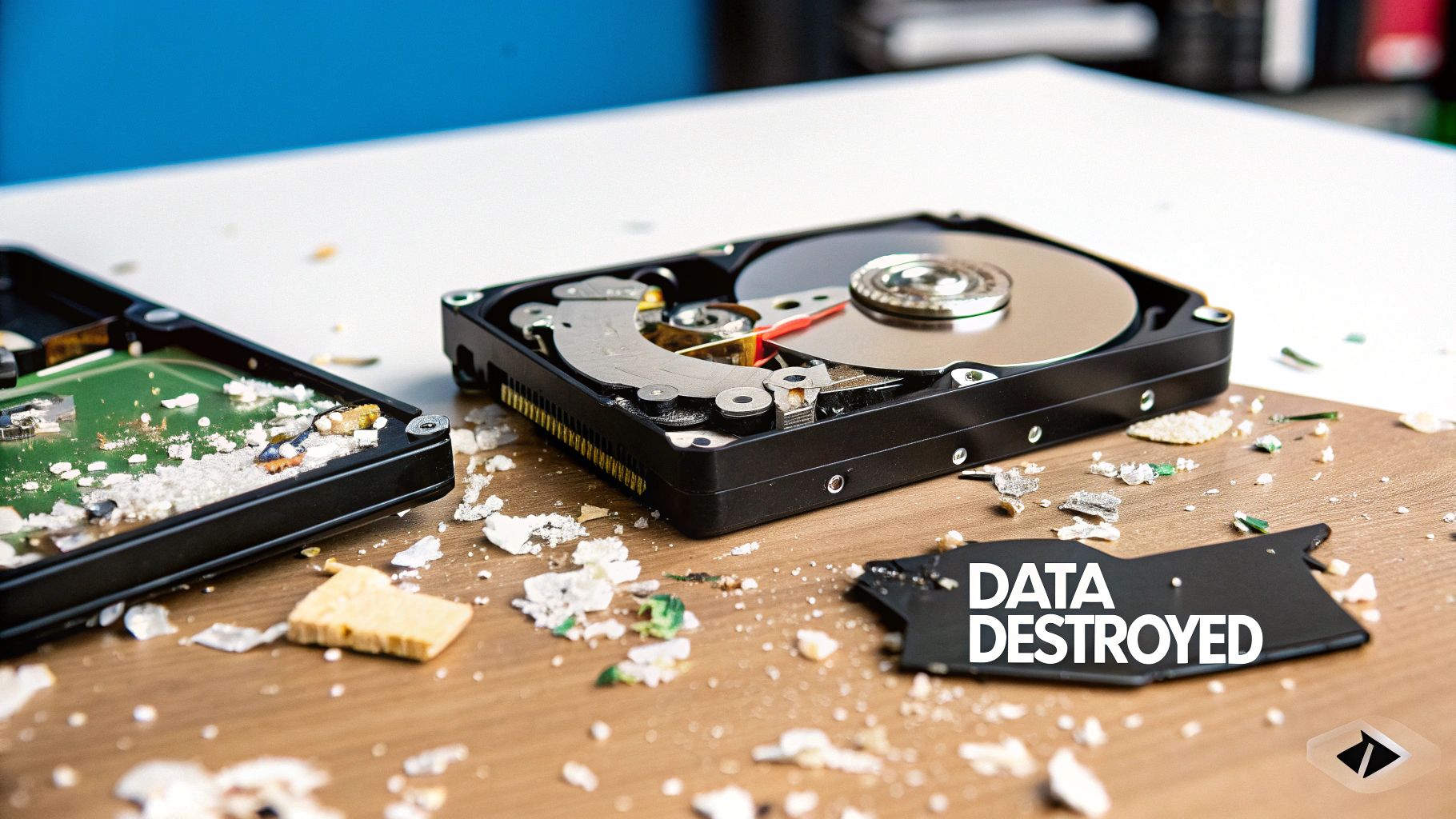
Hard drive shredding is the final, definitive answer for data destruction. It's a physical process that takes a hard drive and pulverizes its internal components into tiny, completely unsalvageable fragments. Unlike just wiping a drive with software—which can leave behind recoverable data "ghosts"—shredding gives you a 100% guarantee that your sensitive information is gone for good.
For any organization, whether a local business or a national enterprise, handling private data, this is the absolute last step in securing assets at the end of their life.
Your Last Line of Defense Against a Data Breach
Think of a filing cabinet stuffed with your company’s most guarded secrets—financial records, employee PII, proprietary research. You wouldn't just throw away the key (deleting files) or paint over the drawers (formatting) and call it secure. A determined person could still pry it open and get everything.
Hard drive shredding is like feeding that entire cabinet into an industrial metal grinder until it’s nothing but a pile of metal dust. There's simply nothing left to recover.
This physical destruction process is non-negotiable for organizations that can’t afford a data breach. A single retired server or an old employee laptop can become a ticking time bomb if you don't dispose of it properly. Our nationwide hard drive shredding services ensure complete security, no matter your location.
Why Software Wiping Is Not Enough
Many businesses think erasing or formatting a drive is good enough. The problem is, these methods often just remove the pointers to the data while leaving the actual information sitting intact on the magnetic platters. With data recovery software widely available, a moderately skilled technician can often pull back those "deleted" files.
This creates a massive liability. Just think about the fallout if this data got into the wrong hands:
- Customer Information: Names, addresses, and credit card numbers could leak, leading to identity theft and lawsuits.
- Employee Records: Social Security numbers and personal details could be stolen, destroying trust and morale.
- Trade Secrets: Proprietary formulas, client lists, and strategic plans could end up with competitors, erasing your competitive edge.
Simply recycling old hard drives without ensuring complete data destruction is a critical mistake. Mishandling outdated hardware can be more than a costly error; it's a security vulnerability waiting to be exploited.
The Undeniable Need for Physical Destruction
For organizations in competitive markets from Atlanta to San Francisco, the stakes are just too high to gamble on incomplete data removal. From hospitals protecting patient health information to research labs safeguarding intellectual property nationwide, the only way to guarantee absolute security is through physical destruction.
You can learn more about building a complete security plan in our detailed guide to data security protocols.
Ultimately, hard drive shredding delivers peace of mind. It transforms a potential liability into a pile of inert, recycled material, closing the loop on your data's lifecycle and making sure your sensitive information never becomes a headline.
Meeting Compliance with Certified Data Destruction
Trying to keep up with the maze of data regulations can feel like a full-time job. Mandates from agencies like HIPAA, NIST, and the DoD have very specific rules for handling sensitive information, and getting it wrong can lead to some serious headaches. This is where certified hard drive shredding comes in—it offers a straightforward, provable way to check all the right boxes for companies across the USA.
Here's a hard truth: just hitting "delete" or reformatting a drive doesn't cut it for compliance. These methods almost always leave behind digital breadcrumbs that can be recovered, creating a huge risk. The regulations are clear—data must be made completely and permanently unrecoverable. Physical destruction is the only way to be sure.
Why Regulations Insist on Physical Destruction
Data protection laws aren't just gentle suggestions; they're legal requirements designed to shield people from the real-world fallout of a data breach. Let's look at what some of the heavy hitters demand.
-
HIPAA (Health Insurance Portability and Accountability Act): If you're a healthcare provider, from a local Atlanta clinic to a national hospital network, you know HIPAA. It requires that Protected Health Information (PHI) be rendered "unreadable, indecipherable, and otherwise cannot be reconstructed." Shredding is one of the few methods that meets that high standard without any gray areas.
-
NIST (National Institute of Standards and Technology): The guidelines in NIST Special Publication 800-88 are pretty much the gold standard for getting rid of data. For anything requiring top-level security, NIST specifically calls out physical destruction methods like shredding, disintegrating, or pulverizing to leave zero chance of recovery.
-
DoD (Department of Defense): While the DoD 5220.22-M standard is a well-known benchmark for data wiping, the ultimate security step for a drive at the end of its life is to destroy it. Shredding ensures classified or sensitive government data is gone for good.
These rules exist because the stakes are incredibly high. Data breaches are a constant threat, making hard drive shredding an absolute necessity for organizations in healthcare, government, and finance nationwide. A single slip-up can expose millions of records and lead to catastrophic costs. Just look at the numbers for 2024: the U.S. alone saw 3,158 breaches affecting 1.35 billion people worldwide, a massive jump from 1,108 cases back in 2020. The recent Change Healthcare ransomware attack is a perfect example, racking up $2.87 billion in response costs after patient data was compromised, crippling operations nationwide. It's a painful lesson in why wiping sometimes isn't enough—physical destruction is essential.
The core idea behind these regulations is finality. It’s not about making data hard to get back; it's about making it impossible. Hard drive shredding is the only process that truly delivers on that promise.
To help clarify the differences, this table breaks down the most common data destruction methods and how they stack up against compliance standards.
Data Destruction Methods: A Compliance Comparison
| Destruction Method | Security Level | HIPAA/NIST Compliance | Best For |
|---|---|---|---|
| Data Wiping | Moderate to High | Yes, with verification | Reusing drives internally with non-critical data. |
| Degaussing | High | Yes, for magnetic media | Quickly sanitizing large batches of magnetic tapes and older hard drives. |
| Hard Drive Shredding | Highest | Yes, universally accepted | End-of-life drives, damaged media, and ensuring maximum security for sensitive data. |
As you can see, while wiping and degaussing have their place, only physical shredding provides the universal, high-security assurance needed for the most sensitive data at the end of its lifecycle.
The Certificate of Destruction: Your Proof of Compliance
So, how do you actually prove to an auditor that you followed the rules? You get a Certificate of Destruction. Think of this document as your official, legally-defensible receipt confirming that your hard drives and other media were properly destroyed.
A proper Certificate of Destruction is your compliance armor. It should always include:
- A unique serial number for tracking
- The date and location where the destruction happened
- A detailed inventory or list of serial numbers for the destroyed drives
- The signature of an authorized witness
- A statement confirming the destruction method and compliance with regulations
For a hospital administrator in Atlanta handling patient files or a lab director in California protecting research data, this piece of paper is non-negotiable. It formally transfers the liability from your organization to your destruction partner and closes the loop on your IT asset disposal process. Without it, you're left exposed to potential fines and legal trouble if an audit ever comes around. This certificate makes your compliance efforts tangible and provable.
On-Site vs Off-Site Shredding: What to Choose
When it's time for the final act of data destruction, the choice you make is a critical one. The decision between on-site and off-site hard drive shredding really boils down to balancing your security needs, convenience, and just how many assets you need to destroy. Both methods get the job done—complete data elimination—but they’re built for different operational demands across the country.
Think about a specialized industrial shredder being brought right to your company's doorstep. That's on-site shredding in a nutshell. A mobile destruction vehicle, which is basically a shredding plant on wheels, rolls up to your location, whether in Atlanta or anywhere else you operate nationwide. You and your team can physically watch every single hard drive get fed into the shredder and turned into tiny metal fragments.
This approach gives you the absolute highest level of security and transparency. If you're an organization bound by strict rules, like a medical lab or a financial institution, being able to witness the destruction firsthand creates an unbreakable chain of custody. There is zero risk of data getting exposed during transit because the drives never leave your sight intact.
The Case for On-Site Witnessed Destruction
On-site shredding is the go-to choice when you need maximum assurance. If your organization deals with sensitive intellectual property, patient health information, or classified data, the peace of mind that comes from personally verifying destruction is priceless. It's the perfect solution for smaller batches of drives where every single asset has to be accounted for with 100% certainty.
Imagine an Atlanta-based law firm retiring a few dozen computers filled with confidential client case files. For them, on-site hard drive shredding is the obvious winner. The process is fast, completely verifiable, and removes any chance of a chain-of-custody slip-up.
When Off-Site Shredding Makes More Sense
Now, off-site shredding follows a different workflow. Your hard drives are picked up from your facility in secure, locked containers, logged with unique serial numbers, and then transported in a vetted, secure fleet to a dedicated destruction plant. Once at the facility, the drives are shredded under constant video surveillance, with the whole process thoroughly documented.
This option is often more efficient and budget-friendly, especially for massive projects. Let's say a national corporation with offices in multiple states is decommissioning an entire data center with thousands of servers. Hauling all those assets to a central destruction facility is far more practical than having a mobile truck running for days on end at their location.
The demand for on-site hard drive shredding has skyrocketed in high-compliance industries because witnessed destruction completely removes transport risks. It's a huge part of a services sector that's projected to grow from USD 0.72 billion in 2024 to USD 1.2 billion by 2033. This growth is particularly strong here in North America, where tough privacy laws and over 3,200 annual U.S. data breaches are pushing companies to be more secure. You can read more about the hard drive shredding services market and its trajectory.
Ultimately, a reliable off-site partner will maintain a strict chain of custody and provide you with a Certificate of Destruction as your final proof of compliance. This makes it a secure, scalable solution for managing huge volumes of electronic waste. The key is finding the right partner. You can get a good overview by checking out different electronic waste recycling companies that offer these certified services. Your decision will hinge on your organization’s specific risk tolerance, budget, and logistical needs.
The Hard Drive Shredding Process from Pickup to Recycling
Setting up a hard drive shredding service is much more than a simple transaction—it's the first step in a rigid security protocol. Knowing exactly what happens from the moment your drives leave your sight helps demystify the process and underscores the safeguards protecting your organization. The entire workflow is built around accountability, rock-solid security, and responsible handling.
It all kicks off by establishing an unbreakable chain of custody. This isn't just a matter of handing over your old drives. It means placing them into secure, locked containers provided by your destruction partner. Every container, and often each drive inside, gets a unique tracking number. This creates a detailed audit trail before a single piece of equipment even leaves your facility.
This first step is absolutely critical, whether you're a local Atlanta business or a national corporation with multiple locations. It guarantees that every single asset is accounted for from the get-go, eliminating any chance of a device going missing on its way to destruction.
From Your Doorstep to Destruction
Once everything is secured, a dedicated and thoroughly vetted fleet takes over for transportation. It doesn’t matter if you’ve chosen on-site or off-site shredding; the logistics are designed for maximum security. For off-site services, this involves GPS-tracked vehicles and trained staff who manage the assets until they arrive at the secure destruction facility.
When they get to the plant, your assets are checked against the initial inventory log. This verification step confirms that every drive that left your location has arrived safely. The shredding itself is then done under strict supervision, usually with constant video surveillance to maintain the integrity of the process.
This flowchart gives you a simplified visual breakdown of the on-site and off-site hard drive shredding journey.
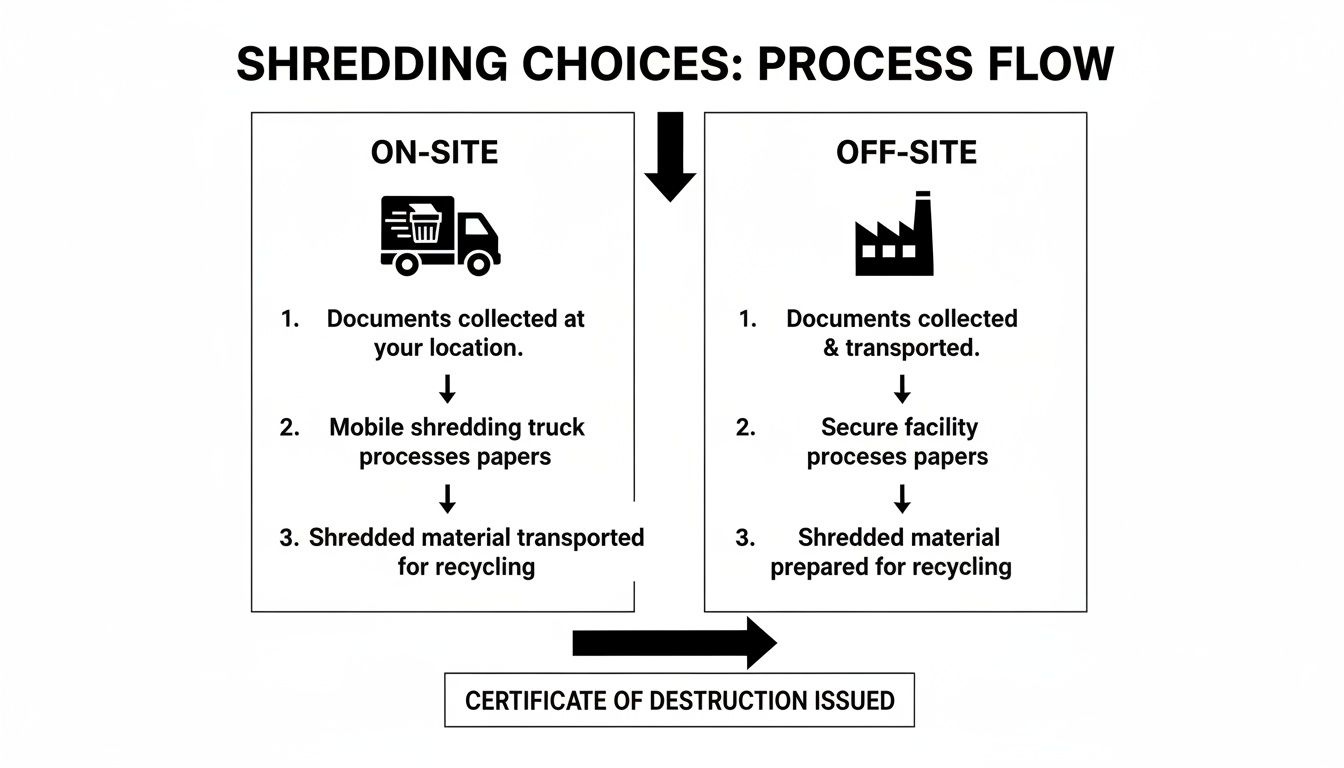
As you can see, while the where is different, both paths lead to the same non-negotiable outcomes: secure destruction and certified proof.
The Final Steps: Documentation and Recycling
After the industrial shredder has turned your hard drives into a pile of unrecognizable metal and plastic fragments, the security process wraps up with one final, crucial piece of documentation. Your organization is issued a formal Certificate of Destruction. This is a legally binding document that serves as your official proof of compliance, spelling out what was destroyed, when it happened, and how.
A Certificate of Destruction isn't just a receipt. It's your verifiable, auditable evidence that you've met your data protection obligations. It confirms the permanent, irreversible destruction of the media and transfers liability, protecting your organization from any future claims.
But the process doesn't end with a piece of paper. That mountain of shredded material—a jumbled mix of aluminum, steel, plastics, and circuit board components—is ready for the final phase of its lifecycle. This is where data security meets environmental responsibility.
Giving New Life to Old Technology
The shredded fragments are carefully sorted and the different raw materials are separated using advanced techniques.
- Aluminum from the drive casings and platters is collected and sent to smelters.
- Steel components are gathered up to be recycled into new metal products.
- Circuit boards are processed to recover valuable precious metals like gold, silver, and copper.
- Plastics are granulated and prepped for use in manufacturing new items.
This final stage ensures your digital waste doesn't just get dumped in a landfill. Instead, it re-enters the supply chain as raw material, shrinking the environmental footprint of your IT asset disposal program. It's a responsible approach that allows your organization to uphold its security standards while contributing to a more sustainable, circular economy.
By picking a certified partner, you ensure this entire journey is handled with precision. You can see a detailed breakdown of these steps and learn more about how the complete disposal process works to fully appreciate the value of a documented, secure, and sustainable workflow.
How Shredding Protects Your Brand and Bottom Line
It’s easy to look at professional hard drive shredding and see it as just another line item, an operational cost. That’s a huge mistake. A much better way to think about it is as a high-return investment in your company’s financial health and its very reputation. The real cost of a data breach goes way beyond the initial government fines; it unleashes a devastating ripple effect that can hobble a business for years.
A single hard drive that falls through the cracks can set off a chain reaction of expenses. We’re talking about astronomical legal fees, the sticker shock of forensic investigations, the mandatory cost of notifying every affected customer, and then offering them credit monitoring services. And the financial bleeding doesn't stop there.
The Hidden Costs of a Data Breach
Beyond the immediate hit to your bank account, the damage to your brand can be far more permanent. Once you break a customer's trust, winning it back is a tough, uphill battle.
- Customer Churn: A breach is often the trigger for a mass exodus of clients. They simply no longer feel their data is safe in your hands.
- Public Relations Crisis: Get ready for negative headlines and a social media firestorm. You'll need to spend a fortune on crisis management just to control the narrative.
- Loss of Competitive Edge: If your trade secrets or proprietary research get out, your unique position in the market could be gone for good.
These intangible costs—the erosion of trust, a tarnished brand, and lost business opportunities—can ultimately hurt much more than any fine.
A Clear Business Case for Proactive Destruction
When you put the predictable, manageable cost of professional shredding next to the potential for a multi-million dollar catastrophe, the business case is crystal clear. Spending a small amount upfront to physically obliterate old media is one of the smartest risk management moves any organization can make. It's about neutralizing a threat before it even has a chance to materialize.
Think of hard drive shredding as an insurance policy for your reputation. You pay a small, fixed premium to protect against a catastrophic, unquantifiable loss that could put you out of business.
This realization is fueling some serious growth in the secure destruction industry. The global market for hard drive shredding services was valued at USD 631.8 million in 2025 and is expected to grow at a healthy clip of 5.4% through 2033. This boom is driven by the urgent need for certified destruction to comply with laws like HIPAA, especially as breach costs just keep climbing. You can find more insights on the hard drive shredding services market and its rapid expansion.
Securing Your Future
For C-level executives and decision-makers in Atlanta and across the country, the message couldn't be simpler. Setting aside a budget for certified shredding isn't an expense—it's a strategic play to protect shareholder value and ensure your company is still around for the long haul. It takes outdated IT assets that are a ticking time bomb and turns them into a verified, secure, and closed loop in your data security strategy.
By getting proactive about data disposal, you’re not just protecting your bottom line. You're reinforcing the trust that your customers have placed in your brand. In a world where data is everything, making sure it’s completely and permanently destroyed is non-negotiable. For any organization looking to build out a stronger asset disposal program, exploring corporate e-waste solutions is the logical next step toward total security.
Finding the Right Hard Drive Shredding Partner
Choosing a vendor to handle your data destruction is a huge decision, one that has a direct impact on your company's security and legal standing. This isn't just about hiring a service to shred some old drives; it's about bringing on a partner who acts as an extension of your own security team. Whether you run a single lab here in Atlanta or manage facilities all over the country, the vetting process needs to be thorough.
The first thing to do is look right past the sales pitch and demand hard proof of their compliance and security protocols. A vendor's qualifications aren't just bullet points on a website—they're the very foundation of a trustworthy partnership. This is how you ensure every single step, from the moment they pick up your drives to the final shred, is handled with absolute integrity.
Essential Qualifications for Any Vendor
Before you even think about signing a contract for hard drive shredding, make sure the company can give you concrete evidence of their capabilities. A truly professional partner will be completely transparent and ready to show you this information, because it’s what backs up their claims.
Here are the non-negotiables you should be looking for:
- NAID AAA Certification: This is the absolute gold standard in our industry. It means the provider is subject to rigorous, unannounced audits by a third party. These audits cover everything—employee background checks, insurance, the physical security of their facility, and their actual destruction processes.
- Documented Chain of Custody: Ask to see their chain-of-custody process in detail. A legitimate service will use locked, tamper-evident containers, track every asset by serial number, and maintain a clear log that shows every person who has handled your media from your door to their shredder.
- Industry-Specific Experience: Don't be afraid to ask about their experience with organizations just like yours. A vendor who understands the ins and outs of HIPAA for a hospital is going to be far better equipped to handle protected health information (PHI) than one who mostly works with retail stores.
A vendor’s certifications and documented procedures are more than just paperwork. They are your assurance that the company adheres to a strict, independently verified set of security protocols designed to protect your most sensitive information.
Key Questions to Ask Potential Partners
Once you have a shortlist of vendors who meet the basic qualifications, it’s time to dig a little deeper. The way they answer these questions will tell you everything you need to know about the quality and reliability of their hard drive shredding service.
- What level of detail is on your Certificate of Destruction? A generic certificate that just says "drives destroyed" won't cut it in an audit. You need a document that lists the individual serial numbers of every single hard drive that was shredded.
- What are your security protocols for drivers and vehicles? Are your drivers background-checked and clearly uniformed? Are the trucks tracked by GPS and kept securely locked at all times? You need to know.
- How do you handle recycling downstream? Ask them about what happens after the shredding. Reputable vendors will have established partnerships with certified e-waste recyclers to ensure all the shredded material is processed responsibly and never, ever ends up in a landfill.
Picking the right partner doesn't just get a job done—it gives you the verifiable proof you need to show you’ve met your compliance obligations and have properly protected your organization's data.
Common Questions About Hard Drive Shredding
Even when the process seems clear, organizations often have a few specific questions before they get started. Here are some straightforward answers to the questions we hear most often about professional hard drive shredding.
Why Can’t I Just Erase or Wipe the Drives Myself?
Thinking you can just reformat a drive is a common but dangerous mistake. It’s like tearing the table of contents out of a book—all the pages are still there, and anyone with the right recovery tools can easily piece them back together. Even specialized wiping software can fail, miss hidden sectors, or leave behind recoverable data fragments.
Hard drive shredding, on the other hand, is like feeding every single page of that book into a cross-cut paper shredder until it’s nothing but confetti. This complete physical destruction is the only way to guarantee the data is 100% unrecoverable. It gives you absolute certainty and closes the door on any potential security breach.
Do I Get Proof That My Drives Were Actually Destroyed?
Absolutely. After we destroy your drives, you receive a formal Certificate of Destruction. This isn't just a receipt; it's a critical legal document that serves as your official, auditable proof of compliance for any future inquiries.
This certificate records all the essential details you need for your records, including:
- The exact date and location of destruction.
- A detailed list of the unique serial numbers for every single drive we shredded.
- Confirmation of the secure destruction method that was used.
Think of this document as your definitive proof that you met your legal and ethical duties to protect sensitive information. It's your official record for any compliance audits that come your way.
What Happens to All the Shredded Material Afterwards?
You might be picturing a pile of metal scraps heading to a landfill, but that's not how it works. Professional hard drive shredding is a crucial step in a responsible, eco-friendly IT lifecycle.
Once the drives are destroyed, the fragments of metal, plastic, and circuitry are carefully sorted and sent to certified recycling partners. These specialists process the materials to recover valuable commodities like aluminum, steel, and even precious metals. These raw materials are then put back into the manufacturing supply chain to create new products. Your data security efforts end up supporting environmental sustainability, too.
Is Professional Shredding Really a Worthwhile Expense?
It's easy to see shredding as just another line item on a budget, but that’s the wrong way to look at it. It’s better to think of it as a high-value insurance policy against a catastrophic data breach. The small, predictable cost of professional shredding is nothing compared to the massive, unpredictable financial disaster that follows a single security incident.
A data breach isn't just an IT problem. It can trigger devastating costs from regulatory fines, lengthy legal battles, crisis management services, and the kind of brand damage that can take years to repair. Proactive shredding turns that enormous, unquantifiable risk into a simple, manageable operational step.
Ready to secure your end-of-life data with a trusted, certified partner? Scientific Equipment Disposal offers NAID AAA Certified hard drive shredding services for organizations throughout the Atlanta area and nationwide. We provide a documented chain of custody and a Certificate of Destruction to ensure your compliance and peace of mind. Contact us today to schedule a secure pickup.