Factory Equipment Decommissioning for Manufacturers: Strategic Guide 2026

When a manufacturing facility closes, modernizes, or upgrades its technology, it faces the complex task of decommissioning its old equipment. This isn't just about hauling away machinery; it’s a detailed process of dismantling, removing, and disposing of industrial assets safely, efficiently, and in full compliance with regulations.
Rethinking Decommissioning as a Strategic Advantage
Let’s be honest—factory decommissioning usually gets filed under "necessary evil." It feels like a pure cost center, an unavoidable expense on the path to something new. But what if you could flip that script? What if decommissioning was a strategic move that could actually boost your bottom line?
As facilities modernize with automation and greener tech, shutting down old lines presents a massive opportunity. This guide cuts through the noise and addresses what manufacturers really worry about: budget blowouts, compliance nightmares, and operational headaches. We'll show you how a well-planned factory equipment decommissioning for manufacturers, whether you're a local plant or a national corporation, can unlock hidden capital from old assets and secure your company’s future.
From Cost Center to Profit Center
The real key is a shift in perspective. Instead of seeing a mountain of logistical hurdles, view this as your chance to recover value. With the right strategy, those retired machines can become a significant new revenue stream.
This way of thinking is catching on fast. The market for these services is exploding, and for good reason.
The Plant and Heavy Machinery Dismantling Services market is valued at $12.13 billion in 2025 and is forecasted to surge to $19.77 billion by 2033. This growth is driven by manufacturers worldwide retiring outdated machinery to make way for automation and greener technologies.
For manufacturers in specialized fields across the U.S., this trend is even more pronounced. A dedicated partner with a nationwide reach can manage the entire on-site de-installation of complex assets like centrifuges, fume hoods, and IT systems, all while ensuring high recycling rates and recovering maximum value.
This simple breakdown shows how we approach the process in three clear phases: Plan, Recover, and Execute.
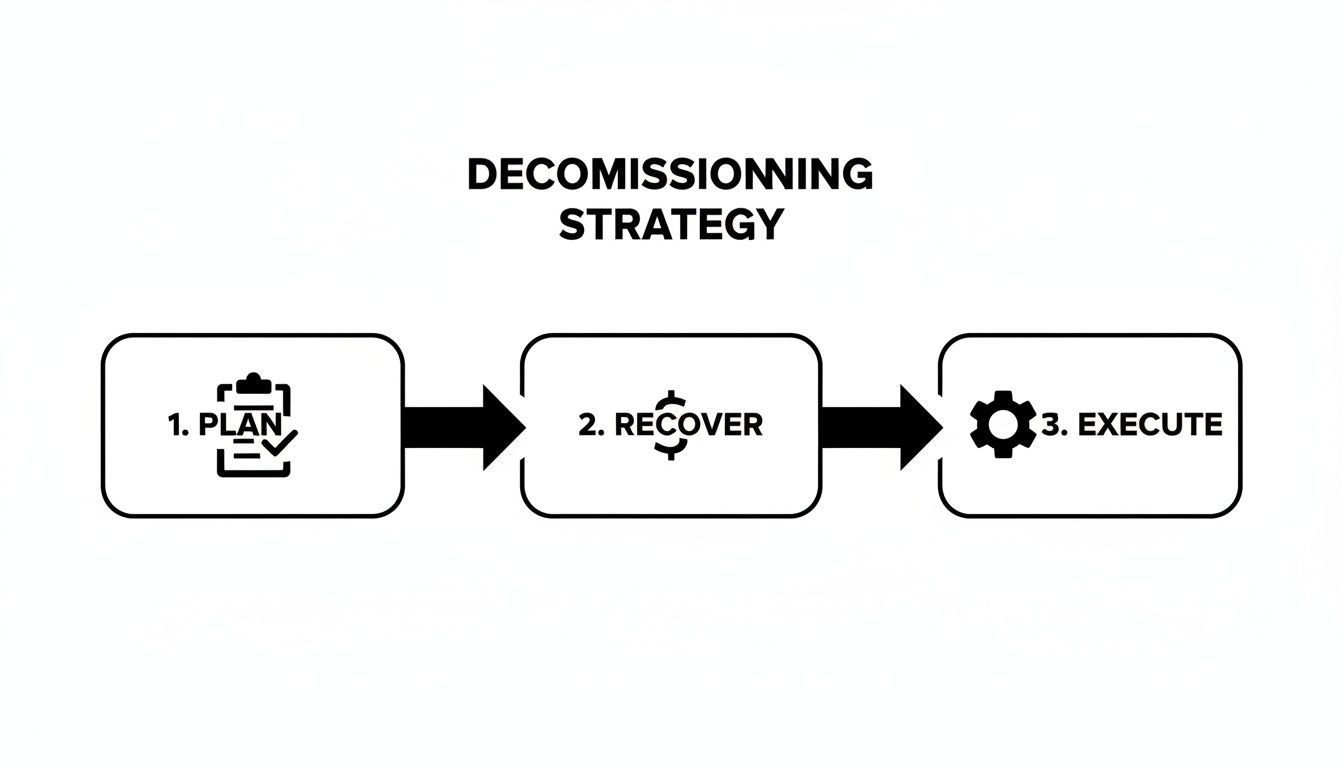
A successful project always comes down to a careful balance of meticulous planning, smart value recovery, and flawless execution on the ground.
To give you a clearer picture, here’s a high-level look at how these stages break down.
| Decommissioning Stage | Primary Goal | Key Activities |
|---|---|---|
| Planning & Scoping | Establish clear objectives, budget, and timeline. | Site audits, asset inventory, regulatory review, risk assessment. |
| Value Recovery | Maximize financial return from retired assets. | Asset valuation, identifying resale channels, planning for scrap/recycling. |
| On-Site Execution | Safely dismantle, remove, and process all assets. | De-installation, hazardous material handling, logistics, data destruction. |
Each stage is critical, and overlooking any one of them can lead to costly delays or compliance issues down the line.
The Role of a Specialized Partner
Bringing in a specialist transforms this complex task from a liability into a streamlined, and often profitable, project. These experts handle every detail, from on-site logistics to ensuring full compliance and secure data wiping for any electronics. If you're dealing with electronics, our guide on corporate e-waste solutions is a great resource.
By taking a strategic approach and getting expert help, manufacturers can turn a necessary shutdown into a powerful step toward a more efficient and profitable future.
Building Your Decommissioning Blueprint
Any successful project starts long before a single bolt gets turned. This is the planning stage, where you lay out the blueprint that will keep scope creep and budget overruns from derailing your entire effort. Forget generic checklists for a moment—the very first decision you need to make is defining the project’s boundaries.
Is this a targeted removal of a single production line, or are we talking about a complete facility shutdown? The answer to that question will shape every single step that follows. Getting this clear from the outset is your best defense against surprises, whether you're managing a nationwide operation or a local plant in a manufacturing hub like Atlanta.
Assembling Your Decommissioning Team
A project of this scale is never a one-person show. Real success comes from putting together a team with leaders from every key department, each owning their piece of the puzzle. This isn’t about just handing out a to-do list; it's about empowering the right people to guide the project from their unique vantage point.
Your core team should have representation from:
- Operations: These are the folks who know the machinery inside and out. They understand how different systems connect and the safest, most logical way to take things apart.
- Finance: This person is all about the numbers. They’ll manage the budget, track every dollar spent, and look for opportunities to get a return on asset sales, ensuring the project makes financial sense.
- Environmental, Health & Safety (EHS): Your EHS leader is your compliance guru. They’ll handle everything from hazardous material regulations to the safety protocols that protect your team on the ground.
- IT: In today’s smart factories, IT is critical. They’re responsible for data security, shutting down networks, and managing the proper disposal of all electronic assets, from servers down to the control panels on the factory floor.
Without everyone at the table, things get missed. For instance, your operations manager might know a specific machine uses hazardous coolants, but only the EHS lead will know the exact regulations—and costs—associated with disposing of them.
Mapping Out a Realistic Timeline and Budget
With your team assembled, you can start building a timeline and a preliminary budget. This has to be more than a back-of-the-napkin guess. A good blueprint accounts for every potential cost, from labor and shipping to specialized waste handling and permit fees.
A well-planned decommissioning process helps avoid unnecessary delays and ensures that the project stays within budget. The first step in any industrial decommissioning project is a thorough site assessment and planning phase.
We saw this play out recently with a university lab in Atlanta that needed to retire several large, old centrifuges. Their initial plan only budgeted for the physical removal. But during a detailed planning session, the team discovered the equipment still contained biological residue that required certified decontamination.
By catching this requirement upfront, they were able to adjust the budget and schedule to bring in a specialized crew. That simple bit of proactive planning saved them from major unexpected costs and the headache of compliance violations down the line. This level of detailed preparation is exactly what you should expect from professional factory equipment removal and disposal services.
A rock-solid roadmap, built on detailed scoping and input from a cross-functional team, is the only way to ensure your decommissioning project stays on track, on budget, and completely compliant.
Turning Retired Assets into Revenue
What if your old equipment wasn't just a pile of scrap, but a hidden revenue stream? The trick to factory equipment decommissioning for manufacturers is to stop seeing it as a cost and start treating it as a profit center. This all starts with strategic valuation and disposition, not just a simple asset list.
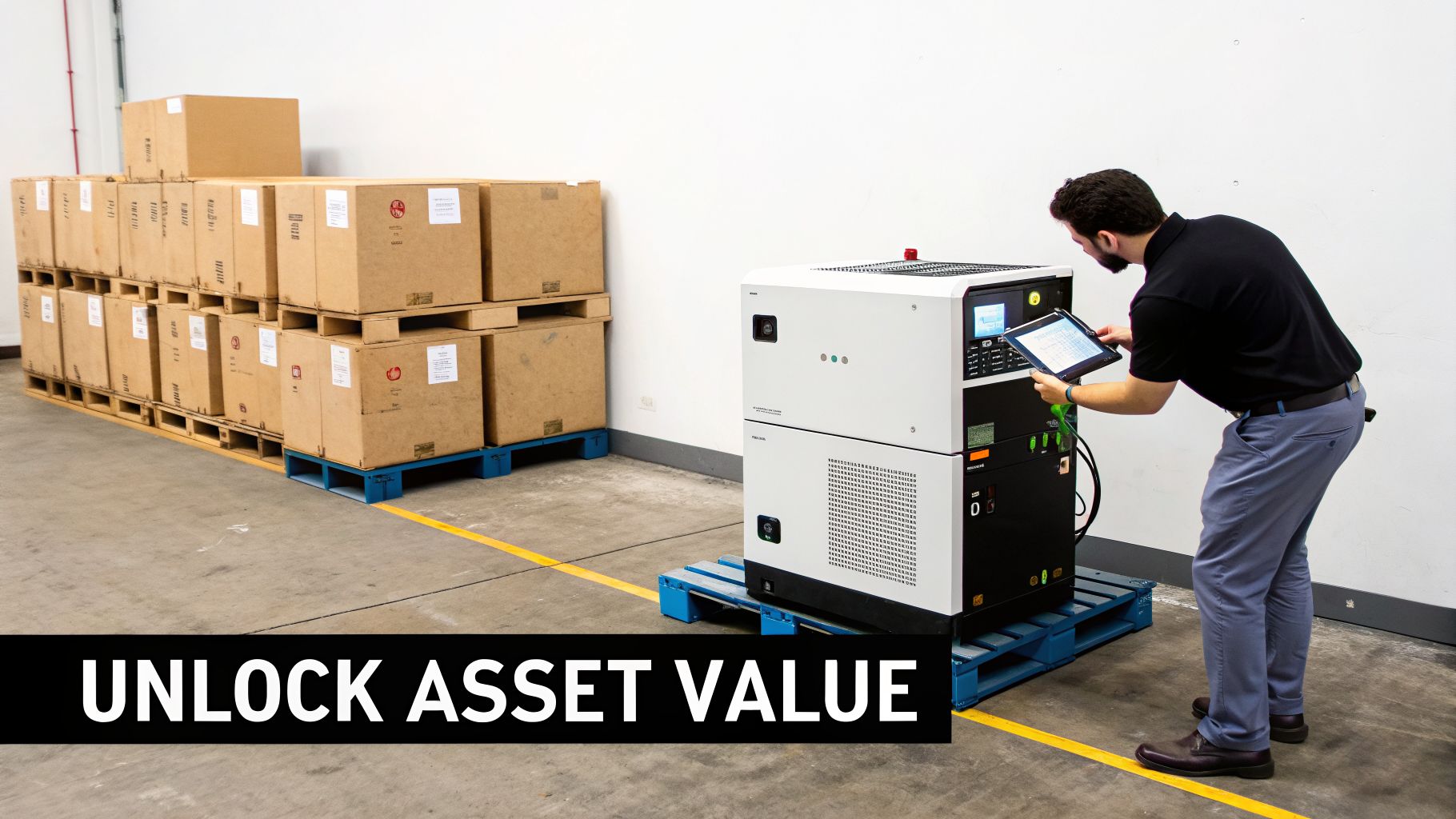
You need to go way beyond a basic spreadsheet. To get real value, you have to create a meticulous inventory that captures the details a potential buyer actually cares about. Document everything: model numbers, serial numbers, original purchase dates, and especially the maintenance logs.
Most importantly, you need to be honest about the current condition. Take pictures and detailed notes. Is it fully functional? Does it just need a few minor repairs? Or is it only good for parts? This level of detail is what separates a high-return project from one that leaves a lot of money on the table.
Separating High-Value Assets from Scrap
With a detailed inventory in hand, you can start the real work of valuation. The goal is to sort every single asset into one of three buckets: high-value for resale, good for salvageable parts, or destined for recycling. Trust me, not everything is scrap, and we've seen specialized equipment retain a shocking amount of its value.
This sorting process is absolutely essential. A CNC machine or a specific lab incubator might have a huge secondary market, while something common like a conveyor belt is probably worth more for its raw materials.
A key part of maximizing your return is protecting your most valuable equipment from the very beginning. As soon as you start the shutdown, get those high-value assets secured so they don't get damaged in the chaos. This simple step preserves their resale potential.
The global market for retired equipment is massive and growing. Aging infrastructure is forcing a decommissioning wave across the manufacturing sector, which means thousands of heavy machines need professional dismantling. In North America, this is amplified by strict environmental rules and liability concerns for assets past their design life. Done right, with recycling rates hitting 98.5% in some major projects, you not only free up space but also recover significant value.
Finding the Right Disposition Channels
Once you know what you have, it's time to find a new home for it. You’ve got a few solid options, each with its own pros and cons.
- Targeted Sales: Selling directly to other manufacturers in your industry often gets the best price. They already know the equipment's value and can put it to use immediately.
- Specialized Brokers: A good decommissioning partner will have a nationwide network of buyers. They can speed up sales and connect you to markets you could never reach on your own.
- Auctions: If you need to move a lot of equipment fast, auctions—either online or on-site—can be a great option. Just know that the prices can be less predictable.
For manufacturers in major industrial hubs like Atlanta, working with a local partner can be a huge advantage. They know the local network and can connect you with potential buyers right in your backyard.
Finally, you absolutely cannot forget about your electronic assets. Any piece of equipment with a hard drive—from control panels on the factory floor to the servers in your office—is holding sensitive data. Secure IT Asset Disposition (ITAD) is not optional. You need proper data destruction to protect your company from a data breach and to stay compliant. To get into the weeds on this, take a look at our complete guide on IT asset disposal.
Navigating the Complex World of Compliance
When it comes to decommissioning a factory, compliance isn't just another item on a checklist—it's the entire foundation of the project. Getting this wrong can bring everything to a grinding halt, inviting massive fines, project delays, and a black mark on your company's reputation that's hard to erase.
The specific rules you’ll have to follow depend entirely on where your facility is and what kind of equipment you're removing. On the federal level, you've got OSHA looking out for worker safety during the de-installation and the EPA setting the rules for waste management. But that’s just the baseline.
Beyond Federal Mandates
A state like California, for example, has its own notoriously strict environmental laws that go well beyond federal standards. Meanwhile, a manufacturer in Georgia will face a different set of local ordinances covering everything from noise levels to how you transport materials off-site. You have to know how all these layers of regulation work together.
This gets especially tricky when you’re dealing with hazardous materials. Let's be honest, industrial sites are full of them. We're talking about everything from machine coolants and solvents to lead paint and asbestos lurking in the bones of older buildings.
Properly managing these materials isn't optional. It involves a few critical steps:
- Identification: Before any work starts, a thorough audit is needed to pinpoint every single hazardous substance on the premises.
- Handling: The crew tasked with handling these substances must have specialized training and the right personal protective equipment (PPE). No exceptions.
- Disposal: You absolutely must partner with a certified disposal vendor who can provide a full chain of custody, giving you documented proof that everything was handled by the book.
Something as simple as mishandling hydraulic fluid can trigger serious EPA penalties. We've seen these principles in action time and again. For a closer look at what this entails, our guide to EPA-compliant laboratory equipment disposal shows how seriously this is taken in a lab setting.
The Critical Role of Data Security
Compliance today goes far beyond just physical hazards and environmental rules. In our hyper-connected world, data security has become one of the biggest—and most overlooked—liabilities in any decommissioning project.
If you're getting rid of any asset with a hard drive—and that includes everything from office PCs and servers to the control panels on your machinery—you have to be certain that the data is completely destroyed. For regulated fields like healthcare or finance, this is non-negotiable. HIPAA, for example, demands verifiable proof that patient data has been wiped clean and is impossible to recover.
The industry benchmark for this is DoD 5220.22-M data sanitization. This is a multi-pass overwrite process that effectively makes data recovery impossible.
A decommissioning plan that ignores data security is a disaster waiting to happen. A single data breach from a supposedly retired asset can lead to millions in fines and reputational damage, easily dwarfing the entire cost of the decommissioning project itself.
Finding the Right Partner
Choosing the right vendor is the single most important decision you'll make to ensure compliance. A qualified partner acts as your shield, navigating the complex regulations so you don't have to. Here's a checklist to help you vet potential decommissioning vendors.
Vendor Selection Checklist for Compliant Decommissioning
| Evaluation Criterion | What to Look For | Why It Matters |
|---|---|---|
| Certifications & Licensing | R2, e-Stewards, NAID AAA certifications. State and local permits for transport and waste handling. | These certifications are non-negotiable. They are independent proof that the vendor meets the highest industry standards for environmental protection, data security, and worker safety. |
| Hazardous Material Expertise | A documented track record of handling materials specific to your industry (e.g., coolants, solvents, heavy metals). | Ask for case studies or references. A vendor who primarily handles office electronics may not be equipped for the complexities of an industrial site. |
| Data Destruction Capabilities | Offers both on-site and off-site data wiping (DoD 5220.22-M) and physical destruction (shredding). Provides Certificates of Destruction. | You need verifiable proof that sensitive IP, customer data, or financial records have been irretrievably destroyed to meet regulations like HIPAA or GLBA. |
| Insurance & Liability Coverage | Substantial liability insurance covering environmental contamination, data breaches, and worker injuries. | If something goes wrong on your property, their insurance should be the first line of defense, not yours. Ask for a Certificate of Insurance (COI). |
| Chain of Custody Documentation | Detailed, serialized tracking from the moment an asset leaves your facility until its final disposition (resale, recycling, or destruction). | This documentation is your legal proof of compliance. It's what you'll show auditors or regulators to prove you acted responsibly. |
| On-Site Safety Record | A clear and enforced safety program (e.g., lockout/tagout procedures, PPE requirements). Ask for their safety manual and incident rates. | De-installation is physically dangerous work. A vendor with a poor safety culture puts your employees, your facility, and your project timeline at risk. |
Ultimately, a proactive approach to compliance—and choosing a partner who shares that mindset—is what turns a regulatory minefield into a professionally managed process. It protects your people, your community, and your company's bottom line.
Executing a Safe and Sustainable Project
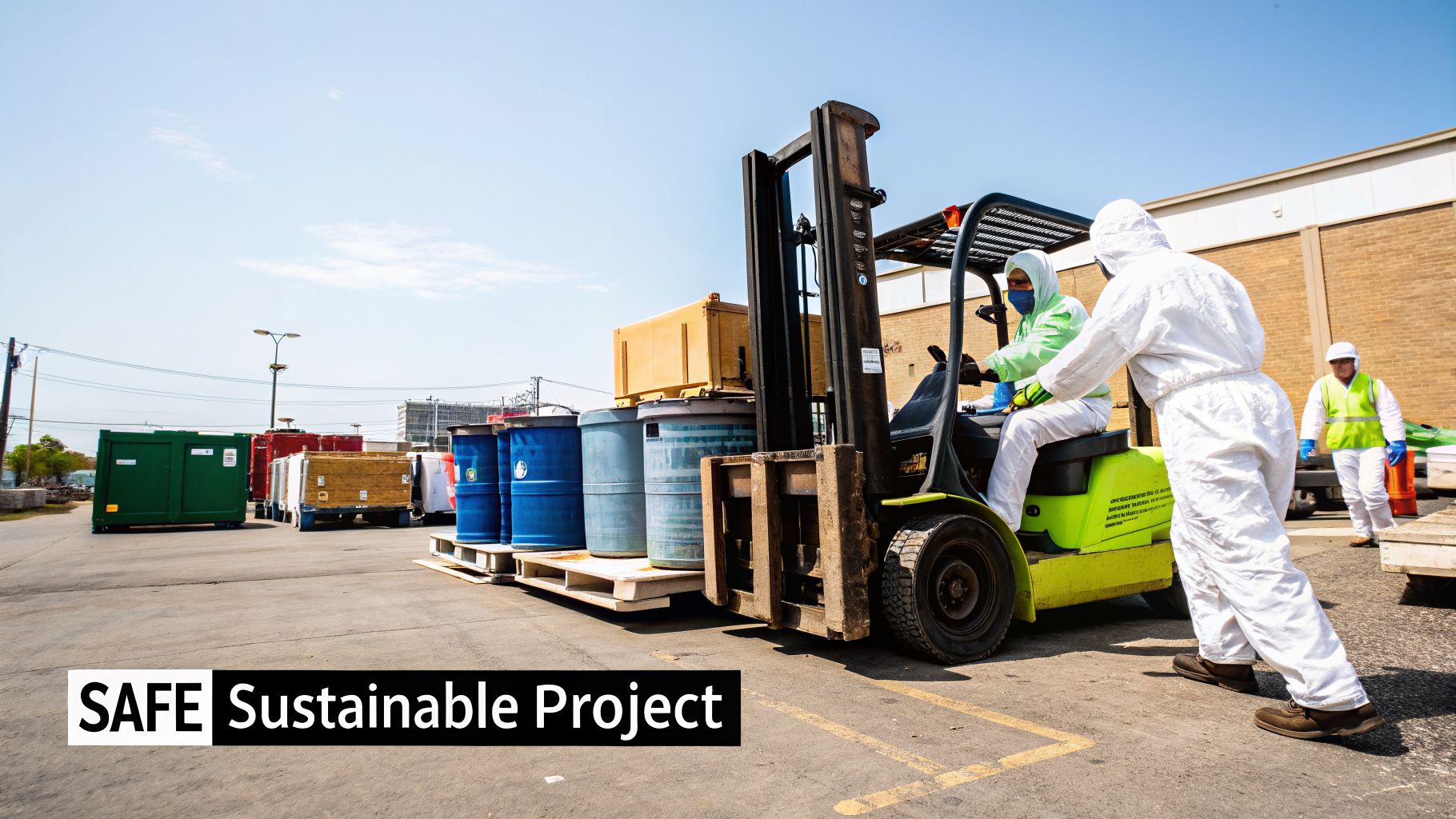
This is where the rubber meets the road. All your careful planning comes down to this moment—the physical, on-site execution of the decommissioning. Success here is all about tight coordination, non-negotiable safety protocols, and knowing exactly what happens to every last asset after it leaves your facility.
The real-world logistics are more than just unbolting machinery. It’s a carefully orchestrated process that requires skilled technicians, specialized equipment, and perfect timing to get right.
Mastering On-Site Logistics and Safety
Your vendor's team and your own need to be in lockstep. We find daily pre-work briefings are essential. They ensure everyone on the floor knows the day's tasks, the specific hazards involved, and the safety measures we're all following. This is absolutely critical when we're dealing with heavy equipment or energized systems.
Proper lockout/tagout (LOTO) procedures aren't just a good idea—they're a lifeline. Before anyone lays a hand on a machine, every single energy source (electrical, hydraulic, pneumatic) must be completely isolated and locked out. There are no shortcuts here.
Part of that safety-first approach means having a deep understanding of potential electrical risks. A detailed arc flash hazard analysis is an indispensable part of any project involving powered equipment, as it identifies hazards before they can become incidents.
Moving massive, heavy machinery requires a partner with a serious logistics network. This ensures efficient pickups, whether it's a single truck for a small lab in Atlanta or a fleet of flatbeds for a complete factory shutdown spanning multiple states. A good partner manages the whole show—from rigging and crating to transport—so your assets get moved safely and on schedule.
The Circular Economy in Action
A huge part of modern factory equipment decommissioning for manufacturers is handling disposal responsibly. So, what really happens to your equipment after it’s hauled away? The goal is simple: avoid the landfill and give those materials a new life.
A truly successful decommissioning project will divert over 95% of all materials from the landfill. This isn't just an environmental talking point; it's smart business that turns potential waste into a valuable commodity stream.
Your old assets are meticulously broken down into their core components. This is far more sophisticated than just scrapping. Think of it this way:
- IT Servers: We separate circuit boards from steel casings, aluminum heat sinks, and power supplies. Precious metals are then recovered from the boards themselves.
- Lab Centrifuges: These are broken down into high-grade stainless steel, copper from the motors, and various plastics. Each material has its own dedicated recycling path.
- Incubators and Fume Hoods: These yield a mix of steel, glass, and electronic controls, all of which are segregated for proper processing.
This is about more than just "being green." The clean steel, aluminum, and copper that we recover re-enters the manufacturing supply chain. This reduces the need to mine and process virgin materials, which in turn lowers the environmental footprint for everyone. For a deeper look at this process, check out our guide on managing e-waste sustainably.
When you partner with a vendor who lives by these principles, you ensure your project doesn't just end safely and efficiently, but with a positive environmental impact you can be proud of.
Answering Your Decommissioning Questions
Even with the best-laid plans, big projects always bring up questions. Having handled factory equipment decommissioning for manufacturers for years, we’ve heard just about everything from facility managers, IT directors, and lab supervisors.
Here are some of the most common questions we get, along with direct, practical answers from our experience on the ground.
How Long Does Equipment Decommissioning Usually Take?
Honestly, the timeline is all over the map. It completely depends on the scope of your project.
We've handled small lab clean-outs in Atlanta with a few dozen machines that were wrapped up in under a week, from the first call to the final truck pulling away. That’s about as fast as it gets.
On the other hand, decommissioning an entire manufacturing plant or even just one complex production line is a much bigger undertaking. These projects can easily take several months to plan and execute safely and correctly.
Your schedule will really be shaped by a few key things:
- Facility Size: The sheer square footage and number of assets are the biggest factors. More stuff just takes more time.
- Equipment Complexity: Heavy, integrated machinery with complex connections takes far longer to de-install than standalone units we can simply unplug and roll out.
- Hazardous Materials: Finding unexpected contaminants like old asbestos insulation or chemical residues can bring things to a halt. Remediation adds significant time and requires specialists.
- Regulatory Hurdles: Permitting and compliance paperwork can be a real drag, and the rules vary wildly between states and even neighboring towns.
The best way to get a realistic schedule is to have your decommissioning partner walk the site with you and map out a detailed project plan from day one. A provider with a strong local presence or an established nationwide logistics network can often speed things up by knowing how to handle these variables.
What Are the Biggest Hidden Costs I Should Watch Out For?
The financial surprises almost always come from one thing: a lack of good planning upfront. We see it all the time. A thorough site assessment and a transparent, line-item quote from your vendor are your best defense against unexpected bills.
These are the most common budget-killers we see in the field:
- Unexpected Hazardous Materials: You find contaminants inside a machine or in the soil beneath it that nobody knew about. Now you need specialized (and expensive) remediation services that weren't in the original budget.
- Inefficient Logistics: Poor coordination is a money pit. It leads to crews standing around waiting, trucks showing up at the wrong time, and labor overruns that can bloat your final invoice.
- Data Breach Consequences: A single hard drive that wasn’t properly wiped can lead to regulatory fines and brand damage that make the entire decommissioning cost look like pocket change.
- Missed Asset Revenue: Failing to properly inventory and market your reusable equipment is like throwing money away. That revenue could have offset a huge chunk of your project costs.
A transparent partner will point out these risks from the start and help you build contingencies into the plan. No one likes sticker shock.
Can We Just Handle Decommissioning In-House to Save Money?
Trying the DIY approach to save a few bucks is a tempting but incredibly risky idea that often ends up costing more in the long run. Decommissioning is a specialty trade that requires specific tools, safety certifications, and a deep understanding of regulations that most in-house maintenance teams just don't have.
Handling decommissioning in-house might look cheaper on paper, but it means your company takes on 100% of the liability. You are solely responsible for worker injuries, environmental fines, and data security breaches—all of which can cost far more than hiring a certified specialist.
An experienced partner doesn't just take that risk off your shoulders; they also have the industry connections to maximize the resale value of your assets. When you look at the net cost, a professionally managed project often comes out way ahead of a DIY attempt.
How Is Our Company's Sensitive Data Protected?
For any legitimate IT Asset Disposition (ITAD) provider, data security is everything. The process has to start with a rock-solid chain-of-custody protocol the second they touch your assets, ensuring every single drive and device is tracked.
You'll want to see a vendor that offers DoD 5220.22-M 3-pass data sanitization. This is a software-based wipe that overwrites a drive's data three separate times, making it virtually impossible to recover anything.
For hard drives that are broken, too old, or just can't be reliably wiped clean, physical destruction is the only answer. This means feeding the drives into an industrial shredder that turns them into small, mangled pieces of metal.
At the end of it all, you must get a serialized Certificate of Data Destruction. This is your official, legal proof that you complied with rules like HIPAA. It’s the document that protects you from any future liability.
Ready to tackle your next decommissioning project with confidence? The team at Scientific Equipment Disposal offers a complete, compliant solution for manufacturers, labs, and corporate facilities. From on-site de-installation and logistics to certified data destruction and sustainable recycling, we handle every detail. Learn how we can help you recover value and eliminate risk by visiting us at https://www.scientificequipmentdisposal.com.