How to Choose an Electronic Recycling Center You Can Trust

Choosing the right electronic recycling center goes way beyond just a logistical task. It’s a serious decision that directly impacts your institution's data security, legal standing, and even your environmental reputation, whether you're operating from a single location or across the country. At its core, this is all about managing risk and making sure you uphold your organization's commitment to responsibly handling sensitive assets.
Foundations for Vetting Your Electronic Recycling Partner
Picking an electronic recycling partner isn't just about getting someone to haul away old equipment. You're entrusting a vendor with your data, your legal compliance, and your brand's integrity. A single misstep here could lead to a devastating data breach, steep fines, and environmental liabilities that follow you for years.
The process has to start with a hard look at the foundational credentials that separate the professional, certified operators from the risky, fly-by-night disposers.

This initial vetting stage is all about the non-negotiables. The goal is simple: build a shortlist of potential partners who have already proven they meet the highest industry standards for both local and nationwide services. That way, you're only spending time on vendors who are actually capable of meeting your institution's strict requirements.
The Power of Third-Party Certifications
Your first line of defense should always be third-party certifications. These aren't just fancy logos they stick on a website; they are concrete proof that an independent body has audited the recycler’s processes from top to bottom.
Two certifications really stand out as the gold standard in our industry:
- R2v3 (Responsible Recycling): This is the leading global standard for electronics repair and recycling. An R2v3-certified recycler has proven their processes for data security, environmental protection, and worker health and safety.
- e-Stewards: Developed by the Basel Action Network, this standard is famous for its incredibly stringent requirements, including a flat-out ban on exporting hazardous e-waste to developing countries.
By insisting on at least one of these, you immediately filter out a huge number of unqualified vendors. It confirms the provider sticks to a rigorous framework for managing e-waste, which protects you from downstream liability no matter where your facilities are located.
A partner’s certification is your assurance that they won’t cut corners. It means they've invested in secure, ethical, and environmentally sound practices, which in turn protects your organization from the fallout of improper disposal.
Scrutinizing Data Sanitization Claims
Beyond general certifications, you have to dig into a vendor’s specific data destruction methods. Vague promises of "secure wiping" just don't cut it. A credible partner will be completely transparent about their sanitization protocols and be able to provide auditable proof.
Look for concrete methods like DoD 5220.22-M wiping, a multi-pass process that overwrites data so it can't be recovered. For non-functional hard drives or media, physical destruction through shredding is the way to go.
This level of scrutiny is absolutely critical for institutions handling protected information, like hospitals bound by HIPAA or research facilities with proprietary data. A reliable recycler understands what’s at stake and is ready to document every single step. You can also review our guide on the top electronic waste recycling companies to see how the leading providers handle this crucial service.
Understanding the Chain of Custody
Finally, don't be afraid to ask the tough questions about logistics. Does the vendor operate its own fleet of secure trucks, or are they just hiring third-party freight carriers? An in-house logistics team means fewer handoffs and a much tighter chain of custody, which drastically reduces the risk of equipment getting lost or stolen.
This might seem like a small detail, but it’s a vital one for both local projects and massive nationwide asset disposition programs. That level of control is a key indicator of a professional and secure operation, whether you need an electronic recycling center in Atlanta or a coordinated pickup across multiple states.
Core Vetting Criteria for Electronic Recycling Partners
To make this process easier, we've put together a quick-reference table that summarizes the essential qualifications to look for. Use this as a checklist when you start comparing potential partners side-by-side.
| Vetting Category | What to Look For | Why It Matters |
|---|---|---|
| Certifications | R2v3 or e-Stewards certification. | Verifies adherence to strict industry standards for security, environmental safety, and worker protection. |
| Data Destruction | Specific methods offered (e.g., DoD 5220.22-M wiping, physical shredding). | Ensures your sensitive data is irreversibly destroyed, protecting you from breaches and compliance violations. |
| Chain of Custody | Use of in-house, secure logistics vs. third-party carriers. | A tighter chain of custody reduces the risk of asset loss or theft during transit. |
| Reporting & Auditing | Certificates of Destruction, serialized asset tracking, and transparent reporting. | Provides auditable proof that your assets were handled correctly, which is critical for compliance. |
| Insurance Coverage | Proof of data breach, liability, and pollution insurance. | Protects your organization financially in the unlikely event of an incident during the disposal process. |
| Downstream Transparency | Clear policies on how materials are processed, reused, or recycled after leaving their facility. | Guarantees your e-waste won't be illegally exported or end up in a landfill, protecting your reputation. |
This table isn't exhaustive, but it covers the absolute must-haves. A vendor who can confidently check all these boxes is one worth considering for a deeper conversation.
Ensuring Bulletproof Data Security and Compliance
For any institution handling sensitive information—whether it's patient records in a hospital or proprietary research at a university—a data breach isn't just a tech problem. It's a catastrophe. You're looking at millions in fines, a reputation that's instantly shattered, and a total loss of trust from the people you serve.
When you hand over your retired assets to an electronic recycling center, you’re not just getting rid of old hardware. You're extending that circle of trust. This is where the conversation shifts from simple disposal to the non-negotiable world of verified, auditable data destruction. A real partner doesn't just promise security; they deliver a legally defensible process that proves your data is gone for good.
Choosing the Right Data Destruction Method
Not all data is created equal, and neither are the methods used to destroy it. A top-tier recycling partner should offer a full suite of options designed for different types of assets and security needs. Knowing the difference is the first step in creating a disposition plan that actually protects you.
You'll generally come across three primary methods:
- Data Wiping: This is a software-based approach that overwrites a hard drive with random characters, often multiple times. The gold standard is the DoD 5220.22-M 3-pass wipe. It's perfect for most institutional needs because it securely sanitizes the drive, allowing it to be refurbished and reused.
- Degaussing: Using a powerful magnetic field, degaussing instantly scrambles the magnetic platters inside a traditional hard drive. The data becomes completely unrecoverable in seconds. While it's much faster than wiping, it also destroys the drive, making it a great choice for media that's faulty or holds extremely sensitive information.
- Physical Shredding: For the highest level of security, nothing beats physical destruction. This is the only real answer for solid-state drives (SSDs), damaged hard drives, or any media that can't be wiped or degaussed. The device is fed into an industrial shredder that reduces it to tiny, unsortable fragments of metal and plastic.
Deciding which method to use comes down to your risk tolerance, compliance mandates like HIPAA, and your own sustainability goals. A university, for example, might choose data wiping for functional laptops to recover some value. A healthcare provider, on the other hand, would likely mandate physical shredding for any drive that ever held patient health information (PHI).
You can take a deeper dive into these options by exploring our detailed guide on secure data destruction.
The Certificate of Data Destruction: Your Proof of Compliance
A verbal promise that your data has been destroyed is worthless in an audit. Your only real safeguard is a formal Certificate of Data Destruction (CoDD). This document is the official, legal record proving you took every necessary step to protect sensitive information. It’s the cornerstone of any compliant IT asset disposition (ITAD) program.
A weak or incomplete Certificate of Data Destruction can leave your organization completely exposed. It needs to be a detailed, legally sound document that creates a clear and unbroken chain of custody from the moment an asset leaves your facility to its final destruction.
A proper CoDD is far more than just a receipt. It has to include specific, verifiable details that will stand up to intense scrutiny:
- A unique serial number for the certificate itself.
- The exact date the assets were processed and destroyed.
- The specific method of destruction used (e.g., DoD 3-pass wipe, physical shredding).
- A detailed inventory of the assets, including make, model, and individual serial numbers.
Imagine a hospital getting rid of 50 old computers. A generic certificate saying "50 PCs destroyed" is totally inadequate and opens you up to huge liability. A truly compliant certificate will list the unique serial number of every single hard drive, confirming each one was properly sanitized. This level of detail is non-negotiable for any organization needing to prove due diligence for HIPAA, GDPR, or internal security audits.
When you’re vetting an electronic recycling center for any project, always insist on seeing a sample of their certificate to make sure it meets these exacting standards.
Mastering Logistics and On-Site Decommissioning
Let’s be honest: even the most ironclad data destruction plan is useless if your assets get lost or damaged on the way to the facility. Logistics is the connective tissue holding the whole process together, and frankly, it's where a lot of e-waste projects fall apart. A top-tier electronic recycling center isn't just a processor; they're a master of the complex journey from your site to theirs, ensuring there are zero weak links in the chain of custody.
I can't overstate the importance of working with a recycler that uses its own trained, insured crews. When a vendor runs its own fleet of trucks, they maintain absolute control from start to finish. This immediately eliminates the risks that come with hiring third-party freight carriers—things like lost assets, handlers who don't know what they're doing, or scheduling nightmares that can derail an entire project.
Planning for a Seamless Pickup
Whether you're clearing out a multi-state data center or decommissioning a single local lab, meticulous planning is the only way to minimize your operational downtime. A real partner acts more like a logistical consultant than a simple pickup service.
They'll work with you to coordinate with building managers, figure out loading dock access, and schedule the job during off-peak hours so your daily operations aren't disrupted.
Think about a hospital decommissioning an entire wing. They can't afford to have crews blocking hallways while patients are around. A professional recycler gets this. They'll schedule the work for nights or weekends and bring the right team and tools—pallet jacks, lift gates, you name it—to get the job done efficiently and quietly. It’s this kind of proactive planning that makes the whole process feel smooth.
Once the equipment reaches a certified facility, a clear, documented process for data destruction is non-negotiable.
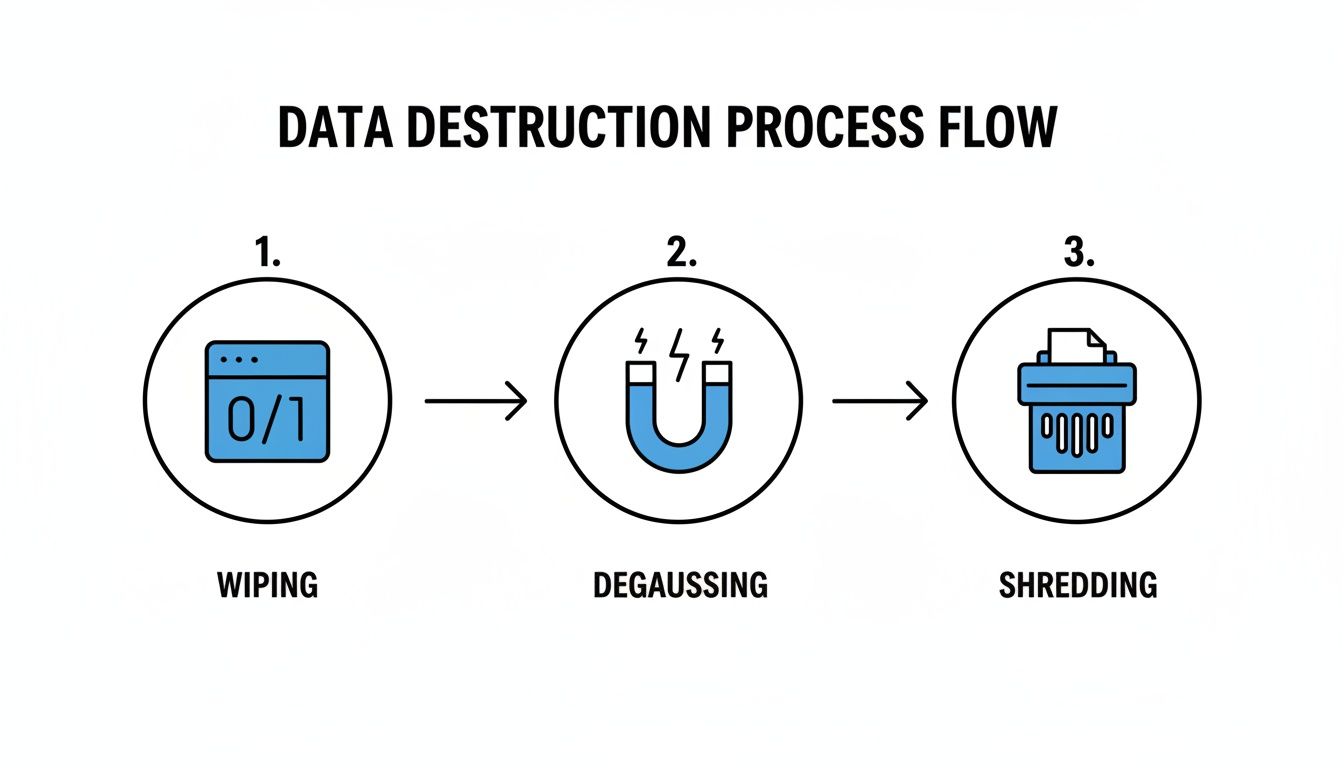
As you can see, a professional partner will offer several distinct methods to guarantee data is destroyed, tailoring the technique to the specific asset and security level required.
Asking the Right Logistical Questions
Before you sign on the dotted line, you need to dig into the details of a vendor's logistics. Their answers will tell you everything you need to know about their professionalism and whether they can handle your specific project, whether it's one site or a nationwide rollout.
Here are a few questions I always recommend asking:
- Who is actually handling the pickup? Are your crews direct employees who have been background-checked and trained, or are you just subcontracting the work?
- What does your insurance coverage look like? Ask to see a Certificate of Insurance. It should include general liability, data breach, and pollution liability coverage. A minimum of $1 million per incident is the industry standard.
- How do you manage delicate equipment versus bulk IT assets? They should have a clear process for packing sensitive lab instruments separately from palletized servers to prevent damage.
- How flexible is your scheduling? Can they handle after-hours or weekend pickups for both local and out-of-state jobs?
A company's approach to logistics is a direct reflection of its commitment to security. A vendor that invests in its own fleet, trained crews, and comprehensive insurance is one that takes its role in protecting your assets—and your reputation—seriously.
This detailed approach is a key part of any sound disposition strategy. To see how this fits into the bigger picture, you can explore our full guide on professional IT asset disposal. The right partner makes everything from decommissioning to final reporting feel effortless and secure.
Confirming Your Partner Can Handle Specialized Equipment
Your organization’s assets go far beyond old laptops and monitors. Think about the high-value, specialized equipment that keeps your labs, data centers, and clinics running. It’s a common mistake to assume every electronic recycling center is equipped to handle these unique assets, but that's a critical distinction you need to make right up front.
A vendor that mainly processes standard office e-waste will likely be out of their depth when faced with a centrifuge that needs decontamination or delicate analytical instruments that require careful handling. This is why digging into their "accepted items list" should be one of your first steps.
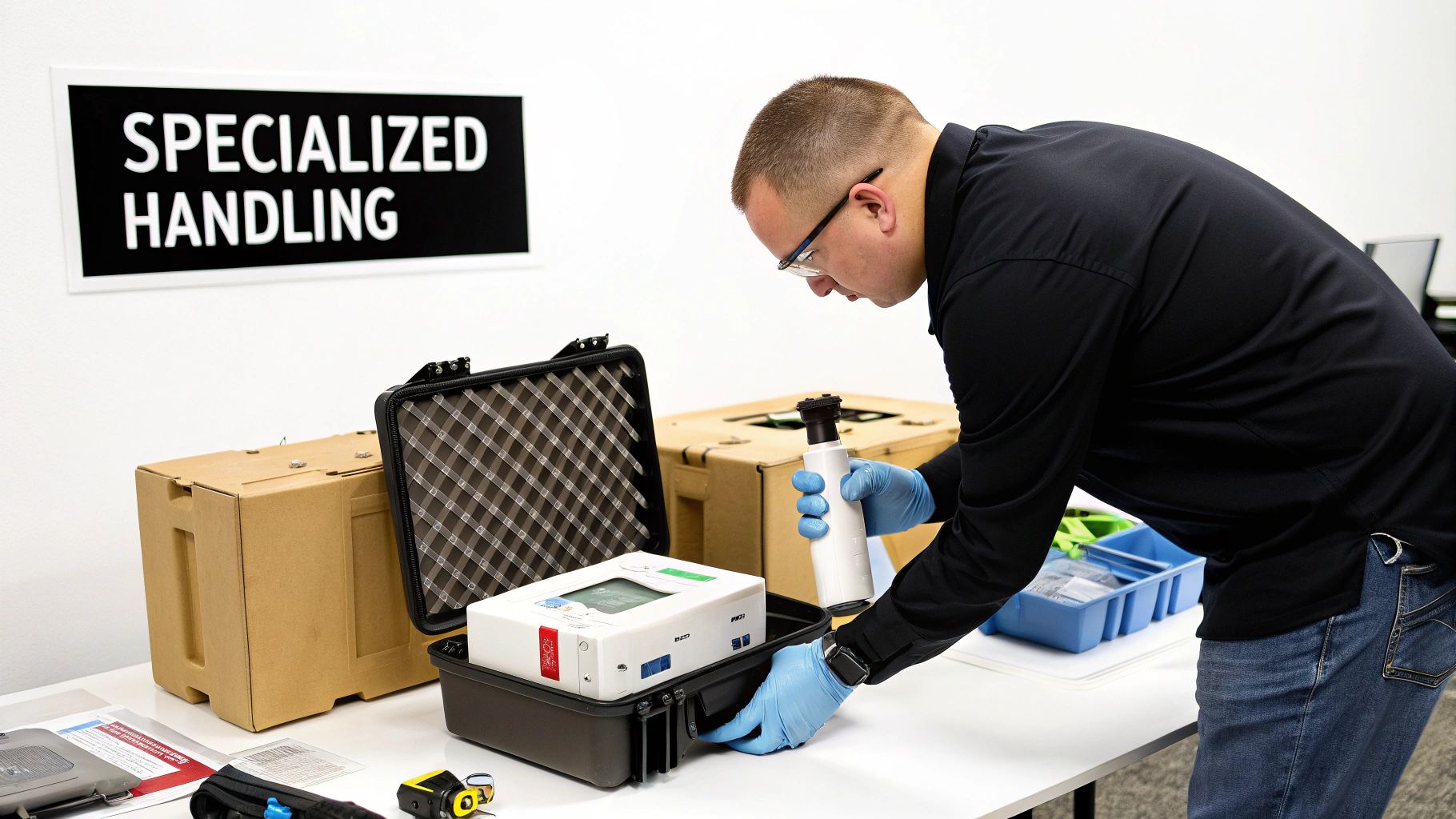
Before you even think about requesting a quote, scan that list. A truly capable partner will explicitly mention the types of equipment you have, which signals they understand the specific logistical and environmental hurdles involved.
Beyond Standard IT Gear
A recycler who knows their stuff won't just talk about computers. Their expertise should cover the core assets that drive your operations.
This is what you should be looking for:
- Laboratory Instruments: Things like centrifuges, incubators, mass spectrometers, and chromatography systems.
- Medical Devices: Defibrillators, imaging equipment, and patient monitoring systems.
- Data Center Hardware: Blade servers, storage area networks (SANs), and high-end network switches.
- Industrial Machinery: Programmable logic controllers (PLCs) and automated manufacturing tools.
If a potential partner’s list is vague and only mentions "computers and peripherals," consider it a major red flag. They probably lack the know-how to manage your full inventory. That forces you to hire multiple vendors—a logistical nightmare that drives up costs and risks. For a deeper dive, our guide on data center equipment recycling offers more specific insights into that world.
To help you get organized, here’s a quick breakdown of common equipment types and what you need to think about before disposal.
Common Equipment Types and Disposal Considerations
| Equipment Category | Examples | Key Disposal & Security Considerations |
|---|---|---|
| Standard IT Assets | Desktops, Laptops, Monitors, Printers | Data wiping (NIST 800-88), asset tag removal, potential for refurbishment. |
| Data Center Hardware | Servers, SANs, Network Switches, Routers | Critical Data Security: On-site or off-site shredding, serialized reporting, high resale value potential. |
| Laboratory Instruments | Centrifuges, Spectrometers, Analyzers | Decontamination is essential. Check for hazardous materials, remove biological agents, requires specialized handling. |
| Medical Devices | Imaging Machines, Patient Monitors, Defibrillators | HIPAA Compliance: Must ensure all Protected Health Information (PHI) is destroyed. Check for embedded batteries and hazardous components. |
| Telecommunications | VoIP Phones, PBX Systems, Video Conferencing Units | Asset tracking for leased equipment, secure data wiping of configuration files, component recovery. |
This table is just a starting point, but it illustrates how different categories demand different protocols. A one-size-fits-all approach simply doesn't work.
The Environmental and Social Stakes
Choosing a partner who can handle your entire portfolio isn't just about making your life easier; it's a core part of corporate social responsibility. Specialized equipment is often packed with hazardous materials like mercury, lead, and cadmium. If managed improperly, these toxins can leach into soil and water, posing a real threat to communities.
This is where a certified, auditable downstream process becomes non-negotiable. A reputable recycler will show you exactly how every component is handled after it leaves their facility. They ensure hazardous materials are safely extracted and managed, while commodities like steel and aluminum are looped back into the manufacturing supply chain.
The hard truth is that the world is falling behind on e-waste recycling. Your choice of a certified partner is a direct action to counter this trend, ensuring your retired assets become part of the solution, not the problem.
Despite the growth in electronics, global collection rates are disturbingly low and are actually getting worse. In 2022, only 22.3% of e-waste was documented as being properly recycled, and projections suggest this will drop to just 20% by 2030. This statistic really drives home the importance of working with certified, compliant operations that prevent hazardous electronics from ending up in landfills or being shipped to illegal processing sites. You can get more details on this from a report on the widening gap in e-waste recycling on dtpgroup.co.uk.
By partnering with a vendor who lives up to these standards, you're not just getting rid of old equipment. You're upholding your organization's ethical and environmental commitments.
Decoding Pricing Models and Service Agreements
Figuring out the cost structure of an electronic recycling center can feel intentionally confusing. Quotes often swing wildly, with pricing models that go from simple per-pound fees to complex, project-based costs that might even include rebates for valuable equipment. Getting a handle on these models is the key to locking in a fair deal and dodging those surprise invoices that plague poorly planned projects.
Ultimately, the final cost comes down to a few core factors. The type and amount of equipment, the logistics of the pickup, and the specific data destruction services you need all play a big part. A single pallet of laptops from a local office is always going to be cheaper than decommissioning an entire lab packed with specialized, heavy instruments.
Common Pricing Structures You Will Encounter
While every job is different, most vendors build their quotes around a few standard models. Knowing what to expect helps you compare proposals and see who’s giving you the straight story.
- Per-Pound Pricing: This is the most common model you'll see, especially for mixed e-waste. The recycler simply charges a set rate for the total weight of everything they haul away.
- Per-Item Pricing: For assets like monitors, servers, or specific lab instruments, some vendors charge a flat fee per unit. This can be a better deal for items that are lighter but more complicated to process.
- Flat-Rate Project Fees: For big jobs like a full lab or data center cleanout, many providers will offer a single, all-in price. This gives you cost certainty and covers everything—logistics, labor, and recycling.
- Rebates or Value Recovery: If your old gear still has some life in it (think newer servers, networking equipment, or high-end lab instruments), the recycler may offer you a credit or a direct payment. This is usually figured out after they test and audit the equipment back at their facility.
The best, most transparent quotes break everything down. Be skeptical of a single, unexplained number. A trustworthy partner will itemize the costs for transportation, labor, data destruction, and recycling fees so you know exactly what you’re paying for.
The Hidden Value in Your E-Waste
It's easy to look at a pile of retired electronics and just see junk, but there’s often real economic value locked inside. The metals inside the world's e-waste generated in 2022 were valued at an incredible USD 91 billion. Meanwhile, critical rare earth elements—the stuff vital for modern electronics—are recycled at rates below 1%. You can dig into more of these fascinating recycling statistics on 4thbin.com.
For any facility getting rid of both IT and lab equipment, understanding this potential value is a crucial part of the pricing conversation. A good partner will be upfront about how they assess remarketable assets and how that value is shared.
Scrutinizing the Service Agreement
The service agreement, often called a Statement of Work (SOW), is the legal document that outlines your partnership. This is your ultimate protection, so you need to review it as carefully as you would any other major contract. Don't just skim it for the price.
Pay close attention to these critical clauses:
- Scope of Work: The agreement must spell out every single service being provided. This means on-site de-installation, packing, transportation, the exact data destruction methods, and the types of equipment covered. Any gray area here is a recipe for a future dispute.
- Liability and Title Transfer: The contract needs to state the precise moment that responsibility for the assets transfers from you to the recycler. Usually, this happens the second their truck pulls away from your property.
- Data Security Guarantees: Look for specific language committing the vendor to the data destruction methods you agreed on, like DoD 5220.22-M wiping. The agreement should also guarantee that you will receive a serialized Certificate of Data Destruction when the job is done.
- Insurance and Indemnification: Your recycler must carry adequate insurance, including coverage for data breaches and pollution liability. An indemnification clause is also non-negotiable—it protects you from any legal trouble caused by their mistakes.
Negotiating a solid contract ensures your organization is protected from start to finish. To get a clearer idea of what a well-managed project looks like, you can learn more about how the process works with a certified provider. It provides a practical roadmap for what to expect.
Common Questions About Choosing a Recycling Partner
Even with a detailed checklist, you're going to have questions. Picking the right partner for a job this important is a big decision, and it’s smart to get into the details. We hear the same questions pop up time and again, whether the project is here in Atlanta or a multi-state cleanout.
Let's get those questions answered right now so you can move forward with confidence.
How Can I Verify My Data Was Securely Destroyed?
This is the big one, and it should be. The only real answer is an official document: a Certificate of Data Destruction. Think of it as more than a receipt—it's your auditable proof that you did your due diligence.
A legitimate certificate isn't vague. It should clearly list:
- The specific items that were processed.
- Serial numbers for every single hard drive or storage device.
- The exact date the destruction took place.
- The method used, like DoD 5220.22-M wiping or physical shredding.
When you're vetting a vendor, always ask for a sample certificate. If it's just a generic form without serialized tracking, that's a serious red flag.
For organizations that need ironclad certainty, some national providers can bring a shredding truck right to your facility. You can literally watch them destroy your drives before they ever leave your property. It's the ultimate in chain-of-custody and peace of mind.
A Certificate of Data Destruction is your legal shield in an audit. It demonstrates you took every necessary step to protect sensitive data and transfers the liability from your shoulders to your certified partner.
What If We Have Specialized Lab Equipment?
This question quickly separates the general e-waste haulers from a true institutional partner. A company that understands your world will have a detailed list of accepted items that goes way beyond computers and printers. You should see things like centrifuges, incubators, analytical instruments, and other scientific gear explicitly mentioned.
Before you sign anything, give your potential partner a detailed inventory of what you have. This simple step ensures they have the know-how and the right downstream channels to handle everything, not just the easy IT stuff. Finding a single partner who can manage both your IT and lab assets makes the entire process incredibly simpler.
What Is the Typical Timeline for a Large Project?
Knowing what to expect helps you manage everything on your end, from scheduling staff to coordinating with building management. While every lab or office cleanout has its own quirks, a well-run project moves surprisingly fast.
Here’s a realistic look at how a major decommissioning project usually breaks down:
- Consultation & Proposal: It starts with a conversation and maybe a site walk-through to see what we're dealing with. A detailed proposal usually follows in 1-3 business days.
- On-Site Service: Our trained and insured crew comes to you. We handle all the de-installation, packing, and loading. This can take anywhere from 1-5 days, depending on how much gear you have.
- Secure Transport: The moment everything is packed, it's loaded onto a secure truck and brought directly to our processing facility. This happens the same day we finish the pickup.
- Processing & Data Destruction: Back at our facility, everything is sorted, and data-bearing devices are wiped or shredded. This part typically takes about 3-7 business days.
- Final Reporting: You'll get your official Certificate of Data Destruction and any other final reports. We aim to have this in your hands within 10 business days of the initial pickup.
From start to finish, you're often looking at a total timeline of about two weeks. That kind of efficiency is a game-changer when you're up against a tight deadline to vacate a space.
Navigating the complexities of e-waste disposal requires a partner you can trust. At Scientific Equipment Disposal, we provide certified, secure, and sustainable recycling solutions for laboratories, hospitals, universities, and businesses across the nation. From our base in Atlanta, GA, we manage local pickups and coordinate complex nationwide projects. Whether it's specialized lab instruments or entire data centers, our team ensures your assets are handled responsibly every step of the way.
Ready to simplify your equipment disposal? Learn more about our services at Scientific Equipment Disposal today.