Guide to E-Waste Recycling in Atlanta: Safe IT Disposal for U.S. Businesses

For any business, lab, or hospital—whether in the Atlanta metro area or across the nation—dealing with old electronics and lab equipment is far more than just a cleanup project. It’s a serious challenge that touches on data security, environmental regulations, and some pretty tricky logistics. This is where professional e waste recycling in Atlanta and nationwide becomes an absolute necessity, not a luxury.
This guide will give you a clear, practical roadmap for managing these assets the right way, no matter where your facility is located.
Your Roadmap to Responsible E Waste Recycling in Atlanta and Beyond
Getting rid of outdated equipment—whether it's servers in Silicon Valley, medical devices in Boston, or centrifuges and fume hoods in Atlanta—demands a process that is both precise and secure. Just tossing these items isn't an option. Frankly, it's irresponsible and opens your organization up to huge risks, from data breaches to reputational damage.
The key to getting this right is partnering with a B2B provider that specializes in this field.
Working with an expert turns a compliance headache into a smooth, streamlined operation. It ensures your sensitive information is protected, you meet strict national standards like HIPAA, and you hit your sustainability targets. Instead of looking at e-waste as a problem to be solved, you can build a secure, responsible process that benefits your organization and the environment.
The Growing E Waste Challenge in Atlanta and Across the U.S.
The global e-waste problem is almost hard to comprehend, and it hits tech-heavy hubs like Atlanta, Austin, and the Research Triangle particularly hard. In 2022, the world generated a staggering 62 million tons of e-waste. What’s worse, only 22.3% of that was properly collected and recycled.
That leaves a massive 77.7% unaccounted for, often dumped in landfills where it poisons the environment. It's also a colossal economic blunder. We're talking an estimated $91 billion in valuable materials like gold, silver, and copper just thrown away instead of being recovered.
For organizations here in Atlanta and across the United States, this isn't some distant global issue—it's a local and national responsibility. Our country's thriving corporate, medical, and research sectors are constantly producing a stream of specialized electronic waste that needs to be handled correctly.
A proactive e-waste strategy is no longer optional. It's a core part of modern corporate responsibility and risk management. Failing to properly manage asset disposition can lead to data breaches, steep regulatory fines, and environmental damage.
Why a Specialized B2B Partner Is Essential
Let's be clear: commercial e-waste disposal is a different beast than residential recycling programs. It involves unique complexities that demand a much higher level of service, security, and expertise, whether you're in Georgia or California.
Here’s what a dedicated B2B partner brings to the table:
- Ironclad Data Security: They provide certified data destruction services, like DoD-standard wiping and physical shredding, to guarantee 100% of your sensitive information is gone for good.
- Regulatory Compliance: The pros live and breathe federal and state regulations like HIPAA. They make sure your disposal process is fully compliant and provide all the necessary paperwork you'll need for any audits.
- Logistical Muscle: A good partner manages everything from on-site de-installation and packing to secure transport with their own nationwide fleet. This means minimal disruption for your team. You can see how a professional e-waste disposal process works and how simple it can be.
- True Environmental Responsibility: Certified recyclers ensure all materials are processed ethically and sustainably. This keeps toxic components out of our soil and water and makes sure valuable resources are recovered and reused.
Getting Your Assets Inventoried and Ready for Disposal
Any successful recycling project starts with a clear, detailed inventory. It sounds tedious, but trust me on this one. Before you can even think about scheduling a pickup, you need a solid handle on exactly what you’re getting rid of. We're talking everything from bulky server racks and lab centrifuges down to the last hard drive and tablet.
Getting this step right from the beginning ensures you get an accurate quote, speeds up the entire process, and keeps the disruption to your daily operations at an absolute minimum.
Think of it this way: a well-organized inventory is the difference between a chaotic, day-long headache and a smooth, efficient removal that’s over in a few hours. Your recycling partner can plan for the right equipment, the right size truck, and the right number of people for the job. This is especially true for organizations in Atlanta or any major U.S. city navigating big facility moves or large-scale IT upgrades.
Creating Your Asset Disposal Catalog
First things first, you need a master list. A simple spreadsheet is your best friend here. The goal is to capture just enough detail to understand the scope of the project without getting lost in the weeds.
For each item, try to capture these key details:
- Asset Type: Be specific. "Server" is better than "IT gear." "Analytical balance" is much more helpful than "lab stuff."
- Manufacturer & Model: This is optional but incredibly useful. It helps us determine if an asset has any resale value, which could potentially offset your recycling costs.
- Location: Just a room number or a general area is perfect. This is a massive help for the removal team.
- Condition: Is it working, non-functional, or in pieces? A quick note is all you need.
- Data-Bearing? (Yes/No): This is the most important column on the list. You absolutely must flag any device that stores information—computers, servers, hard drives, and even some modern scientific instruments.
This inventory isn't just about logistics; it’s a critical part of your risk management. By flagging data-bearing devices from the get-go, you ensure they are pulled aside and marked for certified data destruction. That single step can save you from a world of hurt down the road.
For businesses dealing with a lot of complex or specialized equipment, getting some professional guidance can make a huge difference. To get a better idea of how to handle specific assets, you can learn more about our dedicated lab equipment disposal services in Georgia and see how a focused approach can simplify things nationwide.
Consolidating and Staging Your Equipment
Once your inventory is locked in, it's time to prep the actual assets for pickup. If you have the space, the single best thing you can do is consolidate everything into one, easily accessible area. This could be an empty office, a storage room, or a spot in your warehouse near a loading dock.
Centralizing the equipment for your e waste recycling in Atlanta or any other location makes the pickup dramatically faster and safer. Our crew can work without having to navigate through active labs or busy office floors, which means far less noise and interruption for your team.
Real-World Scenario: A University Lab Cleanout
We worked with a university biology department in Atlanta that was decommissioning an entire floor. They had dozens of benches cluttered with old microscopes, centrifuges, and PCR machines, not to mention a back room packed with old servers and monitors.
Instead of having our team go room by room, the facility manager was smart—he designated an unused lecture hall as the staging area. Over two days, his staff moved all the tagged equipment into that one spot. When our crew arrived, everything was inventoried, consolidated, and ready to go. That simple prep work cut our on-site time from what would have been a full day to just under three hours.
Ensuring Total Data Security and Regulatory Compliance
If your Atlanta-based or national organization handles client records, patient information, or proprietary research, secure data destruction isn't just a good idea—it's an absolute necessity. When you get rid of old IT assets, you have to be certain that every last bit of sensitive data is gone for good, completely irretrievable. This is the foundation of modern risk management.
The stakes couldn't be higher. One data breach can trigger devastating financial penalties, legal headaches, and cause permanent damage to your reputation. This is why a certified e-waste recycling Atlanta partner does more than just haul away old gear; they deliver a critical security service that protects your most valuable asset: your data.
Choosing the Right Data Destruction Method
Not all data storage is created equal, so the methods to sanitize them can't be a one-size-fits-all approach. Your choice depends entirely on the type of media you have and your specific compliance needs.
-
Software-Based Wiping (DoD 5220.22-M Standard): This process overwrites the entire hard drive with random patterns of ones and zeros, usually in multiple passes. The DoD 5220.22-M 3-pass standard is the gold standard for making data unrecoverable on traditional hard drives (HDDs) that might be refurbished or resold.
-
Degaussing: Think of this as a powerful magnetic blast that scrambles the magnetic data on media like old backup tapes or HDDs. It's incredibly fast and effective, but it also renders the drive completely useless afterward.
-
Physical Shredding: When you need absolute, 100% certainty—especially for solid-state drives (SSDs), damaged hardware, or devices holding top-tier sensitive info—nothing beats physical destruction. Industrial shredders grind the media into tiny, confetti-like fragments, making data recovery physically impossible.
Figuring out which assets need what level of attention is a critical first step. This decision process helps simplify things.
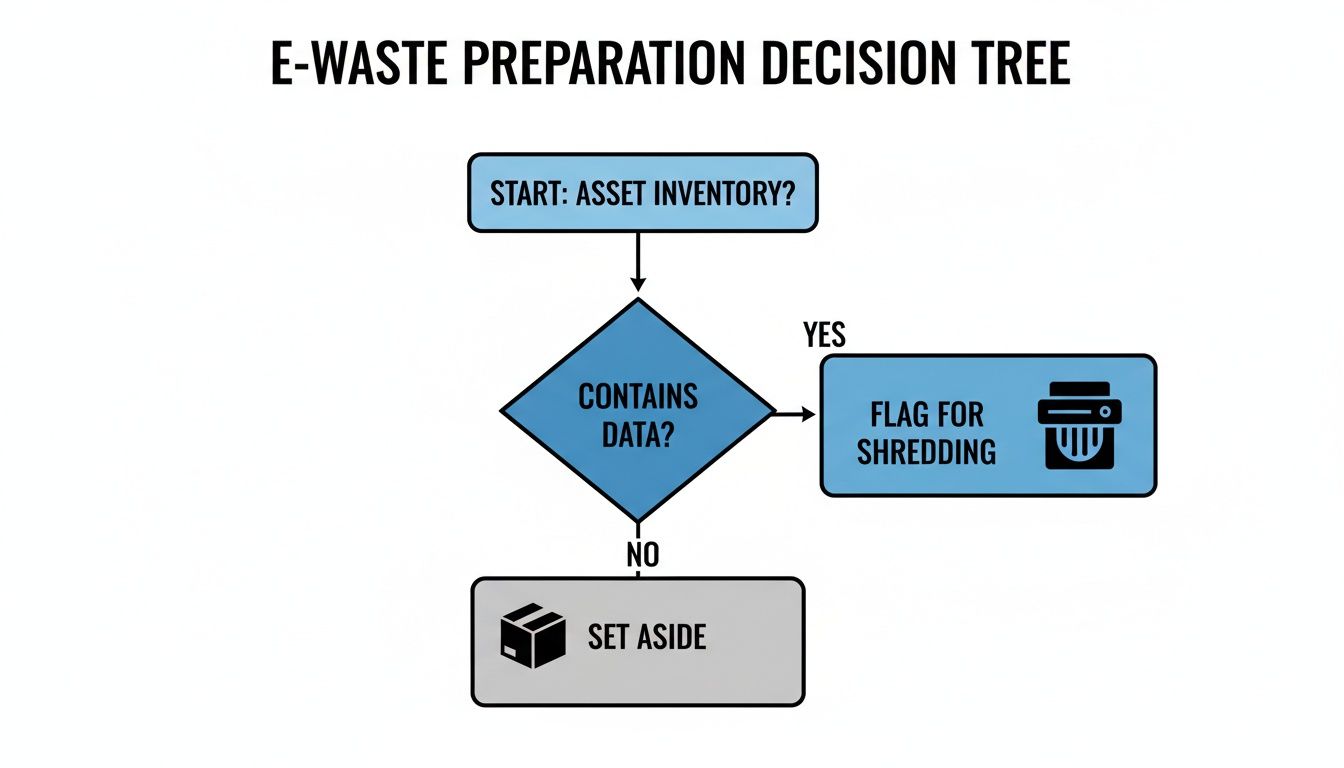
As the flowchart shows, identifying which pieces of equipment hold data and tagging them for secure destruction is a non-negotiable part of the process.
To help you decide, let's break down the common methods and where they fit best.
Comparing Data Destruction Methods
| Method | Description | Best For | Compliance Level |
|---|---|---|---|
| Software Wiping | Overwrites existing data with random characters, often following the DoD 5220.22-M 3-pass or 7-pass standard. | Functional HDDs, devices slated for resale or reuse, general business data. | High |
| Degaussing | Uses a powerful magnetic field to permanently erase all data from magnetic media. Renders the device unusable. | Magnetic tapes, floppy disks, older HDDs. Not effective on SSDs or optical media. | Very High |
| Physical Shredding | Grinds hard drives, SSDs, phones, and other media into tiny, unsalvagable fragments. | SSDs, damaged drives, smartphones, optical media, and any device containing highly sensitive data. | Absolute |
Ultimately, choosing the right method comes down to a simple risk assessment: How sensitive is the data, and what are your compliance requirements? For most modern hardware, a combination of wiping for reusable assets and shredding for everything else is the safest bet.
The Critical Role of Documentation for Compliance
Destroying the data is only half the battle. You have to be able to prove you did it. This is where proper documentation becomes your shield in case of an audit or legal question.
Any reputable recycling partner will provide serialized Certificates of Data Destruction and Certificates of Recycling. These documents are your official records, confirming that your organization followed every required procedure. They should detail the serial numbers of every single device that was wiped or shredded, creating an unbroken chain of custody and demonstrating due diligence under regulations like HIPAA for healthcare and Sarbanes-Oxley (SOX) for public companies nationwide.
For a deeper dive into this crucial topic, you can explore our guide on certified data security protocols.
A Certificate of Data Destruction is more than just a piece of paper. It's your legal proof that you've met your compliance obligations and have taken every necessary step to protect sensitive information from falling into the wrong hands.
The need for such strict processes is clear when you look at the numbers. Back in 2009, U.S. consumers and businesses discarded about 2.37 million tons of electronics, but only 25% was collected for recycling. The rest often ended up in landfills, leaching toxins like lead. Today, e-waste is the world's fastest-growing waste stream, yet global recycling rates remain shockingly low—only 17.4% of 53.6 million metric tons were properly recycled in 2019. This is why partnering with certified recyclers who provide verifiable data destruction is so essential, both for your security and for environmental stewardship.
Coordinating On-Site Logistics and Secure Pickup
This is where the rubber meets the road. All the careful planning for data destruction and inventory management can quickly unravel if the actual pickup is clumsy, disruptive, or insecure. A seamless, professional removal process is a non-negotiable part of any e waste recycling in Atlanta or any other U.S. city, making sure your daily operations aren't thrown into chaos while your assets are handled with care.
This phase is so much more than just moving boxes from point A to point B. It's about executing a well-thought-out plan that respects your workspace, protects your equipment the moment it leaves your control, and maintains a rock-solid chain of custody. You'll see the difference between a true partner and a basic hauling service right away.
Scheduling a Disruption-Free Service
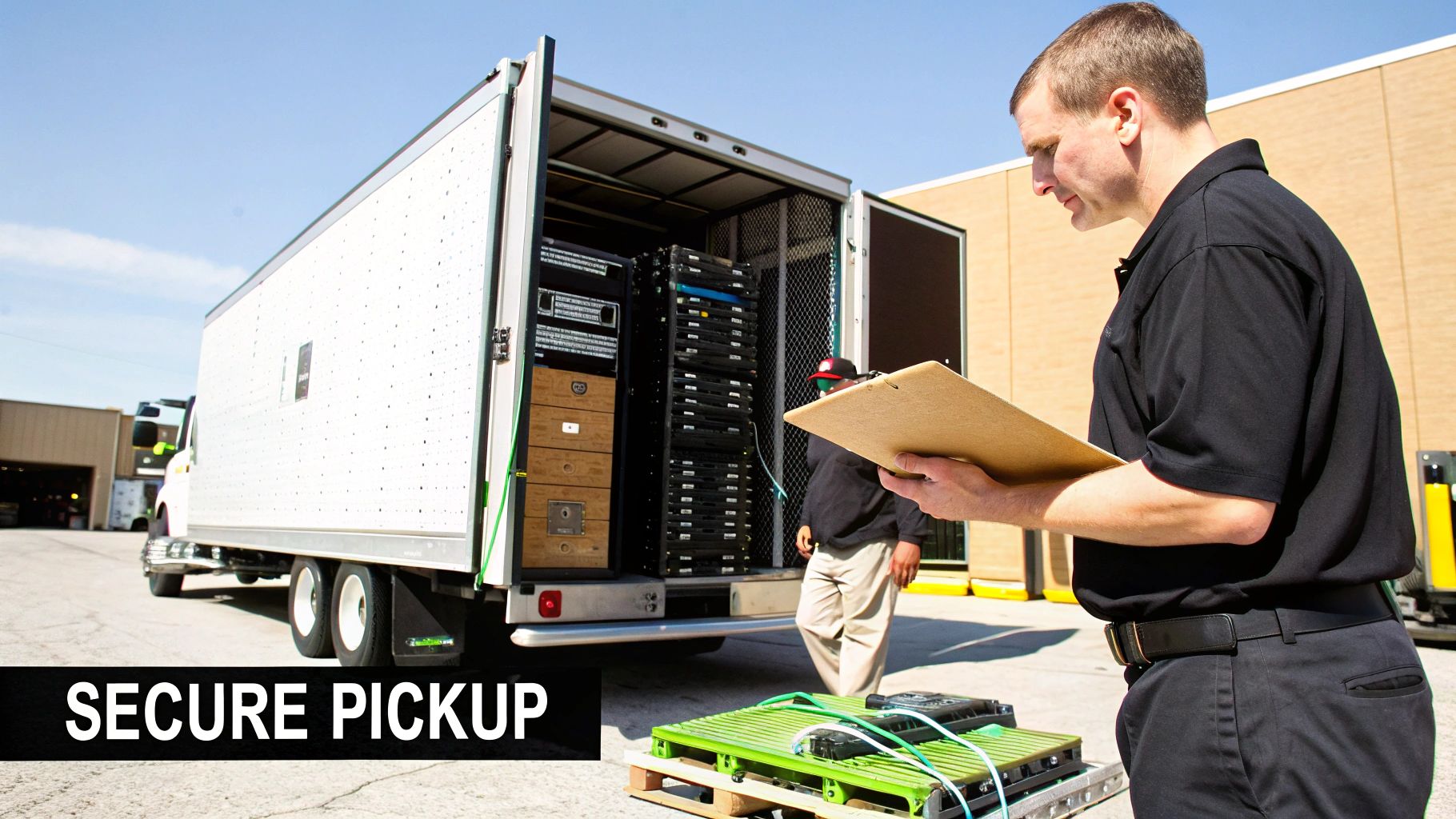
Your business doesn’t grind to a halt just because you're clearing out old tech. The goal is to schedule the decommissioning and pickup to have little to no impact on your team's workflow. That means finding a partner who can work around your schedule—whether it's after hours, on a weekend, or during a planned facility shutdown.
A professional crew shows up ready to work efficiently and on their own. They should be able to handle every part of the physical removal, including:
- On-site de-installation of servers from racks or lab instruments from benches.
- Systematic packing and palletizing to keep everything safe during transit.
- Careful navigation through your facility, from the equipment's location to the loading dock.
Honestly, your team shouldn't have to lift a finger. Their only job should be to point the crew in the right direction. That's the hallmark of a top-tier service.
The Importance of a Secure Chain of Custody
The second a server or hard drive is unplugged, it enters a critical handoff period. A secure chain of custody guarantees that every single asset is tracked and protected from your door all the way to the final processing facility. This is precisely why working with a provider that uses its own fleet of GPS-tracked trucks is such a massive security advantage.
Relying on third-party freight companies opens the door to unnecessary risks and potential breaks in that chain. When your recycler manages the entire process with their own vetted and insured team, you can rest easy knowing your sensitive equipment is never out of their direct control.
A provider-owned fleet isn't just a logistical perk—it's a core security feature. It ensures total accountability, slashes the risk of loss or theft, and maintains the integrity of your data destruction from start to finish.
Information to Have Ready for a Smooth Pickup
A little prep work on your end can make the entire pickup process incredibly smooth. Having the right details handy when you call to book the service helps the logistics team plan the perfect pickup, preventing any last-minute hiccups and ensuring the crew arrives with the right people and gear for the job.
Before you make the call, try to round up these key details:
-
Loading Dock and Elevator Access: Where's the nearest loading dock? If you don't have one, is there a ground-level entrance they can use? For multi-story buildings, confirm if there's a freight elevator and any specific hours it can be used.
-
Contact Person On-Site: Designate one person who will be there on pickup day to let the crew in and answer any questions. Make sure to have their name and direct phone number ready.
-
Count of Large or Oversized Items: Give them a heads-up about any particularly heavy or bulky assets. We're talking server racks, large-scale medical imaging devices, or industrial fume hoods. This helps the team know to bring dollies, pallet jacks, or other heavy-lifting equipment.
With this information ready, the process is fast and efficient. When you're all set, you can use these details to schedule a pickup for your Atlanta-based lab or office and lock in a truly professional experience.
Choosing a Recycler with the Right Certifications
When it comes to e waste recycling in Atlanta, picking the right partner is a big deal. The truth is, not all recycling companies are created equal. The certifications a provider holds are the single most reliable sign of their commitment to data security, environmental safety, and ethical operations across the nation.
Skimping on this due diligence can open your organization up to some serious headaches, from data breaches and hefty non-compliance fines to the reputational nightmare of your equipment ending up in an overseas landfill. A properly certified partner, on the other hand, gives you peace of mind that your e-waste is being managed the right way from start to finish.
The Gold Standards R2 and e-Stewards
As you start vetting recyclers, you’ll see two certifications pop up again and again: R2 (Responsible Recycling) and e-Stewards. These aren’t just logos for a website; they represent a serious, third-party-audited commitment to the highest standards in the industry.
A recycler holding these certifications has proven they follow strict rules for:
- Data Security: They have documented, secure processes for destroying data.
- Environmental Protection: They know how to handle hazardous materials and prevent pollution.
- Worker Health and Safety: They maintain a safe workplace for their team.
- Downstream Vendor Management: They ensure any partners they work with also meet these high standards, which is key to preventing the illegal export of e-waste.
Honestly, choosing a certified recycler is the most effective move you can make to protect your brand and ensure your disposal practices actually line up with your corporate social responsibility (CSR) goals.
Think of certifications like R2 and e-Stewards as a form of insurance. They guarantee a baseline of quality and accountability, protecting your organization from the downstream consequences of improper disposal. Without them, you are essentially trusting a vendor’s word alone.
Why Certification Prevents Illegal Exporting
One of the ugliest secrets of the e-waste world is the illegal export of hazardous electronics to developing countries. Uncertified recyclers can be tempted to sell unprocessed e-waste to the highest bidder, who then ships it overseas. There, it's often dismantled in unsafe conditions, exposing workers and the local environment to toxic materials like lead and mercury.
R2 and e-Stewards certified recyclers are strictly prohibited from this practice. They are required to track every bit of material to its final destination, ensuring each component is processed in a compliant and environmentally sound way. This transparent chain of custody is your guarantee that your old equipment won’t become part of a global environmental problem. You can check out a list of reputable e-waste disposal companies to see how top-tier providers display their credentials.
Connecting Your Efforts to a Positive Impact
Working with a certified recycler is about more than just avoiding risk—it’s an active contribution to the circular economy. This isn’t just an environmental chore; it’s an economically smart process that recovers valuable materials and saves a massive amount of energy.
For instance, recycling e-waste can save up to 90% of the energy needed to produce new aluminum. It also unlocks billions of dollars worth of precious metals like gold and copper from devices that would otherwise be buried. Globally, the 62 million tons of e-waste generated in 2022 contained an estimated $91 billion in recoverable value. With only 22.3% of it being formally recycled, most of that value was simply lost.
Choosing a certified partner ensures you are part of the solution. Discover more insights about the value of responsible e-waste recycling on southeasterndata.com. This commitment turns a simple disposal task into a positive action, allowing you to confidently pick a provider that not only protects your organization but also aligns perfectly with your sustainability goals.
Answering Your Questions About E-Waste Recycling in Atlanta
When it comes to getting rid of old commercial electronics and specialized lab equipment, a lot of questions pop up. We get it. Facility managers, IT directors, and lab techs across the Atlanta area and the U.S. often have the same concerns about the process, costs, and especially data security.
We've pulled together the most common questions we hear on the ground to give you clear, straight-up answers. The goal is to help you make smart, confident decisions for your organization.
What Kinds of Lab and IT Equipment Do You Actually Take?
This is usually the first question we get: "Can you handle this specific piece of equipment?" More often than not, the answer is a resounding yes. Any professional e waste recycling Atlanta partner should be able to manage pretty much anything your facility generates, no matter where you are.
We process a massive range of assets. For laboratories, that means things like:
- Analytical Instruments: Spectrophotometers, chromatographs, and mass spectrometers.
- Benchtop Gear: Centrifuges, incubators, vortex mixers, and hot plates.
- Heavy-Duty Equipment: Biological safety cabinets, fume hoods, and large environmental chambers.
When it comes to IT and office electronics, we’re just as equipped. We responsibly handle servers, data storage arrays, networking hardware like switches and routers, and all the usual office stuff—computers, laptops, monitors, printers, and even entire phone systems.
Bottom line: if it's an electronic asset from a lab, data center, or office, we can handle its secure and compliant disposal. We’ll usually provide a detailed list of accepted items during our first chat to make your inventory process a breeze.
How Much Is This Going to Cost My Business?
Cost is always a big factor, and there’s no simple, flat-rate answer. Every project is different, so the final price tag really depends on a few key things.
Here’s what moves the needle on your quote:
- What You’ve Got: A truckload of ancient CRT monitors has a very different cost profile than a pallet of high-value, modern servers.
- How Much Work Is Involved: If you need us to handle on-site de-installation of servers from racks or dismantle bulky lab equipment, that will factor into the cost.
- The Resale Value of Your Assets: This is the game-changer. If your inventory includes newer, functional IT equipment, the value we can recover from remarketing it often offsets—or even completely covers—the recycling costs.
For a lot of our clients, particularly those doing an IT refresh with valuable gear, the service ends up being cost-neutral or can even generate a rebate check back to your organization. Critical services like data destruction are often baked into the project at no extra cost.
The best way to get a real number is to just ask for a custom quote. It’s a transparent, no-obligation estimate based directly on what you have and what you need done.
Think of it as reverse logistics. Instead of a one-way trip to a landfill, we recover valuable components and put them back into the supply chain. This can turn what used to be a disposal expense into a potential revenue stream for your company.
How Does the Pickup and Logistics Process Actually Work?
We believe getting old equipment out of your facility should be the easiest part of your day. Our pickup process is designed to be a smooth, coordinated effort that causes minimal disruption to your operations.
It usually unfolds in a few simple steps. First, you get in touch with a general idea of your needs—a basic inventory list is a huge help. This lets us size up the project and give you an accurate quote and a solid plan.
Once you give the green light, we’ll work with you to nail down a pickup date and time that fits your schedule. We'll confirm all the necessary details ahead of time, like:
- Any specific site access rules our team needs to follow.
- Loading dock or freight elevator availability.
- Any special handling requirements for oversized or delicate items.
On the scheduled day, our professional crew shows up in a company-owned truck, ready to do all the heavy lifting. They’ll handle the de-installation, packing, and loading, making sure everything is secure from start to finish. Your team’s job is to point us in the right direction; our goal is to execute the plan efficiently without you having to lift a finger.
What Kind of Paperwork Will My Organization Get When It's Done?
Proper documentation is your proof of due diligence and your shield for compliance. After your assets are securely transported and processed, we’ll provide a full packet of official documents for your records. This paperwork is non-negotiable for internal audits and proving compliance with regulations like HIPAA.
You’ll receive two key documents:
- A Certificate of Recycling: This document lists everything we processed and serves as official proof that it was all handled and recycled in an environmentally responsible way, following all local and federal rules.
- A Certificate of Data Destruction: This is arguably the most important piece of paper you'll get. It provides a serialized inventory of every single hard drive or data-bearing device that was wiped or physically destroyed. It verifies that your data was permanently erased according to standards like DoD 5220.22-M.
These certificates create a clear, auditable paper trail that officially closes the loop on your asset disposition. They give you concrete evidence that your organization did everything right to protect sensitive data and meet its environmental obligations, protecting you from potential legal and financial headaches down the road. This formal record-keeping is the cornerstone of any truly professional e waste recycling Atlanta service.
At Scientific Equipment Disposal, we specialize in providing secure, compliant, and sustainable recycling solutions for laboratories, hospitals, and businesses across the Atlanta metro area and the entire United States. We simplify the entire process, from secure on-site pickup to certified data destruction and responsible materials recovery. Learn more about how we can help your organization at Scientific Equipment Disposal.