Discover E Waste Disposal Companies: Your Guide for Secure Disposal Locally and Nationwide

Staring at a room full of obsolete servers, lab instruments, or medical devices? You're not just looking at junk; you're looking at a major liability. Choosing the right e waste disposal companies is less about trash removal and more about strategic risk management for your organization, whether you operate in a single city or across the country.
Why Your E Waste Partner Is a Critical Business Decision

That pile of outdated equipment is a sleeping giant of risk. Hidden inside a retired hard drive, centrifuge, or server is a potential data breach or compliance failure just waiting to happen. The financial and reputational damage from a single misstep can be immense, which is why your choice of partner matters so much.
This isn't just about "being green"—it's about protecting your entire organization. The right partner acts as a true extension of your risk management team, safeguarding sensitive information and ensuring you meet all regulatory requirements. They turn a complex liability into a secure, documented, and compliant process.
The True Scope of the E Waste Challenge
The sheer volume of electronic waste is growing at a stunning rate. In 2022, the world generated a staggering 62 million tonnes of e-waste, but only 22.3% of it was properly collected and recycled. This gap isn't just a missed opportunity to recover valuable materials; it highlights a massive, escalating risk for businesses. You can dig deeper into this global issue and see the rising tide of electronic waste on ewastemonitor.info.
This guide goes way beyond generic recycling checklists. We're handing you a proven framework for selecting a partner that truly understands the high stakes for labs, hospitals, universities, and data centers. The goal is simple: to help you tell the difference between a true asset disposition expert and a simple scrap hauler.
Your selection process should focus on a vendor's ability to protect, document, and defend your disposal practices. It is the ultimate shield against regulatory fines and brand damage.
What to Expect from This Guide
We've designed this guide to arm you with the critical questions and standards you need to make an informed decision. We’ll walk through the essential elements that define top-tier e waste disposal companies, whether you need a local Atlanta provider or a partner with a national footprint.
You'll learn about:
- Essential Services: Beyond a simple pickup, what services actually protect your data and ensure compliance?
- Key Certifications: Which standards, like R2 and e-Stewards, should be non-negotiable?
- Data Security: What do proper data destruction and chain of custody look like in the real world?
- Logistics: How should a secure decommissioning and removal process be handled from start to finish?
By focusing on these key areas, you can ensure your organization's e-waste management aligns with the best practices for both security and environmental stewardship. Integrating these principles is a core part of building out effective and sustainable laboratory practices. We'll give you the tools to choose with complete confidence.
Understanding the Services That Actually Protect Your Organization
When you hire a top-tier e-waste disposal company, you're not just paying someone to haul away old machines. You're bringing in a specialized risk mitigation partner. Their entire job is to shield your organization from the fallout of improperly handled assets.
This work really boils down to three foundational pillars that separate the true professionals from the simple scrap haulers.
These core services—secure logistics, certified data destruction, and transparent reporting—create a protective bubble around your retired equipment. Once you know what each one involves, you'll have the right vocabulary to tell if a vendor is offering a complete, secure solution or just a quick trip to a recycling plant. Let's break down what you should expect from the best e waste disposal companies.
Secure Logistics and On-Site Decommissioning
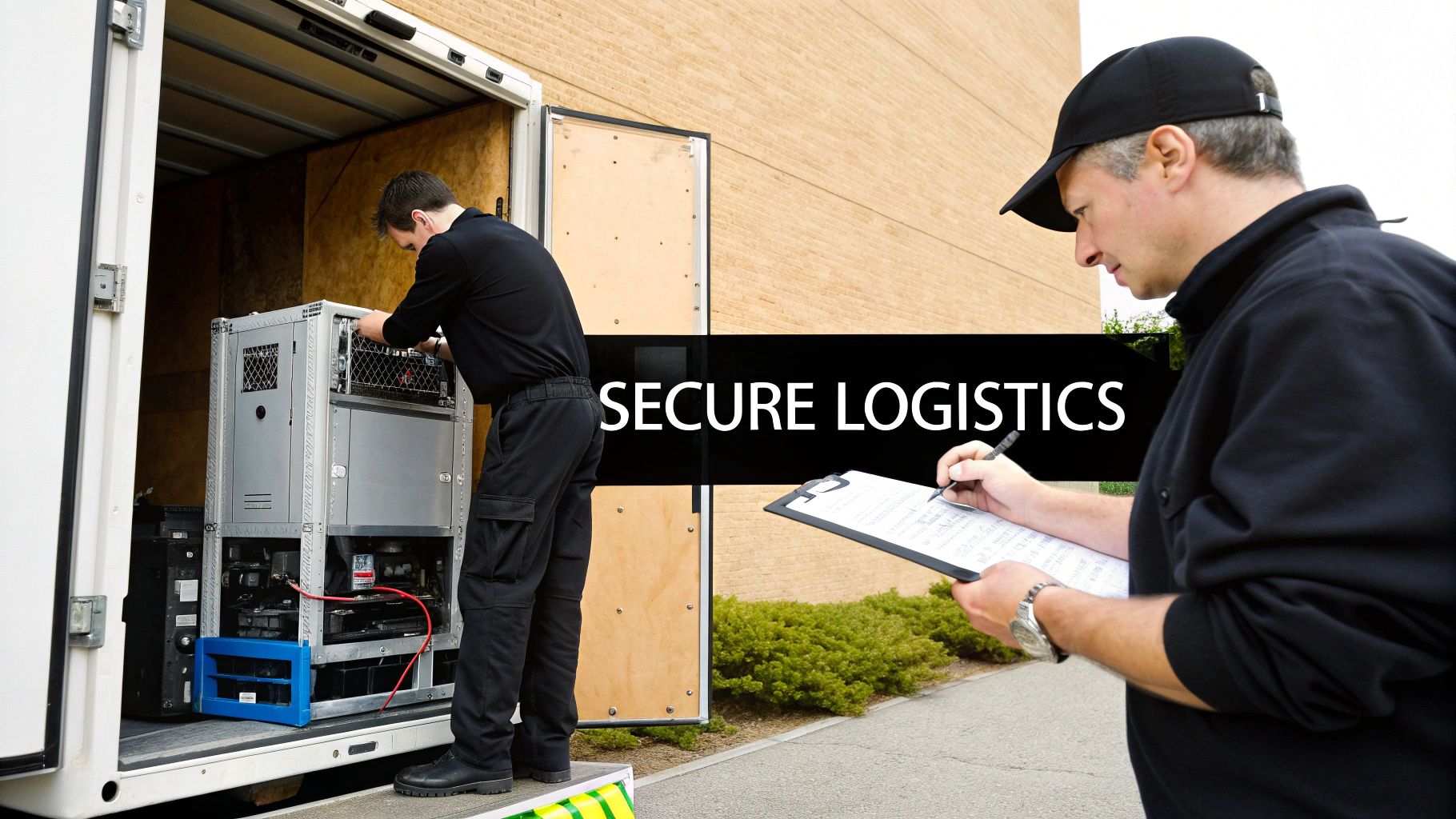
The disposal process starts the second a technician lays hands on your equipment. A premier partner will never just call a random freight service. Instead, they send their own dedicated, background-checked team to manage the entire decommissioning process right there in your facility—whether it's a lab in downtown Atlanta or a data center on the other side of the country.
This isn't just a pickup service. It includes professionally de-installing servers from racks, safely disconnecting complex lab instruments, and carefully packing every single component for transport. The whole operation is handled by their own employees using their own fleet of secure, GPS-tracked trucks. This absolute control over the physical assets from start to finish is non-negotiable for maintaining a secure chain of custody.
A vendor's refusal to use their own trained technicians and vehicles for pickup is a major red flag. Outsourcing logistics introduces unnecessary risks and breaks the chain of custody before your assets even leave the building.
Certified Data Destruction Methods
Once your equipment is off-site, the most critical phase begins: destroying the data. This is not a one-size-fits-all job. A reputable partner offers distinct methods designed for the asset's next step (resale or recycling) and your specific compliance needs, like HIPAA or GLBA.
For newer equipment that can be refurbished and resold, the gold standard is a multipass data wipe. This process overwrites the entire hard drive with random data, making the original information completely unrecoverable. For older, damaged, or highly sensitive media, physical destruction is the only way to go.
This usually involves one of two methods:
- Shredding: The hard drive is physically pulverized into tiny, unrecognizable metal fragments. There's no coming back from that.
- Degaussing: A powerful magnetic field instantly and permanently scrambles the magnetic data stored on the drive's platters, rendering it useless.
These certified methods are the bedrock of protecting your organization from a data breach. To see how these processes are put into practice, you can explore the details of professional data security services for electronic assets.
Transparent Compliance Reporting
The final pillar is proof. Your responsibility doesn’t end when the truck pulls away. It ends when you have legally defensible documents proving every asset was handled correctly. Any e-waste disposal company worth its salt provides detailed, transparent reports that serve as your evidence of due diligence.
This documentation should always include two key items. First, a Serialized Asset Report that inventories every single item picked up, tracked by serial number. Second, a Certificate of Destruction that formally confirms all data-bearing devices were sanitized or destroyed according to industry standards.
This paper trail is your ultimate shield in an audit. It shows you took every required step to comply with data privacy laws and internal policies, closing the loop on your asset lifecycle securely and responsibly.
Decoding the Certifications That Actually Matter
In the world of electronic waste, certifications aren't just fancy badges for a website. They're your proof of due diligence. Choosing a vendor without the right credentials is like hiring an unlicensed contractor to build your facility—you're taking on all the risk with no guarantee of quality or safety.
Think of these certifications as a vendor’s professional license. They are concrete proof that a company follows a strict, independently audited set of rules for data security, environmental safety, and worker protection. For any organization dealing with HIPAA or GLBA regulations, partnering with certified e waste disposal companies isn't just a good idea; it's a fundamental part of staying compliant.
The Foundation of Trust: R2 and e-Stewards
Two certifications stand out as the gold standard for responsible recycling: R2 (Responsible Recycling) and e-Stewards. While they have their differences, both were born from the need to stop the dangerous practice of shipping e-waste overseas or dumping it in local landfills.
A company holding an R2 or e-Stewards certification has passed tough third-party audits. This means they've proven they have a secure facility, a documented chain of custody, and a transparent process for everything they handle. They can track your assets from the moment they leave your lab or data center until they are properly recycled or destroyed.
These certifications guarantee your partner is committed to:
- Environmental Protection: Banning the illegal export of hazardous e-waste to developing nations.
- Worker Safety: Making sure their team handles hazardous materials in a safe, controlled environment.
- Data Security: Using mandatory data destruction methods to protect your sensitive information.
- Accountability: Keeping a transparent, documented trail for all materials that pass through their hands.
Working with a certified recycler is your best defense against the staggering fines and brand damage that come from your old equipment ending up somewhere it shouldn't.
The Data Security Seal of Approval: NAID AAA
While R2 and e-Stewards cover the whole recycling process, NAID AAA Certification zooms in on one thing: secure data destruction. This certification, handed out by the National Association for Information Destruction, is non-negotiable for any vendor handling sensitive data from hospitals, universities, or data centers.
A vendor with NAID AAA Certification has passed unannounced, third-party audits of their hiring practices, operational security, and destruction processes. It’s the highest level of assurance you can get that your information will be completely and permanently wiped out.
This standard verifies that a company has strict protocols for the entire data destruction lifecycle. We're talking employee background checks, secure facility access, and audited procedures for wiping, shredding, or degaussing hard drives. For medical facilities, this is especially critical, as it directly supports HIPAA compliance. Hospitals and labs get peace of mind knowing their partner meets these tough standards, which are a vital part of any responsible medical equipment recycling program.
To help you sort through what matters most for your organization, here's a quick breakdown of the top certifications and what they really mean.
Comparing Key E Waste and Data Security Certifications
| Certification | Primary Focus | What It Guarantees | Ideal For |
|---|---|---|---|
| R2v3 | Comprehensive environmental, health, and safety standards for the entire recycling lifecycle. | A documented chain of custody, data security protocols, and responsible downstream material handling. | Any organization needing a broad, globally recognized standard for electronics recycling. |
| e-Stewards | The strictest environmental standard, with a complete ban on exporting hazardous waste to developing countries. | Total prohibition of toxic waste export, landfilling, and incineration. Rigorous worker protection. | Organizations with a zero-tolerance policy for environmental risk and a strong corporate social responsibility focus. |
| NAID AAA | Exclusively focused on secure data destruction and information security. | Audited and verified processes for shredding, wiping, and degaussing. Includes facility security and employee screening. | Hospitals, data centers, universities, and financial institutions handling sensitive or regulated data (HIPAA, GLBA). |
| ISO 14001 | Environmental Management Systems (EMS). | The company has a framework for measuring and improving its environmental impact. | Organizations looking for partners with a structured approach to environmental management. |
| ISO 45001 | Occupational Health and Safety. | A proactive system for preventing work-related injury and promoting a safe and healthy workplace. | Ensuring your vendor prioritizes the well-being of their employees who handle your equipment. |
Each of these certifications acts as a different layer of verification. While R2 or e-Stewards provides a strong foundation, pairing it with NAID AAA gives you the ultimate confidence that both your physical assets and your digital data are handled correctly.
Why Certifications Matter for Local and Nationwide Partners
Whether you’re searching for "e waste disposal near me" or a partner to handle facilities across the country, these certifications are just as important. They create a consistent baseline of excellence that isn't tied to a specific location. A certified partner in one city is held to the exact same high standards as one in another, which is critical for ensuring compliance across your entire organization.
Looking for these certifications simplifies your vetting process. It lets you quickly weed out vendors who can't back up their security and environmental claims with real proof. By making certified e waste disposal companies a priority, you're not just checking a box—you're building a partnership on a foundation of trust, accountability, and proven expertise.
Your Data's Last Line of Defense: The Destruction Lifecycle
A retired server isn't just a heavy piece of metal; it’s a data vault. When it comes to e-waste disposal, the single most critical task is guaranteeing the complete and permanent destruction of the information stored on your old assets. This is the one area where there is absolutely no room for error.
Getting this right means understanding the entire data destruction lifecycle. This isn't just about wiping a hard drive. It's a structured, documented process that protects your organization from the moment a machine is unplugged until you have legally-defensible proof of its final disposition.
It All Starts with a Secure Chain of Custody
The journey to data destruction begins long before a hard drive meets a shredder. It starts with a detailed inventory and establishing a rock-solid chain of custody. Think of it as a security detail for your data—every single person who handles an asset and every move it makes is tracked and documented without fail.
A reputable partner will barcode and serialize every data-bearing device at your facility before it ever gets loaded onto their truck. This creates an unbroken audit trail. You'll know with certainty that the server leaving your Atlanta data center is the exact same one that is sanitized or destroyed at their secure facility.
The certifications shown below are the bedrock of this trustworthy process, covering everything from responsible recycling practices to audited data security protocols.
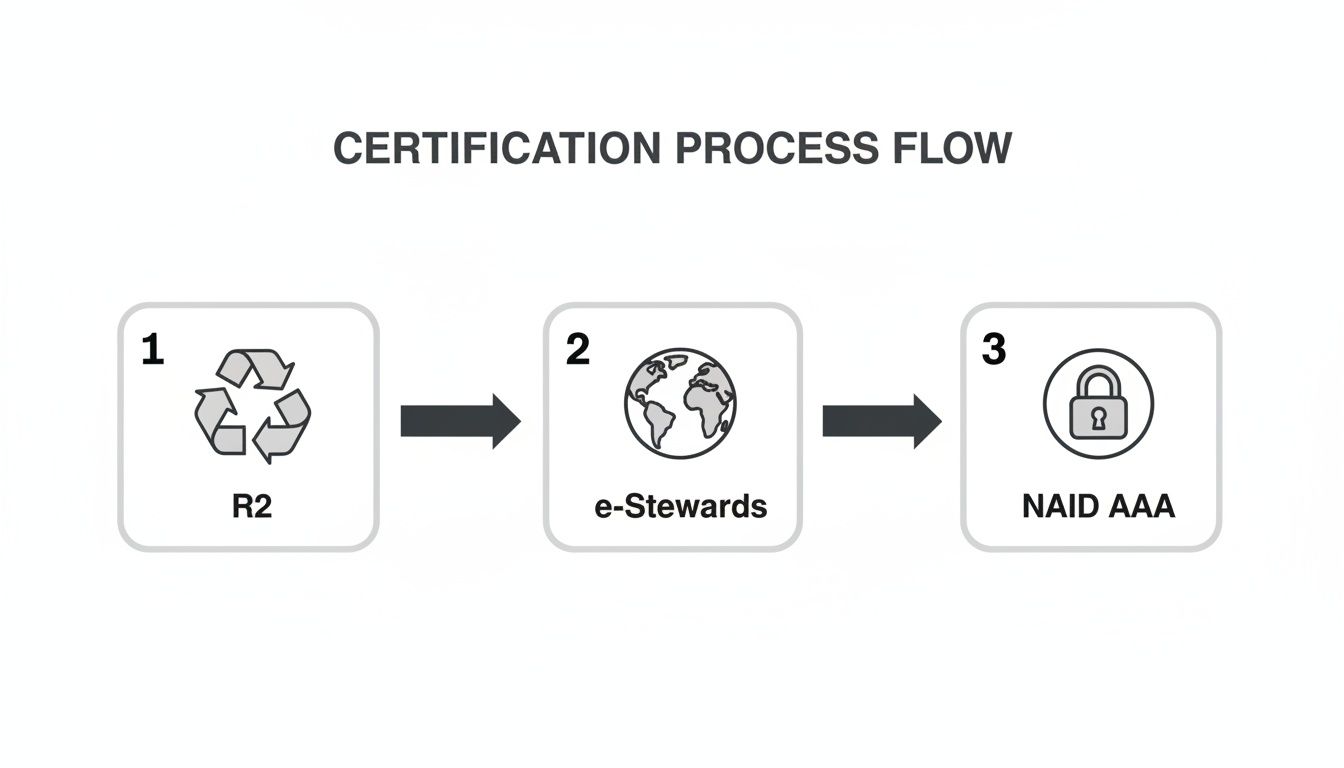
This flow shows how premier certifications like R2, e-Stewards, and NAID AAA work in concert to ensure a secure and compliant journey for your equipment.
Choosing the Right Method for the Job
Once your assets are under a secure chain of custody, the next decision is how to destroy the data. Professional e waste disposal companies don't take a one-size-fits-all approach. The method they use depends entirely on whether the device will be remarketed or recycled.
-
Software-Based Wiping: This is the go-to for newer, functional equipment you plan to resell. Using rigorous standards like DoD 5220.22-M, specialized software overwrites every sector of the hard drive with random data multiple times. This makes the original information completely unrecoverable, effectively sanitizing the device while keeping its value intact.
-
Physical Destruction: When dealing with damaged, outdated, or extremely sensitive media, physical destruction is the only way to go. This route guarantees that data can never be accessed again, no matter what technology comes along in the future.
There are two main ways to physically destroy a drive:
- Shredding: The device is fed into an industrial shredder that pulverizes it into small, indecipherable fragments of metal and plastic. There's no coming back from that.
- Degaussing: A powerful magnetic field instantly and permanently scrambles the magnetic signature on the drive's platters, rendering it a useless, unreadable piece of metal.
Picking the right method is a crucial part of a compliant disposal strategy. You can see a full breakdown of how our proven disposal process works to understand how these steps fit together from start to finish.
The Final, Critical Step: Your Legal Proof
The data destruction lifecycle isn't over until you have one last, vital document in your hands: the Certificate of Destruction (CoD). This is far more than a receipt. It is your legally defensible proof that you took every required step to protect sensitive patient, student, or corporate data.
A proper Certificate of Destruction is a serialized document. It must list every unique asset destroyed, the specific method of destruction used, the date it happened, and a signed statement of compliance. Without this detailed record, you have no verifiable proof of your due diligence.
This certificate officially closes the loop on your liability. It confirms that your organization has met its obligations under regulations like HIPAA or GLBA, giving you both peace of mind and a powerful defense in the event of an audit.
Finding the Right E-Waste Partner Locally and Nationally
Whether you run a single lab in a major city like Atlanta or manage a sprawling network of facilities across the country, your choice of e-waste partner comes down to their logistical muscle. An asset’s journey from your floor to its final disposition is loaded with potential risks. A great partner builds a secure bridge over those risks, whether they're moving equipment across town or across state lines.
The difference between local and national providers isn't just about the size of their map; it's about their whole approach. The best e-waste disposal companies tailor their logistics to the unique headaches of your location and scale, ensuring security and compliance are never sacrificed for the sake of distance.
The Agility of a Local Atlanta Partner
For any organization in the Atlanta metro area, a local provider brings some serious advantages in speed and flexibility. They get the local rhythm—from navigating downtown traffic to working around the specific needs of a hospital wing shutdown or a university’s chaotic end-of-semester cleanout.
A huge tell of a solid local partner is their investment in their own infrastructure. You want to see companies that operate their own box trucks and employ their own background-checked technicians. This in-house control means they aren't waiting on a third party and can offer flexible pickup windows or respond quickly to an urgent call, like a last-minute lab decommission. Their direct oversight gives you an unbroken, secure chain of custody from the moment they walk through your door.
A partner with their own fleet and staff isn't just another vendor; they are a direct extension of your security team. This model cuts out the risks that come with third-party logistics and guarantees accountability from pickup to final destruction.
Scaling Up for Nationwide Consistency
When your organization has multiple sites scattered across different states, the game changes. You need less local agility and more consistent, scalable service. A national partner has to prove they have a network that can deliver the exact same high standards for data security and compliance at every single location. This is non-negotiable for a coordinated, multi-state IT asset refresh or a phased corporate consolidation.
The big question to ask them is how they keep everything uniform. A top-tier national provider will have standardized processes for everything, from on-site de-installation protocols to generating serialized Certificates of Destruction. This ensures your facility in California gets the same certified service as the one in Georgia, making your compliance and oversight burden a whole lot lighter. As you look for solutions, learning about local options for medical equipment recycling near me can give you a good sense of a company's regional capabilities.
The Booming Market and Your Advantage
Finding this kind of logistical expertise is easier than ever, thanks to explosive industry growth. The electronic waste recycling market hit USD 70.1 billion in 2024 and is on track to surge to an incredible $251.9 billion by 2034.
This rapid expansion creates a fiercely competitive market that works in your favor, driving down costs and pushing service quality up. For Atlanta’s medical labs and corporate IT departments, this boom means you have access to highly effective, affordable partners with the precise logistical chops you need. You can read more about these e-waste market projections to see how this growth is shaping the industry.
Your E-Waste Vendor Vetting Checklist: The Questions That Matter
Picking the right partner to handle your retired lab, hospital, or data center assets is about more than just a slick website or a low price. You need to dig deeper. To truly protect your organization from compliance headaches and data breaches, you have to ask the tough questions that separate the pros from the pretenders.
Think of it like hiring someone for a high-security role in your facility. You wouldn’t just take their resume at face value, right? You’d verify every credential, check every reference, and run a thorough background check. You need to apply that same level of scrutiny when choosing between e waste disposal companies. This checklist will help you do exactly that.
We've broken down the essential questions into four key areas: certifications, data security, logistics, and what happens to your equipment "downstream."
Verifying Certifications and Compliance
First things first: prove it. Certifications are the non-negotiable proof that a company is committed to doing things the right way. They aren't just fancy logos; they represent rigorous, third-party audits of a company's entire process.
- Question to Ask: "Can you please provide a copy of your current R2v3 or e-Stewards certificate?"
- What to Look For: A legitimate partner will have this ready to go and send it over immediately. If they hesitate, give excuses, or show you an expired certificate, that's a major red flag. This single document is the bedrock of their credibility and your due diligence.
Scrutinizing Data Security Protocols
Next, let's talk about your most valuable—and vulnerable—asset: the data on your old equipment. A "Certificate of Destruction" is the final piece of paper, but the process that leads to it is what really protects you.
- Question to Ask: "What is your documented process for issuing a serialized Certificate of Destruction for our assets?"
- What to Look For: You want to hear about a clear, traceable, and auditable system. They should describe how they track each asset by serial number from the moment it leaves your facility to its final destruction. The report should detail the method used (wiping or shredding) and be a formal document you could confidently present in an audit, not just a simple receipt.
Evaluating Logistics and Personnel Security
How a company picks up and transports your equipment is just as critical as how they process it. A vendor that cuts corners here is creating a massive security hole you could drive a truck through—literally.
Relying on third-party contractors for pickup and transport is a huge gap in the chain of custody. A truly secure partner owns the entire process, using their own background-checked technicians and their own GPS-tracked vehicles.
Here are the key questions to ask about their logistics:
- Do you own and operate your own fleet of trucks? A "yes" means they have direct control over the physical security of your assets on the road.
- Are your technicians and drivers full-time employees who have passed background checks? This is your assurance that the people physically handling your sensitive equipment are vetted and accountable directly to the company you hired.
Ensuring Downstream Transparency
Finally, you need to know where your assets go after they leave the recycler's facility. A responsible partner has a transparent and ethical recycling chain. The last thing you want is for your branded equipment to end up in a landfill overseas, creating an environmental and PR nightmare.
The global e-waste problem is staggering. Projections show over 347 million metric tonnes of unrecycled material will accumulate by 2025, and very few nations even have e-waste laws. In some regions, as little as 11.8% of e-waste is properly recycled, highlighting the enormous risk of uncertified vendors shipping your problems offshore. You can explore more crucial e-waste statistics to grasp the scale of this challenge. The responsibility to get this right falls squarely on you.
- Question to Ask: "Can you provide documentation showing your downstream recycling partners?"
- What to Look For: A reputable, certified recycler will have an audited and fully documented list of their downstream vendors. They should be able to prove, on paper, that all materials are sent to other certified partners for final processing. This ensures your environmental and social governance goals aren't just lip service.
Got Questions About E-Waste Disposal? We've Got Answers.
When it comes time to clear out old equipment, a lot of practical questions pop up. Let's walk through some of the most common concerns to help you feel confident about choosing the right e-waste disposal partner.
Can You Handle a Mix of Lab, Medical, and IT Equipment?
Absolutely. In fact, that's what a specialized provider is built for. We regularly manage a wide variety of assets, from sensitive lab instruments like centrifuges and incubators to hospital gear and standard IT hardware like servers, computers, and network switches.
The real key is finding a partner who gets the unique handling needs for each type of equipment. A good company will have documented processes for decontaminating medical devices, safely decommissioning complex lab machinery, and, of course, sanitizing all data from IT assets—all in one coordinated pickup.
The best e-waste partners offer a one-stop solution. It just makes life easier. You simplify your logistics, deal with fewer vendors, and get consistent security and compliance standards applied to everything you're getting rid of.
What Happens to My Assets After They Are Picked Up?
Once your equipment is on our truck, it’s taken directly to a secure processing facility. The first thing we do is inventory and sort every single item based on whether it can be reused or needs to be recycled.
Anything with resale value gets put through its paces—thoroughly tested, repaired if needed, and all data is completely wiped using methods like a DoD 5220.22-M 3-pass sanitization. For items that are truly at the end of their life, we carefully dismantle them. Materials like metals, plastics, and glass are separated and sent to our certified downstream partners to be processed back into raw materials. The entire journey is documented to maintain a clear chain of custody.
Do I Need to Wipe Our Hard Drives Before You Arrive?
While it’s always a great idea to be proactive about data security, it's not on you to handle the final wipe. Guaranteed data destruction is a core part of what a certified e-waste partner does. We offer both software-based wiping for drives that can be reused and physical shredding for any that are obsolete or damaged.
Think of it as transferring the responsibility. This is a huge benefit of hiring a professional service. You’ll receive a Certificate of Destruction, which is your legally defensible proof that every bit of data was handled according to industry best practices, keeping you compliant with regulations like HIPAA. For any audit trail, that piece of paper is critical.
Ready to simplify your lab or IT asset disposition with a trusted, local partner? Scientific Equipment Disposal offers secure, compliant, and sustainable e-waste solutions tailored for Atlanta-area hospitals, labs, and data centers. Get in touch with us today.