Compliance-Focused Industrial Equipment Disposal: A Nationwide & Local Guide

When you hear "industrial equipment disposal," you might picture a crew hauling away old machinery. But in reality, compliance-focused disposal is about retiring those assets in a way that strictly follows every legal and regulatory rule, whether you're in Atlanta, GA or anywhere across the US. It's a vital process that shields your organization from massive fines, crippling data breaches, and serious damage to your reputation by putting rules, data security, and a documented chain of custody first.
Why Compliant Disposal Is a Critical Business Function Nationwide
When an industrial or lab asset hits the end of its life, just getting it out the door is a dangerous and old-fashioned way of thinking. This isn’t a simple cleanup job. It's a strategic process tied directly to your organization’s financial stability, data integrity, and public image, no matter where your facilities are located.
Think about it like decommissioning a naval vessel. You don't just scrap the hull and call it a day. It's a meticulous, protocol-driven operation governed by strict rules. Every single component, from the navigation computers to the engine parts, has to be handled according to specific procedures.
The High Stakes of Non-Compliance
Cutting corners on equipment disposal regulations can unleash a flood of problems. For organizations in specialized fields like healthcare, research, and data management, the risks are especially high.
- Severe Financial Penalties: Regulatory bodies like the EPA and the agencies enforcing HIPAA don't mess around. Violations can trigger fines that easily run into the millions.
- Catastrophic Data Breaches: A single hard drive from a retired server or medical device, if not properly sanitized, can expose sensitive corporate or personal data. The result? Lawsuits and a complete loss of customer trust.
- Lasting Brand Damage: The public fallout from a compliance failure can be far more expensive than any fine. It tells your customers, partners, and the public that you’re careless with your responsibilities.
The global industrial waste management market was valued at around $650 billion in 2023, and compliance is now the name of the game. For places like hospitals and universities, getting it wrong can be devastating. U.S. EPA enforcement actions for hazardous waste violations alone have led to penalties exceeding millions of dollars every year.
This guide is a clear roadmap for organizations in Atlanta and across the US—from hospitals and universities to IT data centers and government agencies. We'll cover the core pillars of a solid program: navigating the maze of regulations, guaranteeing total data destruction, and maintaining a rock-solid chain of custody.
Knowing how to responsibly retire these assets isn't just good practice—it's essential for protecting your entire operation. As you build your strategy, take a look at our detailed guide on managing e-waste for more expert insights.
Understanding Key Regulations for Equipment Disposal in the US
When it comes to disposing of industrial equipment, you're not just throwing things out. You're dealing with a web of federal, state, and local rules designed to protect the environment, secure private data, and keep everyone safe. Think of these regulations as the official rulebook—and not knowing the rules is no excuse.
Getting this wrong can lead to some serious headaches, from steep fines to legal battles. For any organization, especially those in healthcare, research, or IT, understanding the regulations is the first step to building a disposal plan that's both responsible and legally defensible. The rules boil down to three main areas: federal environmental laws, data privacy laws, and specific state-level rules.
The EPA and the Resource Conservation and Recovery Act
On the federal level, the big player is the Environmental Protection Agency (EPA), which enforces the Resource Conservation and Recovery Act (RCRA). This law gives the EPA control over hazardous waste from the moment it’s created until it’s finally disposed of. They call this the "cradle-to-grave" approach.
A lot of industrial and lab equipment gets caught in this net because of what's inside. Older lab gear like spectrophotometers or atomic absorption units might have mercury-vapor lamps. The circuit boards in your servers and medical devices are often loaded with lead and other heavy metals.
Under RCRA, these items are often classified as universal waste or, in some cases, hazardous waste. That means you can't just toss them in a dumpster. The law is very clear about how they must be handled, labeled, transported, and ultimately disposed of to keep toxic materials out of our soil and groundwater.
Data Privacy Laws Like HIPAA
Beyond the environmental side of things, data security is a huge piece of the compliance puzzle. The Health Insurance Portability and Accountability Act (HIPAA) is the perfect example. This federal law demands strict protection of all patient health information (PHI).
When a hospital gets rid of a diagnostic machine, a patient monitor, or even a computer on a cart, they aren't just retiring hardware. They're retiring a device that probably stored or handled sensitive patient data. The HIPAA Security Rule requires that this data be made completely "unusable, unreadable, or indecipherable to unauthorized individuals." This turns secure data sanitization from a good idea into a legal requirement.
Simply forgetting to wipe a hard drive on a retired medical cart is a direct violation that can result in multi-million-dollar fines and a PR nightmare. Similar rules exist for financial data (GLBA) and other personal information, spreading this need for data security across many different industries nationwide. You can dive deeper into these rules by checking out our guide to EPA-compliant laboratory equipment disposal.
State and Local Environmental Rules
Federal laws set the baseline, but states often add their own, sometimes stricter, environmental regulations. This is where having local expertise for your specific location is so important.
For example, the Georgia Environmental Protection Division (EPD) has its own rules for managing solid and hazardous waste. While they generally follow the federal RCRA standards, there might be specific state-level differences in permitting for disposal sites, waste transport manifests, and reporting. Other states, like California with its DTSC regulations, have even more stringent requirements.
An organization in Atlanta has to follow both the EPA's rules and Georgia's EPD directives. A disposal partner who knows the local landscape will understand how to handle these layers of compliance, making sure a piece of equipment is processed correctly from a lab in downtown Atlanta to a certified recycler in Norcross.
Real-World Scenario: Decommissioning University HPLC Machines
Imagine a university in Georgia needs to retire a dozen obsolete High-Performance Liquid Chromatography (HPLC) machines. A compliance-focused approach would involve checking for mercury-containing UV detectors (an RCRA concern), wiping any hard drives that stored research data (a data security best practice), and ensuring the disposal vendor follows Georgia EPD guidelines for transporting and recycling electronic waste. This multi-layered check ensures full compliance at every level.
Your Step-By-Step Workflow for Compliant Equipment Disposition
Tackling compliance-focused industrial equipment disposal without a solid plan is asking for trouble. A last-minute, scattered approach can quickly lead to data breaches, regulatory fines, and logistical nightmares.
Instead of treating it like a headache, think of it as a playbook. We've developed a proven, five-step workflow that turns this complex job into a managed process that protects your organization from start to finish. It’s a roadmap that ensures nothing gets missed, from the moment an asset is identified for retirement to the second you get that final proof of destruction.
Let's walk through it using a real-world scenario: a hospital lab cleanout right here in Atlanta.
Step 1: Create an Asset Inventory
Before a single plug is pulled, you have to know exactly what you’re dealing with. The first move is always to create a detailed asset inventory. This isn’t just a quick checklist; it’s a strategic breakdown of every single item.
For our hospital client retiring old lab equipment, this means documenting every centrifuge, analyzer, and computer on the floor. We record serial numbers, current locations, and the condition of each asset. Most importantly, we classify each item based on its end-of-life path:
- Reuse: Is the equipment still in working order? Can it be resold or donated to generate value?
- Recycling: Does the machine contain precious metals or other materials that can be recovered?
- Destruction: Does it hold sensitive data or hazardous materials that demand certified destruction?
This initial sorting process drives every decision that follows, from the type of data sanitization needed to the logistics of getting it off-site.
Step 2: Perform Secure De-Installation
With a full inventory in hand, it’s time for the physical work to begin. Secure de-installation is far more than just yanking cords from the wall. It involves safely disconnecting equipment from power, plumbing, and data networks, which is especially critical in a lab or heavy industrial setting.
Many organizations find it easier to bring in specialists, which is why your workflow might include professional decommissioning services to handle the heavy lifting safely and correctly.
Back at our hospital, de-installing a large blood analyzer isn’t a job for the maintenance crew. It requires technicians who can manage potential biohazards, safely cap fluid lines, and stabilize the machine for transport without any spills or damage. This step is about keeping people safe and protecting the asset’s value if it's headed for the resale market.
If you’re dealing with a manufacturing environment, our guide on factory equipment decommissioning for manufacturers offers a deeper look into those specific challenges.
Step 3: Execute Verified Data Sanitization
For compliance, this is where the rubber really meets the road. Any piece of equipment with a hard drive or memory—from a server in the data center to a modern medical device—must have its data professionally and permanently destroyed. Just hitting "delete" is not an option.
To ensure your data is gone for good, you have to choose the right sanitization method. This isn't a one-size-fits-all decision; the best approach depends on your security policies, compliance needs, and the type of media involved.
Data Sanitization Methods Comparison
| Method | Description | Security Level | Best For | Compliance Alignment |
|---|---|---|---|---|
| Software Wiping | Overwrites the entire drive with random data using multiple passes, rendering the original data unrecoverable. The DoD 5220.22-M standard is the common benchmark. | High | Functional hard drives (HDDs), solid-state drives (SSDs), and servers intended for resale. | HIPAA, GLBA, SOX |
| Physical Destruction | The media is physically shredded into tiny, useless fragments. This method is absolute, irreversible, and provides maximum security. | Maximum | Damaged or non-functional hard drives, backup tapes, and any scenario demanding the highest possible security assurance. | NSA, DoD |
In the Atlanta hospital project, the hard drive from a retired imaging machine containing patient data would be wiped using the DoD 5220.22-M standard. However, a failed server drive that stored financial records would be sent straight to the shredder to completely eliminate any risk of a breach.
Step 4: Manage Compliant Logistics and Transport
Once the assets are de-installed and the data is secured, the next piece of the puzzle is logistics. This step is all about moving the equipment from your facility to a certified processing plant safely and securely.
Everything needs to be properly packed, labeled, and tracked. We shrink-wrap and label each pallet with a manifest that matches the original inventory. The truck has to be secure, and the entire trip must be documented to maintain an unbreakable chain of custody. For clients with sites across the country, working with a partner who runs their own logistics fleet is a huge advantage, as it guarantees consistent security from state to state.
This diagram helps visualize how different regulatory streams come together during the disposal process.
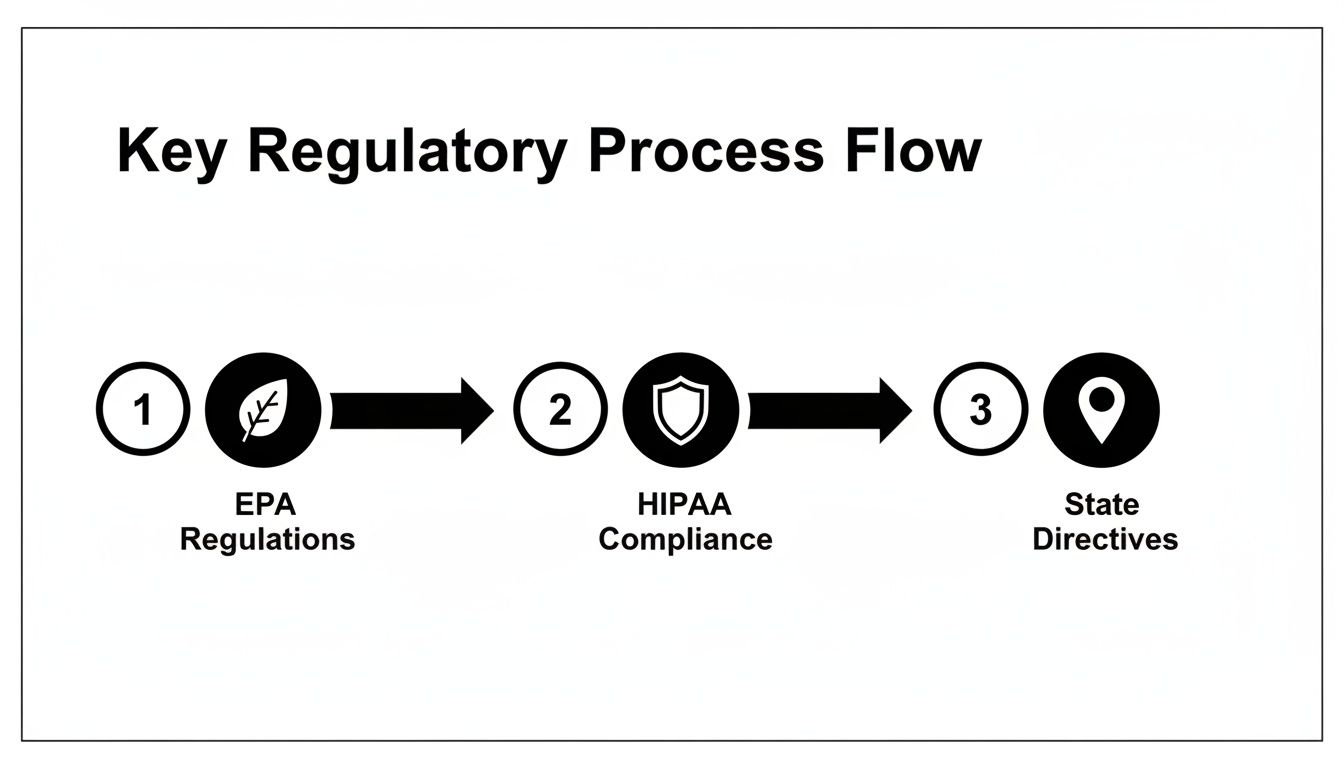
As you can see, compliance isn’t just one checkpoint. It’s a continuous path that navigates federal environmental rules, data privacy laws like HIPAA, and specific state-level mandates.
Step 5: Choose a Certified Partner and Verify Chain of Custody
The final and most crucial step is handing your equipment off to a certified disposal partner. This is the company that will handle the final recycling or destruction and, most importantly, provide you with the documentation to prove it was all done correctly.
A vendor holding R2 or e-Stewards certifications is your best bet. These credentials show a commitment to doing things the right way, both for the environment and for your data security. They must provide you with complete chain of custody documentation that ends with a Certificate of Destruction.
That certificate is your official, auditable proof that every asset was managed responsibly and all data was destroyed according to regulatory standards. For our hospital client, this document closes the loop on their project, confirms HIPAA compliance, and shields them from any future liability.
Mastering Data Security and Chain of Custody
When your lab, IT, or industrial equipment is ready to go, two things become critically important: destroying the data it contains and documenting its journey from your facility to its final destination. Getting data security and chain of custody right isn't just a "best practice"—it's how you build a rock-solid procedural and legal shield around your organization.
Think of them as two sides of the same coin. Data destruction ensures your sensitive information is gone for good. The chain of custody proves it, giving you a documented paper trail that shows you acted responsibly every step of the way. You can't have one without the other if you want a truly compliance-focused industrial equipment disposal process.
Securing Data Beyond Recovery
Any piece of equipment with a hard drive—from a laboratory analyzer to a data center server—is a potential data breach waiting to happen. Just hitting "delete" on a file is useless; that data can be pulled back with basic recovery software. This is why professional data sanitization is completely non-negotiable.
The industry-standard method for software wiping is the DoD 5220.22-M 3-pass standard. It works by overwriting the entire drive with patterns of ones and zeros multiple times. It’s like writing over the same spot on a piece of paper again and again until the original message is completely obliterated.
But what about drives that are broken, failed, or hold information so sensitive that you need absolute certainty? Software wiping only works on functional hardware.
Physical Destruction: The Ultimate Failsafe
For the highest level of security, nothing beats physical destruction. This is exactly what it sounds like. We feed hard drives, SSDs, tapes, and other media into industrial shredders that grind them into small, useless metal fragments. It is the only way to guarantee, with 100% certainty, that no data can ever be recovered.
Putting strong data loss prevention strategies in place is crucial for protecting sensitive information before any equipment ever leaves your control. Deciding between wiping and shredding comes down to your own security policies, the condition of the asset, and any specific rules you have to follow. Our guide on secure data destruction can walk you through making the right call.
The Unbroken Evidence Trail of Chain of Custody
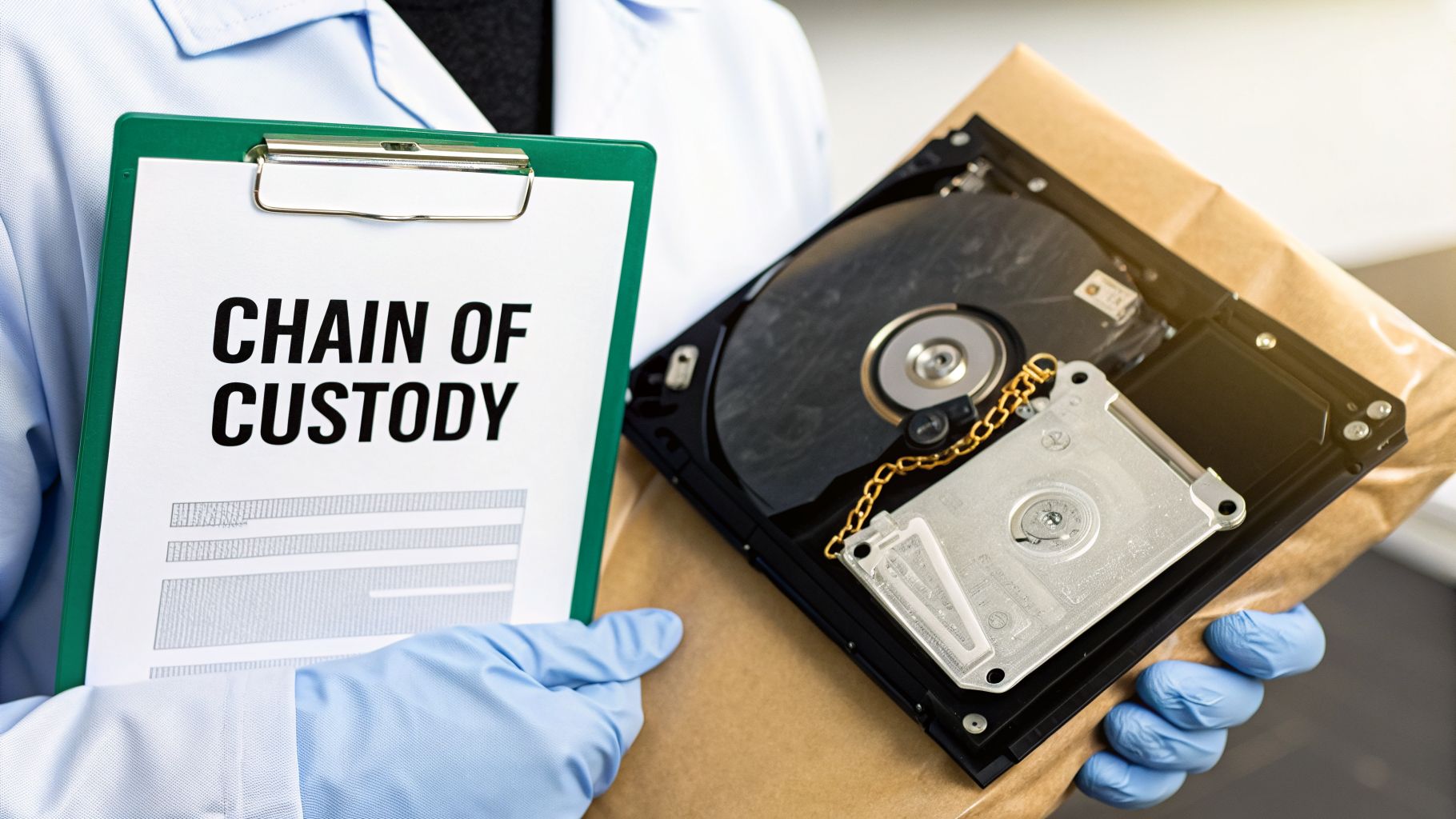
Once the data is handled, you need to prove you managed the physical asset correctly. This is the job of the chain of custody—a complete, unbroken paper trail that documents every person who handled your equipment, from the moment it leaves your loading dock to its final recycling or destruction.
This isn't just about paperwork. In an audit, this documentation is your first and best line of defense. A proper chain of custody file always includes these key items:
- Initial Pickup Receipt: Confirms the transfer of assets from your facility to the disposal partner. It notes the date, time, and a general description of what was picked up.
- Serialized Asset Log: This is the detailed manifest. It lists every single asset by its unique serial number, creating an auditable link between your inventory and the items being processed.
- Certificate of Destruction: This is the final, most important document. It’s a formal, signed certificate stating that your assets and the data they held have been destroyed according to compliance standards, specifying the method used.
This level of documentation is absolutely required for organizations here in Atlanta and across the country, especially if you're in healthcare, finance, or government. With the specialized e-waste management market projected to hit USD 1,352.6 million globally by 2025—and the U.S. market alone racing toward $849.7 million by 2034—this kind of accountability is quickly becoming the standard for everyone.
Finding a Compliant Disposal Partner in Atlanta and Beyond
Picking the right partner for compliance-focused industrial equipment disposal is a huge decision, whether your facility is in the heart of Atlanta or you have sites scattered across the country. The core principles—security, compliance, and a clear chain of custody—don't change. What matters is finding a vendor who lives and breathes those principles in their day-to-day work.
For any organization in Georgia, there's a real upside to working with a local partner. They get the regional logistics, from planning pickups around Atlanta's infamous traffic to knowing the right state-certified recycling facilities. A local vendor's reputation is on the line right here in the community, which makes them much more accountable.
The Atlanta Advantage: Local Expertise in Action
A local partner just knows the Atlanta market. They understand the specific hoops you have to jump through with Georgia’s environmental regulations and can offer a level of hands-on service that a national-only provider calling from a thousand miles away simply can't match.
Think about these real-world scenarios we handle all the time:
- Atlanta Hospital: A major hospital in Midtown needs to swap out a floor of old patient monitors. A local partner can schedule a weekend or after-hours pickup to avoid any disruption to patient care. They'll ensure every device is handled under strict HIPAA data security rules and provide a direct chain of custody from the hospital wing straight to their Norcross processing facility.
- University Lab Cleanout: A university just outside Marietta is decommissioning an entire chemistry lab. A local team can send technicians on-site to safely de-install fume hoods and analyzers. They'll manage the compliant disposal of any components with hazardous materials according to Georgia EPD rules and inventory every single asset for a perfect audit trail.
In both cases, the local provider's ability to show up, adapt, and provide knowledgeable service is the game-changer. They aren't just a voice on a national hotline; they're a team on the ground that can solve problems unique to Atlanta businesses.
Nationwide Reach with Consistent Accountability
Now, for businesses with a national footprint—like a company with data centers in Georgia, Texas, and California—the challenge shifts. It’s less about a local presence and more about consistent, high-quality execution at every single location. You need to know the same tough security and compliance standards are being met everywhere.
This is where a vendor that owns and operates its own logistics fleet is a massive advantage. When your disposal partner controls their own trucks and employs their own drivers, they control the entire process from start to finish. It cuts out the risk of using third-party freight companies, where security can get sloppy and accountability gets fuzzy.
A partner-owned logistics fleet delivers universal benefits:
- Uniform Security: Every truck is operated and every driver is trained to the exact same security standards. Your assets are protected from the moment they leave your dock until they arrive for processing.
- Unbroken Chain of Custody: With one company managing the entire transport, the chain of custody never breaks. It’s a single, auditable trail from coast to coast.
- Simplified Scheduling: Coordinating pickups from ten different sites is a nightmare with ten different regional haulers. With a single partner, it’s one phone call.
Ultimately, whether you need a local expert in Atlanta or a national provider with a seamless logistics network, the goal is the same. You need a partner who delivers a secure, documented, and compliant disposal process every single time. That’s how you get the peace of mind that comes from knowing your assets—and your company’s reputation—are fully protected.
How to Choose the Right Disposal Vendor
Picking a partner for your compliance-focused industrial equipment disposal is a serious decision. Think of it less like hiring a hauling service and more like bringing on a compliance specialist. You’re not just looking for someone with a truck; you need a proven expert who will protect you from liability.
The right vendor acts as an extension of your own team, making sure every piece of equipment is handled correctly. The wrong one? They can open you up to staggering legal, financial, and reputational damage. This isn't just about getting the best price—it’s about finding a partner with total transparency and a documented track record.
Key Questions to Ask Potential Vendors
Before you even think about signing a contract, you need to ask some tough questions. A trustworthy partner will have these answers ready and won't hesitate to share them.
- Are you R2 or e-Stewards certified? These certifications are the gold standard. They’re independent proof that a vendor follows the strictest rules for environmental safety and data security. Don't just take their word for it; ask to see the certificate.
- Can I see a sample of your chain of custody documentation? This is non-negotiable. Ask for a complete packet—pickup receipts, detailed asset logs, and a final Certificate of Destruction. This paperwork is your legal shield.
- How do you verify and document data destruction? They need to walk you through their exact process, whether it’s software wiping that meets DoD 5220.22-M standards or physical shredding. More importantly, how do they prove it was done for your records?
If a vendor gets defensive or vague when you ask these questions, consider it a huge red flag. Real compliance experts build their business on transparency and solid paperwork.
In-House Logistics vs. Subcontractors
Here’s another critical question to ask: "Do you handle all logistics in-house, or do you use subcontractors?"
A vendor that uses its own fleet of trucks and its own trained drivers gives you a massive security advantage. It means there’s a single, unbroken chain of custody from your loading dock straight to their secure facility. Using subcontractors introduces a third party into the mix, creating a potential weak link in your compliance armor where equipment or data can get lost.
The market for waste disposal equipment is growing fast, with the recycling machinery portion expected to hold a 35.40% revenue share by 2025. This boom is driven by the need for compliant, high-tech processes to handle sensitive electronics and lab gear. You can see more on this trend by looking at recent market research on global waste disposal equipment.
Ultimately, you’re looking for a true partner, not just a hauler. You need a company that delivers secure, sustainable, and stress-free disposal. To see what sets the leaders apart, take a look at what to look for in an e-waste recycling company.
Frequently Asked Questions About Equipment Disposal
When it's time to retire old equipment, a lot of questions come up. Getting the disposal process right is about more than just clearing out space—it's about staying compliant and protecting your organization. We hear these questions all the time from clients in Atlanta and beyond, so we've put together some straightforward answers.
What Types of Equipment Require Specialized Disposal?
Simply put, any piece of equipment that holds data or contains regulated materials needs special handling. This goes way beyond just heavy industrial machines and covers a lot of the common assets found in labs, hospitals, and data centers across the United States.
Think about it: computers, servers, and even modern medical instruments store sensitive information that falls under privacy laws. On the other side of the coin, older lab gear with mercury switches or circuit boards with lead solder are governed by strict EPA and state environmental regulations. Both of these categories demand a formal, documented disposal to keep you clear of hefty fines and legal trouble.
A Certificate of Destruction is your official proof that you've met all legal requirements. In an audit, this document is your first line of defense, showing exactly what was destroyed, along with the when, where, and how. Without it, you have no verifiable evidence of compliant disposal.
Is Wiping a Hard Drive Enough to Be Compliant?
In many cases, yes—as long as it's done professionally. Using a recognized data sanitization standard like DoD 5220.22-M is an effective way to wipe a hard drive clean, meeting compliance rules like HIPAA for most working devices. This also allows the drive to be safely reused.
But software wiping isn't a magic bullet. It’s useless on drives that are damaged or simply won't power on. For those situations, or when your security protocols demand the absolute highest level of certainty, physical destruction (shredding) is the only way to make that data 100% unrecoverable. No matter which method is used, make sure you get a Certificate of Destruction.
When you need a trusted partner to handle your sensitive lab and IT assets with proven compliance protocols, Scientific Equipment Disposal delivers. We offer on-site services, certified data destruction, and complete chain-of-custody documentation for organizations throughout the Atlanta metro area and nationwide. Find out how we can help at https://www.scientificequipmentdisposal.com.