Scientific Equipment Decommissioning Services: Safe, Compliant Asset Recovery

When you need to get rid of old laboratory and medical equipment, it’s not as simple as just unplugging it and hauling it away. Scientific equipment decommissioning services offer a systematic, fully documented process to safely remove, sanitize, and dispose of these assets. Think of it as a critical risk-management strategy—one that protects your organization from costly data breaches and compliance headaches. Whether your facility is in Atlanta, Georgia, or any other city nationwide, professional decommissioning ensures your retired assets are handled the right way from start to finish.
What Exactly Is Scientific Equipment Decommissioning?
Picture a high-security facility getting ready to move or shut down. You wouldn’t just toss out the old files and turn off the lights, right? You’d follow a strict protocol to account for every asset, secure sensitive information, and leave the building in a safe, compliant state.
That’s exactly what scientific equipment decommissioning is for labs, hospitals, and research centers across the country.
This specialized service manages the entire end-of-life process for scientific assets. It covers everything from small benchtop centrifuges and incubators to massive, complex systems like MRI machines, mass spectrometers, and the servers that hold their valuable data. The mission is simple: get this equipment out of service without exposing your organization to unnecessary risk.
The Key Players and Primary Goals
Getting decommissioning right is a team effort. It requires careful coordination between several people inside your organization, each with a critical role.
- Lab Managers and Principal Investigators: They know the equipment best. They identify what’s obsolete and understand the research or clinical history of each asset.
- Facility and Operations Directors: These folks handle the physical logistics. They coordinate power-down schedules and make sure the de-installation process doesn’t disrupt your active operations.
- IT and Data Security Officers: This team’s job is to make absolutely sure all sensitive data—from patient records to proprietary research—is wiped clean and cannot be recovered.
- Environmental Health & Safety (EHS) Teams: They are the experts on safety, confirming that equipment is properly decontaminated and that any hazardous materials are managed according to strict regulations.
The primary goals of any professional decommissioning project are twofold: mitigating risk and recovering value. This means preventing data breaches and environmental violations while maximizing the financial return from resalable assets.
Mitigating Risk and Recovering Value
The risks of getting equipment disposal wrong are huge. A single hard drive with protected health information (PHI) or confidential research data can lead to millions in fines and destroy your reputation if it ends up in the wrong hands. In the same way, incorrectly disposing of e-waste or lab equipment with leftover chemical residue can bring on severe environmental penalties.
This is why professional scientific equipment decommissioning services are so essential, for both local businesses and national corporations. They give you a documented, auditable process that transfers this risk away from your organization. A certified partner ensures that every single step—from on-site removal to final disposal—is handled with full compliance.
The need for these services is growing fast, directly tied to the explosion of electronic waste and tougher data privacy laws. In fact, the IT equipment disposal market, a major part of this work, is projected to grow at a steady 8.3% CAGR from 2025 to 2033. This trend highlights just how much hospitals, universities, and government agencies are seeking secure, compliant ways to handle old assets. You can explore additional details about the IT equipment disposal market's projected growth.
Mastering Compliance and Data Security Protocols
Getting rid of old scientific equipment isn't just about hauling it away. It's a process loaded with legal and security landmines. One wrong move can lead to staggering fines and a public relations nightmare that your organization may never recover from.
This is exactly why you partner with a professional scientific equipment decommissioning service. We live and breathe this stuff. We navigate the maze of regulations for you, ensuring every piece of equipment is handled and documented correctly, whether you're a single-site hospital in the Atlanta area or a research university with labs across the country.
Navigating Healthcare and Environmental Regulations
Two areas demand absolute attention: data privacy and environmental safety. For any facility with medical equipment, the Health Insurance Portability and Accountability Act (HIPAA) isn't a suggestion—it's the law.
HIPAA requires that any Protected Health Information (PHI) on devices like imaging machines, patient monitors, or servers must be made completely unrecoverable. A single hard drive tossed in a dumpster with patient data on it can trigger a data breach and fines that run into the millions.
At the same time, you have the Environmental Protection Agency (EPA) and state agencies like the Georgia EPD watching for e-waste violations.
- Hazardous Materials: A lot of scientific gear contains things like mercury, lead, or cadmium. It’s illegal to just dump these in a landfill.
- Electronic Waste (E-waste): Circuit boards, displays, and other electronics must be handled by certified recyclers to keep toxic materials out of our environment.
A truly compliant decommissioning plan tackles both data security and environmental rules in one seamless process, protecting you from liability on all fronts.
The Art of Digital Shredding and Data Destruction
When it comes to your data, hitting "delete" does virtually nothing. Think of a hard drive like a book. Deleting a file is like ripping the table of contents out—the chapters are all still there, you just made them a little harder to find. Real data sanitization is a much more permanent solution.
Data sanitization is the digital equivalent of shredding a document into such fine confetti that no one could ever piece it back together. It’s about making data permanently and irrevocably unreadable.
One of the most reliable methods we use is the DoD 5220.22-M 3-pass wipe. This is a government-standard process that writes over the entire hard drive with new data three separate times, completely obliterating any trace of the original files. It’s the perfect way to ensure compliance while allowing the drive to be safely reused. Protecting data during the handover is also critical, which is why we rely on secure data transfer methods to safeguard information from start to finish.
For drives that are broken or for situations demanding the absolute highest level of security, physical destruction is the only answer. We use industrial-grade shredders to grind hard drives, memory cards, and other media into tiny, mangled pieces of metal, making data recovery physically impossible.
Comparing Data Destruction and Sanitization Methods
Deciding whether to wipe or shred comes down to your security needs and whether the equipment has any resale value. This table breaks down the choice to help you select the right security level for your decommissioned lab and IT assets.
Comparing Data Destruction and Sanitization Methods
| Method | Description | Best For | Compliance Level |
|---|---|---|---|
| Data Sanitization (Wiping) | A software-based process that overwrites all data multiple times, using standards like the DoD 3-pass method. | Hard drives in good working order that can be refurbished and resold, helping you recover asset value. | High (HIPAA, SOX) |
| Physical Destruction (Shredding) | The physical grinding of the storage media into small, irrecoverable fragments. | Damaged or outdated hard drives, or for assets that require the highest possible level of security assurance. | Highest (NSA/CSS) |
Ultimately, sanitization lets you recoup value from working assets, while shredding provides undeniable proof of destruction for sensitive or non-functional drives.
The Unbreakable Chain of Custody
So, how do you prove your equipment was handled properly once it leaves your building? The answer is a documented chain of custody. This is an unbroken paper trail that follows your assets from the moment we scan them at your facility to their final destination.
This log records every step and every person involved—on-site inventory, secure transport, and final processing. It's your verifiable proof that nothing was lost, stolen, or mishandled along the way.
The process ends with the most important document of all: the Certificate of Destruction. This legal document is your official proof that your data-bearing devices were sanitized or destroyed according to federal standards. You can learn more about how a https://www.scientificequipmentdisposal.com/certificate-of-destruction/ protects your organization in our detailed guide. It's your ultimate shield against future liability and the final word in compliance.
A Step-By-Step Walkthrough of the Decommissioning Process
Turning a massive facility cleanout from a headache into a straightforward, manageable project is what scientific equipment decommissioning services are all about. We've broken down the entire process into clear phases. Think of it as a roadmap for any lab manager or hospital administrator in Atlanta, GA, or across the United States, designed to keep your project on time, on budget, and completely compliant.
Phase 1: Initial Planning and Asset Inventory
Every successful decommissioning job starts with a rock-solid plan. This is the blueprint for the entire operation. It kicks off with an initial assessment where a project manager works with you to figure out the scope, lock in timelines, and spot any potential roadblocks upfront.
Next comes the most crucial part: a comprehensive asset inventory. This isn't just about making a quick list. It’s a detailed catalog of every single piece of equipment that needs to go.
- Every asset, from a small tabletop centrifuge to a massive MRI machine, gets its own unique ID tag.
- We log all the key details—make, model, serial number, and its current condition.
- Most importantly, we identify every device that holds data, flagging it for secure data sanitization down the line.
This detailed inventory is the foundation for the whole project. It guarantees every single asset is tracked from the moment we tag it in your facility to its final destination.
Phase 2: On-Site De-Installation and Segregation
Once the inventory is locked in, our team gets to work on-site. This is where the physical de-installation begins, and our main priorities are safety and efficiency. Our technicians coordinate with your facility staff to schedule power-downs and work around your schedule to cause as little disruption as possible.
Our techs carefully disconnect and dismantle all the equipment, always following the manufacturer's guidelines, especially for sensitive or complex instruments.
A huge part of this phase is segregation. As soon as equipment is de-installed, it’s sorted right then and there. We separate items destined for resale, equipment headed for recycling, and any electronics containing sensitive data that need to be handled securely.
Sorting on the spot like this keeps things organized, prevents any mix-ups, and makes the entire process run smoothly as we prep everything for transport.
Phase 3: Data Destruction and Secure Logistics
For any organization, this is the most critical phase for avoiding liability. All the equipment we flagged as data-bearing during the inventory is moved to a secure, designated area for sanitization. Here, our data security specialists get to work, following the exact data destruction plan we developed with you.
This flowchart shows the simple, certified process we follow to make sure your data is handled correctly.
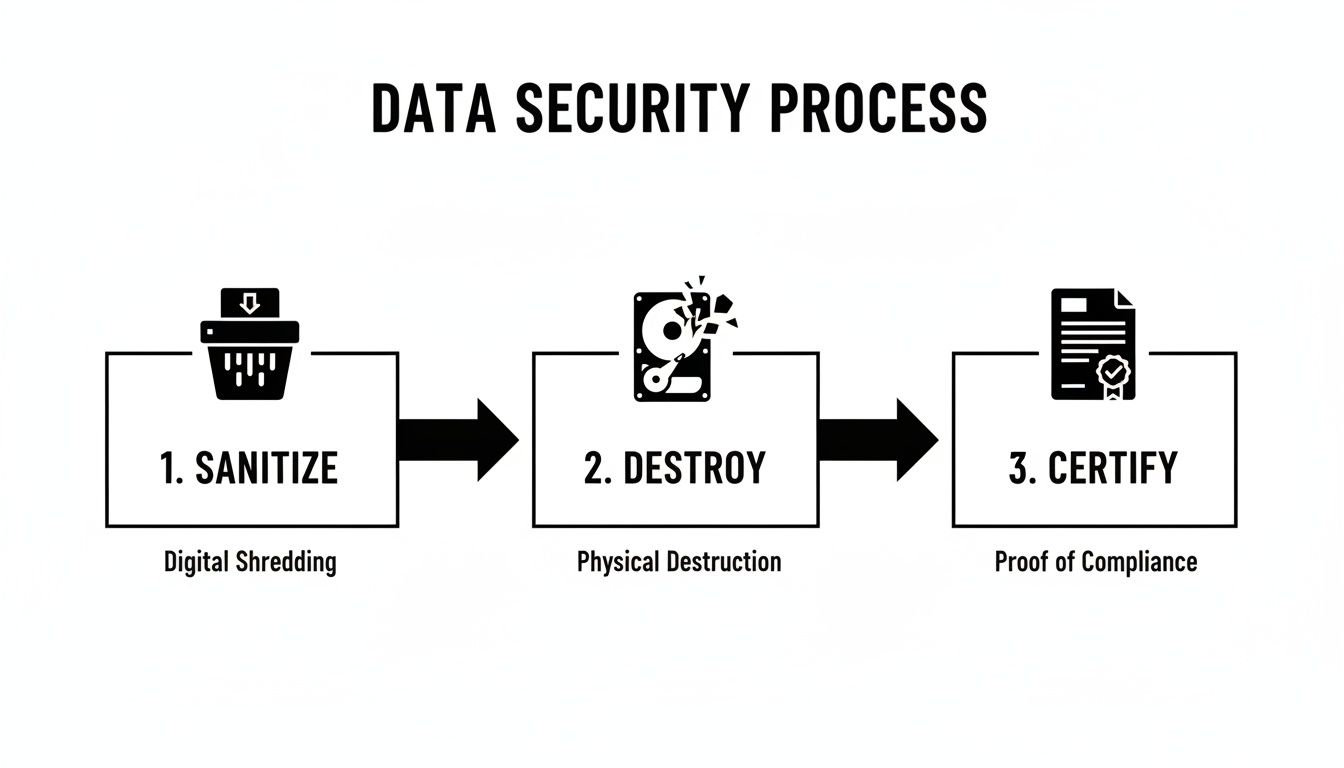
This simple, three-step approach ensures that every last bit of sensitive information is gone for good before the equipment ever leaves your property.
After the data is destroyed, we professionally pack everything. We use custom materials and crating to protect delicate instruments during transit, which helps preserve their potential resale value. Everything is then loaded onto our secure, GPS-tracked trucks and transported to our certified processing facility. You can read more about why certified disposal is so important in our guide on how to dispose of scientific equipment safely.
Phase 4: Final Processing and Reporting
The journey for your old equipment ends at our processing facility. The first thing we do is check in every asset against the original inventory, confirming the chain of custody is unbroken.
Here’s what happens next:
- Triage and Testing: Any items with potential resale value are put through rigorous testing, cleaned up, and refurbished for the secondary market.
- Responsible Recycling: Equipment that has reached the end of its life is carefully dismantled into its base components—metals, plastics, and circuit boards. These materials are then sent to our certified downstream partners to be responsibly recycled.
- Final Documentation: After every asset is processed, we issue your final report. This package includes a full inventory reconciliation, weight tickets for recycled materials, and the all-important Certificate of Destruction and Recycling.
This certificate is your official, legally-defensible proof that your organization’s scientific equipment was decommissioned in full compliance with data security and environmental laws. It’s the final piece of the puzzle, giving you a complete audit trail and total peace of mind.
Understanding Project Costs and Realistic Timelines
When you're planning a lab cleanout or facility shutdown, two questions always come up: "How much will this cost?" and "How long will it take?" The honest answer is, it depends. Every project is unique, so think of it less like buying an off-the-shelf product and more like a service tailored to your exact needs.
Whether you're managing a lab in the Atlanta metro area or a research facility anywhere in the nation, the factors that shape the final price and timeline are the same. A professional quote isn't just an expense; it’s an investment in getting the job done right and protecting your organization from the massive financial and legal headaches of a data breach or compliance mistake.
Key Factors That Drive Project Costs
No two decommissioning projects are ever the same, and a few key details will directly affect the bottom line. Once you understand these drivers, you can plan your budget more effectively and see exactly where the investment goes.
Here’s what we look at:
- Volume and Type of Equipment: A few dozen benchtop instruments are straightforward. De-installing massive systems like MRI machines or industrial autoclaves is a different story. The need for specialized rigging, heavy lifting, and careful handling adds to the complexity and cost.
- Data Destruction Requirements: How secure do your hard drives need to be? DoD-standard data wiping is a common request, but if you need physical shredding for hundreds of drives, that requires specialized machinery and more labor, which will be reflected in the quote.
- Logistical Challenges: The physical layout of your facility is a huge factor. A ground-floor lab with a loading dock is easy. A lab on the tenth floor with no service elevator? That’s a logistical puzzle that takes more time, planning, and specialized equipment to solve safely.
- Hazardous Materials: If any equipment has been exposed to chemical or biological materials, it must be properly decontaminated before we can touch it. Handling these items involves strict safety protocols and adds to the project's scope to ensure everyone's safety and full compliance.
How Value Recovery Can Offset Costs
Here’s the good news: not all of your old equipment is junk. One of the biggest upsides of working with professional scientific equipment decommissioning services is the chance to recover value from your retired assets. Well-maintained, functional instruments often have a strong resale value on the secondary market.
A professional decommissioning partner doesn't just see a pile of equipment; they see an opportunity. By identifying, testing, and remarketing your viable assets, we can generate revenue that gets credited directly back to you. This can significantly offset the total project cost.
This approach turns what looks like a pure expense into a financially smart move. The trick is to partner with a company that has the network and expertise to find buyers for your refurbished lab assets. You can check out our guide for more information about scientific equipment removal for labs and universities and see how this process works.
Setting Realistic Timelines
Timelines can range from a few days to over a month, depending entirely on the project's size. If you have a small lab with a dozen or so items to clear out, we can often wrap that up in just a few days from the first call to the final pickup.
On the other hand, a large-scale decommissioning—like clearing out an entire hospital wing or a multi-story research building—is a much bigger undertaking. These projects often take several weeks to a month or more. They demand detailed planning, careful coordination with different departments, and a phased de-installation schedule to avoid disrupting your day-to-day operations.
This kind of methodical, sustainable asset management is becoming the industry standard. In fact, the global waste disposal equipment market is projected to hit USD 4.7 billion by 2026, a clear sign that businesses are investing in smarter, compliant ways to manage waste. Partnering with experts who live and breathe asset management is no longer just a good idea—it's a crucial long-term strategy. You can discover more insights about the global waste disposal equipment market and its rapid growth.
How to Select the Right Decommissioning Partner

Choosing a partner for your scientific equipment decommissioning is easily one of the most important calls you'll make in the entire asset retirement process. This isn't about finding the cheapest pickup service; it’s about finding a true partner who will shield your organization from massive legal, financial, and reputational headaches.
The right partner becomes a genuine extension of your team, making sure every single piece of equipment is handled with total compliance and security. Whether you're in the Atlanta metro area or managing facilities across the country, your vendor choice will make or break the success of the whole project.
Non-Negotiable Vendor Criteria
As you start looking at potential partners, you'll find there are a few credentials that are completely non-negotiable. Think of these certifications as your guarantee that a vendor takes environmental responsibility and data security as seriously as you do.
Your vetting checklist must start with these basics:
- R2v3 or e-Stewards Certification: These are the gold standards in electronics recycling, period. A certified vendor has survived tough third-party audits to prove they manage e-waste responsibly, track all their materials, and keep their facility secure. Never, ever partner with an uncertified provider.
- Verifiable Data Security Credentials: The vendor has to prove they follow recognized data destruction standards. Demand proof that they perform DoD 5220.22-M 3-pass sanitization or offer NSA-compliant physical shredding, all backed by a detailed, auditable process.
- Proof of Adequate Insurance: Your partner must carry enough liability insurance, including specific policies for pollution liability and errors and omissions. This is your safety net in the unlikely event something goes wrong during transport or processing.
A vendor’s certifications are not just logos on a website; they are your guarantee of a compliant, secure, and professional partnership. They separate the legitimate experts from the simple "haul-it-away" services.
Vetting Logistical and On-Site Capabilities
Beyond the paperwork, you need to size up a vendor's real-world operational muscle. Their logistics game directly affects the safety and efficiency of your project. You want a partner with a proven track record, especially one that can handle local jobs in areas like Atlanta while also providing nationwide coverage for multi-state operations.
When you're comparing options, consider those who offer the full suite of services, including specialized extras like an equipment storage service for assets that are waiting for final disposal or relocation.
Finally, the professionalism of their on-site crew is critical. The technicians walking into your facility should be trained, uniformed, and able to work smoothly alongside your own staff. Their ability to de-install equipment safely and efficiently without blowing up your daily operations is the mark of a top-tier scientific equipment decommissioning service.
Powerful Questions to Ask Potential Vendors
Once you've got a shortlist of certified vendors, it's time to start digging. Asking sharp, direct questions will quickly reveal who the real experts are and who is just faking it. Use this list to confidently vet every potential partner.
- Can you walk me through your chain of custody process, from pickup to the final certificate? They should be able to clearly explain how every asset is inventoried, tracked, and documented at every single step.
- How do you prove you're compliant with HIPAA and EPA regulations? You're listening for specific answers about data destruction certificates, recycling paperwork, and how they audit their own downstream vendors.
- What's your process for handling equipment that might have been exposed to contaminants? A real pro will have a clear protocol for working with your Environmental Health & Safety team.
- Can you give me references from similar projects in our industry? Talking to past clients from hospitals, universities, or labs is the absolute best way to check their real-world performance.
Working with a certified service ensures your assets are processed using advanced and sustainable methods. This is more important than ever, with the global recycling equipment market valued at an impressive USD 31.38 billion in 2025, pushed forward by innovations in AI sorting and e-waste robotics. By choosing a competent partner, you get access to this sophisticated infrastructure. You can read the full research about recycling equipment market trends to see how it's shaping the industry. Our job as an e-waste recycling company is to bring these certified, responsible practices right to your facility's doorstep.
Common Questions About Equipment Decommissioning
Even the best-laid plans for an equipment upgrade or facility move can leave you with a lot of questions. We get it. Whether you're a lab manager in Atlanta orchestrating a huge move or an IT director anywhere in the United States worried about data, you need straight answers. Here are some of the most common questions we hear about scientific equipment decommissioning services.
Can We Handle Decommissioning Ourselves to Save Money?
This is almost always the first question, and it makes sense. On the surface, going the DIY route seems like a great way to cut costs. But that path is loaded with hidden risks that can make any initial savings look tiny in comparison.
When you handle this in-house, your team suddenly becomes responsible for a tangled mess of environmental regulations and data security laws. One simple mistake—like an improperly wiped hard drive or a piece of e-waste ending up in the wrong bin—can bring on a world of trouble.
These aren't just hypotheticals. The real-world consequences include:
- Massive Fines: Getting on the wrong side of the EPA or state e-waste laws can lead to financial penalties that dwarf the cost of hiring a professional.
- Data Breach Liability: Imagine a single device with patient or research data getting loose. That could mean millions in HIPAA fines and a public relations nightmare you can't fix.
- Workplace Injuries: Having your staff de-install heavy, complicated scientific instruments without the right tools or training is a serious safety hazard.
Think of a professional service as an investment in risk management. The cost of one data breach or compliance fine is exponentially higher than the fee for a partner who guarantees a secure, documented, and fully insured process.
What Happens to the Equipment After You Take It?
Once we’ve loaded everything up and it leaves your facility, the real work begins back at our certified processing center. It's a transparent, step-by-step process designed to get the most value out of your old assets while recycling everything responsibly.
First, every single piece is sorted and triaged against the inventory list we created on-site.
- Resale and Refurbishment: If a piece of equipment still has life in it, we put it through its paces. It gets thoroughly tested, cleaned, and professionally refurbished. We then find a new home for it through our remarketing channels, and you often get a credit back to help offset the project's costs.
- Data Destruction: Any device that holds data gets its final security treatment. This is non-negotiable. Depending on our agreement, that means either a certified, multi-pass data wipe or sending it straight to the shredder for total physical destruction.
- Responsible Recycling: For equipment that's truly at the end of the line, we break it down to its core components. We de-manufacture everything into separate commodities—metals, plastics, circuit boards, and glass—which are then sent to our network of fully vetted, certified recycling partners.
We operate on a zero-landfill philosophy. Our goal is to keep as much material as possible out of the dump and ensure every last component is handled in an environmentally sound way. You'll see it all documented—weights, methods, and final destinations—in your final report.
How Do You Manage Sensitive Hospital or Lab Equipment?
We live and breathe in highly regulated environments like hospitals, clinics, and research labs. Our teams are trained specifically to handle the unique challenges of these facilities, making sure safety and compliance are always the top priority.
It all starts with working closely with your people, especially your Environmental Health and Safety (EHS) department. If there's any chance equipment was exposed to biological or chemical agents, we won't touch it until it's been decontaminated according to the strict protocols we develop with your EHS officers.
When it comes to devices that could contain Protected Health Information (PHI)—like patient monitors, imaging machines, or servers—data security is everything. We deploy a rock-solid, HIPAA-compliant data destruction process.
Here's how that works:
- Secure Segregation: Right away, on-site, we separate any device that could hold PHI.
- Documented Sanitization: Every single drive is wiped or physically destroyed, and you get a serialized report to prove it.
- Auditable Chain of Custody: We maintain an unbroken, fully documented chain of custody from the moment we pick it up until it's fully processed.
This creates a bulletproof, verifiable trail that protects patient privacy, keeps your staff safe, and ensures your organization stays compliant.
Do You Handle Small Projects for Just a Few Items?
Absolutely. We have the trucks and teams to handle massive facility shutdowns, but we also provide the same professional scientific equipment decommissioning services for smaller jobs. We know that equipment retirement happens all the time, not just during a big move.
Maybe you're a small clinic in the Atlanta area with a single diagnostic machine to retire, or a university lab with a handful of old instruments to clear out. The core process is exactly the same. You get the same level of security, documentation, and professional service as our largest clients.
Our pickup services are available nationwide, and we have dedicated routes all over Georgia for our local customers. This makes it easy and affordable to do the right thing, no matter how many items you have. The best first step is to just send us your inventory list. We can give you a clear plan and a quote that makes sense for your project. After all, knowing what happens to old laboratory equipment after disposal helps you see the value in a certified process, big or small.
When your lab, hospital, or data center needs a trusted partner for asset disposition, Scientific Equipment Disposal provides secure, compliant, and sustainable solutions for clients locally in Georgia and across the United States. Contact us today to schedule your pickup or to discuss your decommissioning project.