Secure Hard Drive Destruction in Gwinnett County, Georgia: Your 2026 Guide

For any organization in Gwinnett County, Georgia—from a local hospital or a growing tech startup to a major national data center—secure hard drive destruction isn't just an IT task. It's a fundamental business necessity. Simply hitting "delete" or reformatting a drive is a massive gamble, leaving your most sensitive information dangerously exposed. The only way to be certain your data, and your company's reputation, is safe is through professional, certified physical destruction, a service available both locally and nationwide.
Why Secure Data Destruction Is a Business Imperative in Gwinnett and Beyond

As a key player in Georgia's booming data center market, the amount of confidential information created and stored right here in Gwinnett is staggering. Every time a server is updated, an employee laptop is replaced, or a storage system is decommissioned, it leaves behind a digital ghost of sensitive data. We're talking about patient records, proprietary research, customer financials, and internal company strategy. This challenge isn't unique to Georgia; businesses nationwide face the exact same risk.
Letting that data fall through the cracks isn't a minor slip-up. It's a direct threat. A single, improperly handled hard drive can be a goldmine for identity thieves and corporate spies, leading to consequences that can cripple an organization anywhere in the U.S.
The Real-World Risks of Improper Disposal
Ignoring professional data destruction is a huge mistake. These aren't just hypothetical what-ifs; they are real, tangible risks that companies in Gwinnett and across the country face every single day.
- Crippling Financial Penalties: For anyone in healthcare or finance dealing with national regulations like HIPAA or FACTA, a data breach can trigger fines that easily run into the millions. These penalties aren't just a slap on the wrist; they're designed to be painful.
- Irreparable Reputational Damage: Trust is earned over years and lost in an instant. Once a data breach becomes public, customers and partners lose confidence, often for good.
- Costly Legal Liabilities: Beyond fines, you open the door to expensive lawsuits. It's a fact that business litigation may follow data breaches, leading to a financial and operational nightmare.
- Loss of Competitive Advantage: Your intellectual property, trade secrets, and five-year plans are all on those drives. If a competitor gets their hands on it, your market advantage could vanish overnight.
The costs are real. It's estimated that roughly 90% of companies that suffer a major data loss are forced to close their doors within two years. In Georgia, home to one of the largest data center markets in North America with a major hub right here in Gwinnett County, the stakes are incredibly high. The demand for compliant secure hard drive destruction in Gwinnett County Georgia has never been greater, reflecting a growing national trend.
Why "Deleting" Is Not Enough
So many IT teams, from those in Duluth to others across the nation, honestly believe that formatting a drive or dragging files to the trash bin is enough. This is a dangerous and all-too-common myth. Think of a hard drive like a library's card catalog. Deleting a file is like tearing up the index card—the book itself is still sitting right there on the shelf.
The data is still physically present on the drive's platters. With basic, easily accessible recovery software, a motivated person can bring it all back. Physical shredding is the only method that guarantees data is 100% unrecoverable. It's not just deleted; it's gone.
This is even more critical with modern solid-state drives (SSDs). Their storage technology makes traditional wiping software unreliable. Physically destroying the drive by shredding it into tiny pieces is the only way to be absolutely certain the memory chips are pulverized and the data can never be accessed again. For any Gwinnett organization that handles sensitive information—or any business nationwide—that kind of certainty isn't a nice-to-have; it's a must-have.
Choosing Your Destruction Method: Wiping vs. Shredding
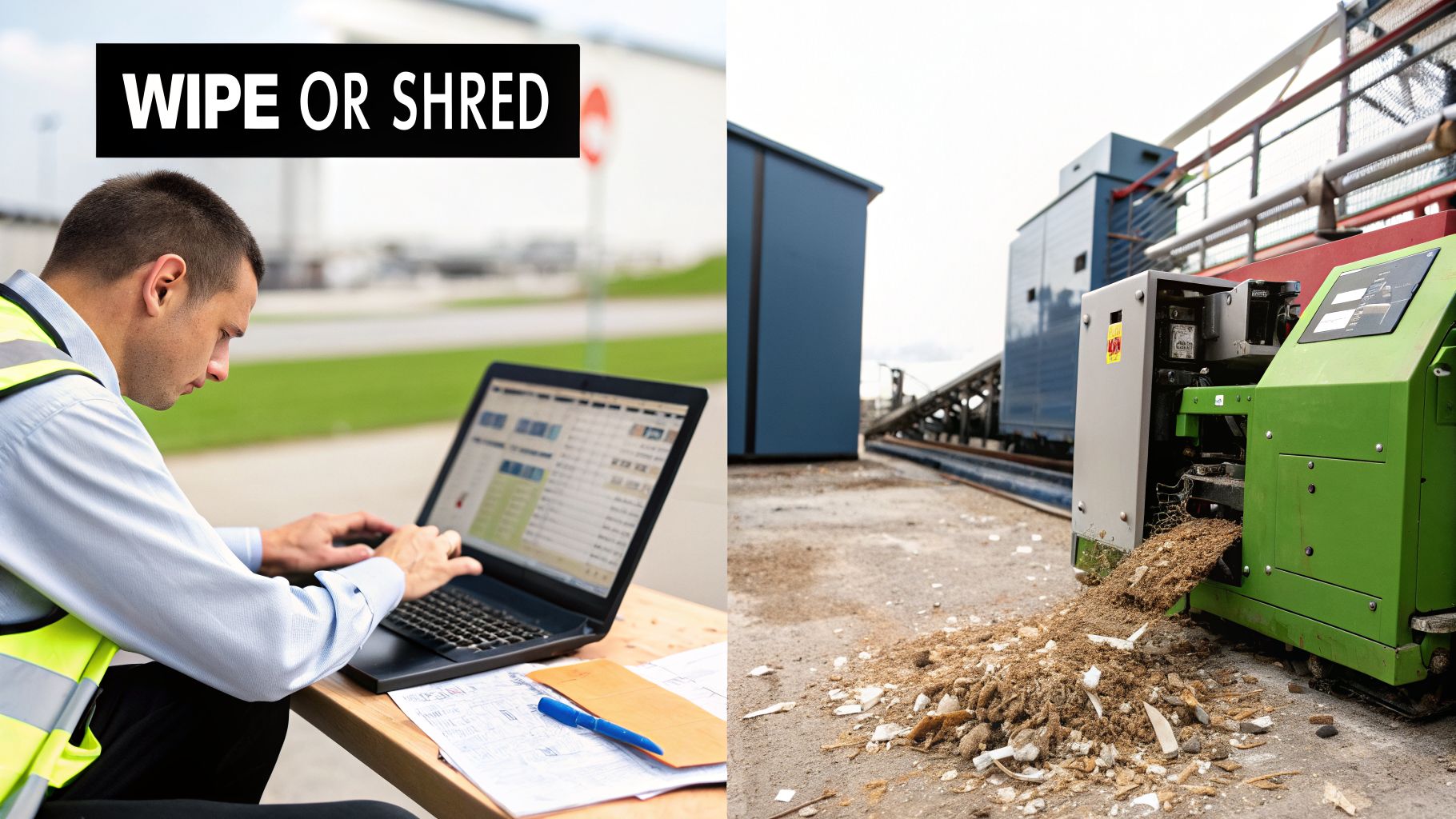
When it's time to retire old hard drives and servers, you’re immediately faced with a critical decision: should you wipe the data or physically shred the drives? This isn't just a technical detail; it's a strategic choice that directly impacts your security, budget, and compliance standing, whether your operations are local or national.
There’s no single right answer. It all comes down to your specific situation.
Think of it this way. A law firm in Lawrenceville upgrading its fleet of perfectly good laptops has very different needs than a Suwanee-based data center decommissioning a rack of failed servers. The law firm likely wants to resell those laptops to recover some value, making data wiping the clear winner. The data center, however, is dealing with broken hardware packed with sensitive data. For them, the absolute finality of physical shredding is the only option.
For any organization in Gwinnett County, making the right call means looking at asset value, compliance rules, and your tolerance for risk. Let's break down each method.
When Data Wiping Makes Sense
Data wiping, often called sanitization, uses specialized software to systematically overwrite every sector of a hard drive with random data. This process makes the original information completely unrecoverable by any software-based means. The industry benchmark for this is the DoD 5220.22-M standard, which uses a 3-pass overwrite to ensure nothing is left behind.
The huge advantage of wiping is that it preserves the hard drive for reuse. This makes it the perfect solution if you plan to:
- Resell or Donate Equipment: If you're a school or university in Gwinnett refreshing your computer labs, wiping the drives allows you to sell the old machines and put that money back into your budget. It also makes it possible to donate the equipment, giving it a second life.
- Repurpose Assets Internally: An expanding business in Norcross can wipe older computers and redeploy them for new hires or in less demanding roles. It’s a smart way to stretch your IT budget without compromising the security of the previous user's data.
Wiping is a fantastic tool for recovering asset value. But it’s absolutely essential that the process is done correctly and fully documented. You should always receive a Certificate of Sanitization for every single drive, verifying the method used and confirming it was successful.
If this sounds like a good fit, it helps to understand exactly what the process involves. We have a detailed guide that explains how to wipe a hard drive completely.
Why Shredding Is the Ultimate Security Guarantee
While wiping is great for working drives, physical shredding delivers a level of security that is absolute. There are no questions. An industrial-grade shredder literally tears hard drives, SSDs, and backup tapes into tiny, confetti-like pieces. The data platters and memory chips are physically obliterated, rendering the data 100% unrecoverable.
Shredding is the gold standard for any organization where security is the top priority. It's the only real choice for:
- Failed or Obsolete Drives: You can't run wiping software on a hard drive that won't even spin up. For dead drives, shredding is the only way to destroy the data inside.
- High-Stakes Compliance: For hospitals in the Gwinnett medical system following HIPAA, or financial firms near Peachtree Corners bound by GLBA, the risk of a data breach is just too high. Shredding removes all doubt and ensures compliance.
- Decommissioning Data Centers: When a data center in Gwinnett County or anywhere in the U.S. takes hundreds or thousands of servers offline, on-site shredding offers immediate, witnessed proof that sensitive data has been destroyed before the assets ever leave the building.
The decision often comes down to balancing asset value against risk. A working laptop might be worth $200 after wiping, but if it holds protected health information, a single HIPAA violation could cost millions. That $200 isn't worth the risk. This is why many organizations use a hybrid approach: they wipe what can be safely reused and shred everything else.
Hard Drive Wiping vs. Physical Shredding: Which Is Right for You?
Choosing between wiping and shredding doesn’t have to be complicated. This table breaks down the key differences to help you decide what’s best for your Gwinnett County organization.
| Factor | Data Wiping (e.g., DoD 5220.22-M) | Physical Shredding |
|---|---|---|
| Data Security Level | High. Renders data unrecoverable by software methods. | Absolute. Physical destruction makes data 100% unrecoverable. |
| Asset Reuse | Yes. The drive and device remain fully functional for resale or redeployment. | No. The drive is physically destroyed and cannot be reused. |
| Best For | Functional laptops, desktops, and servers being resold, donated, or repurposed. | Failed/damaged drives, end-of-life media, and high-security data (HIPAA, GLBA). |
| Verification | Certificate of Sanitization. | Certificate of Destruction. On-site shredding allows for visual witness. |
| Compliance | Meets NIST 800-88 "Clear" standards. Good for many compliance needs. | Meets NIST 800-88 "Destroy" standards. The highest level for HIPAA, DoD, etc. |
Ultimately, selecting a method for secure hard drive destruction in Gwinnett County, Georgia, is about matching the process to your organization’s risk tolerance and operational goals. By understanding the pros and cons of both wiping and shredding, you can build a data destruction plan that is both ironclad and cost-effective.
Navigating Data Destruction Compliance in Georgia and the U.S.
For any organization in Gwinnett County or nationwide, getting data destruction wrong isn't a simple mistake. It’s a serious compliance breach that can bring auditors to your door and lead to crippling fines. Compliance isn't just about having an internal policy; it's about following legally enforceable rules that apply across the United States.
Simply tossing a hard drive into a shredder doesn’t cut it anymore. You have to prove you did it, and you have to prove you did it the right way. Understanding the specific regulations that apply to you is the only way to build a data destruction program that will actually protect you.
Key Regulations Impacting Gwinnett Businesses
Different businesses answer to different authorities. A hospital in Lawrenceville faces different data security mandates than a financial firm in Peachtree Corners or a defense contractor in Norcross. The first step is figuring out which federal and state rules apply to your organization.
Here are the main regulations that demand secure hard drive destruction in Gwinnett County, Georgia, and across the nation:
HIPAA (Health Insurance Portability and Accountability Act): This is the big one for any healthcare provider, clinic, or lab that handles protected health information (PHI). HIPAA is crystal clear: PHI must be rendered “unusable, unreadable, or indecipherable.” This means professional shredding or certified data wiping isn’t just a good idea—it’s mandatory.
NIST 800-88 (National Institute of Standards and Technology): While NIST 800-88 is technically a set of guidelines, it has become the undeniable gold standard for government agencies and their contractors nationwide. It outlines specific methods like "Clear," "Purge," and "Destroy." For the most sensitive data, physical destruction is the only way to meet the highest "Destroy" standard.
GLBA (Gramm-Leach-Bliley Act): If you're in the financial world—banks, investment firms, accountants—you're governed by GLBA. The "Safeguards Rule" specifically requires you to securely dispose of customer information to protect their nonpublic personal information (NPI).
FACTA (Fair and Accurate Credit Transactions Act): This law applies to a surprisingly wide range of businesses, from landlords and employers to auto dealers. If you use consumer credit reports for any reason, you must take "reasonable measures" to destroy them when they're no longer needed. Physical destruction is considered a primary "reasonable measure."
Trying to juggle all these overlapping rules is a huge challenge. A crucial first step is to conduct a comprehensive compliance risk assessment. It's the only way to get a clear picture of exactly where your risks are and what standards you must meet.
Proving Your Diligence: What Auditors Look For
When an auditor shows up, they don't care about your good intentions. They want to see cold, hard proof that you followed a secure, documented, and repeatable process from start to finish.
An auditor's primary goal is to verify that you have a consistent, repeatable, and documented process for data destruction. A one-off shredding event without paperwork is a red flag. They want to see a formal policy and the documentation to back it up.
This is why the Certificate of Destruction is arguably the most critical document you'll get from your destruction vendor. It’s your official, legal receipt proving your data-bearing devices were destroyed in full compliance with the law.
The Power of Documentation: Chain of Custody
While the Certificate of Destruction is the end of the story, the process begins much earlier with a solid chain of custody. This is simply the chronological paper trail that tracks your hard drives from the moment they leave your control to their final destruction.
A truly secure chain of custody isn't optional. It must include:
- Serialized Asset List: Every single hard drive must be logged by its unique serial number. No exceptions.
- Secure, Locked Containers: Drives should be immediately placed in locked, tamper-proof bins for transport.
- Documented Transfer of Custody: Signatures must be captured every time the assets change hands, creating an unbroken line of accountability.
- GPS-Tracked Transport: The vehicle carrying your assets must be tracked from your door to the secure destruction facility.
This level of detailed documentation is your absolute best defense in an audit. It demonstrates that you treated data security with the seriousness it deserves at every single step. When you pair a strong destruction process with other responsible disposal practices, like those detailed in our guide to electronics recycling in Gwinnett County, GA for businesses, you build a truly comprehensive and defensible asset disposition program.
The Importance Of Chain Of Custody And Certified Destruction
True security in data destruction isn’t about the final shred. It’s about the entire journey—from the moment a hard drive leaves your control to the second it’s turned into tiny fragments. Without a bulletproof process, you’re just inviting liability.
This is why a strict chain of custody is an absolute must. It’s the documented, chronological paper trail that follows your assets every step of the way. Think of it as a security detail for your data, providing a verifiable log from your Gwinnett County facility to the destruction plant, a standard practiced by top-tier nationwide vendors.
What A Secure Chain Of Custody Looks Like
A real chain of custody is more than a handshake and a promise. It’s a formal system built to prevent assets from being lost, stolen, or mishandled. This process is your first and best defense in proving you did your due diligence.
An airtight process always includes these critical steps:
- Serialized Asset Tracking: Every single drive, server, or device gets scanned and logged by its unique serial number before it leaves your premises.
- Secure, Tamper-Evident Transport: Assets are locked into sealed containers, making sure they stay protected and untouched during transit.
- GPS-Monitored Vehicles: The truck carrying your sensitive media is tracked in real-time, giving you a precise record of its route.
- Formal Custody Transfers: Signed paperwork at pickup and delivery confirms exactly who had your assets and when, leaving no gaps in accountability.
This level of detail ensures that a drive from a medical lab in Snellville or a server from a Norcross data center is accounted for every inch of the way. It simply removes all doubt.
Witnessed Destruction: The Ultimate Verification
For organizations that require absolute, undeniable proof, on-site witnessed destruction is the answer. With this service, a mobile shredding truck comes directly to your location in Gwinnett County or other service areas nationwide. You and your team can literally watch your hard drives get destroyed.
There is no more powerful form of verification than seeing your assets destroyed with your own eyes. It instantly confirms that the job was done, leaving no room for questions or uncertainty.
This option has become a game-changer for hospitals, labs, and IT departments across Gwinnett. Mobile shredding trucks provide immediate visual confirmation, and the best providers in the Atlanta area and across the country have made this a standard, accessible service.
This infographic shows how various compliance standards like HIPAA, NIST, and GLBA/FACTA all tie into a secure, documented destruction process.
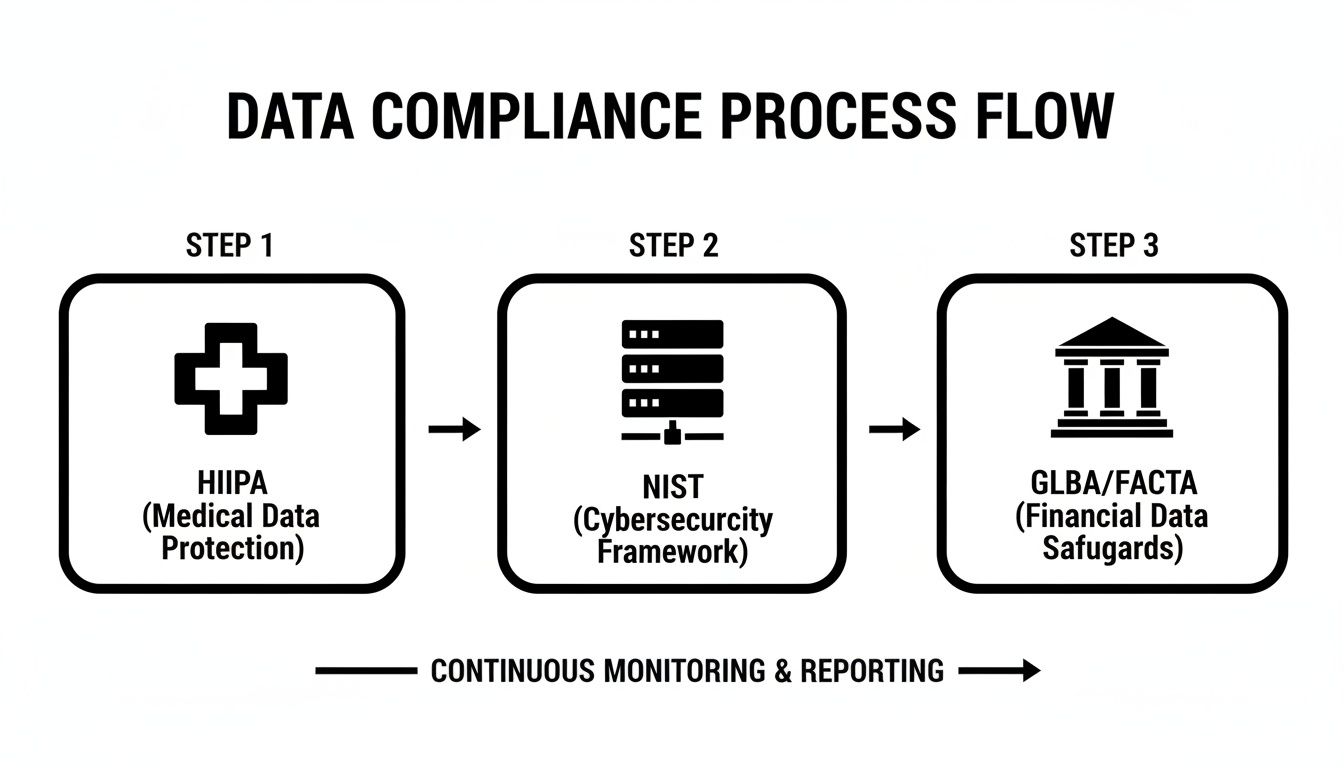
While each regulation focuses on a different sector—healthcare, government, or finance—they all share a common demand: a secure, documented, and final destruction workflow.
The Certificate Of Destruction: Your Legal Proof
Once the shredding is done, whether on-site or off-site, you must get a formal Certificate of Destruction. This isn’t just a receipt. It’s a legally binding document that acts as your official proof of compliance—your shield during an audit or in a legal dispute.
For any business needing secure hard drive destruction in Gwinnett County, Georgia, a proper certificate is non-negotiable. It should clearly list:
- Unique serial numbers of all destroyed assets
- The date and location of destruction
- The specific destruction method used (e.g., physical shredding)
- A statement that transfers all liability from your organization to the vendor
This document closes the loop on your chain of custody, giving you a complete, auditable record from start to finish. If you want to see what this critical document includes, you can review a sample Certificate of Destruction to understand its format. It’s the final piece of the puzzle that confirms your data is gone for good.
Responsible Recycling and Environmental Stewardship
Once your hard drives have been shredded, the job is only halfway done. Sure, the data is gone for good, but what about the pile of twisted metal, plastic, and electronics left behind? This is where true data security meets environmental stewardship.
Properly handling this shredded material isn’t just about being green—it's a critical final step in a compliant asset disposition plan. Just dumping the debris in a landfill is a huge missed opportunity and, frankly, an environmental mistake. A modern, responsible approach ensures those materials re-enter the supply chain as valuable commodities.
From Shredded Debris to Valuable Resources
After we run a hard drive through a shredder, it becomes a jumbled mix of different materials. Each component has a specific path to follow so it can be recycled responsibly, which keeps hazardous waste out of our local soil and water.
The main materials we recover from shredded hard drives include:
- Aluminum: A hard drive's casing and platters are made of high-grade aluminum, which is incredibly recyclable.
- Steel: You'll find steel in the motor casing and other structural parts, another metal that's easy to recycle.
- Circuit Boards: These are the real prize. They have small amounts of precious metals like gold, silver, and copper that can be extracted through specialized smelting.
This is what a genuine zero-landfill policy looks like in practice. It’s a detailed sorting and recovery process that guarantees every part of your old equipment is put to good use instead of sitting in a landfill.
A vendor's commitment to a zero-landfill policy shows you what they're really about. It turns what would be e-waste into a new source of raw materials, making sure your old assets actually contribute to a circular economy.
We've seen this focus on responsible disposal become a major priority for businesses all over the region. Gwinnett County's electronics recycling industry has grown significantly as organizations now get the importance of balancing data security with environmental care. The recycling process ensures metals like steel, aluminum, copper, and iron are all properly recovered. In fact, our recycling partners in the Norcross area are all certified to meet strict federal and state e-waste regulations. You can see more on Gwinnett County's focus on responsible electronics recycling on beyondsurplus.com.
The Importance of R2v3 Certification
So how do you know a vendor’s recycling promises are legit? You look for third-party certifications. In our world, the gold standard for electronics recycling is R2v3 (Responsible Recycling).
When a recycler is R2v3-certified, it means they've passed tough audits to prove they meet the highest standards for environmental protection, data security, and worker safety. Working with a vendor who only uses R2v3-certified downstream partners is non-negotiable for us.
This certification is your guarantee that:
- Your e-waste won’t be illegally shipped overseas to places with weak environmental laws.
- Strict data security protocols are followed throughout the entire recycling chain.
- Hazardous materials like mercury and lead are handled safely and responsibly.
When you choose a partner for secure hard drive destruction in Gwinnett County Georgia who insists on R2v3 certification, you’re making a statement. It shows your organization is not only secure but also a responsible member of the community. You can take a deeper dive into this topic by reading our article on managing e-waste.
How to Select a Secure Destruction Vendor in Gwinnett County
Choosing the right partner for secure hard drive destruction in Gwinnett County, Georgia, is easily the most important decision you'll make in this whole process. Get it right, and your vendor becomes a seamless extension of your security team. Get it wrong, and you could be looking at massive risk and liability. You have to look past the sales pitch and really dig into what makes a vendor trustworthy, whether they serve just your local area or operate nationwide.
This isn't about chasing the lowest bid. It’s about finding a partner who can back up their security claims with a process that's both transparent and fully auditable. Let's walk through the absolute must-haves when picking a destruction vendor you can trust with your organization’s most sensitive data.
Look for NAID AAA Certification
First things first: your search should start and end with vendors holding NAID AAA Certification. This isn't just some logo they can buy. It's the gold standard for secure data destruction, known for its incredibly tough and thorough requirements. Think of it as the data security world’s equivalent of a CPA for an accountant.
Any vendor with NAID AAA Certification has passed grueling, unannounced audits that cover:
- Employee Security: Every single employee with access to your sensitive material has gone through deep background checks and drug screenings.
- Secure Facility Protocols: Their destruction facility is under 24/7 video surveillance, has iron-clad access controls, and operates under a meticulously documented security plan.
- Auditable Processes: The entire chain of custody, from the moment they pick up your drives to their final destruction, is documented, tracked, and completely verifiable.
If a vendor you're considering isn't NAID AAA Certified, take them off your list. It’s the minimum qualification that proves they’re serious about security and have actually invested in the infrastructure to protect you.
Vet Their Chain of Custody Process
A secure chain of custody is the absolute backbone of compliant data destruction. You need to ask very direct questions about how a vendor tracks and protects your assets from the second they leave your Gwinnett County facility. Vague answers are not acceptable here.
Ask them to walk you through their exact process. You need to know:
- How do you log our assets at pickup? The only right answer is scanning and documenting every single drive by its unique serial number. No exceptions.
- Are your transport containers locked and tamper-evident? Your drives should be placed into sealed, secure bins right there on-site before they go anywhere.
- Are your vehicles GPS-tracked? Real-time tracking gives you an indisputable record of where your assets are at all times.
- Who handles our assets? It should only be uniformed, badged, and background-checked employees—never temp workers or third-party couriers.
If a vendor stumbles or can't give you clear, confident answers to these questions, that’s a huge red flag.
Inquire About Insurance and Liability
Even the best-laid plans can go wrong. That's what insurance is for. A truly professional destruction vendor will carry significant liability insurance that is specifically written to cover data breaches.
Ask to see their Certificate of Insurance. Look for professional liability or "errors and omissions" coverage that explicitly names data breaches. This is what protects your organization if your data is somehow compromised while in their possession. A vendor who skimps on proper insurance is essentially betting your business on their ability to be perfect 100% of the time.
Understand Their Recycling and Downstream Partners
Once your drives are shredded into tiny pieces, that material has to be recycled responsibly. This is a crucial final step for both environmental compliance and data security. You need to know exactly where that shredded metal and plastic ends up.
Ask the vendor if they have a zero-landfill policy. More importantly, ask if their downstream recycling partners are R2v3 Certified. This certification ensures the shredded material is handled in an environmentally sound manner and that no data fragments could ever be recovered. For any organization committed to sustainability, this is completely non-negotiable. You can learn more about how to find a qualified e-waste recycling company that puts these standards first.
Common Questions About Hard Drive Destruction
Planning for secure hard drive destruction always brings up a few practical questions. As a company that handles this for facilities across Gwinnett County and the entire U.S., we've heard them all. Here are the answers to the questions we get asked the most.
What’s the Price Tag on Hard Drive Destruction in Gwinnett County?
There's no single price for hard drive destruction; the cost really depends on what you need. Key factors include the service type, how many drives you have, and the destruction method.
- On-Site Shredding: This is our most secure service. We bring a mobile shredding truck right to your Gwinnett County facility. You can watch the destruction happen, which is great for peace of mind. Pricing is usually per drive or by the bin.
- Off-Site Shredding: For bigger projects with lots of drives, sending them to our secure facility can be more economical. We manage the secure transport, and you get a full Certificate of Destruction.
- Data Wiping: If you're thinking about reselling or reusing your devices, wiping the data is the way to go. It's priced per drive and keeps the hardware's value intact, which can help your bottom line.
A certified vendor will always give you a custom quote that matches your exact needs and compliance standards.
Do We Have to Pull the Hard Drives Out of the Computers Ourselves?
Not at all. In fact, most IT teams prefer that we handle it. Our professional ITAD (IT Asset Disposition) services include removing drives from desktops, laptops, servers, and other equipment.
Letting our trained, background-checked technicians manage the removal saves your staff a ton of time and tedious work. It also tightens up your chain of custody, ensuring a secure process from start to finish. When you get a quote, just confirm this service is included.
Expert Tip: Having your vendor remove the drives is a best practice. It eliminates the risk of a drive getting misplaced or mishandled by internal staff before it ever leaves your building, which is a critical link in your chain of custody.
Is a Certificate of Destruction All We Need for HIPAA?
A Certificate of Destruction is a critical piece of your HIPAA compliance strategy, but it doesn't stand alone. You absolutely must have a signed Business Associate Agreement (BAA) with your destruction vendor.
Think of it this way: The BAA is the legal contract that holds your vendor accountable for protecting your patients' Protected Health Information (PHI) under HIPAA rules. The Certificate of Destruction is the official receipt proving the physical destruction was completed according to that agreement. An auditor will want to see both.
How Should We Get Our Hard Drives Ready for Pickup?
Prepping for pickup is straightforward. The most important step is to gather all the devices and drives for destruction in one secure, locked location at your facility. If you can, create a simple inventory log with serial numbers as you go.
We will provide locked, tamper-evident bins for you to place everything in. Once those assets are in our containers, they are completely secure until we unlock them for destruction. This simple step is vital for maintaining a solid chain of custody from your door to ours.
When you're ready to implement a secure, compliant, and environmentally responsible plan for your old equipment, the team at Scientific Equipment Disposal is here to help. We provide NAID AAA certified hard drive destruction and sustainable electronics recycling for businesses, labs, and universities throughout Gwinnett County, the Atlanta metro area, and nationwide. Contact us today for a transparent, no-obligation quote. Learn more about our secure data destruction services at https://www.scientificequipmentdisposal.com.