End-of-Life Medical Equipment Removal Solutions: A Practical Guide for Local & Nationwide Facilities

When you hear "End-of-Life Medical Equipment Removal," what comes to mind? It’s not just about getting rid of old machines. This is a specialized service that covers certified data destruction, regulatory compliance, logistical planning, and eco-friendly recycling for used medical devices, available both locally and nationwide.
For any healthcare facility, lab, or research institution—from a clinic in Atlanta, Georgia, to a national hospital network—this process is absolutely critical to avoid huge liability risks. If handled incorrectly, those outdated assets can quickly become major operational threats, leading to data breaches, million-dollar HIPAA fines, and serious environmental penalties.
Why Proper Medical Equipment Removal Is Non-Negotiable
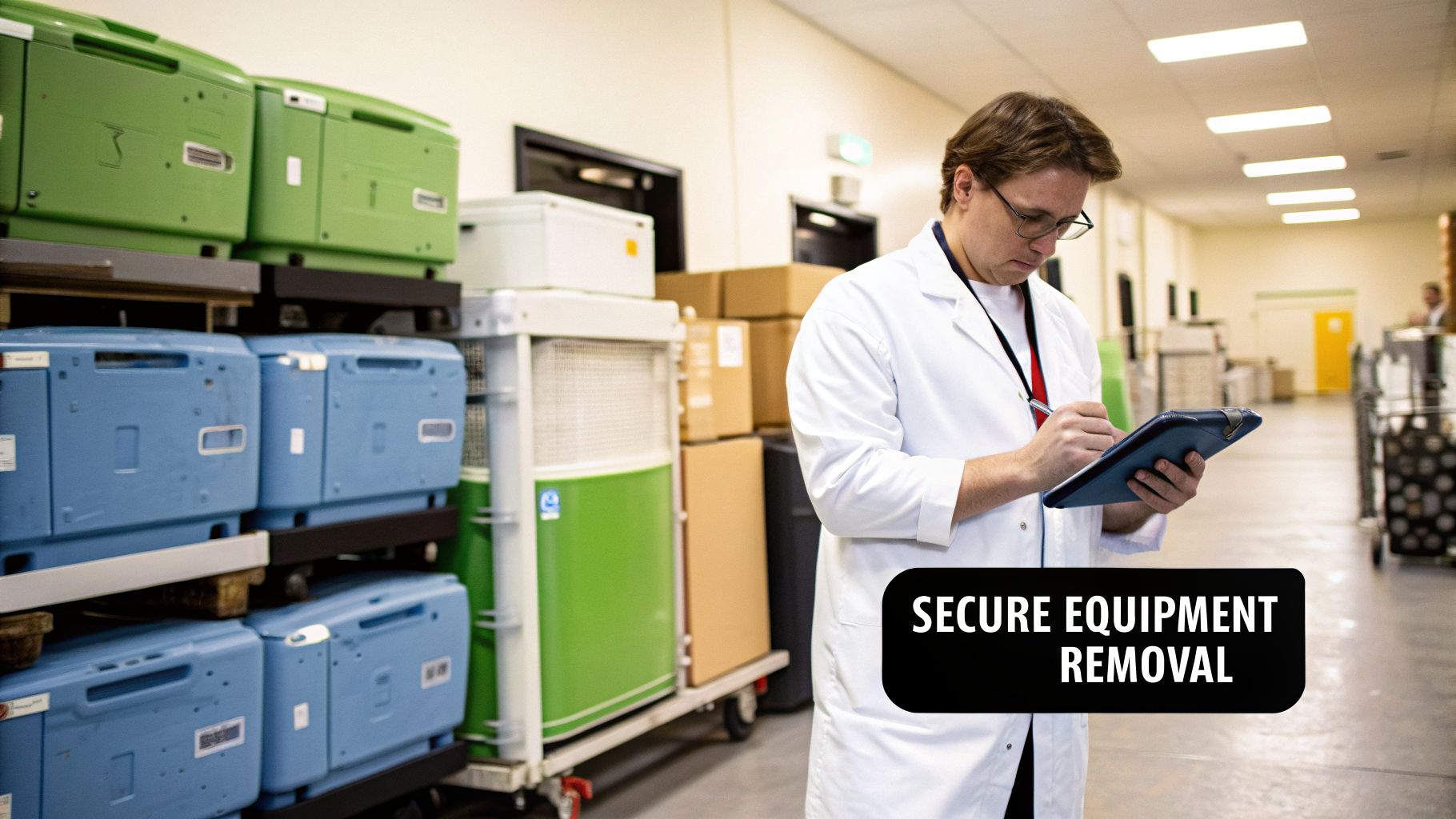
When your hospital upgrades its imaging machines or a lab decommissions its analyzers, what really happens to the old equipment? It's tempting to see these bulky devices as simple scrap metal, but they are packed with liability. Leaving them in a storage closet or calling a standard junk hauler is a risk you can't afford to take, whether you're in a single location or operating across the country.
This is precisely where professional end-of-life medical equipment removal solutions come in. You shouldn't think of it as trash disposal, but as a secure and documented transfer of liability. A professional partner takes on the entire lifecycle of retiring these assets, turning your complex compliance problem into a managed, documented, and worry-free process, scalable for local and national needs.
More Than Just Hauling Away Old Machines
At its heart, professional equipment removal is a risk management strategy. The service goes far beyond just logistics and involves several crucial components that protect your organization from severe consequences.
Failing to use a structured approach leaves facilities—from local Atlanta-area clinics to nationwide healthcare systems—exposed to significant penalties.
Key risks of improper disposal include:
- Data Breaches and HIPAA Violations: So many medical devices, from patient monitors to complex lab equipment, store Protected Health Information (PHI). If that data isn't properly sanitized, you're looking at a breach, with potential fines reaching millions of dollars per incident.
- Environmental Compliance Penalties: Medical and lab equipment is often full of hazardous materials like lead, mercury, and other substances regulated by the EPA. Dumping this equipment incorrectly can lead to stiff environmental penalties and damage to your reputation, no matter your location.
- Logistical and Safety Hazards: De-installing and moving heavy, sensitive equipment like an MRI machine or a large fume hood requires specialized tools and expertise. One wrong move can cause expensive facility damage or, even worse, serious injuries.
A professional removal process is built around a core set of services designed to address these risks head-on. The table below breaks down what you should expect from a qualified partner.
Key Services in EOL Medical Equipment Removal
| Service Component | Description | Core Benefit |
|---|---|---|
| Secure Data Destruction | DoD-compliant wiping or physical shredding of all data-bearing devices. | Protects against PHI breaches and ensures HIPAA compliance. |
| On-Site De-Installation | Professional de-installation and removal of equipment from any facility, nationwide. | Prevents property damage, ensures staff safety, and minimizes operational disruption. |
| Documented Chain of Custody | Serialized asset tracking from pickup to final disposition. | Provides an auditable trail for legal and regulatory peace of mind. |
| Compliant Recycling | Responsible recycling of e-waste and proper disposal of regulated materials. | Avoids environmental fines and supports corporate sustainability goals. |
| Certificate of Disposal | Official documentation certifying compliant data destruction and recycling. | Serves as tangible proof for audits and internal records. |
Each of these services works together to create a secure, compliant, and defensible process for retiring your medical assets, whether at a single site or across multiple states.
The Role of a Professional Removal Partner
A specialized partner like Scientific Equipment Disposal provides the structured framework needed to manage these challenges effectively. Our job is to handle the entire workflow so your team doesn't have to, ensuring every step is documented, secure, and compliant.
A professional EOL service doesn’t just remove equipment; it removes risk. By providing certified data destruction, compliant recycling, and a documented chain of custody, we give healthcare administrators and lab managers what they need most: peace of mind.
This partnership is especially valuable for organizations going through facility upgrades, relocations, or complete closures. It lets your operational teams focus on their core duties while the complexities of asset disposition are handled by proven experts. From on-site de-installation and secure transport to certified recycling and data destruction, every single action is meticulously planned and executed for a secure, sustainable outcome.
Navigating the Complex Web of Compliance
When you’re ready to retire old medical assets, you’re not just clearing out space. You’re stepping into a maze of strict rules and regulations. This isn't just bureaucratic red tape—it's a critical framework built to protect patients, the environment, and your facility’s hard-earned reputation.
Get it wrong, and you could be looking at serious financial penalties and legal trouble. That’s why compliance has to be the absolute foundation of any end-of-life medical equipment removal solution, both locally and nationally.
You can think of compliance as having two major sides. On one side is data security, and on the other is environmental protection. A professional disposal partner has to be an expert in both to give you a service that's truly secure from every angle.
HIPAA: The Data Security Mandate
The biggest hurdle for any healthcare facility is easily the Health Insurance Portability and Accountability Act (HIPAA). The HIPAA Privacy and Security Rules are non-negotiable when it comes to Protected Health Information (PHI).
You'd be surprised where PHI can hide. Countless pieces of medical equipment—from patient monitors and infusion pumps to MRI machines and lab analyzers—have hard drives or memory chips that store sensitive patient data.
Simply hitting "delete" or reformatting a drive doesn't even come close to meeting HIPAA standards. The law demands that PHI be made completely "unreadable, indecipherable, and otherwise cannot be reconstructed." In plain English, the data has to be gone for good, professionally and permanently.
A single piece of equipment disposed of the wrong way can trigger a data breach affecting thousands of patients. With HIPAA fines that can soar past $1.9 million per violation category each year, certified data sanitization isn't just a good idea—it's a fundamental part of managing your risk.
To keep you compliant, a removal service absolutely must:
- Identify every single device that might have stored PHI.
- Use certified data sanitization methods, like DoD 5220.22-M wiping protocols.
- Physically shred any drives that can't be successfully wiped clean.
- Give you a Certificate of Destruction as a paper trail for audits and proof of compliance.
Environmental Rules and the RCRA
Beyond the data, you have to consider what the equipment is actually made of. The Environmental Protection Agency (EPA) enforces the Resource Conservation and Recovery Act (RCRA), which sets the rules for disposing of solid and hazardous waste. A lot of older medical and lab devices are full of materials that the EPA considers hazardous.
For example, this equipment can contain:
- Mercury in older switches and fluorescent lights.
- Lead in CRT monitors and solder.
- Cadmium in rechargeable batteries.
- PCBs in old transformers and capacitors.
Just dumping equipment with these materials is illegal and can lead to massive fines and cleanup costs. This is where a partner who knows their stuff is essential. They're trained to spot these hazardous materials and make sure they are handled exactly as federal, state, and local laws require. To learn more about this, you can dig deeper into EPA-compliant laboratory equipment disposal and see how it protects your facility.
State and Local Requirements: Georgia and Beyond
Federal laws like HIPAA and RCRA set the national baseline, but states often add their own layers of rules. Here in Georgia, for example, the Environmental Protection Division (EPD) has specific regulations that build on federal mandates, especially around e-waste and universal waste.
A vendor working in the Atlanta metro area must have a deep, practical understanding of these local rules. This is the only way to ensure that every piece of equipment—whether from a major downtown Atlanta hospital or a clinic in a suburb like Alpharetta or Marietta—is processed in full compliance with every level of government.
Choosing a partner with nationwide capabilities gives you the best of both worlds. You get local, on-the-ground expertise with the power to scale across state lines, ensuring your end-of-life medical equipment removal solution is bulletproof, no matter where your facilities are located.
Ensuring Ironclad Patient Data Security
Let’s move from the paperwork of compliance to the hands-on reality of data security. This is, without a doubt, the most critical part of getting rid of old medical equipment. Any device with a hard drive or memory chip is a potential liability.
Simply hitting "delete" or reformatting a drive is like putting a flimsy "keep out" sign on an unlocked door. It might feel secure, but it leaves a shocking amount of patient information exposed to anyone with the right tools.
Under HIPAA, true data security means certified, irreversible destruction. The goal isn't just to hide the data—it's to make any Protected Health Information (PHI) completely and permanently unrecoverable.
Beyond Deletion: Certified Data Sanitization
Professional data sanitization is a world away from dragging files to the trash can. The industry benchmark for software-based wiping is the DoD 5220.22-M 3-pass sanitization method.
Think of it like this: you write a secret on a whiteboard. Wiping it once leaves a ghost image. The DoD method is like wiping the board clean, scribbling over the entire surface with random nonsense, wiping it again, writing new nonsense, and then wiping it a final time. This layered overwriting process destroys the original data so thoroughly that even forensic specialists can't get it back.
A professional partner ensures every single bit of data is forensically unrecoverable. This documented process transforms a major liability into a confirmed, compliant action, giving your IT and compliance teams the concrete proof they need.
Software wiping is the go-to for devices with working hard drives that might be resold or reused. But it’s not the only tool we use.
Software Wiping vs. Physical Destruction
Not every data-storing device can be wiped clean with software. For older, damaged, or certain types of media like solid-state drives (SSDs) and memory cards, we need a more direct approach. That’s where physical destruction—shredding—comes in.
Software Wiping (e.g., DoD 5220.22-M): This is best for functional hard disk drives (HDDs). The data is overwritten multiple times, which preserves the physical drive for potential reuse while guaranteeing the data is gone for good. It's a secure and environmentally sound method when possible.
Physical Destruction (Shredding): This is the only guaranteed method for non-functional drives, SSDs, and other media where software wiping isn't reliable. We feed the device into an industrial shredder that grinds it into tiny, unrecognizable pieces of metal and plastic. No data can ever be retrieved from that.
A complete data security plan uses both. A qualified vendor will always try to wipe drives to the DoD standard first. If a drive fails the process for any reason, it’s immediately pulled and tagged for the shredder.
The Chain of Custody: A Legal Receipt for Your Data
How do you prove your equipment was handled properly after it left your building? The answer is a Chain of Custody document.
Think of it as a legal receipt for your data's entire journey. This document tracks every piece of equipment by serial number, from the moment we pick it up at your facility to its final, certified destruction. Every single step is logged, timed, and signed for, creating a clear, unbreakable audit trail.
This paperwork is your irrefutable proof that you met your HIPAA obligations. It’s also important to see how these practices fit into broader security standards. For example, you can learn more about how global frameworks inform best practices by reading about ISO 27001 and Australian data privacy laws.
Ultimately, this process gives your compliance officers and IT teams the documented assurance they need. You can learn more about our specific HIPAA-compliant medical equipment disposal services and see exactly how we implement these safeguards for organizations like yours.
The On-Site Removal and Decommissioning Process
Once the compliance checklists are signed off and the data security plan is ready, what actually happens on removal day? This is where the plan springs into action. The on-site decommissioning and removal phase is a carefully choreographed process, designed to be smooth, safe, and cause as little disruption as possible to your facility's daily operations.
Think of it less like a standard moving crew and more like a specialized team for sensitive, heavy-duty medical technology. The work starts long before our truck arrives, beginning with a detailed project assessment that maps out every single step. This ensures that whether we’re de-installing a massive MRI machine in a downtown Atlanta hospital or clearing out a research lab on the West Coast, the execution is seamless.
Coordination with your facility managers is absolutely critical. A professional team works directly with your staff to schedule the removal during off-peak hours, secure elevator access, and protect all your floors and doorways. This proactive planning is what prevents bottlenecks and allows your own team to keep doing their important work without interruption.
Executing the On-Site Workflow
On the scheduled day, the entire process unfolds as a series of precise, practiced steps. The main goal is to safely de-install, pack, and transport every single asset, from the smallest benchtop centrifuge to the biggest imaging systems.
The on-site process typically includes:
- Systematic De-Installation: Our technicians, who have experience with specific equipment like fume hoods or large diagnostic machines, will safely disconnect and dismantle each unit. This requires specialized know-how to avoid damaging the equipment or your building.
- Professional Packing and Tagging: Every item is carefully packed and labeled with its own unique serial number. This is a crucial step for maintaining the Chain of Custody, making sure every asset is tracked from your door to its final destination.
- Secure Transport and Logistics: All equipment is loaded onto our dedicated, company-owned fleet of trucks. Using our own in-house fleet instead of third-party movers adds a major layer of security and accountability, guaranteeing your assets are under expert control at all times, whether the job is local or cross-country.
For a closer look at what a full-scale project involves, our guide on medical equipment decommissioning for healthcare facilities provides more detail on managing complex cleanouts. This workflow gives hospital administrators and lab managers a clear, predictable path when planning facility upgrades or complete shutdowns.
From Your Facility to Final Disposition
Just because the equipment has left your site doesn't mean the job is over. The secure transport ensures every asset arrives at a certified facility for the next stages: certified data destruction and responsible recycling.
A seamless on-site removal isn’t just about the heavy lifting; it’s about precision, safety, and total accountability. A professional team minimizes disruption to your operations while ensuring every piece of equipment is securely managed from the moment it’s unplugged.
This is especially vital for any assets that hold sensitive data. The process for guaranteeing data security is straightforward and methodical, protecting your organization from the risk of a breach.
This diagram shows the three core steps of our certified data destruction process, from sanitization to final proof of destruction.
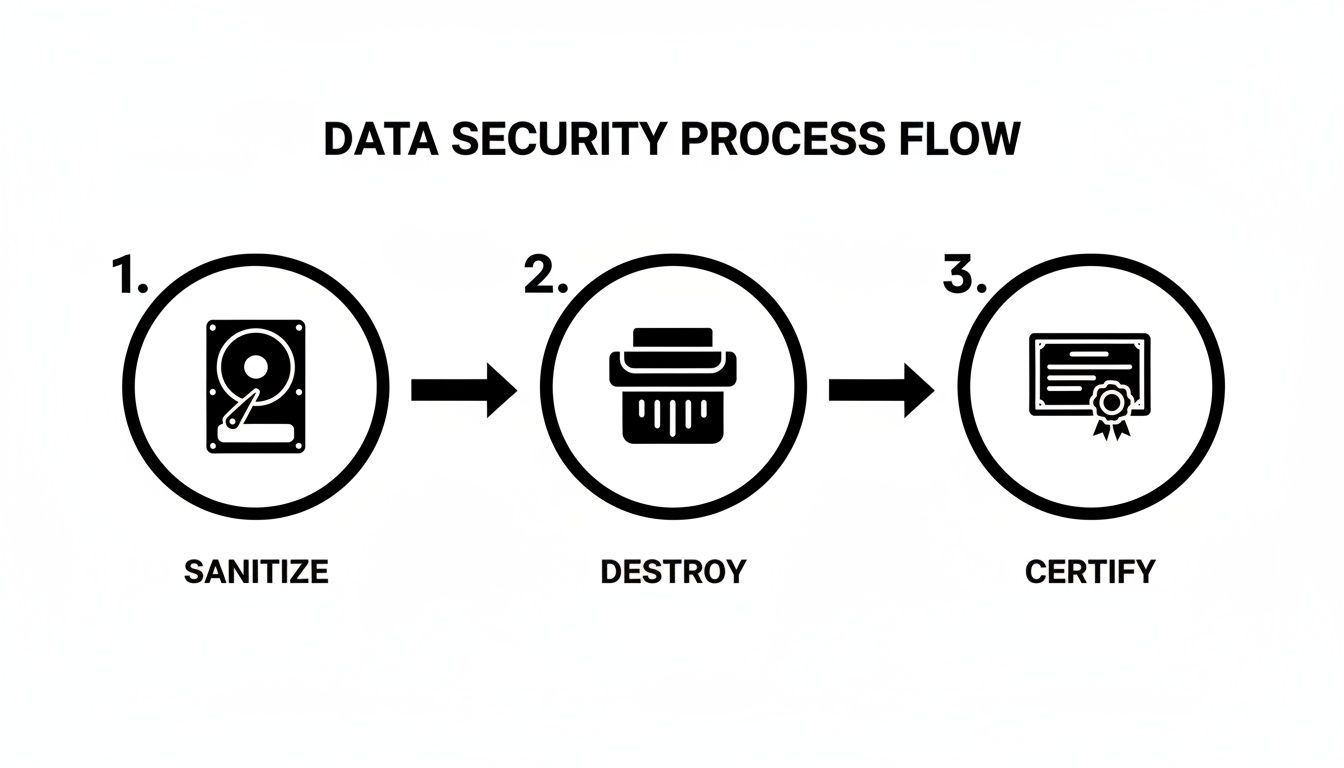
This visual shows how a multi-layered approach—combining software wiping with physical shredding and backing it all up with certification—creates an unbreakable chain of security for your data. This disciplined method provides the documented proof you need for HIPAA compliance and complete peace of mind.
Choosing Your Medical Equipment Removal Partner
Picking the right company for your end-of-life medical equipment removal is one of the most important calls a facility manager will ever make. This is not like hiring a standard moving service. You're handing over your organization's legal liability and hard-earned reputation to another business.
A real partner doesn't just haul away old machines. They provide documented, certified proof that every single risk—from data breaches to environmental violations—has been professionally managed.
The right choice shields your facility from massive HIPAA penalties, steep environmental fines, and logistical headaches. Whether you run a single clinic in Atlanta or oversee a nationwide healthcare system, your vendor must deliver consistent, compliant results every time. Vetting isn't a formality; it's your primary risk management strategy.
The Vendor Vetting Checklist
So how do you tell a professional from a basic hauler? You need a framework. This checklist covers the absolute non-negotiables. Use it to ask the tough questions and demand proof.
- Certifications for Data and Environmental Processing: These are not optional. They are your only guarantee that a vendor follows nationally recognized standards.
- A Verifiable Chain of Custody: In an audit, a paper trail is your best friend. Your partner must provide meticulous documentation that tracks every asset from your door to its final destination.
- In-House Logistics and Transport: A vendor using its own trained team and dedicated fleet gives you far more security and accountability than one that outsources the work, especially for nationwide projects.
- Proof of Substantial Liability Insurance: Accidents can and do happen. Make sure your partner is insured to cover any potential damages during the removal process.
By sticking to these criteria, you can confidently compare different end-of-life medical equipment removal solutions and find a partner who truly has your back.
Essential Qualifications and What to Ask
Let’s dig a little deeper. You need to know exactly what to look for and what to request. A transparent, professional vendor will have no problem providing clear answers and paperwork for all of these points.
Choosing a vendor is a transfer of liability. The most crucial factor is finding a partner with verifiable certifications and transparent processes that give you complete peace of mind, knowing your compliance and security are in expert hands.
This table breaks down the essentials—what they are, why they matter, and the specific proof you need to ask for.
Vendor Selection Checklist
| Qualification | Why It's Critical | What to Ask For |
|---|---|---|
| NAID AAA Certification | This is the gold standard for secure data destruction. It’s an independent verification that a vendor’s process for wiping and destroying data meets the highest security standards, ensuring HIPAA compliance. | "Can you provide a copy of your current NAID AAA certification?" |
| R2 or e-Stewards Certification | These certifications prove a vendor follows responsible and legal electronics recycling practices. They are your guarantee that your equipment won't be illegally dumped, protecting you from environmental liability. | "Are you R2 or e-Stewards certified? Please provide your certificate number for verification." |
| Chain of Custody Documentation | This detailed report is your auditable proof of due diligence. It should list serial numbers, pickup dates, and the final disposition (e.g., destroyed, recycled), creating a trail for every asset. | "Can you show me a sample Chain of Custody report and walk me through your asset tracking process?" |
| Proof of Insurance | This protects your facility from liability if an accident causes property damage or injury during de-installation and removal. Don't just take their word for it. | "Please provide a current Certificate of Insurance (COI) that lists your general liability, auto, and workers' compensation coverage." |
A partner that can immediately and confidently provide these items is demonstrating a true commitment to professionalism and accountability.
To see how these practices come together, you can explore the services of a certified e-waste recycling company and see how they build a secure and compliant program from the ground up. This groundwork is essential for selecting a partner that acts as an expert advisor, safeguarding your facility now and for years to come.
Frequently Asked Questions About Equipment Removal
When it's time to clear out old equipment, we get a lot of the same questions from lab managers and IT directors. Here are some straightforward answers to the most common things people want to know about how our end-of-life medical equipment removal solutions work.
What Types of Medical and Lab Equipment Do You Remove?
We handle pretty much everything, from single items to entire facilities. Our goal is to be your single point of contact for a full lab cleanout or facility decommissioning project, whether you're in the Atlanta area or anywhere else in the U.S.
That means we can take small benchtop items like microscopes and centrifuges, but we also have the crews and logistics to handle massive diagnostic systems like X-ray and MRI machines. We also manage all the related IT gear—servers, computers, data storage, you name it—so you don't have to juggle multiple vendors.
Is Data Destruction Really Necessary for Every Device?
If a device ever stored, processed, or even just transmitted Protected Health Information (PHI), then yes. Certified data destruction isn't just a good idea; it's a legal requirement under HIPAA. You'd be surprised how many modern lab devices, from patient monitors to complex imaging machines, have hard drives or memory chips inside.
We use methods like DoD-standard wiping or physical shredding that make data completely unrecoverable. To see how the documentation protects your facility, you can learn more about obtaining a Certificate of Destruction and proving your compliance.
How Does Pricing for Equipment Removal Work?
Every project is different, so the pricing really depends on the scope of work. The main factors are the quantity and type of equipment, how much work is needed to de-install everything, building access challenges, and the distance to our processing facility.
We always provide a transparent, itemized quote after a detailed on-site or virtual walkthrough. While some materials might have a recycling value that can help offset the cost, the real value you get is the secure, compliant, and documented transfer of liability from your facility to ours.
Can You Handle Projects Outside of Atlanta?
Absolutely. While we are an Atlanta-based company providing rapid, local service across Georgia, we have the logistics network and expertise to manage projects for healthcare systems nationwide.
This is a huge benefit for research companies or hospital networks with facilities in different states. It ensures you get the same consistent standards for compliance, documentation, and service, no matter where your labs or clinics are located. We deliver a unified solution for all your end-of-life equipment needs.
Ready to simplify your equipment disposal with a partner you can trust? Scientific Equipment Disposal provides secure, compliant, and documented removal solutions for facilities in Atlanta, across Georgia, and nationwide.
Contact us today to schedule your assessment and ensure your assets are handled with the highest standards of safety and security. Visit https://www.scientificequipmentdisposal.com to get started.