Finding Medical Equipment Disposal Near Me: A Nationwide & Local Guide

Typing "medical equipment disposal near me" into a search bar often kicks off a complicated and frankly, overwhelming process for facility managers. Whether you're in Atlanta, Austin, or anywhere in between, the last thing you need is another complex task. The real solution isn't just finding someone to haul things away; it's about partnering with a specialized vendor who handles the entire lifecycle—from secure logistics and compliant recycling to certified data destruction.
For institutions across the United States, this means finding a team that understands both federal regulations and specific state requirements.
Why Your Search For Medical Equipment Disposal Near Me Ends Here

When a hospital wing gets an upgrade or a university lab is decommissioned, you’re not just clearing out space. You’re managing a complex mix of assets, from bulky centrifuges and fume hoods to servers packed with sensitive patient data. Each piece of equipment carries a legacy of compliance that doesn't just end when you unplug it.
A quick online search will give you a list of generic haulers, but they just don't cut it. True medical and lab equipment disposal demands a partner with deep expertise. It’s a job that requires a solid grasp of environmental regulations, data security protocols like HIPAA, and the logistical muscle to de-install and transport heavy, sensitive machinery without disrupting your day-to-day operations, no matter your location.
The Growing Need For Specialized Disposal
The pressure on healthcare and research facilities to properly manage outdated equipment is only getting more intense. The global medical waste management market was valued at USD 16.7 billion in 2025 and is projected to skyrocket to USD 34.3 billion by 2035. This boom underscores the sheer volume of retired assets that need to be handled the right way.
We wrote this guide to move beyond generic advice and tackle the specific hurdles that institutions across the nation face. Our goal is to turn a daunting task into a clear, manageable process. For anyone managing these assets, a critical first step is understanding the nuances of specialized services like lab equipment disposal services in Georgia, because both local knowledge and nationwide capability are what make for a smooth execution.
For facility managers, the real cost of improper disposal isn't just a potential fine. It’s the risk to your institution's reputation, the threat of a data breach, and the environmental impact of sending valuable, recyclable materials to a landfill.
When you're vetting potential partners, it's crucial to focus on a few key areas that directly impact compliance and efficiency for facilities anywhere in the U.S.
Key Considerations For Local & National Medical Equipment Disposal
| Factor | Why It Matters For Facilities Nationwide |
|---|---|
| Nationwide Reach with Local Presence | A vendor with a national network and local teams understands regional traffic, facility access points, and state-specific disposal regulations. |
| HIPAA Compliance | For hospitals and clinics everywhere, this is non-negotiable. Look for vendors offering certified data destruction with a clear chain-of-custody. |
| Environmental Certifications | Every state has its own environmental protection rules. A partner with R2 or e-Stewards certification ensures materials are recycled responsibly, not dumped. |
| Logistical Capability | Can they handle de-installation of heavy equipment in a busy facility? Experienced crews are essential for a smooth, disruption-free process. |
| Full-Service Offering | The ideal partner manages everything: assessment, de-installation, transport, data destruction, recycling, and reporting across multiple locations. |
Choosing the right partner simplifies everything, turning a regulatory headache into a straightforward, compliant process.
Your Actionable Roadmap To Compliant Disposal
Think of this guide as your roadmap. We’ll walk you through the essential steps and key considerations so you can confidently select a specialist like Scientific Equipment Disposal. We’re focused on practical, actionable information that empowers you to:
- Navigate Local & Federal Regulations: Understand the specific compliance landscape in your state to sidestep costly mistakes.
- Ensure Data Security: Learn the best practices for HIPAA-compliant data destruction on any retired IT assets.
- Manage Complex Logistics: Plan for the physical removal of heavy, awkward, and sensitive lab apparatus.
- Achieve Sustainability Goals: Find a partner who is genuinely committed to responsible recycling and keeping equipment out of landfills.
By the time you’re done reading, your search for "medical equipment disposal near me" will be solved with a clear path forward.
Navigating Compliance And Certifications Across the U.S.
When you’re getting rid of old medical and lab equipment, you’re dealing with more than just a logistical headache—it’s a maze of strict legal and environmental rules. Just searching for "medical equipment disposal near me" won’t cut it. You absolutely have to find a partner who gets the complex web of federal and state regulations that control these assets from the moment they’re unplugged.
Get it wrong, and the consequences are severe. A lot of electronic medical devices, for example, fall under the Resource Conservation and Recovery Act (RCRA), a federal law enforced by the EPA. One wrong move, and your institution could be facing staggering fines and a major hit to its reputation.
The Foundation: Federal And State Regulations
On the federal level, the EPA sets the baseline for managing hazardous waste. Think about all the electronic guts inside your lab equipment—circuit boards in centrifuges, monitors on diagnostic machines—many contain lead and mercury. If they're tossed out like regular trash, they're classified as hazardous e-waste under RCRA.
Each state's Environmental Protection Division (EPD) or equivalent agency takes those federal standards and adds its own layer of oversight. Your disposal partner has to be fluent in both sets of rules. This is why a specialized national expert with local teams is so critical; they know how to keep your facility off the regulatory radar by ensuring every single item is handled correctly.
A common mistake is thinking old equipment is just scrap metal. But a single CRT monitor or a diagnostic machine with a soldered circuit board can trigger a RCRA violation if it ends up in a standard landfill. That mistake could cost your facility thousands.
This isn't a problem that's going away. The global market for medical waste containers is projected to skyrocket from USD 2.25 billion in 2025 to USD 3.88 billion by 2032. For the nation's busy medical labs and universities, this trend highlights a serious risk: improper e-waste disposal can lead to daily fines of up to $37,500 under RCRA.
Why Certifications Are Your Best Insurance Policy
So, how can you be sure a disposal vendor actually follows all these complex rules? The proof is in their third-party certifications. These aren't just fancy logos for a website; they are hard-earned credentials that show a real commitment to the highest standards.
When it comes to medical equipment disposal, two certifications are the gold standard:
- R2 (Responsible Recycling): This certification is a deep dive into best practices for electronics recycling. An R2-certified partner is audited on everything from worker safety and environmental protection to data security.
- e-Stewards: Often considered the toughest certification out there, e-Stewards has a strict zero-tolerance policy for exporting hazardous e-waste to developing countries. It’s a guarantee your equipment will be handled responsibly, period.
Choosing a vendor with these credentials gives you a vital layer of protection. It shows you've done your due diligence and effectively shifts the liability for proper disposal to a certified expert. To see how these standards are put into practice, take a look at the details of a responsible medical equipment recycling program.
The Importance Of Chain-Of-Custody Documentation
Beyond certifications, the single most critical piece of paper for your compliance file is the chain-of-custody documentation. This is the official paper trail proving you handed off your assets to a qualified vendor and tracking them all the way to their final disposition.
A reputable partner will always provide you with a Certificate of Recycling or a Certificate of Destruction. This document isn't complete unless it details:
- A full list of the equipment received.
- The exact date of the transaction.
- A clear statement confirming everything was handled according to all federal, state, and local regulations.
This paperwork is your official record. Without it, you’re leaving your organization wide open to potential legal challenges and audits. It's the final, non-negotiable step in a truly compliant disposal process.
Protecting Patient Data During Equipment Disposal
That retired diagnostic machine or old lab computer isn't just hardware; it’s a potential data breach waiting to happen. From patient monitors to administrative PCs, every device with a hard drive holds a ghost of its former life—often in the form of protected health information (PHI). For any facility governed by HIPAA, you can't just unplug these machines and haul them away. Data sanitization is a mandatory, non-negotiable first step.
Getting this wrong can lead to crippling penalties, a damaged reputation, and a total loss of patient trust. This makes your search for “medical equipment disposal near me” less about finding a hauler and more about finding a data security expert. Your duty to protect patient data doesn't end until that information is verifiably and permanently destroyed.
This is a serious business. In the U.S., the medical waste disposal industry—which includes secure data destruction—is projected to pull in $7.1 billion in revenue by 2025. That number is a direct reflection of the high stakes involved in managing the staggering 5.9 million tons of medical waste produced by U.S. facilities every single year. You can dig deeper into the growth of the medical waste industry on ibisworld.com.
Choosing The Right Data Destruction Method
Not all data destruction methods are created equal. The right approach really depends on the type of device and your specific compliance needs, so understanding the differences is key to keeping your facility secure.
Generally, you have three primary ways to sanitize data-bearing equipment:
- Software-Based Wiping: This uses specialized software to overwrite a hard drive with random data, making the original information impossible to recover. The DoD 5220.22-M standard, which uses a three-pass overwrite, is the gold standard for thorough data erasure. This is a great option for functional hard drives that might be refurbished and reused.
- Degaussing: Think of this as a powerful magnetic blast. A degausser neutralizes the magnetic field on a hard drive or magnetic tape, instantly and permanently erasing everything. Because this process renders the drive completely inoperable, it's only for media that's headed for the scrap heap.
- Physical Shredding: This is the most final, brute-force method. The hard drive is literally fed into an industrial shredder that grinds it into tiny, unrecognizable metal fragments. Shredding is your best bet for non-functional drives, solid-state drives (SSDs), or any time you need the absolute highest level of security.
This simple decision tree can help you figure out the best path forward for your old equipment.
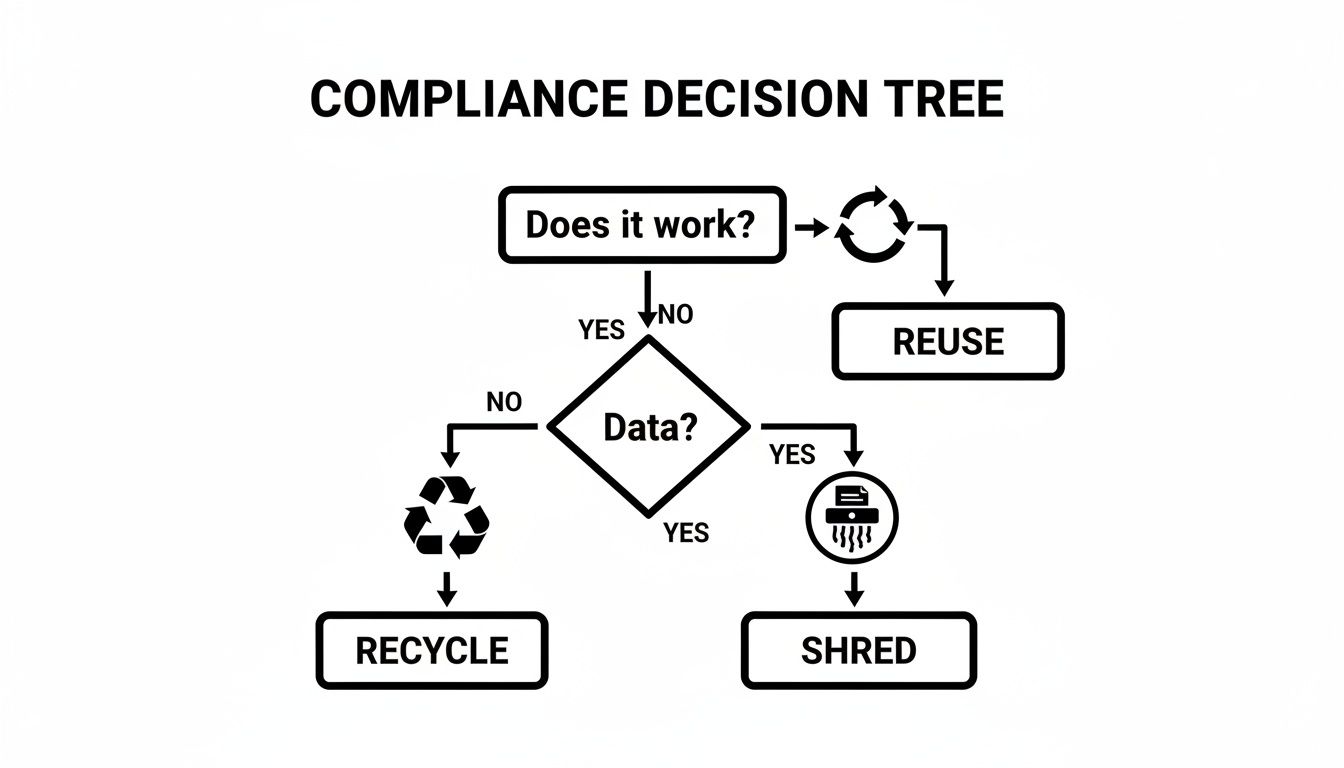
This flowchart gives you a quick way to assess your devices, guiding you from checking functionality to confirming data presence, ensuring every piece of equipment follows a compliant disposal pathway.
The Critical Role Of Chain Of Custody
Picture a hospital retiring a dozen ultrasound machines. Each one has a hard drive packed with thousands of patient images and records. From the moment those machines are unplugged, the entire process has to be meticulously documented.
A secure chain of custody is your auditable proof that sensitive data was handled responsibly at every stage. It tracks each asset from your facility to the secure disposal vendor and, finally, to its ultimate destruction.
This isn't just a handshake deal. It involves asset tagging, creating serialized inventory lists, and using secure, locked transportation. Once the job is done, your disposal partner must provide you with a Certificate of Data Destruction. This legal document is your proof of HIPAA compliance, certifying the specific serial numbers of the hard drives destroyed and the method used.
Our guide to comprehensive data security measures explains exactly how this process provides complete peace of mind. That certificate is the final, essential document that closes the loop on your data liability for good.
Getting It All Out: Managing the Logistics of Equipment Removal
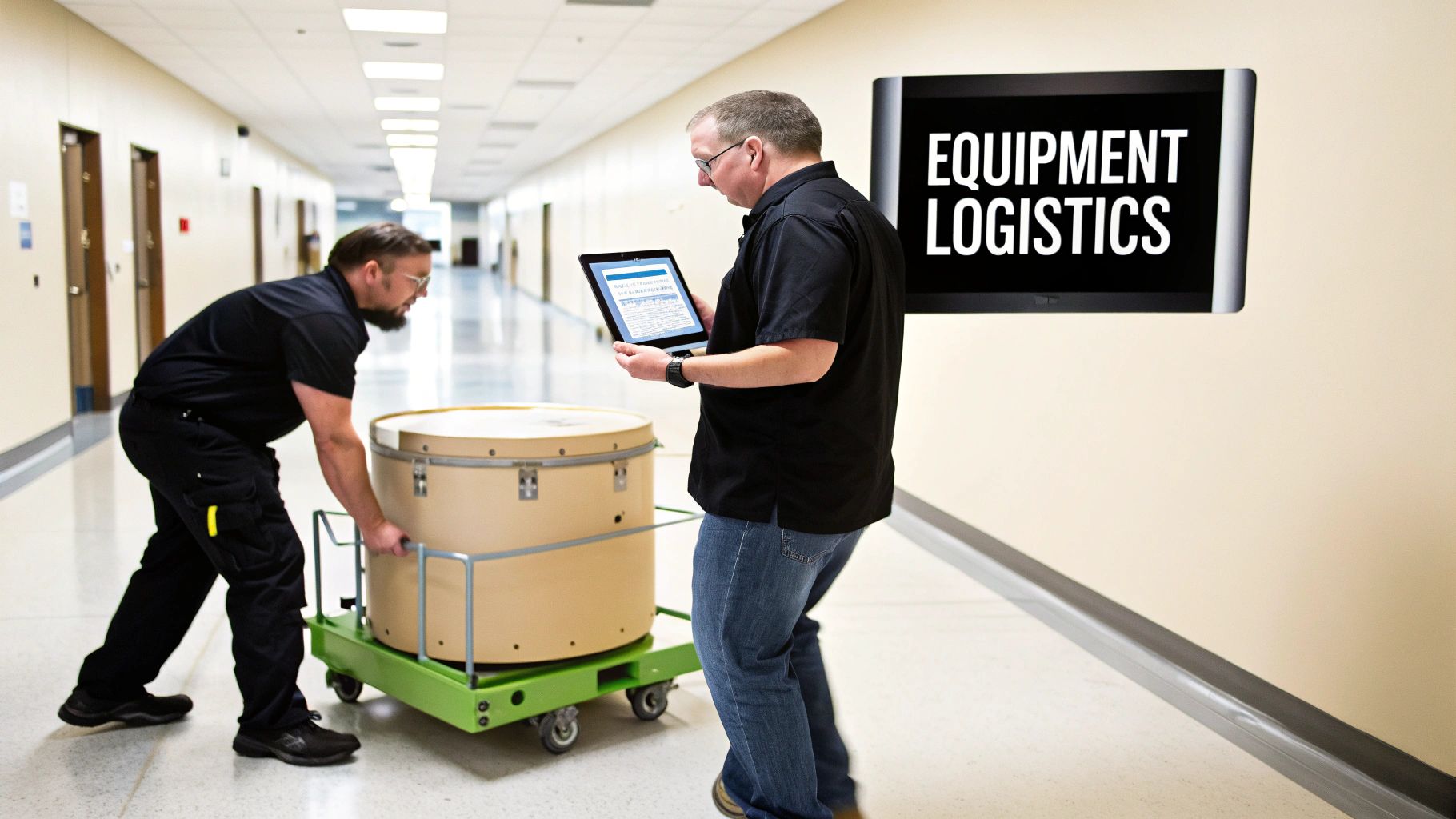
You’ve handled the compliance paperwork and the data security plan. Now for the hard part: getting all that equipment physically out of your building. This is where the rubber meets the road, and it’s often the most complex piece of the entire puzzle.
Moving bulky, sensitive, or potentially hazardous machinery out of an active hospital, clinic, or university lab is a serious undertaking. It’s about more than just heavy lifting; it demands a surgical approach to avoid disrupting your daily operations.
Real-World Scenario: Decommissioning a University Lab
Picture this: a university is clearing out an entire biology lab to build a new research wing. The room is packed with a mix of gear—biosafety cabinets, massive incubators, a dozen centrifuges, and an old server rack humming in the corner. Each item is its own logistical beast.
- Biosafety Cabinets: You can't just unplug these and wheel them away. They often require professional decontamination to neutralize any biological hazards before they even leave the room.
- Incubators and Freezers: These things are heavy, awkward, and usually crammed into tight spaces. One wrong move could damage the equipment, a door frame, or worse.
- Server Racks: This isn’t a job for amateurs. It means systematically disconnecting the network, pulling individual servers, and ensuring every single data-bearing drive is handled securely.
In a situation like this, a true disposal partner doesn't just send a truck. They send a logistics team that works directly with the university's facility manager. They'll map out a detailed project plan, scheduling the work after hours to avoid interrupting classes and bringing the right crew and tools to de-install and move everything safely.
From Your Inventory List to Our Pickup Truck
A smooth removal always begins with a clear, detailed inventory. Before anyone shows up, you need an asset list of every single item destined for removal. This is the blueprint that helps a vendor give you an accurate quote and plan the job properly.
A good partner will work with you to dial in that list. They’ll ask the right questions: Is the equipment on the ground floor or the fifth? Does anything need to be disconnected from plumbing or hardwired electrical? This back-and-forth nips surprises in the bud and makes sure pickup day is smooth and efficient.
You can see how a structured approach makes all the difference by reviewing how our streamlined disposal process works.
The success of an equipment removal project is determined long before the truck arrives. It's won in the planning phase—through detailed inventory, clear communication with your vendor, and a shared understanding of on-site challenges.
Once the plan is locked in, the on-site team gets to work. They arrive with dollies, pallet jacks, and any other specialized tools needed for the job. They move methodically through the asset list, tagging each item as it's prepped for transport. This creates a transparent chain of custody from the second that equipment leaves your control.
Breaking Down the Costs of Equipment Removal
One of the first questions we always get from facility managers is about the cost. The truth is, pricing for medical and lab equipment disposal isn't one-size-fits-all. It’s shaped by a few key variables, and understanding them will help you know what to expect.
Here are the main factors that drive the final quote:
- Type of Equipment: Some items, like standard IT gear, have value in their raw materials, which can help offset or even cover disposal costs. On the other hand, highly specialized equipment that needs careful manual disassembly might have a service fee.
- Quantity and Weight: This one's straightforward—the total volume and weight of your equipment directly affects the labor and transportation needed.
- Location and Accessibility: A simple pickup from a ground-floor loading dock is going to be more cost-effective than a job that involves navigating narrow hallways or carrying heavy machines down three flights of stairs.
- De-installation Needs: If your equipment has to be professionally disconnected from utilities or carefully dismantled before it can be moved, that specialized labor will be factored into the price.
A transparent vendor will always provide an itemized quote that breaks these costs down clearly. You should know exactly what you’re paying for, with no hidden fees or last-minute charges.
What Kind Of Equipment Can We Take Off Your Hands?
One of the biggest things that stops a lab cleanout dead in its tracks is simple uncertainty. You find yourself staring at a room full of old machines wondering, "Can they even take this stuff?" That hesitation can stall a project for weeks, leaving bulky, outdated equipment chewing up valuable square footage.
To clear up any confusion, we've outlined the common types of medical, lab, and IT equipment we handle all the time. Use this as a guide to start building your inventory list and get a clear picture of what we can responsibly manage for you.
General Lab And Scientific Instruments
This is the bread and butter of most research or diagnostic labs—the everyday workhorses. We're talking about the benchtop devices that, while not massive, can really pile up over the years. Getting them disposed of properly means their valuable metals and electronics get recycled, not tossed into a landfill.
We regularly accept a huge range of these instruments, including:
- Centrifuges: From the small microfuges to large, floor-standing models.
- Microscopes: Optical, electron, and digital scopes of all kinds.
- Incubators and Ovens: Standard and specialized units used for cell culture or material testing.
- Spectrophotometers and Spectrometers: UV-Vis, IR, mass spectrometers, and more.
- Autoclaves and Sterilizers: Both tabletop units and larger bulk sterilizers.
Large-Scale And Fixed Lab Systems
Next up are the big guys—the systems that are often bolted down and hardwired into your facility. These pieces are complex, not just because of their size and weight, but because they're often tied into your building's HVAC, plumbing, or high-voltage electrical systems. Getting them out requires a team that knows exactly what they're doing.
We have extensive experience de-installing larger systems like:
- Fume Hoods: Both ducted and ductless models.
- Biosafety Cabinets (BSCs): All classes, handled with proper decontamination protocols in mind.
- Lab Benches and Casework: Especially those with integrated sinks, gas lines, and fixtures.
- Environmental Chambers: Any temperature and humidity-controlled units.
A critical part of our service for these big items is the pre-removal planning. Our team works directly with your facility managers to map out a safe de-installation that causes the least possible disruption to your day-to-day operations.
This kind of careful coordination is non-negotiable, especially when you're dealing with equipment that may have residual hazardous materials.
IT, Electronics, And Data-Bearing Devices
In any modern medical or research facility, IT hardware is absolutely everywhere. From the front-desk computers to the servers in the closet and the controllers on the lab bench, these devices need to be disposed of just as carefully—maybe even more so, since they almost always hold sensitive data. Any reputable medical equipment disposal service must include bulletproof handling of this e-waste.
Our IT asset disposition services cover the full spectrum of electronic equipment:
- Computers and Laptops: Desktops, all-in-ones, workstations, and notebooks.
- Servers and Networking Gear: Rack-mounted servers, switches, firewalls, and routers.
- Data Storage Arrays: SAN, NAS, and other enterprise storage systems.
- Monitors and Displays: Including old-school CRT monitors that need special handling.
- Printers, Scanners, and Peripherals: Pretty much any electronic office gear.
To see the complete list, feel free to review our full guide on accepted items for disposal and recycling.
Accepted Equipment And Materials Checklist
While we can take almost anything with a cord or a circuit board, some items require a bit more planning due to the materials inside them. The table below breaks down the most common medical, lab, and IT assets we accept and highlights key disposal considerations for each. This helps you know what to expect.
| Equipment Category | Examples of Accepted Items | Key Disposal Considerations |
|---|---|---|
| General Lab Instruments | Centrifuges, incubators, microscopes, autoclaves, spectrophotometers, mixers, shakers. | Decontamination is often required. Must be free of biological or chemical hazards. |
| Large Lab Apparatus | Biosafety cabinets, fume hoods, environmental chambers, large-scale sterilizers, lab casework. | Requires professional de-installation. Coordination with facility utilities (plumbing, electrical) is key. |
| Medical & Imaging | X-Ray machines, ultrasound systems, EKG/ECG machines, defibrillators, patient monitors. | Some devices (X-Ray, CRTs) contain lead. Data-bearing devices must be sanitized to HIPAA standards. |
| Refrigeration Units | Lab freezers, refrigerators, cold storage units, cryostats. | Refrigerants (like CFCs) must be safely evacuated by a certified technician before recycling. |
| IT & Data Center Gear | Computers, servers, laptops, networking equipment, data storage arrays, monitors. | Data security is paramount. All devices undergo certified data destruction (wiping or shredding). |
| Electronics & Peripherals | Printers, scanners, batteries (UPS), power supplies, cables, scientific testing devices. | Batteries contain heavy metals and need specialized recycling to prevent environmental contamination. |
By having a clear idea of which items on your inventory list might fall into these specialized categories, you can have a much more productive conversation with us. It ensures we plan for a fully compliant, safe, and environmentally sound project from the first phone call.
Alright, you’ve waded through the compliance rules, wrestled with data security, and mapped out the logistics. Now for the satisfying part: clearing out all that old equipment for good. Whether your facility is in a major metro area or a smaller town, getting a professional pickup scheduled is the last piece of the puzzle.
It all starts with a quick inventory. Don't worry about getting it perfect, but a basic list—something like "15 desktop PCs, 2 centrifuges, and a biosafety cabinet"—is exactly what we need to get the ball rolling on a preliminary quote. A little prep work here makes that first call incredibly productive.
Your First Call: What to Have Ready
When you get in touch, having a few details handy will help us give you a fast, accurate quote. We’ve built our process to be as straightforward as possible, so you can move from planning to pickup without hitting any snags.
To kick things off, just try to have this info nearby:
- Your Equipment List: The types of items and a rough count.
- Location Details: The facility address and exactly where the equipment is (e.g., third-floor lab, ground-floor storage room).
- Logistical Notes: Any potential hurdles are good to know about. Think stairs, tight hallways, or any equipment that still needs to be professionally disconnected.
With these details, we can put together a totally transparent quote that lines up with the actual scope of your project. No hidden fees, no surprises—just a clear breakdown of the services.
From Quote to Pickup: The Typical Timeline
Once you give the quote the green light, we move fast to get your project on the calendar. Because we have our own dedicated fleet and an experienced logistics crew, we can be incredibly responsive. For most projects, we can typically schedule an on-site service within just a few business days.
Our entire goal is to make this process feel seamless. From that first phone call to the final truck pulling away, our team handles every single detail. A typical lab cleanout is often done and dusted in a single day, letting you get back to your real work.
This kind of quick turnaround is only possible because we are a specialized provider with a national reach and local expertise. We aren't trying to coordinate with third-party haulers across the country; our team, our trucks, and our expertise are ready to deploy. That presence is what turns a potentially complex disposal project into a simple, hassle-free experience.
Got Questions About Medical Equipment Disposal? We Have Answers.
When it comes to a lab cleanout or decommissioning project, a lot of questions can pop up. It's completely normal. Most facility managers we talk to are trying to get their heads around the same key issues.
They usually boil down to three things: what really happens to the equipment after it leaves our dock, how much is this going to cost, and—the big one—how do you handle our sensitive data? Getting straight answers is the only way to feel confident when you're looking for a "medical equipment disposal near me" partner you can trust.
What Happens To My Old Equipment After Pickup?
Once your assets are loaded up and on their way, they come back to our processing facility to be triaged. This isn't a one-size-fits-all situation; every single piece is assessed to figure out its best possible path forward. Our goal is simple: maximize what can be recovered and stick to a strict 100% landfill diversion policy.
Here’s a look at how that breaks down:
- Assessment: First, we see if anything is still functional. Equipment with life left in it gets tested and prepped for refurbishment. Giving an asset a second life is always the greenest option.
- Dismantling: For items that have reached the end of the road, we carefully de-manufacture them. This means breaking them down into their core materials—metals, plastics, circuit boards, and so on.
- Recycling: All those separated materials are then routed to our certified downstream recycling partners. This ensures they get back into the manufacturing stream instead of ending up in the ground.
The entire process is built around sustainability. But let's be clear: for any device that holds data, security comes first. Those items are immediately quarantined for certified data destruction before any other step is taken. Your security is non-negotiable.
How Are Disposal Service Costs Determined?
There's no simple price list for this kind of work because every project is different. The good news is that for a lot of standard IT assets and electronics, the value we recover from the raw materials often covers our service costs. In many cases, this can result in no charge for the pickup.
However, some things can affect the final quote. If you have specialty items, like lab freezers that need refrigerant safely evacuated or a heavy piece of machinery that requires on-site de-installation, there might be a service fee. We believe in being completely upfront, which is why we provide a detailed, itemized quote before we do anything. You’ll know exactly what to expect, with no surprises.
How Can I Be Certain My Data Is Securely Destroyed?
This is the most critical question, and for us, data security is the bedrock of our service. It's never an add-on or an afterthought.
We provide DoD 5220.22-M 3-pass data wiping free of charge for all functional hard drives. This is the same rigorous standard used by government agencies to sanitize data. If a drive won't power on or you're dealing with other media types, we move to physical shredding.
Once the job is done, we issue a formal Certificate of Data Destruction. Think of this as your official, legally-binding proof that every bit of data was destroyed in full compliance with HIPAA. It’s the final step that closes the loop on your data liability and gives you verifiable peace of mind.
Ready to clear out your outdated equipment with a partner who prioritizes security, compliance, and sustainability? Contact Scientific Equipment Disposal today for a transparent quote and to schedule your pickup anywhere in the United States. Let's get started.