Choose The Best Computer Recycling Company In Dacula Georgia


A facilities lead in Dacula usually doesn’t call a computer recycling company because recycling is interesting. They call because a storage room is full, a refresh is overdue, a lab is being cleared, or compliance has started asking uncomfortable questions about where retired devices go.
That’s when the problem gets real. The pile isn’t just old desktops and dead monitors. It’s workstations with user credentials, servers with regulated data, backup devices nobody has touched in years, and lab equipment that can’t be treated like curbside junk. For hospitals, universities, clinics, research groups, and enterprise IT teams, disposal isn’t housekeeping. It’s a risk decision.
The Challenge of Surplus Tech for Dacula Organizations
A common Dacula scenario looks like this. IT has replaced a floor of endpoints. Facilities has a deadline to reclaim space. A department administrator wants old assets gone fast. Then someone opens the room and realizes the “old electronics” include computers, docking stations, network gear, external drives, printers, and a few odd pieces of lab equipment that no general hauler wants to touch.
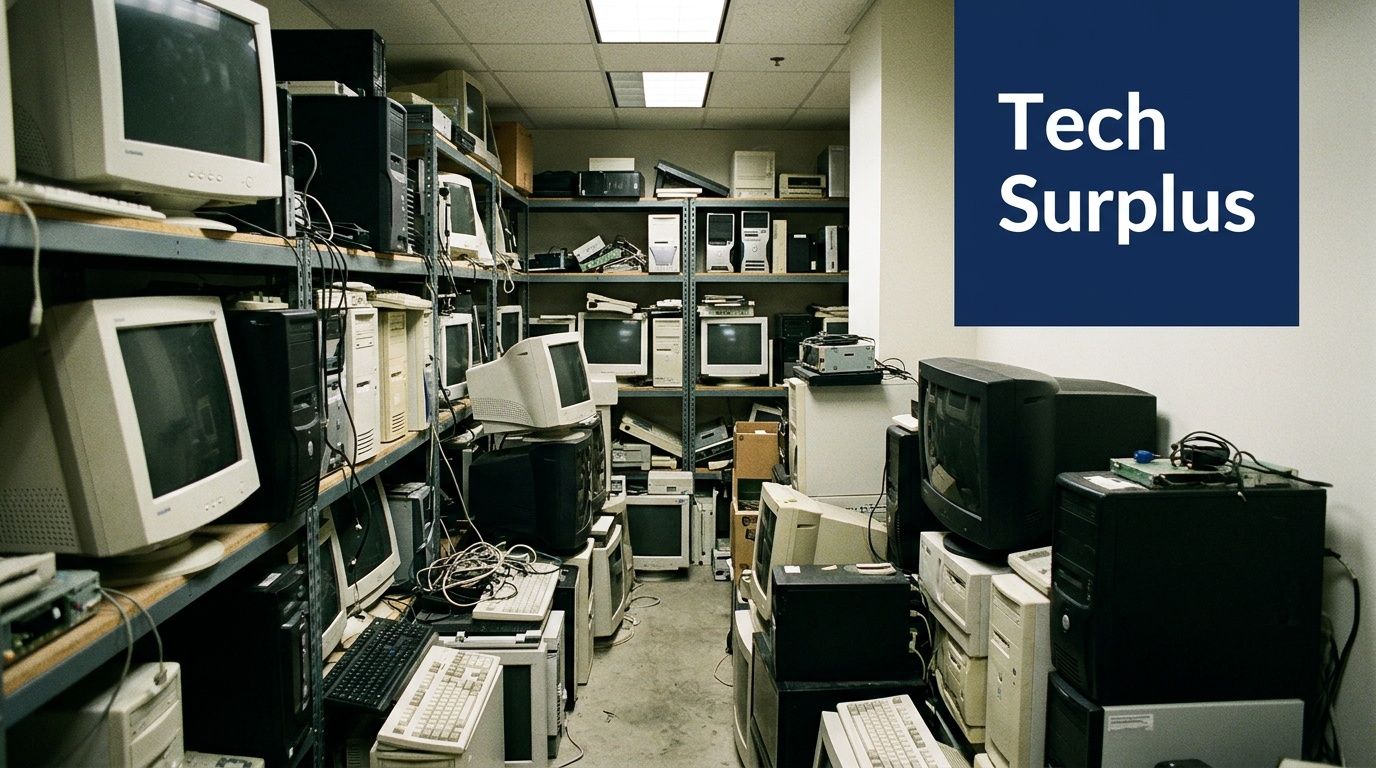
That’s where many organizations make the wrong first move. They search for a Computer Recycling Company in Dacula Georgia, find pages built around household drop-offs, and assume the service is close enough. It usually isn’t. Existing local content overwhelmingly targets consumer and small business electronics and fails to address B2B-specific compliance for lab and medical equipment disposal, which leaves hospitals, universities, and clinics with very little practical guidance on regulated asset disposition, as noted by Dacula electronics recycling market coverage.
Where consumer recycling advice falls short
A consumer recycler may be perfectly fine for a broken TV or a few household laptops. That doesn’t mean they’re equipped for:
- Regulated data handling: Drives, servers, and storage arrays need documented sanitization or destruction.
- Specialized equipment removal: Pipettes, centrifuges, incubators, and similar assets require different handling than office peripherals.
- Audit-ready documentation: Hospitals and universities need paperwork that stands up during internal review.
- Coordinated pickups: Loading a few items into staff vehicles is not the same as managing a decommission.
Organizations don’t get into trouble because they meant to recycle incorrectly. They get into trouble because they used a vendor built for the wrong job.
The practical standard is simple. If the vendor speaks mainly to residents, generic drop-off lists, and basic item acceptance, keep looking. B2B work needs a tighter chain of custody, stronger data controls, and a workflow built for operations teams, not one-off public traffic.
For Dacula organizations that need a more business-focused option, Gwinnett County business electronics recycling support is the kind of service model worth comparing against any local provider.
Beyond the Basics Understanding E-Waste Risks in Georgia
Dacula isn’t dealing with a small or abstract disposal issue. The community has a population of 8,151 and generates about 163,020 pounds of electronic waste annually, yet only about 15% is properly recycled, according to Dacula e-waste data. For any organization managing a refresh, relocation, or shutdown, that backdrop matters. You’re operating in a market where proper downstream handling can’t be assumed.
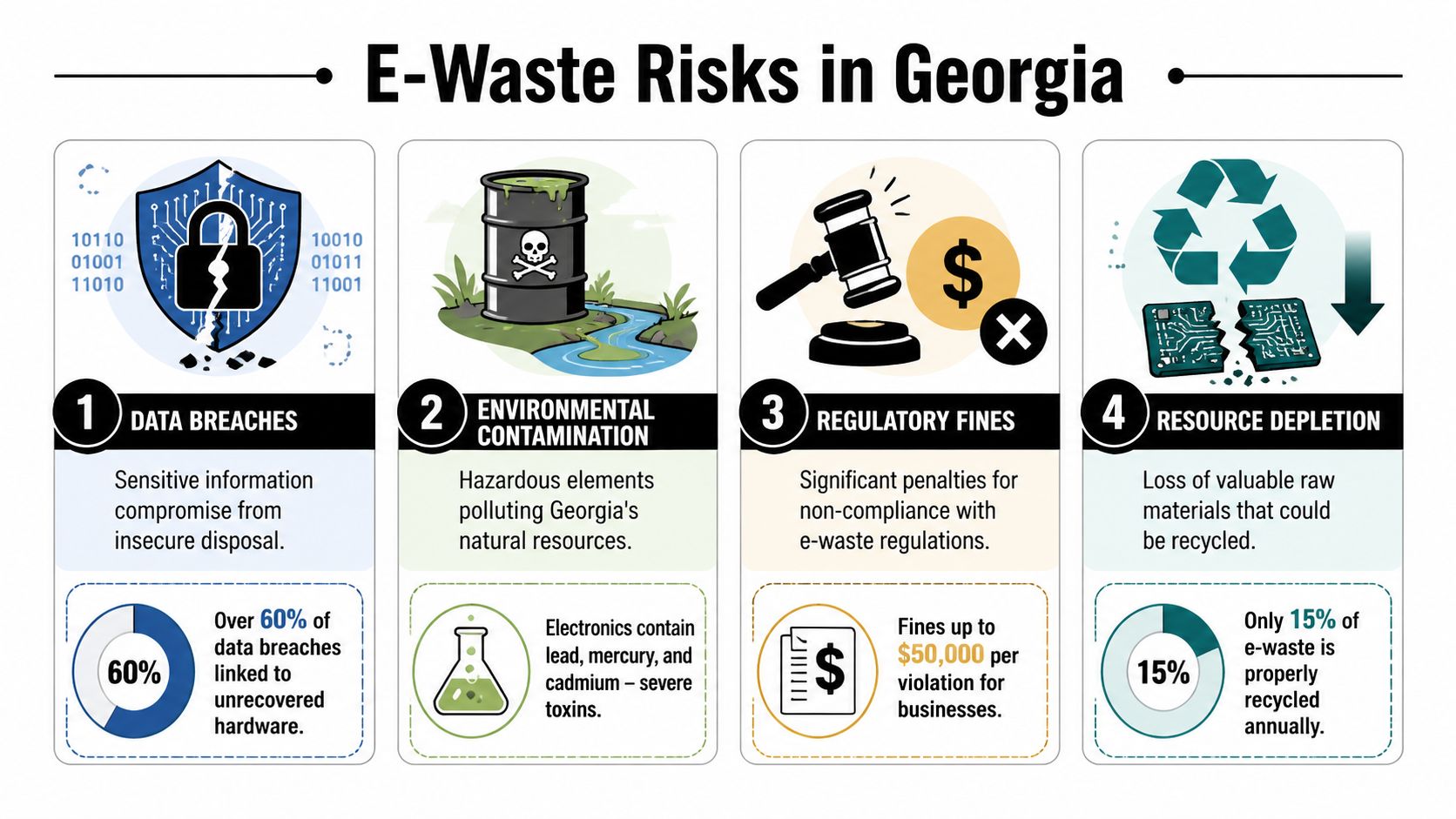
The risk profile has three parts. Data security. Environmental compliance. Operational control. If a vendor is weak in any one of them, the project gets expensive fast.
Data-bearing assets create legal exposure
Most organizations don’t lose sleep over broken keyboards. They worry about hard drives, SSDs, backup units, and servers. That’s the right instinct. The issue isn’t whether a device powers on. The issue is whether the media inside can still expose patient records, financial records, student data, research files, or internal credentials.
A recycler that can’t explain exactly how it sanitizes media, when it shreds media, and how it documents each step is asking you to trust a black box. In regulated environments, that’s not a vendor relationship. That’s a liability transfer that never really transfers.
Environmental handling still matters in Georgia
Georgia may not have the most restrictive statewide consumer disposal rules, but that doesn’t make careless disposal safe for a business. Electronics contain mixed materials and, in some categories, components that require controlled handling. The compliance question isn’t only whether something leaves your building. It’s whether the downstream process is responsible, documented, and aligned with accepted recycling standards.
Here’s the trade-off many buyers miss:
| Approach | What looks convenient | What usually goes wrong |
|---|---|---|
| Self-haul | Fast internal cleanup | No formal chain of custody, weak documentation, staff time diverted |
| Generic junk removal | One vendor for everything | Limited technical handling, poor media controls, mixed downstream outlets |
| Certified electronics recycler | More structured process | Better documentation, asset segregation, and defensible handling |
Logistics failures become compliance failures
A disposal project can fail before the truck even leaves the site. Devices get stacked loosely, serials aren’t captured, departments hand over unapproved assets, or equipment is removed by staff who aren’t trained to de-install it safely. In a lab or server environment, that creates property risk, downtime, and documentation gaps.
Practical rule: If the vendor treats pickup like a hauling job, expect the rest of the project to be handled like one too.
For Dacula organizations with larger footprints across Gwinnett County and metro Atlanta, it helps to review a provider with broader Atlanta electronics recycling coverage rather than choosing based on proximity alone. The best local option isn’t always the one with the shortest drive. It’s the one with the strongest controls.
Your Vetting Guide Essential Certifications and Data Security
A university lab closes out a grant, or a hospital replaces diagnostic workstations, and procurement gets one question from legal, compliance, and IT security at the same time: who handled the retired equipment, and can we prove it? In Dacula, that question matters more for lab and medical devices than many general consumer-focused recyclers are prepared to address. A qualified Computer Recycling Company in Dacula Georgia needs more than pickup capacity. It needs documented controls that stand up to internal audit, privacy review, and downstream environmental scrutiny.
What certifications tell you
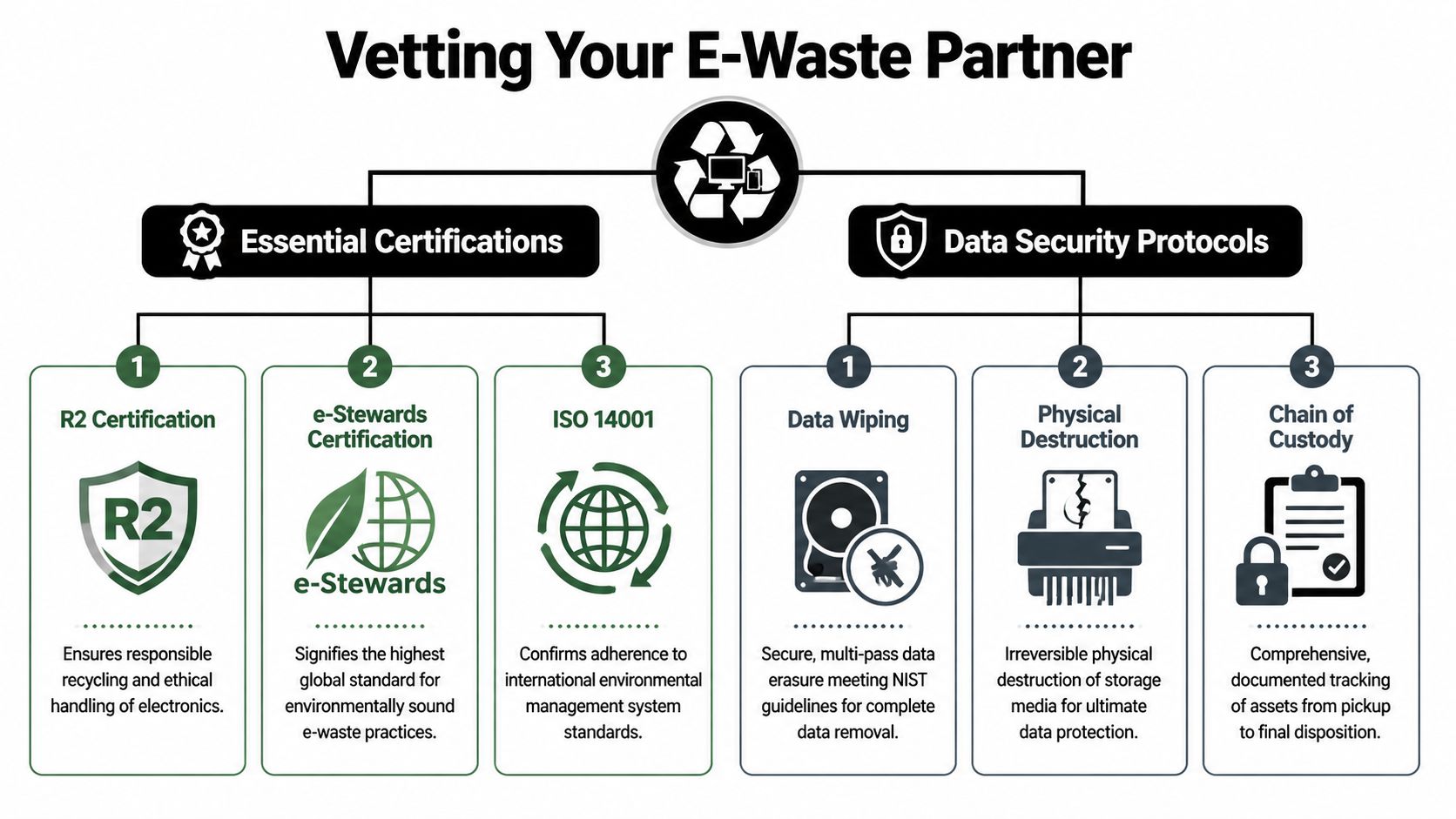
Certification acronyms only matter if the buyer knows what operational control each one reflects. I advise clients to read them as evidence of system maturity, not marketing polish.
Use this checklist when you screen vendors:
- R2 certification: Confirms the recycler operates under a recognized framework for electronics reuse, recycling, and data-bearing device handling.
- ISO 14001: Shows the company runs an environmental management system with documented procedures and corrective action processes.
- ISO 45001: Matters when crews will be in live facilities, labs, loading docks, or clinical spaces where safety controls affect your own site risk.
- ISO 9001: Indicates the vendor has a quality management system designed to keep intake, tracking, reporting, and final disposition consistent across jobs.
Those credentials are worth verifying directly with the vendor. For hospitals and universities, I also recommend asking whether the same certified processes apply to lab peripherals, medical carts, analyzers, and embedded storage devices, not just standard office PCs.
Ask process questions that expose risk
Weak vetting usually starts with broad questions that invite broad answers. “Are you secure?” and “Do you recycle responsibly?” do not help a compliance review. Process questions do.
That’s why I like frameworks built for vendor screening in general. Jackson Digital's hiring checklist covers another service category, but the logic is useful here. Ask how the provider operates, who performs the work, what records are created, and how exceptions are handled.
Start with questions like these:
- Who performs pickup, data handling, and downstream processing? Employees, subcontractors, or a mix?
- How do you separate reusable assets from scrap without breaking chain of custody?
- What reporting do you provide after pickup, after sanitization, and after final disposition?
- How do you handle devices with missing asset tags, damaged media, or unknown ownership?
- What is your procedure for lab systems, diagnostic equipment, or devices with embedded storage?
If a vendor cannot answer in sequence, with documents and defined decision points, the risk sits with your organization.
Wiping and shredding serve different purposes
Data destruction is where many disposal projects fail review. Functional media can often be sanitized and preserved for remarketing or audited recycling. Failed media, encrypted unknowns, and certain regulated assets may need physical destruction instead.
The point is not to prefer one method every time. The point is to match the method to the asset condition, the data profile, and your internal policy.
Here is the practical split:
| Asset type | Best-fit method | Why it matters |
|---|---|---|
| Functional hard drives | Documented multi-pass wiping | Preserves asset value while sanitizing data |
| Nonfunctional media | Physical shredding | Media that will not operate cannot be reliably sanitized through software |
| High-risk regulated storage | Wiping plus policy-driven destruction if required | Supports stricter internal retention and privacy controls |
| Mixed old storage with unknown condition | Audit first, then separate wipe-eligible from shred-only items | Prevents assumptions during bulk pickups |
This distinction matters even more in lab and medical environments. Equipment may contain hidden storage in control modules, imaging consoles, embedded PCs, or attached workstations. A recycler focused on consumer drop-offs may miss that. A B2B-focused provider should account for it in the intake process.
Chain of custody starts before sanitization
A clean wipe certificate does not fix a sloppy handoff. If devices move from department to staging area to truck without inventory discipline, your exposure starts well before processing.
Look for a provider that can show:
- Asset identification: Serialized intake records, pallet counts, or another documented inventory method
- Secure handoff: Named custody from your team to pickup staff and from pickup staff to the processing floor
- Disposition proof: Certificates and final reports tied back to the shipment
- Exception handling: A written process for damaged, unlabeled, or unexpected devices
- Media segregation: Separate control for data-bearing items versus non-data-bearing scrap
For organizations comparing providers, business e-waste recycling company services should be judged on these controls, especially when the project includes research equipment, medical electronics, or mixed IT assets from multiple departments.
Streamlining Operations On-Site Logistics and De-installation
The biggest difference between a serious recycler and a scrap hauler shows up on pickup day. One arrives with a plan for de-installation, packing, site coordination, and custody records. The other arrives with labor and a truck. Those are not the same service.
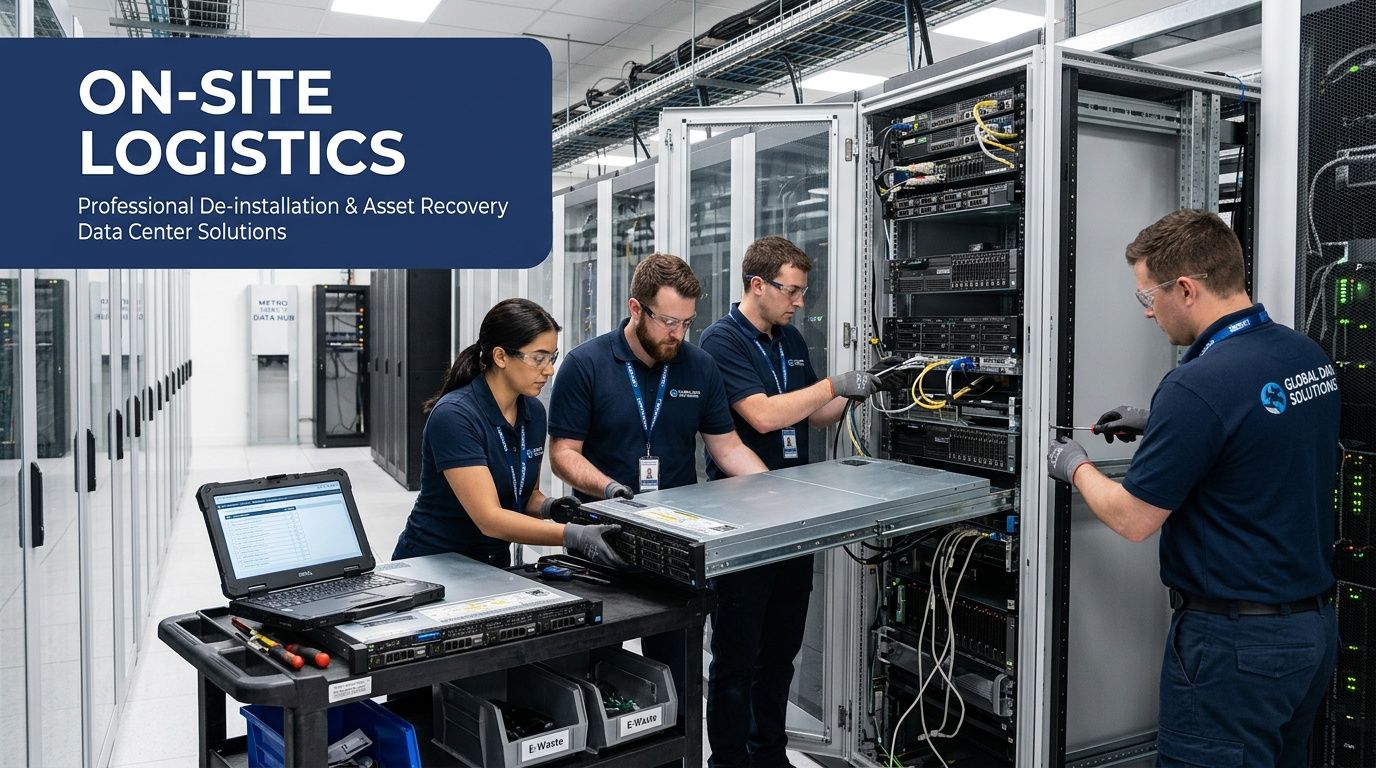
For hospitals, universities, and data-heavy organizations in Dacula, logistics should be treated as a security control. The minute a server is unracked or a lab room is cleared, the project moves from policy to physical execution. That’s where mistakes happen.
Why self-transport creates hidden risk
Internal teams often think they can save money by boxing devices, using campus or facility staff, and delivering everything themselves. Sometimes they can. Often they create three new problems:
- Improper packing: Screens crack, drives are mishandled, and reusable assets lose recovery value.
- Weak custody records: Assets move through too many hands with too little documentation.
- Operational drag: Your own staff spends time staging scrap instead of supporting the live environment.
S.E.D. provides on-site de-installation and logistics for complex lab equipment and IT arrays using a dedicated box-truck fleet, and that coordinated planning can reduce facility shutdown time by 40% compared with self-haul methods, according to Dacula-area electronics waste disposal logistics. That metric matters because downtime is often more expensive than the recycling line item.
Good logistics protect both uptime and evidence
In a proper pickup, the crew doesn’t just “take stuff away.” They work from an asset list, coordinate access, separate reusable equipment from nonfunctional material, and maintain a documented chain of custody from removal through transport. That discipline is what keeps the project clean during an audit or an internal investigation.
The safest loadout is boring. Everything is labeled, documented, staged correctly, and removed by people who’ve done it before.
This matters even more during partial decommissions. A hospital may still be operating while one department is cleared. A university may be refreshing a lab during an academic break. A corporate IT team may need a row of racks removed without disrupting adjacent infrastructure. Generic hauling crews aren’t built for that kind of controlled work.
What to look for in field execution
The strongest vendors usually show these traits on site:
- Pre-pickup planning: They confirm scope, access constraints, and asset categories before arrival.
- De-install capability: They can remove rack-mounted or specialized equipment safely.
- Packing discipline: They bring the materials and labor needed to protect equipment in transit.
- Direct transport: Their own fleet or tightly controlled transport process reduces handoff risk.
If your project includes larger volumes, live environments, or mixed equipment categories, compare providers that can support free business electronics pickup in Gwinnett County with a documented operational process, not just a calendar slot.
Scientific Equipment Disposal Your Certified Partner in Dacula
A Dacula hospital clears a pathology lab during a renovation. The outgoing load includes centrifuges, analyzers, old workstations, backup drives, and a few devices no one has inventoried correctly. That is not a standard computer recycling job. It is a controlled disposal project with chain-of-custody, data protection, and departmental coordination issues built into it.
Dacula organizations with lab equipment, medical devices, and conventional IT assets need a vendor that can manage mixed streams without splitting the project across multiple contractors. That requirement eliminates many consumer-oriented recyclers quickly. Hospitals, universities, research groups, and clinical labs need one provider that can remove technical equipment, document handling, and keep the job aligned with internal compliance requirements.
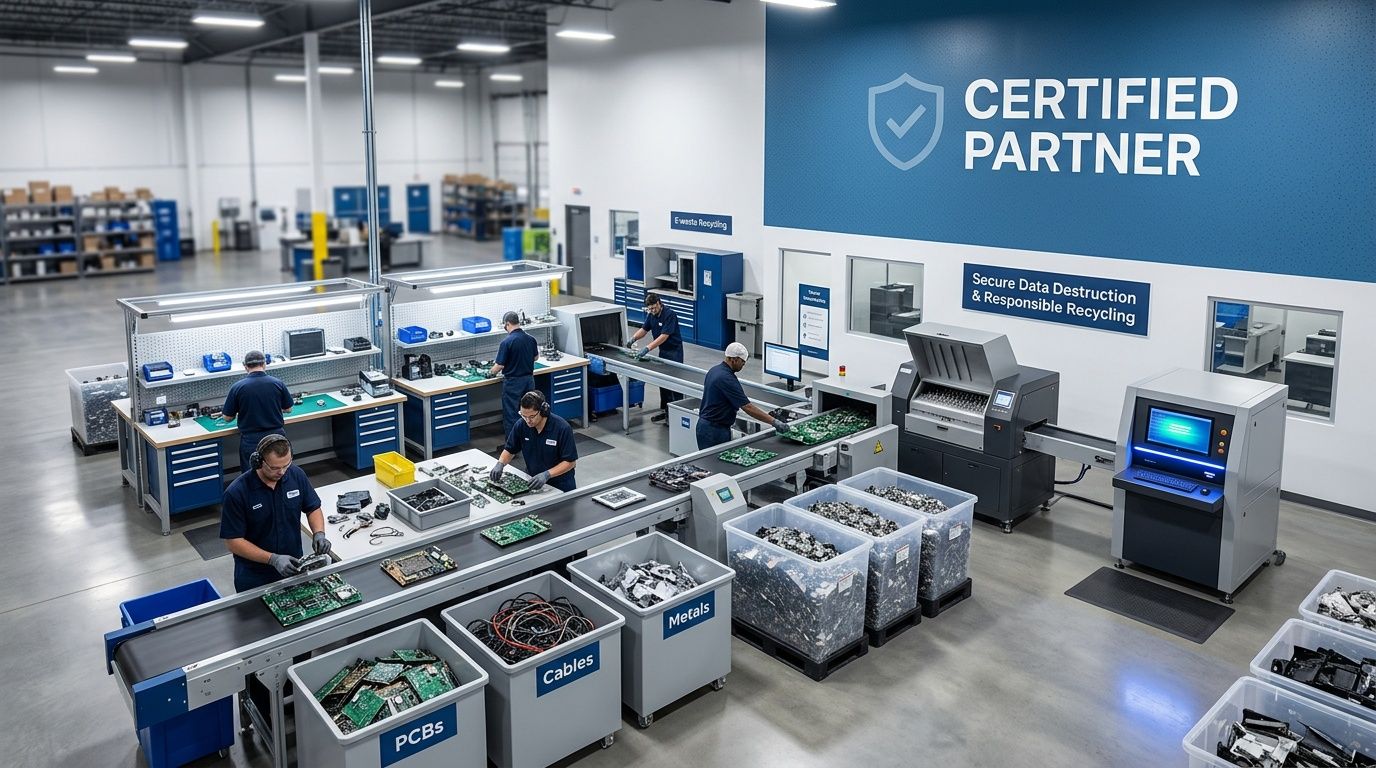
Scientific Equipment Disposal fits that B2B need well because the service model is built around institutional disposal, not household drop-offs or one-off office cleanouts. That distinction matters. A university surplus team may need coordinated pickup across departments. A medical facility may need documented media destruction while maintaining access controls in active areas. A general recycler can collect equipment. A qualified partner for lab and medical environments can do that work without creating extra risk for compliance, facilities, or IT.
Built for mixed lab and medical asset streams
General electronics recyclers usually center their marketing around laptops, desktops, and monitors. That leaves a gap for organizations disposing of pipettes, incubators, centrifuges, balances, servers, storage hardware, and related support equipment in the same project window.
Scientific Equipment Disposal addresses that gap directly. For a lab renovation or departmental relocation, that means fewer handoffs, fewer scheduling conflicts, and less confusion about which vendor owns which asset category. Operationally, that is a better setup than sending one company for IT gear and another for scientific equipment while internal staff try to reconcile records afterward.
Mixed projects are common in Dacula facilities. Labs do not retire equipment in neat categories. A single room can contain data-bearing devices, bench equipment, peripherals, network hardware, and outdated media that all require different disposition steps.
Better fit for compliance-driven buyers
For regulated organizations, the primary question is not whether a vendor uses the word certified on a webpage. The question is whether the company can support the controls your team will be asked to prove later. That includes documented pickup procedures, defensible data destruction methods, asset tracking, and disciplined downstream handling.
Scientific Equipment Disposal aligns with that buying standard. The company is a stronger fit for organizations that treat disposal as a risk-managed process instead of a hauling task. That is the gap many Dacula buyers miss when they compare vendors only on pickup availability or basic recycling claims.
Teams evaluating options can review certified scientific equipment disposal providers for lab and medical equipment to compare how specialized providers differ from general electronics recyclers.
Data destruction that fits institutional risk
The company also addresses a common problem in hospital and university projects. Media arrives in mixed condition. Some drives are still functional and may be eligible for sanitization. Others are damaged, obsolete, or too risky to process that way and should be physically destroyed.
That split matters in practice.
Healthcare teams need a vendor that treats data-bearing media as a controlled category tied to HIPAA exposure, not as scrap tucked into a broader load. Universities face a different but equally serious issue. Research data, student records, grant files, and departmental documents often remain on legacy devices long after the equipment itself stops being useful. Corporate IT groups face the same exposure with retired servers, backup appliances, and storage arrays.
A disposal partner earns trust by being specific about what happens to each asset type after pickup, and by documenting those steps in a way that stands up to internal review.
A service model that works in real facilities
Scientific Equipment Disposal also supports on-site de-installation, packing, pickup, and transport with its own box-truck fleet. For active facilities, that matters because the project often fails or slows down at the physical handling stage, not at the recycling stage. Internal teams rarely have spare labor to disconnect equipment, move it through controlled corridors, protect it for transit, and keep records current at the same time.
Regional proximity also helps. A provider operating out of Norcross and serving the Atlanta metro is better positioned to support Dacula schedules that involve loading dock restrictions, elevator reservations, restricted-access rooms, or after-hours removal windows. For hospitals and universities, that kind of operational fit is often the difference between an orderly project and a cleanup that creates audit problems later.
Planning Your E-Waste Project and Taking the Next Step
Most disposal projects go off track before pickup because no one defines the scope clearly. The good news is that a manageable process usually starts with a simple internal review. You don’t need perfect documentation on day one, but you do need enough structure to avoid handing a recycler a pile of unknowns.
Start with an inventory that’s useful
An inventory doesn’t have to be elegant. It has to be usable. Separate what you have into practical categories such as desktops, laptops, monitors, servers, networking gear, external storage, and lab equipment. If a department can identify model names, serial numbers, and condition, even better.
Don’t bury the most sensitive assets in a general list. Call out anything that stores data directly. That includes obvious devices like servers and less obvious devices like external drives, backup appliances, and storage arrays that may still be sitting in closets or under benches.
Mark the assets that need special handling
The next pass should identify two things. Which items need data sanitization or destruction, and which items need specialized removal. That second category gets overlooked. A tower PC on a shelf is one thing. A rack-mounted server or lab instrument in an active workspace is another.
A practical internal worksheet should include:
- Data-bearing devices: Hard drives, SSDs, backup media, servers, and storage equipment.
- Specialized equipment: Lab assets, medical devices, or bulky items that require careful handling.
- Condition notes: Functional, nonfunctional, damaged, or unknown.
- Site notes: Access restrictions, loading dock timing, stairs, freight elevator access, or after-hours requirements.
Choose value, not just the lowest quote
Procurement teams naturally compare price. They should. But recycling isn’t a category where the cheapest line item tells the whole story. A low quote can hide weak documentation, subcontracted pickups, vague data destruction language, or no real de-install capability.
The better way to compare vendors is to weigh:
| Evaluation point | Low-cost vendor risk | Better-value vendor outcome |
|---|---|---|
| Data handling | Unclear sanitization process | Documented wipe or destruction path |
| Logistics | Client does the staging and lifting | Vendor manages removal and transport |
| Documentation | Thin or generic paperwork | Audit-ready records and clear disposition |
| Asset recovery | Usable equipment treated as scrap | Reuse or remarketing considered where appropriate |
Make the handoff easy for your team
Once you’ve narrowed the asset list and identified sensitive equipment, ask the recycler for a consultation based on your actual site conditions. A good vendor should help you refine the scope, not just push a pickup date. That conversation is where hidden risks surface early, while they’re still easy to fix.
From there, the path is straightforward. Confirm the item list. Clarify the handling method for data-bearing devices. Lock in site logistics. Schedule the pickup around your operational windows. Then make sure internal stakeholders know who is authorized to release assets on the day of service.
If you’re looking for a Computer Recycling Company in Dacula Georgia that can handle business electronics and laboratory equipment with strong compliance controls, Scientific Equipment Disposal is worth contacting for a no-obligation review of your project scope, data security needs, and pickup logistics.
Scientific Equipment Disposal helps Dacula-area hospitals, universities, labs, corporate IT teams, and public agencies retire electronics and lab assets without guessing through the compliance details. If you need a secure, practical plan for data-bearing devices, on-site de-installation, or mixed equipment pickups, contact Scientific Equipment Disposal to discuss your project and get a customized path forward.