Research Facility Equipment Removal Services for Seamless Lab Decommission

Shutting down a research lab involves a lot more than just unplugging machines and calling a mover. It's a high-stakes project where one wrong move can easily result in steep regulatory fines, a major data breach, or losing thousands in recoverable asset value. This is where professional research facility equipment removal services become your most important partner, whether your lab is in Atlanta, GA, or part of a nationwide research network. They provide a structured, compliant process for a very complex job.
Why Partnering with a Removal Service Is Critical
Trying to manage a full lab cleanout with an in-house team is a recipe for trouble. The project demands a mix of complex logistics, deep regulatory knowledge, and specialized handling skills that most facilities simply don't have on staff. Whether you're in a competitive research hub like Boston or a corporate R&D center in San Diego, the need for an expert is universal. A nationwide provider can service facilities across the country, ensuring consistent standards everywhere.
A professional partner turns a potentially chaotic shutdown into a manageable, transparent process. They have the experience to handle everything—from de-installing sensitive, multi-million dollar analytical instruments to removing bulky fume hoods—and ensure every item is packed and transported correctly. This not only prevents damage but also maximizes the chance for asset recovery through resale, offering services from coast to coast.
Mitigating Compliance and Security Risks
In any lab decommission, the two biggest liabilities are regulatory compliance and data security. A qualified removal service knows the rules set by agencies like the EPA, ensuring any hazardous materials are managed and disposed of correctly. This is especially true for labs that operate at different biosafety levels, where preventing contamination is non-negotiable. You can see more about how specialized university laboratory cleanout services handle these exact challenges.
Beyond environmental compliance, these partners are also built to protect your most sensitive information.
The chain of custody for any device that holds data is a critical part of HIPAA compliance. An experienced vendor will ensure every hard drive is either sanitized using a certified method, like the DoD 5220.22-M 3-pass wipe, or physically destroyed. They'll then provide you with auditable proof, like a Certificate of Data Destruction, for your records.
The Value of a Structured Approach
Ultimately, working with a professional service gives you peace of mind because they bring a proven, end-to-end solution. Their process looks something like this:
- Initial Site Assessment: A thorough walkthrough of your facility, whether it's a local lab or a nationwide network of sites, to map out logistics and plan the removal strategy.
- Detailed Asset Inventory: Cataloging every single piece of equipment to track its journey from your lab to its final disposition.
- Secure Logistics: Coordinated packing, removal, and transport with a documented and unbroken chain of custody.
- Certified Disposal: Providing you with auditable documentation that proves all recycling and data destruction was handled in full compliance with regulations.
This methodical approach guarantees a secure, compliant, and efficient project, letting your team stay focused on their real job: the science.
Building Your Decommissioning Blueprint
A successful lab cleanout doesn't start the day the trucks arrive. It begins weeks, sometimes months, earlier with a solid plan. Think of it as the blueprint for your entire project. Without it, you’re setting yourself up for costly surprises and delays, whether you’re a local Atlanta lab or a nationwide R&D facility with locations from California to North Carolina.
The very first thing we do on any project is a detailed site assessment. This is more than just a quick look-around. We walk the entire facility, mapping out every potential headache—from tight corners and undersized freight elevators to equipment that's hard-wired to gas lines or specialized plumbing. Our teams are available nationwide to conduct these crucial on-site evaluations.
Creating a Strategic Asset Inventory
After the walkthrough, it’s time to build a comprehensive asset inventory. This isn't just a simple checklist. We’re talking about a strategic document that captures serial numbers, the condition of each item, and its potential resale value. This applies to everything from centrifuges and mass spectrometers to servers and fume hoods.
This inventory becomes the single source of truth for the entire project. It's what allows us to track every single item from its spot in your lab to its final destination, whether that’s resale, recycling, or certified destruction. This is the bedrock of an unbroken chain of custody.
Proper asset management is also key to sustainable lab practices, which is a rapidly growing priority. The market for lab equipment disposal is booming, driven by new environmental rules. Valued at about $800 million USD in 2026, it's projected to hit $1,350 million USD by 2035. That 5.4% annual growth rate shows just how seriously the industry is taking responsible disposition.
Getting the planning phase wrong is a recipe for disaster. You could be looking at steep regulatory fines, a devastating data breach, or just straight-up financial loss from misplaced assets.
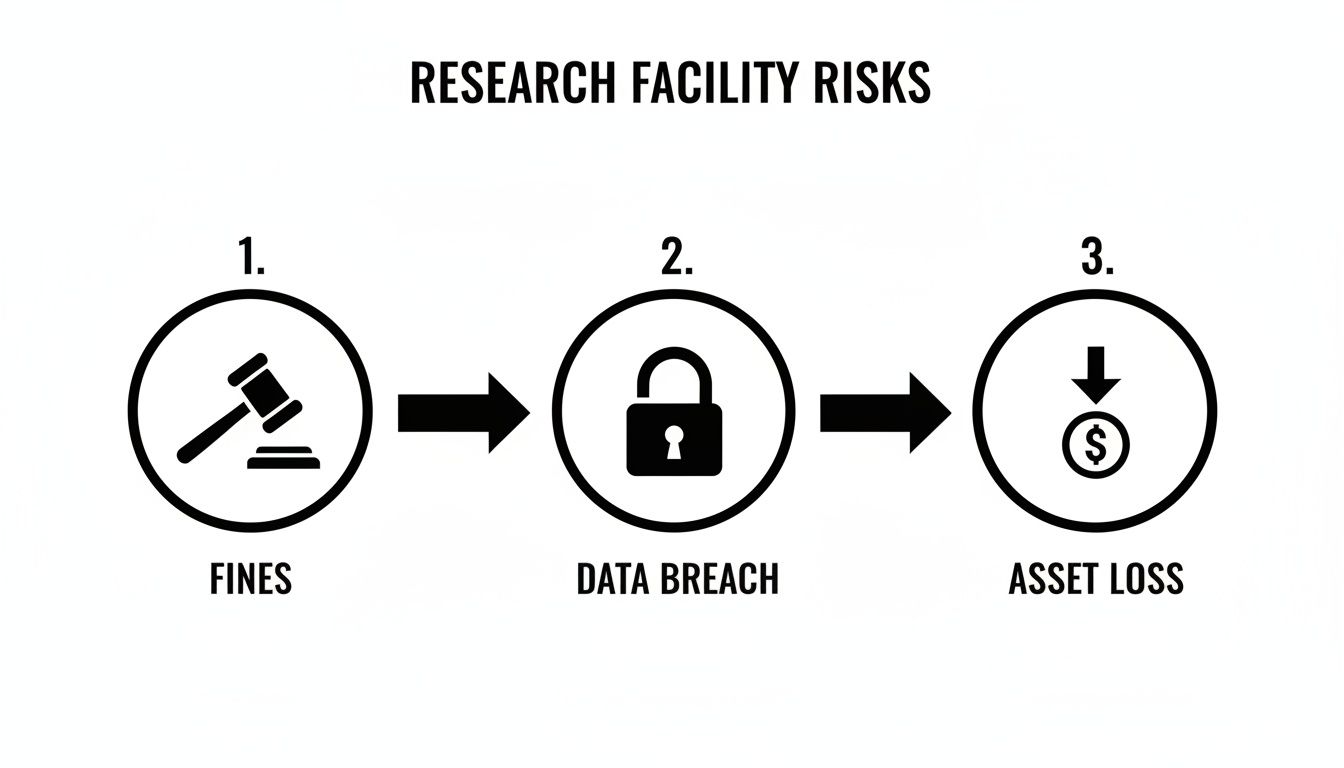
As you can see, one mistake in planning can easily trigger a cascade of problems. Your decommissioning blueprint is the first and best defense against these liabilities.
Before bringing in any vendors, it’s smart to get your own initial plan in order. This simple checklist covers the absolute essentials you should have figured out.
Initial Planning Checklist for Lab Decommissioning
| Task | Objective | Key Considerations |
|---|---|---|
| Identify Key Stakeholders | Establish a clear point of contact and decision-making team. | Lab Manager, Facilities Director, IT, EHS, Finance. |
| Define Project Scope | Determine exactly what equipment is being removed and what stays. | Full cleanout vs. partial removal? Are fixtures included? |
| Gather Equipment Documentation | Collect manuals, service records, and decontamination history. | This is crucial for both safety and assessing resale value. |
| Review Lease/Facility Agreements | Understand your obligations for returning the space to its original state. | Are you responsible for utility disconnection or floor repairs? |
| Set a Preliminary Timeline | Establish a target completion date and key milestones. | Factor in operational downtime and vendor lead times. |
Having these details ready will make the entire process smoother and help you get more accurate quotes from partners.
Understanding all the moving parts in this stage is critical. For a much more detailed breakdown, you might want to read our complete guide to lab equipment decommissioning services.
Mastering Compliance and Data Security
When you're decommissioning a research facility, hospital, or R&D lab, compliance and data security aren't just checkboxes on a list. They're the absolute foundation of a successful project. Getting this wrong can lead to massive fines, data breaches, and a damaged reputation.
Simply moving equipment out the door is never enough. You have to prove that every single step was handled according to strict regulatory standards. This is where professional research facility equipment removal services come in, protecting your organization from serious liability across all your locations, nationwide. It all boils down to two critical areas: environmental safety and ironclad data protection.
Ensuring Environmental Compliance
Labs are often filled with equipment containing hazardous materials. We see it all the time—older refrigerators with legacy refrigerants, devices packed with mercury, or equipment that’s been used in various Biosafety Level (BSL) environments. For example, a BSL-2 lab works with agents that are a moderate health hazard, and that equipment requires a thorough, documented decontamination before it can even be touched.
A qualified vendor will navigate the maze of EPA guidelines for you. Their process is meticulous and, most importantly, auditable.
- Decontamination Verification: They won't move anything until they have proof that equipment from BSL-1 through BSL-3 labs has been properly decontaminated according to protocol.
- Hazardous Material Segregation: They are trained to spot and separate items containing regulated materials like lead, mercury, or refrigerants for special handling.
- Certified Recycling: The job isn't done until these materials are sent to certified e-waste recyclers who can process them safely, guaranteeing they stay out of landfills.
This documented approach is your best defense against environmental fines. When you're putting together your decommissioning plan, a detailed audit and compliance checklist for biotechnology research is an invaluable tool.
Safeguarding Sensitive Information
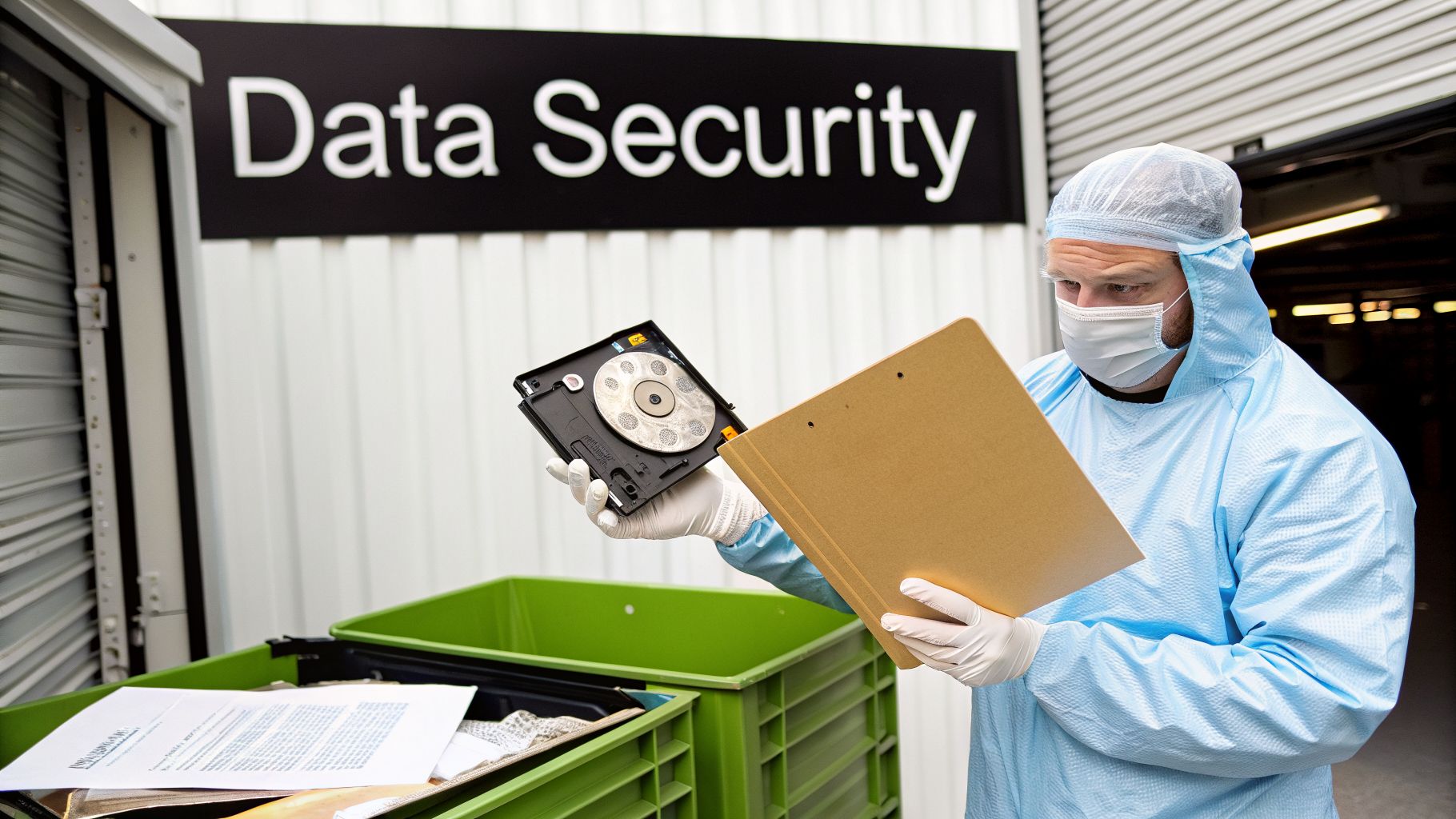
Just as critical as environmental safety is what happens to the data on your old equipment. Every computer, server, and even many modern analytical instruments have hard drives. These can hold anything from proprietary research and intellectual property to patient information governed by HIPAA. A single discarded hard drive falling into the wrong hands can be catastrophic.
The only way to guarantee security is through certified data destruction. This means you must receive a Certificate of Data Destruction for every single drive, providing an auditable paper trail that proves you met your legal and ethical obligations.
There are two primary methods for certified data destruction, and a good vendor will offer both.
- Data Sanitization: This is a software-based approach that overwrites the drive's data multiple times. The DoD 5220.22-M 3-pass wipe is a widely accepted standard that makes the original data completely unrecoverable. It's a great option for newer, functional hard drives that might be resold.
- Physical Destruction: For older drives, non-functional media, or anything containing extremely sensitive information, shredding is the gold standard. The drive is physically pulverized into tiny pieces, making it impossible to reassemble or access the data.
A top-tier partner will not only offer both but also provide clear, serialized documentation for each asset. You can dive deeper into the specifics by reading our guide on security and data destruction.
At the end of the day, mastering compliance means leaving no stone unturned. It's about ensuring every asset is disposed of responsibly and every byte of data is verifiably destroyed.
From Blueprint to Action: The Secure Removal and Transfer
You’ve got your plan and compliance strategy locked down. Now, it’s time to move from paper to the physical world—the execution phase. This is where you’ll really see an experienced team's value as they turn that complex blueprint into a smooth, hands-on operation. The focus now is all about the secure packing, handling, and transport of every single asset on your inventory list.
Let's be clear: this isn't your average moving job. Research facility equipment removal services are a different beast entirely. We use specialized materials and proven techniques designed for fragile, high-value scientific instruments. You can't just throw bubble wrap around a high-performance liquid chromatography (HPLC) system or an electron microscope and hope for the best.
Specialized Packing and Logistics
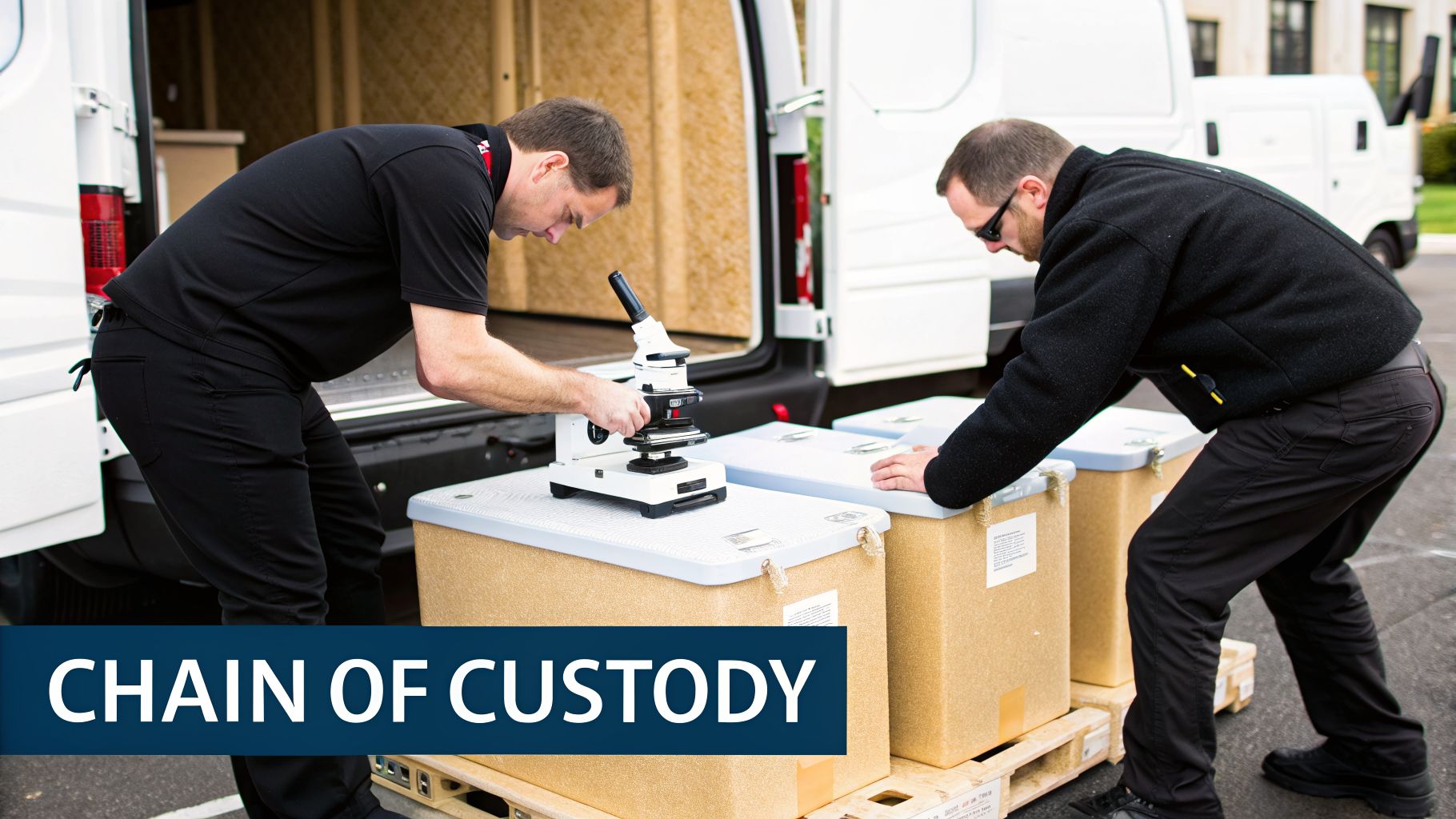
A professional crew will show up with the right tools for the job: custom-built crates, anti-static bags for electronics, and cushioned pallets that absorb the bumps and shocks of transit. Each piece of equipment is carefully de-installed, packed, and then tagged with a unique tracking number that ties directly back to your asset inventory. This level of detail is non-negotiable, whether you're moving across Atlanta, GA, or shipping equipment nationwide.
Some of the key logistics we handle include:
- Custom Crating: We often build wooden crates right on-site to create a perfect, secure fit for large or awkwardly shaped gear like mass spectrometers or robotic arms.
- Shock and Tilt Monitoring: For the most sensitive items, we attach special indicators that give you a clear record if the crate was dropped or mishandled in transit.
- Climate-Controlled Transport: Certain equipment needs to stay within a tight temperature or humidity range. For that, we use specialized, climate-controlled vehicles to ensure its integrity.
Maintaining an Unbroken Chain of Custody
Remember that detailed asset inventory from the planning stage? It now becomes the foundation of your chain of custody. This isn't just about ticking boxes; it's your auditable proof that every item was handled securely from the moment it left your facility to its final destination.
An unbroken chain of custody is your ultimate proof of due diligence. It provides complete transparency for stakeholders, auditors, and regulatory bodies by documenting every touchpoint and transfer of responsibility for each asset.
This process meticulously tracks everything. It could be a single server hard drive being sent for certified shredding or a large centrifuge being delivered to a resale partner. Every handoff is documented with signatures, dates, and times, creating a clear, defensible record for your files.
This kind of detailed management is more critical than ever as research facilities grow and modernize. In fact, the global laboratory equipment market is projected to hit $74.8 billion USD by 2033, fueled by major R&D investments. This growth means a constant cycle of equipment upgrades and, in turn, a greater need for compliant removal services. You can dive deeper into these trends by exploring the laboratory disposables market data.
Ultimately, executing a secure transfer comes down to three things: precision, documentation, and accountability. It's how you ensure your valuable assets are protected, sensitive data stays secure, and your organization remains fully compliant from start to finish.
This is it. The single most important decision you'll make for your lab decommissioning project. Who are you going to trust with your assets, your data, and your reputation?
Let's be blunt: choosing the right partner is everything. This isn't just about finding the lowest bid. The right team is your insurance policy against regulatory nightmares, catastrophic data breaches, and logistical meltdowns. Whether you're in Atlanta looking for a local crew or need a partner with a national footprint, your vetting process has to be rigorous.
Picking the wrong vendor can sink the whole project. Imagine an unqualified mover dropping a million-dollar analyzer, or a team that doesn't understand HIPAA casually mishandling a hard drive full of sensitive data. It happens. Your partner for research facility equipment removal services needs to be a specialist who has been there and done that, with service capabilities across the USA.
What to Look For: Certifications and Real-World Experience
First things first, check their credentials. You're looking for nationally recognized certifications that prove they take environmental responsibility and data security seriously.
- R2v3 or e-Stewards Certification: These are the big ones. Think of them as the gold standard for electronics recycling. A vendor with one of these is committed to safe environmental practices, worker safety, and maintaining a secure chain of custody.
- NAID AAA Certification: This one is from the International Secure Information Governance & Management Association (i-SIGMA). While not as common, it's a huge green flag that signals a top-tier commitment to secure data destruction.
Beyond the paperwork, you need to dig into their actual experience. Have they ever handled a project like yours? Decommissioning a BSL-3 lab is a completely different ballgame than clearing out a corporate R&D office. Ask for case studies. Better yet, ask for references from projects similar to yours. You can start by looking through a list of certified scientific equipment disposal providers.
Why Integrated Services and Accountability Matter
Finding a partner who handles everything in-house—the de-installation, the logistics, the data destruction, and the final recycling—is a massive advantage. This is especially true for nationwide operations, where a single vendor can provide consistent service in multiple states. It streamlines the whole process for you, but more importantly, it drastically reduces security risks by minimizing how many different hands touch your equipment.
A single, accountable partner minimizes the risk of communication gaps and ensures a seamless, unbroken chain of custody from your facility to the final disposition. This model provides maximum transparency and security.
This becomes even more critical as the industry grows. The global market for lab services is exploding, especially in places like the Asia-Pacific region, which is seeing huge investments like AstraZeneca's $2.5 billion R&D facility in Beijing. As labs get bigger and more complex, you need a partner who can navigate intricate disposal standards. You can get more details on this booming laboratory equipment services market on prnewswire.com.
Must-Ask Questions for Any Potential Vendor
Before you even think about signing a contract, you need straight answers to these questions. Don't let them give you vague responses.
- Insurance: What are your liability insurance limits? Will you provide a Certificate of Insurance (COI) that names our organization as an additional insured?
- Data Security: Is data destruction performed in-house, or do you subcontract it? What specific methods do you use? You want to hear things like a DoD 5220.22-M wipe or physical shredding.
- Downstream Vendors: Can you show us a list of your downstream recycling partners and prove they are certified? This is how you confirm where your assets really end up.
- Documentation: What kind of reports will we get back? Ask for samples of their Certificate of Data Destruction and Certificate of Recycling. You need to see what the final paperwork looks like.
Taking the time to choose your decommissioning partner carefully is the best thing you can do to guarantee your project is secure, compliant, and successful.
Finalizing Your Project with Complete Documentation
You might think the job is done once the trucks pull away, but you're not across the finish line just yet. The final, and arguably most important, step in any lab decommission is locking down the paperwork. This documentation is your official, auditable proof that everything was handled correctly and compliantly.
Without this paper trail, you're leaving your organization wide open to questions and potential liability months or even years from now. A true professional partner in research facility equipment removal services will deliver a full closeout package—this isn't just a handful of receipts, but a complete portfolio giving you legal and financial closure.
Key Reports for Your Project File
The first thing you need is the finalized asset disposition report. This document should be a perfect mirror of the inventory you created at the start of the project. It has to account for every single piece of equipment, detailing its final destination—whether it was sold, recycled, or destroyed.
Next up are the certificates. These are non-negotiable and prove you've met all your legal responsibilities.
Certificate of Data Destruction: This is a critical document. It must list every single hard drive and data-storing device by its unique serial number. It also has to confirm the exact destruction method used, like a DoD 5220.22-M 3-pass wipe or physical shredding. Take a look at this sample Certificate of Destruction to see what a properly formatted one includes.
Certificate of Recycling: This certifies that any non-resalable equipment and electronics went to a certified recycler. It’s your proof that hazardous materials were kept out of landfills and everything was handled in an environmentally sound way.
Getting this paperwork organized isn't just about ticking a box. This file is your go-to resource for internal audits, for backing up financial write-offs, and for validating your company's sustainability claims.
This final documentation package is what lets you finally close the book on the project with confidence. It’s the definitive proof that your research facility cleanout—whether in Atlanta or anywhere else in the US—was done securely and by the book. Your project simply isn't complete until this file is in your hands.
Your Top Equipment Removal Questions, Answered
Over the years, we've helped countless facility managers navigate the complexities of lab decommissioning. Whether you're in our backyard here in Atlanta, GA, or on the other side of the country, the same questions tend to pop up. Let's get right to them.
How Long Does a Lab Decommission Actually Take?
There's no one-size-fits-all answer here. The timeline depends entirely on the scope of your project.
We've seen small, single-room lab cleanouts wrapped up in just a couple of days. On the other hand, a multi-story research facility with dozens of labs can easily take several weeks. The main variables are the sheer volume of equipment, any specialized de-installation needs (like for a BSL-2 or BSL-3 environment), and the simple logistics of getting equipment out of your building.
Can I Get Any Money Back for My Old Equipment?
Yes, absolutely. It's a common misconception that old lab gear is just scrap. Many standard pieces—think centrifuges, incubators, and various analytical instruments—still hold significant value.
A good partner won't just haul it away. We assess the condition of every asset, identify which items have a solid resale potential, and tap into the secondary market to help you recover value and offset your project costs.
The single most important factor for HIPAA compliance is an auditable, unbroken chain of custody for all data-bearing media, from your lab to its final certified destruction. This is non-negotiable.
Once the equipment is gone, keeping proper records is the final, crucial step for compliance and any future audits. Brushing up on document archiving best practices is a smart move to close out your project professionally.
For a partner that delivers secure, compliant, and transparent outcomes for your lab decommission, trust Scientific Equipment Disposal. We offer local expertise in Atlanta and a seamless nationwide service network. Visit us at https://www.scientificequipmentdisposal.com to schedule your project assessment today.