Disposing of Laboratory Equipment and Electronics: A Guide for Local and Nationwide Facilities

The constant drive for innovation in research labs, hospitals, and biotech firms across the nation means a continuous cycle of upgrades. From Atlanta to San Diego, facilities are always pushing the boundaries of science and medicine.
But this progress creates a huge, often-overlooked problem: what do you do with the mountains of retired laboratory equipment and electronics left behind?
This isn’t just a matter of spring cleaning. It’s a serious logistical puzzle for organizations both locally and nationwide.
When Cutting-Edge Tools Become a Liability
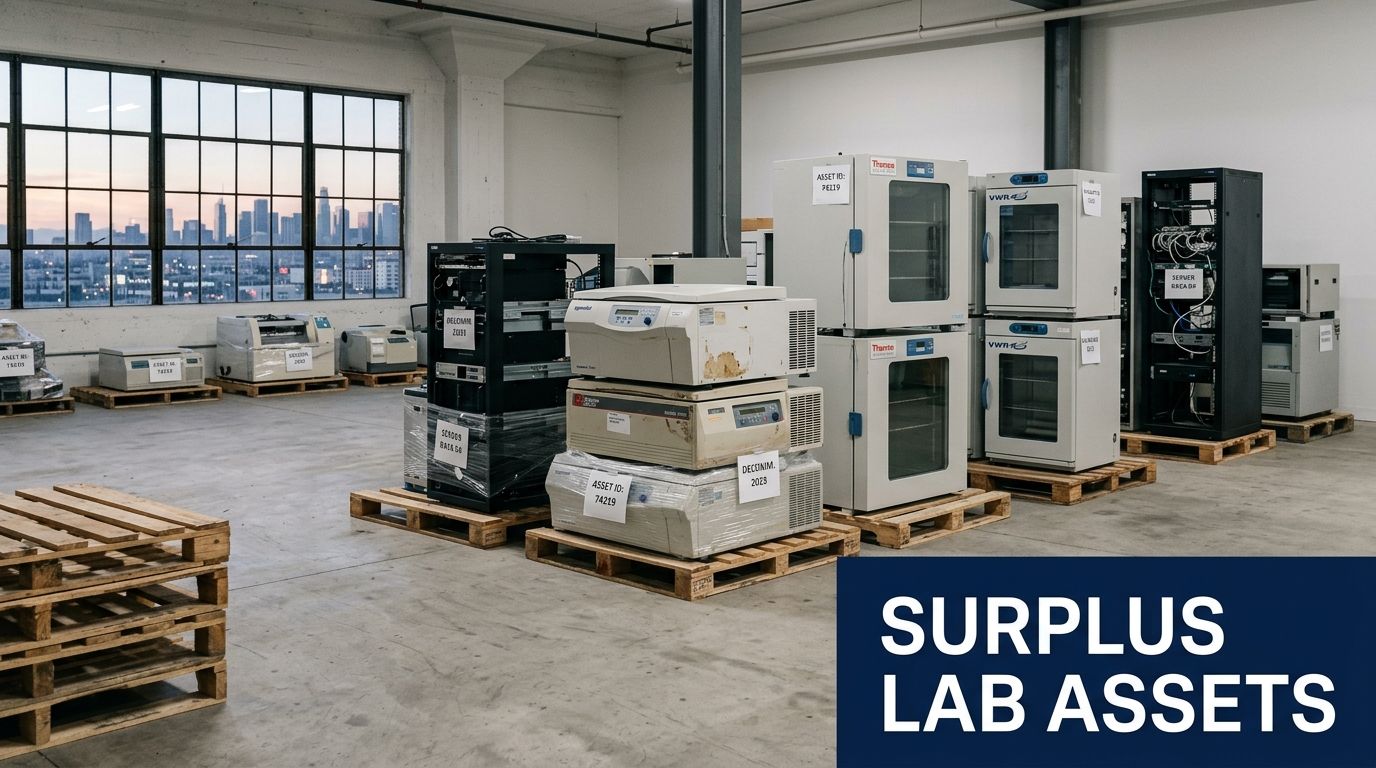
Think about the lifecycle of your lab equipment. Today's state-of-the-art analyzer or server is tomorrow's dust-collecting liability. Technology moves so fast that a piece of equipment's useful life is shorter than ever. Soon, you're looking at centrifuges, incubators, and entire server racks piling up in a warehouse or basement, whether you're in a single building or managing facilities across the country.
What was once a valuable asset has become a problem that needs a smart, scalable solution. This is where a strategic approach becomes non-negotiable.
You have to consider:
- Environmental Impact: Lab equipment is a major source of e-waste, often containing hazardous materials that are illegal to just throw in a landfill. This applies under federal EPA regulations, impacting every state.
- Data Security: That old PCR machine or network server could still hold sensitive patient data, research, or intellectual property. It has to be professionally sanitized according to national standards.
- Compliance: HIPAA, EPA, and other regulations carry heavy fines. One mistake in the disposal process can be incredibly costly, no matter where your facility is located.
Effectively managing this requires understanding the full spectrum of equipment—from simple consumables like PCR reaction tubes to massive, complex analytical systems. You can explore our guide for more on handling corporate e-waste solutions.
This isn't a niche issue; it's a massive, growing challenge tied directly to market growth. The global market for lab equipment was valued at around USD 35.90 billion in 2025 and is expected to explode to USD 74.22 billion by 2035.
Here in the U.S., the numbers are just as stark. The market is projected to more than double, climbing from USD 9.55 billion to USD 20.24 billion in that same timeframe. For every new piece of equipment purchased, an old one needs to go.
For hospitals, universities, and government agencies nationwide, managing this constant flow of surplus laboratory equipment and electronics is no longer an afterthought—it's a core operational necessity.
This trend isn't slowing down. It just means the challenge of asset disposition will become more intense, making a proactive, professional partnership essential for any forward-thinking organization, from a single local lab to a multi-state enterprise.
Navigating the Complex Rules of Asset Disposition
Getting rid of old laboratory equipment and electronics isn’t like calling a standard junk removal service. It’s more like decommissioning a high-security facility. You wouldn’t just leave the doors unlocked and walk away; you’d bring in a certified team to clear the contents, make sure no sensitive information is left, and dismantle everything according to strict protocols. The same goes for your lab and IT assets, whether you are in Georgia, California, or New York.
This process is wrapped in a thick layer of local, state, and federal rules. For hospitals, research centers, and government agencies, ignoring these regulations isn't a small mistake. It can open the door to devastating data breaches, six-figure fines, and a hit to your reputation that’s hard to come back from. Knowing the rules is the only way to protect your organization.
The Twin Pillars of Compliance: HIPAA and DoD Sanitization
When we talk about compliance, two standards are absolutely critical nationwide: HIPAA for data privacy and the Department of Defense (DoD) 5220.22-M for data destruction. Think of them as two sides of the same coin—one tells you what to protect, and the other tells you how to do it.
HIPAA (Health Insurance Portability and Accountability Act): This federal law is non-negotiable for any hospital, clinic, or lab handling Protected Health Information (ePHI). Any device that ever touched patient data—from a server in the data center to a diagnostic machine in a patient room—must be professionally sanitized so that data can never be recovered.
DoD 5220.22-M: This is the government's gold standard for how you destroy data. It specifies a method for overwriting a hard drive with new data multiple times, making the original information impossible to retrieve. For drives that are broken or when you need absolute certainty, physical shredding is the final, definitive step.
A HIPAA violation isn't cheap. Fines can skyrocket to $1.5 million per year for what's considered "willful neglect." This makes finding a disposal partner who lives and breathes compliance a business necessity, not a choice, for any US-based organization.
The pressure to comply has created a huge need for specialized asset management. In fact, the global market for these services is expected to hit an incredible USD 54.5 billion by 2030. As equipment gets replaced faster and faster, organizations nationwide need partners who know these rules inside and out.
Your Certified Partner as a Compliance Shield
A certified disposal partner is your shield against liability. They take these complicated rules and turn them into a secure, documented process that you can stand behind, whether you need a single pickup in Atlanta or coordinated service across multiple states. You can see how experienced commercial removal companies approach similar large-scale projects, which gives you a good idea of the coordination required.
The right partner does a lot more than just pick up your old gear. They deliver true peace of mind with a system that covers all your bases:
- Secure Chain of Custody: From the moment we de-install a piece of equipment, it’s tracked, logged, and secured—with nationwide logistics capabilities.
- Verified Data Destruction: We perform and certify all data sanitization or physical destruction, handing you a formal Certificate of Data Destruction for your records.
- Environmentally Sound Recycling: We guarantee that all materials are recycled according to strict EPA guidelines, keeping hazardous e-waste out of landfills. For a closer look, you can read our guide on EPA-compliant disposal.
This documented, by-the-book approach is your proof that you’ve done your due diligence. For any hospital, university, or government lab, it’s the only way to turn a potential risk into a fully compliant, worry-free process.
A Practical Guide to Lab Decommissioning for Local and Nationwide Operations
A full-scale lab decommission or facility move can feel like a massive undertaking. We get it. We’ve helped countless hospitals, universities, and research centers navigate this exact process across the country. The secret isn't magic—it's a solid, step-by-step plan that turns potential chaos into a controlled, efficient project.
This is our playbook, honed from years of experience, for managing a smooth disposition project. We'll walk you through everything from the initial inventory to the final truck pulling away, ensuring minimal disruption to your operations.
Phase 1: Planning and Inventory
First things first: you can't manage what you don't measure. A successful project always starts with a detailed inventory of every single piece of laboratory equipment and electronics you need to get rid of.
Think of it as creating a manifest. Without it, you’re flying blind on the scope, logistics, and compliance risks.
Your inventory list needs to capture a few key details for each asset:
- Item Type: Is it a centrifuge, a server, a mass spectrometer, or a simple computer monitor?
- Location: Note the building, floor, and room number. This is crucial for the pickup team, especially in multi-site projects.
- Data Status: Does it have a hard drive or store data? This is non-negotiable for HIPAA and DoD compliance.
Once your inventory is ready, you can schedule a pickup. For larger projects, especially those needing significant de-installation work or nationwide coordination, give yourself a good 4-6 weeks of lead time. This gives a disposal partner like us enough time to do a site walk, nail down the logistics, and line up the right crew and equipment for each location.
Phase 2: Preparing Your Space for Pickup
With a plan and schedule in place, it's time to get your physical space ready for a quick and safe pickup. The goal here is simple: stage your assets so the removal team can get in and out as efficiently as possible.
A well-prepped space can be the difference between a one-day job and a week-long headache. When you segregate assets and clear the path, the removal team can work quickly and safely. It respects your time and protects your facility.
Follow these key steps to get your site ready:
- Group Data-Bearing Devices: Pull together all items with hard drives—computers, servers, analyzers, etc. This flags them for secure data destruction right away.
- Consolidate Small Items: Don't leave small things scattered. Put pipettes, IT peripherals, and other small equipment into boxes or onto pallets.
- Flag Special Handling: Clearly label anything heavy, awkward, or fragile. While we can't take biohazards, knowing which machines need extra care is a huge help.
- Clear the Way: Make sure hallways, loading docks, and elevators are completely clear. It sounds simple, but a blocked path is the number one cause of delays.
This flow chart shows exactly how we handle data-bearing assets to ensure total compliance from start to finish.
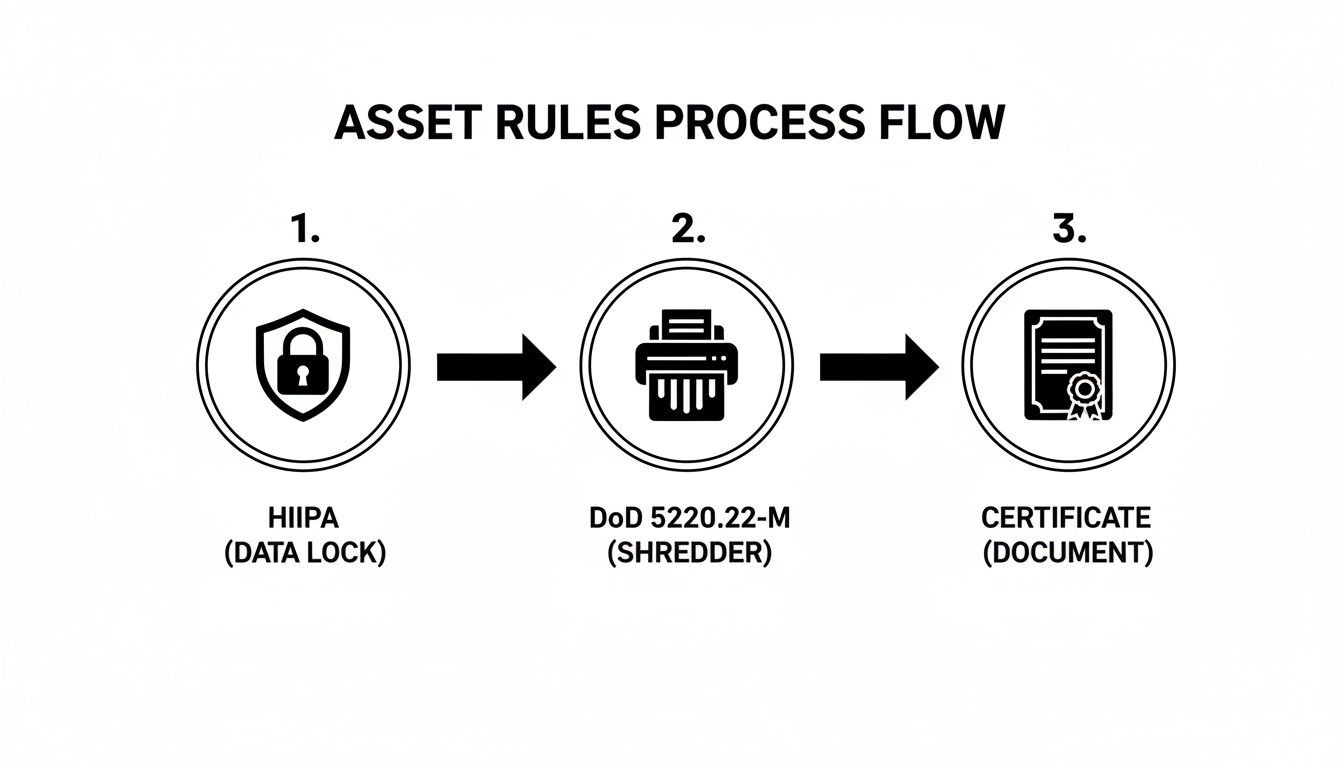
The process is locked down. From HIPAA-compliant handling to DoD-level shredding and final certification, we make sure your data is gone for good.
To make things even easier, here's a simple checklist you can use to prepare your facility for a smooth pickup, whether it's one location or several.
| Lab Decommissioning Checklist |
|---|
| Phase |
| 1. Planning |
| 1. Planning |
| 2. Staging |
| 2. Staging |
| 2. Staging |
| 3. Logistics |
| 3. Logistics |
| 4. Final Checks |
Following this checklist will take the guesswork out of the process and set your team and ours up for a successful project.
Phase 3: The Heavy Lifting and Removal
This is where the magic happens. On pickup day, our professional team arrives with the right tools, dollies, and manpower to handle everything. We’ll take care of dismantling large systems, carefully packing sensitive electronics, and loading everything safely onto secure, GPS-tracked vehicles.
Working from the inventory list you created, our crew will check off each item as it’s loaded. This is where all your prep work pays off. Because you’ve already sorted the data-bearing devices and cleared the pathways, the team can move like a well-oiled machine.
If you want to dig deeper into the nuts and bolts of this process, you can learn more about the specifics of lab equipment decommissioning services in our detailed guide.
By following these steps, any organization can tackle a complex lab cleanout with confidence, knowing every piece of equipment is handled responsibly from start to finish.
What We Take (And What We Don’t)
When you're clearing out a lab, the last thing you need is a surprise. Knowing what your disposal partner can handle—and what they can't—is the key to a smooth, compliant project from day one. We believe in being upfront about this so you can plan your lab decommission without any guesswork.
Think of it like this: we're specialists in electronic and physical asset recycling. We're not a hazardous waste company. That single distinction is the most important one to make when sorting your inventory.
Core Equipment We Accept
Our team is equipped to handle the vast majority of equipment you'd find in a typical research lab, hospital, or IT closet across the United States. If it plugs into a wall or was used for general lab work, chances are we can take it.
We routinely pick up and process a wide range of items, including:
- General Lab Instruments: This covers all the daily workhorses like centrifuges, incubators, stir plates, vortex mixers, water baths, and microscopes.
- Analytical Equipment: We handle many types of analyzers, spectrometers, and chromatographs (like HPLC systems), as long as they have been properly decontaminated.
- IT and Office Hardware: All your standard e-waste is fair game. This includes computers, servers, laptops, monitors, printers, networking gear, and all the cables and peripherals that go with them.
For a more exhaustive list, feel free to check our detailed guide on accepted laboratory equipment and electronics.
Understanding Restricted Items
Just as important as what we take is what we absolutely cannot handle. Certain items fall far outside the scope of e-waste recycling because they pose serious biological, chemical, or radiological hazards. These materials require their own set of licensed handlers and specialized facilities.
The bottom line is hazard level. We recycle physical assets. Items contaminated with active biological agents, chemicals, or radioactive materials aren't just "equipment" anymore—they are classified as hazardous waste and legally must be managed by a certified specialist in that field.
These restrictions are non-negotiable. They are in place to protect your people, our team, and the community.
The market for laboratory equipment and electronics is massive, and it turns over fast. With North America making up 39% of global purchasing and labs replacing 20-30% of their gear every few years, a huge amount of surplus equipment is constantly being generated. A partner who is crystal clear about what they can and can’t accept is essential for local and national operations.
To make it even clearer, here’s a table breaking down the difference between what a recycler like us handles versus what requires a specialist.
Commonly Accepted vs. Restricted Items
| Item Category | Accepted Examples (Handled by Recycler) | Restricted Examples (Requires Specialist) |
|---|---|---|
| General Lab Equipment | Centrifuges, shakers, non-contaminated incubators, microscopes. | Items contaminated with biohazards (e.g., blood, infectious agents). |
| Analytical Instruments | Decontaminated mass spectrometers, HPLCs, PCR machines. | Any equipment containing radioactive sources or isotopes. |
| Chemical-Related Items | Empty and cleaned glassware, lab plastics. | Loose chemicals, reagents, solvents, or unidentifiable substances. |
| Contained Systems | Fume hoods and biosafety cabinets (after professional decontamination and certification). | Pressurized gas cylinders or tanks, even if they appear empty. |
| Waste Materials | General electronic scrap from equipment. | Sharps containers, biohazardous waste bags, or any medical waste. |
By separating your assets this way before you even call, you can make sure everything goes to the right place. It speeds up your project and ensures you’re meeting all safety and compliance standards.
When the Truck Leaves, Your Proof Arrives: The Importance of Certified Reporting
Just because your retired laboratory equipment and electronics are loaded onto a truck and driven away, don't assume the job is over. In fact, the most important part is just beginning: getting the proof that everything was handled correctly. The final, non-negotiable step in any responsible asset disposal project is a complete reporting package from your disposal partner.
This isn't just about shuffling papers. This is your official, auditable proof that you’ve met every compliance standard for every piece of equipment from every location.
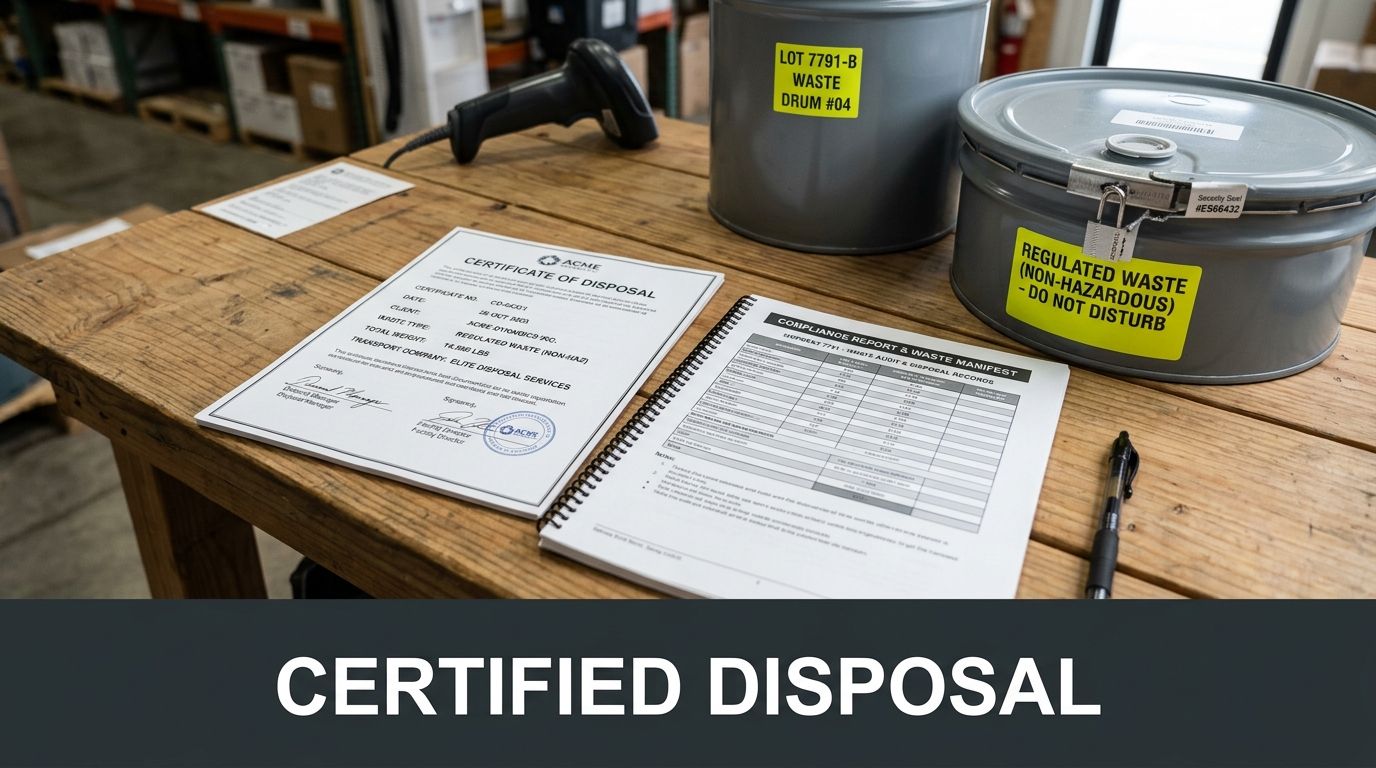
Think of it as the official seal on your entire project. For any organization, this documentation is what shields you from liability, keeps auditors happy, and gives you genuine peace of mind. Without it, you're leaving your organization wide open to serious risks.
Your Certificates are Your Compliance Shield
When we complete a project, you'll receive two vital documents: the Certificate of Disposal and the Certificate of Data Destruction. Each one has a distinct and critical job to do in protecting your facility.
Certificate of Disposal: This is our guarantee to you that your assets were recycled or disposed of according to every local, state, and federal environmental law. It’s your confirmation that hazardous e-waste materials didn't end up in a landfill on your watch.
Certificate of Data Destruction: This document certifies that every hard drive and piece of data-storing media was professionally sanitized using standards like DoD 5220.22-M or physically shredded into oblivion. For hospitals and clinics, this is the definitive proof you need to show you’ve met your HIPAA obligations.
These certificates are much more than just receipts; they're legal documents that prove you did your due diligence. You can dive deeper into the specifics by reading our guide to understanding a certificate of destruction.
Why This Paperwork is Non-Negotiable
In the world of regulatory compliance, if it isn't documented, it never happened. A handshake or a simple invoice just won't cut it when you're facing an audit or a legal question. A proper reporting package provides real, tangible benefits that go far beyond just clearing out space in your lab.
When an auditor from the EPA or HHS shows up and asks how you got rid of that old server that stored patient records, you don't want to be scrambling. Handing them a Certificate of Data Destruction with a clear serial number trail ends that conversation. It's your third-party proof that you did everything by the book.
This comprehensive documentation is your best defense against future headaches. It serves as your organization’s proof of responsible stewardship, protecting your reputation and your budget.
Key Benefits of Certified Reporting:
- Makes Audits Painless: Gives you the exact paperwork needed to satisfy both internal and external auditors nationwide.
- Reduces Legal Risk: Acts as a powerful shield against potential fines or lawsuits related to data breaches or improper waste disposal.
- Shows You’re Responsible: Demonstrates a real commitment to environmental sustainability and data security to your board, stakeholders, and community.
For any hospital, university, or government agency, this final step is what turns a simple equipment pickup into a true compliance partnership. It's the ultimate value we deliver—verifiable proof that every single asset was handled correctly from start to finish.
Common Questions About Equipment Disposal for Local and National Clients
When it's time to clear out surplus laboratory equipment and electronics, facility managers and IT directors across the country all seem to run into the same questions. The whole process can feel a little overwhelming, with worries about costs, data security, and staying compliant. We get it. Here are some straight, practical answers to the questions we hear most often.
What Is the Cost to Dispose of Laboratory Equipment and Electronics?
This is usually the first question on everyone's mind. The honest answer? It really depends on the specifics of your project, whether it's a single site or a nationwide initiative.
A few things will shape the final price:
- The sheer volume and types of equipment you need gone.
- Logistics like facility access (loading docks, elevators) and geographical location(s).
- How much on-site de-installation labor is needed from our team.
For a lot of standard pickups—think IT assets and smaller, non-hazardous lab gear—we can often handle the job at no cost. The value we recover from the recyclable materials is enough to offset our costs for labor and transport, even for multi-state pickups.
However, if you're looking at a major project like a full lab cleanout, a service fee might come into play. This is typical when the job requires extensive hands-on work, like dismantling large fume hoods, biological safety cabinets, or massive analytical machines.
The best way forward is always to get a custom quote. A good partner will give you a detailed breakdown based on your inventory, your location(s), and any special services you need, like certified data destruction.
This way, you know exactly what to expect with no surprises.
How Do You Guarantee Data Security for Our Equipment?
In our line of work, data security isn't just a feature; it's everything. Protecting your sensitive information—whether it’s patient data, proprietary research, or financial records—is our absolute priority. We use a multi-layered process that meets the toughest industry and government standards across the nation.
Our entire approach is built on two core methods: sanitization and destruction.
Data Sanitization: For hard drives that are still working, we use specialized software to completely erase the data. We stick to the DoD 5220.22-M 3-pass standard, which overwrites the entire drive three separate times. This makes the original data impossible to recover and keeps you compliant with regulations like HIPAA.
Physical Destruction: When a hard drive is dead, too old, or your policy simply demands it, we physically destroy it. Our industrial shredders chew through hard drives and other media, reducing them to tiny fragments. There is no putting them back together and no way to get data off them.
Once we’re done, we issue a Certificate of Data Destruction. This is your official, auditable proof that every data-bearing device was handled securely and its contents permanently destroyed. It’s a critical piece of documentation for your records, especially in highly regulated fields.
Can't We Just Throw Old Lab Equipment in a Dumpster?
Let me be blunt: tossing old lab or IT gear into a commercial dumpster is one of the riskiest moves you can make. It opens your organization up to serious environmental, legal, and financial trouble. This equipment is considered e-waste for very good reasons under federal and state laws.
First, this stuff is often full of hazardous materials. Circuit boards, batteries, and old CRT monitors contain lead, mercury, cadmium, and other toxins. If that ends up in a landfill, those chemicals can seep into the soil and groundwater. Because of this, most states have rules that strictly forbid landfilling e-waste.
Disposing of lab equipment in a dumpster isn't just an environmental mistake; it's a massive security risk. Any device with a hard drive or internal memory could become an open invitation for a data breach if it's not properly sanitized.
Second, and maybe even more important, is the data risk. Even if you think a device has been wiped, sensitive information can often still be recovered. Tossing a server, computer, or even a networked scientific analyzer into a dumpster is just asking for a data breach. A single incident from improper disposal can lead to crippling fines, lawsuits, and a damaged reputation that’s hard to repair.
Working with a certified recycler guarantees two things: all materials are handled in an environmentally sound way, and all your data is verifiably destroyed. It’s the only way to be sure you’re fully compliant nationwide.
How Far in Advance Should We Schedule a Pickup?
The ideal timeline really comes down to the size of your project. The general rule is simple: the larger and more geographically diverse the project, the more notice you should give. For a deep dive into our services, you can learn more about our Atlanta-based recycling solutions and our nationwide capabilities.
Here’s a quick guide to help you plan:
- Large-Scale or Nationwide Projects: For a full lab decommissioning, facility move, or a huge IT asset refresh involving hundreds of items across multiple sites, we suggest reaching out 4 to 6 weeks in advance. This gives us plenty of time for site visits, inventory assessment, and a solid logistical plan that minimizes disruption to your team.
- Routine or Smaller Pickups: If you just have a few pallets of computers, monitors, and other lab instruments piling up at a single location, scheduling is much faster. We can often arrange a pickup with just one to two weeks' notice. As a provider with both local and national reach, we have the flexibility to fit you into our schedule.
A little planning always goes a long way. It ensures both our teams are on the same page and can execute a flawless, hassle-free pickup.
For a seamless, compliant, and cost-effective solution to your equipment disposal needs, trust the experts at Scientific Equipment Disposal. We provide secure, sustainable outcomes for organizations of all sizes, offering both local service and nationwide logistics. Get a free quote today.