A Quick Guide to Local and Nationwide Electronic Waste Recycling Companies

Piles of old electronics stacking up in a storage room aren't just a space problem—they're a serious business risk. When it comes to the sea of electronic waste recycling companies out there, picking the right partner, whether local or nationwide, is one of the most important things you can do to protect your organization from data breaches, steep environmental fines, and a damaged reputation.
Why Your E-Waste Partner Is a Critical Business Decision
Dealing with obsolete technology has evolved. It's no longer about just getting rid of stuff; it's a core part of risk management and corporate responsibility. If you're an IT director, lab manager, or facilities supervisor, the stakes are incredibly high. This is especially true in regulated fields like healthcare, education, and research, where compliance isn't just a suggestion—it's mandatory. One wrong move with a local or national vendor can have severe consequences.
The sheer volume of e-waste is staggering. In 2022, the world generated 62 million tonnes of it, and that number is on track to hit 82 million by 2030. The real shocker? Only about 22% of this massive pile was properly collected and recycled. That gap is where the risks for your business live.
The True Cost of a Poor Partnership
Picking an uncertified or careless recycling partner opens your organization up to a world of hidden dangers. Think about a university getting rid of old lab equipment or a hospital retiring patient monitoring systems. Without a rock-solid, certified process from a reputable national or local e-waste company, you're looking at potential disasters like:
- Data Breaches: Unsanitized hard drives are a goldmine for criminals. Sensitive student records, patient data, or proprietary research can easily end up in the wrong hands.
- Compliance Fines: Improperly dumping items with hazardous materials like lead or mercury can trigger incredibly costly environmental penalties from regulators.
- Reputational Harm: The last thing you want is a news story about your equipment being found in an illegal dump. That kind of damage to your public image can be permanent.
A true e-waste partnership is an extension of your compliance and security teams. It’s about finding a vendor who understands your industry’s specific challenges and provides a documented, auditable process that protects you at every step.
This guide is designed to give you a clear framework for vetting and choosing an e-waste recycler who acts like a genuine partner. We'll walk through all the essential criteria—from certifications and data destruction standards to logistics and transparent pricing—so you can build a secure and sustainable asset disposition program. For organizations looking to improve their environmental footprint, this proactive approach is a key part of adopting sustainable laboratory practices.
Below is a quick-reference table outlining the key areas to focus on when you're evaluating potential partners. It’s a great checklist to keep handy during your initial conversations and site visits.
Key Evaluation Criteria for E-Waste Recycling Partners
| Evaluation Area | What to Look For | Why It Matters |
|---|---|---|
| Certifications | R2, e-Stewards, NAID AAA, ISO 14001/45001. | Independent, third-party validation that the recycler follows the highest industry standards for environmental safety, data security, and worker health. |
| Data Destruction | DoD 5220.22-M or NIST 800-88 compliant wiping, on-site/off-site shredding. | Guarantees that sensitive data is permanently destroyed, protecting you from breaches and ensuring compliance with privacy laws like HIPAA or GLBA. |
| Chain of Custody | Serialized asset tracking, detailed reports, Certificates of Destruction/Recycling. | Provides an unbroken, auditable trail for every single asset, proving responsible disposal from the moment it leaves your facility to its final disposition. |
| Logistics & Services | Nationwide and local service, on-site de-installation, professional packing, secure transport, flexible scheduling. | A partner who handles the physical removal simplifies the process, minimizes disruption to your operations, and reduces the risk of damage or loss in transit. |
| Environmental Compliance | Zero-landfill policy, no illegal export of hazardous materials, downstream vendor audits. | Ensures your e-waste doesn't end up harming the environment or contributing to illegal dumping, protecting your organization's reputation and avoiding fines. |
| Financials & Insurance | Transparent pricing (per pound, per item, flat fee), proof of liability and data breach insurance. | Clear pricing avoids surprise costs, while adequate insurance protects you financially in the unlikely event of an incident during transport or processing. |
Using this table as a guide will help ensure you don't miss any critical details. A thorough vetting process upfront saves a massive amount of headache, risk, and potential cost down the road.
Decoding Certifications and Ensuring Downstream Transparency
When you're vetting an e-waste recycler, certifications are your first line of defense. Seeing logos like R2 (Responsible Recycling) or e-Stewards isn't just window dressing—it’s proof that the vendor has passed rigorous, third-party audits covering everything from environmental safety to data security.
These credentials act as an immediate filter, separating the professional, compliant operators from the risky ones.
Think about a university lab in Chicago getting rid of old equipment. This isn't just a few old computers; it's specialized gear that could contain hazardous materials like mercury or lead. An R2-certified partner is bound by a strict hierarchy: first, they must attempt reuse, and only then can they move to responsible materials recovery. This documented process guarantees those hazardous bits are managed safely and kept out of a landfill, saving the university from massive environmental fines and a PR nightmare.
Beyond the Logo: Verifying a Recycler's Claims
Certifications are a great start, but they aren't the whole story. The real test is a vendor’s commitment to downstream transparency. This simply means they can prove—not just tell you—exactly where every single piece of your equipment goes after it leaves your loading dock.
A reputable vendor, whether operating locally in cities like Miami or Houston or across the entire country, should be able to hand you a clear map of their downstream partners, and all of those partners should be certified, too. This is where you need to start asking pointed questions. Don't be shy about digging into their documentation to verify their entire recycling chain. A truly transparent partner will welcome the scrutiny.
Here’s what you should be asking for:
- Downstream Vendor Audits: Request the reports showing they've actually vetted their partners.
- Material Flow Reports: These documents trace specific materials—like circuit boards or plastics—all the way to their final destination.
- Proof of No-Export Policies: This is a big one. It ensures your hazardous e-waste isn't illegally shipped overseas to places with questionable labor and environmental practices.
True transparency means a vendor can provide an unbroken, auditable chain of custody, not just to their front door, but all the way to final disposition. This paper trail is your ultimate shield against compliance risks.
Making an Informed Decision
Getting a handle on these details is absolutely fundamental to picking the right partner. If you want a deeper look at what separates the best from the rest, check out our guide on the leading e-waste disposal companies.
In the end, a vendor’s willingness to provide this level of detail says everything about their integrity. If they hesitate, dodge questions, or can’t produce the paperwork, consider it a giant red flag. Your organization’s security and reputation are on the line, and they depend on you partnering with someone who operates with complete openness.
Making Data Security Your Top Priority
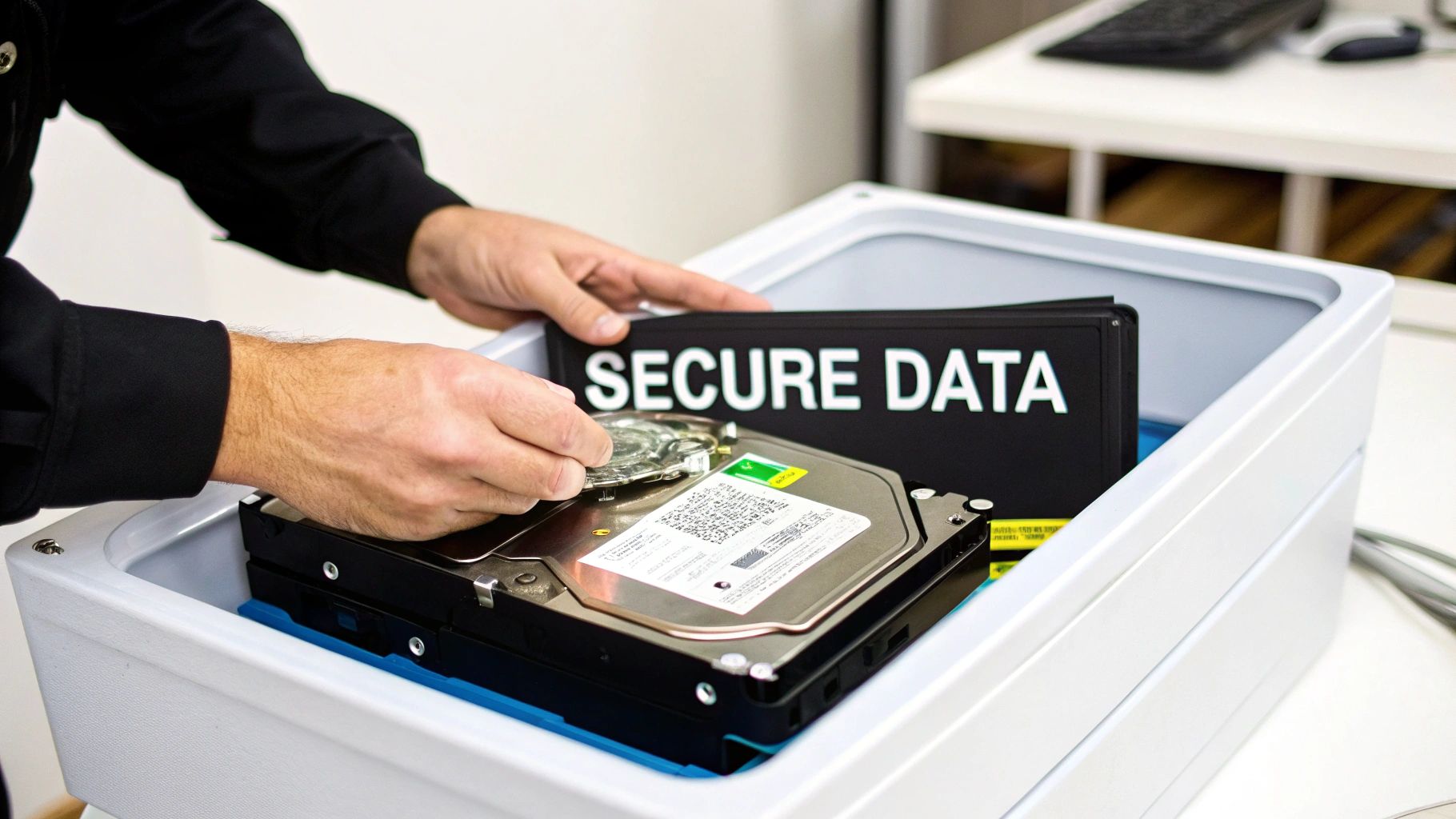
Let's be blunt: a single misplaced hard drive can easily become a catastrophic data breach. When you're vetting electronic waste recycling companies, the first and most important question should be about how they handle and destroy your sensitive data. Just "wiping" a drive isn't a real security strategy anymore.
You need an airtight, auditable process. This is non-negotiable, especially in environments like hospitals in Boston or clinics in Dallas where secure, compliant asset disposition is the single most critical part of the job. The industry is in a "data-security arms race," with tightening privacy laws and the ever-present threat of ransomware attacks. This is pushing smart organizations to demand certified wiping, on-site shredding, and a flawless chain-of-custody as the baseline standard. You can find more on why this is so crucial for healthcare on invrecovery.org.
Understanding Data Destruction Methods
Not all data destruction is created equal. A legitimate e-waste partner will offer a few different levels of sanitization, so you can pick the right method based on your data's sensitivity and your own internal risk policies.
Here’s a quick rundown of the common industry standards:
- Single-Pass Wiping (1x Overwrite): This is the most basic form of data sanitization, where random data is written over the drive once. It’s okay for non-sensitive assets but probably won't cut it for any serious compliance needs.
- DoD 3-Pass Sanitization (DoD 5220.22-M): This is a much more secure process that overwrites the data three times using different patterns. For years, this has been the go-to benchmark for corporate and government data destruction and is solid enough for most compliance requirements.
- Physical Shredding: This is the end of the line for data. The hard drive is physically pulverized into tiny metal fragments, making data recovery completely impossible. This method is the gold standard for devices that held sensitive IP, patient records, or financial data.
For organizations that need absolute proof, many recyclers offer on-site shredding. This means your own team can physically watch your media get destroyed before it even leaves your building, giving you that extra layer of verified security.
The Certificate of Destruction Explained
Once the data is gone, your partner must provide a legally sound Certificate of Destruction (CoD). This document is your official proof of compliance and a critical tool for managing risk. It's what turns e-waste disposal from a simple task into a documented, defensible business process.
A Certificate of Destruction isn't just a receipt; it's a legal document that formally transfers liability from your organization to the recycling vendor. It is your ultimate proof that you took every necessary step to protect sensitive information.
A real CoD needs to include specific, verifiable details to hold up in an audit. Look for the date of destruction, the methods used (like DoD 3-pass or physical shredding), and a serialized inventory of every single hard drive or data-bearing device that was processed. Without those details, the certificate is practically worthless.
Before you sign any contract, always ask for a sample CoD to make sure it meets your organization’s standards. You can learn more about how we implement these rigorous protocols in our guide to data security.
Nail Down Your Vendor's On-Site Logistics and Chain of Custody
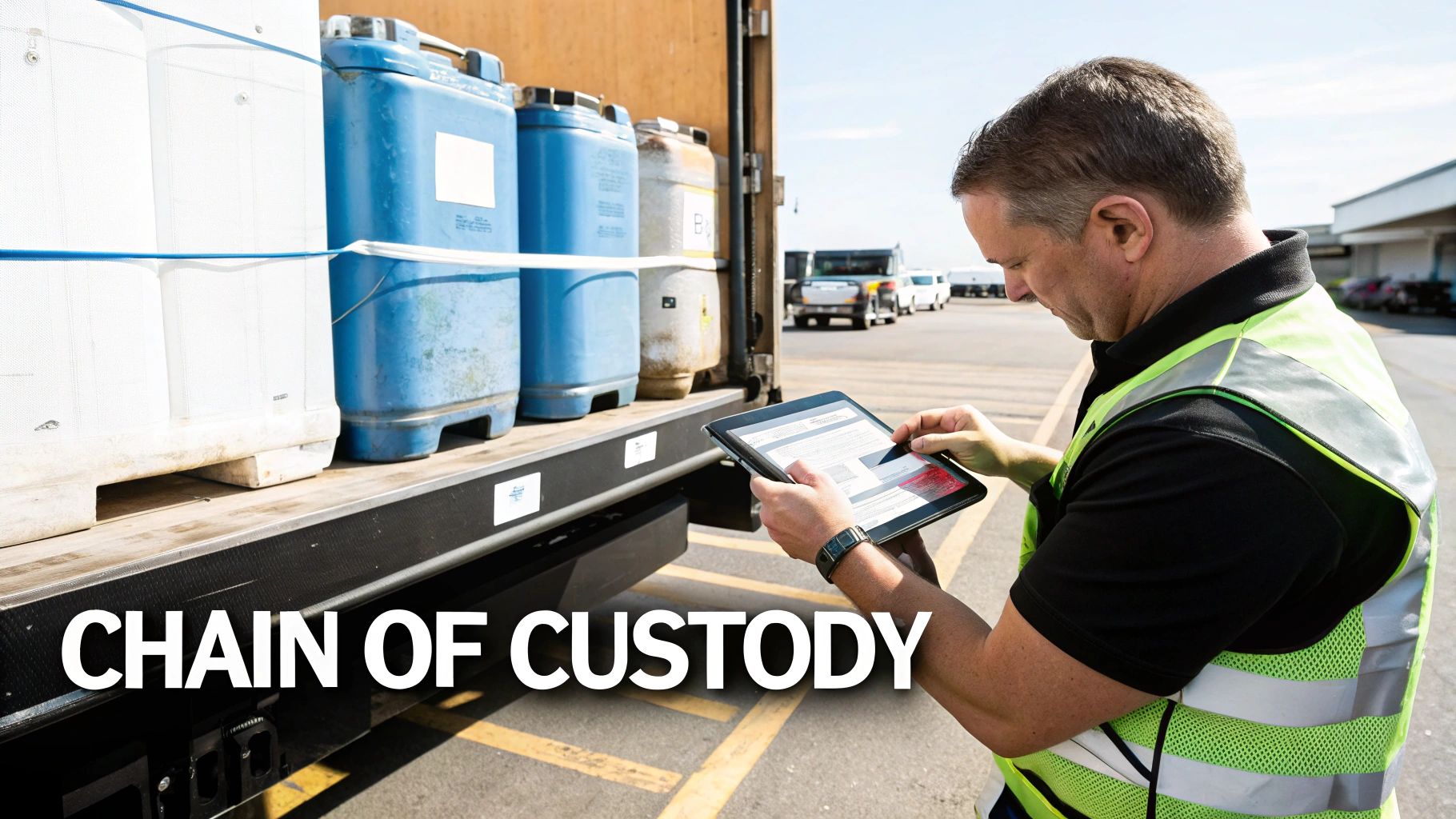
Here’s something that gets overlooked all the time: the security of your old equipment doesn't start when it hits the recycling plant. It starts the second a vendor’s crew steps into your building. On-site logistics is a make-or-break moment, and it’s one of the most critical parts of evaluating electronic waste recycling companies. A real pro gets this and manages the whole process with military precision, whether you're in a single location or have facilities across the U.S.
This is about so much more than just hauling away junk. It’s a secure, documented handoff. You should be looking for partners who offer professional de-installation and packing, especially if you're dealing with a complex data center or a lab where gear is wired into your infrastructure. When a vendor uses their own badged employees and their own fleet of GPS-tracked trucks, you’re immediately cutting down the risk of something walking away.
The Unbroken Chain of Custody
A rock-solid chain of custody is the absolute backbone of a compliant e-waste program. Think of it as an unbroken, auditable paper trail that follows every single piece of equipment from your dock to its final destruction or recycling. This isn't just bureaucratic fluff; it's essential for asset management, financial reporting, and proving you're following the rules.
Let’s imagine you’re decommissioning a data center in a city like Atlanta. You’ve got hundreds of servers, switches, and storage arrays, and every single one is packed with sensitive data. A top-tier recycling partner will roll out a multi-step verification process that looks something like this:
- Serialized Asset Tagging: Before a single thing is unplugged, each device gets tagged and scanned. This creates a detailed inventory that you can match against your own asset list. No guesswork.
- Secure Transport: All the gear is packed into sealed, tamper-evident containers before being loaded onto the vendor’s truck.
- Verified Manifests: A shipping manifest is created, listing every single serialized item. Both your team and the vendor’s team sign off on it, confirming exactly what's leaving the building.
An airtight chain of custody transforms asset disposal from a logistical headache into a secure, transparent, and defensible business process. Without it, you have no verifiable proof of what left your building or where it ended up.
This level of detail gives you more than just peace of mind. It guarantees every hard drive is accounted for before it gets shredded, and it gives your finance department the documentation they need to officially retire those assets from the books. The right partner will give you a clear rundown of how their logistics and tracking work before you even sign a contract.
When you're vetting a potential vendor, ask them point-blank to show you examples of their chain-of-custody paperwork. If their process seems fuzzy or if they rely on random third-party shippers with no direct oversight, that’s a massive red flag. The security of your data and the integrity of your compliance reports all hinge on getting this first step right.
Navigating Pricing Models and Total Cost of Service
When you're comparing quotes from electronic waste recycling companies, it’s easy to get tunnel vision and just go for the lowest number. But I can tell you from experience, that initial invoice almost never shows the full picture. A smart financial decision means digging deeper into the pricing structures and understanding the total cost of service—which includes all the hidden risks and potential returns.
The global e-waste recycling market is ballooning. Valued at roughly USD 70.1 billion in 2024, it's expected to hit USD 251.9 billion by 2034. Here in the U.S., the market is already an estimated USD 14.1 billion for 2024. You can find more details about this expanding market on gminsights.com.
What does that mean for you? More vendors, more options, and a lot more complexity in how services are priced. It's on you to sort through the noise.
Unpacking Common Pricing Models
Most recyclers stick to a few standard pricing models. A per-pound rate is very common for big disposals, where you're simply charged based on the total weight of your assets. You’ll also see per-item fees, with a flat price for every computer, server, or monitor. For larger jobs like a full data center cleanout, you’re more likely to get project-based pricing, which is a single fee for the entire scope of work.
Each of these models has its place. But the real question is what's actually included in that price. Does that per-pound rate cover certified data destruction? Does the flat project fee include on-site de-installation and asset tagging? Asking these questions is how you uncover the true cost.
The cheapest quote almost always comes from a vendor cutting corners on data security, environmental compliance, or downstream transparency. The true cost of service isn't the invoice—it's the price of a data breach or a compliance fine.
Calculating the Total Value Proposition
A financially sound decision looks way beyond the initial sticker price. A certified, full-service partner might charge more upfront, but they deliver a much lower total risk and far greater long-term value. This value comes from two key places: cost avoidance and potential revenue.
- Cost Avoidance: Working with a certified recycler completely sidesteps the risk of six-figure fines for improper disposal or a multi-million-dollar data breach. That's a huge, if sometimes invisible, financial benefit.
- Asset Remarketing: What if some of your old equipment isn't actually junk? Top-tier recyclers will evaluate your assets for resale potential. They can refurbish and sell the good stuff, returning a share of the revenue to you and offsetting your initial costs.
The table below breaks down these different pricing models and what to look out for. It clearly shows why a slightly higher initial investment often leads to a much better financial outcome in the long run.
Comparing E-Waste Vendor Pricing Models
| Pricing Model | How It Works | Pros | Cons / What to Watch For |
|---|---|---|---|
| Profit-Sharing / Revenue Share | The vendor assesses the resale value of your assets. They sell the equipment and share a percentage of the revenue with you after deducting their costs. | Can result in net positive revenue. Encourages the vendor to maximize asset value. Aligns vendor and client interests. | Payouts can be slow. Requires valuable, remarketable assets. Less transparent vendors may inflate their "costs." |
| Flat Fee / Project-Based | A single, all-inclusive price for a defined scope of work (e.g., decommissioning a data center). | Predictable, simple budgeting. Good for large, complex projects with many moving parts. | You might overpay if the asset value is higher than estimated. The scope must be clearly defined to avoid extra charges. |
| Per-Pound Rate | You are charged a set rate for the total weight of the material being recycled. | Simple and easy to understand for bulk, low-value disposals. | Doesn't account for the value of individual assets. Can get expensive for heavy, worthless items. Often excludes critical services like data destruction. |
| Per-Item Rate | You pay a fixed fee for each piece of equipment (e.g., $10 per PC, $20 per server). | Straightforward for smaller batches of equipment. Easy to calculate costs upfront if you have an accurate inventory. | Becomes inefficient and costly for large quantities. Fees for data destruction or hard drive removal are often extra. |
| Free or "We Pay You" | The vendor offers to pick up your equipment at no cost, or even pay you a small amount, planning to profit from remarketing or scrap. | No upfront cost. Seems like the best deal on the surface. | HIGH RISK. Often associated with uncertified vendors cutting corners on data security and compliance. Your assets could end up anywhere. |
Ultimately, choosing a pricing model isn't just about the initial quote. It’s about finding a partner whose financial incentives are aligned with your goals for security, compliance, and value recovery. The "free" option is almost never worth the risk.
How to Build Your E-Waste Management Program
So, how do you pull this all together and build an e-waste program that actually works? It really comes down to asking the right questions from the very start.
Whether you're looking for an e-waste company near you or trying to coordinate a disposition strategy across multiple states, the core principles don't change. You need a partner who goes beyond just picking up boxes and becomes a genuine extension of your risk management team.
The best place to begin is by creating a simple checklist to vet potential electronic waste recycling companies. You’ll want to focus on the absolute non-negotiables: certifications, data security protocols, downstream transparency, and on-site logistics. A vendor’s ability to give you clear, documented answers in these areas is the single best sign of their professionalism. Don't be shy about asking for proof, like a sample Certificate of Destruction or a downstream vendor audit report.
Vetting Your E-Waste Partner
A quality partner will also have real, hands-on experience in your specific industry. Think about it—handling sensitive lab equipment is a completely different ballgame than processing a pallet of old office computers. Partners with experience in specialized sectors like healthcare or research don't just offer disposal; they provide invaluable guidance on compliance and safety.
We see this all the time with specialized assets, which you can learn more about through our medical equipment recycling program.
This whole process—from getting that first quote to understanding the complete financial picture—can be a journey.
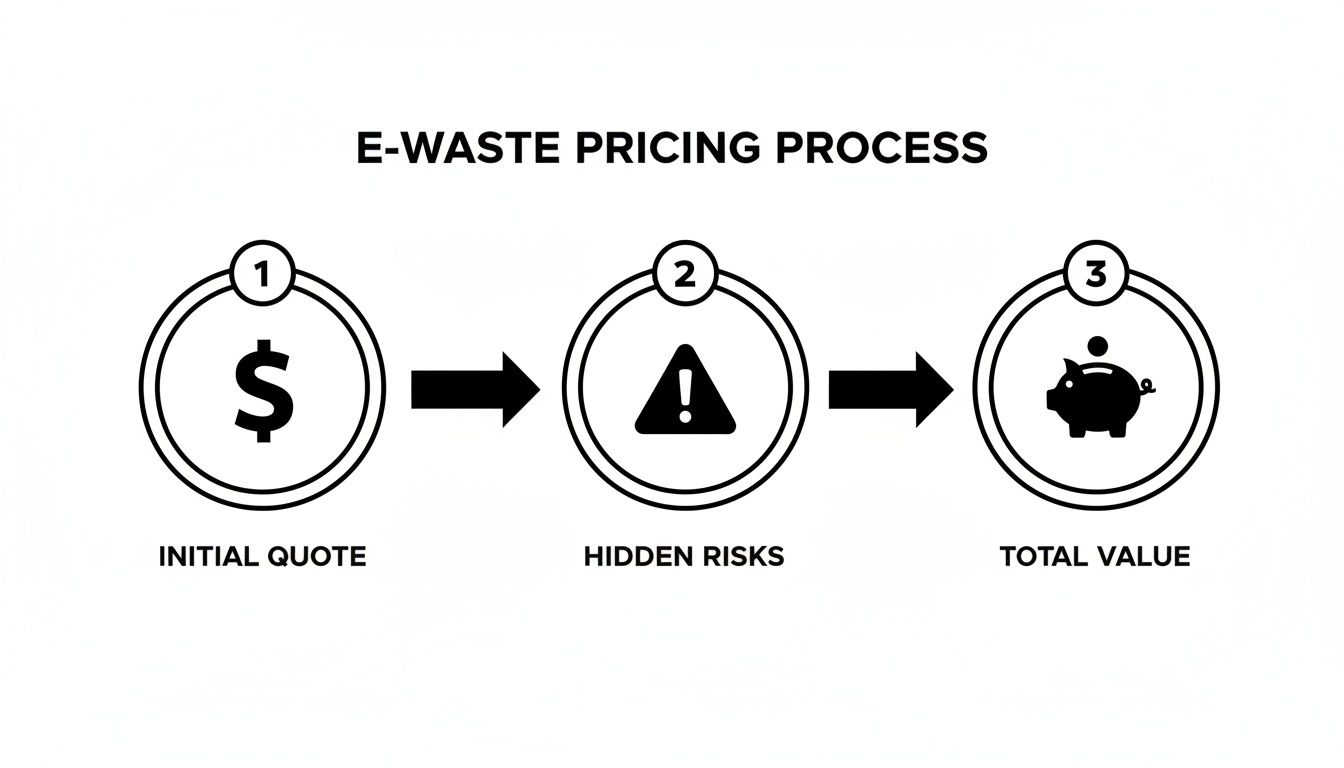
As you can see, the lowest initial quote often hides significant risks. A true partner delivers total value by helping you anticipate and mitigate those hidden liabilities from the get-go.
The real goal is to build a secure, compliant, and sustainable program that fits your organization's specific needs. That requires a partner who is completely transparent and relies on proven, documented processes.
Ready to build a program that protects your organization? The next step is to seek a consultation with a certified e-waste expert to get started.
Your E-Waste Recycling Questions, Answered
When you're setting up a recycling program for your facility, a few common questions always come up. Here are some quick answers based on what we see in the field every day.
What Kind of Equipment Needs a Specialist?
It's not just about the obvious stuff like old computers and servers. Think bigger. We're talking about highly specialized gear like laboratory instruments, sensitive medical devices, and heavy-duty data center hardware.
This isn't your average office e-waste. These assets often have a complicated mix of challenges: they can hold incredibly sensitive data, contain hazardous materials like mercury, or include proprietary tech. You absolutely need to work with certified electronic waste recycling companies who know the rulebook for regulations like HIPAA and complex environmental laws.
How Can I Be 100% Sure My Data Is Gone for Good?
Don't just take a vendor's word for it. Your partner must provide a formal Certificate of Data Destruction. This isn't just a piece of paper; it's a legal document that confirms the job was done right. It should detail the serial numbers of every single device, the exact destruction method used, the date, and a signature from an authorized official.
For absolute peace of mind, nothing beats watching it happen. Ask your vendor if they offer on-site shredding. This lets you physically witness your hard drives and other media being turned into scrap metal before they even leave your building. It’s the ultimate way to guarantee an unbroken, verifiable chain of custody for your most critical assets.
Should I Go With a National Company or a Local Partner?
For a handful of old keyboards, a mail-in box program might be fine. But for institutional-level needs? It's a non-starter. You need a dedicated partner, whether they have a strong local footprint or a well-oiled nationwide logistics network.
A true partner brings the service to you, handling critical on-site tasks that a mail-in program could never offer:
- Professional de-installation and removal of bulky, complex equipment.
- Secure packing and creating a serialized inventory right on your premises.
- Transportation using their own company-owned, GPS-tracked fleet.
This hands-on approach takes the burden off your internal team, drastically cuts the risk of assets getting lost or damaged, and gives you the rock-solid chain of custody you need to prove compliance. At the end of the day, a direct partnership gives you far more control and security over the entire process.
Ready to build a secure, compliant, and sustainable e-waste program for your Atlanta-area lab, clinic, or business? Scientific Equipment Disposal provides certified, on-site services to protect your data and ensure responsible recycling. Schedule your free consultation at https://www.scientificequipmentdisposal.com.