Your Guide to Data Center Equipment Recycling in Gwinnett County, GA and Nationwide

When you're running a hyperscale facility in the Atlanta metro area or anywhere across the US, figuring out data center equipment recycling in Gwinnett County GA is a core part of your strategy, not just a clean-up task. This isn't your standard e-waste run. It’s a complex job involving certified data destruction, compliant recycling, and the heavy logistics of moving sensitive IT assets. Working with a certified local and national partner is the only way to make sure the entire process is handled securely and correctly from start to finish.
Why Data Center Recycling in Gwinnett is a Different Ballgame
Gwinnett County’s explosion as a top-tier national data center market has created a unique problem: a constant, massive flood of retired IT hardware. With Georgia’s competitive energy costs and the endless hunger for AI processing power, facilities are swapping out equipment faster than ever. This boom has created a serious need for recycling solutions built specifically for data centers, both locally and nationwide.
Your average e-waste service just can't keep up. They aren't built for the sheer scale, security demands, or logistical complexity of data center gear. A pallet of old office PCs is one thing; racks of decommissioned servers, SANs, and networking switches that held sensitive corporate data are something else entirely.
The Gwinnett County Data Center Lifecycle Challenge
The rapid growth in Gwinnett County, especially in places like Norcross, creates a cycle of upgrades and disposals that presents both opportunities and significant hurdles for data center managers across the country.
| Driving Factor | Resulting Challenge | The Sustainable Solution |
|---|---|---|
| Rapid AI Adoption | Shorter server lifecycles; massive volume of retired hardware. | Scheduled, high-volume IT asset disposition (ITAD) programs. |
| Data Privacy Regulations (HIPAA, etc.) | Strict requirements for auditable, 100% data destruction. | Certified DoD 5220.22-M wiping and on-site shredding. |
| Environmental Compliance | Need to avoid landfills and properly process hazardous materials. | R2 or e-Stewards certified recycling with full documentation. |
| Operational Uptime | De-installation must not disrupt live data center environments. | Experienced teams providing on-site de-racking and removal. |
This cycle demands a professional, forward-thinking approach. Simply reacting to piles of old equipment isn't a viable strategy for risk management or compliance, whether your facility is in Georgia or another state.
The Scale of the E-Waste Problem Here
The amount of old equipment is hard to wrap your head around. Norcross, sitting right in the middle of Gwinnett, has become North America's sixth largest data center market. This growth is accelerating hardware refresh cycles, especially as AI workloads push older servers into retirement at record speed.
In 2023 alone, Georgia's data centers produced over 10,000 tons of e-waste. Gwinnett's cluster of facilities, which is on track to grow another 25% by 2026, is a huge part of that number, reflecting a nationwide trend.
The real problem isn't just the weight of the old hardware. It’s the incredible density of sensitive data and the regulated materials packed inside every single unit. One server rack can hold petabytes of information and contain dozens of components that need special handling. For security and compliance, you absolutely need expert oversight.
This is Not Your Standard Disposal Job
This is exactly why a generic "electronics recycling" service won't cut it. Data center decommissioning calls for a partner who gets the unique challenges of your environment, whether you're in Gwinnett or managing facilities across the country.
- Rock-Solid Data Security: You have to be certain that every last bit of data is gone for good. That means certified data wiping or physical shredding—it's not optional, especially if you're in a field governed by HIPAA or financial regulations.
- Navigating Compliance: Proper disposal isn't just about being green; it’s about following a web of local, state, and federal laws. Using a certified electronics recycling company in Gwinnett County guarantees you’re checking every box.
- Logistical Know-How: Getting tons of heavy, bulky equipment safely de-installed, palletized, and moved out of a live data center without causing chaos is a specialized skill.
For local operators and national corporations alike, finding an expert like S.E.D. isn't just a good idea—it's essential for managing risk, staying compliant, and protecting your company’s reputation.
Building Your Decommissioning And Asset Recovery Plan
A solid data center decommissioning plan is your best defense against security breaches, logistical headaches, and compliance fines. It’s what separates a controlled, secure project from a chaotic one. Honestly, a successful project is decided long before you ever power down a single server.
The first thing you have to do is create a complete and detailed asset inventory. This means documenting every single piece of gear slated for retirement—servers, storage arrays, switches, and even the power distribution units (PDUs).
If you’re building a strategy from the ground up, a good Hardware Asset Management Guide can provide a solid foundation for tracking assets through their entire lifecycle.
Categorizing Assets For Security And Value
Once you have your master list, you need to sort it. This is where you separate the high-risk gear from the low-risk items and find opportunities to recover value. Not all equipment is the same.
- Data-Bearing Devices: This is your top priority. It includes servers, SANs, and individual hard drives (HDDs and SSDs) that hold sensitive customer or corporate data. These require certified, secure data destruction.
- Networking Gear: Think switches, routers, and firewalls. They might contain configuration data that could become a security risk if they aren't properly wiped.
- Infrastructure Hardware: Racks, cabinets, UPS systems, and cabling don't store data, but they hold plenty of recyclable value.
This breakdown directly shapes your scope of work. For instance, if your inventory shows 150 hard drives governed by HIPAA, that tells your recycling partner you'll need a Certificate of Destruction as part of the deal.
This whole process is becoming more urgent. Georgia’s data center boom, especially with AI driving hardware refresh cycles down to just 18-24 months, is creating a tidal wave of e-waste. In the Atlanta region alone—including Gwinnett hubs like Norcross and Sugar Hill—data centers are on track to add over 1 gigawatt of power by 2025. That translates to an estimated 15,000 metric tons of recyclable IT gear every year.
This diagram shows how data center growth in Gwinnett County leads directly to more e-waste, making a professional recycling plan essential.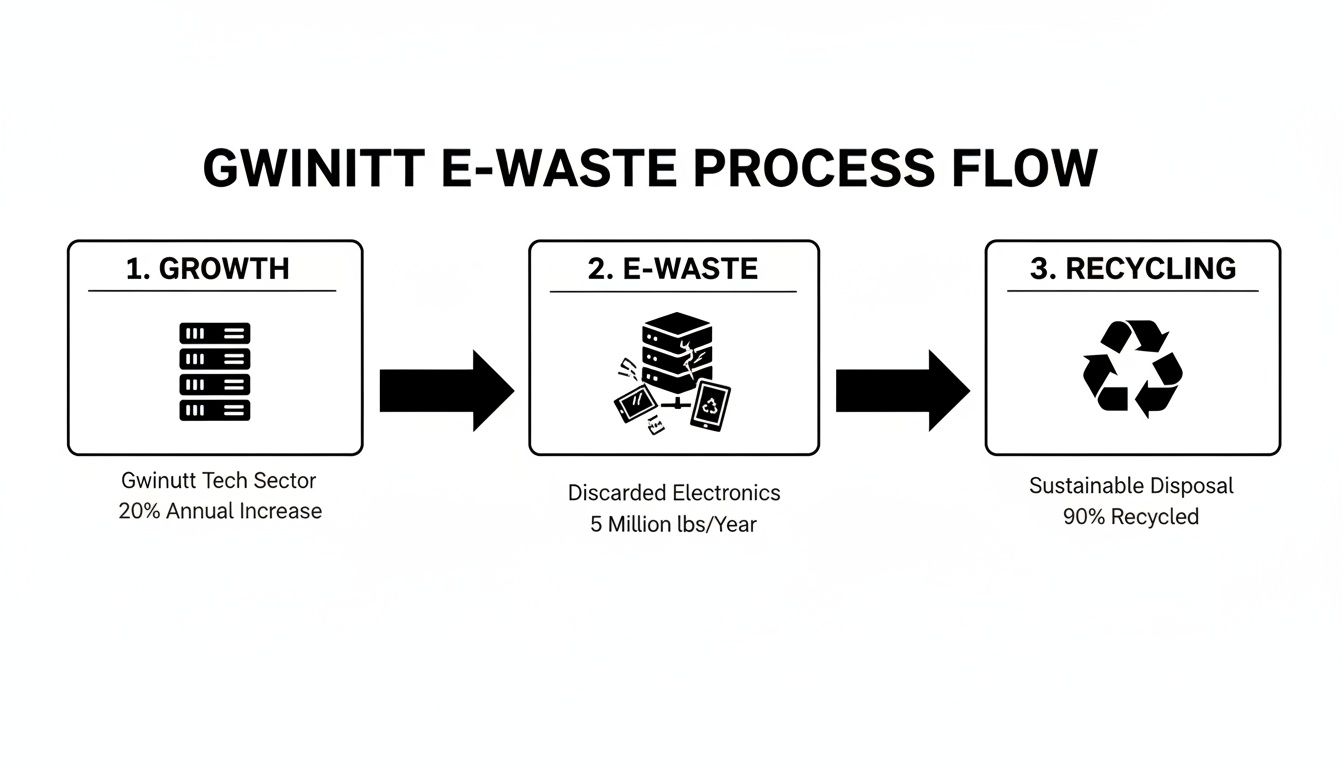
As you can see, the more data center operations expand, the more retired hardware needs to be managed. Professional recycling isn't just an option; it's a critical part of the infrastructure lifecycle.
A common oversight we see is failing to account for peripherals and cables. They seem minor, but the combined weight and material value add up. A detailed plan makes sure nothing gets left behind, which maximizes your recycling efficiency and any potential financial returns.
With a clear inventory and categorization in hand, you're ready to define your project's requirements. This proactive approach is the key to a smooth process. It lets you get an accurate quote and ensures your partner for data center equipment recycling in Gwinnett County GA is fully prepared. You can see our specific process in our guide to IT asset disposition services in Gwinnett County GA.
Choosing Your Secure Data Destruction Method
Once you have a complete inventory of your retired servers and storage arrays, the next big question is how to handle the data on them. This isn't just about security—it's about compliance, your budget, and deciding if your old gear has any life left in it.
For data centers here in Gwinnett County and across the nation, it really comes down to two proven methods: software-based data wiping and good old-fashioned physical shredding. The right call depends entirely on what kind of equipment you have and what your goals are.
DoD Wiping for Value Recovery
Think of this as a digital deep clean. DoD 5220.22-M compliant wiping uses specialized software to overwrite every bit of data on a hard drive with random characters, making the original information impossible to recover. The key benefit? The drive itself is left perfectly functional.
This is the way to go for newer or high-value equipment. By preserving the hardware, you can tap into the resale market and actually generate revenue from your decommissioned assets. We've seen projects where reselling a few racks of servers completely offset the entire cost of the disposal project. It turns an expense into an investment for your next tech refresh.
Physical Shredding for Maximum Security
Physical shredding is exactly what it sounds like. We use powerful, industrial-grade shredders to grind hard drives, backup tapes, and other storage media into tiny, mangled pieces of metal and plastic. There’s no coming back from that.
This method provides undeniable, absolute proof of destruction. It's the best option for:
- Older or broken hard drives that have no resale value.
- Proprietary storage devices that can't be wiped with standard software.
- High-security environments or when your internal policy demands physical destruction.
Deciding Between Data Wiping And Physical Shredding
To make the decision easier for Gwinnett County IT managers and nationwide facility directors, we've broken down the key differences between wiping and shredding. This table can help you match the right method to your specific assets and compliance needs.
| Method | Best For | Key Benefit | S.E.D. Service |
|---|---|---|---|
| Data Wiping | Newer servers, storage arrays, and HDDs with resale potential. | Preserves the hardware, allowing for refurbishment and value recovery. | On-site or off-site DoD 5220.22-M compliant wiping. |
| Physical Shredding | End-of-life hard drives, SSDs, backup tapes, and proprietary media. | Provides absolute, verifiable destruction for maximum security. | On-site or off-site shredding with serialized reporting. |
Ultimately, many data center decommissioning projects use a hybrid approach—wiping what’s valuable and shredding what isn’t. We can help you create a plan that makes the most sense for your inventory.
This kind of responsible disposal is vital for organizations across the Atlanta metro and the entire US. For hospitals, universities, and corporate data centers, it ensures HIPAA compliance and keeps sensitive equipment out of landfills. Without proper data center equipment recycling in Gwinnett County GA, this gear contributes to Georgia's e-waste problem, where only about 20% of electronics are currently recycled.
No matter which path you choose, the process must end with a Certificate of Destruction. This is your legal, auditable proof that every single serialized asset was properly sanitized or destroyed according to all regulations. It's the final, crucial piece of the chain-of-custody puzzle.
For a deeper dive into how we handle this process from start to finish, check out our complete guide on secure hard drive destruction in Gwinnett County Georgia.
Managing The Logistics Of Equipment Removal
Once you’ve sorted out the data destruction, the next big hurdle is physically getting tons of heavy, bulky hardware out of your facility. Moving equipment out of a live data center is a huge operational challenge. This is exactly where bringing in a partner with a dedicated logistics crew makes all the difference for a smooth, secure project, whether locally or nationwide.

The entire goal is to make the removal process feel completely managed, causing zero disruption to your daily operations. That's especially true in a busy area like Gwinnett County, where data centers in Duluth, Suwanee, and Lawrenceville are running 24/7.
What On-Site De-Installation Looks Like
A professional de-installation isn’t just a couple of guys showing up with a truck. It’s a carefully choreographed process designed from the ground up for safety and efficiency.
You can expect the process to look something like this:
- Site Assessment: The logistics team will first walk the floor to assess the layout, check access points, and identify any potential obstacles in your data hall.
- Safe Power-Down and Disconnection: Trained technicians will properly disconnect all hardware from power and network sources, following your established procedures.
- Systematic De-Racking: Servers, switches, and storage arrays are carefully removed from their racks to prevent any damage to the equipment or your surrounding infrastructure.
- Secure Palletizing and Packing: Assets are serialized, palletized, and shrink-wrapped right there on-site. This ensures a secure chain of custody before they even leave your building.
This level of detail is what prevents costly accidents and ensures every single piece of equipment is accounted for from the moment it’s touched.
One of the biggest mistakes we see is teams underestimating the sheer complexity of moving gear out of a crowded data center. A professional crew knows how to navigate tight corridors and work around live racks without causing a single minute of downtime. It's a specialized skill.
Local & National Logistics for Your Facility
The right partner for data center equipment recycling in Gwinnett County GA will have a deep understanding of the local landscape and the capability to scale services nationwide. For instance, businesses like Scientific Equipment Disposal (S.E.D.), headquartered right here in Norcross, GA, are stepping up with tailored server decommissioning services. They can handle everything from on-site de-installation with their own box-truck fleet to secure data wiping using DoD 5220.22-M standards across the United States.
This kind of local expertise and national reach does more than just simplify logistics. It diverts hazardous materials like lead and mercury from landfills—reducing environmental toxicity by up to 70% per recycled load. It can also recover value through refurbishment and resale, potentially offsetting 15-30% of your upgrade costs.
Having a provider with a local presence and national coverage means you get a team that offers flexible scheduling and can respond quickly, wherever your data center is located. This simplifies the whole process, especially for large-scale projects that might require multiple pickups. You can get more details in our guide on how to arrange for an electronic recycling free pick up.
Ensuring Compliance And Unlocking Asset Value
Let's be honest, handling IT asset disposition (ITAD) often feels more like a necessary chore than a strategic opportunity. But thinking of it as just "clearing out old hardware" is a major missed opportunity. It's actually a critical process that blends strict environmental compliance with smart financial thinking. When you work with an R2v3 certified recycler, you're getting a guarantee that hazardous materials like lead and mercury from your server racks and storage arrays will never end up in a landfill. For data center equipment recycling in Gwinnett County GA and nationwide, that's non-negotiable.
But just ticking the compliance box is only half the story. The real game-changer is turning all that decommissioned hardware from a liability into a genuine financial asset. This is where a modern ITAD partner shines, transforming a disposal headache into a win for both your budget and your company’s reputation.
The Financial Upside of Responsible Recycling
Too many data center managers see retired equipment as nothing but a sunk cost. The reality is, a lot of that gear still has significant resale value, especially servers and networking switches that are less than five years old. With the right refurbishment and resale strategy, you can generate a surprisingly substantial return.
This newfound revenue can be put to good use:
- Offset or completely cover the costs of data destruction and recycling logistics.
- Help fund your next hardware refresh, taking a bite out of the capital expense for new equipment.
- Contribute directly to your department's bottom line, showing a clear and measurable return on investment.
This approach completely flips the old disposal model on its head. Instead of paying to get rid of your old tech, your old tech can actually start paying you. You can explore our full range of IT asset disposal solutions to see exactly how we make this happen.
The Power of Local, Certified Recycling
Having a certified partner with a local presence in Gwinnett County and national capabilities makes a world of difference. At Scientific Equipment Disposal, our R2v3 certified processes guarantee zero landfill diversion. We physically shred hard drives right here in-house and ensure components like plastics and glass from monitors are reused, which can cut the resource needs for new manufacturing by up to 50%.
The impact is real. Professional electronics recycling efforts in Gwinnett County have already kept over 500 tons of e-scrap out of landfills in 2024 alone. This creates local jobs and slashes carbon monoxide emissions from new metal mining by more than 50% through recovery. Georgia's data center boom is a huge driver of this change, which you can read more about on Inteleca.com.
By working with a certified local partner with a national footprint, you aren't just ensuring compliance—you're actively strengthening the circular economy. This sends a powerful message to customers and stakeholders that you're an environmentally conscious organization.
Ultimately, picking the right recycling partner is a business decision with benefits that ripple across your entire organization. It secures your data, guarantees environmental compliance, and taps into hidden financial value sitting right there in your data center. This is how the sharpest businesses in Gwinnett and across the US are turning an operational necessity into a real competitive advantage.
Your Data Center Recycling Questions, Answered
When it's time to decommission a data center, IT managers and facility owners in Gwinnett County and across the nation always have questions. It's a big job, and you need to get it right. We get it.
Here are some of the most common questions we hear—and the straight answers you need.
What Types Of Data Center Equipment Do You Recycle?
Simply put, we take everything. A true ITAD partner handles the entire infrastructure, not just the easy-to-recycle items, for facilities anywhere in the United States.
Our teams are equipped to de-install and securely process:
- Servers: Any and all rackmount, blade, and tower servers.
- Storage Hardware: Full SANs (storage area networks), NAS units, and every single hard drive or SSD.
- Networking Gear: Switches, routers, firewalls, load balancers, and everything in between.
- Infrastructure Components: Server racks, cabinets, UPS battery systems, and all the power and data cabling that ties it all together.
If it lived in your data center, we can handle its responsible and secure retirement. This gives you one point of contact for the entire project, simplifying the whole process.
How Can We Be Certain Our Data Is Completely Destroyed?
This is non-negotiable. Data security is guaranteed through a documented, auditable process that starts the second we step foot in your facility, whether in Gwinnett County or elsewhere. We establish a secure chain of custody that follows every single asset until its final disposition.
You get options that align with your security policies. This includes DoD 5220.22-M 3-pass data wiping, which is perfect for assets that still have value and can be resold.
For devices that are obsolete, faulty, or when your policy requires maximum security, physical shredding offers undeniable proof that the data is gone forever.
Every project concludes with a Certificate of Destruction. This is your legal, auditable record that proves every serialized, data-bearing device has been properly sanitized or destroyed. This document is what you’ll need to satisfy any compliance audits for regulations like HIPAA, SOX, or GDPR.
Is There A Cost For Data Center Equipment Recycling?
Many projects end up being low-cost or even generating a cash return for your company. It all comes down to the mix of equipment you have.
The key is value recovery. If your retired servers, networking gear, or storage arrays have a second life, we refurbish and sell them on your behalf. That revenue is shared back with you as a rebate.
This rebate often offsets—or completely covers—the costs for logistics, recycling, and data destruction. We always provide a transparent quote upfront that breaks down all the services, potential costs, and the projected financial return you can expect.
Do You Offer Pickup Services Throughout Gwinnett County and the US?
Yes. As a Gwinnett County-based provider with a nationwide logistics network, we manage on-site de-installation, packing, and secure transport for data centers anywhere in the US.
Our local service area covers all the major business and data center hubs in Gwinnett, including:
- Suwanee
- Norcross
- Lawrenceville
- Duluth
- Buford
Nationally, our team coordinates secure pickups from coast to coast. This is a complete, turnkey service. Your team doesn't have to lift a finger or worry about the back-breaking work of moving tons of heavy equipment. We handle all the logistics so you can stay focused on your core operations.
When you’re ready to implement a secure, compliant, and financially smart strategy for your retired IT assets, Scientific Equipment Disposal is here to help. We provide expert guidance and hands-on service for data center equipment recycling in Gwinnett County and nationwide. Visit us at https://www.scientificequipmentdisposal.com to get started.