Your Guide to Corporate E-Waste Solutions in Atlanta and Nationwide


Corporate e-waste solutions aren't just about hauling away old electronics. They are specialized services designed to manage the secure disposal, recycling, and complete data destruction of a company's outdated tech assets. Think of it less as simple recycling and more as a critical function focused on regulatory compliance, data security, and operational efficiency—all to shield your business from some very serious risks.
Untangling Your Corporate E-Waste Strategy
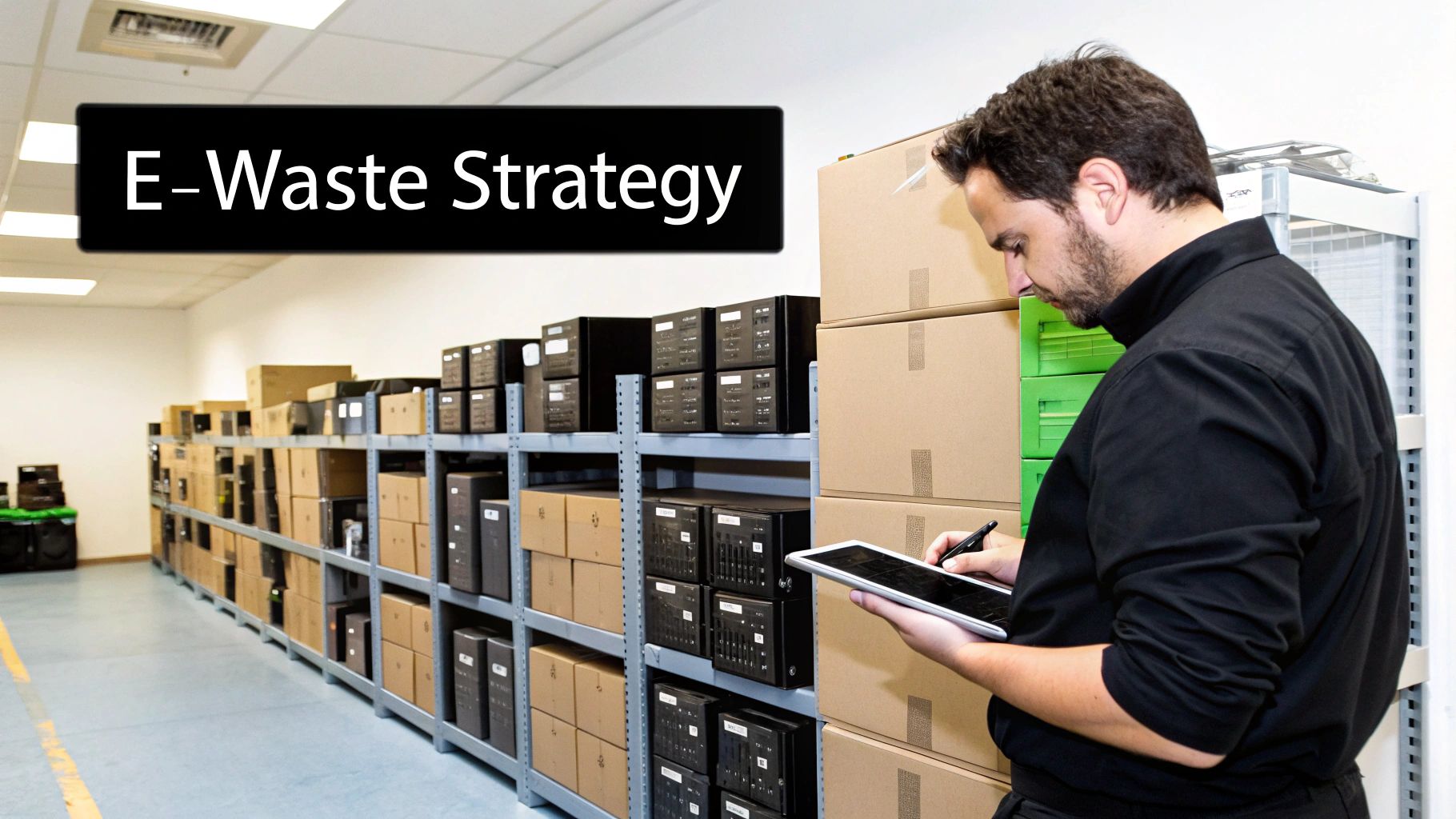
When you're staring at a storage room overflowing with retired servers, old computers, and specialized lab instruments, you're looking at a major business challenge. This isn't just clutter; it's a pile of sensitive data and regulated materials that demands professional handling. This guide is here to cut through the confusion and reframe e-waste disposal as a vital business operation, not just a cleanup task.
Proper management is a multi-layered process. Get it wrong, and your organization is exposed to data breaches, staggering regulatory fines, and a black eye on your public reputation. For companies all over the country, from Atlanta's thriving business sectors to tech hubs nationwide, this problem is only getting bigger.
The Growing E-Waste Challenge
The sheer amount of electronic waste is exploding. Since 2010, global e-waste generation has shot up by a staggering 82%. This tidal wave puts immense pressure on businesses across the United States to find a responsible way to handle their end-of-life equipment.
For industries like healthcare, finance, and technology, this goes way beyond an environmental talking point—it's a legal and financial necessity.
That’s where a specialized partner becomes essential. These experts do more than just pick up your old gear. They deliver a documented, secure, and compliant process that protects your entire organization from start to finish. A true professional understands the distinct needs of different sectors, whether you're in Atlanta, GA or Austin, TX, such as:
- Healthcare Facilities: Ensuring HIPAA compliance by certifying the destruction of patient records on old medical devices and IT hardware.
- Data Centers: Managing the large-scale retirement of servers, storage arrays, and networking equipment while guaranteeing data is wiped beyond any possibility of recovery.
- Research and Education: Handling the disposal of sensitive lab equipment and academic data with a bulletproof, verifiable chain of custody.
A professional e-waste strategy transforms a regulatory headache into a secure and streamlined process. It’s an investment in risk mitigation, protecting your company’s data, reputation, and bottom line.
Consider this guide your playbook for building that strategy. We’ll show you how an expert partner can handle everything from complex lab decommissions to routine IT asset refreshes, making sure your organization stays compliant and secure.
To get a head start on choosing the right vendor, you can explore the key differences between various electronic waste recycling companies and find one that truly fits your needs. Our goal is to equip you to make smart decisions, turning a potential liability into a manageable and sustainable part of your operations.
Why Your Business Needs More Than Just a Recycling Bin
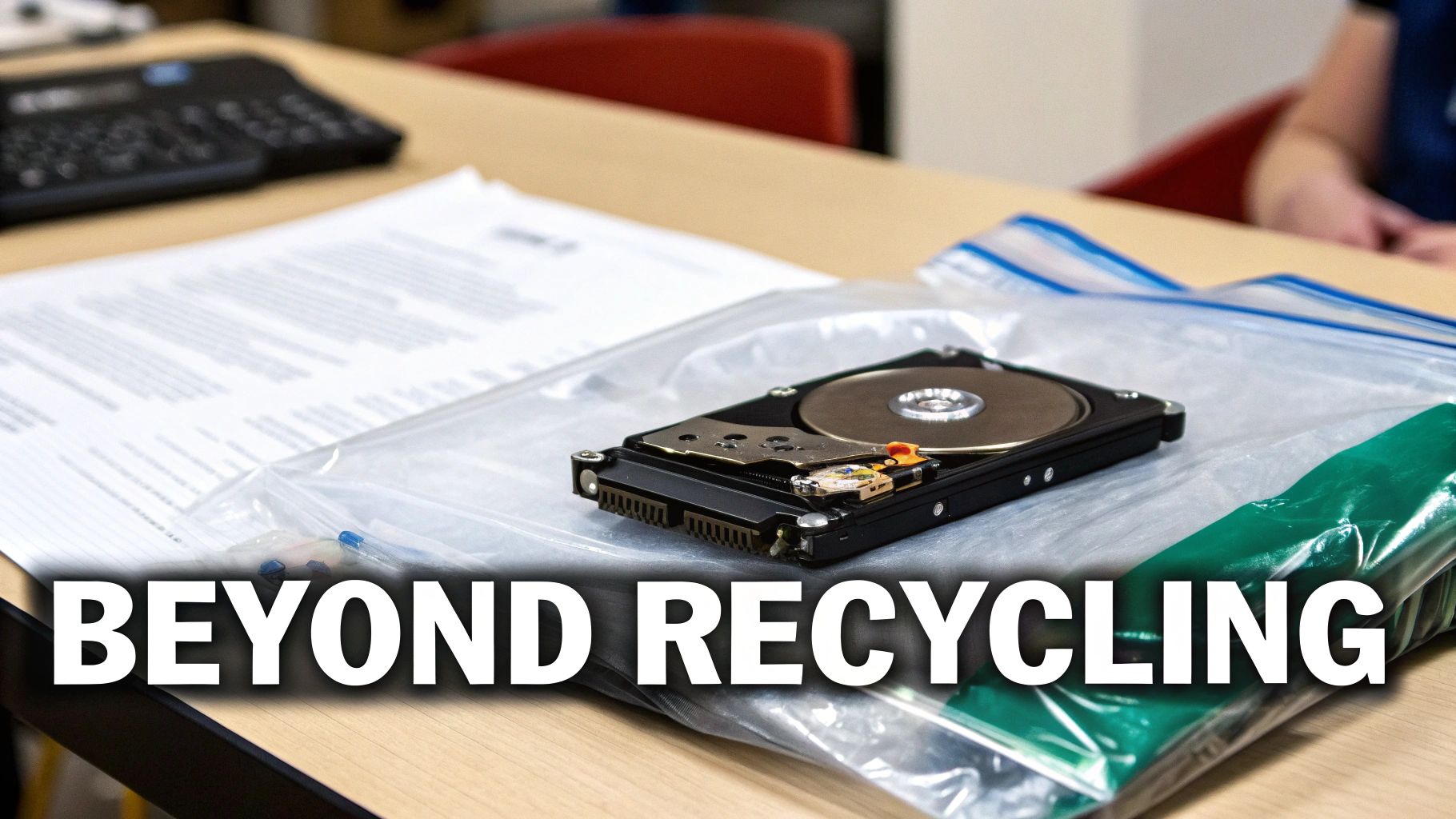
When your company retires old electronics, it's tempting to think the job is done once they're out the door. But tossing them into a standard recycling program is a bit like using a band-aid for a major injury—it doesn't address the real risks hidden underneath.
Think about it. When a business gets rid of a computer, server, or medical device, it isn't just disposing of plastic and metal. It's handling a container filled with sensitive, valuable, and potentially compromising information. This is where a simple recycling program falls dangerously short.
Professional corporate e-waste solutions are built around two pillars that casual recycling can't even begin to address: airtight data security and bulletproof regulatory compliance. These aren’t just "best practices"; they are fundamental to protecting your organization from massive liabilities.
The Unseen Threat Lurking in Old Hardware
Every single retired hard drive, server, or smartphone is a data breach waiting to happen. Hitting 'delete' or even reformatting a drive is child's play for data recovery specialists. Customer lists, financial records, patient data, and priceless trade secrets can all be pulled from devices that weren't properly sanitized.
This is precisely why certified data destruction is non-negotiable. It’s a process designed to make information completely and permanently unrecoverable, shielding your company from the catastrophic fallout of a data leak. We generally tackle this in two ways:
- Software-Based Wiping: We use specialized software to overwrite every sector of a drive with random data, multiple times. This follows strict protocols like the DoD 5220.22-M 3-pass sanitization method, ensuring nothing is left behind.
- Physical Destruction: When a device is broken or you simply need absolute, 100% certainty, nothing beats a shredder. This process physically grinds hard drives and other storage media into tiny, useless fragments.
Choosing the right path is a critical first step. To get a deeper understanding of these methods, check out our complete guide to data security in e-waste management.
A single discarded hard drive can contain enough sensitive information to trigger a multi-million-dollar data breach. Proper destruction isn't an expense—it's an insurance policy against catastrophic liability.
Navigating the Maze of Regulatory Compliance
For businesses in Atlanta and across the country—especially in fields like healthcare, finance, and research—compliance isn't just a suggestion. It’s a legal mandate. Get it wrong, and you’re looking at severe penalties, from crippling fines to potential criminal charges.
A professional e-waste partner lives and breathes this stuff. They provide the critical paperwork, like a Certificate of Destruction, that serves as your proof of compliance. Key regulations you need to know include:
- HIPAA (Health Insurance Portability and Accountability Act): Demands the permanent, secure destruction of all protected health information (PHI) on any electronic device. No exceptions.
- FACTA (Fair and Accurate Credit Transactions Act): Requires businesses to destroy consumer information to protect people from identity theft.
- RCRA (Resource Conservation and Recovery Act): Governs how you handle hazardous materials common in electronics, like lead and mercury.
The global e-waste problem puts a sharp point on why this matters. The world has piled up over 347 metric tons of unrecycled e-waste, with a mind-boggling 420.3 million metric tonnes produced so far. With only 17.4% of e-waste ever making it to a proper recycling facility, the gap is widening fast. This isn't just an environmental issue; it's a massive security and compliance risk for every business.
The Building Blocks of a Secure E-Waste Solution
When you bring on a partner for corporate e-waste solutions, you’re doing a lot more than just hiring a pickup service. You're entrusting a specialized team with a multi-stage process where every single step is critical for your security, compliance, and brand reputation.
A truly effective program is built on five core pillars. Think of it like an engine—if one component fails, whether it's logistics, data destruction, or the final recycling, the whole system breaks down. This can leave your company exposed to data breaches, legal fines, and environmental liability. Knowing what to look for in each area is the key to building a partnership you can actually trust.
Seamless On-Site Logistics and Removal
The whole process starts long before your old equipment ever leaves your facility. Professional on-site logistics are the foundation of a smooth and secure project. This isn’t about a couple of guys showing up with a dolly; it's a planned, coordinated effort designed for your specific environment—be it a busy office in Atlanta, a high-security data center on the West Coast, or a decommissioned laboratory in the Midwest.
This first phase should always include:
- Professional De-installation: Experienced technicians who can safely disconnect and dismantle everything from server racks to complex scientific instruments without getting in the way of your daily operations.
- Secure Packing and Palletizing: Assets are carefully inventoried on-site, packed with the right materials to prevent damage, and secured on pallets to match an organized manifest.
- Efficient Removal: The team handles all the heavy lifting, navigating tight hallways and busy loading docks to get the equipment onto a secure vehicle with minimal disruption.
Secure Chain of Custody During Transit
Once your equipment is packed and ready to roll, the focus shifts to maintaining an unbroken chain of custody. This is simply the documented trail that tracks your assets from the moment they leave your control until they arrive at the secure processing facility. It's your concrete proof that nothing was lost, stolen, or mishandled en route.
A rock-solid transit protocol involves several key elements. The provider must use their own fleet of locked, GPS-tracked vehicles—not third-party freight carriers where control is easily lost. Every asset should be barcoded or tagged, and the manifest signed by both your representative and the logistics team at pickup. This creates a legally defensible record that is absolutely essential for compliance audits.
A documented chain of custody is non-negotiable. It transforms the process from a simple pickup into a secure, auditable transfer of liability, protecting your organization every step of the way.
Certified Data Destruction
This is, without a doubt, the most critical pillar for protecting your organization. Every single hard drive, server, and smartphone is a potential data breach waiting to happen. A top-tier e-waste partner must offer certified data destruction services that guarantee complete, permanent data removal, all backed by official documentation.
There are two primary methods for this:
- Software-Based Sanitization: This method uses specialized software adhering to standards like DoD 5220.22-M to overwrite all data on a drive with random characters. The original information becomes completely unrecoverable. It's a great option for newer, functional drives that might be resold.
- Physical Shredding: For drives that are old, non-functional, or when you need absolute certainty, physical destruction is the way to go. Industrial shredders grind the storage media into tiny, unrecognizable metal fragments, completely destroying the data-bearing platters forever.
After the job is done, you must receive a Certificate of Data Destruction. This document lists the serial numbers of every single device that was sanitized or shredded, serving as your official proof of compliance for regulations like HIPAA.
The table below breaks down the core services you should expect from a comprehensive provider.
Core Services in Corporate E-Waste Management
| Service Component | Description | Key Benefit for Your Organization |
|---|---|---|
| On-Site Logistics | Professional de-installation, packing, and removal of equipment from your facility by a trained team. | Minimizes disruption to your operations and ensures assets are handled safely from the very start. |
| Secure Transit | Transportation in locked, GPS-tracked company vehicles with a documented chain of custody. | Provides a secure, auditable trail that protects against theft or loss and confirms liability transfer. |
| Data Destruction | Certified data wiping (e.g., DoD 5220.22-M) and physical shredding of all data-bearing devices. | Guarantees protection of sensitive information and ensures compliance with data privacy laws (HIPAA, etc.). |
| Responsible Recycling | Dismantling of all equipment and processing of materials through certified downstream recycling partners. | Ensures environmental compliance, prevents hazardous materials from entering landfills, and supports sustainability goals. |
| Asset Value Recovery | Testing, refurbishing, and remarketing of functional, high-value assets to recover residual value. | Creates a revenue stream that can offset or even exceed the costs of the entire disposal program. |
Each of these services plays a vital role in creating a secure, compliant, and financially sound e-waste program.
Responsible Recycling and Downstream Accountability
After all the data has been securely destroyed, the focus turns to environmentally responsible disposal. Tossing electronics in a dumpster isn't just a bad idea—it's illegal and incredibly harmful due to the hazardous materials inside, like lead and mercury. A certified partner guarantees that 100% of your assets are recycled according to strict environmental standards.
This means they have a fully documented process for dismantling equipment into its core components—metals, plastics, circuit boards—and sending those raw materials only to certified downstream partners for processing. This commitment not only keeps you compliant with regulations but also reinforces your corporate sustainability goals. For businesses in Georgia, finding a vendor that understands local rules is crucial. You can find more details about compliant e-waste recycling in Atlanta to make sure your program checks all the right boxes.
Asset Value Recovery
Here's something many people overlook: not all retired equipment is "waste." Many newer or high-value assets still have significant life left in them. The final pillar of a complete solution is Asset Value Recovery (AVR), a process where your provider identifies, tests, and remarkets this functional equipment on your behalf.
This service can turn what was once a disposal cost into a new revenue stream, generating a return that can help offset the costs of the entire program. A transparent partner will give you detailed reports on what was sold and for how much, sharing a portion of the profits with your organization. It's the best way to maximize the financial return on your retired IT assets.
Finding the Right E-Waste Partner for Your Business
Choosing a provider for your corporate e-waste solutions is easily the most critical decision you'll make in your entire asset disposition strategy. This isn't just about hiring someone to haul away old computers. It's about bringing on a partner who acts as an extension of your own risk management and compliance teams, whether you're a local Atlanta business or a national corporation.
For any business, the choice demands a sharp focus on both local capabilities and nationwide service, rock-solid credentials, and a track record you can actually verify.
The right partner shields your organization from the massive financial and reputational fallout that comes with a data breach or a compliance failure. They give you peace of mind because their process is transparent, secure, and documented from beginning to end. When you get this right, you can get back to your real job, knowing your retired assets are being handled responsibly.
The diagram below really breaks down the key parts of a secure e-waste program, showing how logistics, destruction, and recycling all have to work in concert.
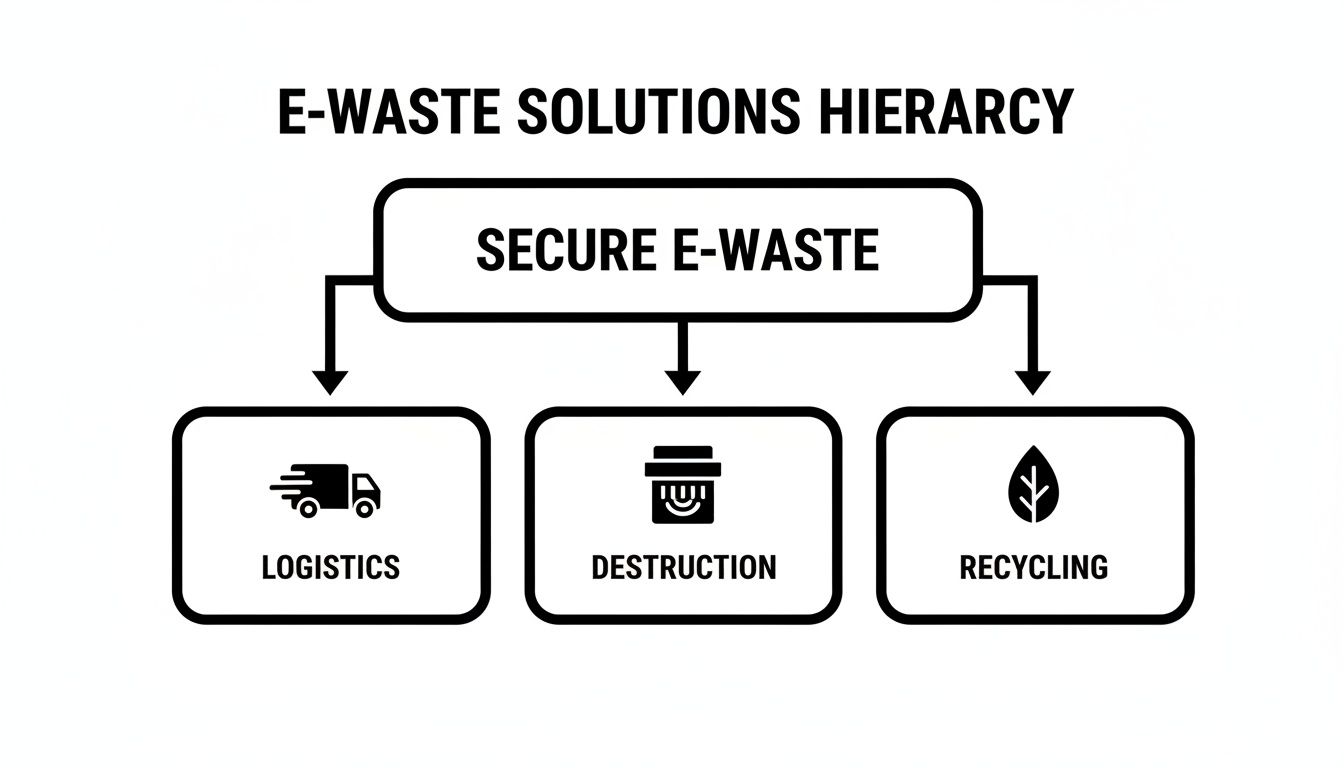
As you can see, secure logistics and certified destruction are the foundation. Those steps have to happen before any responsible recycling can even begin. It’s a security-first approach, every single time.
Vetting Your E-Waste Partner
When you start evaluating vendors, you need a clear framework. Lots of companies offer basic pickup services, but very few provide the specialized, soup-to-nuts management that a corporation really needs. Your vetting process should boil down to a few non-negotiable questions that separate the true experts from the generalists.
Here's what you absolutely must ask any potential partner:
- Do you offer both local and nationwide services? A provider with a physical footprint in the Atlanta area—like a headquarters in Norcross—and a national logistics network is ideal. This combination ensures responsive local service and the capability to manage projects across multiple states consistently.
- What certifications do you hold? You need to see industry-standard certifications like R2 (Responsible Recycling) or e-Stewards. These aren't just logos for a website; they are hard-earned proof that the vendor meets the highest standards for environmental safety, data security, and worker protection.
- Can you handle our specific types of equipment? Your needs probably go way beyond old laptops and monitors. Make sure they have documented experience handling the specialized assets you actually have, whether that's sensitive lab instruments, medical devices, or entire server racks from a data center.
Choosing a partner is a transfer of liability. You are entrusting them with your data and your legal compliance. Verifiable certifications and a transparent process are your best defense against future risk.
Data Destruction and Compliance Documentation
Beyond the big certifications, you have to dig into the nitty-gritty of their data destruction methods. A vague promise to "wipe drives" is a giant red flag. A real expert will give you clear, detailed answers and have the paperwork to prove it.
Demand absolute clarity on these points:
- Documented Destruction Methods: Can they perform both software-based wiping that meets DoD 5220.22-M standards and physical shredding for dead or damaged drives? A top-tier provider offers both and will help you decide which method makes sense for each asset.
- Ironclad Chain of Custody: How do they track your equipment from the moment it leaves your facility to its final disposition? Ask to see their chain of custody forms and learn about their secure, GPS-tracked trucks.
- Guaranteed Certification: Will you receive a formal Certificate of Data Destruction and a Certificate of Recycling? These documents are your legal proof of compliance. They should be detailed, listing the serial numbers of every single asset they processed for you.
Picking the right vendor is a big job, and it helps to understand the different players in the market. To help your research, you can check out a helpful comparison of top e-waste disposal companies to see what sets them apart. This context will arm you to ask even smarter questions when you're vetting potential partners.
Ultimately, your goal is to find a partner who operates with total transparency. That’s what gives you the confidence that your assets, your data, and your company's good name are fully protected.
The Real Cost of E-Waste Disposal
When you start looking at corporate e-waste solutions, it’s easy to focus on the upfront price. But the real financial story isn't about what a pickup costs; it's about the massive value and return on investment (ROI) you get from a professional partnership. Thinking of responsible disposal as just another expense is a huge mistake—it’s actually one of the smartest moves you can make to protect your company from risk and keep operations running smoothly.
The true costs show up when things go wrong. A single hard drive tossed in a dumpster can set off a financial bomb. The fallout isn't just a simple line item; it can include everything from massive regulatory fines to a tarnished brand and crippling legal fees.
Beyond the Invoice: The Tangible ROI
A smart e-waste program pays for itself over and over by shielding your organization from much bigger financial headaches. This isn't just theory; it’s a measurable defense against liabilities that could otherwise sink a business. The real value is in what you don't have to deal with later.
Here’s where you’ll see the actual returns:
- Dodging Data Breach Fines: The average cost of a single data breach runs into the millions. A professional partner gives you certified data destruction, creating a documented paper trail that’s your best defense against compliance penalties and lawsuits.
- Protecting Your Brand Reputation: In today's market, customers and partners want to align with responsible companies. Having a documented, sustainable recycling program boosts your brand image and helps you avoid the negative press that comes from a disposal scandal.
- Boosting Operational Efficiency: Warehouses and storage closets packed with old tech are just dead weight. Getting that valuable space back and freeing up your team from managing obsolete assets directly improves productivity and cuts down on overhead.
Unlocking Hidden Value in Your Old Tech
Beyond just avoiding risk, a professional e-waste solution can actually put money back into your budget. This happens through a process called asset value recovery, where your provider identifies, refurbishes, and resells functional equipment that still has market value.
This service flips what was once a cost center into a potential profit center. The revenue from selling off usable assets can seriously reduce—or even completely cover—the cost of the entire disposal program, delivering a direct financial win.
Globally, the scale of this missed opportunity is staggering. The world is facing an unprecedented e-waste crisis, with 62 million tonnes generated in 2022 alone—an 82% jump from 2010. Buried in that mountain of electronics was an estimated $62 billion worth of recoverable natural resources like gold, copper, and other valuable materials.
For any business planning to dispose of IT assets, working with a certified provider isn't just about checking a compliance box; it's about reclaiming that strategic value. You can dig deeper into these findings and the global e-waste challenge in the latest UN report.
This really drives home the financial logic. Instead of letting valuable assets collect dust in a closet or contribute to a global waste problem, you can turn them back into capital. A professional partner has the know-how and market connections to get the best return, giving you transparent reports and a shared revenue model that directly benefits your bottom line. It’s a financially sound strategy that aligns perfectly with your security and sustainability goals.
Putting Your E-Waste Plan Into Action
Okay, you've got a solid strategy. Now comes the most important part: turning that plan into reality. Actually getting your corporate e-waste program off the ground doesn't have to be a headache. With a clear roadmap, you can make the whole process feel straightforward and get your team executing flawlessly from day one.
This is where the rubber meets the road. It all starts with knowing exactly what you have and ends with a certificate in your hand proving it was all handled correctly. Following a structured process takes the operational burden off your internal teams and guarantees every step is secure and compliant.
Your Step-by-Step Implementation Roadmap
A successful program is all about methodical execution. These steps will guide you from the initial walk-through to the final paperwork, ensuring nothing gets missed along the way. This approach works whether your facility is here in Atlanta or you're coordinating pickups across the country.
-
Get a Handle on Your Inventory: Before you can even think about a quote, you need a rough idea of what you’re getting rid of. Walk through your facility and make a high-level list of the equipment. Note the general categories (laptops, servers, monitors, lab instruments) and give your best guess on the counts. This is the single most important first step for any vendor to scope the project.
-
Identify Your Key Players: Figure out who needs to be in the loop internally. This usually means someone from IT (for data security), facilities (for logistics), and finance or procurement (to sign off on the budget). Getting everyone on the same page early on is the best way to avoid delays down the road.
-
Engage a Vendor for a Real Quote: With your inventory list in hand, it's time to reach out to a certified e-waste partner. Give them the details on your equipment, your location, and any special needs like on-site data destruction. A professional provider will come back with a clear, itemized quote—no hidden fees, no surprises.
The global e-waste problem is getting bigger, faster. This makes planning ahead more critical than ever. Electronic waste is officially the fastest-growing waste stream in the world, and it's projected to blow past 60 million metric tons in 2025. That’s more than double the amount from just a decade ago.
Scheduling Logistics and Getting Proof
Once you’ve picked your partner and approved the quote, the final steps are all about action and verification. This is where a good provider really earns their keep, taking the logistical weight completely off your shoulders.
You'll coordinate with their team to schedule an on-site service at a time that causes the least disruption for your business. Their crew shows up to handle all the de-installation, packing, and secure transport. But the most crucial part of this whole process is the paperwork you get afterward. You must insist on receiving a Certificate of Data Destruction and a Certificate of Recycling that details every single asset they processed. These documents are your official proof of compliance.
To see exactly how this workflow looks from start to finish, you can explore the process of a professional e-waste solution.
Your E-Waste Questions Answered
When you're dealing with corporate e-waste, a lot of questions come up around logistics, data security, and exactly what's involved. We get it. Here are some straightforward answers to the most common questions we hear, so you can feel confident you’re handling things the right way.
What's the First Step for an E-Waste Pickup?
The best place to start is with a basic inventory. You don't need anything too formal, just a general list of what you need to get rid of.
Simply jot down the types of equipment (like servers, laptops, or lab instruments) and a rough count of each. With that list in hand, you can call a certified e-waste provider for a real conversation. They'll use that info to figure out your data security and logistical needs, which allows them to give you an accurate quote and a solid service plan.
How Can I Guarantee My Data Is Destroyed?
This is non-negotiable: you absolutely must get a Certificate of Data Destruction from your vendor. Think of this as your legal receipt, proving that every bit of sensitive information was wiped clean or physically destroyed according to standards like DoD 5220.22-M or NIST 800-88.
For an extra layer of security, you can always ask for on-site physical shredding. This is a great option because you can literally watch your hard drives and storage media get turned into fragments, giving you total peace of mind.
What Kinds of Equipment Do You Take?
A real corporate partner handles a lot more than just old computers and monitors. We're talking about the specialized, heavy-duty assets you find in complex business environments.
Our services cover a wide range of equipment, including:
- Data Center Hardware: Servers, storage arrays, networking gear, and even the server racks they sit in.
- Medical and Laboratory Instruments: Scientific devices, diagnostic tools, and clinical equipment.
- Telecommunications Systems: Old business phones, routers, switches, and all the related infrastructure.
Before you commit, always double-check that your vendor can handle the specific inventory you have.
Do You Provide Services Outside of Atlanta?
Yes. While we have deep roots and a strong presence here in Atlanta, our logistics network is nationwide. This is a huge advantage for companies with a footprint beyond Georgia.
Whether you're shutting down a single lab here in Atlanta or coordinating a multi-state office cleanout, our national reach means you get the same consistent, compliant, and reliable service at every single one of your locations.
Ready to put a secure, compliant, and responsible e-waste plan in place for your organization? Contact Scientific Equipment Disposal today. We’ll give you a transparent quote and show you how our expert team can manage your entire project, from start to finish. Learn more at https://www.scientificequipmentdisposal.com.