Your Guide to Certified Scientific Equipment Disposal Providers

When your lab, hospital, or research facility has aging scientific equipment, getting rid of it is more than just a logistical headache. It’s a major risk. This is where certified scientific equipment disposal providers come in—they turn a complicated problem into a secure, compliant, and sustainable process, whether you're a local lab or a nationwide enterprise.
Why Certified Disposal Is a Must for Modern Labs
For any organization handling sensitive research or patient data, disposing of old lab equipment isn’t just spring cleaning. It’s a critical business function.
Think of it like hiring a certified public accountant for your taxes. You wouldn't trust complex financials to just anyone, and the same logic applies here. You need a real expert to navigate the intricate rules and protect your most valuable information, with services available both locally and across the country.
The stakes are high. Improper disposal can lead to staggering regulatory fines, reputation-shattering data breaches, and environmental penalties. You can’t just toss an old mass spectrometer or DNA sequencer in a standard recycling bin. These machines often hold sensitive data and contain materials that demand special handling.
The Growing Mountain of Surplus Equipment
The need for specialized disposal services is exploding. This boom is tied directly to the blistering pace of innovation in life sciences and medicine, where today's cutting-edge tech becomes yesterday's news in a flash. As labs upgrade, they create a mountain of surplus assets that all need to be decommissioned properly.
The market data tells the story. The global laboratory equipment and disposables market hit a massive USD 40.5 billion in 2024 and is on track to nearly double, reaching an estimated USD 74.8 billion by 2033. This growth highlights the sheer volume of surplus gear—from pipettes and centrifuges to fume hoods and incubators—that facilities must manage. You can explore the full research from IMARC Group to see the trends for yourself.
A Universal Challenge for Labs of All Sizes
This isn't a problem just for the big players. A university lab in the Atlanta metro area faces the same fundamental compliance and security risks as a nationwide biotech firm with labs from California to New York. Both need a partner who gets the specific, high-stakes requirements of scientific asset disposition.
Choosing a certified provider is an investment in risk management. It ensures that every piece of equipment, from a simple benchtop device to a complex analytical system, is handled according to strict protocols, protecting your organization from liability and safeguarding your reputation.
Professional certified scientific equipment disposal providers are the solution. They offer a complete service designed to tackle the unique challenges of the scientific community:
- Guaranteed Data Security: They use proven methods like DoD 5220.22-M data wiping to completely sanitize hard drives and storage media, making sure your proprietary research or patient information is gone for good.
- Regulatory Compliance: These experts know the ins and outs of federal, state, and local regulations, including EPA rules for e-waste and HIPAA for protected health information. They ensure your disposal process is 100% by the book. You can read more about how to achieve EPA-compliant laboratory equipment disposal in our detailed guide.
- Environmental Responsibility: A huge part of their job is keeping e-waste out of landfills. The best providers can recycle or repurpose up to 80-90% of materials, helping you hit your organization's sustainability goals.
When you partner with a certified specialist, you transform a complex liability into a secure and streamlined operation. It lets your team get back to focusing on innovation, not worrying about the afterlife of old equipment.
Breaking Down the Certifications That Actually Matter
When you see a disposal company's truck covered in logos and acronyms, it's easy to tune them out. But when it comes to getting rid of scientific equipment, those certifications aren't just for show. You're not just hiring a pickup service; you're buying documented proof that your retired assets will be handled securely and responsibly.
Think of them as seals of approval. Each one is a guarantee from a third-party auditor that the vendor follows strict rules for environmental safety, data security, and even how they treat their own employees. Getting this right protects your lab, hospital, or company—whether in a specific city like Atlanta or operating nationwide—from some serious financial and reputational headaches down the road.
The Gold Standards in Secure and Responsible Disposal
For any facility dealing with sensitive research or patient data, a few certifications are simply non-negotiable. They separate the real professionals from the "guy with a truck" operations. They are the foundation of a partnership you can trust, ensuring every part of the disposal process is locked down.
Here's what you need to look for:
- R2 (Responsible Recycling): This is one of the biggest names in electronics recycling. An R2 certified provider has proven they follow best practices for everything from environmental protection and worker safety to securely managing data on the devices they handle. They also have to track all materials to their final destination.
- NAID AAA: This one is all about data security. The National Association for Information Destruction (NAID) sets the global benchmark for destroying sensitive information. A NAID AAA certification means the company has passed surprise, unannounced audits covering their hiring practices, facility security, and destruction processes. It’s a serious commitment.
- e-Stewards: Often seen as the toughest environmental standard out there, e-Stewards was created to ensure truly ethical recycling. It completely bans exporting hazardous e-waste to developing nations and using prison labor. If you want the highest level of environmental and social accountability, this is the certification to look for.
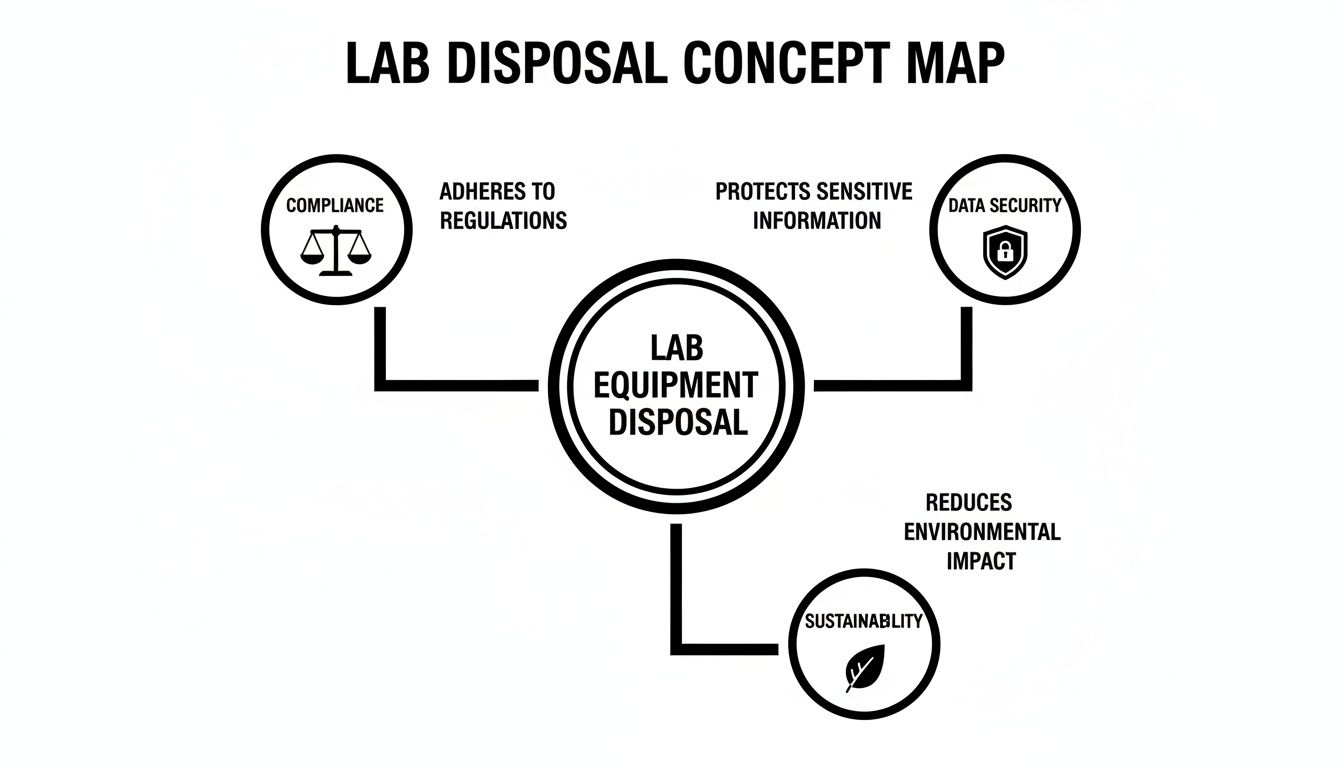
These three areas—compliance, security, and sustainability—all have to work together. You can't have one without the others for a truly risk-free disposal process.
Key Certifications for Scientific Equipment Disposal Providers
To make it even clearer, here’s a quick-glance table comparing these crucial certifications and what they mean for your facility.
| Certification | What It Guarantees | Why It Matters for Your Lab or Facility |
|---|---|---|
| R2 | A comprehensive standard for responsible electronics recycling, covering environmental, health, and safety practices. | Ensures your equipment is recycled in a way that protects the environment and worker health, while also including data security protocols. |
| NAID AAA | The highest level of verification for secure data destruction, validated through unannounced third-party audits. | Your absolute best assurance that PHI, research data, or intellectual property is permanently destroyed and won't lead to a costly breach. |
| e-Stewards | The most stringent standard for ethical and environmental electronics disposal, with a zero-export, zero-landfill policy. | Guarantees your old equipment won't end up illegally dumped overseas or in a landfill, protecting both the environment and your brand’s reputation. |
Choosing a partner with these credentials isn't just about checking a box; it's about building a chain of custody you can actually depend on.
Wiping Data Clean: The DoD Standard
Beyond the company's certifications, you need to know how they actually destroy the data. Many modern lab instruments, from gene sequencers to mass spectrometers, contain hard drives packed with incredibly sensitive information. For a hospital, that’s Protected Health Information (PHI) protected by HIPAA. For a corporate R&D lab, it could be millions of dollars in trade secrets.
This is where the method of data sanitization becomes critically important.
The most respected and secure method is the DoD 5220.22-M 3-pass wipe. This protocol, first created by the U.S. Department of Defense, works by overwriting every bit of data on a hard drive with new, meaningless data—and it does this three separate times. After that, the original information is effectively gone for good.
If a vendor uses this DoD-level wipe, it's a strong signal they take data security seriously. It’s the gold standard for sanitizing drives that might be reused or resold. While physical shredding is another great option, the 3-pass wipe is your best defense against a data breach from a device that was supposedly "erased." It’s a core practice you should expect from any top-tier e-waste recycling company.
Ultimately, these certifications and standards give you a clear roadmap for finding the right partner. They help you sift through the options and find a provider who can deliver the security, compliance, and peace of mind your organization absolutely requires. Always ask for proof of these credentials—it's the single most important step in protecting your assets and your reputation.
Choosing Between Data Wiping and Shredding
When you're getting rid of old lab or scientific equipment, the hardware is one thing, but the data inside is a whole different story. That data—whether it's patient records, research findings, or proprietary formulas—is almost always more valuable and far more sensitive than the machine it's on.
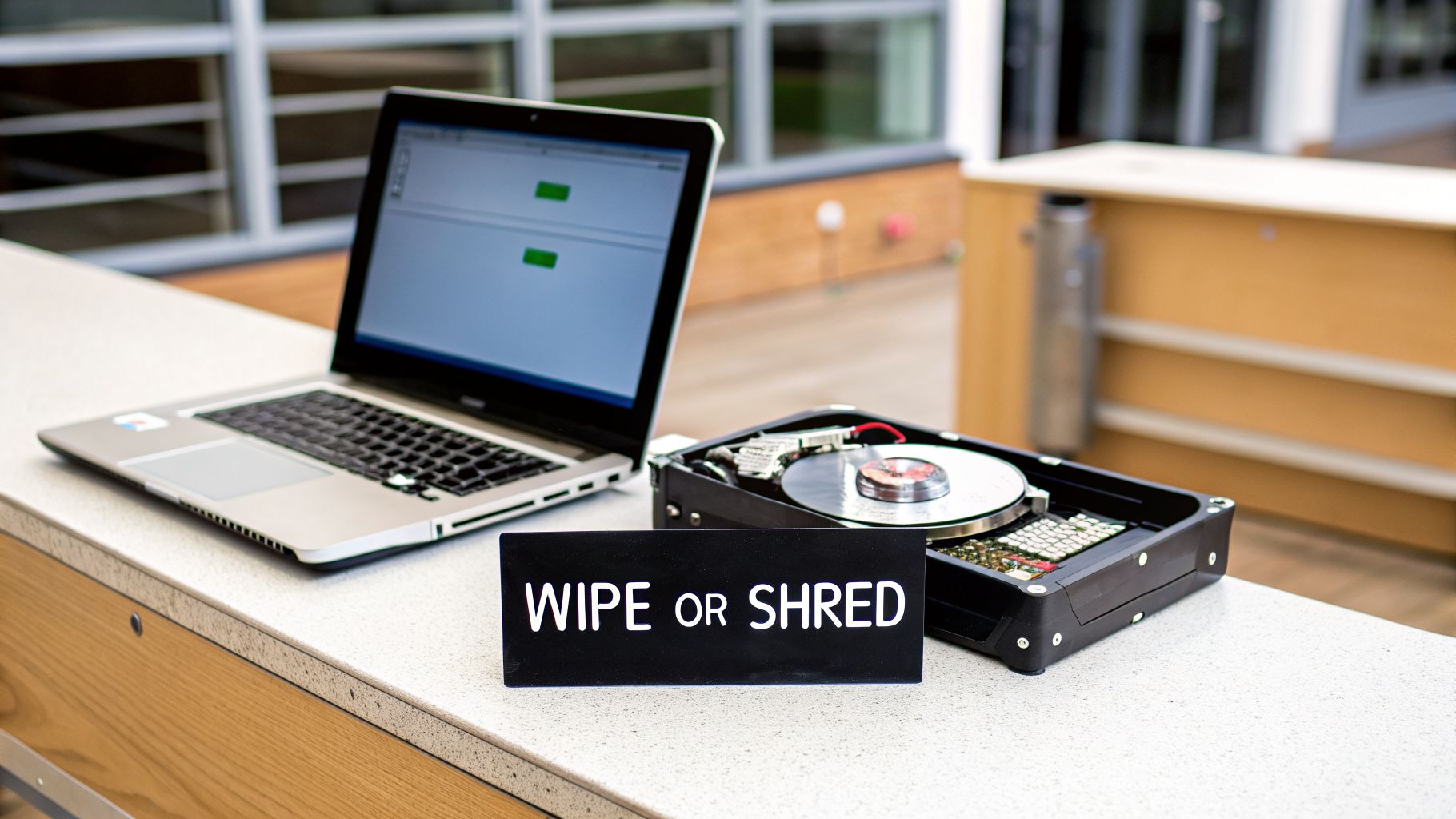
Making sure that information is gone for good is the most critical part of the job. It’s all about mitigating information theft risks from equipment you no longer need. You've really got two main paths to take: digitally wiping the drives or physically shredding them to bits.
Data Wiping: The Digital Deep Clean
Think of data wiping (or sanitization) like professionally renovating a house. You're not tearing it down; you're clearing it out so it can be used again safely. Wiping uses specialized software to overwrite every single part of a hard drive with random data, usually multiple times. This makes the original information completely unrecoverable.
This is the perfect route to take when the hard drives still work and have some resale or reuse value. A professional vendor will use a process like the DoD 5220.22-M 3-pass standard to ensure the data is securely erased, meeting tough compliance rules like HIPAA.
Here’s where wiping makes the most sense:
- Corporate IT Refresh: A company is upgrading laptops for its sales team. The old laptops are still in great shape, so wiping the hard drives allows the company to sell them and recoup some of their initial investment.
- University Lab Upgrade: A research lab replaces a genomic sequencer that's only a few years old. The machine is still valuable, so the drive is sanitized, and the equipment is sold on the secondary market to help pay for the new one.
Shredding: The Brute Force Solution
Shredding is the demolition option—there's no coming back from it. We physically run the hard drive or storage device through an industrial shredder that grinds it into tiny metal fragments. There's simply nothing left to recover data from.
You go with shredding when a drive is broken, too old to have any value, or contained such sensitive data that you can't afford to take even the smallest risk. A national provider can bring a shredding truck right to your facility for on-site destruction or handle it at their own secure location.
No matter which method you choose—wiping or shredding—the final and most critical piece of the puzzle is the Certificate of Destruction. This legal document is your official proof that you did your due diligence. It lists the serial numbers of the drives and confirms exactly how and when they were destroyed, giving you an essential audit trail.
This choice is becoming more important every day. With the lab disposables market expected to grow at a CAGR of 9.54% through 2031, the volume of electronic waste from labs is only going up. As certified scientific equipment disposal providers based in the Atlanta metro area but serving clients nationwide, we've built our services around the strict security needs of medical facilities and research centers, offering everything from DoD-standard wiping to fully documented shredding.
A qualified vendor will help you weigh the security needs against the potential to recover asset value. For organizations managing a large number of drives, services for secure hard drive destruction in Gwinnett County, Georgia offer a local, compliant, and straightforward solution. In the end, it's about making the smart call for your organization's security and budget.
Making Your Lab Decommissioning Logistics Painless
Let’s be honest: lab decommissioning sounds like a logistical nightmare. But it doesn’t have to be. The best disposal partners are really masters of logistics. They offer a complete, end-to-end service that turns a potentially chaotic process into a smooth, coordinated project from the moment they walk in your door. This is where a truly certified scientific equipment disposal provider proves their worth—they do a lot more than just pick up your old gear.
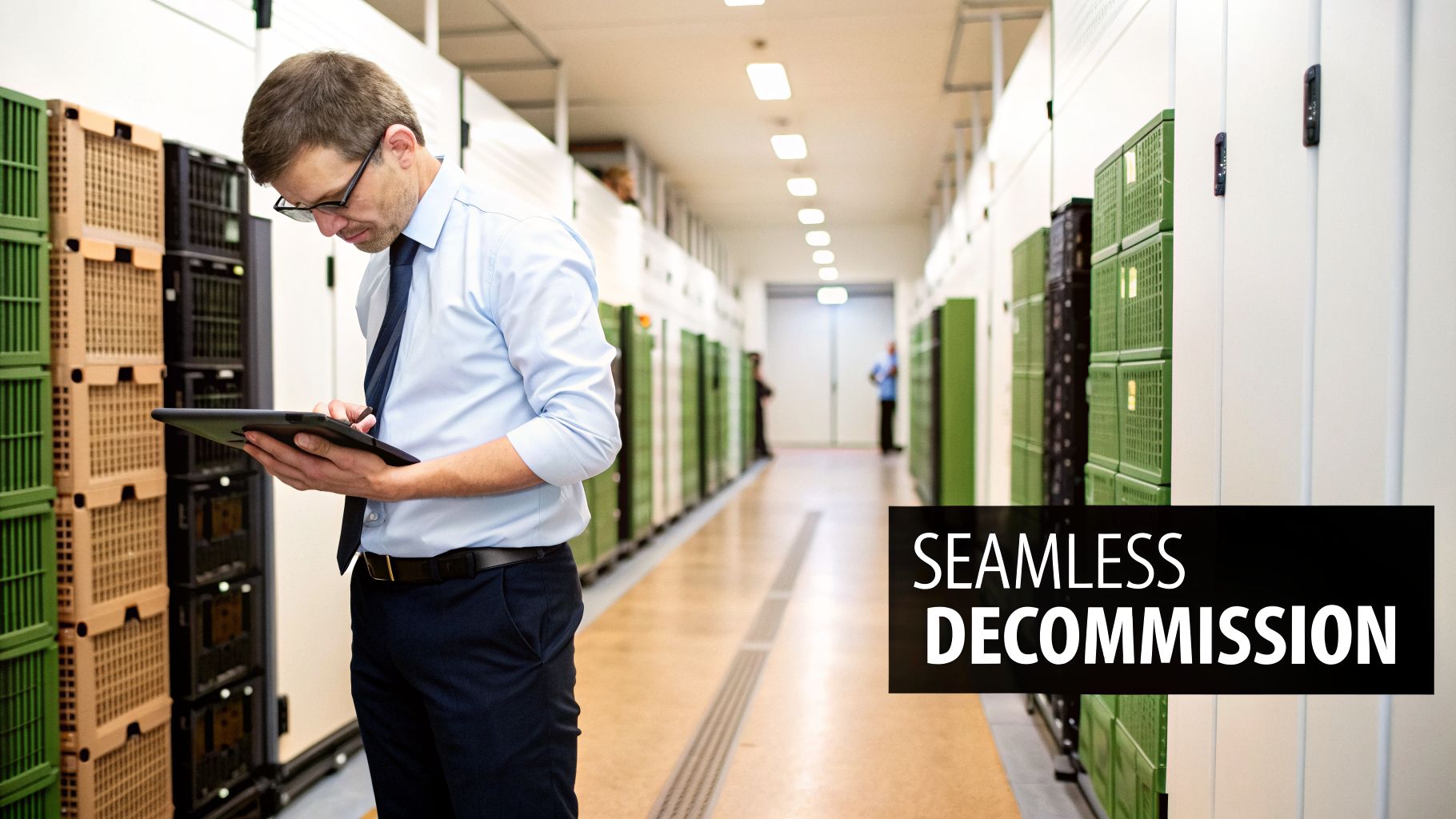
The real value is having one partner who is accountable for the entire job. A top-tier provider handles every single step on-site, including the professional de-installation of instruments, careful packing of sensitive equipment, and secure transport using their own fleet of trucks. This approach means less disruption for your busy lab, hospital, or research center, whether it's a single site or multiple locations across the U.S.
From First Call to Final Sweep-Out, The Process Is Everything
Whether your lab is in a major city like Atlanta or you’re managing multiple sites across the country, having one coordinated partner makes life infinitely simpler. A good process is designed to work around your schedule, not interrupt it. It’s a world away from the headache of trying to manage separate vendors for packing, moving, and data destruction.
This kind of logistical skill is becoming more important than ever. The North American laboratory equipment market was valued at USD 30,060.8 million in 2023 and is expected to hit USD 50,279.2 million by 2030. This boom is fueled by massive R&D spending and the constant need for tech upgrades, which means a staggering amount of equipment needs to be decommissioned in the U.S. every year. You can find more global market insights from DataM Intelligence.
What a Full-Service Logistics Solution Actually Looks Like
A complete logistics solution is about more than just heavy lifting. It's about smart planning and careful execution that protects both your assets and your facility.
Here’s what that process should involve:
- On-Site Assessment: It starts with a project manager visiting your facility. They'll inventory all the equipment, note any challenges like tight hallways or floors that need protection, and map out a detailed plan for removal.
- Smart Scheduling: The provider works with your facility manager to schedule the work during off-hours or quiet periods. The goal is to get the job done without interfering with your daily operations.
- Professional De-installation: A trained crew comes in to safely disconnect and break down everything, from huge analytical instruments to entire rows of server racks.
- Secure Packing and Palletizing: Your assets are carefully wrapped, packed, and palletized right there on-site. This prevents damage during transit and keeps all the parts and pieces together.
- Dedicated Transport: The equipment is loaded onto the provider’s own trucks. This creates an unbroken, secure chain of custody from your door straight to their facility, with no risky handoffs to third-party freight companies.
When one partner handles everything from the initial plan to the final sweep-out, you get total accountability. There are no gaps where security can fail or liability gets murky.
Having that single point of contact is priceless, especially for complicated projects. For labs and universities facing a full-scale decommissioning, a well-managed process is the difference between chaos and calm. You can learn more on our page covering scientific equipment removal for labs and universities. By picking a provider with serious logistical muscle, you can be sure your project gets done securely, efficiently, and with the least possible impact on your team’s work.
How to Select the Right Disposal Provider
Picking a partner for your equipment disposal is a huge decision. Get it right, and you’ll protect your security, compliance, and budget. But get it wrong, and you could be facing serious liabilities and data breach nightmares. It’s a choice that matters whether you need a local vendor in your city or a partner with nationwide reach.
So, how do you tell a truly professional disposal provider from a less-than-reputable operator just trying to make a quick buck? You have to go beyond the sales pitch and ask the tough, specific questions that reveal what they're really about. This is your vetting checklist—use these questions to interview any potential vendor and find a partner you can trust.
Verifying Core Credentials and Security Protocols
Before you even think about logistics or pricing, you need to lock down their security and compliance credentials. The answers you get here will tell you almost everything you need to know about how seriously they take protecting your organization.
Start with the absolute most important question: Are you R2, e-Stewards, or NAID AAA certified?
- A good answer: "Yes, we are [certification name] certified. We can send you a copy of our current certificate right now." A great partner will be proud of their certification and can explain exactly what it means for keeping your equipment and data secure.
- A red flag: Watch out for vague answers like, "We follow those standards," or "We work with a certified partner." This usually means they aren't certified themselves. This creates a break in the chain of custody and leaves your organization completely exposed.
Next, hit them on data destruction: Can you provide a Certificate of Destruction for all data-bearing media?
- A good answer: "Absolutely. We issue a serialized Certificate of Destruction for every single project. It's your legal proof that the data is gone for good." They should also be able to tell you if they use the DoD 5220.22-M or NIST 800-88 standard for wiping.
- A red flag: If they hesitate, try to charge extra for it, or can't show you a sample, walk away. That certificate is non-negotiable. It’s your only documented proof of due diligence.
Evaluating Logistical Capabilities and Accountability
Once you’ve confirmed their security is rock-solid, it’s time to find out how they’ll actually get the job done. A vendor’s process for removing equipment from your facility is just as important as what happens to it afterward.
Ask about how they run their operation: Do you manage logistics in-house or use third-party contractors?
An ideal provider uses their own trained employees and their own fleet of trucks for all on-site work and transportation. This creates a single, unbroken chain of custody, ensuring total accountability from your facility all the way to theirs.
When a company uses random third-party freight carriers or temporary labor, it introduces massive risks and potential gaps in liability. You lose control and visibility the second your assets leave the building.
Dig into their process with this question: What does your on-site service include?
- A good answer: They should outline a full-service, white-glove process. This includes an initial site visit, professional de-installation, secure packing of every item, and careful removal—all scheduled to cause minimal disruption to your team.
- A red flag: If their plan is just "curbside pickup" or they expect your staff to do all the prep work, they aren't a true decommissioning partner. They're just a hauler, and they're shifting all the work and risk back onto your shoulders.
Vendor Vetting Checklist
Use this checklist to evaluate potential scientific equipment disposal providers and ensure they meet your organization's standards.
| Question to Ask | Ideal Answer or Green Flag | Warning Sign or Red Flag |
|---|---|---|
| Are you R2, e-Stewards, or NAID AAA certified? | "Yes, here is a copy of our current certificate." They can explain what it means. | "We follow those standards," or "Our downstream partner is certified." |
| Can you provide a serialized Certificate of Destruction? | "Yes, it's standard for every project and lists every asset." They can provide a sample. | "That costs extra," hesitation, or an inability to provide a sample. |
| Do you use your own employees and trucks for pickup? | "Yes, all our staff are background-checked and trained, and we use our own secure fleet." | "We use third-party logistics partners" or "We hire local contractors." |
| What does your on-site service include? | "We handle everything: de-installation, packing, palletizing, and removal." | "We offer curbside pickup" or "Your team will need to have everything ready for us." |
| What is your process for data-bearing lab instruments? | "We identify all data-bearing devices, remove storage media on-site if requested, and follow a strict wipe or shred protocol at our facility." | "We just recycle them" or no clear process for handling embedded data. |
| Can you provide client references from a similar industry (e.g., hospital)? | "Of course, we can connect you with several long-term clients in your field." | "Our client list is confidential" or providing irrelevant references. |
| Do you have pollution liability and data breach insurance? | "Yes, we carry [specific amount] in coverage and can provide a Certificate of Insurance." | Vague answers, low coverage amounts, or an inability to provide proof of insurance. |
This checklist is your first line of defense. A vendor who can confidently answer these questions is one that takes their responsibility—and your security—seriously.
For an even deeper look at vetting potential partners, check out our guide on how to choose an electronic waste recycling company.
By arming yourself with these critical questions, you can cut through the marketing fluff and find a provider who delivers the security, compliance, and logistical support your organization truly needs. A strong partnership here protects your data, your reputation, and your peace of mind.
Got Questions About Equipment Disposal? We've Got Answers.
Even with a solid plan, a few questions always pop up. Here are the answers we give lab managers and facility directors most often, helping you tackle the final details of your project.
What Types of Equipment Do You Handle?
Just about everything in a lab. We can manage a huge range of assets, from small benchtop gear like centrifuges, microscopes, and pipettes all the way up to massive analytical instruments, ultra-low temperature freezers, and even entire lab cleanouts.
And don’t forget the IT gear tied to that equipment. We securely process all the associated computers, servers, monitors, and data storage arrays that control your instruments or hold their valuable data. Every single component is accounted for.
How Much Will This Service Cost?
This is the big question, and the answer really depends on what you have, how much of it there is, and where you're located. Your data destruction needs also play a role. But here's the good news: it's often much more affordable than you might think.
Because we have strong remarketing channels for reusable equipment, we can often provide our services at no cost—or even write you a check. The value we recover from your usable assets helps pay for all the logistics and recycling costs. The best way to know for sure is to ask for a detailed, itemized quote.
One of the biggest myths we hear is that certified disposal is just too expensive. The truth is, a good partner will work hard to find the value in your old equipment to drive your costs down, often to zero. This makes full compliance and security totally achievable.
Can I Trust Data Wiping Services?
Absolutely, as long as it's done by a certified professional following strict standards. When we use methods like DoD 5220.22-M or NIST 800-88, the data isn't just deleted—it's destroyed for good.
This process overwrites your hard drives with random data, sometimes multiple times, making the original information impossible to recover with any known technology. For your own records and peace of mind, we always issue a serialized Certificate of Destruction to prove the job was done right.
Do You Offer Nationwide Services or Just Local?
While we have deep roots in the Atlanta metro area, our reach is fully nationwide. As a top-tier provider, we operate our own logistics network to coordinate secure pickups and complex decommissioning projects for facilities all across the country.
This means you get the same consistent, secure, and compliant service whether you're managing a single lab or a hospital network with locations in multiple states.
Ready to simplify your lab decommissioning with a secure, compliant, and sustainable solution? Contact Scientific Equipment Disposal for a no-obligation quote and see how we can help you manage your surplus assets. Visit us at https://www.scientificequipmentdisposal.com to learn more.