Lab Laboratory Equipment Disposal: Safe & Compliant Nationwide

Every piece of lab laboratory equipment in your facility, from a workhorse centrifuge in an Atlanta lab to a complex spectrometer in a research center in California, has a lifecycle that goes far beyond its day-to-day use. That journey includes a critical final chapter: end-of-life management. For labs across the country, from bustling urban centers to remote research outposts, having a solid disposal plan isn't just good practice—it's essential for staying efficient, compliant, and sustainable.
The Inevitable Lifecycle Of Lab Equipment
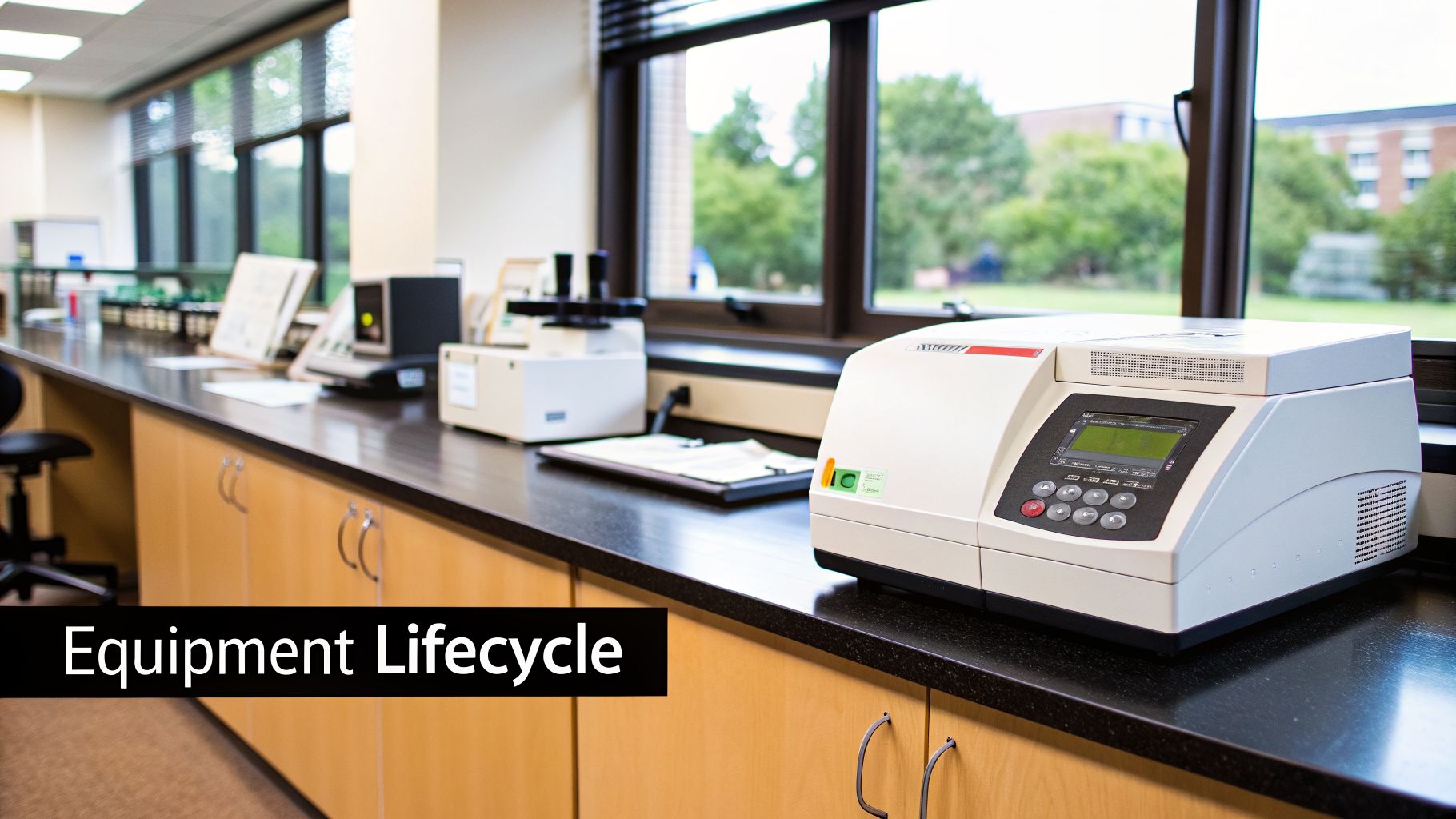
Think of your scientific instruments like a car. When a vehicle gets old or just doesn't meet your needs anymore, you don't just leave it on the side of the road. You make a plan for its retirement, whether that’s a trade-in, a private sale, or responsible scrapping. The exact same logic applies to the assets in your facility, no matter where your lab is located in the U.S.
This cycle of renewal is happening all the time. From biotech startups in research hubs like Boston and San Francisco to major research universities nationwide, labs are constantly upgrading their tools to keep up with scientific progress. This creates a steady stream of surplus equipment that someone has to manage.
The Growing Need For A Disposal Strategy
This constant churn is driven by a market that's expanding at an incredible pace. The global laboratory equipment sector was valued at roughly USD 35.90 billion in 2026 and is expected to more than double to USD 74.22 billion by 2035. This boom reflects the massive demand from pharmaceutical, biotech, and research institutions across North America and the world.
End-of-life management isn't just a logistical headache; it's a critical phase for maintaining operational efficiency, ensuring regulatory compliance, and meeting modern sustainability goals. A proactive plan prevents retired equipment from becoming a liability.
All this growth means more equipment becomes outdated, and it's happening faster than ever. Suddenly, strategic disposal shifts from a background task to a core operational priority for labs everywhere. Without a clear process, facilities risk piling up obsolete assets that eat up valuable space and create serious compliance risks. Adopting comprehensive IT Asset Management best practices is the key to managing the entire lifespan of your equipment, from the day it arrives to the day it leaves.
Why A Nationwide Plan Is So Essential
A formal disposal strategy is your roadmap for navigating this lifecycle responsibly, whether you operate a single lab or a network of facilities across multiple states. It helps your organization sidestep common pitfalls and even unlock hidden value in those retired assets.
A well-defined plan addresses several key areas:
- Operational Efficiency: Frees up lab space and resources by systematically clearing out non-functional or obsolete equipment.
- Regulatory Compliance: Ensures all disposal activities meet strict federal, state, and local environmental and data security standards, protecting your organization from hefty fines.
- Sustainability Goals: Supports corporate responsibility initiatives by diverting waste from landfills and promoting the reuse of valuable materials.
To get started, it helps to have a clear checklist. This simple framework outlines the key stages and considerations for any successful lab equipment disposal project, applicable anywhere in the nation.
Your Lab Equipment Disposal Planning Checklist
| Stage | Key Objective | Primary Consideration |
|---|---|---|
| Inventory & Assessment | Create a complete list of surplus assets. | What equipment is being retired? What is its condition and potential value? |
| Decontamination | Ensure all equipment is safe to handle. | Has all biohazardous, chemical, or radioactive material been removed and certified? |
| Data Security | Protect all sensitive information. | Does the equipment store patient data, research, or IP that needs to be destroyed? |
| Logistics & Removal | Plan the physical removal of the assets. | Who will handle de-installation, packing, and transportation from the facility, locally or cross-country? |
| Final Disposition | Choose a compliant disposal pathway. | Will the equipment be resold, recycled, or disposed of? Is the vendor certified and do they have a national reach? |
| Documentation | Maintain a complete audit trail. | Can you provide Certificates of Destruction and Recycling for compliance purposes? |
Having this plan in place turns a complex process into a manageable workflow, ensuring nothing gets missed.
Ultimately, understanding the full lifecycle of your lab equipment is the first step toward managing it effectively. If you're wondering what happens next, you can explore our guide on what happens to old laboratory equipment after disposal.
Understanding Different Lab Equipment Disposal Categories
When it's time to clear out old equipment, you can't just treat everything the same. Just like you separate paper, plastic, and glass for recycling at home, your lab assets need to be sorted into a few key categories.
Getting this right from the start helps you plan for specific handling requirements and avoid the headaches of compliance missteps or data breaches. Think of it as creating a decommissioning inventory. By grouping items with similar challenges, you can make the entire disposal process much smoother, whether you're in a specific city like Atlanta or managing facilities nationwide.
Let’s break down the common equipment categories you’ll run into.
General Benchtop Equipment
This is the everyday stuff—the workhorses you'll find on nearly every bench in your facility. They're usually smaller, but you probably have a lot of them.
- Examples: Pipettes, centrifuges, vortex mixers, shakers, hot plates, and pH meters.
- Disposal Challenges: The main hurdle here is decontamination. These items have almost certainly been in contact with biological or chemical materials. Before they can go anywhere, they have to be properly cleaned and certified safe according to your EHS (Environment, Health, and Safety) protocols.
- Material Value: While one or two might not seem like much, the value adds up fast when you're clearing out a whole lab. Many contain recyclable metals and plastics that a certified national partner can recover.
For a closer look at the regulatory side of things, check out our guide on EPA-compliant laboratory equipment disposal.
Analytical Instruments
These are the sophisticated, high-value machines your lab relies on for precise measurement and analysis. They come with their own unique disposal challenges that require a much more careful approach, no matter your location.
Analytical instruments aren't just pieces of hardware; they are often repositories of sensitive data and can contain both valuable and hazardous materials. Getting rid of a mass spectrometer is a completely different ballgame than tossing a beaker.
Common examples include:
- Mass spectrometers
- Gas and liquid chromatographs (GC/LC)
- DNA sequencers
- Spectrophotometers
- Real-time PCR systems (thermocyclers)
Disposing of these instruments brings a two-part challenge. First, many contain hazardous components like mercury lamps or even small radioactive sources that demand specialized handling. Second, and equally important, they often have internal hard drives or are connected to computers that store sensitive research, patient data, or valuable intellectual property.
Large-Scale Systems and Fixtures
This category covers the heavy-duty, often built-in systems that act as the backbone of your lab's infrastructure. Simply moving these giants is a major logistical project that requires local expertise and nationwide capability.
- Examples: Fume hoods, biological safety cabinets (BSCs), large autoclaves, and environmental chambers.
- Disposal Challenges: Their sheer size and weight make removal a job for professionals. Beyond that, systems like fume hoods and BSCs are built specifically to contain hazardous substances. They need expert decontamination and careful dismantling to ensure no contaminants are released back into your facility.
Associated IT and Electronics
Finally, don't overlook the massive network of computers and electronics that keep a modern lab running. From the dedicated PC that operates an analyzer to the servers storing all your research, this IT gear is everywhere.
Common IT assets in a lab setting include:
- Desktop computers and laptops
- Monitors and peripherals
- Servers and data storage arrays
- Network equipment like switches and routers
For this category, data security is priority number one. A single hard drive can hold years of proprietary research. Simply hitting "delete" isn't enough to protect you. These drives must be physically destroyed or professionally sanitized using methods like the DoD 5220.22-M 3-pass wipe to make absolutely sure that data can never be recovered.
Navigating Compliance and Data Security in Disposal
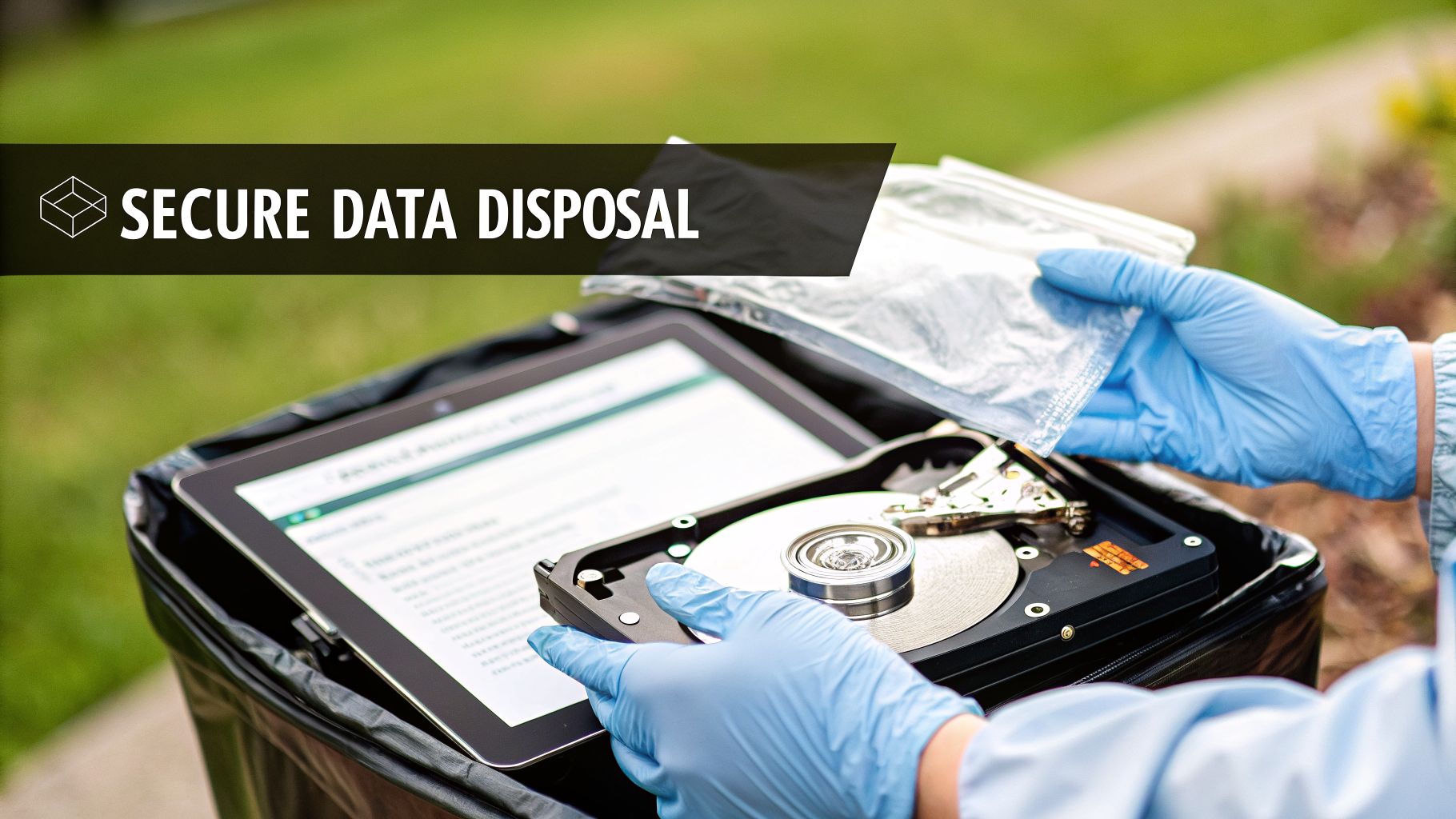
Tossing out old lab equipment without a clear plan isn't just a logistical headache—it's a serious business risk. The second a retired asset leaves your facility, you're exposed to a tangle of legal and security issues. One wrong move can lead to massive fines or a data breach that damages your reputation for good.
From federal laws to local city ordinances, staying on the right side of the rules is critical. For any lab in the United States, the two things that matter most are environmental compliance and data security. One protects your organization legally, while the other protects your most valuable information.
The High Stakes of Data Security
Think about the modern analytical instruments and computers in your lab. They're not just tools; they're vaults of sensitive information. This could be anything from confidential patient health data to proprietary research that’s worth millions.
For example, imagine a hospital in a major city like Atlanta discards a diagnostic machine without properly wiping the hard drive. If that drive, full of patient records, ends up in the wrong hands, the fallout is immediate and severe—identity theft, crippling fines, and a public relations disaster.
A simple "delete" doesn't actually get rid of your data. It just hides the file, leaving the information behind for anyone with basic recovery software to find. Professional data sanitization isn't just a good idea; it's an absolute must.
This is exactly why a certified, fully auditable data destruction process is non-negotiable for any piece of lab laboratory equipment that stores data. When you're dealing with equipment that may hold patient information, understanding the nuances of HIPAA compliance for data is crucial to staying protected.
Understanding Data Destruction Standards
To make sure your data is gone forever, professional disposal partners use proven, military-grade methods. The gold standard in the industry is the DoD 5220.22-M 3-pass sanitization standard.
This technique overwrites the entire hard drive with specific data patterns three separate times. It's like painting over a canvas three times with different colors—it makes it physically impossible to see the original image underneath. For drives that are old or broken, physical shredding is the ultimate failsafe.
Key Regulations Governing Lab Equipment Disposal
Beyond data, several major regulations control how lab equipment must be handled and disposed of across the nation. While this isn't a full legal guide, these are the main frameworks you need to know:
- Environmental Protection Agency (EPA): The EPA’s Resource Conservation and Recovery Act (RCRA) sets the national rules for solid and hazardous waste. A lot of lab laboratory equipment is classified as e-waste because it contains toxic materials like lead, mercury, and cadmium that can't just be dumped in a landfill.
- Health Insurance Portability and Accountability Act (HIPAA): The HIPAA Security Rule demands that you protect electronic protected health information (ePHI) no matter where it's stored. That includes the hard drives inside your old medical and lab equipment. Violations can lead to fines well into the millions.
- Occupational Safety and Health Administration (OSHA): OSHA rules apply to the decontamination process, making sure that equipment is cleaned and safe for any team—and yours—to handle, transport, and recycle, whether locally or across state lines.
Working with a certified vendor who lives and breathes these regulations is your best defense against risk. A qualified partner with nationwide service will provide a clear Certificate of Destruction, giving you the official documentation you need to prove you've met all your compliance duties. You can learn more about our process in our overview of security and data destruction services. That paperwork is your proof, protecting your organization long after the equipment is gone.
Exploring Sustainable Pathways for Retired Equipment
So, what really happens to a centrifuge after it’s wheeled out of your facility in Atlanta? Many assume it's headed for a landfill, but that’s far from the truth. Its retirement can actually be the start of a new, sustainable journey. Instead of becoming another piece of waste, your old lab equipment can be broken down and transformed back into valuable raw materials, fueling what’s known as the circular economy.
This trip from a lab asset to a usable resource is a carefully managed process. When equipment gets to a certified recycling facility, it isn't just tossed into a crusher. It’s painstakingly dismantled by hand. Think of it as a reverse assembly line where skilled technicians take everything apart, sorting each component for its next life.
The Journey from Lab to New Life
This systematic deconstruction is critical because modern lab equipment is a complex mix of materials. Each one—from steel to plastic to glass—has a different path back into the manufacturing stream.
The process generally breaks down like this:
- Careful Dismantling: Technicians take apart each unit piece by piece to get to the internal components and separate all the different material types.
- Material Sorting: Metals like steel, aluminum, and copper are grouped together. Circuit boards, plastics, and glass are also segregated into their own categories.
- Commodity Preparation: Once sorted, the materials are processed—shredded, baled, or even melted down—so they can be sold as raw commodities to manufacturers.
This detailed approach ensures that the absolute maximum amount of material is recovered. Instead of being buried in the ground, these resources get a second chance, re-entering the supply chain and reducing the need to mine for new materials.
This simple but powerful flow, from dismantling to the final reuse of raw materials, is shown below.
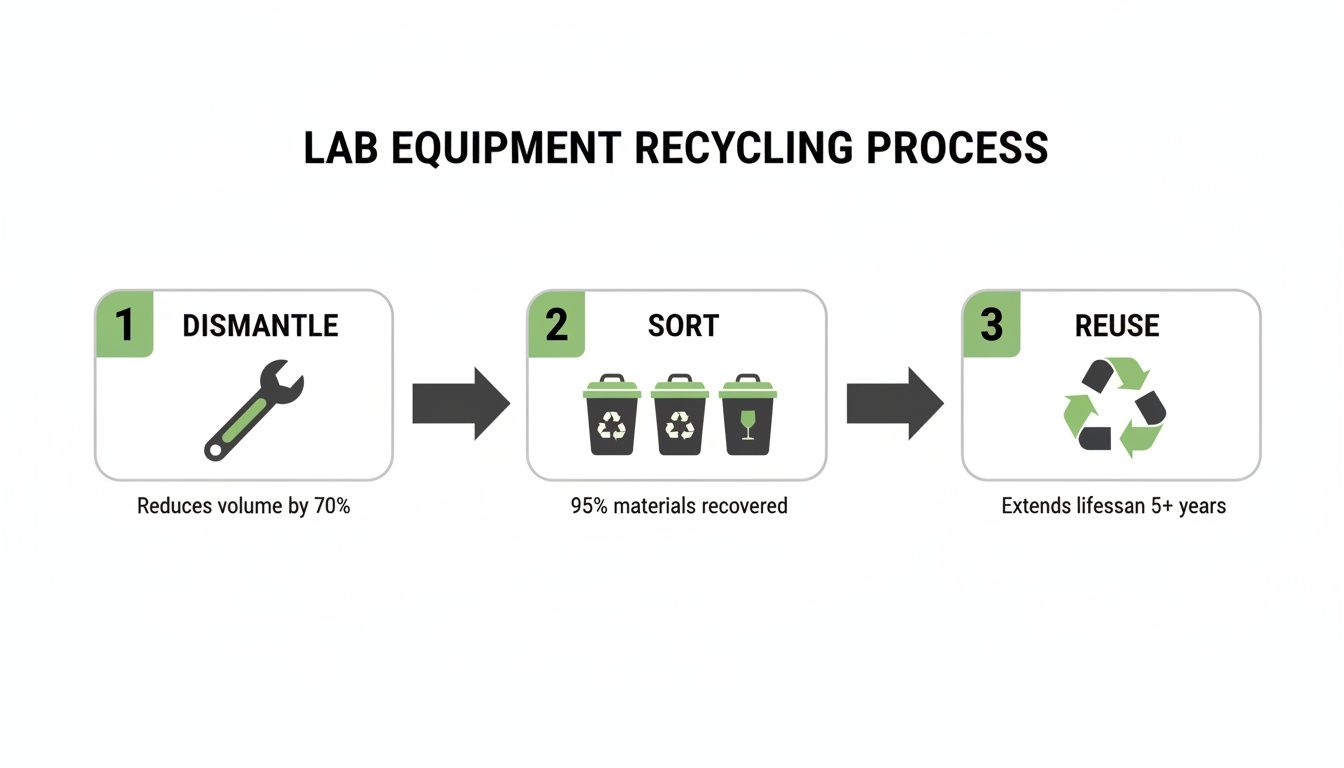
As you can see, responsible recycling is a straightforward process that turns your old assets back into valuable commodities, directly supporting a circular and more sustainable economy.
Global Impact of Your Local Choice
Your decision to work with a certified recycler has a real, positive impact that goes far beyond your local area. According to the United Nations, global e-waste is piling up five times faster than we’re able to properly recycle it, creating a massive environmental problem.
Choosing a sustainable disposal partner isn't just about checking a box for corporate responsibility. It’s a tangible action that conserves natural resources, reduces landfill pressure, and lowers the carbon footprint associated with manufacturing new materials.
Take copper, for example—it’s a key component in almost all electronic lab instruments. Recycling it uses up to 85% less energy than mining and refining new copper from ore. By making sure your old equipment is recycled the right way, you’re directly contributing to major energy savings and reducing the environmental damage that comes from mining. It makes your choice of a disposal vendor a key part of your organization's sustainability goals, whether you are in Atlanta, GA or anywhere else in the USA.
For a closer look at how we handle this, feel free to check out our detailed guide on laboratory equipment recycling and disposal solutions. Ultimately, choosing a sustainable path ensures the lifecycle of your lab equipment doesn't end as waste, but as a valuable resource for the future.
A Step-by-Step Guide to Smooth Lab Decommissioning
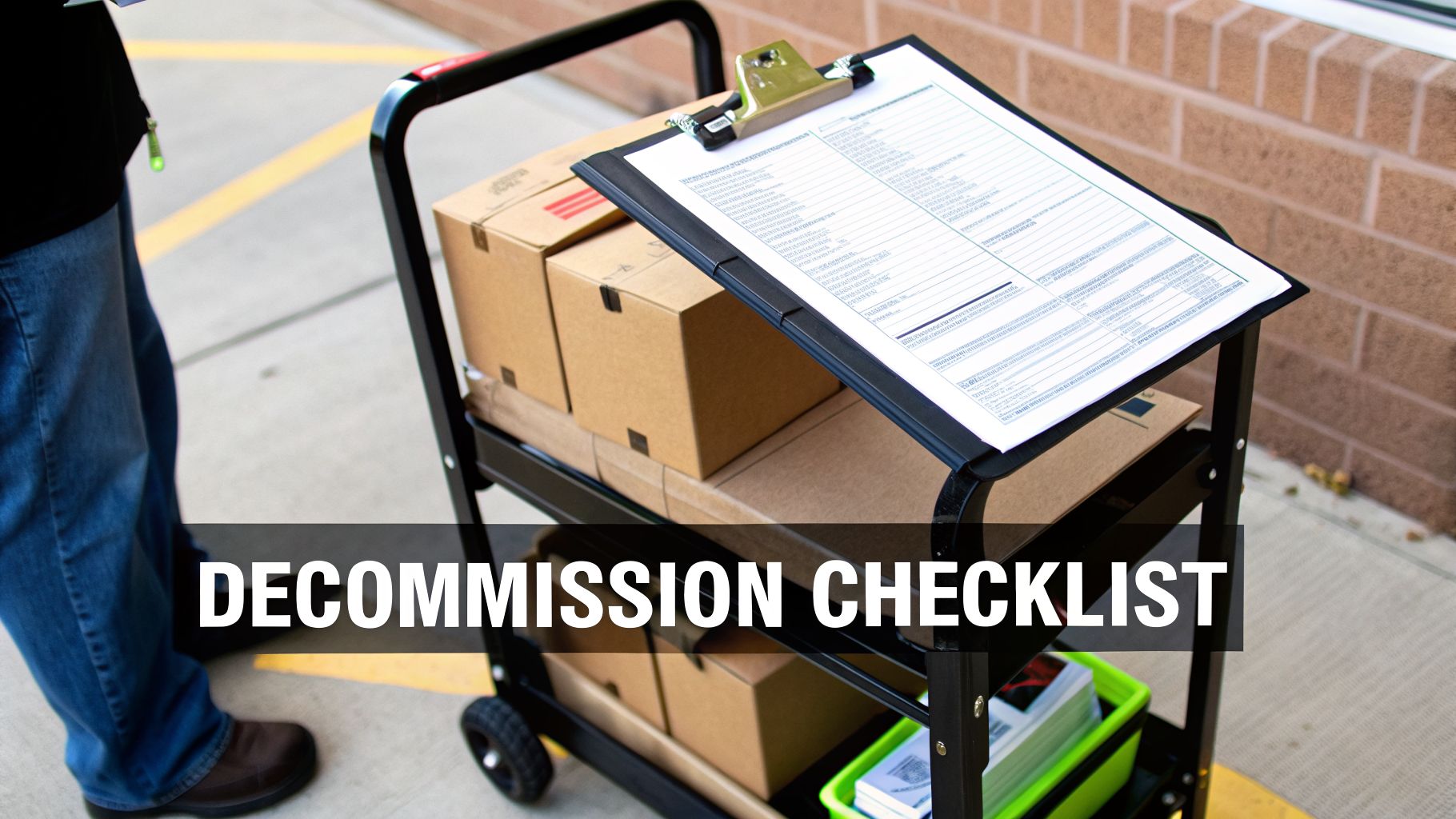
Getting rid of old lab equipment isn't just a matter of hauling it out the door. A proper decommissioning project requires careful planning and precise execution. We see it as a four-phase process that facility managers and lab staff nationwide can follow to ensure everything is handled safely and by the book.
This is more important now than ever. Labs are constantly upgrading, and North America makes up a huge piece of that pie, accounting for 31-35% of the entire global laboratory equipment market.
Much of this is driven by the U.S. pharmaceutical and biotech industries, which are fueled by over $45 billion in annual NIH grants. For labs in research hubs like the Atlanta metro area, as well as those in cities like San Diego, Boston, and Raleigh-Durham, this means a steady stream of new centrifuges, incubators, and analytical tools—and a steady stream of old ones that need to go. You can read more on the growth of the laboratory equipment market landscape.
Phase 1: Create a Detailed Asset Inventory
First things first: you have to know exactly what you’re dealing with. Before any logistics can be planned, you need a full inventory of every piece of lab laboratory equipment you're removing. This isn’t just a headcount; it’s a detailed record that will guide the entire project.
For each item, your inventory should log:
- Asset Type: What is it? A benchtop centrifuge, an analytical balance, a PCR machine?
- Manufacturer and Model: This helps us figure out any resale value or specific recycling needs.
- Serial Number: This is crucial for tracking each piece of equipment and for the final paperwork.
- Condition: Is it working, broken, or just outdated?
- Location: Note the specific lab or room number where it’s currently located.
This master list becomes your project's command center. It gives your team and your disposal partner a clear picture of the job's scope, helps flag high-value or potentially hazardous items, and makes logistical planning possible nationwide.
Phase 2: Coordinate with Your Disposal Partner
Once you have your inventory, it’s time to bring in your disposal partner. The earlier you start this conversation, the better. A professional national partner will take your asset list and build out a plan of action, giving you a clear outline of costs, timelines, and any special requirements.
Collaboration is key. A good disposal vendor doesn't just show up on pickup day; they work with you to plan every detail, from decontamination requirements to data destruction and scheduling, whether for a single site or multiple locations.
For example, when working with a provider that has a local Atlanta-area presence and national capabilities, you can sync calendars to find a pickup window that causes the least disruption to your day-to-day operations. This is the kind of close coordination you should expect, ensuring no last-minute surprises pop up.
Phase 3: Prepare Equipment for Safe Transport
This phase is all about getting the equipment ready to leave your facility safely. It comes down to two critical tasks: decontamination and data destruction.
First, your internal EHS team needs to certify that every piece of lab equipment is completely free from any biological or chemical hazards.
Once decontamination is documented, the next step is data. Any instrument with a hard drive—from complex analyzers to the computers that run them—must have its data professionally wiped. Your disposal partner handles this, either on-site before removal or back at their secure facility, to make sure all sensitive information is gone for good. You can find out more in our complete guide to lab equipment decommissioning services.
Phase 4: Final Documentation and Pickup
This is the final step that ties it all together. After your partner has picked up the equipment and completed all services like data destruction, they will provide you with the critical paperwork.
This includes a Certificate of Destruction and Recycling, which lists every single asset by its serial number. This document is your official record of compliance. It’s your proof that all retired lab laboratory equipment was disposed of responsibly, protecting your organization from any future liability. Once you have this in hand, the project is officially and properly closed out.
How to Choose the Right Lab Equipment Disposal Partner
Picking a partner for your lab equipment disposal is the single most important decision you'll make in the whole decommissioning process. This isn't just about getting someone to haul away old machines. It's about trusting a vendor with your compliance, data security, and your organization's reputation.
The right partner protects you. The wrong one can open you up to major liability and risk. This holds true whether you're a local Atlanta hospital or a national research group with facilities coast to coast. You have to ask the right questions before you sign anything.
The Full-Service Partner vs. The Scrap Hauler
It's critical to know the difference between a real, full-service disposal partner and a basic scrap hauler. A scrap hauler's job is to pick up metal. They're focused on the weight and value of the raw materials, often without any understanding of a lab's strict compliance needs.
A full-service partner, on the other hand, is a specialist with national reach. We manage the entire end-of-life process because we understand the complexities of lab equipment. This means we handle everything—from careful on-site de-installation and secure transport to certified data destruction and providing the auditable paperwork you need to prove compliance across all your locations.
Choosing a partner based on the lowest price is a classic mistake. A cheap hauler might save you a little money upfront, but one data breach or compliance slip-up can lead to fines and reputation damage that completely dwarf those initial savings.
Critical Questions to Ask Potential Vendors
You need to separate the true professionals from the simple haulers. Here's a checklist of questions you should ask any potential vendor, whether you need local service in Atlanta or a nationwide solution. Their answers will tell you everything you need to know about their ability to protect your facility.
1. Do you own and operate your own logistics fleet and use your own employees?
When a vendor uses their own trucks and trained staff, they have complete control over the chain of custody. This gets rid of the risks that come with using third-party freight companies and ensures your assets are handled securely from your door to ours, anywhere in the country.
2. What specific data destruction standards do you follow?
Don't accept a vague answer here. Look for a partner that guarantees DoD 5220.22-M 3-pass sanitization for every single data-bearing device. Also, ask if they offer physical shredding for devices that are non-functional. This is the ultimate failsafe for protecting your lab's sensitive information.
3. What e-waste and data security certifications do you hold?
A reputable partner should be able to show you their certifications. Credentials like R2 (Responsible Recycling) or NAID AAA Certification for data destruction aren't just fancy logos; they are proof that the vendor meets the highest industry standards for security and environmental responsibility.
4. Will I receive a serialized Certificate of Destruction?
This is non-negotiable. A generic certificate is not good enough for an audit. You need a detailed report that lists every single piece of equipment by its unique serial number. This creates a clear, auditable paper trail confirming that every one of your retired lab equipment assets was disposed of and its data was destroyed properly.
Frequently Asked Questions About Lab Equipment Disposal
When it's time to decommission a lab, questions are bound to come up. Facility managers, EHS officers, and department heads all need to be on the same page, and we've heard just about every question from labs nationwide.
Disposing of old lab laboratory equipment doesn't have to be a headache. Here are some straightforward answers to the most common questions we get from labs across the country.
What Kind of Documentation Should I Expect from a Disposal Vendor?
You absolutely need a serialized Certificate of Destruction and Recycling. This isn't just a receipt—it's your legal proof that every single asset was handled correctly according to all data privacy and environmental laws, whether federal, state, or local.
For the certificate to hold up, it must list each piece of equipment by its unique serial number. This creates a solid, defensible audit trail that protects your organization long after the equipment is gone.
How Do We Handle Equipment That May Be Contaminated?
This is a crucial step that your own team handles first. Your internal Environment, Health, and Safety (EHS) department needs to take the lead on decontaminating the equipment, following your organization's specific rules for biological, chemical, or radiological materials.
Before any disposal partner can touch the equipment, it must be certified as clean. You'll need to provide a formal decontamination statement to your vendor, confirming that all safety procedures were followed before they can even schedule a pickup at your U.S. location.
Can We Get Any Value Back from Our Old Lab Equipment?
Yes, you can often get a return on retired assets. While not all lab laboratory equipment has a second life, many items are in demand and can be refurbished and resold, especially if they’re still in good working order.
A national disposal partner with remarketing experience can tell you what your equipment might be worth. It’s a great approach that not only puts money back in your budget but also supports the circular economy by giving the instrument a longer functional life. It’s a true win-win for labs everywhere.
Ready to clear out your retired assets with a partner you can trust? Scientific Equipment Disposal offers secure, compliant, and sustainable solutions for labs throughout the Atlanta area and nationwide. Get a free quote and simplify your lab decommissioning today!