Your Guide to a Certified Electronics Recycling Company in Gwinnett County and Nationwide

If you’re running an organization in Gwinnett County, GA—whether it's a hospital in Lawrenceville or a tech firm in Norcross—you know that old electronics are more than just clutter. They represent a serious security and compliance headache. The only real solution is to bring in a certified electronics recycling company. These are the specialists who handle secure on-site de-installation, Department of Defense (DoD) grade data destruction, and environmentally sound recycling for everything from your old servers to complex lab instruments.
Finding Your Certified Electronics Recycling Partner in Gwinnett County
This guide is here to show you why certification isn’t just a nice-to-have; it's essential for protecting your data and your reputation. We'll walk through how to find a trusted partner that can meet the high standards of Gwinnett's business and government communities, as well as businesses across the United States, making sure your asset disposal process is both painless and bulletproof.
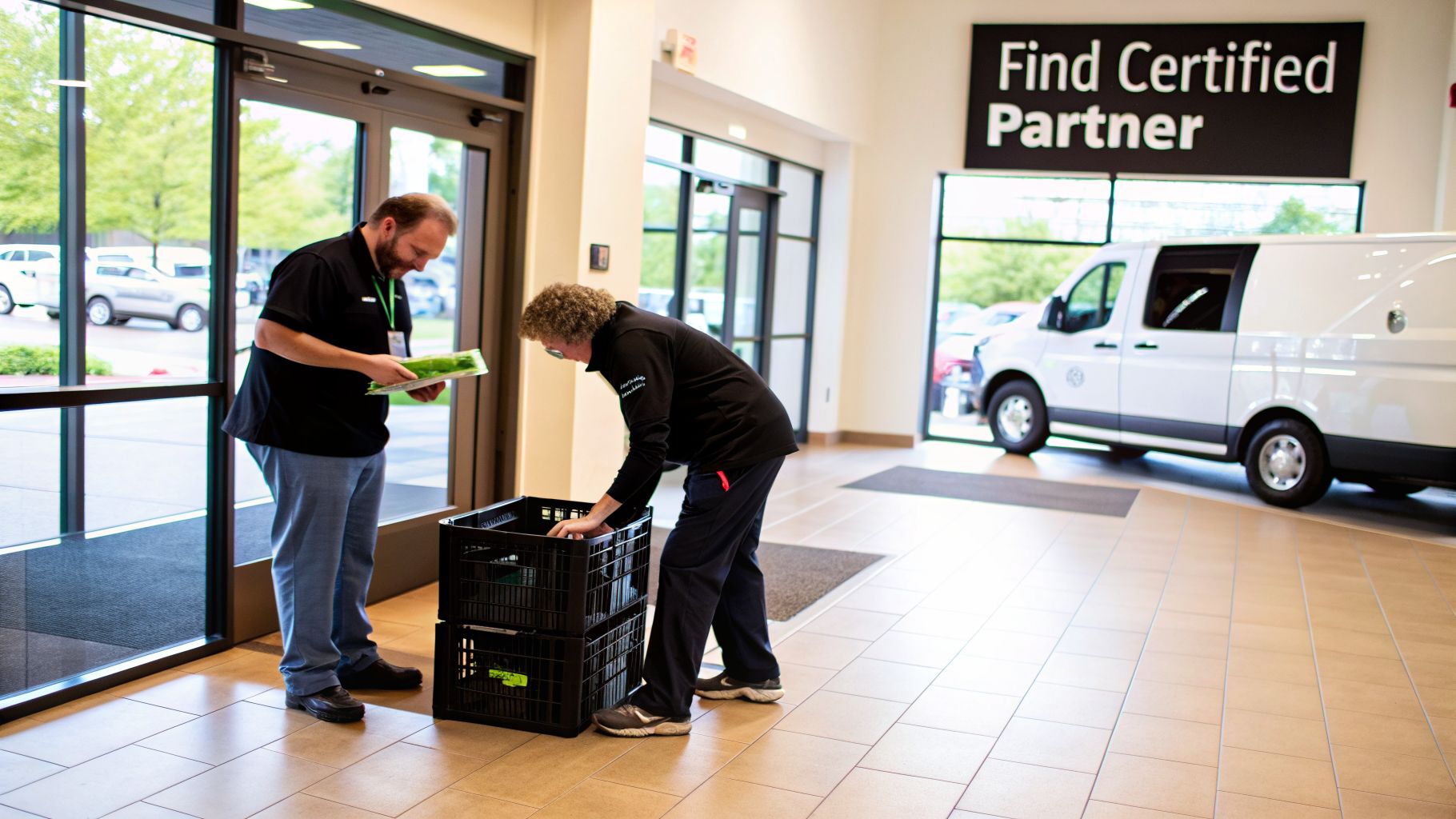
Choosing who handles your electronics disposal is a decision that has a direct line to your organization's security, compliance record, and public image. This isn't just about hauling away old gear. It's about protecting sensitive data and making sure you're following all environmental rules, whether you're in Georgia or anywhere else in the nation.
The Growing Demand for Secure E-Waste Management
The need for a reliable certified electronics recycling company in Gwinnett County has never been greater, reflecting a nationwide trend. Businesses are upgrading technology faster than ever, which means the pile of retired computers, servers, and specialized equipment is growing right alongside them. What’s on those devices? Customer records, financial data, and your company's private intellectual property.
This isn’t lost on local government, either. Gwinnett County's own initiative, RP017-25, put out a multi-year contract for up to $2,000,000 for certified electronics recycling. The terms are strict: no county data can leave custody, and the vendor must provide detailed quarterly reports. That tells you everything you need to know about the local emphasis on security and accountability—a standard expected by organizations nationwide.
This level of official scrutiny highlights a critical point for every organization in Gwinnett and beyond:
Choosing a vendor isn't just a matter of convenience; it's a strategic decision. An uncertified handler could expose your organization to data breaches, environmental fines, and significant reputational damage. A certified partner, on the other hand, provides a verifiable shield against these risks.
What to Look for in a Gwinnett County Partner
When you're vetting potential partners, you have to look past the price tag. The right company is really an extension of your own risk management team. In fact, building a robust vendor risk management framework is a key part of making a smart choice and ensuring you pick a secure and dependable company, whether they operate locally or have a national footprint.
A top-tier partner will offer a full suite of services built to give you complete peace of mind. The table below breaks down the essential services that any business, hospital, or government agency in our area should demand.
Key Services for Gwinnett County Organizations
| Service | What It Means for Your Organization | Core Benefit |
|---|---|---|
| On-Site De-Installation | Professionals come to your facility to handle the breakdown, removal, and logistics. | Minimizes disruption to your operations and frees up your staff. |
| Secure Data Destruction | Meets DoD 5220.22-M standards for wiping and offers physical shredding for total security. | Guarantees sensitive data is irreversibly destroyed, protecting you from breaches. |
| Certified Recycling | Follows R2 or e-Stewards standards to ensure all materials are handled responsibly. | Ensures environmental compliance and protects your brand's reputation. |
| Chain of Custody | Provides detailed documentation, like a Certificate of Destruction, for every single asset. | Creates a fully auditable trail for compliance and internal records. |
By prioritizing these capabilities, you're not just getting rid of old equipment—you're ensuring your organization meets its compliance obligations while protecting its most valuable information. You can dig deeper into this topic in our guide on selecting a professional e-waste recycling company.
What 'Certified' Really Means for Your E-Waste Disposal
When you see the word "certified" next to an electronics recycler, it's easy to think it's just another marketing buzzword. But for any organization in Gwinnett County, or anywhere in the U.S., choosing a certified electronics recycling company is one of the most critical risk management decisions you'll make.
Certification isn't just a label. It's a guarantee of security, compliance, and ethical processing. Think of it this way: you wouldn't let an unvetted, uninsured contractor handle a critical renovation in your facility. The same logic applies to your old electronics, which are packed with sensitive data and regulated materials.
An uncertified vendor is an unknown quantity. They operate without any real oversight or accountability, which opens your organization up to a whole host of serious problems.
The Dangers of Uncertified E-Waste Disposal
Going with an uncertified recycler is a gamble you can't afford to lose. One improperly wiped hard drive can lead to a devastating data breach, exposing everything from patient records to your company’s trade secrets. The legal and financial fallout from that kind of mistake can be massive, not to mention the permanent damage to your reputation.
Worse yet, many fly-by-night operators cut costs by illegally dumping equipment. If your assets are found in a local landfill or illegally shipped overseas, the liability can trace directly back to you, leading to hefty fines and a public relations nightmare.
The real value of a certified recycler is the verifiable audit trail they provide. This "chain of custody" is your documented proof that every single asset was handled securely and responsibly from the moment it left your doors to its final recycling or destruction.
Decoding the Most Important Certifications
While there are many credentials out there, two certifications truly represent the gold standard for electronics recycling. When a vendor holds these, you know they follow the absolute strictest protocols for both data security and environmental protection.
- R2v3 (Responsible Recycling): This is a comprehensive standard covering everything from secure data sanitization to worker safety. An R2v3-certified partner ensures your electronics are managed under a globally recognized set of best practices, maximizing resource recovery and minimizing environmental harm.
- e-Stewards: Known for its tough environmental requirements, the e-Stewards certification demands a zero-landfill policy for all hazardous e-waste. It also strictly forbids exporting this material to developing nations, giving you the highest level of assurance that your equipment is handled responsibly.
The global e-waste problem really highlights why these standards are so important. A recent analysis revealed that the world produced a mind-boggling 136 billion pounds of electronic waste in 2022. Nearly 78% of it was never properly managed, and only 22% made it into formal recycling streams. This trend is putting enormous strain on regions like the U.S. Southeast. In contrast, certified programs can achieve landfill diversion rates approaching 99.9% and keep organizations compliant.
Working with a certified provider turns your equipment disposal from a potential liability into a documented asset. It’s a proactive measure that protects your data, your brand, and your budget. You can learn more about how to identify qualified partners by exploring our guide on certified scientific equipment disposal providers. The peace of mind a certified partner delivers is something a cheaper, uncertified alternative can never offer.
Making Sure Your Data is Actually Gone
For any organization in Gwinnett County handling sensitive information—whether you're a hospital system in Lawrenceville, GA, or a law firm in Duluth, GA—data destruction isn't just a good idea. It's a critical part of your risk management and compliance strategy. Just hitting "delete" or reformatting a hard drive simply doesn't cut it anymore. Trace data can often be pulled from those drives, leaving your organization wide open to a breach.
When you work with a certified electronics recycling company in Gwinnett County, you're partnering with a specialist who understands what real data security looks like. It means using proven, industry-standard methods to ensure every last byte of your information is 100% unrecoverable. This is how you protect yourself from lawsuits, data breaches, and a damaged reputation.
Software-Based Wiping: The First Line of Defense
The gold standard for wiping functional hard drives and other storage media is the DoD 5220.22-M 3-pass sanitization process. This method, first outlined by the Department of Defense, is a thorough and permanent way to erase data.
Think of it as a three-step process for digitally destroying a document:
- First Pass: The drive is completely overwritten with zeros.
- Second Pass: Then, it’s overwritten again, this time with ones.
- Third Pass: Finally, it's overwritten with random characters, which jumbles any lingering magnetic traces into indecipherable noise.
This is like shredding a sensitive document, burning the shreds to ash, and then scattering those ashes into the wind. It ensures that even the most sophisticated recovery attempts will come up empty. It’s a powerful solution for organizations that need to meet tough compliance standards like HIPAA or protect their own proprietary data. To see how this is done right here in Gwinnett, check out our guide on secure hard drive destruction in Gwinnett County, Georgia.
Physical Shredding: The Ultimate Failsafe
But what about drives that are broken, too old to be reliably wiped, or simply non-functional? That's where physical destruction comes in. It’s the only acceptable method for these situations. A certified partner will use industrial-grade shredders to physically demolish the storage media.
Picture a massive, powerful machine that tears through steel, plastic, and silicon, reducing your old hard drives, SSDs, and backup tapes into a pile of tiny, mixed-up fragments. There's no coming back from that. This method gives you the ultimate peace of mind because it physically eliminates any possibility of data being retrieved.
Physical shredding isn't just about destruction; it's about providing irrefutable proof that your data is gone forever. This is especially critical for Gwinnett County healthcare providers retiring patient data terminals or financial firms decommissioning servers with client information.
This combination—software wiping for working drives and physical shredding for everything else—creates a security process with no gaps. No device leaves your control without its data being verifiably and permanently destroyed.
Security from Start to Finish
Real data security is more than just the final act of destruction. It starts with solid internal protocols and ends with documented proof that you did everything right. Having clear information security policies is the foundation, ensuring data is managed correctly from the moment an asset is marked for retirement.
A certified recycling partner builds on those policies by providing:
- A Secure Chain of Custody: We document every step, from the moment we pick up assets at your Gwinnett facility to their final destruction.
- On-Site Services: For maximum oversight and security, we can perform data wiping or even shredding right at your location.
- A Certificate of Destruction: You'll receive a legally binding document that serves as your official audit trail, proving compliance.
For any Gwinnett organization, these measures aren't just extra services; they're essential parts of a smart risk management plan. They give you the confidence to retire outdated equipment, knowing your most sensitive information is protected by the highest standards in the industry.
How The On-Site Recycling Process Works
Getting rid of old electronics can feel like a huge, complicated mess. But when you partner with a certified electronics recycling company in Gwinnett County, the whole project becomes simple—and surprisingly hands-off for you. A true professional service handles every single detail, taking the weight off your IT staff and delivering a secure, fully documented result.
Let's walk through the entire process, from your first call to the moment you get your final compliance paperwork. We’ll use the example of a typical corporate office refresh in Peachtree Corners, GA to show how we turn a logistical nightmare into a smooth, seamless operation.
Step 1: Initial Consultation And Planning
It all starts with a conversation. You tell us the scope of your project—maybe you're decommissioning 150 workstations, a dozen servers, and a rack of old network gear. We’ll work with you to understand exactly what you need, from specific data security protocols to building access restrictions and your ideal timeline.
This planning phase is absolutely crucial. Our dedicated logistics coordinator maps out the entire job, scheduling our on-site team to work around your business hours and minimize any disruption. Need a weekend pickup so your daily operations aren't interrupted? Or maybe a phased removal over several days? The plan is built to fit your schedule.
Step 2: Secure On-Site De-Installation
On the scheduled day, our professional, uniformed team arrives at your Gwinnett County location. This isn't just a random crew with a truck; these are trained technicians who know how to handle sensitive electronics safely and efficiently. They come prepared with all the necessary tools and materials, like dollies, packing supplies, and protective gear.
Our team will systematically de-install all the equipment, from unplugging every desktop computer to carefully un-racking servers. Each asset is inventoried on the spot and prepped for secure transport. For busy IT departments, this on-site service is a game-changer. It frees up your internal team to focus on getting the new technology up and running, not wrestling with old hardware.
Step 3: GPS-Tracked Secure Transport
Once everything is packed up, the assets are loaded into a secure, locked box truck. This is a critical difference from a standard junk hauler. Every one of our vehicles is GPS-tracked, ensuring a continuous, verifiable chain of custody from your facility in Peachtree Corners all the way to our processing plant.
This secure transit provides total peace of mind. You know exactly where your assets are at all times, which eliminates the risk of equipment "going missing" on the way. It’s an essential security measure that protects your data's integrity until it's formally destroyed.
Step 4: Certified Data Destruction And Recycling
Back at our secure facility, the real work starts. Hard drives and any other data-bearing media are immediately segregated for destruction. As we’ve covered, functional drives go through a DoD-standard wiping process. Any non-functional media gets physically shredded into tiny, unrecognizable fragments.
This is the core of our data security promise: sanitize, shred, and certify.
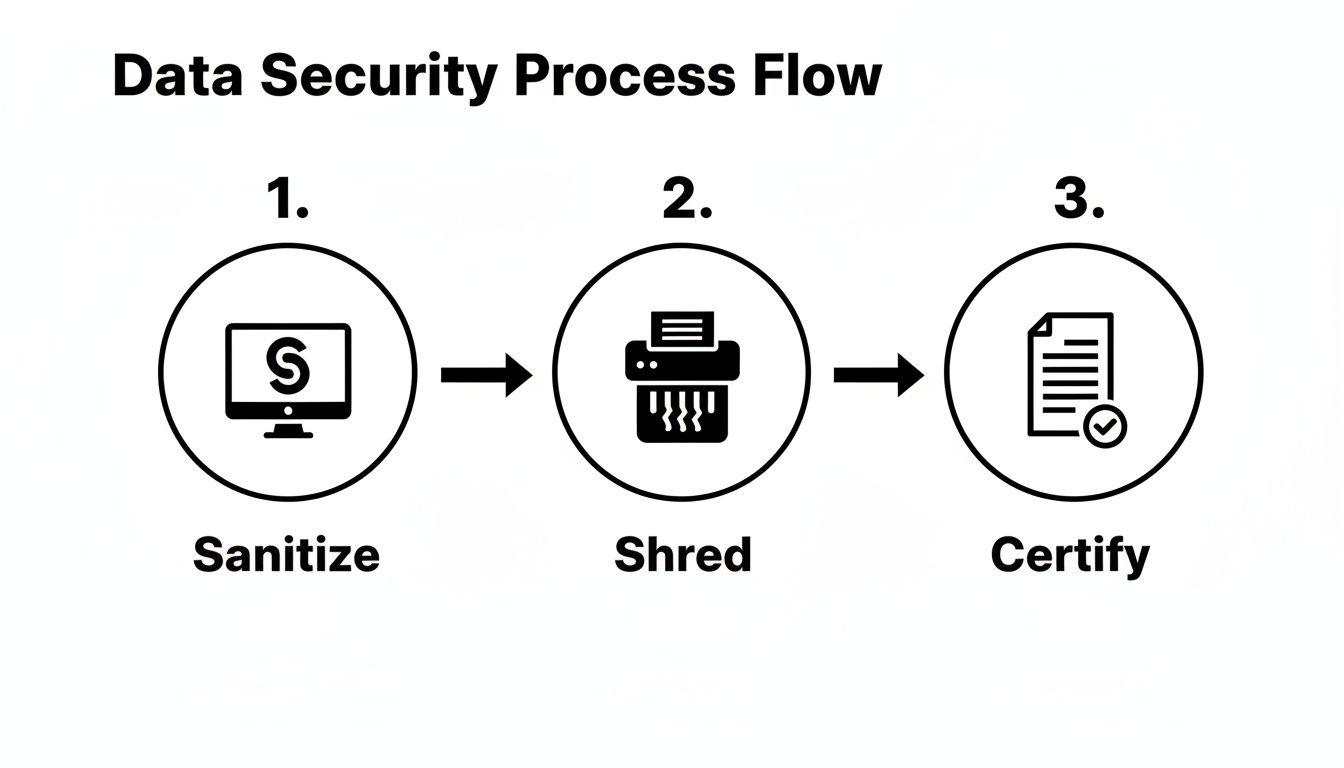
This multi-layered approach guarantees that your data is gone for good, no matter what condition the device was in. The remaining electronic components are then carefully sorted and responsibly recycled according to R2 or e-Stewards standards, keeping tons of e-waste out of our landfills.
Step 5: Final Reporting And Documentation
Within a few business days, you’ll receive a comprehensive reporting package in your inbox. This is your official, audit-proof record of compliance. It includes:
- A Certificate of Destruction: This is the legal document that lists the serial numbers of all destroyed hard drives, proving your data was handled correctly.
- A Certificate of Recycling: This confirms that all the non-data materials were processed in an environmentally responsible way.
- Sustainability Metrics: A report detailing the total weight of materials recycled and diverted from landfills, which is great for supporting your corporate social responsibility goals.
This last step closes the loop, giving your organization all the documentation you need for any internal or external audit. You can get an even more detailed look at the full lifecycle by reviewing our step-by-step process overview. From start to finish, the entire process is designed for maximum security, convenience, and compliance.
Theory is one thing, but seeing how a certified electronics recycling company in Gwinnett County operates in the real world makes all the difference. We believe actions speak louder than words, so let’s walk through a few projects we’ve handled right here in the Metro Atlanta area and across the U.S.
These aren't just hypotheticals. They are real-world examples of how our specialized services solve complex challenges for local organizations, from start to finish.

Each case started with a distinct problem. Our job was to deliver a solution that guaranteed total compliance, zero data risk, and a full audit trail for their records.
Case Study 1: A Lawrenceville Healthcare System
A major healthcare system in Lawrenceville, GA, had a massive undertaking on its hands. They needed to decommission and properly dispose of over 400 patient monitors, countless workstations, and multiple racks of old servers at one of their main medical centers. With strict HIPAA rules in play, this was a high-stakes project.
The Problem: The most critical concern was the sensitive Protected Health Information (PHI) sitting on every hard drive. A data breach was unthinkable, and the hospital administration needed absolute, undeniable proof that every bit of data was destroyed for good. On top of that, the entire process had to happen without disrupting daily hospital operations.
Our Plan in Action: We worked with them to create an after-hours, multi-day pickup schedule. Our team came on-site to handle the de-installation, carefully inventorying every single asset by its serial number. All data-holding devices were loaded into a secure, GPS-tracked vehicle and brought to our facility for DoD 5220.22-M 3-pass data wiping, followed by physical shredding.
The Result: The hospital received a detailed Certificate of Destruction, which itemized every hard drive we destroyed. This gave them a complete, auditable record for their compliance files and total peace of mind. The project was finished on time without ever getting in the way of patient care.
Case Study 2: The Gwinnett County School District Tech Refresh
When a large Gwinnett County school district decided to do a massive, district-wide computer refresh, it created a logistical puzzle of epic proportions. They were replacing thousands of old desktop computers and laptops across 15 different school campuses.
- The Problem: The district’s IT team was already maxed out just deploying all the new computers. They simply didn’t have the manpower or resources to handle pickups from 15 separate locations. They needed a partner to manage the entire removal process, from packing up old machines to transporting them away.
For a project of this scale, logistics and coordination are just as critical as data security. The mission was to get old assets out of classrooms and storage closets fast to make room for new technology, all while ensuring no student or faculty data could ever be compromised.
Our Plan in Action: We stepped in to act as the central logistics coordinator for the whole project. We developed a phased pickup schedule, hitting several schools a day over a two-week period. Our crew provided all the labor for palletizing and loading the equipment, which completely freed up the school district's IT staff to focus on their primary job.
The Result: We smoothly and efficiently removed over 3,500 computers from the 15 campuses. The district got detailed asset reports for complete accountability, and every hard drive was securely wiped to protect student privacy. If you want to learn more about local options, our guide on where to recycle computers in Gwinnett County, GA is a great resource.
Case Study 3: A Duluth Financial Firm’s Data Center
A financial services firm in Duluth, GA, was decommissioning a small data center as it migrated to a cloud-based setup. The servers and storage arrays contained decades of incredibly sensitive client financial data. For them, proof of destruction wasn't just important—it was a regulatory necessity.
The Problem: The firm's compliance officer needed ironclad, irrefutable proof that every single gigabyte of data was gone forever. They were especially concerned about the solid-state drives (SSDs) in their storage arrays, as they knew sanitizing them can be trickier than traditional hard drives.
Our Plan in Action: We recommended the most transparent solution available: on-site physical shredding. We brought our mobile shredding truck directly to their Duluth office parking lot. Their team was able to witness the complete destruction of every single hard drive and SSD firsthand.
The Result: The firm got immediate peace of mind and a Certificate of Destruction handed to them on the spot. This verifiable, transparent process completely eliminated their data risk and gave them the concrete evidence they needed to satisfy both internal and external auditors.
Common Questions About E-Waste & Lab Equipment Recycling
When it's time to clear out old equipment, questions always come up. As the go-to certified electronics recycling company in Gwinnett County and across the nation, we believe in giving you straight answers so you can make the right call for your organization. Here are the most common questions we get, designed to help you vet any potential partner and keep your company secure.
How Is The Cost Of Electronics Recycling Determined?
No two projects are the same, so pricing isn't a flat rate. The final cost really boils down to the work involved. Key factors are the types and sheer volume of your equipment—a full truck of servers is a completely different job than a pallet of monitors.
Logistics are also a major piece of the puzzle. Does our team need to come on-site to de-install equipment in a secure data center? Are we navigating multiple floors or a busy loading dock? We also factor in the distance to your facility in Gwinnett County, Georgia or any other U.S. location and whether any of the assets have resale value. Newer IT hardware, for instance, might have recoverable value that can offset your total service cost. A good partner will always give you a detailed, itemized quote so you know exactly what you’re paying for before we start.
What Is A Certificate Of Destruction And Why Do I Need It?
Think of a Certificate of Destruction as the official death certificate for your data. It's a legally recognized document that serves as your proof that specific hard drives and other data-storing devices were properly destroyed according to industry standards. This isn't just a piece of paper; it's a critical part of your compliance audit trail.
For any Gwinnett County organization—especially in healthcare, finance, or government—this document is non-negotiable. If you're ever audited or face a data breach investigation, the Certificate of Destruction proves you took professional, defensible steps to protect sensitive information. Without it, you have no verifiable evidence of proper data disposal, leaving you wide open to serious legal and financial risk.
Can You Handle Both Our Office IT And Specialized Lab Equipment?
Yes. A truly comprehensive certified electronics recycling company has to manage more than just standard office IT. While we handle thousands of computers, servers, and printers every year, our expertise extends to highly specialized laboratory, medical, and industrial equipment. This is absolutely critical for organizations in Gwinnett’s booming biotech and healthcare sectors, as well as similar industries nationwide.
We regularly manage the disposal of complex instruments such as:
- Centrifuges and incubators
- Spectrometers and analytical devices
- Medical imaging machines and patient monitors
- Fume hoods and other large-scale lab apparatus
When you're vetting a partner, you must confirm they have the experience and equipment to handle the unique safety and logistical needs of your specific assets.
How Can I Be Sure My Company Is Environmentally Compliant?
Your best bet is to work only with a recycler holding a top-tier certification like R2v3 (Responsible Recycling) or e-Stewards. These aren't just plaques for the wall; they require recyclers to pass tough, ongoing audits that examine every single step of their process.
These standards are your guarantee against irresponsible disposal. They strictly forbid the illegal export of hazardous e-waste to developing countries and mandate a zero-landfill policy for toxic materials. This ensures your old equipment doesn't become an environmental problem, here or abroad.
A certified partner will also provide detailed sustainability reports. These reports quantify the positive impact of your project, showing the total weight of materials kept out of landfills and the amount of resources recovered. This is great data for your own corporate social responsibility (CSR) reporting.
What Happens To The Batteries In Our Devices?
Batteries, especially the lithium-ion kind in laptops and medical carts, are one of the most hazardous parts of e-waste. They pose a major fire risk and contain toxic heavy metals. As a certified electronics recycling company in Gwinnett County, we follow strict protocols for handling them.
First, all batteries are carefully removed from devices during the disassembly stage. From there, they are sorted by their chemistry (lithium-ion, lead-acid, NiMH, etc.). Each type is then sent to a specialized recycling facility equipped to safely extract valuable materials like lithium, cobalt, and lead while neutralizing the hazardous components. This not only stops pollution but also feeds raw materials back into the manufacturing supply chain.
Ready to clear out your old equipment with a partner you can trust? Scientific Equipment Disposal provides secure, compliant, and sustainable electronics and lab equipment recycling for organizations throughout Gwinnett County, the Metro Atlanta area, and across the United States. Contact us today for a transparent quote at https://www.scientificequipmentdisposal.com.