A Practical Guide to Sustainable Laboratory Practices in the US


When we talk about sustainable laboratory practices, we're not just talking about a feel-good initiative. It's a fundamental shift in how labs across the United States operate—moving away from a linear "use and toss" mentality to a smarter, circular approach that prioritizes efficiency and responsibility. This means looking at everything from energy consumption and waste streams to how you purchase and manage supplies, all without ever compromising the integrity of your research.
Why Sustainable Lab Practices Matter More Than Ever
Picture a university research facility, whether in Atlanta, Boston, or San Diego, struggling with sky-high utility bills and overflowing hazardous waste bins. It's a common story nationwide. But by making a few strategic changes—like adjusting freezer temperatures and rolling out a basic plastic recycling program—they managed to cut their annual operating costs by over 15%.
They also dramatically improved their compliance standing with local and federal regulations. This isn't just theory; it's the real, tangible outcome of putting sustainable lab practices into action. This guide is designed to get labs anywhere in the country those same kinds of results.
The Real-World Benefits of Going Green
For busy lab managers in hospitals, universities, or corporate settings across the US, the "why" has to connect directly to the bottom line and day-to-day operations. The good news is, the advantages are clear, compelling, and hit all the right notes for your budget, your team, and your institution's public image.
Here's what you stand to gain:
- Serious Financial Savings: It's no secret that labs are energy hogs, often consuming up to 10 times more energy than a standard office space. Simple tweaks, like keeping fume hood sashes closed or consolidating supply orders to reduce shipping, translate directly into lower utility and disposal bills.
- A Safer, More Compliant Workplace: A core principle of green lab work is simply using fewer hazardous materials. This not only makes the environment safer for your staff but also lightens your regulatory load, reducing the risk of costly fines from agencies like the EPA or local authorities.
- A Boost to Your Reputation: Showing a real commitment to environmental stewardship sends a powerful message. It helps attract top-tier talent, resonates with students and stakeholders, and builds a positive identity for your organization in the local community and on a national scale. For a deeper dive into responsible equipment management, you can explore our resources on lab asset disposition.
Focusing on efficiency and waste reduction isn't just about helping the planet. You're building a more resilient, cost-effective, and safer laboratory from the ground up. The return on that investment goes far beyond just dollars and cents.
In this guide, we'll walk you through the essential pillars of a successful sustainability program. We'll cover everything from getting leadership on board and establishing a framework to mastering waste segregation and navigating the complexities of a compliant lab decommissioning. Our goal is to give you practical, actionable strategies that deliver measurable results for your lab, no matter where you are located.
Building Your Lab's Sustainability Framework
Good intentions are a start, but they won't create lasting change on their own. A truly sustainable lab is built on a solid, intentional framework that weaves efficiency and responsibility right into its culture. This whole process starts long before a single chemical is ordered or a piece of equipment is plugged in—it begins with leadership, clear goals, and smarter choices from the get-go.
It's about shifting from putting out fires to having a proactive strategy. By laying this foundation, you set the stage for real, impactful changes that cut waste, save serious money, and improve safety across your entire operation. This framework doesn't need to be complicated, but it absolutely has to be deliberate.
Think of it this way: focusing on sustainability directly benefits your lab's bottom line, its safety record, and its overall reputation.
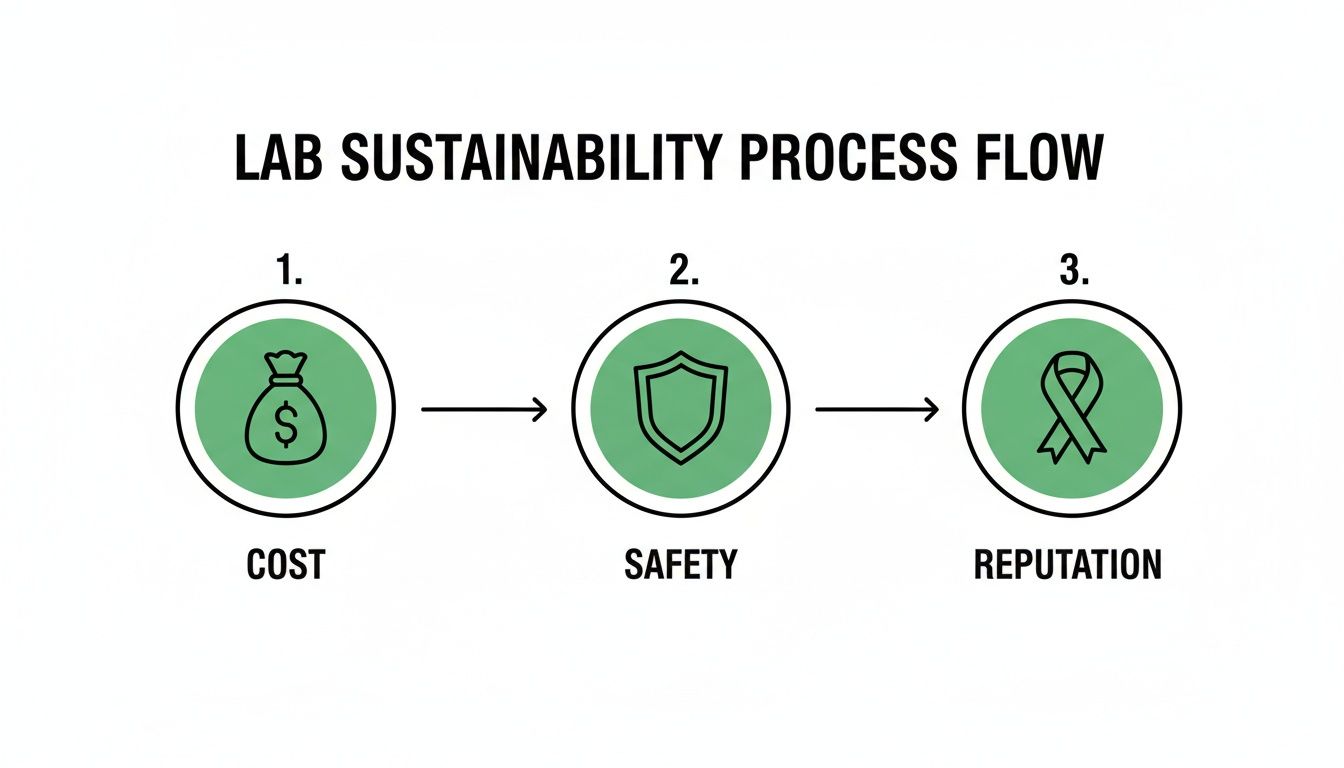
This shows that green lab practices aren't just an environmental side project. They're a core business strategy that strengthens your financial health, operational safety, and institutional standing.
Assemble Your Green Team
First things first: you need to get the right people around the table. A dedicated "Green Team" acts as the engine for your sustainability program, driving the initiatives and making sure everyone stays accountable. This can't be a siloed group; for it to work, you need representation from across different departments.
Your ideal team should have a seat for key players from:
- Lab Management: They provide the oversight, approve new ideas, and champion the program from a leadership level.
- Procurement: These folks influence every purchasing decision and are key to building relationships with sustainable vendors.
- Environmental Health & Safety (EHS): They ensure every new practice meets compliance standards and actually makes the workplace safer.
- Lab Technicians and Researchers: These are the people on the ground who will implement daily practices. Their feedback is pure gold.
This collaborative group will take the lead on drafting your sustainability policy and keeping an eye on its progress.
Draft a Clear Sustainability Policy
A formal policy is what turns your goals from abstract ideas into a concrete, actionable plan. This document needs to be straightforward, easy for everyone to understand, and focused on things you can actually measure. Ditch the vague statements and define specific targets your team can rally behind.
For instance, your policy should outline clear, quantifiable objectives like these:
- Reduce overall energy consumption by 15% within the next 18 months.
- Divert 50% of non-hazardous solid waste from landfills by the end of the year through new recycling programs.
- Decrease water usage by 10% by installing low-flow fixtures.
The best policies are living documents. Start with goals you know you can hit, track your progress, and then revise your targets upward as your program gets stronger. Success builds momentum.
This policy becomes your roadmap, guiding decisions from the executive suite all the way down to the lab bench. It provides the "why" for every new initiative, making it much easier to get buy-in from your entire team.
Implement Smart Procurement and Inventory Tactics
If you're looking for the highest-impact area to start, look no further than procurement. Every single purchase has a lifecycle cost that goes way beyond its initial price tag. Smart procurement means you're evaluating items based on their total environmental and financial footprint.
A great first step is creating a preferred vendor list that prioritizes suppliers who are committed to sustainability. These are the vendors who offer energy-efficient equipment, greener chemical alternatives, and even take-back programs for packaging or old instruments. When you’re looking at a new piece of equipment, don't just glance at the price. Consider its long-term energy draw, maintenance needs, and what it will take to dispose of it down the road. Sometimes, a more expensive initial purchase can save you thousands over its lifetime.
At the same time, you have to get a handle on inventory. Implementing a digital tracking system helps prevent over-ordering and makes sure reagents get used before they expire, which cuts down on costly hazardous waste disposal. These precise systems are a huge part of understanding your lab's operational flow. To see how equipment and asset lifecycles are managed professionally, you can explore the logistics of our equipment disposal services. A well-managed inventory is truly your first line of defense against unnecessary waste and expense.
Reducing Your Lab's Energy and Chemical Footprint
Once you have a solid sustainability framework, it's time to dig into the daily actions that deliver the biggest returns. This is where policy becomes practice, generating immediate savings and cutting down on your lab's energy and chemical consumption.
Many of these strategies cost next to nothing to implement but can make a huge dent in your operational expenses and environmental impact.
Labs are notorious energy hogs, but honestly, most of that consumption comes from just a few key pieces of equipment. By targeting these high-draw items with simple habit changes and smart scheduling, you can achieve substantial reductions without ever compromising your research.
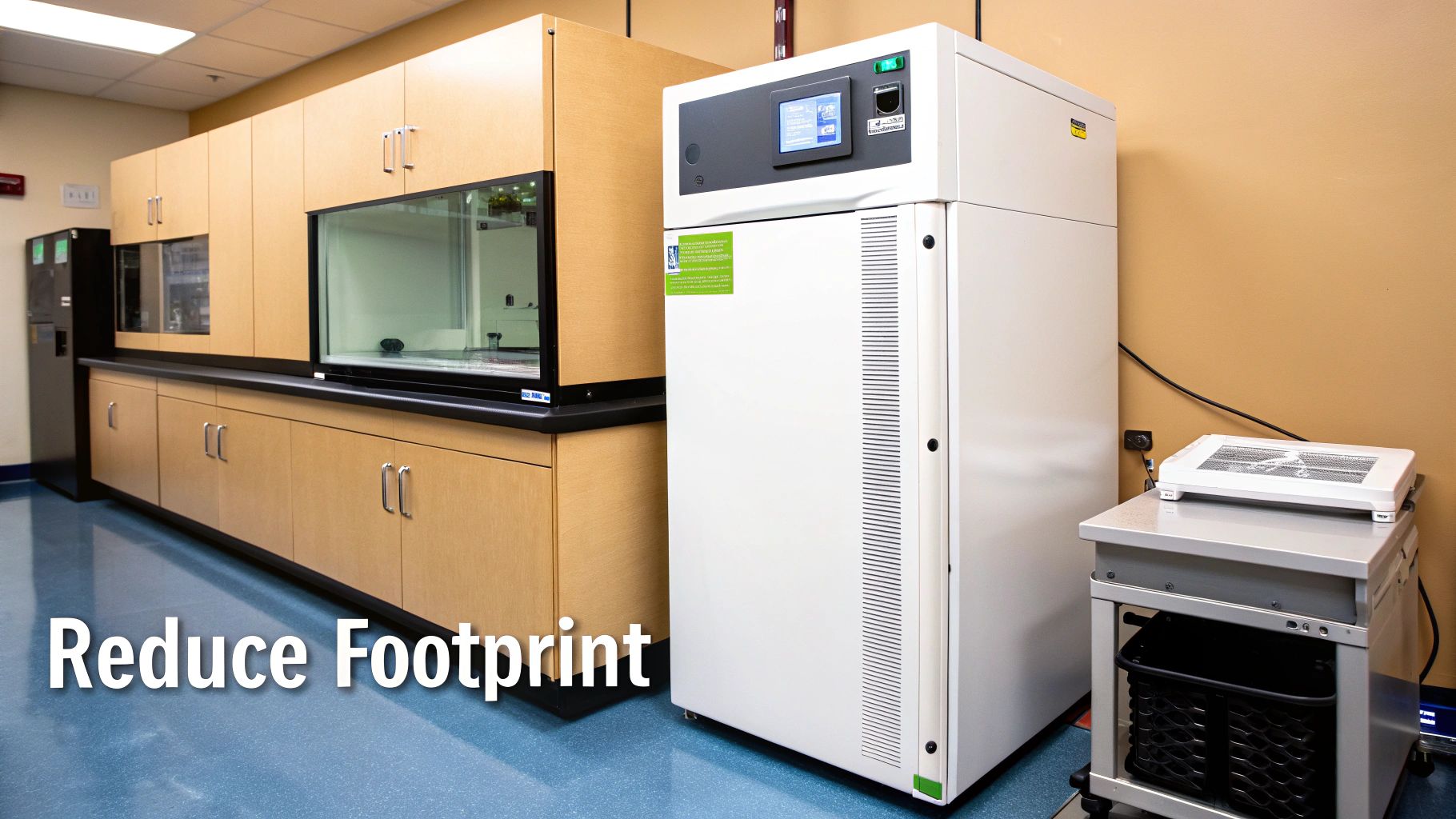
Tackle Energy Hogs With Simple Habits
The single most energy-intensive piece of equipment in many labs is the ducted fume hood. I've seen it time and time again. When left running 24/7, a single fume hood can use as much energy as 3.5 homes every year, mostly because it’s constantly pulling conditioned air out of the building.
Here’s the easy fix: just shut the sash. The simple act of consistently shutting the sash when the hood isn't in active use can slash its energy draw dramatically.
Beyond fume hoods, look for other easy wins. We recommend grouping equipment like vortexers, shakers, and small centrifuges onto smart power strips. This allows your team to kill the power to everything with a single switch at the end of the day, wiping out that phantom power drain.
Ultra-low temperature (ULT) freezers are another major culprit. A few high-impact, low-cost tips can make a world of difference:
- Set a Defrosting Schedule: Regular defrosting prevents ice buildup, which makes the compressor work overtime and burn more energy. A twice-yearly schedule is a great place to start.
- Organize Your Samples: An organized freezer means less time hunting with the door open. Less open-door time prevents cold air loss and cuts down on the energy needed to re-cool the unit.
- Check and Clean Seals: Worn or dirty door seals are a huge source of energy waste. A quick wipe-down and inspection ensures a tight seal and keeps the freezer running efficiently.
Streamline Your Chemical Inventory
Managing your chemical footprint is just as important as managing energy use. An unorganized or bloated chemical inventory is a recipe for waste, unnecessary spending, and increased safety risks. The first move toward a greener chemical management system is a thorough inventory audit.
This means going through everything, identifying what’s expired, redundant, or unused, and getting it disposed of properly. You'll free up valuable storage space and avoid the high cost of disposing of chemicals that have degraded past their useful life. A digital inventory system is your best friend here—it helps track what you have, prevents duplicate orders, and makes it easy to share resources between lab groups.
A lean, well-managed chemical stockroom is a safer and more cost-effective stockroom. By treating your reagents like the valuable assets they are, you naturally reduce waste and improve your lab's overall chemical safety profile.
This shift in mindset is happening across the industry. Sustainability is a major focus now, with institutions actively buying energy-efficient equipment and adopting greener processes. The move to electronic records is a perfect example; the use of EHRs for 8.7 million patients has already saved 1,044 tons of paper and avoided 92,000 tons of carbon emissions. You can discover more about these impactful laboratory trends and their benefits.
Embrace the Principles of Green Chemistry
Beyond just using fewer chemicals, sustainable lab practices are about improving their quality. This is the heart of green chemistry: designing products and processes that reduce or eliminate the use and generation of hazardous substances.
This doesn't mean you have to overhaul your protocols overnight. Often, it's about simple, one-for-one substitutions of common hazardous solvents with safer, more biodegradable alternatives.
Swapping out harsh chemicals can dramatically improve your lab's environment and simplify waste management. We've compiled a quick reference table for some of the most common substitutions we see labs making.
Green Chemistry Substitutions for Common Lab Solvents
| Hazardous Chemical | Common Use | Greener Alternative | Key Benefit |
|---|---|---|---|
| Dichloromethane (DCM) | Extractions, chromatography | 2-Methyltetrahydrofuran (2-MeTHF) | Derived from renewable resources, less toxic |
| Benzene | Solvent, synthesis | Toluene | Lower toxicity and carcinogenicity |
| Acetone | Glassware cleaning, solvent | Isopropyl Lactate | Biodegradable, lower vapor pressure |
| Formaldehyde | Fixative, disinfectant | Glyoxal | Less volatile and significantly less toxic |
Making these kinds of switches not only creates a healthier workplace but also reduces the regulatory burden that comes with hazardous waste. For labs looking to dive deeper, our articles offer extensive guidance on enhancing lab chemical safety.
For labs across the country, implementing these changes—from shutting a sash to swapping a solvent—offers immediate and measurable benefits. They are the practical, on-the-ground steps that turn a sustainability plan into powerful, positive outcomes for your budget, your team, and the environment.
Mastering Waste Segregation and Recycling Programs
Waste management is one of the most visible—and often most mismanaged—parts of any lab sustainability program. Poorly handled, it results in overflowing bins, sky-high disposal costs, and a significant environmental footprint.
But when you get it right, a smart waste segregation and recycling program becomes a powerful symbol of your lab’s commitment to sustainable practices. This isn't just about putting a blue bin in the corner; it's about fundamentally rethinking your lab’s waste streams and empowering your team to turn discarded materials into valuable resources.
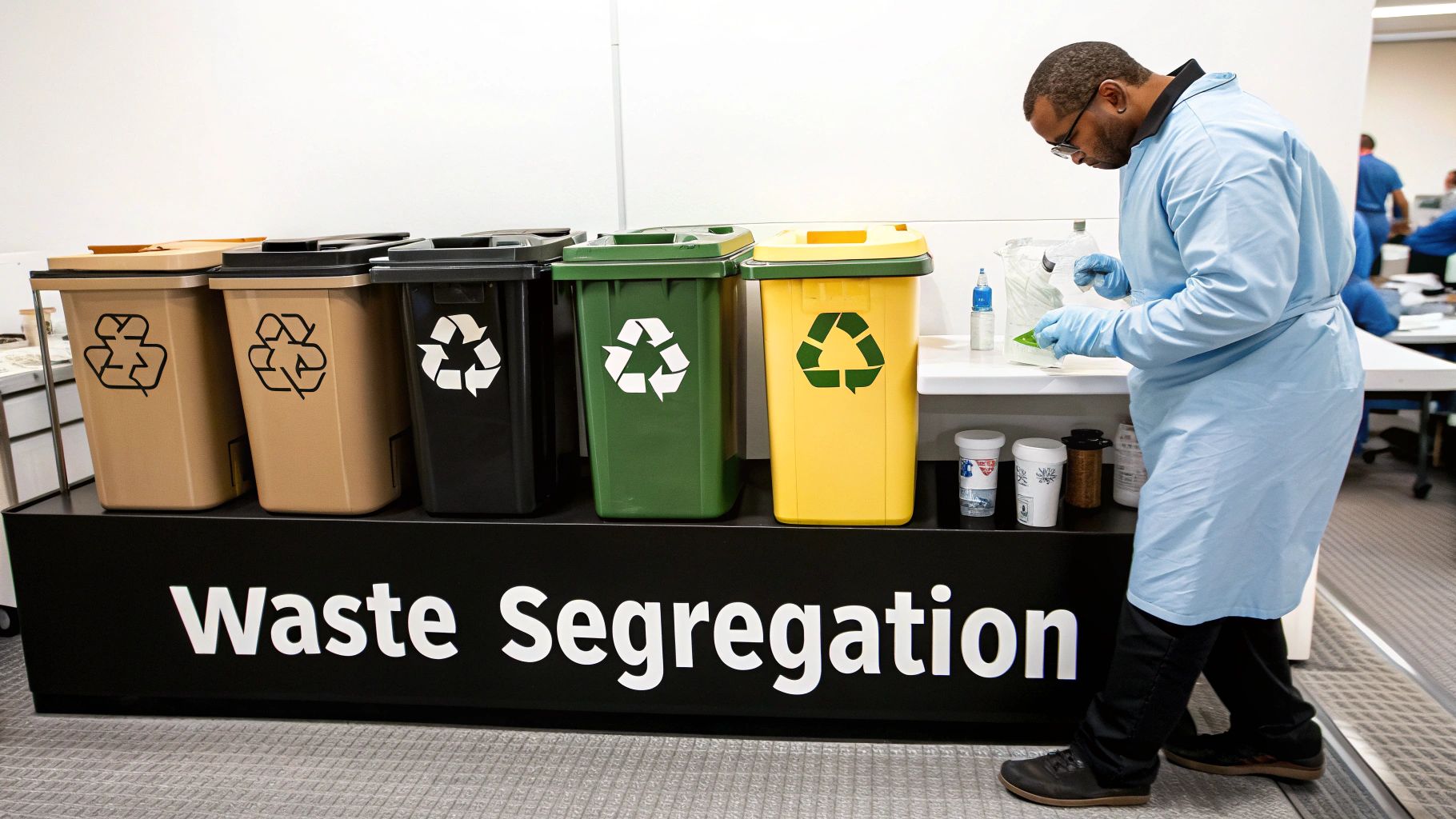
Clarifying Your Lab’s Waste Streams
There's a common misconception that nearly everything coming out of a lab is hazardous. This assumption leads to over-classification, where perfectly safe materials are tossed into expensive regulated medical waste (RMW) or biohazard bins. The reality is quite different.
According to the World Health Organization, about 85% of hospital and lab waste is actually non-hazardous general waste—no different from what you'd find at home. A much smaller portion, just 10%, is infectious, while the remaining 5% is non-infectious but still classified as hazardous. Understanding this is your first step toward a smarter, more cost-effective disposal strategy. You can dig deeper into the global standards for biomedical waste management to see how they apply.
Before you can segregate anything, you need to know what you're actually producing. A simple waste audit will show you the primary materials your lab generates, helping you build a system that fits your real-world workflow.
Designing an Intuitive Bin System
Once you know what you’re throwing away, the next step is to make it incredibly easy for your team to do the right thing. The best systems use clear, consistent, and visual cues to guide people at the moment they dispose of something.
Here’s a blueprint for a user-friendly, color-coded system:
- Black or Gray Bins (General Trash): For non-hazardous, non-recyclable stuff like paper towels, food wrappers, and office trash.
- Blue Bins (Mixed Recycling): For clean and dry plastics, aluminum cans, and paper. Clear signage with pictures is crucial here to avoid contamination.
- Green or White Bins (Glass): Specifically for unbroken, non-contaminated lab glass. This keeps dangerous shards out of other streams.
- Red Bins (Biohazard): Exclusively for regulated medical waste, like items contaminated with blood or other potentially infectious materials.
- Yellow Bins (Sharps): Puncture-proof containers for needles, scalpels, and other sharps.
Your goal is to make the correct choice the easiest choice. Place bins in logical, high-traffic areas and use large, universally understood symbols. A well-designed system should require almost no thought from the user.
Case Study: A University Pipette Tip Box Program
To see how this works in the real world, let's look at a university lab in Georgia that was drowning in plastic waste—especially pipette tip boxes. These bulky polypropylene boxes were filling up their expensive biohazard bags, even when they weren't contaminated.
They launched a simple but brilliant recycling program.
- Collection Points: They set up dedicated collection bins just for empty, non-contaminated pipette tip boxes in each lab bay.
- Central Consolidation: Once a week, a student volunteer gathered the boxes and took them to a central holding area.
- Vendor Partnership: The lab teamed up with a local recycling vendor that accepted #5 plastics. The vendor provided large collection containers and scheduled monthly pickups.
The results were impressive. In the first year alone, the program diverted over 2,000 pounds of plastic from the RMW stream, saving the university thousands of dollars in disposal fees. Its success quickly inspired other departments to launch similar initiatives.
For labs dealing with a mix of disposable plastics and larger equipment at its end-of-life, a specialized partner is key. Our guide to lab equipment disposal and recycling services provides detailed information on how to handle these items responsibly, ensuring your sustainable practices extend through an asset’s entire lifecycle.
Navigating Compliant Lab Decommissioning and E-Waste
What happens at the end of a lab asset's life is just as important for your sustainability goals as how it's used every day. Too often, decommissioning is a frantic afterthought. This mistake can lead to serious compliance risks, surprise costs, and a huge environmental footprint. A smart, planned approach to lab decommissioning and e-waste is a must-have for any truly sustainable lab.
This goes way beyond just unplugging old gear. It requires a clear, documented plan that covers everything from taking inventory and decontamination to wiping data securely and recycling responsibly. For labs across the country, from major research hubs to local clinical facilities, getting this right isn't optional.
The Decommissioning Roadmap
Whether you're retiring a single centrifuge or shutting down an entire facility, a successful decommissioning project hinges on meticulous planning. The very first step is always a thorough asset inventory. You absolutely have to know what you have, where it is, and its current state.
Your inventory list should be specific:
- What is the equipment? (e.g., centrifuge, incubator, server rack)
- Where is it located in the facility?
- Did it handle any hazardous materials, like chemicals or biologicals?
- Does it store any sensitive data?
Once you have your list, every piece of equipment needs a complete decontamination. This is a critical safety and compliance step. It ensures any leftover hazardous materials are neutralized before the asset ever leaves your building. Always, always keep detailed records and certificates of decontamination on file.
The E-Waste Challenge: Data Security and HIPAA
In any healthcare or research environment, e-waste presents a massive data security problem. Lab instruments, analytical machines, and the computers running them often hold protected health information (PHI) or sensitive research data. Disposing of them improperly is a fast track to a HIPAA violation and can do serious damage to your reputation.
This is why certified data destruction is so essential. Just hitting 'delete' on a file is nowhere near enough.
A compliant e-waste strategy has to guarantee that data is permanently and verifiably destroyed. The only way to ensure you're protected is to work with a certified vendor who provides a clear chain of custody and proof of destruction.
For example, your e-waste partner should be using established sanitization methods like the DoD 5220.22-M 3-pass standard, which overwrites data repeatedly to make it impossible to recover. For any hard drives or storage media that won't power on, secure physical shredding is the next required step. You should always get a Certificate of Destruction as your final, auditable proof.
Partnering for Sustainable and Compliant Disposal
Let's be honest—managing the logistics of equipment removal, data sanitization, and certified recycling is a complicated job. This is why it's so important to partner with a specialized, nationwide provider that can service labs in any state. A good vendor takes the entire headache away, from on-site de-installation and packing to the final disposition.
They make sure valuable materials like metals and plastics are actually recycled instead of ending up in a landfill, which directly supports your lab's sustainability mission. For a complete look at what this process involves, our guide on how to properly dispose of old lab equipment breaks it all down.
This focus on responsible end-of-life management isn't happening in a vacuum; it’s part of a much larger industry trend. The global medical waste management market is seeing explosive growth, which shows a real institutional shift toward sustainable lab practices. The market was valued at around USD 16.7 billion in 2025 and is projected to more than double to USD 34.3 billion by 2035. This growth underscores just how important specialized offsite treatment and certified disposal services have become. You can discover more insights about the medical waste market's expansion to see how it reflects a deeper commitment to both compliance and sustainability.
Answering Your Top Questions on Sustainable Lab Practices
Switching to greener lab operations always brings up a few practical questions. As a lab manager or EHS officer, you're juggling budgets, compliance, and getting your team on board. We get it. Here are some straightforward answers to the questions we hear most often from labs across the country.
Where Do We Even Start if Our Budget is Tight?
This is the number one question we get, and the answer is usually simpler than people expect: focus on the low-cost, high-impact stuff first. You don't need a huge capital investment to get the ball rolling.
Honestly, the most powerful changes are often behavioral and cost nothing at all. A simple policy to shut fume hood sashes when they're not in active use can slash your energy consumption overnight. The same goes for turning off equipment that’s sitting idle and optimizing your freezer maintenance schedules. These are free actions that deliver real energy savings.
Another great starting point is dialing in your waste segregation. Just by correctly separating your non-hazardous waste from regulated medical waste, you can dramatically cut down on those expensive disposal fees. These first steps are crucial because they generate savings you can then reinvest into bigger projects later, like upgrading to more energy-efficient equipment.
How Can We Guarantee Lab Equipment Disposal is HIPAA Compliant?
When it comes to equipment that has stored any kind of data, security is completely non-negotiable. The only way to truly guarantee HIPAA compliance is by working with a certified e-waste disposal vendor who provides a transparent chain of custody and proof of data destruction.
You'll want to find a provider that offers on-site services and uses established standards like DoD 5220.22-M 3-pass sanitization. This process overwrites data multiple times, making it completely unrecoverable. For any devices that have failed, like a dead hard drive, secure physical shredding is the only way to go.
Your vendor absolutely must provide a Certificate of Destruction for your records. This is your auditable proof of compliance. It protects your organization from the massive penalties that come with a data breach. A good partner will have a clear, documented workflow to protect your sensitive data from the moment it leaves your facility to its final destruction.
What Are the Biggest Hurdles to Starting a Lab Recycling Program?
Even with the best intentions, you can run into a few snags. In our experience, the two things that almost always trip up a new lab recycling program are contamination and communication.
Contamination is what happens when the wrong things get tossed in the recycling bins. This can ruin an entire batch, forcing it all to be sent to a landfill. The best way to fight this is with crystal-clear signage—with pictures!—placed directly on every single bin. Don't assume your team knows what goes where; make it impossible for them to get it wrong.
The second piece is getting genuine buy-in from your people. You have to explain the "why" behind the new program in team meetings, send out updates, and share your progress. A fantastic tactic is to appoint volunteer "Green Champions" within the lab. These folks help build momentum and encourage peer-to-peer accountability, making sustainability a shared responsibility for the whole team.
Navigating compliant equipment disposal and building a sustainable program can feel like a lot, but you don't have to figure it all out on your own. At Scientific Equipment Disposal, we specialize in secure, responsible, and sustainable solutions for labs throughout the United States. Learn how we can simplify your lab decommissioning process.